
Most marketers now use AI in some part of their work. Salesforce’s 2026 State of Marketing report found that 75% of 4,450 marketing decision-makers have adopted AI, and McKinsey’s 2026 State of AI survey says nearly nine in ten organizations use AI regularly in at least one business function.
Adoption is wide, but AI still does a minority of the work. In the CMO Survey, US marketing leaders say AI handles 24.2% of their marketing activities in 2026, up from 13.1% in 2024. Gartner finds CMOs put 15.3% of their marketing budgets toward AI, yet only 30% say they have the infrastructure to scale it.
This page collects AI marketing statistics for 2026 on adoption, budgets, ROI, search, advertising, consumer trust and jobs. Each stat names its source and date. Figures from earlier versions of this page are kept where their source still supports them and shown next to the newer number where one exists. Figures that could not be confirmed are listed near the end with the reason.
On this page
- AI Marketing Market Size And Budget Statistics
- AI Adoption In Marketing Statistics
- How Marketers Use AI
- AI Marketing ROI And Productivity Statistics
- AI Search And SEO Statistics For Marketers
- AI In Advertising, Video And Email Marketing
- AI In Influencer And Social Media Marketing
- Consumer Attitudes Toward AI In Marketing
- AI And Marketing Jobs, Skills And Barriers
- Key Takeaways
- Frequently Asked Questions
- Sources And Methodology
AI Marketing Market Size And Budget Statistics
AI In Marketing Market Size Forecasts
1. The global AI in marketing market was valued at $20.4 billion in 2024. Grand View Research estimates it at $35.0 billion in 2026 and projects $82.2 billion by 2030, a 25.0% compound annual growth rate from 2025 to 2030. (Grand View Research, 2026)
2. MarketsandMarkets values the AI in marketing market at $25.86 billion in 2024 and forecasts $296.32 billion by 2035, growing 25.2% a year from 2025. The two forecasts use different definitions and end years, so they are not directly comparable. (MarketsandMarkets, 2026)
How Much Of The Marketing Budget Goes To AI
3. CMOs direct an average of 15.3% of their marketing budgets to AI. Organizations with mature AI programs put 21.3% toward it. The survey covered 401 marketing leaders in North America, the UK and Europe, fielded January to March 2026. (Gartner 2026 CMO Spend Survey, via Marketing Dive, May 2026)
4. Marketing budgets rose slightly to 7.8% of company revenue in 2026, from 7.7% in 2025. Organizations with mature AI programs average 8.9%. (Gartner 2026 CMO Spend Survey, via Marketing Dive, May 2026)
5. Only 30% of CMOs say their organization has the infrastructure to reach its AI goals, while 70% name AI as a key priority for 2026. (Gartner 2026 CMO Spend Survey, via Marketing Dive, May 2026)
6. In 2025, marketing budgets were flat at 7.7% of company revenue and 59% of CMOs said their budget was not enough to execute their strategy. Gartner surveyed 402 CMOs from February to March 2025. (Gartner 2025 CMO Spend Survey, May 2025)
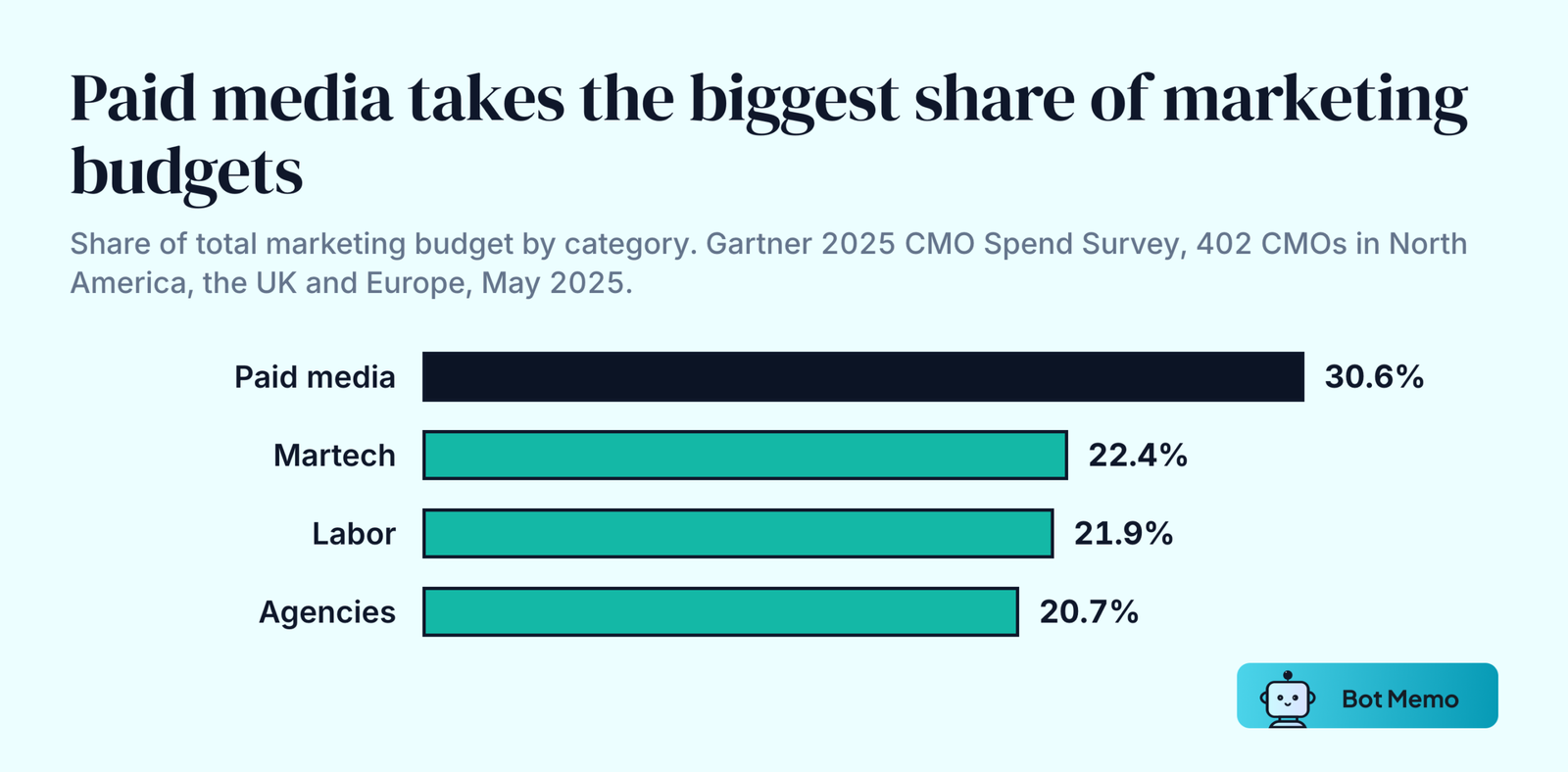
7. Paid media took the largest share of 2025 marketing budgets at 30.6%, followed by martech at 22.4%, labor at 21.9% and agencies at 20.7%. (Gartner 2025 CMO Spend Survey, May 2025)
For the companies raising money to build these tools, see our AI startup funding statistics.
AI Adoption In Marketing Statistics
How Many Marketers Use AI
8. 75% of marketers have adopted AI, according to a survey of 4,450 marketing decision-makers in North America, Latin America, Asia-Pacific and Europe, fielded October 8 to November 17, 2025. (Salesforce State of Marketing, 10th edition, February 2026)
9. 66% of marketers worldwide use AI in their roles, and 91% of marketing leaders say people at their organization use AI to help with their jobs. HubSpot surveyed more than 1,000 marketing and advertising professionals. (HubSpot, State of AI, 2025)
10. 91% of marketing teams now use AI, up from 63% a year earlier, in a survey of about 1,400 marketers. (Jasper, State of AI in Marketing 2026, January 2026)
11. Back in March 2023, 73% of US marketing professionals said their companies were using generative AI to create text, images, video or other content. Botco.ai surveyed 1,000 marketers. (Botco.ai, 2023)
12. In January 2023, 37% of US professionals in advertising and marketing had used AI to help with work tasks, the highest rate of any industry surveyed. Healthcare had the lowest rate at 15%. The survey covered 4,500 professionals. (Statista, 2023)
13. 69% of marketers were using ChatGPT in a 2023 survey of 3,812 digital marketers. (Authority Hacker (archived), 2023)
14. 36% of marketers used AI chatbots in their marketing role, and 58% planned to increase their investment in AI and automation like chatbots in 2024. (HubSpot, 2024 State of Marketing, 2024)
How Much Marketing Work AI Does
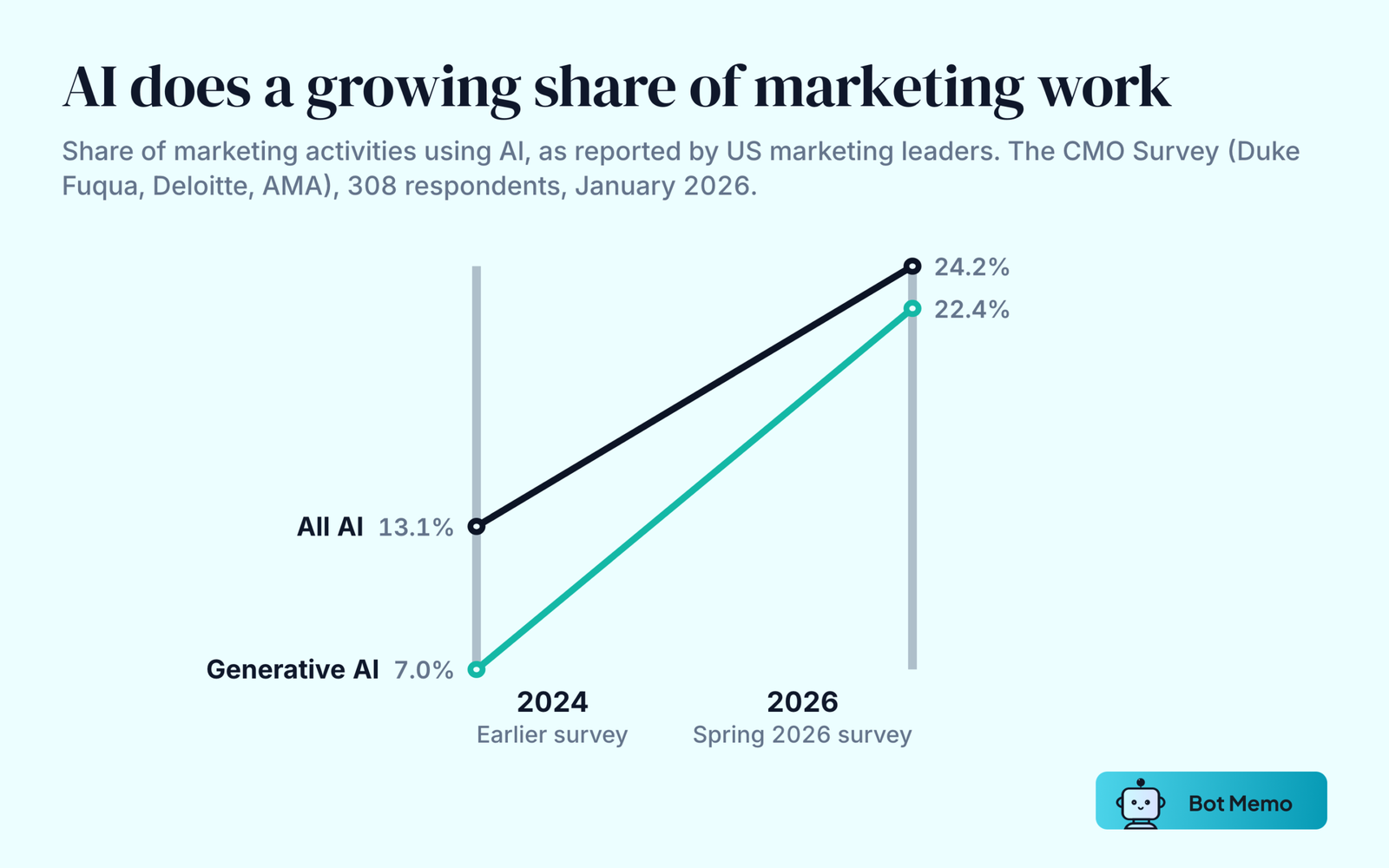
15. AI accounts for 24.2% of marketing activities in 2026, up from 13.1% in 2024. Generative AI grew faster, from 7.0% to 22.4% of activities over the same period. The CMO Survey polled 308 US marketing leaders from January 7 to 29, 2026. (The CMO Survey, Spring 2026, 2026)
16. Marketing leaders expect AI to account for 55.9% of their marketing activities within three years. (The CMO Survey, Spring 2026, 2026)
AI Adoption Across Companies
17. Nearly nine in ten respondents report regular AI use in at least one business function. 44% say AI is scaling across their enterprise, up from 38% a year earlier, and 56% use AI in three or more functions, up from 51%. (McKinsey, The State of AI in 2026, August 2026)
18. Then and now: McKinsey found organizational AI adoption had hovered at about 50% for six years before jumping to 72% in early 2024 (McKinsey, 2024). Its 2025 survey of 1,993 participants in 105 countries put regular AI use in at least one function at 88%, up from 78% a year earlier. (McKinsey, The State of AI in 2025, November 2025)
19. In 2020, 57% of companies were piloting or deploying AI, 59% had an AI strategy and 70% understood how AI could create business value. Only 10% were getting significant financial benefits from it. MIT Sloan Management Review and BCG surveyed more than 3,000 managers. (MIT Sloan Management Review and BCG, October 2020)
20. 95% of B2B marketers say their organizations use AI-powered applications, and 89% use AI tools to create or optimize written content. Only 28% use conversational tools or chatbots. (Content Marketing Institute and MarketingProfs, B2B Content Marketing Trends, 2026)
How Marketers Use AI
Top AI Use Cases In Marketing
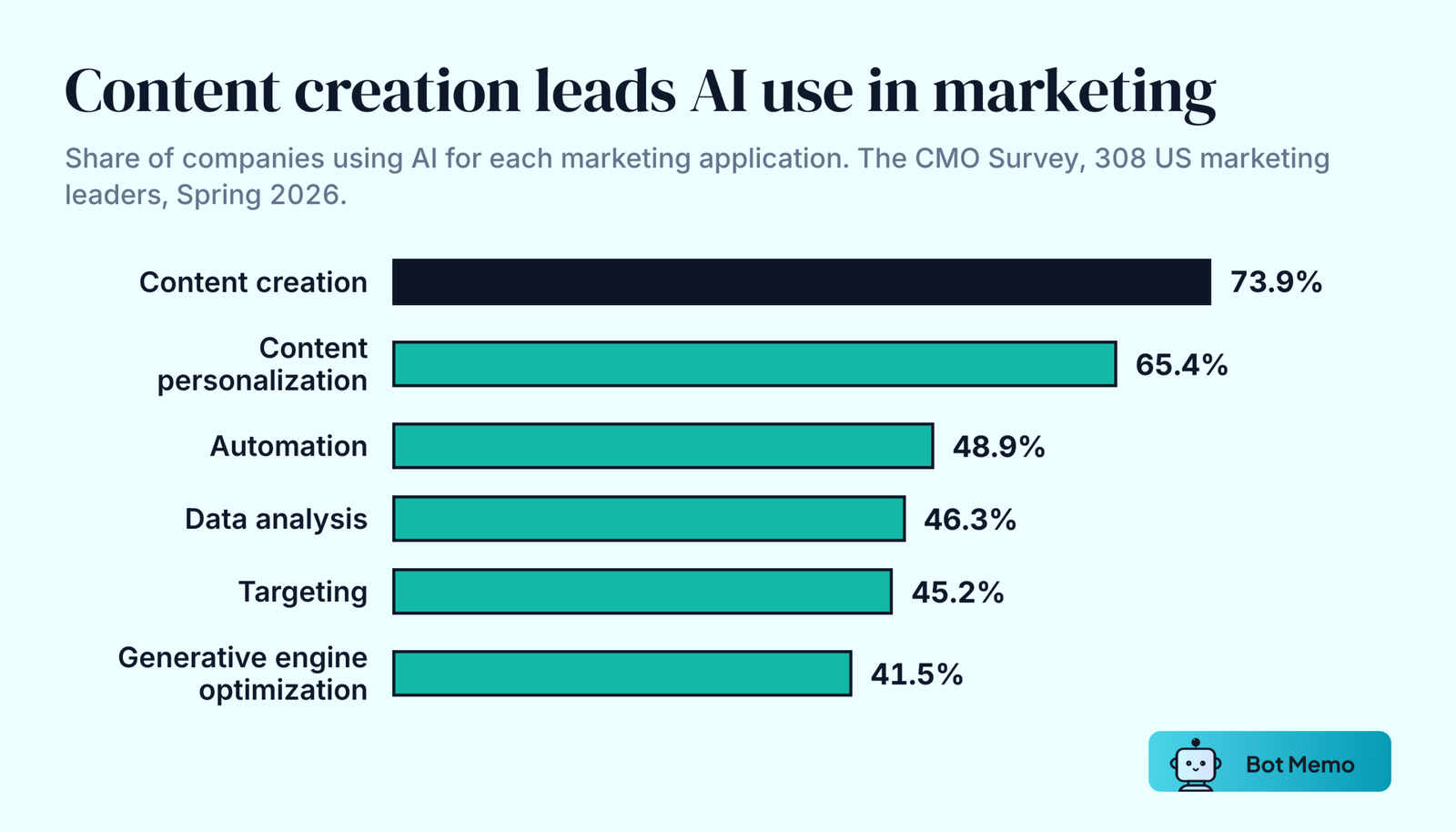
21. Content creation is the most common AI application in marketing, used by 73.9% of companies, followed by content personalization at 65.4%, automation at 48.9%, data analysis at 46.3% and targeting at 45.2%. (The CMO Survey, Spring 2026, 2026)
22. The most common task marketers use generative AI for is text-based content creation (52%), and 48% use it for research. (HubSpot, State of AI, 2025)
23. 80% of marketers use AI for content creation and 75% use it for media production. HubSpot surveyed more than 1,500 marketers. (HubSpot, 2026 State of Marketing, 2026)
24. Common uses in 2024 included finding ideas, repurposing content, writing copy for social posts, emails and blogs, and generating images. (HubSpot, 2024 State of Marketing, 2024)
25. Among US marketers using AI or machine learning tools in 2022, the top uses were email marketing (63%), advertising (58%) and data analysis (57%). Capterra surveyed 185 US marketers in July 2022. (Capterra, 2022)
AI For Personalization
26. 78% of marketers say they need more personalized content than they can produce, and 75% are turning to AI to close the gap. (Salesforce State of Marketing, 10th edition, February 2026)
27. 84% of marketers admit to running generic campaigns, and 83% say customers now expect two-way conversations. (Salesforce State of Marketing, 10th edition, February 2026)
28. 72% of marketers agree that AI and automation tools like chatbots help them personalize the experience customers get with their company. (HubSpot, 2024 State of Marketing, 2024)
29. 24% of marketers said AI tools that help customer service teams respond to tickets, such as chatbots, self-service tools and generative AI emails, would help their business most. (HubSpot, 2024 State of Marketing, 2024)
For AI in support and service, see our AI customer experience statistics.
AI Content Quality And Fact-Checking
30. 65.8% of marketers think AI content is equal to or better than human writing. (Authority Hacker (archived), 2023)
31. 63% of AI adopters cite inaccuracies in AI content as a major challenge. (Authority Hacker (archived), 2023)
32. 88.1% of marketers say they verify the accuracy of AI-generated content, and 11.9% do not fact-check it. Earlier versions of this page reversed these two figures. (Authority Hacker (archived), 2023)
33. 82% of marketers said content generated by AI or machine learning software is just as good as, or better than, human-generated content. (Capterra, 2022)
34. 49% of marketers using these tools said they are very successful at producing clear, easy-to-read text. Only about a third said the same for producing accurate or error-free text, the lowest score of any quality measured. (Capterra, 2022)
AI Marketing ROI And Productivity Statistics
Return On AI Investment
35. Of the companies using generative AI, 66% have received a positive ROI. 43% say they get a 2x return and 22% a 3x return. (Botco.ai, 2023)
36. Only 7% of respondents reported a negative ROI from generative AI. (Botco.ai, 2023)
37. 75% of marketing leaders whose organizations have invested in AI say the investment has produced a positive ROI. (HubSpot, State of AI, 2025)
38. 41% of marketers can confidently prove the ROI of AI, down from 49% a year earlier. Among those who track it, 60% report at least a 2x return. (Jasper, State of AI in Marketing 2026, January 2026)
39. 67% of small businesses use AI for content and SEO, and 68% report increased content marketing ROI with AI. Semrush surveyed more than 2,600 businesses. (Semrush (archived), 2024)
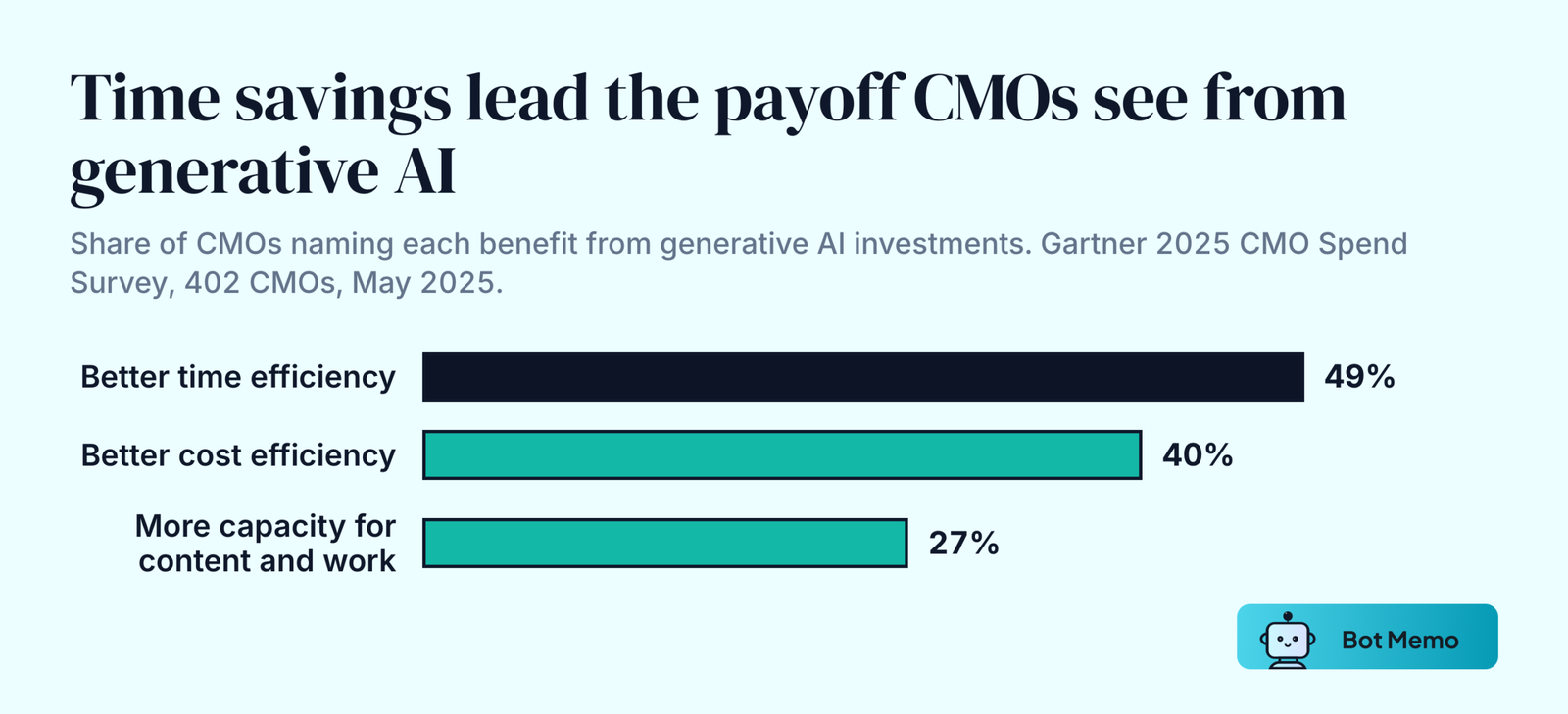
40. CMOs say generative AI is paying off through better time efficiency (49%), better cost efficiency (40%) and more capacity to produce content or handle more work (27%). Just 1% say generative AI is not a current priority. (Gartner 2025 CMO Spend Survey, May 2025)
41. Revenue gains from AI are most often attributed to its use in marketing and sales, ahead of product development and software engineering. 37% of respondents attribute at least some EBIT impact to AI, about the same as a year earlier. (McKinsey, The State of AI in 2026, August 2026)
Time Savings From AI In Marketing
42. Marketing AI users report being 44% more productive and save an average of 11 hours a week. ZoomInfo surveyed 1,002 US go-to-market professionals. (ZoomInfo, State of AI in Sales and Marketing, 2025)
43. 88% of marketers found that AI or machine learning software saves their company time and money. (Capterra, 2022)
44. Jasper users ran more than 76 million generations in 2025. (Jasper, December 2025)
Implementing AI In Marketing
45. 69% of marketers said it took their company six months or longer to implement AI or machine learning software. 68% use a mix of free and paid versions of these tools. (Capterra, 2022)
46. McKinsey analysed more than 400 AI use cases across 19 industries and nine business functions. It found AI techniques could add 30% to 128% more value than traditional analytics, depending on the industry. (McKinsey, Notes from the AI Frontier, April 2018)
47. Two-thirds of the opportunities to use AI were in improving existing analytics use cases. In one-third of cases the model had to be refreshed at least monthly, and almost one in four needed a daily refresh, especially in marketing and sales. (McKinsey, Notes from the AI Frontier, April 2018)
48. 44% of business leaders said their companies planned data modernization efforts in 2024 to take better advantage of generative AI. (PwC, 2024 AI Business Predictions (archived), February 2024)
AI Search And SEO Statistics For Marketers
AI Overviews And AI Mode Reach
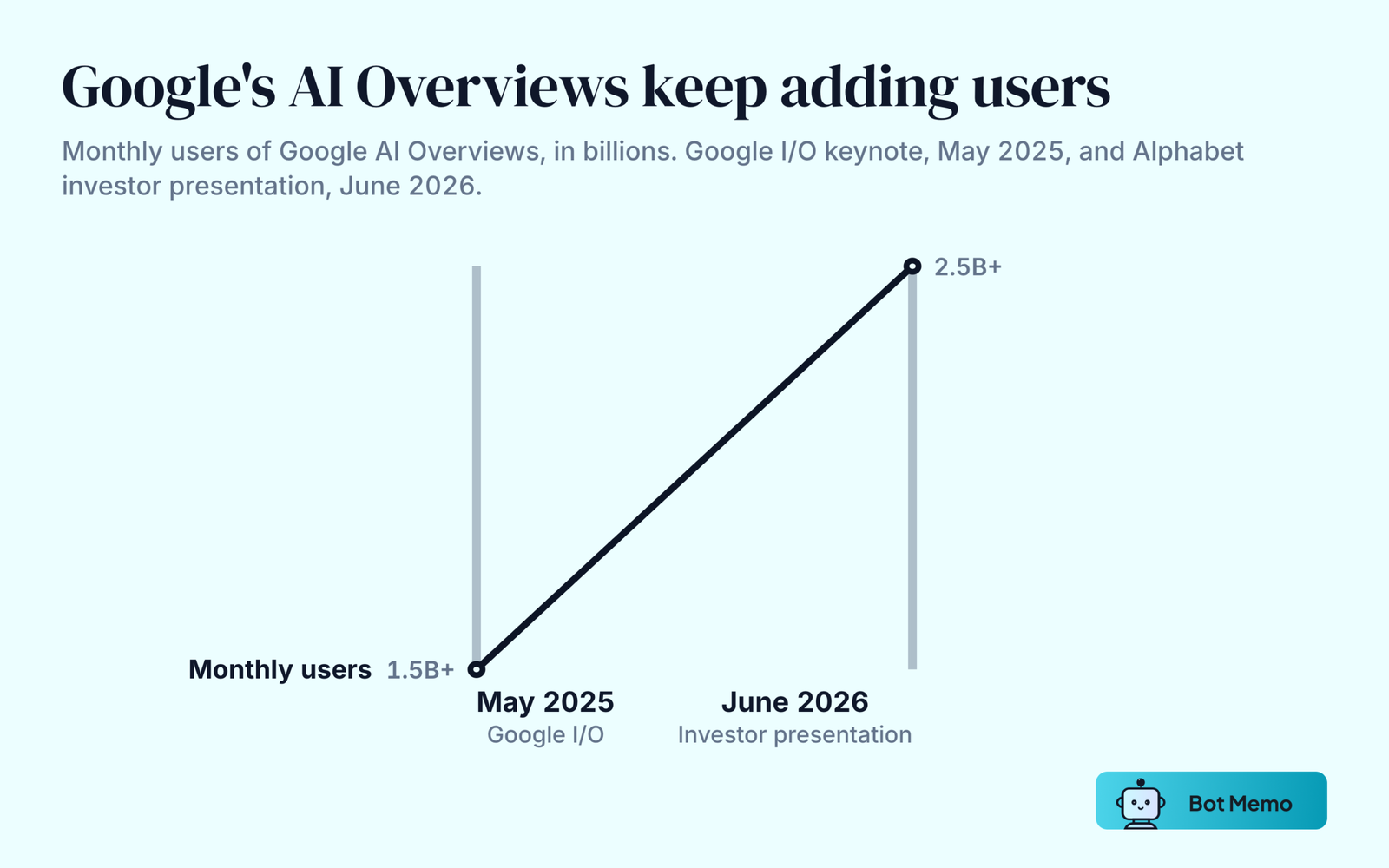
49. Google’s AI Overviews have more than 2.5 billion users a month, and AI Mode has passed 1 billion monthly users a year after launch. (Alphabet investor presentation, June 2026)
50. Earlier milestones: AI Overviews had more than 1.5 billion monthly users in May 2025 (Google I/O 2025) and more than 2 billion across 200+ countries and territories and 40 languages by July 2025. (Alphabet Q2 2025 earnings, July 2025)
51. AI Overviews appeared for 6.49% of tracked queries in January 2025 and peaked at 24.61% in July, then fell back to 15.69% by November. Semrush tracked more than 10 million keywords. (Semrush, 2025)
Click-Through Rates When AI Summaries Appear
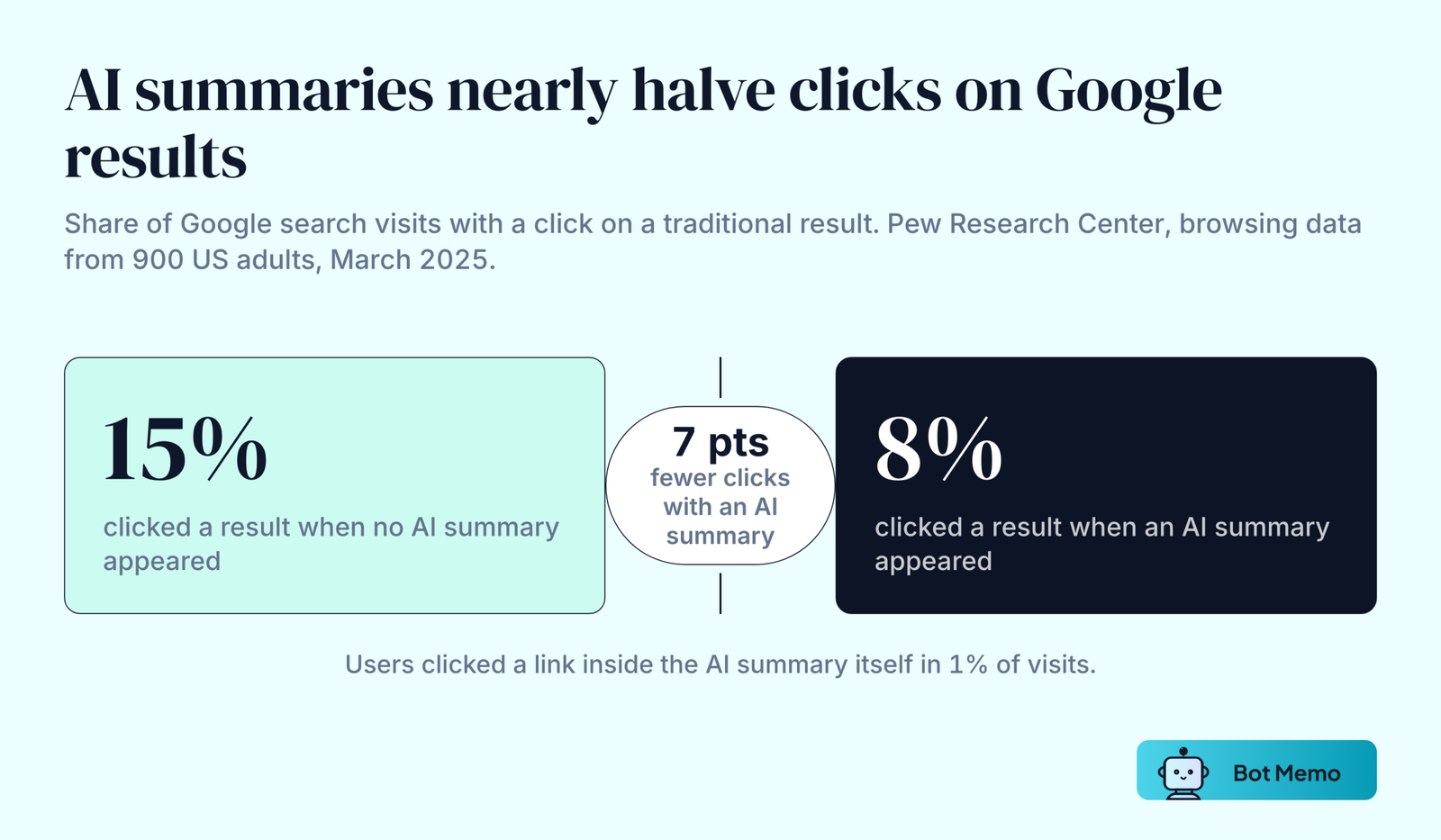
52. Google users who saw an AI summary clicked a traditional search result in 8% of visits, compared with 15% for users who did not see one. 18% of the searches studied produced an AI summary. (Pew Research Center, July 2025)
53. Users clicked a link inside the AI summary in just 1% of visits. They ended their browsing session on 26% of pages with an AI summary, compared with 16% of pages with only traditional results. Pew tracked 900 US adults in March 2025. (Pew Research Center, July 2025)
54. Organic click-through rate on queries showing an AI Overview fell 61%, from 1.76% in June 2024 to 0.61% in September 2025. Paid click-through rate on those queries fell 68%, from 19.70% to 6.34%. Seer Interactive tracked 3,119 search terms across 42 organizations. (Seer Interactive, September 2025)
55. In a larger 2026 dataset of 53 brands, organic click-through rate on AI Overview queries climbed from a low of 1.3% in December 2025 to 2.4% in February 2026. In February, paid click-through rate was 16.2% when an AI Overview showed and 21.8% when it did not. (Seer Interactive, 2026)
Zero-Click Searches And Publisher Traffic
56. 68.01% of US Google searches ended without a click in the first four months of 2026, based on Similarweb panel data. (SparkToro, June 2026)
57. Searches for news that end without a click to a news website grew from 56% to nearly 69% between May 2024 and May 2025, according to Similarweb data. (Digiday, 2025)
58. Median year-over-year referral traffic from Google Search to 19 premium publishers fell 10% over eight weeks in May and June 2025. News brands fell 7% and non-news brands 14%. (Digital Content Next, August 2025)
LLM Referral Traffic And AI Search Optimization
59. Traffic referred by large language models converts at about 18%, higher than any other channel in the dataset. It grew 80% from the first half to the second half of 2025, but still makes up less than 2% of referral traffic on average. (Search Engine Land, February 2026)
60. Generative AI traffic to US retail sites rose 3,300% year over year during the 2025 Prime Day event. (Adobe, July 2025)
61. ChatGPT’s growth: about 400 million weekly users in February 2025 and more than 800 million by October 2025 (TechCrunch, October 2025). OpenAI reported more than 900 million weekly active users in February 2026. (Search Engine Land, February 2026)
62. 88% of marketers have begun optimizing for AI-generated responses such as ChatGPT answers and Google AI Overviews, and 85% say AI is reshaping their SEO strategy. (Salesforce State of Marketing, 10th edition, February 2026)
63. 41.5% of companies already use generative engine optimization, the practice of getting content to appear in AI-generated search results. (The CMO Survey, Spring 2026, 2026)
More search numbers are in our AI SEO statistics and ChatGPT statistics.
AI In Advertising, Video And Email Marketing
AI In Paid Media
64. Meta’s AI-powered Advantage+ campaigns reached more than $75 billion in annual revenue run-rate in the second quarter of 2026, and more than 9 million small businesses use at least one of its generative AI ad creative tools. (Meta Q2 2026 earnings call, July 2026)
65. Advertisers who had not used Advantage+ creative before saw a 22% increase in return on ad spend after turning on its AI features. More than 1 million advertisers used Meta’s generative AI tools to create more than 15 million ads in a month. (Meta Engineering, December 2024)
66. Advertisers created three times as many Gemini-generated assets in 2025 as the year before. In the fourth quarter of 2025 alone, Gemini generated nearly 70 million creative assets in AI Max and Performance Max campaigns. (Google, February 2026)
AI Video For Marketing
67. More than 70 million videos had been created with Google’s Veo 3 since May 2025, and enterprise customers had generated more than 6 million videos on Vertex AI since June. (Google Cloud, July 2025)
68. eToro used Veo 3 to produce 15 fully AI-generated versions of one ad, each in the native language of its market, for a business serving clients in 75 countries. (Google Cloud, July 2025)
69. OpenAI’s Sora app passed 1 million downloads less than five days after its launch on September 30, 2025. (CNBC, October 2025)
70. AI video company Runway raised $308 million at a $3.3 billion valuation in April 2025 (TechCrunch), then $315 million at a $5.3 billion valuation in February 2026. General Atlantic led both rounds. (TechCrunch, February 2026)
See the AI video statistics and the top AI video generation startups for more.
AI In Email Marketing
71. 49% of email marketers said they would use generative AI for static copy, and 70% expected up to half of their email operations to be AI-driven by 2026. Litmus surveyed 692 marketing professionals in the US, UK, Canada, Australia and Ireland. (Litmus State of Email, via MarTech, 2025)
AI In Influencer And Social Media Marketing
Influencer And Virtual Influencer Market Size
72. Statista estimated the global influencer marketing market at more than $24 billion in 2024. Statista now puts it at about $33 billion in 2025, more than triple its 2020 size. (Statista, 2025)
73. Then and now: Grand View Research estimated the virtual influencer market at $3.60 billion in 2022, growing 38.9% a year to 2030, with North America holding more than 44% of the market and the solution segment more than 69% (archived 2024 edition). Its current edition values the market at $11.2 billion in 2025 and projects $110.4 billion by 2033, a 33.6% annual rate, with North America at 44.6%. The earlier edition expected the services segment to grow fastest through 2030. (Grand View Research, 2026)
How Consumers Respond To Virtual And AI Influencers
74. 35% of US consumers said they had bought a product or service promoted by a virtual influencer. Statista surveyed 1,044 US adults in March 2022. (Statista, 2022)
75. Among consumers aged 35 to 44, 45% said they had bought a product or service promoted by a virtual influencer. (Statista, 2022)
76. 37% of social media users said AI influencers would make them more interested in a brand, while another 37% said it would make the brand untrustworthy. 49% of influencers worried AI influencers would take their jobs. The findings come from Sprout Social research reported by the New York Post. (New York Post, May 2024)
Consumer Attitudes Toward AI In Marketing
Trust And Disclosure
77. 78% of US consumers believe generative AI is the future, but only 39% are excited about that future. Dentsu surveyed 1,000 US adults in March 2023. (Dentsu Consumer Navigator, 2023)
78. 27% of consumers had used generative AI tools and 42% were interested in them. (Dentsu Consumer Navigator, 2023)
79. 78% of consumers said brands should disclose when a service is delivered using AI. (Dentsu Consumer Navigator, 2023)
80. Almost 90% of consumers worldwide want to know whether an image was created using AI, and 76% say it is getting hard to tell whether an image is real. Getty Images ran four surveys of 7,500 adults each across 25 countries between July 2022 and September 2023. (Getty Images VisualGPS, 2024)
81. 76% of consumers are concerned about AI causing misinformation on a business’s website: 43% are very concerned and 33% somewhat concerned. 14% are neutral and 9% are unconcerned. Forbes Advisor surveyed 2,000 US adults. (Forbes Advisor, 2023)
82. Consumers are most concerned about AI being used for product descriptions (70%), product reviews (60%) and job applications (59%). (Forbes Advisor, 2023)
How People React To AI-Generated Content
83. 56% of consumers preferred an AI-written article over a human-written one when they did not know which was which. 52% said they become less engaged when they suspect content is AI-generated. Bynder surveyed 2,000 people in the US and UK. (Bynder, April 2024)
84. Consumers aged 25 to 34 were the best at spotting AI-generated content. (Bynder, April 2024)
85. Consumers see the most room for generative AI to improve technology, entertainment and shopping experiences, and are most skeptical about its use in sports, arts and culture, and customer service. (MNTN Research, June 2023)
AI And Marketing Jobs, Skills And Barriers
AI And Marketing Jobs
86. 53% of marketers believe AI will eliminate more marketing jobs than it creates. The Marketing AI Institute surveyed nearly 1,900 marketing and business leaders from February to April 2025. (Marketing AI Institute, State of Marketing AI, 2025)
87. 81.6% of marketers think content writers’ jobs are at risk because of AI. (Authority Hacker (archived), 2023)
88. Agency headcount fell an average of 8% in 2025, and Forrester predicts a further 15% cut in agency jobs in 2026. (Forrester, Predictions 2026, 2025)
89. 39% of CMOs planned to cut agency budgets and 39% planned to reduce labor costs in 2025. 22% said generative AI had reduced their reliance on external agencies for creative and strategy work. (Gartner 2025 CMO Spend Survey, May 2025)
90. 39% of respondents expect AI to reduce their organization’s total employment in the coming year, up from 32% a year earlier. (McKinsey, The State of AI in 2026, August 2026)
The wider picture is in our AI replacing jobs statistics.
Skills And Barriers To AI Adoption
91. 98.1% of marketers say some understanding of AI is important for their job. (Authority Hacker (archived), 2023)
92. Among marketers not yet using AI, 45.2% said lack of knowledge was the main barrier. (Authority Hacker (archived), 2023)
93. Marketing leaders name lack of budget (20.1%), technology integration and data architecture (19.1%), bandwidth and time (14.1%) and talent management (13.1%) as the biggest barriers to getting value from marketing technology. (The CMO Survey, Spring 2026, 2026)
94. 74% of marketing and business leaders say AI is critically or very important to their success over the next year. (Marketing AI Institute, State of Marketing AI, 2025)
95. 61% of marketers believe marketing is going through its biggest disruption in 20 years because of AI. (HubSpot, 2026 State of Marketing, 2026)
96. Gartner predicts that by 2028, 60% of brands will use agentic AI for one-to-one customer interactions. (Gartner, via Digital Commerce 360, January 2026)
Key Takeaways
- Adoption is close to universal. 75% of marketers have adopted AI (Salesforce), and nearly nine in ten organizations use it in at least one function (McKinsey).
- AI still does a minority of marketing work: 24.2% of activities in 2026, with leaders expecting 55.9% within three years (CMO Survey).
- CMOs put 15.3% of marketing budgets into AI, but only 30% have the infrastructure to scale it (Gartner).
- Proving ROI is getting harder, not easier. 41% of marketers can confidently prove AI ROI, down from 49% (Jasper).
- AI summaries cut clicks. Pew found users clicked a traditional result in 8% of visits with an AI summary versus 15% without.
- Consumers want disclosure. Almost 90% want to know if an image is AI-made (Getty Images).
Frequently Asked Questions
How Many Marketers Are Using Generative AI?
75% of marketers have adopted AI, according to Salesforce’s 2026 survey of 4,450 marketing decision-makers. HubSpot puts the share of marketers using AI in their roles at 66%. The CMO Survey finds generative AI now accounts for 22.4% of marketing activities, up from 7.0% in 2024.
How Big Is The AI In Marketing Market?
Grand View Research values the AI in marketing market at $20.4 billion in 2024 and projects $82.2 billion by 2030. MarketsandMarkets puts it at $25.86 billion in 2024 and forecasts $296.32 billion by 2035.
How Much Of The Marketing Budget Goes To AI?
Gartner’s 2026 CMO Spend Survey found CMOs direct an average of 15.3% of their marketing budgets to AI. Total marketing budgets were 7.8% of company revenue.
What ROI Do Marketers Get From AI?
75% of marketing leaders whose organizations invested in AI report a positive ROI (HubSpot). Among marketers who track AI ROI, 60% report at least a 2x return (Jasper). McKinsey finds marketing and sales is the function where revenue gains from AI are reported most often.
How Do AI Overviews Affect Clicks?
Pew Research Center found Google users clicked a traditional result in 8% of visits when an AI summary appeared, compared with 15% without one. Seer Interactive measured a 61% fall in organic click-through rate on AI Overview queries between June 2024 and September 2025, followed by a partial recovery in early 2026.
Will AI Replace Marketing Jobs?
53% of marketers believe AI will eliminate more marketing jobs than it creates (Marketing AI Institute). Agency headcount fell 8% in 2025, and Forrester expects a further 15% cut in agency jobs in 2026.
Sources And Methodology
Every statistic on this page links to the organization that published it. Primary sources were used wherever they are public. Where a primary page blocks access, as Gartner’s newsroom does, the figure is cited through a trade publication that reported the release, and that publication is named. Where an original page has been taken down or overwritten, the figure links to an archived copy of the original. Survey figures describe the people each survey reached. Vendor surveys come from companies that sell marketing or AI products, and market-size numbers are forecasts that vary by definition.
This page was updated in September 2026. The following figures from earlier versions were corrected or removed because their cited source does not support them:
- “Nearly 3 out of 4 marketers are using AI tools” (Botco.ai): the survey measured companies using generative AI to create content (73%), not individual tool use. Reworded.
- “11.9% of AI-written content is fact-checked” (Authority Hacker): the survey says 88.1% fact-check and 11.9% do not. Corrected.
- “68% say AI helped them grow their careers” and “lack of time for testing, 22.5%” (Authority Hacker): neither figure appears in the survey text. Removed.
- “71% found AI effective, 2% ineffective” and “42% say AI content isn’t original” (Semrush): the report is no longer available and neither figure could be confirmed in archived copies. Removed. “68% plan to invest in AI tools” was corrected to the report’s actual 68% figure, businesses reporting increased content marketing ROI.
- “Only 8% of marketers use the free version” (Capterra): not in the source. Replaced with the source’s figure that 68% use a mix of free and paid tools.
- “63% of agencies and brands will use ML tools for influencer marketing” (Statista): the figure could not be traced to a primary source. Removed.
- “Two-thirds preferred to know whether content was AI-generated” (Bynder): not on the cited page. Removed.
- “30% see significant and 55% moderate brand safety risk” (Statista): the split sits behind a paywall and could not be confirmed. Removed.
- “10% are indifferent” (Forbes Advisor): the survey reports 4% somewhat and 5% very unconcerned. Corrected to 9%.
- “Organizations using AI rose from 55% in 2023 to 72% in 2024” (McKinsey): the 2024 report says adoption hovered at about 50% for six years before reaching 72%. Reworded, and the 2025 and 2026 figures added.
- The PwC figure on 44% of business leaders now uses the source’s own wording, data modernization efforts, with the link moved to an archived copy because the page now shows a newer edition.
- HubSpot 2024 use cases: the report lists finding ideas, repurposing content, writing copy and generating images. Reworded.
- The influencer market figure is now shown against its 2020 baseline, as Statista currently states, and the virtual influencer figures sit next to Grand View Research’s current edition.
Several figures that circulate widely in AI marketing roundups were checked and left out because their attributed source does not contain them. They include an “87% of marketers use generative AI” figure credited to Salesforce’s State of Marketing (the report’s headline is 75%), a “$4.52 return per $1” figure credited to Meta, and a “65% of marketing tasks replaceable” figure credited to Anthropic.

About the author
Editorial Staff
The Editorial Staff at Bot Memo is a team of writers, analysts, and AI agents dedicated to mapping the global AI startup ecosystem. Led by Chintan Zalani, the team tracks thousands of funding rounds, classifies companies across verticals, and distills it all into actionable intelligence for investors and founders.