

AI Overviews now has over 2.5 billion monthly users, and AI Mode passed one billion in mid-2026. Over the same stretch, Google Search revenue grew 17% year over year, to $63.3 billion in a single quarter.
Those two facts sit awkwardly beside the numbers site owners feel. In Pew Research Center’s measured study of clicking behavior, people clicked a traditional search result on 8% of visits when an AI summary appeared, against 15% when it did not. Publisher analytics show Google search referrals falling by a third in a year.
This page collects the AI SEO statistics for 2026 that hold up at their source: Google’s own documentation and disclosures, Alphabet’s quarterly filings, measured research, court and regulator records, and vendor studies with their samples stated in the sentence. Each stat names its source and date. Older figures that have since changed are shown as then and now.
On this page
- AI Overviews And AI Mode Statistics
- AI Search Traffic, CTR And Zero-Click Statistics
- Google Search Revenue And Market Share
- Google's Rules On AI-Generated Content
- AI Visibility Controls For Site Owners
- Antitrust And Regulation Of AI Search
- AI Adoption In SEO And Content Marketing
- AI SEO Numbers That Nobody Publishes
- Key Takeaways
- Frequently Asked Questions
- Sources And Methodology
AI Overviews And AI Mode Statistics
How Many People Use Google’s AI Search Features
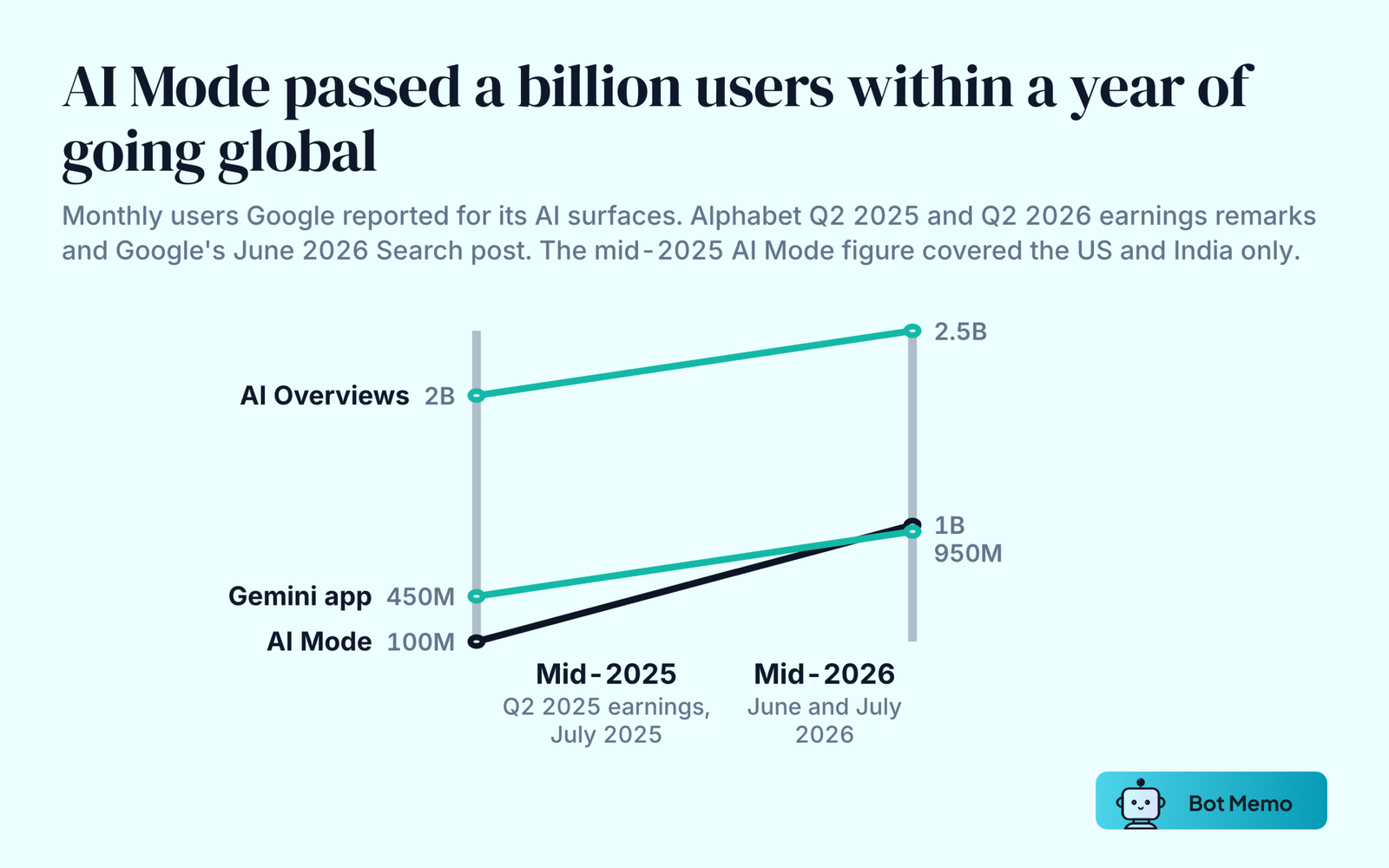
1. AI Overviews has over 2.5 billion monthly active users and AI Mode has passed one billion monthly users. These are the latest user figures Google has published for the two surfaces. (Google, June 2026)
2. AI Overviews grew from over 1.5 billion monthly users in April 2025 to over 2 billion in July 2025, across more than 200 countries and territories and 40 languages. (Alphabet Q2 2025 remarks, July 2025)
3. When Google launched AI Overviews in May 2024, it said it expected to bring them to over a billion people by the end of that year. The feature was pitched as a quick overview of a topic with links to learn more, plus help planning meals and trips. (Google, May 2024)
4. AI Mode had over 100 million monthly active users in the US and India in July 2025. After Google expanded it globally in October 2025, it passed 1 billion monthly active users by July 2026. (Alphabet Q2 2026 remarks, July 2026)
5. The Gemini app has 950 million monthly active users, up from more than 450 million in July 2025, with daily active users tripling in a year. (Alphabet Q2 2026 remarks, July 2026)
How Often AI Overviews Trigger
6. Google does not publish an AI Overviews trigger rate. Its documentation says only that AI Overviews appear when its systems judge them additive to classic Search, “and as such, often don’t trigger.” (Google Search Central, updated December 2025)
7. In Pew Research Center’s measured panel, 18% of all Google searches generated an AI summary, and 58% of respondents ran at least one search that produced one during March 2025. (Pew Research Center, July 2025)
8. Pew’s researchers later found that longer queries, queries that begin with a question word, and queries containing both a noun and a verb are more likely to trigger AI Overviews. (Chapekis, Lieb, Shah and Smith, arXiv, August 2026)
9. Semrush’s tracker, built on more than 10 million keywords from its own database, recorded AI Overviews on 6.49% of queries in January 2025, a peak of 24.61% in July 2025 and 15.69% in November 2025. The swing shows how often Google retunes the feature. (Semrush, 2025)
10. A year earlier, BrightEdge’s tracker reported AI Overviews falling from 11% to 7% of queries in June 2024, with education keywords dropping from 26% to 13%, entertainment from 14% to nearly zero, and ecommerce from 26% to 9%. BrightEdge does not publish its query set or method. (BrightEdge, June 2024)
11. The same BrightEdge tracker reported roughly 50% more AI Overviews on “best” keywords, about 20% more on “what is” questions, about 20% fewer on “vs” comparisons, and a 10% rise in AI Overviews carrying financial warnings. It did not say whether these are absolute or relative changes. (BrightEdge, June 2024)
12. BrightEdge also reported that the overlap between AI Overviews and the traditional results on the same page shrank by a further 3% across all queries. (BrightEdge, June 2024)
ChatGPT, Chatbots And Where Searchers Start
13. ChatGPT has more than 900 million weekly active users and more than 50 million consumer subscribers, according to an OpenAI statement in February 2026. That is up from the 800 million weekly users chief executive Sam Altman announced in October 2025. (Newsweek, February 2026; TechCrunch, October 2025)
14. Across 48 markets, 10% of people use AI chatbots for news each week, up from 7% a year earlier, and 16% of under-35s do. The Reuters Institute’s survey covers about 2,000 respondents per market. (Reuters Institute Digital News Report, June 2026)
15. Search as the main gateway to news is unchanged for older audiences and down 3 percentage points among people under 35. The Reuters Institute notes that its chatbot figures cover standalone chatbots, not AI Mode or AI Overviews. (Reuters Institute Digital News Report, June 2026)
16. Similarweb estimates AI referral traffic at over 1.1 billion visits to websites in June 2025, up 357% year over year. The figure comes from Similarweb’s own traffic modelling. (Similarweb, 2025)
17. In a one-week personal test, an Ahrefs writer found Perplexity could handle most of what they used Google for, though not operator searches such as site:. Google was better for local results. It is an anecdote, not a study. (Ahrefs, 2024)
AI Search Traffic, CTR And Zero-Click Statistics
The Pew Measurement Of Clicks With And Without AI Summaries
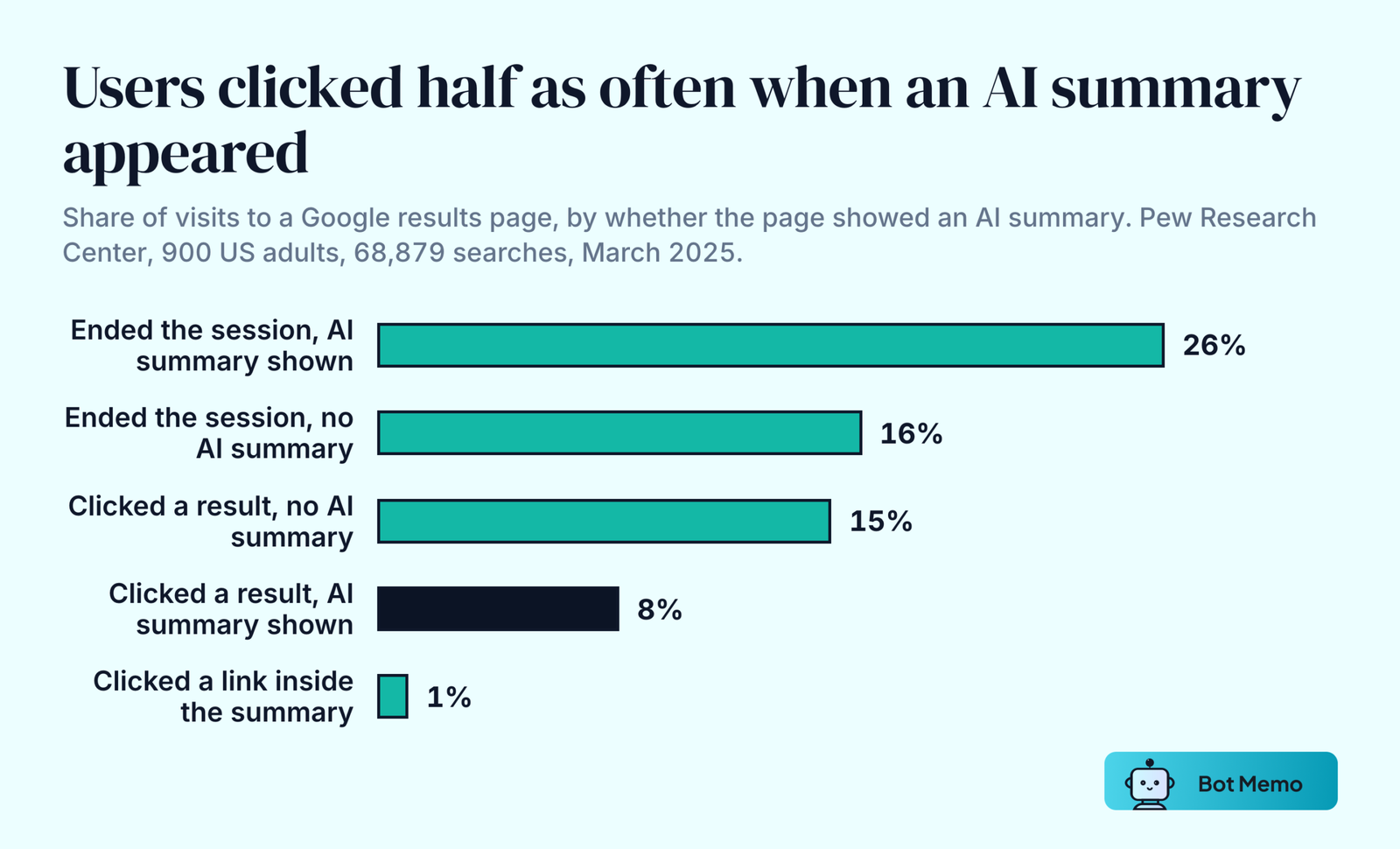
18. Users who saw an AI summary clicked a traditional search result on 8% of visits. Users who did not see one clicked on 15% of visits, nearly twice as often. (Pew Research Center, July 2025)
19. Users clicked a link inside the AI summary itself on just 1% of visits to pages that had one. (Pew Research Center, July 2025)
20. Users ended their browsing session on 26% of search results pages with an AI summary, against 16% of pages with only traditional results. (Pew Research Center, July 2025)
21. The sample was 68,879 unique Google searches by 900 US adults on Pew’s KnowledgePanel Digital, with browsing tracked from 1 to 31 March 2025. Clicking was observed; whether each page showed a summary was reconstructed by re-running the searches in April. The 8% is clicks per visit, not a click-through rate. (Pew Research Center, July 2025)
What Google Says About Clicks
22. Google says total organic click volume from Search to websites “has been relatively stable year-over-year,” and that it sends “slightly more quality clicks” than a year earlier, meaning clicks where the user does not quickly return. Google publishes no numbers, sample or method behind either claim. (Google, August 2025)
23. Google says it now sends “billions of clicks to websites every week through AI features in Search.” That is an absolute figure with no baseline or rate attached. (Alphabet Q2 2026 remarks, July 2026)
24. At launch, Google said links included in AI Overviews “get more clicks than if the page had appeared as a traditional web listing” for the same query. No figure was given. (Google, May 2024)
Third-Party CTR And Zero-Click Search Studies
25. Across 300,000 informational keywords in aggregated Search Console data, Ahrefs found that an AI Overview correlated with a 34.5% lower click-through rate for the top-ranking page in March 2025. Its repeat study put the drop at 58% for December 2025. (Ahrefs, April 2025; Ahrefs, February 2026)
26. 58.5% of US Google searches and 59.7% of EU Google searches ended with no click (zero-click search), according to SparkToro’s analysis of a Datos clickstream panel of desktop and Android users. (SparkToro, 2024)
27. In the same study, every 1,000 US Google searches sent 360 clicks to the open web, meaning sites Google does not own and that were not paid ad clicks. In the EU the figure was 374. (SparkToro, 2024, corrected January 2025)
28. Then: the top organic result earned a click-through rate of about 40%, and First Page Sage, an SEO agency, put it at 39.8% in its 2025 report. Now: its September 2026 edition puts the blended position-one rate at 7.1%, an 82% fall in twelve months. The data covers 1,184 client and panel domains and 3.67 billion Google impressions from March to August 2026. (First Page Sage, 2025 and September 2026)
29. In the same data, the top organic result earned a 3.6% click-through rate on pages with an AI answer and 22.6% on pages without one. (First Page Sage, September 2026)
Publisher Search Traffic
30. Organic search traffic from Google to more than 2,500 publisher sites fell by a third (33%) globally between November 2024 and November 2025, and by 38% in the United States. The data comes from the analytics company Chartbeat, not from the Reuters Institute’s own survey. (Reuters Institute Trends and Predictions, January 2026)
31. News executives expect traffic from search engines to fall by 43% over the next three years. That is a forecast from a survey of 268 executives, not a measurement. (Reuters Institute Trends and Predictions, January 2026)
Google Search Revenue And Market Share
Search Revenue Grew Through The AI Rollout
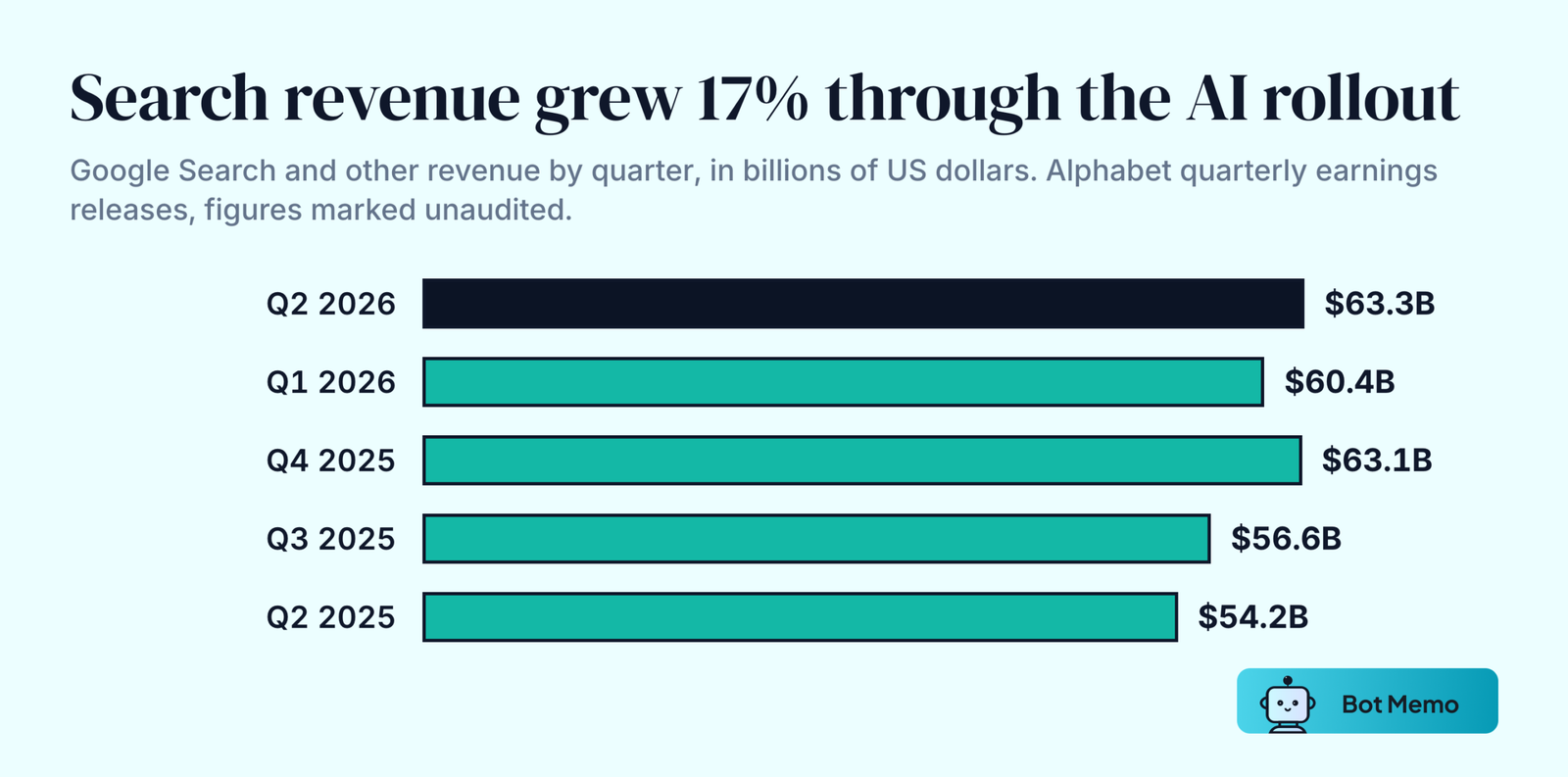
32. Google Search and other revenue was $63.27 billion in the second quarter of 2026, up 17% from $54.19 billion a year earlier. Alphabet’s release marks its tables as unaudited. (Alphabet Q2 2026 earnings release, July 2026)
33. In the first quarter of 2026, Search revenue grew 19%, to $60.40 billion, with Alphabet saying queries were “at an all time high.” Alphabet does not disclose a query count. (Alphabet Q1 2026 earnings release, April 2026)
34. Search revenue was $56.57 billion in the third quarter of 2025, up 14.5%, and $63.07 billion in the fourth quarter, up 17%. (Alphabet Q3 2025 earnings release, October 2025; Alphabet Q4 2025 earnings release, February 2026)
35. Alphabet’s consolidated revenue reached $119.8 billion in the second quarter of 2026, up 24%, with Google Services at $94.5 billion. (Alphabet Q2 2026 earnings release, July 2026)
The $150 Billion Search Figure, Then And Now
36. In January 2023, Fortune described search as generating about $150 billion a year for Google, a figure based on 2021 revenue. Now: Search and other revenue was $63.27 billion in a single quarter of 2026. (Fortune, January 2023)
37. In February 2024, Gartner predicted that traditional search engine volume would drop 25% by 2026 as users moved to AI chatbots and virtual agents. The forecast window has now closed. Alphabet reports record query levels but publishes no count, so the prediction cannot be checked against Google’s numbers. (Gartner, February 2024)
Google’s Search Engine Market Share
38. Google held 91.02% of worldwide search engine market share across all platforms in August 2026, against 91.06% in June 2024. Bing rose from 3.72% to 4.55% over the same period. (Statcounter, June 2024 and August 2026)
39. On mobile, Google’s share was 95.55% worldwide in August 2026, up from 95.17% in June 2024. (Statcounter, June 2024 and August 2026)
40. A widely shared April 2023 reading that Google’s US share had fallen to 77.52% was wrong. After Statcounter revised its data, Google’s US share for April 2023 was 86.58%, against 86.94% in March and 88.88% a year earlier. (Search Engine Land, May 2023)
Google’s Rules On AI-Generated Content
Scaled Content Abuse Replaced The Old Automation Policy
41. Google’s spam policy now calls it “scaled content abuse”: many pages generated mainly to manipulate rankings rather than help users, “no matter how it’s created.” The older policy name, “spammy automatically-generated content,” no longer appears. (Google Search Central, updated August 2026)
42. The first example Google lists under scaled content abuse is “using generative AI tools or other similar tools to generate many pages without adding value for users.” (Google Search Central, updated August 2026)
43. Then: in March 2024 Google wrote that it had “long had a policy against using automation to generate low-quality or unoriginal content at scale.” Now: the same idea sits under scaled content abuse, which covers any production method. (Google, March 2024)
44. Google’s position since February 2023 has been that it rewards high-quality content “however it is produced.” Using AI is not itself against its guidelines; using it mainly to manipulate rankings is. (Google Search Central, February 2023)
Core Updates And Quality Changes, Then And Now
45. Then: Google said the March 2024 core update and its spam work would reduce low-quality, unoriginal content in search results by 40%. Now: after the rollout finished in April 2024, Google updated the same post to say the reduction was 45%. (Google, March and April 2024)
46. The March 2024 update refined Google’s core ranking systems to surface more helpful information and reduce unhelpful, unoriginal content, extending tuning Google began in 2022. (Google, March 2024)
47. Then: SEO roundups have long repeated that Google changes its algorithm 500 to 600 times a year, a figure with no current source. Now: Google says it ran more than 700,000 experiments in 2023 and made 4,781 launches to Search. (Google, How Search Works, 2023 data)
48. Google also introduced a site reputation abuse policy, which SEOs nicknamed “parasite SEO”: third-party pages published on a host site mainly to borrow that site’s ranking signals. (Search Engine Land, March 2024; Google Search Central, 2026)
49. Trust sits at the center of E-E-A-T (experience, expertise, authoritativeness and trust) in Google’s search quality rater guidelines, which call it the most important member of the family. (Google Search Quality Rater Guidelines, September 2025 edition)
What Google Says About Optimizing For AI Features
50. Google says “there are no additional requirements to appear in AI Overviews or AI Mode, nor other special optimizations necessary,” and that traditional SEO best practices still apply. (Google Search Central, updated December 2025)
51. Google also says site owners do not need new machine-readable files, AI text files, markup or special schema.org structured data to appear in AI features. (Google Search Central, updated December 2025)
52. On llms.txt files, Google says keeping one is “completely fine” but “will neither harm nor help” visibility in Google Search, because Google Search ignores them. (Google Search Central, updated July 2026)
Can Google Or Anyone Detect AI Content
53. Asked whether AI writing can be detected, Wharton professor Ethan Mollick answers “No,” adding that “even OpenAI says you can’t.” (Ethan Mollick, One Useful Thing, October 2023)
54. Researchers showed that paraphrasing AI-generated text is enough to defeat a range of detectors, including watermark-based ones. The work is a preprint. (Sadasivan et al., arXiv, March 2023)
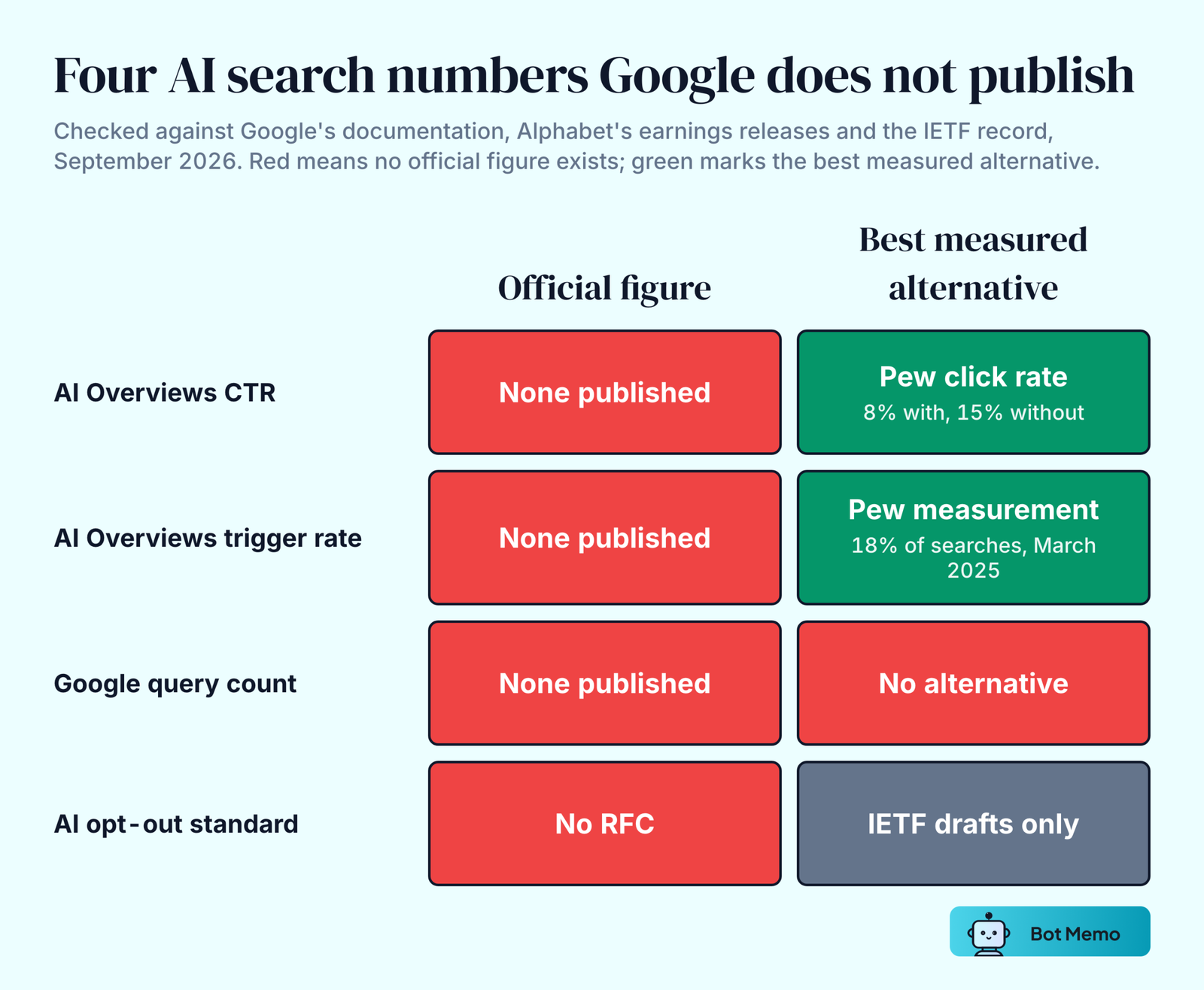
55. Seven GPT detectors wrongly labeled 61.22% of 91 TOEFL essays by non-native English writers as AI-generated, on average, and 97.8% of the essays were flagged by at least one detector. The finding is about non-native writers specifically, not a general false-positive rate. The study was later published in the journal Patterns. (Liang et al., arXiv, April 2023)
56. OpenAI has said AI content detectors have not proven reliable enough to judge student work. (OpenAI Help Center, 2023)
AI Visibility Controls For Site Owners
Google’s Generative AI Opt-Out
57. In June 2026 Google began testing a control that lets site owners choose whether their site appears in and helps ground its generative AI features, including AI Overviews, AI Mode and AI Overviews in Discover. Sites that opt out get no traffic or impressions from those features. (Google, June 2026)
58. Google says the opt-out is not used as a ranking signal for results outside its generative AI features. It rolled out first to a subset of UK site owners, in engagement with the UK Competition and Markets Authority, and reached all websites worldwide on 31 August 2026. (Google, June and August 2026)
59. Google-Extended, the older token many sites use, does not remove a site from Google Search and is not a ranking signal. It governs use of content for training future Gemini models and for grounding. (Google Crawling Infrastructure, updated July 2026)
What Search Console Reports For AI Overviews And AI Mode
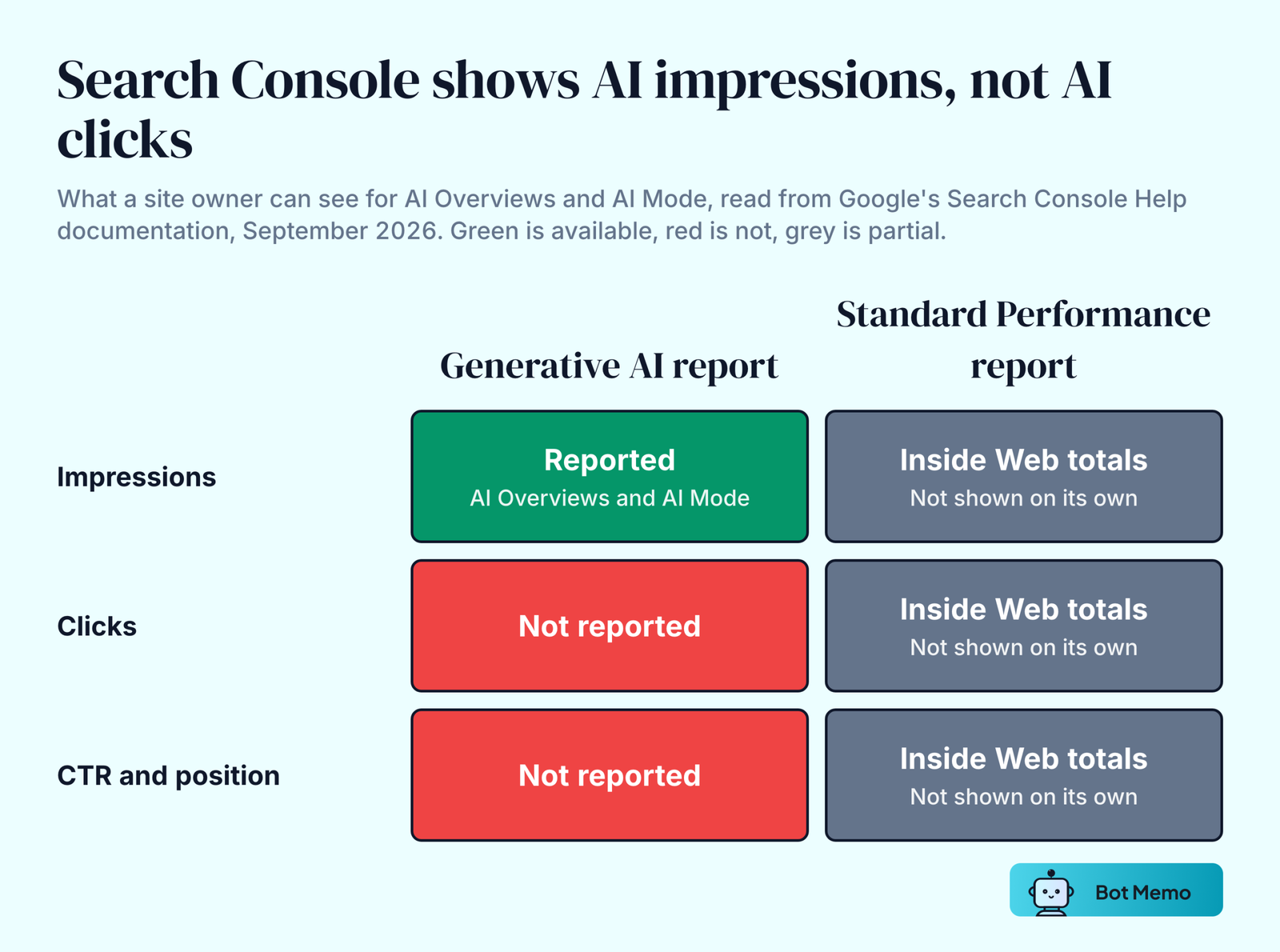
60. Search Console’s generative AI performance report shows impressions for AI Overviews and AI Mode, broken down by page, country, date and device. It shows no clicks, click-through rate or position. It reached all websites worldwide on 31 August 2026. (Search Console Help, 2026)
61. Traffic from AI features is already counted in the standard Performance report under the “Web” search type. A site’s totals include it, but the report does not show it on its own. (Google Search Central, updated December 2025)
AI Crawlers And Their Controls
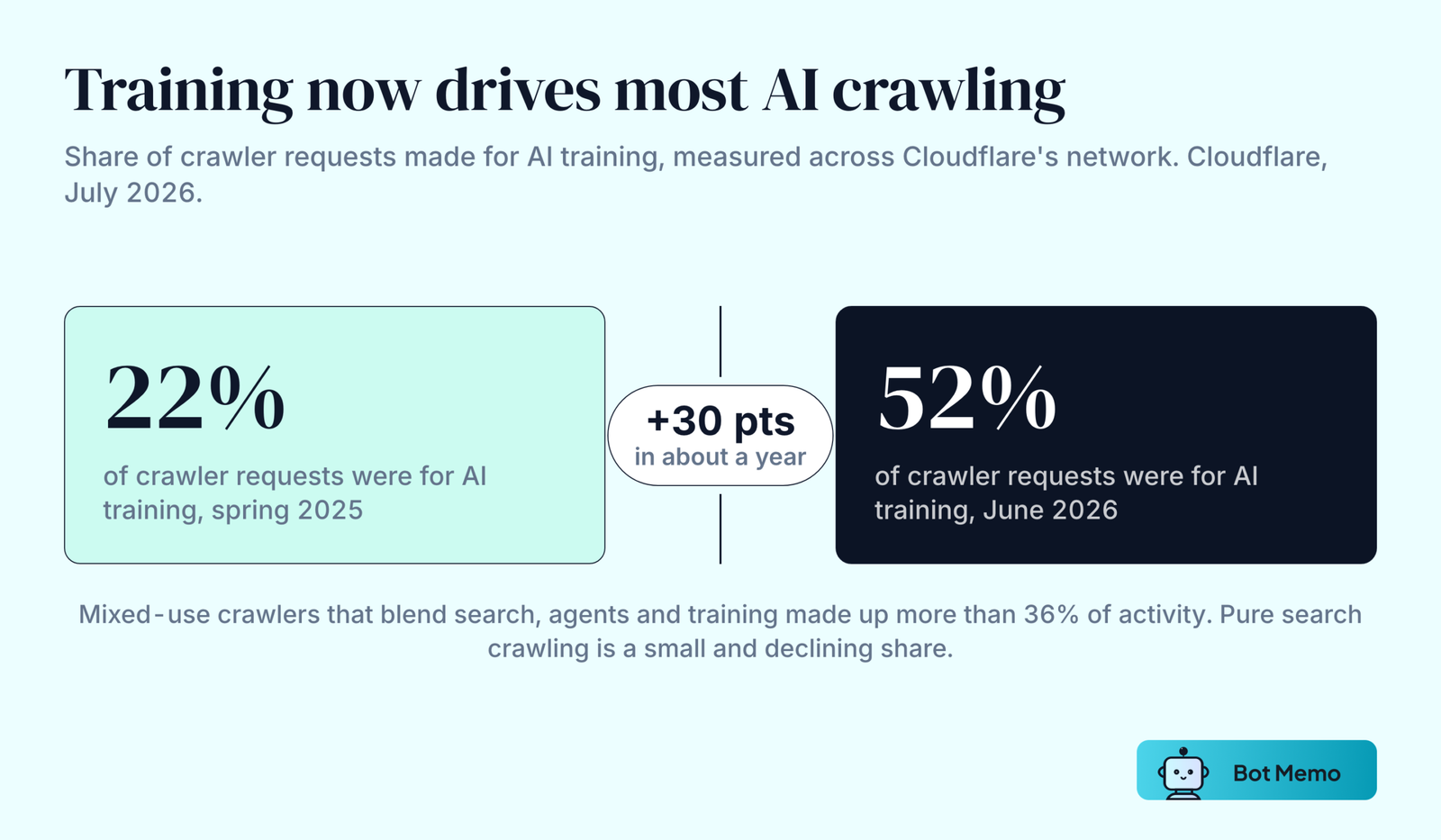
62. 52% of crawler requests on Cloudflare’s network were for AI training in June 2026, up from 22% in spring 2025. Mixed-use crawlers that blend search, agents and training made up more than 36% of activity. (Cloudflare, July 2026)
63. More than 20% of the web sits behind Cloudflare, including 36% of the world’s most-visited websites, which is the basis for those crawler shares. (Cloudflare, July 2026)
64. For the first week of August 2025, Cloudflare measured OpenAI’s crawlers fetching 887 HTML pages for every referral they sent back, and Perplexity’s 118. Anthropic’s ratio was nearly 50,000 to 1, though Cloudflare says such ratios may be overstated, by an unclear amount, because native-app traffic such as Claude’s carries no referrer header. (Cloudflare, August 2025; Cloudflare, updated July 2026)
65. OpenAI runs separate crawlers for search (OAI-SearchBot), training (GPTBot) and user-requested fetches (ChatGPT-User). Sites that block OAI-SearchBot will not appear in ChatGPT search answers, though they can still show as navigational links. Blocking training does not remove search visibility. (OpenAI, 2026)
66. Anthropic likewise separates ClaudeBot (training), Claude-User (user requests) and Claude-SearchBot (search indexing). All respect robots.txt, and Anthropic warns that IP-based blocking may not work reliably as an opt-out. (Anthropic, April 2026)
67. There is no finished standard for AI usage preferences. The IETF’s AI Preferences working group has two drafts in progress, the vocabulary draft at version 08 (September 2026) and the attachment draft at version 05 (August 2026). Neither is an RFC. (IETF, September 2026)
Antitrust And Regulation Of AI Search
United States v. Google Remedies
68. The final judgment in United States v. Google, entered 5 December 2025, requires Google to give qualified competitors data from its web search index at marginal cost, including document IDs, the URL for each, when it was first seen and last crawled, and its spam score. (US District Court for DC, Final Judgment, December 2025)
69. Google must also offer qualified competitors a five-year search syndication license on terms no worse than those it offers other syndication customers. (US District Court for DC, Final Judgment, December 2025)
70. Judge Amit Mehta wrote that “GenAI plays a significant role in these remedies,” and AI products whose main function includes answering user queries fall inside the decree. The court rejected a forced sale of Chrome, mandatory choice screens and a complete ban on default payments. (Memorandum Opinion, December 2025)
71. Both sides have appealed to the D.C. Circuit. The judgment took effect on 3 February 2026, and on 7 May 2026 the court denied, without prejudice, Google’s request for a partial stay while it appeals, so the remedies apply during the appeal. The Justice Department filed its brief on 28 July 2026, with oral argument not yet scheduled. (US District Court for DC, May 2026; US Department of Justice, July 2026)
EU Digital Markets Act Decisions
72. The European Commission fined Google EUR 890 million on 23 July 2026 for two breaches of the Digital Markets Act: EUR 460 million for favoring its own services in Google Search and EUR 430 million for anti-steering rules on Google Play. (European Commission, July 2026)
73. The Commission found Google shows its own services more prominently in search results, including at the top of the page and with enhanced visuals and filters, while comparable third-party services do not get the same prominence. (European Commission, July 2026)
74. A separate decision on 16 July 2026 specifies that AI chatbots offering search functions are eligible to receive the search data Google must share with rival search engines, and that Google should share the same data it collects to optimize its own search, subject to anonymisation. A companion decision gives rival AI assistants equal access to features on Android devices. (European Commission, July 2026)
AI Adoption In SEO And Content Marketing
Enterprise SEO Teams And AI
The figures in this cluster come from seoClarity’s survey of enterprise SEO professionals: 722 opt-in responses collected from August to September 2023, drawn largely from the vendor’s own audience. They predate Claude 3 and the Gemini models.
75. 83% of respondents at companies with more than 200 employees said their SEO performance improved after they started using AI. (seoClarity, 2023)
76. 82% of enterprise SEOs planned to invest more in AI for SEO, mainly to improve overall performance and automate repetitive tasks. (seoClarity, 2023)
77. When choosing an AI tool, 64.48% prioritized the accuracy and reliability of its insights above everything else. Content optimization, keyword research and content generation were the most common uses. (seoClarity, 2023)
78. ChatGPT was the model respondents trusted and used most, at 49.7%. (seoClarity, 2023)
79. The biggest concerns were content quality and authenticity (65.14%) and data security and privacy (58.64%). (seoClarity, 2023)
How Marketers Use AI
80. Then: 61.4% of marketers said they used AI in 2023. Now: 69.1% said so in 2024, in Influencer Marketing Hub’s survey of 1,290 marketers. (Influencer Marketing Hub, 2023 and 2024)
81. Half (50%) of small and mid-sized business marketers said insufficient AI adoption was holding them back from their goals, and 88% said their team must increase its use of automation and AI to meet customer expectations and stay competitive. Forrester surveyed 313 marketers for Mailchimp in March 2023. (Intuit Mailchimp, 2023)
82. 59% of people who use AI at work reported greater job satisfaction, in Tech.co’s survey of 1,047 senior leaders at US businesses. (Tech.co, 2024)
83. 35% of companies reported using AI in their business, in IBM’s global poll of 7,502 senior business decision-makers. (IBM, May 2022)
What People Think Of AI Content And Personalized Results
84. 43% of Americans said AI-generated written work can be as good as something written by a human, and 36% thought it could outperform human writing. (Ipsos, 2023)
85. 71% of consumers expect companies to deliver personalized interactions, and 76% get frustrated when that does not happen. (McKinsey, November 2021)
86. In 2022, writer Dan Shipper built a chatbot trained on every episode of the Huberman Lab podcast, an early example of people asking a narrow AI model instead of a search engine. (Every, 2022)
AI SEO Numbers That Nobody Publishes
Much of the confident data circulating about AI and search is not published by anyone in a position to know.
No Official Click-Through Rate For AI Overviews
87. Google publishes no absolute click-through rate for AI Overviews or AI Mode. Its claims are relative or qualitative: stable click volume, higher-quality clicks, and “billions” of weekly clicks. Any specific AI Overviews CTR attributed to Google did not come from Google. (Google, August 2025)
88. Search Console has no separate clicks metric for AI surfaces. AI clicks are inside a site’s Web totals, but they cannot be isolated. (Search Console Help, 2026)
No Google Query Count Or Trigger Rate
89. Alphabet discloses no query count for Search, AI Overviews or AI Mode. Any “billions of searches per day” figure is not an Alphabet disclosure. (Alphabet Q2 2026 earnings release, July 2026)
90. Google publishes no AI Overviews trigger rate. The best measured alternative is Pew’s 18% of searches from March 2025; most other circulating figures come from vendor rank trackers. (Pew Research Center, July 2025)
No Standard For AI Opt-Out Files
91. llms.txt is not a standard, and no RFC for expressing AI usage preferences has been published. Google treats such files as unnecessary and without effect in Search. (Google Search Central, updated July 2026)
For related data, see our ChatGPT statistics, Gemini statistics, AI marketing statistics, AI writing statistics and AI browser statistics.
Key Takeaways
- Google’s AI surfaces operate at full search scale: over 2.5 billion monthly users for AI Overviews and over 1 billion for AI Mode as of mid-2026.
- Google Search revenue grew 17% to $63.27 billion in the second quarter of 2026, as the AI features rolled out.
- In Pew Research Center’s measured panel, users clicked a traditional result on 8% of visits with an AI summary and 15% without one.
- Publisher organic traffic from Google fell 33% globally in a year in Chartbeat’s data, while Google says total click volume is stable. Only the first figure comes with a sample.
- Google says no special optimization, AI text file or llms.txt is needed for AI features; its rules target scaled low-value content regardless of how it is made.
- Site owners gained a real control in 2026: a generative AI opt-out and a Search Console report of AI impressions, though not AI clicks.
- Regulators are now shaping search: a US court ordered index sharing and syndication, and the EU fined Google EUR 890 million under the Digital Markets Act.
Frequently Asked Questions
How Many People Use Google AI Overviews?
AI Overviews has over 2.5 billion monthly active users, according to Google in June 2026. It had over 1.5 billion in April 2025 and over 2 billion in July 2025.
How Many People Use Google AI Mode?
AI Mode passed 1 billion monthly active users by July 2026, up from over 100 million in the US and India a year earlier. Google expanded it globally in October 2025.
Do AI Overviews Reduce Clicks To Websites?
In Pew Research Center’s panel of 900 US adults, users clicked a traditional search result on 8% of visits when an AI summary appeared and 15% when it did not. Ahrefs found a 58% lower click-through rate for the top result on keywords with an AI Overview. Google says overall click volume is relatively stable but publishes no figures.
How Often Do AI Overviews Appear In Google Search?
Google publishes no trigger rate. Pew measured AI summaries on 18% of searches in March 2025. Semrush’s keyword tracker ranged from 6.49% in January 2025 to 24.61% in July 2025 and 15.69% in November 2025.
What Percentage Of Google Searches End Without A Click?
SparkToro’s 2024 study found 58.5% of US Google searches and 59.7% of EU searches ended with no click. For every 1,000 US searches, 360 clicks went to the open web.
Does Google Penalize AI-Generated Content?
No, not for being AI-generated. Google rewards helpful content however it is produced. Its scaled content abuse policy targets pages made mainly to manipulate rankings “no matter how it’s created,” and names mass-producing pages with generative AI without adding value as its first example.
Do I Need An llms.txt File For AI Search?
Not for Google. Google says an llms.txt file will neither harm nor help visibility in Google Search, which ignores it, and that no special files or markup are needed to appear in AI features.
Is Google Losing Search Market Share To AI?
Not by Statcounter’s measure. Google held 91.02% of worldwide search share in August 2026, almost unchanged from 91.06% in June 2024, and its Search revenue grew 17% year over year in the second quarter of 2026.
Can I Stop Google Using My Site In AI Overviews?
Yes. Since June 2026 Google offers a generative AI opt-out, available to all websites worldwide from 31 August 2026. Opted-out sites get no traffic or impressions from AI Overviews or AI Mode, and Google says the choice does not affect ranking elsewhere in Search.
Sources And Methodology
Statistics on this page are drawn from primary sources wherever one exists: Google’s documentation and blog, Alphabet’s earnings releases, Pew Research Center and its preprint, the Reuters Institute, Cloudflare, OpenAI and Anthropic documentation, the IETF, US court records and European Commission decisions. Vendor studies and surveys are included with their sample or method stated in the same sentence. Google’s documentation pages are living documents, so the last-updated date is given where it matters. Figures were checked against their sources in September 2026.
Revenue figures are in US dollars as reported by Alphabet, whose quarterly tables are marked unaudited. Fines are in euros as announced by the European Commission.
Figures Retired From Earlier Versions Of This Page
Earlier versions of this page carried the figures below. Each was checked again against the source it cited and is no longer shown, for the reason given.
- 68% of companies reporting higher SEO ROI with AI, 67% using AI for content and SEO, 9% averse to AI, and 79% seeing better content quality (Semrush, 2024): the report URL now redirects to a product page and the figures have no live source.
- 30.1% of marketers expecting AI to hurt search traffic, 69% using ChatGPT, and 85.1% of AI users writing blog content with it (Authority Hacker, 2024): the survey page has been deleted.
- 98% of organizations prioritizing SEO in 2024, up from 90% (BrightEdge): neither figure appears on the cited page.
- An average Google CTR of 3% to 5% (Semrush State of Search, 2023): the cited page contains no CTR figures. Measured click rates from Pew appear above.
- An “80% AI plus 20% human” content split (Boring Marketer, 2024): cited to a company homepage with no study behind it. The helpful content crackdown it was paired with is now cited to Google directly.
- 26% of B2B marketers seeing more leads from chatbots (Statista, 2021): the linked chart measures AI-in-marketing market revenue, not chatbots or leads.
- 37% of marketers automating repetitive tasks and 25% of ecommerce marketers writing product descriptions with AI (HubSpot, 2023): the source now serves a gated 2026 edition and the 2023 figures cannot be confirmed.
- 76% using generative AI for copy and 29% of enterprises using natural language processing (Mailchimp, 2023): neither figure is in the cited release, which surveyed small and mid-sized businesses.
- 23% of marketers against 54% of IT staff adopting AI (IBM, 2022): neither figure is in the cited release. IBM’s 35% adoption figure appears above.
- 62% of marketers using AI (Influencer Marketing Hub, 2023): the report’s figure is 61.4%, shown above.
- 30% of marketers using AI tools daily (Influencer Marketing Hub, 2023): the figure does not appear in the cited report.
- Perplexity’s 52.4 million visits in March 2024: a secondhand figure from a roundup page that has since been overwritten.
- 40% disagreeing that AI matches human quality and 47% disputing that AI can outperform human writers (Ipsos, 2023): neither figure is in the poll’s AI results. The poll’s 43% and 36% appear above.
- Organic search driving 53% of website traffic, voice search at 20% of mobile searches, 500 to 600 Google algorithm updates a year, and a 27.5% CTR advantage for the top result (Embryo, 2023): uncited figures on a roundup page, several recycled from studies published before 2019. Google’s own count of Search launches replaces the update figure above.
- The claim that Google uses social signals as a ranking factor: it carried no source.
- A link to Semrush’s Keyword Magic Tool offered as an AI keyword research example: a product page, not a statistic.
- Image captions linking a Conductor SEO predictions page and a Market.us AI content marketing report: neither caption carried a figure, and the images have been replaced by the charts above.

About the author
Editorial Staff
The Editorial Staff at Bot Memo is a team of writers, analysts, and AI agents dedicated to mapping the global AI startup ecosystem. Led by Chintan Zalani, the team tracks thousands of funding rounds, classifies companies across verticals, and distills it all into actionable intelligence for investors and founders.