


The defining AI video story of the past year is not a launch. It is a shutdown. OpenAI opened Sora 2 to the public on 30 September 2025, watched it pass a million downloads in under five days, and closed the app on 26 April 2026. The API follows on 24 September 2026.
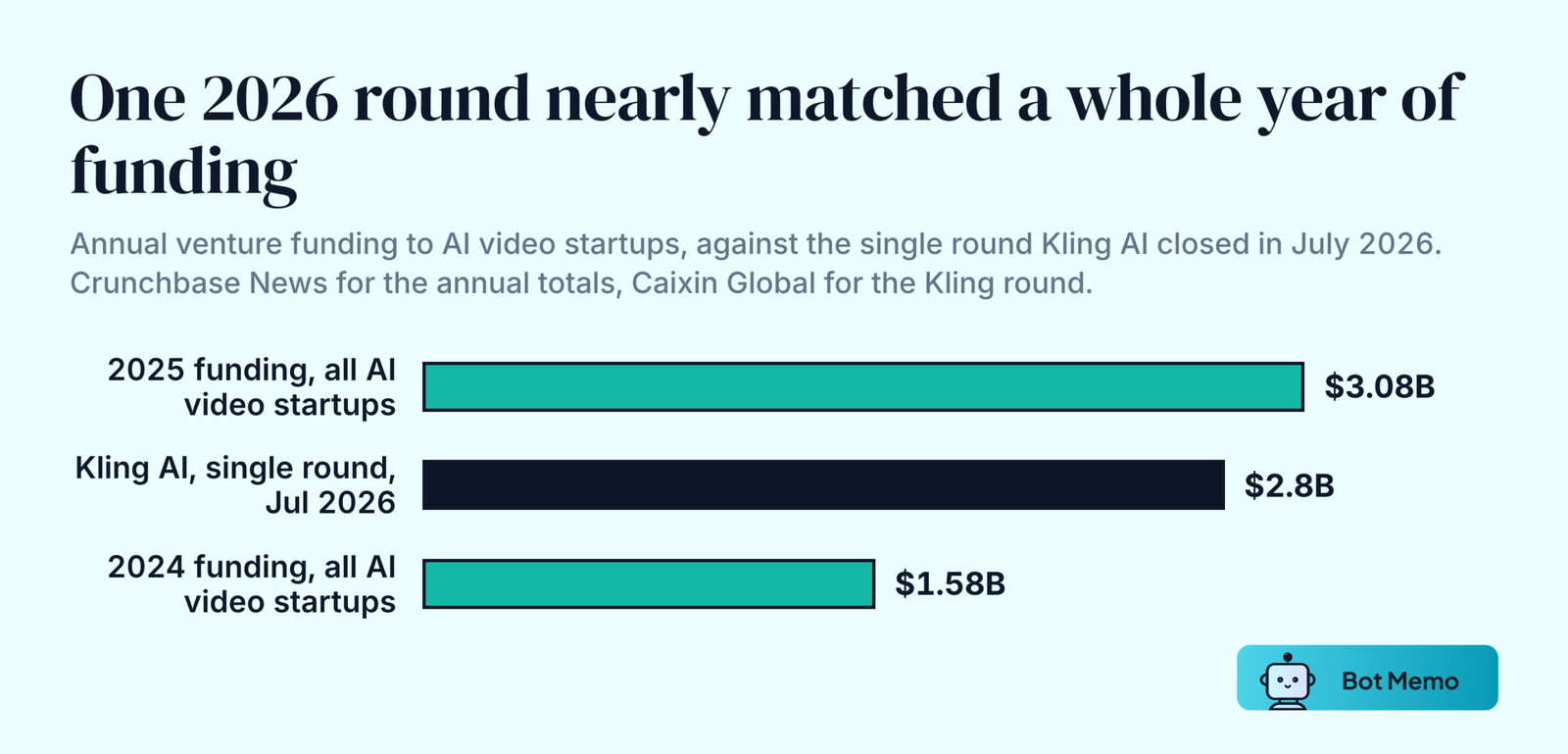
Meanwhile the money moved east. Kuaishou’s Kling AI raised about $2.8 billion in a single round in July 2026 at an $18 billion valuation, which is close to the entire global funding total for AI video startups in 2025. Annualize its second-quarter revenue and the result is roughly two and a half times the recurring revenue of the largest Western competitor.
The figures below are grouped by what they measure, because AI video numbers get mixed up constantly. A market forecast is not revenue. An annualized run rate is not a year of sales. A download is not a user. Each stat names its source and its date.
On this page
- AI Video Market Size And Growth Forecasts
- AI Video Funding And Valuations
- Platform Usage And Adoption
- Revenue, ARR And What AI Video Costs
- AI Video In Marketing, Advertising And Training
- Copyright, Licensing And Regulation
- Content Quality, Detection And Video Analysis
- Key Takeaways
- Frequently Asked Questions
- Sources And Methodology
AI Video Market Size And Growth Forecasts
Three Research Houses Size Three Different Markets
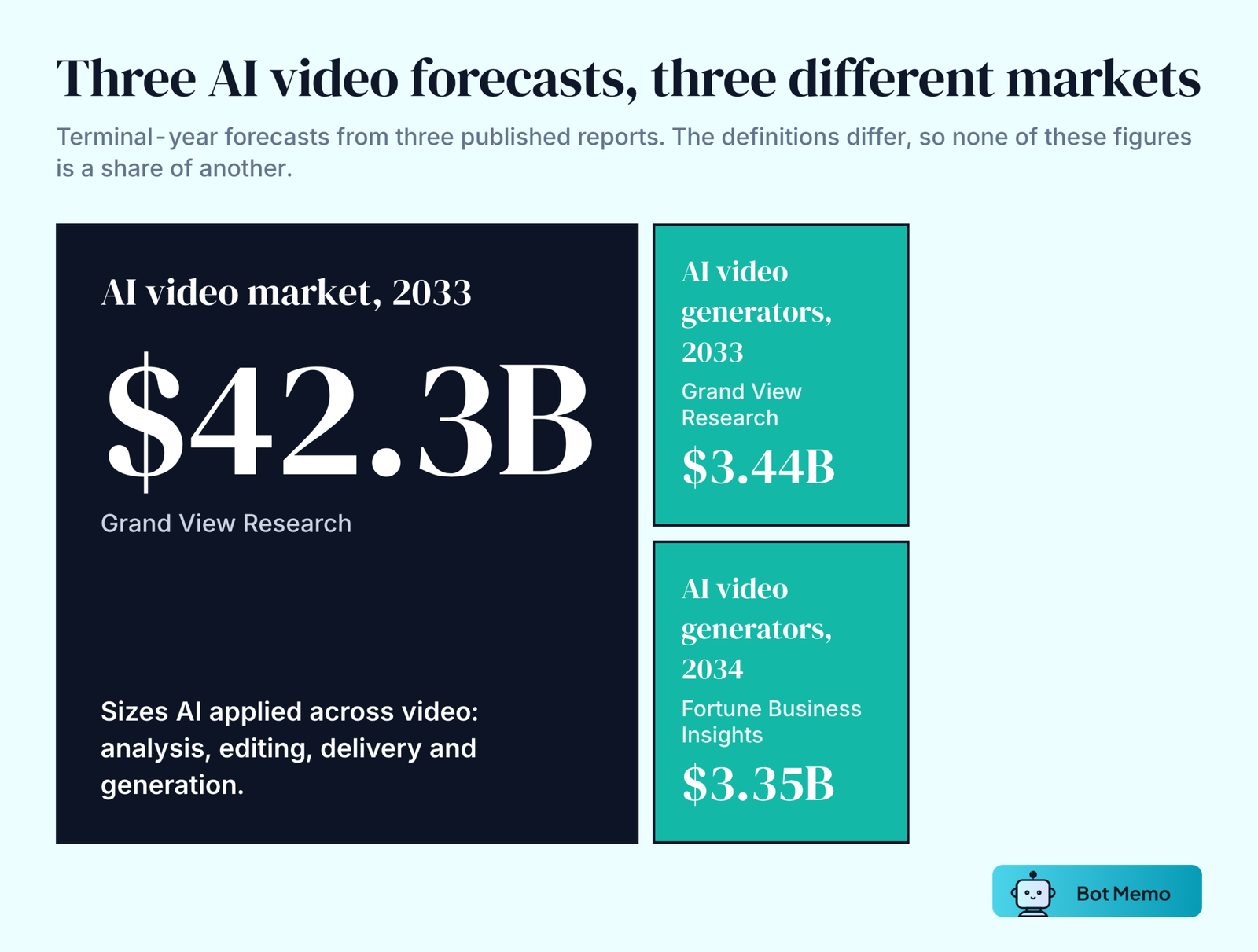
The single most common error in AI video coverage is treating these forecasts as versions of one number. They are not. They cover different things.
1. Grand View Research values the broad AI video market at $3.8 billion in 2024, growing from $5.5 billion in 2026 to $42.3 billion by 2033, a 32.2% compound annual rate. That scope includes AI applied to video analysis, editing and delivery, not only generation. (Grand View Research, 2026)
2. The same firm sizes the narrower AI video generator market at $788.5 million in 2025, reaching $3,441.6 million by 2033 at a 20.3% rate from 2026 to 2033. (Grand View Research, 2026)
3. Fortune Business Insights puts that same generator market at $847 million in 2026, reaching $3,350 million by 2034 at 18.8%. (Fortune Business Insights, 2026)
The two generator forecasts land within about 3% of each other at their terminal years, which is reassuring. The gap between them and the broad AI video figure is a definitional gap, not a disagreement.
4. This page previously carried Grand View Research’s earlier edition of the generator report, which projected a 19.9% compound rate from 2024 to 2030. The firm has since rebased it: the current edition runs 2026 to 2033 at 20.3%. The growth assumption barely moved. (Grand View Research, 2023 and 2026)
5. Grand View Research also reports significant merger and acquisition activity within the AI video generator industry. (Grand View Research, 2023 and 2026)
Forecasts like these are worth treating as scaffolding rather than measurement. The revenue figures further down are disclosed by operating companies, and they tell a sharper story.
The Deepfake Segment Is Sized Separately, And Wildly So
AI video and deepfakes overlap but are not the same market, and the two published estimates differ by more than an order of magnitude at the base year.
6. The global deepfake AI market was sized at $6.83 billion in 2023 and forecast to reach $119.34 billion by 2033, a 33.12% compound rate. (GlobeNewswire, 2024)
7. Video is expected to hold the largest share of that market across the forecast period. (GlobeNewswire, 2024)
8. Asia Pacific holds the largest regional share, while North America is expected to grow fastest, driven by corporate adoption. (GlobeNewswire, 2024)
9. MarketsandMarkets sizes the same market at $0.53 billion in 2024 and $0.85 billion in 2025, reaching $7.27 billion by 2031 at a 42.8% rate. That base year is roughly one thirteenth of the figure above. (MarketsandMarkets, 2026)
10. Deepfake technology is not exclusively harmful. Documented positive applications include integrating virtual and augmented reality for educational experiences such as historical reenactment. (MarketsandMarkets, 2024)
AI Video Funding And Valuations
2025 Funding Nearly Doubled To $3.08 Billion
11. Global venture funding to AI video startups reached $3.08 billion in 2025, up 94.6% from $1.58 billion in 2024. (Crunchbase News, February 2026)
That is the credible growth benchmark for the category. The “840% AI video growth” figure that circulates on vendor blogs has no traceable primary source and is not used here.
Kling AI’s $18 Billion Round Reset The Ceiling
12. On 2 July 2026 Kling AI closed about $2.8 billion of a roughly $3 billion target round, the largest ever raised by a developer of AI video models. (Caixin Global, July 2026)
13. Caixin puts the pre-money valuation at $15 billion. The round was reported as valuing Kling at $18 billion post-investment, down from a $20 billion target set in April 2026. (Caixin Global and South China Morning Post, July 2026)
14. Kuaishou sold a 16.7% stake and retains 68.3% control. Investors include Alibaba, Tencent, Baidu and Zhejiang Huace Film & TV (Caixin Global, July 2026). Kling plans to begin a Hong Kong listing process within a year (South China Morning Post, July 2026).
One round in 2026 came within $280 million of the entire prior year of global AI video funding. For where generative video sits inside the wider picture, see our AI startup funding statistics.
Runway And Luma Absorbed The Western Capital
15. Runway raised a $315 million Series E at a $5.3 billion post-money valuation on 10 February 2026, led by General Atlantic, with Nvidia, Adobe Ventures, AMD Ventures, Fidelity and Felicis participating. (TechCrunch, February 2026)
16. Runway’s total funding stands at roughly $1.05 billion including the Series E, per Sacra. Crunchbase’s own database puts the figure at $860 million, a gap of about $190 million that neither source reconciles. (Sacra, 2026)
17. Luma AI raised a $900 million Series C on 19 November 2025, led by HUMAIN, with AMD Ventures, Andreessen Horowitz, Amplify Partners and Matrix Partners participating. The round accompanied a 2 gigawatt AI supercluster partnership in Saudi Arabia. Luma did not disclose a valuation in the announcement; press coverage put it at roughly $4 billion. (PR Newswire, November 2025)
18. On 31 March 2026 Runway launched a $10 million fund and builders programme for pre-seed and seed AI media startups, moving an operating company into the investor seat. (TechCrunch, March 2026)
For how these valuations compare across generative AI, see our generative AI market stats.
Platform Usage And Adoption
Sora Launched Faster Than ChatGPT, Then OpenAI Closed It
19. OpenAI launched Sora 2 with an iOS app on 30 September 2025, invite-only, in the US and Canada. (OpenAI, September 2025)
20. The app passed 1 million downloads in under five days, faster than ChatGPT managed, despite the invite gate. In their first weeks Sora took 627,000 iOS downloads against ChatGPT’s 606,000. (TechCrunch, October 2025)
21. Sora reached 4 million downloads by the end of October 2025 and was generating millions of ten-second videos a day. (CNBC, October 2025)
22. The Android app followed on 4 November 2025, 35 days after iOS. (TechCrunch, November 2025)
Then the curve broke.
23. Cumulative installs reached 9.6 million by January 2026, but consumer spending across that entire base was $1.4 million, about 15 cents per install. (TechCrunch, January 2026)
24. Downloads fell 32% month over month in December 2025, then 45% to 1.2 million installs in January 2026. (TechCrunch, January 2026)
25. Sora slipped from first on the App Store free chart in October 2025 to 126th. (eMarketer, March 2026)
26. Worldwide users peaked near 1 million and fell below 500,000 on Similarweb data, while the service cost an estimated $1 million a day to run against $2.1 million of in-app purchase revenue across its whole life. These figures come from The Wall Street Journal’s reporting on the shutdown, which sits behind a subscription. (The Wall Street Journal, March 2026)
27. OpenAI announced the shutdown on 24 March 2026. The app and web experience closed on 26 April 2026, and the API retires on 24 September 2026. (OpenAI Help Center, 2026)
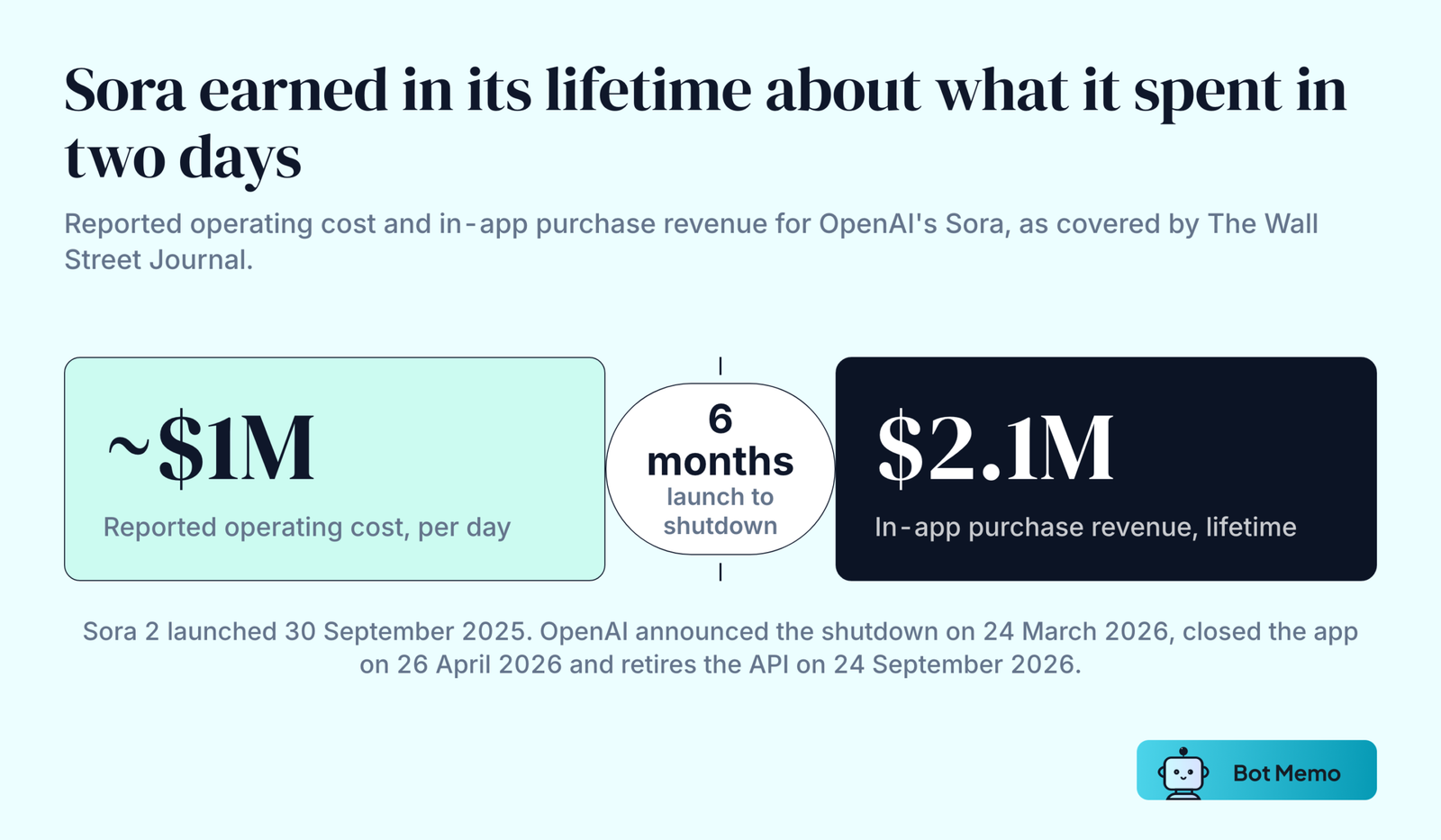
Sora is the sharpest single data point yet on how quickly consumer retention can collapse in this category. It is one product, so it does not settle the question on its own. It is worth noting that every revenue figure in the next section belongs to a company that sells to businesses.
Veo And Flow Passed 275 Million Videos
28. Google launched Veo 3 on 20 May 2025 with native audio and dialogue generation and SynthID watermarking. It shipped at 720p; 1080p arrived in September 2025 and 4K upscaling in January 2026. (Google Developers Blog, 2025)
29. By late July 2025 Veo 3 had generated over 70 million videos globally. (Google Cloud, July 2025)
30. Enterprise customers generated more than 6 million videos on Vertex AI between the June 2025 preview and general availability at the end of July. (Google Cloud, July 2025)
31. Google’s Flow filmmaking tool, launched alongside Veo 3 in May 2025, passed 275 million videos generated within five months. (Google, October 2025)
For how generative video is landing in production workflows, see our AI filmmaking statistics.
Kling AI Reports 60 Million Creators And 600 Million Videos
32. As of December 2025 Kling served more than 60 million creators, had generated over 600 million videos, and counted more than 30,000 enterprise users. (Kuaishou investor relations, January 2026)
33. A separately reported figure put monthly active users above 12 million in January 2026. That number came from a sourced press report rather than a Kuaishou disclosure, so it carries less weight than the figures above. (Pandaily, January 2026)
34. Kuaishou launched the Kling AI 3.0 series in February 2026 (Kuaishou, May 2026). The Kling 3.0 Turbo model and native 4K output followed in the second quarter, which Kuaishou calls the first video generation model to support native 4K. (Kuaishou, August 2026)
Runway And Luma Compete On Model Quality
35. Runway launched Gen-4 on 31 March 2025 and Gen-4.5 on 1 December 2025. (Runway, December 2025)
36. Gen-4.5 took first place on the Artificial Analysis text-to-video leaderboard at 1,247 Elo, ahead of Veo 3 at 1,226, Kling 2.5 at 1,225 and Sora 2 Pro at 1,206. Newer models have since entered that leaderboard, so the ranking is a snapshot. (Runway, December 2025)
37. Luma’s current model is Ray3.2, which replaced Ray2. Dream Machine’s user base is widely reported in the 25 to 30 million range, but Luma has not tied an exact figure to a date, so treat it as approximate. (Luma AI, 2026)
Revenue, ARR And What AI Video Costs
Runway Doubled Its Run Rate In Five Months
38. Runway’s annualized revenue was $70 million at the end of 2024 and $90 million in June 2025. Actual recognised revenue for calendar 2024 was $44 million, well below the annualized figure. (Sacra, 2026)
39. Annual recurring revenue reached $200 million in September 2026, roughly double the $100 million the company was at in April 2026. Co-chief executive Anastasis Germanidis stated the figure publicly on 8 September 2026. (Bloomberg, September 2026)
40. Runway says its net revenue retention runs above 300%, meaning existing customers roughly triple their spending, and expects to pass $350 million by the end of 2026. (Bloomberg, September 2026)
Worth noting what this corrects. Equity research had forecast $265 million to $300 million of annualized revenue by the end of 2025. Runway did not reach $200 million until nine months into 2026, so that forecast ran roughly a year ahead of the business.
These four figures do not form a smooth curve, and they are not all the same measurement. The 2024 and 2025 numbers are equity research estimates of annualized revenue. The April 2026 figure is inferred from Runway’s own statement that recurring revenue doubled between April and September, not from a separate disclosure on that date. Read them as four readings taken on different bases rather than one series.
Kling Grew Revenue Fast And Lost Money Doing It
41. Kling’s annualized run rate was $100 million in March 2025 and $240 million in December 2025. Kuaishou defines that run rate as monthly operating revenue multiplied by twelve. (Kuaishou investor relations, January 2026)
42. It reached approximately $500 million in March 2026, disclosed with Kuaishou’s first-quarter results rather than in a standalone release. (Kuaishou, May 2026)
43. Full-year 2025 revenue was 1.04 billion yuan, about $150 million, which was 0.7% of Kuaishou’s total revenue. (Caixin Global, March 2026)
44. First-quarter 2026 revenue exceeded 650 million yuan, about $90 million, up more than 300% year on year. Kuaishou reports the March run rate and this quarterly figure in the same release. (Kuaishou, May 2026)
45. Second-quarter 2026 revenue exceeded 850 million yuan, up more than 200% year on year and 30% on the quarter, taking first-half revenue to 1.5 billion yuan. (TechNode, August 2026)
46. Kling posted net losses of 500 million yuan in 2024 and 1.9 billion yuan in 2025, driven by computing costs. Revenue growth and profitability are separate questions here. (Caixin Global, July 2026)
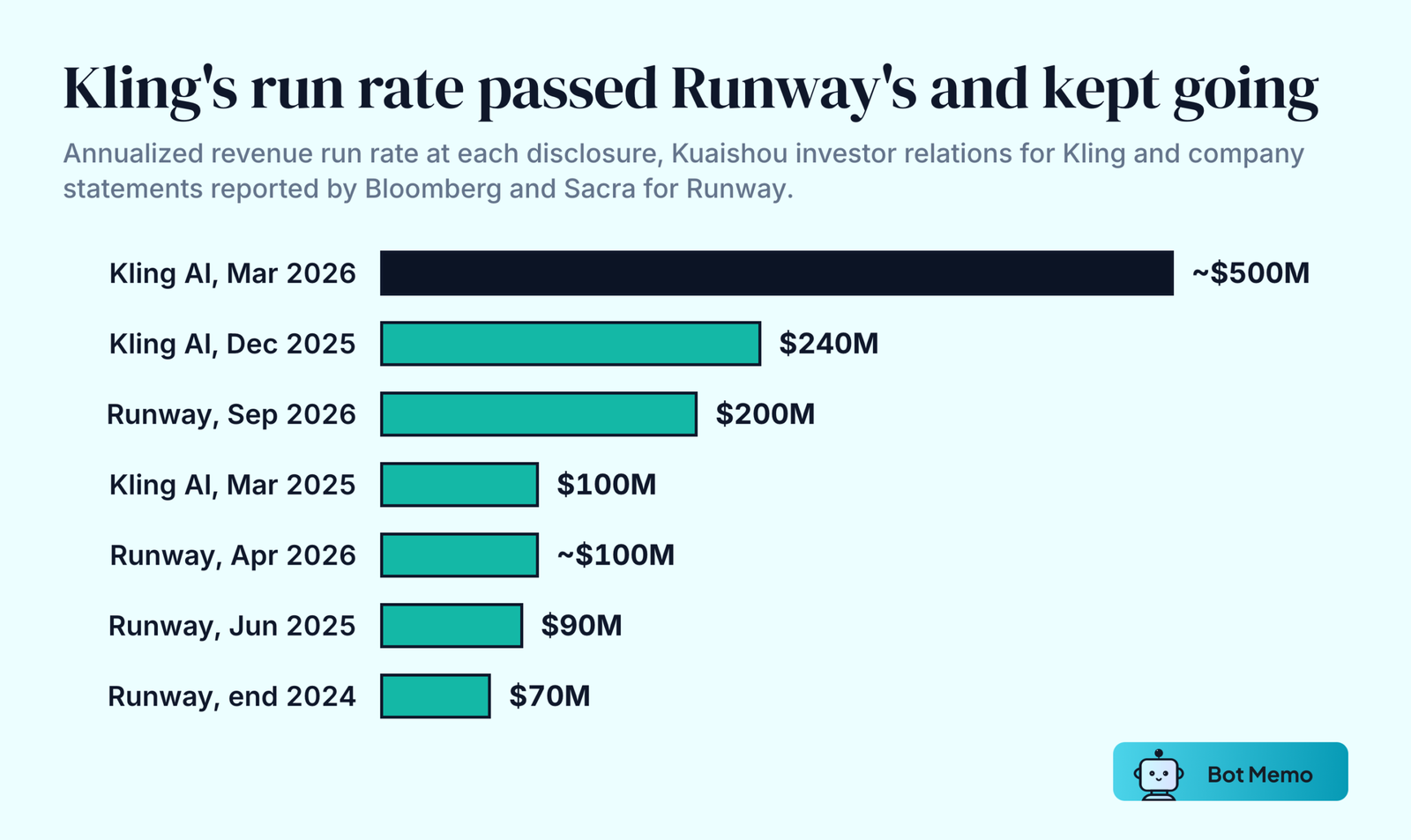
One caution on comparing these companies. Runway’s $200 million is annual recurring revenue. Kling’s $500 million is an annualized run rate taken from a single month of March 2026, and Kuaishou did not restate it at the second quarter. The two Kling figures roughly reconcile. Second-quarter revenue of 850 million yuan annualizes to 3.4 billion yuan, or about $470 million, a little under the $500 million March run rate. That is what you would expect, because the March figure scales up a single peak month while the quarterly figure averages three. Neither is directly comparable to Runway’s recurring revenue base.
What A Second Of AI Video Costs
Published API rates are the one cost figure in this category that can be checked directly.
47. Runway charges $0.05 per second for gen4_turbo and $0.12 per second for gen4.5, billed in credits at one cent each. (Runway, 2026)
48. Google prices Veo by model rather than by resolution, all rates covering video with synchronized audio. Veo 3.1 and Veo 3 both run $0.40 per second, the Fast tier of each runs $0.10, and Veo 3.1 Lite runs $0.05. (Google Cloud, 2026)
49. Luma’s Ray3.2 runs from about $0.03 per second at 540p to $0.24 at 1080p, with high dynamic range output priced at double the standard rate. (Luma AI, 2026)
50. OpenAI listed Sora 2 at $0.10 per second at 720p and Sora 2 Pro from $0.30 to $0.70 depending on resolution, with a 50% batch discount. That rate card retires with the API on 24 September 2026. (OpenAI, 2026)
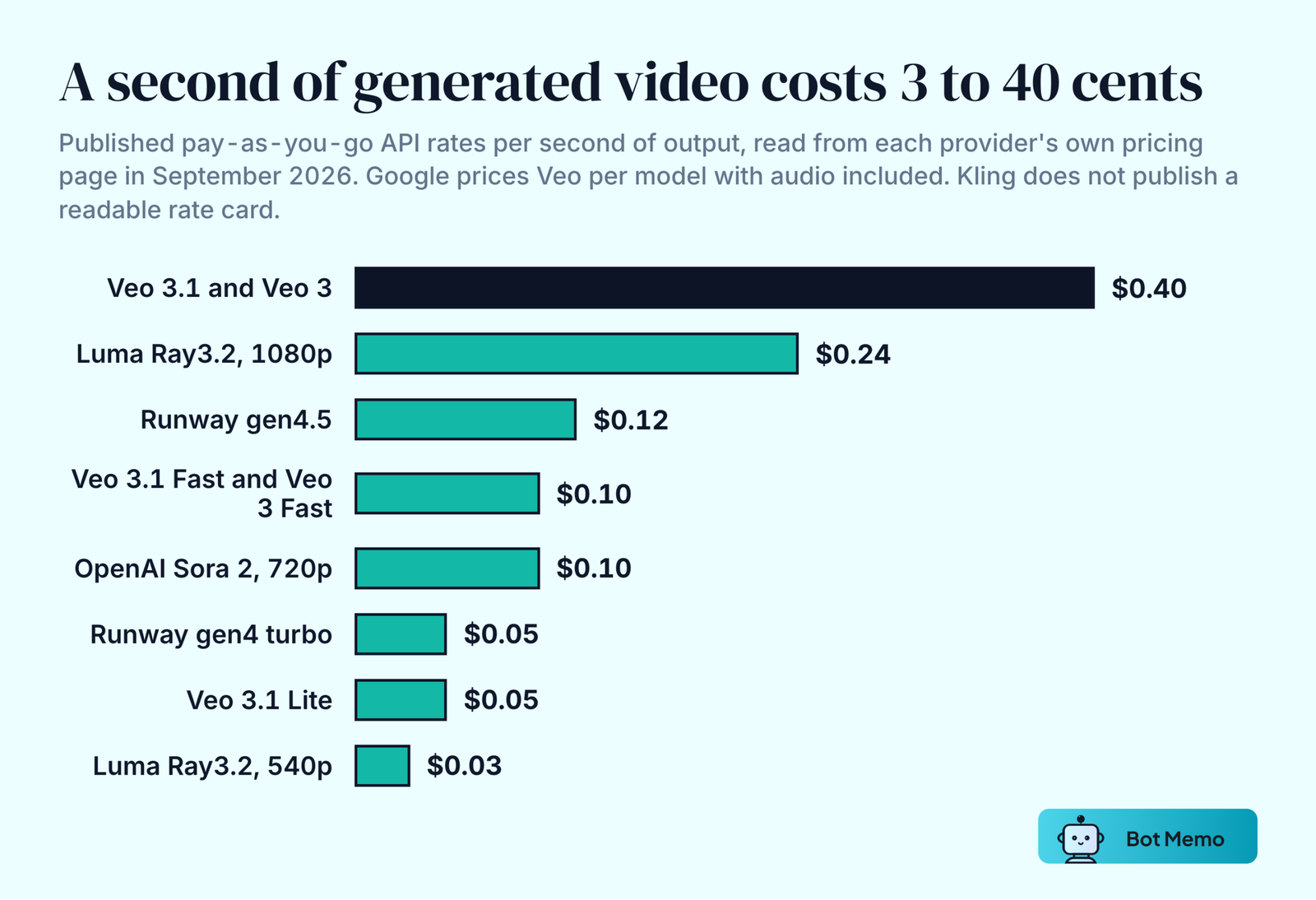
A minute of finished video at the cheapest tier costs about $1.80. At Veo 3.1’s full rate it costs $24. Those numbers explain both the enterprise adoption and Sora’s economics.
One figure this page will not give you is a percentage saving against traditional production. Every version of that claim traces back to a video tool vendor’s own marketing, with no independent methodology behind it.
AI Video In Marketing, Advertising And Training
Generative AI Creative Went From A Fifth To A Third
Ad buyers give the cleanest adoption signal in this category, because they report on budgets rather than enthusiasm.
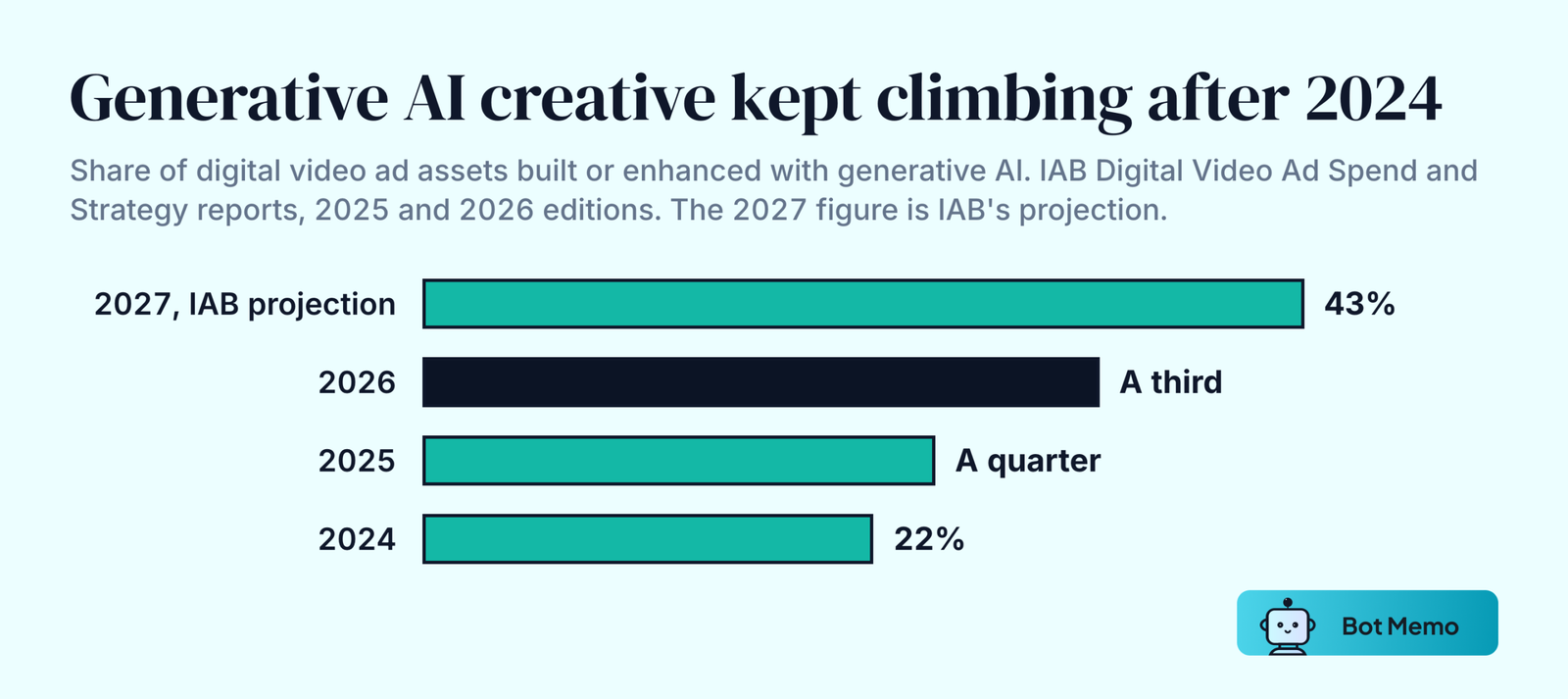
51. IAB’s 2025 report found 22% of video ad creative was built or enhanced with generative AI in 2024, and projected the share would reach 39% to 40% by 2026. (IAB, 2025)
52. That same report found 86% of digital video ad buyers either used or planned to use generative AI for video ad creative. (IAB via PR Newswire, 2025)
53. IAB’s 2026 edition, published 14 July 2026, reports that one third of buyers’ ad assets will use generative AI this year, up from one fourth in 2025, with 43% projected by 2027. (IAB, July 2026)
54. Nearly two in three buyers now use generative AI for digital video creative, up from half in 2025. (IAB, July 2026)
The 2025 projection called for 39% to 40% of creative by 2026. The actual came in at a third. Adoption is real and it is running slightly behind the forecast.
55. Buyers want humans in the loop: 40% overall say so, rising to 50% among small and medium spenders. (IAB, July 2026)
56. Among smaller buyers, 96% are not satisfied with their current level of generative AI use for creative ad production. High adoption and low satisfaction are coexisting. (IAB, July 2026)
57. US digital video ad spend passes $80 billion in 2026, growing nearly 20% faster than the total ad market on 11% year-on-year growth. (IAB, 2026)
What Video Marketers Report Using
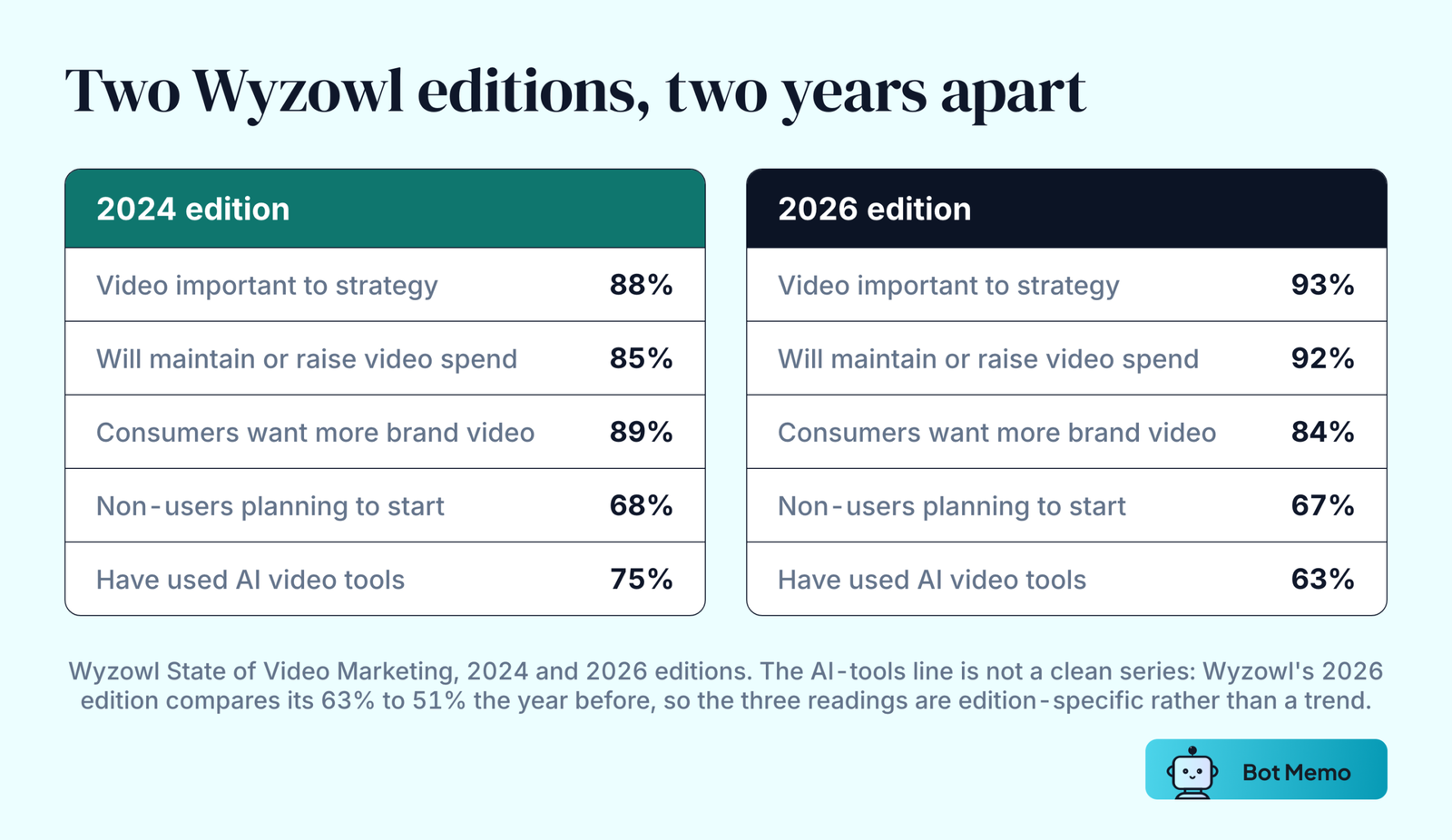
Wyzowl has run the same survey for twelve years, which makes its editions the best available before-and-after on marketer behaviour.
58. 93% of video marketers see video as an important part of their overall strategy, up from 88% in the 2024 edition. (Wyzowl, 2024 and 2026)
59. 92% plan to spend the same or more on video marketing in 2026, up from 85% for 2024. (Wyzowl, 2024 and 2026)
60. 84% of consumers want to see more video from brands in 2026, down from 89% in the 2024 edition. (Wyzowl, 2024 and 2026)
61. 67% of marketers who do not use video plan to start in 2026, against 68% for 2024. (Wyzowl, 2024 and 2026)
62. 63% say they have used AI video tools to create or edit marketing videos, against 75% in the 2024 edition. Wyzowl compares its own 63% to 51% the year before, so the three readings do not form a clean series and each one belongs to its edition. (Wyzowl, 2024 and 2026)
63. 82% of video marketers say video has given them a good return, down from an all-time high of 93%. 91% of businesses use video at all. (Wyzowl, 2026)
A 2024 survey of video marketers adds the attitude data that later editions did not re-ask.
64. 24% of businesses were already working on AI-generated videos, and 71% planned to use them a lot more. (Broadcast 2 World, 2024)
65. 90% of businesses felt handcrafted videos had an edge over AI video productions, and 50% preferred to pay under $500 per video. (Broadcast 2 World, 2024)
Training Video Is Where AI Video Reports Clear Outcomes
66. 68% of respondents saw a positive impact on learning satisfaction scores from using AI video in training courses. (Synthesia, 2024)
67. 57% saw a positive impact on course completion rates, and 60% on average time to completion. (Synthesia, 2024)
68. Synthesia now offers more than 240 ready-to-use AI avatars across more than 160 languages, up from the 160-plus avatars it listed in 2024. (Synthesia, 2024 and 2026)
Copyright, Licensing And Regulation
Two Major Labels Settled, Sony Escalated
69. Universal Music Group settled its AI copyright suit against Udio on 29 October 2025 and signed licensing agreements covering recorded music and publishing, with a jointly built artist opt-in service planned. (The Hollywood Reporter, October 2025)
70. Warner Music Group settled on 19 November 2025 and signed its own licensing deal. (TechCrunch, November 2025)
71. Sony Music is the last major without a deal. After a judge barred it from adding recordings to its original case in June 2026, Sony filed a second suit in July 2026 covering 30,117 sound recordings, with a claim reported around $4.5 billion. (Variety, July 2026)
Disney Signed The Biggest Licensing Deal, Then Walked Away
72. On 11 December 2025 Disney and OpenAI announced a $1 billion equity investment with warrants and a three-year licence giving Sora access to more than 200 characters across Disney, Marvel, Pixar and Star Wars. Talent likenesses and voices were excluded. (OpenAI, December 2025)
73. That investment never closed. It was announced subject to definitive agreements, and when OpenAI shut Sora down in March 2026 Disney dropped both the stake and the licence. No money changed hands. (Variety, March 2026)
The largest character-licensing agreement in generative video lasted about fifteen weeks between announcement and collapse.
Hollywood Sued MiniMax, And New Rules Took Effect
74. On 16 September 2025 Disney, Warner Bros. Discovery and NBCUniversal sued the Chinese AI company MiniMax in the US District Court for the Central District of California over its Hailuo AI video and image generation. (Variety, September 2025)
75. A federal judge denied MiniMax’s motion to dismiss on 22 May 2026. No settlement has been announced. (Variety, 2026)
US model operators keep moving toward licensing while overseas operators face court.
76. Under the TAKE IT DOWN Act, covered platforms had until 19 May 2026 to provide a removal-request path for non-consensual intimate imagery and to remove reported content, including known identical copies, within 48 hours. The FTC sent warning letters to 15 platforms ahead of the deadline, and civil penalties run to $53,088 per violation. (Federal Trade Commission, May 2026)
77. From 2 August 2026, Article 50 of the EU AI Act requires providers of systems generating synthetic video to mark outputs in a machine-readable format so they are detectable as artificially generated, and requires deployers of deepfakes to disclose their artificial origin. (European Commission, 2026)
Content Quality, Detection And Video Analysis
A Fifth Of A New YouTube Feed Is AI-Generated
78. Sampling the first 500 videos shown to a brand-new YouTube account, 104 of them, or 21%, were AI-generated. The data was collected in October 2025 and published that December. (Kapwing, December 2025)
79. In the same sample, 165 videos, or 33%, were classified as low-quality “brain rot” content. (Kapwing, December 2025)
80. TikTok added a slider in November 2025 letting users tilt their For You feed away from AI content, using C2PA content credentials and invisible watermarking. It reduces AI content rather than removing it. (Social Media Today, November 2025)
81. YouTube’s synthetic content disclosure policy, introduced in March 2024, reached full three-tier enforcement covering proactive labelling, removal and Partner Programme suspension by January 2026. (Social Media Today, 2026)
People Cannot Reliably Tell AI Video From Real Video
82. Across 1,276 participants tested on synthetic images, video, audio and audiovisual stimuli, accuracy on video alone was 50.7%, against 50% for a coin toss. The mean across all modalities was 51.2%. (Communications of the ACM, 2025)
83. A 2026 benchmark using seven video generators released in late 2025 and early 2026 found humans identified AI-generated public-speaking videos 52.6% of the time, while the best automated detector reached 69.7% AUROC. (arXiv, 2026)
84. A meta-analysis pooling 56 papers and 86,155 participants put overall human accuracy at 55.54%, and 57.31% for video specifically. The 95% confidence intervals crossed 50%, so the result cannot be separated from chance. (Computers in Human Behavior Reports, 2024)
85. The literature is not unanimous. A University of Florida study published in January 2026 found the opposite split: participants were correct about two thirds of the time on deepfake videos while performing at chance on still images, and a convolutional network showed the reverse, at 97% on images and chance on video. (University of Florida, 2026)
The honest reading is that human detection sits somewhere between chance and modestly better than chance, depending on what is shown and how. No study supports the idea that people can reliably spot generated video.
The Other Half Of AI Video Is Reading It, Not Making It
86. You Only Look Once, published at CVPR 2016, is a real-time object detector fast enough to run on a webcam feed, built to mimic how human vision instantly identifies objects and their relationships. It generalises well to new domains. (Redmon et al., CVPR, 2016)
87. Object classification in security cameras is used to detect hazardous or suspicious objects. (Viso.ai, 2026)
88. Google analysed 8,000 campaigns from top advertisers running on YouTube with a custom model, finding connections between unrelated videos across Brazil, France, Germany, India, Japan, Korea, the UK and the US, and that advertising increasingly celebrates self-expression and individuality. (Think with Google, 2024)
89. The same analysis found brands using storytelling to convey shared experiences and human connection, a shift toward community-focused advertising after the isolating years of the pandemic. (Think with Google, 2024)
90. People are more likely to trust a brand when a familiar creator is using it. In one Lululemon campaign featuring the YouTuber Casey Neistat, the comments indicate Neistat improved viewers’ perception of the product. (Think with Google, 2024)
The Research That Made Generated Video Possible
91. Text-To-4D Dynamic Scene Generation, known as MAV3D or Make-A-Video3D, generates three-dimensional dynamic scenes from text descriptions. (Meta AI, arXiv, 2023)
92. VideoPoet is a large language model for zero-shot video generation, synthesising video from images, video, text and audio, and extending a one-second clip to ten seconds. (Google Research, arXiv, 2023)
93. AnimateAnything animates static images with fine-grained motion area and motion strength guidance. (Alibaba Group, arXiv, 2023)
94. Dreamix showed that video diffusion models, usually associated with image generation, work as general video editors, editing a clip to match a prompt describing the result. (Google Research and Hebrew University, arXiv, 2023)
95. Looking further out, AI is expected to build more immersive experiences for audiences by generating hyper-realistic virtual environments, though the flaws in generated video were already well documented by 2024. (The Washington Post, 2024)
Deepfakes remain a genuine risk, which is what the 2026 rules above are built to address.
Key Takeaways
- The consumer app thesis failed its first big test. Sora launched faster than ChatGPT and shut down inside seven months, on roughly $1 million a day of cost against $2.1 million of lifetime consumer revenue.
- Enterprise revenue is the whole story. Runway reached $200 million of annual recurring revenue and reports net revenue retention above 300%. Kling’s first-quarter revenue grew more than 300% year on year to over 650 million yuan.
- The capital moved to China. Kling raised about $2.8 billion at $18 billion in July 2026, within $280 million of the entire 2025 global funding total for AI video startups.
- Growth and profit are different questions. Kling grew revenue more than 300% year on year while losing 1.9 billion yuan in 2025 on computing costs.
- Advertiser adoption is real and slightly behind forecast. A third of video ad assets use generative AI in 2026, against a projection of 39% to 40% made a year earlier.
- Licensing replaced litigation, except where it did not. Two major labels settled with Udio, Sony filed a second suit over 30,117 recordings, and Disney’s billion-dollar deal collapsed before closing.
- Nobody can spot AI video reliably. Human accuracy on video sits between 50.7% and 57.31% across the main studies, and the largest meta-analysis cannot separate it from chance.
Frequently Asked Questions
How Big Is The AI Video Market In 2026?
It depends which market. Grand View Research sizes the broad AI video market at $5.5 billion in 2026, growing to $42.3 billion by 2033. The narrower AI video generator market is much smaller: $788.5 million in 2025 per the same firm, or $847 million in 2026 per Fortune Business Insights. Company revenue is a firmer number. Kling reported 1.5 billion yuan of revenue in the first half of 2026 and Runway reached $200 million of annual recurring revenue in September 2026.
How Many People Use AI Video Generators?
Kling reported more than 60 million creators and over 600 million videos generated as of December 2025, alongside more than 30,000 enterprise users. Luma’s Dream Machine is widely reported in the 25 to 30 million range without a dated company figure. OpenAI’s Sora reached 9.6 million cumulative app downloads before it was discontinued.
Is Sora Still Available?
No. OpenAI announced the discontinuation on 24 March 2026. The Sora app and web experience closed on 26 April 2026, and the API retires on 24 September 2026. Reported operating costs of about $1 million a day against $2.1 million of lifetime in-app purchase revenue, alongside a user base that fell from roughly 1 million to under 500,000, drove the decision.
What Is Kling AI’s Revenue?
Kling’s annualized run rate reached approximately $500 million in March 2026, up from $240 million in December 2025 and $100 million in March 2025. Reported quarterly revenue was over 650 million yuan in the first quarter of 2026 and over 850 million yuan in the second, taking first-half revenue to 1.5 billion yuan. Full-year 2025 revenue was 1.04 billion yuan, about $150 million.
How Much Does AI Video Generation Cost?
Published API rates run from about $0.03 per second for Luma’s Ray3.2 at 540p and $0.05 for Runway’s gen4_turbo and Veo 3.1 Lite, up to $0.40 per second for Veo 3.1 and Veo 3 on Vertex AI. A finished minute therefore costs roughly $1.80 at the cheapest tier and $24 at the most expensive. No independent study compares that to traditional production cost; the percentage savings quoted around the web come from video tool vendors’ own marketing.
What Percentage Of Videos Are AI-Generated?
In a sample of the first 500 videos served to a new YouTube account, 21% were AI-generated and 33% were classified as low-quality “brain rot” content. That data was collected in October 2025. There is no reliable platform-wide figure, because detection at scale remains unsolved.
Can People Tell AI Video From Real Video?
Barely. A study of 1,276 participants found 50.7% accuracy on video, against 50% for chance. A 2026 benchmark on the newest generators found 52.6%, with the best automated detector at 69.7% AUROC. A meta-analysis of 56 papers put overall accuracy at 55.54% and video accuracy at 57.31%, with confidence intervals that cross chance in both cases. One University of Florida study found humans doing better on video than on still images, so the literature is not unanimous, but no study shows reliable human detection.
What Share Of Video Ads Use AI?
One third of digital video ad assets will use generative AI in 2026, up from one fourth in 2025 and 22% in 2024, with 43% projected for 2027. Nearly two in three ad buyers now use generative AI for video creative, up from half in 2025.
How Much Has Been Invested In AI Video Startups?
Global funding reached $3.08 billion in 2025, up 94.6% from $1.58 billion in 2024. In 2026 a single round changed the scale. Kling raised about $2.8 billion at an $18 billion valuation in July. Runway raised $315 million at $5.3 billion in February 2026, and Luma raised $900 million at about $4 billion in November 2025. For the largest individual AI rounds of the year so far, see our top AI funding rounds of Q1 2026.
Sources And Methodology
Every figure here was read at the source that published it, and each one is dated because this category turns over fast. Market forecasts, annualized run rates, recognised revenue, downloads and users are kept separate throughout, because conflating them is how AI video numbers go wrong.
Currency: yuan figures are given in yuan with the US dollar conversion each publisher used. Kling’s 2025 revenue of 1.04 billion yuan is reported at roughly $150 million, the conversion in the original coverage.
Retired from the previous version of this page, each with a reason.
- “Sora is still unreleased to the public as of August 2024,” and the claim it generates videos up to a minute long. Sora 2 launched publicly on 30 September 2025 and was discontinued in 2026. The whole arc replaces the 2024 snapshot.
- “Video content was forecast to account for 82% of all internet traffic by 2022,” credited to the Cisco Visual Networking Index, 2018. Cisco discontinued the VNI programme. This was a 2018 forecast about 2022, made by a series that no longer publishes. There is no clean successor figure, so no replacement percentage is offered rather than inventing one.
- Five claims about AI replacing voice-over actors, credited to a voiceover blog. The source is a voiceover coaching company’s promotional post with no data behind any of the five claims. Removed rather than restated.
- A “49% time efficiency, 40% cost efficiency, 27% expanded content capacity” breakdown of generative AI return, credited to McKinsey’s State of AI. That breakdown does not appear in the report or in any coverage of it. Cut rather than re-attributed.
- Product descriptions of Lumen5 and Muse.ai as top AI video generators. Both companies still operate, but neither publishes usage or revenue figures, so they added no data to a statistics page. The named platforms in this version are the ones that disclose numbers.
- Coca-Cola’s 2023 partnership with OpenAI and a Synthesia case study, both credited to a market research report. Company anecdotes from 2023 carry no measurement.
Corrected rather than dropped.
- The CVPR 2016 paper is titled You Only Look Once, not “You Look Only Once”. The previous version had the words transposed.
- Grand View Research’s AI video generator forecast has been rebased since this page first cited it. The 19.9% compound rate for 2024 to 2030 is now 20.3% for 2026 to 2033, and both editions are shown.
- Wyzowl’s AI-tools figure is not a trend line. The 2024 edition read 75% and the 2026 edition reads 63%, with Wyzowl itself comparing that 63% to 51% the year before. All three readings are shown as edition-specific.
- Runway’s “$300 million in revenue” was an equity research forecast of annualized revenue by the end of 2025, not reported revenue. The company did not pass $200 million until September 2026.
- A widely repeated “150,000 paying users” figure for Runway is not in the research note it is usually credited to, and traces to no primary source. Removed.
- Disney did not invest $1 billion in OpenAI. The investment was announced subject to closing conditions in December 2025 and dropped in March 2026 without money changing hands.
- Veo 3 launched at 720p in May 2025. The 4K capability it is often described as launching with arrived in January 2026.
- Runway’s Gen-4.5 launched on 1 December 2025, not in mid-2025.
- Sora’s Android app launched 35 days after iOS, not two months.
- The Kapwing sample was collected in October 2025 and published that December, so it describes an October 2025 feed.
- Wyzowl’s 2024 edition reported that 89% of consumers wanted more video from brands. This page previously printed 88%. The archived 2024 edition says 89%, so the comparison now uses that.
- Luma’s Series C announcement does not disclose a valuation, and AWS appears in it as a customer rather than an investor. The roughly $4 billion figure comes from press coverage, and the named investors are HUMAIN, AMD Ventures, Andreessen Horowitz, Amplify Partners and Matrix Partners.
- Google prices Veo per model with audio included, not per resolution. An earlier pass mixed rates from different tiers; the figures here are one like-for-like rate per model, read off the live table.
- Kling’s $18 billion valuation, the $20 billion target set in April and the Hong Kong listing plan are reported by the South China Morning Post. Caixin’s own reporting covers the $15 billion pre-money figure, the stake sold and the investor list.
- Think with Google moved. The analysis of 8,000 YouTube campaigns now sits on business.google.com, and the old thinkwithgoogle.com address redirects there. The link points at the live destination.
Claims excluded for lack of a primary source. The “840% AI video growth” figure common on vendor blogs traces to no verifiable dataset. A widely repeated claim that Kling passed 100 million users across 224 countries does not appear in the Kuaishou results release it is usually credited to, so it is left out. A widely repeated “100 million videos in 90 days” milestone for Google Flow is attributed to Google in August 2025 but does not appear on any Google page that can be read directly, so only the 275 million figure Google publishes itself is used. Percentage cost savings against traditional video production trace only to video tool vendors’ own marketing. Kling’s per-second API price is not published in a form that can be read directly, so it is left out of the pricing comparison rather than estimated.
Two sources here cannot be opened without a subscription or an account. Sora’s operating cost, lifetime revenue and user decline were reported by The Wall Street Journal, and IAB’s full reports sit behind a login, so the IAB figures are taken from the association’s own published newsroom summaries. Both are named in the text rather than routed through an aggregator that restates them.
Limitations. Private company revenue depends on voluntary disclosure. Download and monthly-active-user counts come from third-party app analytics that can differ from operator figures. Cumulative video generation counts are operator self-reported and independently unverified. Market forecasts are vendor estimates built on differing definitions and are treated here as context, not measurement.

About the author
Editorial Staff
The Editorial Staff at Bot Memo is a team of writers, analysts, and AI agents dedicated to mapping the global AI startup ecosystem. Led by Chintan Zalani, the team tracks thousands of funding rounds, classifies companies across verticals, and distills it all into actionable intelligence for investors and founders.