

Netflix told shareholders in July 2026 that generative AI workflows had been used in roughly 300 of its titles so far that year, with the heaviest concentration in post-production. It is the first title count on AI use in production that a listed company has put its name to.
Most AI filmmaking research still runs on vendor projections and executive opinion. The measured numbers point somewhere else: California has shed roughly 114,000 creative economy jobs since late 2022, and the report tracking that decline attributes it to something other than AI. The 152 figures below are numbered so they can be cited directly.
On this page
- AI Adoption in Film Production
- AI Video Tools: Usage, Specs and Shutdowns
- AI Filmmaking Market Size and Funding Statistics
- The Rules Productions Have to Follow
- Copyright, AI-Made Films and the Studio Lawsuits
- AI and Film Industry Jobs
- What Audiences and Filmmakers Think About AI in Film
- Key Takeaways
- Frequently Asked Questions
- Sources and Methodology
AI Adoption in Film Production
The adoption of artificial intelligence in film production used to be measured by asking executives what they planned to do. Since July 2025 there has been a firmer source: a listed streaming platform stating in its own filings which titles used the technology, and for what.
How Many Titles Use Generative AI Workflows
-
Generative AI workflows were used in roughly 300 Netflix titles in 2026, with the largest concentration of work in post-production. (Netflix Q2 2026 Shareholder Letter, 16 July 2026)
-
Netflix named three of them: Glory (India), Brasil 70: A Saga do Tri (Brazil) and The American Experiment (US), which used generative tools for enhanced crowds, historical battle sequences and worldbuilding establishing shots. (Netflix Q2 2026 Shareholder Letter)
-
The same letter reports Q2 2026 revenue of $12.6 billion, up 13% year over year at a 33% operating margin, with full-year guidance of $51.0 billion to $51.4 billion. (Netflix Q2 2026 Shareholder Letter)
-
Netflix does not define what counts as a generative AI workflow or what share of a title’s work it covers, and “roughly 300” is the count as of the July letter, not a full-year total. (Netflix Q2 2026 Shareholder Letter)
The First Generative AI Footage to Reach Screen
-
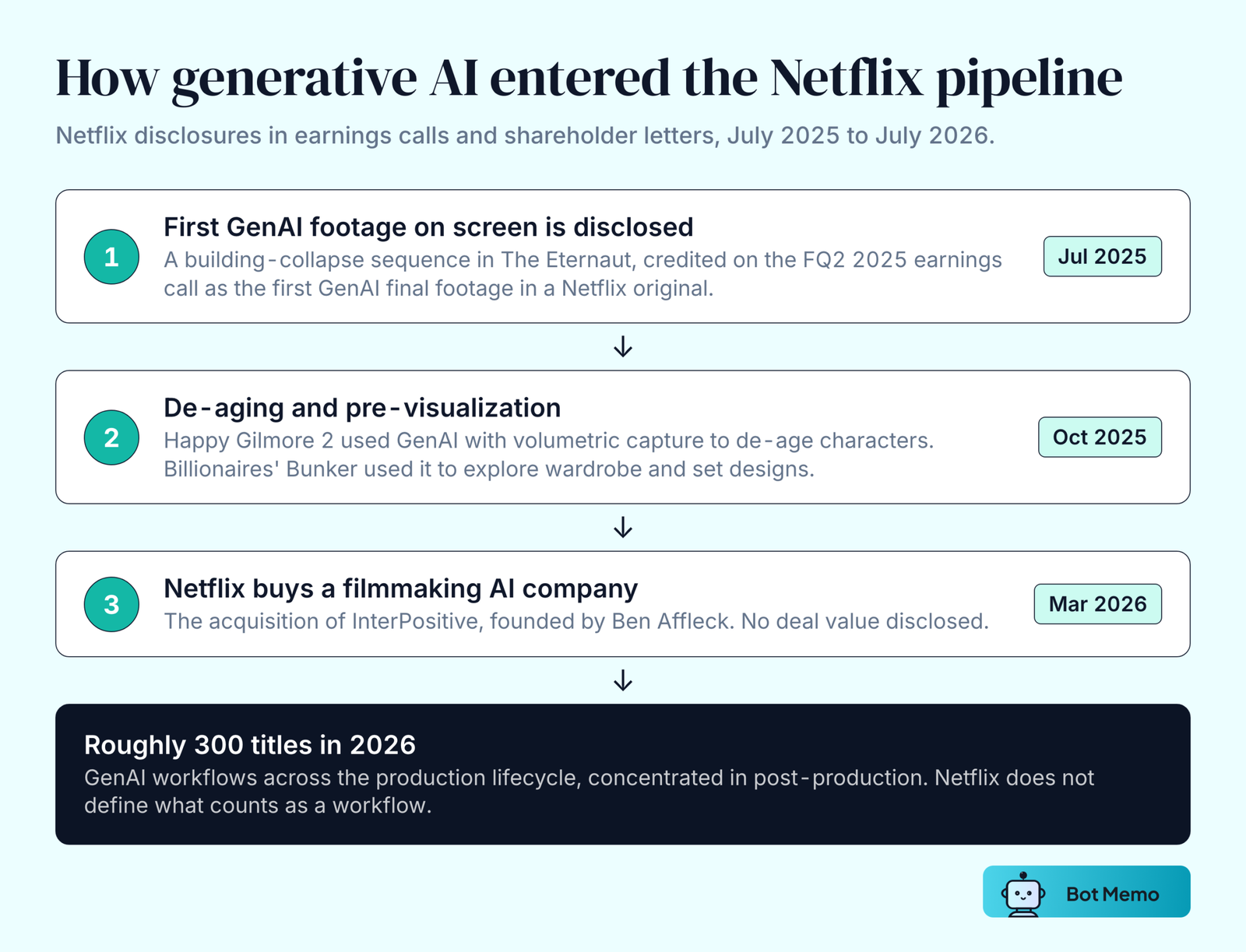
The building-collapse sequence in the Argentine series The Eternaut was “the very first GenAI final footage to appear on screen in a Netflix original series or film,” according to co-CEO Ted Sarandos. (Netflix FQ2 2025 Earnings Call Transcript, 17 July 2025)
-
Sarandos said that sequence “was completed 10x faster than it could have been completed with” traditional VFX tools and workflows. The figure is his characterization on an earnings call, not a measured benchmark. He added that the cost of the sequence “just wouldn’t have been feasible for a show on that budget.” (Netflix FQ2 2025 Earnings Call Transcript)
-
Filmmakers on Happy Gilmore 2 used generative AI with machine learning and Eyeline’s volumetric capture to de-age characters during the opening flashback. Producers of Billionaires’ Bunker used generative tools in pre-production to explore wardrobe and set designs. (Netflix Q3 2025 Shareholder Letter, 21 October 2025)
-
Netflix announced the acquisition of InterPositive, the filmmaking technology company founded by Ben Affleck, in March 2026. No deal value was disclosed. (Netflix Q1 2026 Shareholder Letter, 16 April 2026)
Where AI Sits in the Production Process
-
The use cases media analyst Doug Shapiro lists for generative AI in Hollywood are story development, storyboarding and animatics, pre-visualization, B-roll, editing, visual effects and localization services. (Doug Shapiro, 18 September 2023)
-
Comments to the US Copyright Office listed de-aging, color correction, detail sharpening, de-blurring, crowd removal, video stabilization and rotoscoping as assistive AI uses. The footnote collecting them draws on the Motion Picture Association for colour correction, detail sharpening, de-blurring and rotoscoping, and on a separate commenter for crowd removal and video stabilization. (Copyright and Artificial Intelligence, Part 2, footnote 63, page 11, 29 January 2025)
-
On Everything Everywhere All at Once, VFX artist Evan Halleck used Runway’s green screen background-removal tool on the rock universe scene. Background removal is rotoscoping work, and Halleck described rotoscoping in the same piece as “a very slow and painful process.” (22 February 2023)
-
The film’s VFX team was eight people, and the 300-shot multiverse sequence was made by hand without the tool. (22 February 2023)
AI Video Tools: Usage, Specs and Shutdowns
Vendor pages are dependable for specs, dates and company-stated usage, and worthless for competitive claims. What follows is what these companies publish about their own production workflows, with the superiority claims left out.
How Much Video These Tools Generate
-
Google reported “over 275 million videos generated in Flow” five months after launching its AI filmmaking tool. (Google, 15 October 2025)
-
Google’s newest cumulative Flow figure is “over 1.5 billion images and videos” created since launch. It counts images alongside videos, so it does not supersede the 275 million video count on like-for-like terms. (Google, February 2026)
-
In the seven weeks after Veo 3 launched, “over 40 million Veo 3 videos” were generated across the Gemini app and Flow. (Google, 10 July 2025)
-
Flow is available in “140+ countries around the world with a Google AI Pro or Ultra plan.” (Google, 10 July 2025)
-
SynthID had watermarked “over 10 billion images, videos, audio files and texts” as of May 2025. That total covers all Google generative media, not video alone. (Google I/O 2025, 20 May 2025) A year later the same disclosure reads “over 100 billion images and videos and 60,000 years of audio.” (Google, 19 May 2026)
-
Google adds a visible watermark to Veo 3 videos “except for videos generated by Ultra members in Flow.” The top paid filmmaking tier is exempt from visible watermarking, though invisible SynthID still applies. (Google, 30 May 2025)
-
Adobe reported Firefly had been “used to generate over 18 billion assets globally” in under two years. That total covers images and vectors as well as video. (Adobe, 12 February 2025) Four months later the count was “more than 24 billion assets.” (Adobe, 17 June 2025)
OpenAI Sora’s Two-Stage Shutdown
-
The Sora consumer app and website shut down on 26 April 2026. (OpenAI Help Center)
-
The Sora API is scheduled to be discontinued on 24 September 2026. (OpenAI Help Center)
-
At general availability in December 2024, Sora generated video “up to 1080p resolution, up to 20 sec long, and in widescreen, vertical or square aspect ratios.” (OpenAI, 9 December 2024)
-
OpenAI’s early-access program logged feedback “across 500,000+ model requests from 300+ users from 60+ countries.” That was a pre-launch alpha, not an adoption figure. (Sora System Card)
-
All Sora output carried C2PA metadata, but paying users could download files without the visible watermark from launch. (Sora System Card)
AI Tools Built for Post-Production
The attention goes to text-to-video, but the automation that has actually reached professional pipelines sits further downstream, in editing, cleanup, grading and localization.
-
Runway’s Aleph is described by the company as “a state-of-the-art in-context video model” able to perform “a wide range of edits on an input video such as adding, removing, and transforming objects, generating any angle of a scene, and modifying style and lighting.” Object removal and angle generation are post-production tasks, not text-to-video generation. (Runway, 25 July 2025)
-
Runway’s Ruby is a native color grading model that converts SDR video into HDR, available in Tool Mode, Workflows and Runway Dev. Color grading and finishing are the newest part of the pipeline these tools have reached. (Runway changelog, 20 August 2026)
-
Luma claims Ray3 is “the first model to produce video in true 10-, 12-, and 16-bit High Dynamic Range (HDR) ACES2065-1 EXR format, making it suitable for high-end film and advertising pipelines.” The “first” is the company’s own claim; the format is the point, because ACES2065-1 EXR is what professional finishing pipelines already accept. (Luma, 18 September 2025)
-
Veo 3.1 Lite runs at “less than 50% of the cost of Veo 3.1 Fast, but with the same speed,” in 720p and 1080p, with duration set at 4, 6 or 8 seconds. Production costs are now a stated product axis rather than a side effect. (Google, 31 March 2026)
-
Veo 3.1’s “Extend” builds videos “even lasting for a minute or more” by generating each new clip from the final second of the previous one. That is a stitching feature, not a single-generation clip length. (Google, 15 October 2025)
-
ElevenLabs lists AI-powered dubbing in 32 languages among its products. Localization is where AI audio touches film most directly. (ElevenLabs, 30 January 2025)
Commercially Safe Training Claims
-
Moonvalley calls Marey “the world’s first commercially safe video model,” trained “only on licensed, high-resolution footage.” The company offers no third-party audit of the claim on that page. (Moonvalley)
-
Adobe makes a competing first claim, calling Firefly Video “the only generative AI video model that is IP-friendly and commercially safe.” (Adobe, 12 February 2025)
-
Adobe states Firefly “is only trained on content that Adobe has permission to use,” meaning licensed Adobe Stock and public domain content, never customer content. (Adobe, 12 February 2025)
-
Adobe Firefly now also carries Luma’s Ray3, a frontier model trained outside Adobe’s own licensing rule. Luma named Adobe “the first partner to launch Ray3 outside of Dream Machine.” (Luma, 18 September 2025)
AI Filmmaking Market Size and Funding Statistics
Market forecasts for AI in film are thin and they age badly. Funding figures are firmer, because companies announce their own rounds and those announcements are dated.
The Generative AI in Movies Market Forecast
-
The global generative AI in movies market is forecast to reach $4,490.7 million by 2033 at a 28.2% compound annual growth rate (CAGR). (Dimension Market Research, April 2024)
-
The same forecast puts the 2024 base value at $481.0 million. (Dimension Market Research, April 2024)
-
North America is expected to hold about 46.8% of that market in 2024. The share is a single-year estimate, not a forecast-period average. (Dimension Market Research, April 2024)
-
Cloud-based deployment is projected to command the largest revenue share in 2024. (Dimension Market Research, April 2024)
-
Content generation is expected to lead as the top use case across the forecast period. (Dimension Market Research, April 2024)
-
That page has not been updated since April 2024, and it contradicts itself on the forecast window three ways, heading the forecast 2024 to 2033, saying 2025 to 2033 in its key takeaways, and labelling the same 28.2% as a 2023 to 2032 CAGR in its summary table. Treat it as a dated vendor projection. (Dimension Market Research, April 2024)
What AI Video Companies Have Raised
-
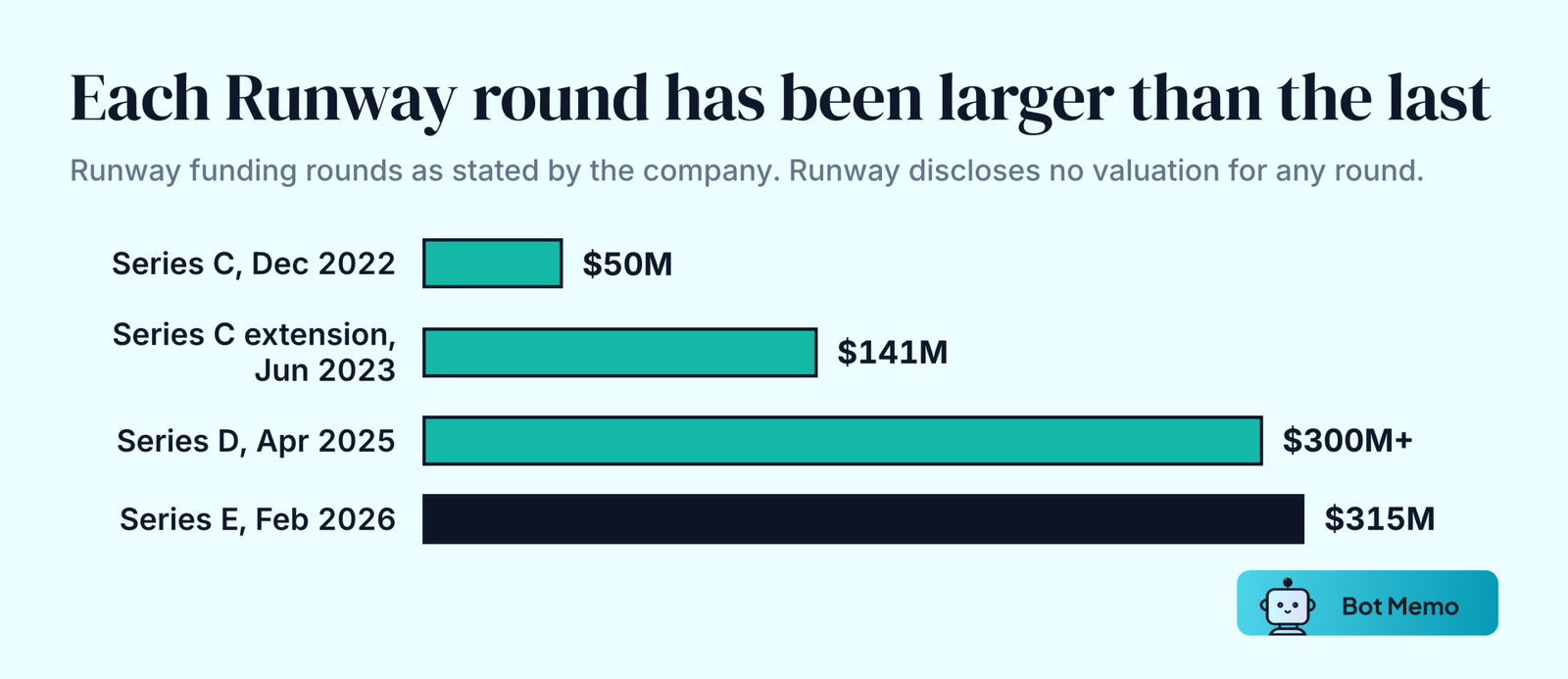
Runway closed a $50 million Series C led by Felicis in December 2022. (Runway)
-
Runway added a $141 million Series C extension in June 2023 with participation from Google, NVIDIA and Salesforce Ventures. (Runway)
-
Runway raised “over $300M in Series D funding” led by General Atlantic in April 2025. (Runway)
-
Runway announced $315 million in Series E funding led by General Atlantic in February 2026. (Runway)
-
Runway states no valuation for any round. The valuations in circulation come from press reporting, not the company. (Runway)
-
Luma raised a “900M Series-C” in November 2025, partnering with HUMAIN to build a 2GW compute supercluster. Luma states no valuation. (Luma, 19 November 2025)
-
Luma says its team has grown to “over 130 researchers, engineers, designers, artists, and operators.” (Luma, 19 November 2025)
-
Luma describes Dream Machine as powering creation “for over 30 million users,” a company-stated count with no definition of an active user. (Luma, 18 September 2025)
-
Synthesia and ElevenLabs are adjacent to filmmaking rather than in it, supplying enterprise video and localization. Their rounds belong here as AI-video capital formation. Synthesia raised a $200 million Series E at a $4 billion valuation in January 2026. (Synthesia, 26 January 2026)
-
Synthesia passed “over $100 million in annual recurring revenue” in April 2025, alongside a strategic investment from Adobe Ventures. (Synthesia, 15 April 2025)
-
ElevenLabs raised at an $11 billion valuation in February 2026, bringing total funding to $781 million across five rounds. (ElevenLabs, 4 February 2026)
-
ElevenLabs reported crossing $500 million ARR in the first four months of 2026, on a page published 5 May 2026 and last updated 31 August 2026. The company’s own pages give two different 2025 closing-ARR figures, over $330 million on the funding announcement and $350 million here. (ElevenLabs)
For a wider view of where this capital is going, see Bot Memo’s list of the top AI video generation startups and its generative AI market statistics.
Studio Partnerships and Equity Stakes
-
Lionsgate and Runway announced a partnership in September 2024 to train a new AI model on Lionsgate’s proprietary catalog. (Runway, 18 September 2024)
-
The two expanded in June 2026, with Lionsgate taking an equity interest in Runway and both launching a joint development program. The size of the stake was not disclosed. (Runway, 11 June 2026)
-
AMC Networks partnered with Runway in June 2025 to bring its models into marketing and TV development. The scope covers marketing and development, not production, and no deal value was disclosed. (Runway, 4 June 2025)
The Rules Productions Have to Follow
Awards bodies, festivals and unions have written binding text on AI. It frequently says something narrower than the coverage of it, so the wording below is quoted rather than summarised.
Netflix’s Generative Workflow Guidance for Producers
-
Netflix requires prior written approval and legal guidance before key creative elements, defined as main and secondary characters, creature designs, hero props and fictional settings, are developed with generative AI. The guidance sits on the production partner portal, which requires a partner login. (Netflix partner guidance, read 19 September 2026)
-
Final picture and sound elements “require escalation and written approval before delivery.” (Netflix partner guidance)
-
Producers may not use talent likeness or voice, Netflix material, or a third-party rights holder’s work to train or fine-tune a model without clearance. (Netflix partner guidance)
-
The guidance applies globally to owned live action scripted productions only. Documentaries and animated productions need separate guidance. (Netflix partner guidance)
-
Netflix frames its position as “creative support, not creative substitution,” with artists “staying in the creative chair throughout, so the work remains human authored, copyrightable, and the product of deliberate creative decisions.” (Netflix, branded generative AI index page)
Academy Awards Eligibility Rules
-
For the 98th Academy Awards, the Academy of Motion Picture Arts and Sciences approved rules on 21 April 2025 in which Rule Two paragraph 7 states that generative AI and other digital tools “neither help nor harm the chances of achieving a nomination,” and that each branch judges the achievement “taking into account the degree to which a human was at the heart of the creative authorship.” (98th Academy Awards complete rules, page 4)
-
The phrase “Generative Artificial Intelligence” appears exactly once in the entire 98th rulebook, and it is in Rule Two, not Rule Twenty-One. Rule Twenty-One in that rulebook is Production Design. (98th Academy Awards complete rules)
-
The 99th Academy Awards rules, dated 1 May 2026, add a third sentence: the Academy “reserves the right to request more information about the nature of the use and human authorship.” (99th Academy Awards complete rules)
-
New in the 99th rules, Rule Ten paragraph 6 lets the Cinematographers Branch Executive Committee “request the disclosure of any known use of generative AI or other AI tools” in a cinematographer’s submitted work. No equivalent branch-level disclosure provision appears in the 98th rulebook. (99th Academy Awards complete rules)
-
Also new in the 99th rules, Rule Six paragraph 1 requires acting roles to be “demonstrably performed by humans with their consent.” (99th Academy Awards complete rules)
-
Rule Twenty-Four paragraph 2 of the 99th rules requires that “the screenplay must be human-authored.” Neither this nor the acting provision appears in the 98th rules, and both are eligibility conditions rather than judging guidance. (99th Academy Awards complete rules)
Festival Disclosure Rules
-
Sundance requires AI disclosure starting with the 2027 edition. Clause 24 of the submission rules makes it “the sole responsibility of the Applicant to disclose any usage or utilization of Artificial Intelligence,” with non-disclosure grounds for disqualification. (2027 Sundance submission rules, page 5 of 11, June 2026)
-
Sundance imposes no restriction on AI use, only disclosure. (2027 Sundance submissions FAQ, question 12)
-
The 2026 Sundance rules PDF contains no AI clause at all, which dates the disclosure requirement to the 2027 edition. (2026 Sundance submission rules)
-
Tribeca bans generative AI in submission packets for its Love and Laughs program, run with Universal. The 2026 Tribeca Festival entry rules, all 12 pages, contain zero AI language. (Tribeca; 2026 Tribeca Festival rules and regulations)
-
Annecy has the most demanding rule found, and it applies to the Mifa market rather than the festival. Any substantial use of AI “must be stated in your submission,” and significant AI impact triggers a required statement of intent justifying the use artistically, naming the tools, assessing legal issues and anticipating workforce effects. (Mifa Pitches 2026 regulations, page 4, 25 November 2025)
-
Annecy also states that “submissions without original graphic concepts will not be eligible.” (Mifa Pitches 2026 regulations)
-
Cannes has no AI rule. The official English regulations for feature films in Official Selection for both 2025 and 2026, plus the 2026 short film regulations, contain zero occurrences of “artificial”, “intelligence”, “AI”, “generative”, “synthetic” or “algorithm.” (2025 feature film regulations; 2026 feature film regulations; 2026 short film regulations)
What the Rules Say About AI Scriptwriting
-
The Writers Guild of America’s ratified position is that “neither traditional AI (technologies including those used in CGI and VFX) nor generative AI … is a writer, so no written material produced by traditional AI or GAI can be considered literary material.” (WGA, page last updated 18 December 2025)
-
A company “can’t give you an AI-generated screenplay and pay you a rewrite fee.” The writer is treated as the first writer of that screenplay. (WGA)
-
A writer may choose to use AI when performing writing services if the company consents, but “the company can’t require the writer to use AI software (e.g., ChatGPT) when performing writing services.” (WGA)
-
“The Company must disclose to the writer if any materials given to the writer have been generated by AI or incorporate AI-generated material.” (WGA)
The Academy’s 99th rules add a matching eligibility condition at stat 66, which makes human authorship of a screenplay both a contract term and an awards requirement.
What Union Contracts Actually Say
Performer contracts do the work that deepfake legislation has not. They define a digital replica, require consent for one, and price its use.
-
The Animation Guild’s 2024 agreement states that “an AI System (including any Gen AI System) is not a person,” and that an employee’s use of one “shall not affect any of the employee’s rights or entitlements,” including for credit. (IATSE Local 839 Memorandum of Agreement, Article 21.N paragraph 3.b.i)
-
A producer who hands an animation writer Gen AI-produced written material and instructs them to build a synopsis, outline, screenplay or teleplay on it “shall disclose to the animation writer that the written material was Gen AI-produced.” (Local 839 MOA, paragraph 3.b.iv)
-
No employee may be scanned for visual or vocal likeness without consent, the consent must be clear, conspicuous and separately signed, and “the employee’s consent to such scanning may not be a condition of employment.” (Local 839 MOA, paragraph 9, page 20)
-
The same contract removes the union’s ability to block deployment: “the arbitrator shall have no authority to prohibit or restrict the use of any AI System or the resulting outputs under this Agreement.” (Local 839 MOA, paragraph 7, page 20)
-
SAG-AFTRA’s 2023 TV/Theatrical agreement requires mandatory consent from performers for creating and using employment-based digital replicas, and performers are generally entitled to compensation, including pension and health, for both creation and use. (SAG-AFTRA)
-
Consent must be specific to a project. Producers cannot obtain blanket consent, and it cannot be buried in standard terms. It has to be clear and conspicuous, “such as BOLD AND ALL CAPITALS,” and separately signed or initialed. (SAG-AFTRA, Digital Replicas 101)
-
Under the background actor provisions, “Replicas must not be used to meet the background counts for the day.” (SAG-AFTRA, Digital Replication of Background Actors guidelines)
-
SAG-AFTRA’s own definition excludes traditional CGI and VFX from generative AI. Any research that counts VFX work as AI adoption is using a broader definition than the contract does. (SAG-AFTRA, Digital Replicas 101, page 5)
-
The 2025 SAG-AFTRA Interactive Media agreement sets compensation for real-time dialogue generation at “no less than 750% of applicable minimum scale per Digital Replica per Interactive Program.” (2025 Interactive Media Agreement Summary, section 18.d)
-
Employers must provide a usage report within 90 days of an interactive program’s public release, covering which characters used the replica and how compensation was calculated. (2025 Interactive Media Agreement Summary, section 18.e)
Copyright, AI-Made Films and the Studio Lawsuits
Intellectual property rights are the unresolved question here. Major studios have filed three cases against AI image and video companies. One written ruling exists across all of them, and it settles only whether the complaint may proceed.
Whether a Film With AI Effects Is Copyrightable
-
The US Copyright Office holds that “a film that includes AI-generated special effects or background artwork is copyrightable, even if the AI effects and artwork separately are not.” This is published guidance, not binding law, and its worked example covers effects and background art rather than performer de-aging. (Copyright and Artificial Intelligence, Part 2, page 27, 29 January 2025)
-
Prompts alone are not authorship. The Office concluded that prompts work as instructions that “convey unprotectible ideas.” (Part 2, page 18)
-
Human authors keep copyright in their own authorship perceptible in AI output, plus “the creative selection, coordination, or arrangement of material in the outputs, or creative modifications of the outputs.” (Part 2, page iii)
-
Copyright “does not extend to purely AI-generated material, or material where there is insufficient human control over the expressive elements.” (Part 2, page iii)
-
Editing tools are treated differently from prompts, because they “can enable the user to control the selection and placement of individual creative elements.” Whether that clears the originality bar is decided case by case. (Part 2, page 27)
-
The Office received more than 10,000 comments on its Notice of Inquiry, roughly half of them on copyrightability, from all 50 states and 67 countries. (Part 2, pages ii and preface)
-
Its conclusion was that no new law is needed: “Questions of copyrightability and AI can be resolved pursuant to existing law, without the need for legislative change.” (Part 2, page iii)
-
On training data, the pre-publication Part 3 states that “training a generative AI foundation model on a large and diverse dataset will often be transformative,” while warning that “the speed and scale at which AI systems generate content pose a serious risk of diluting markets for works of the same kind as in their training data.” No final Part 3 has been published, and the Office says the final version is expected without substantive changes. (Part 3 pre-publication version, pages 45 and 65, May 2025)
-
On digital replicas the Office takes the opposite position, concluding that “new federal legislation is urgently needed,” covering “all individuals, not just celebrities, public figures, or those whose identities have commercial value.” (Part 1, pages 22 and iv, 31 July 2024)
Films Written or Generated With AI
-
Zone Out, a short credited to an AI named Benjamin, was made in 48 hours for the Sci-Fi London 48-hour film challenge. Its 2016 predecessor was Sunspring. (11 June 2018)
-
Director Oscar Sharp described the goal this way: “What I was really trying to do is attempt to automate each part of the human creative process,” Sharp says, “to see if we learn anything about what it really is to be a human person creating films.” (11 June 2018)
-
Critterz, in production at Vertigo Films, is billed by its producers as the first feature-length film to combine OpenAI DALL-E generated visuals with traditional animation techniques, in an approach they describe as “human-led and AI-assisted.” (Federation Studios, 8 September 2025)
-
The producers remastered the original short using Sora and secured copyright through the law firm Perkins Coie, which puts the Copyright Office guidance above to a practical test. (Native Foreign)
-
Critterz did not premiere at Cannes 2026. A search of the festival’s own 2026 Official Selection listing returns no match in any section. Its only Cannes presence was in the Marché du Film, the sales market. (Festival de Cannes; trade report, 4 May 2026) It has not premiered or been released anywhere since, and the tool it was remastered on was itself discontinued at stat 20.
Studio Lawsuits Against AI Video Companies
-
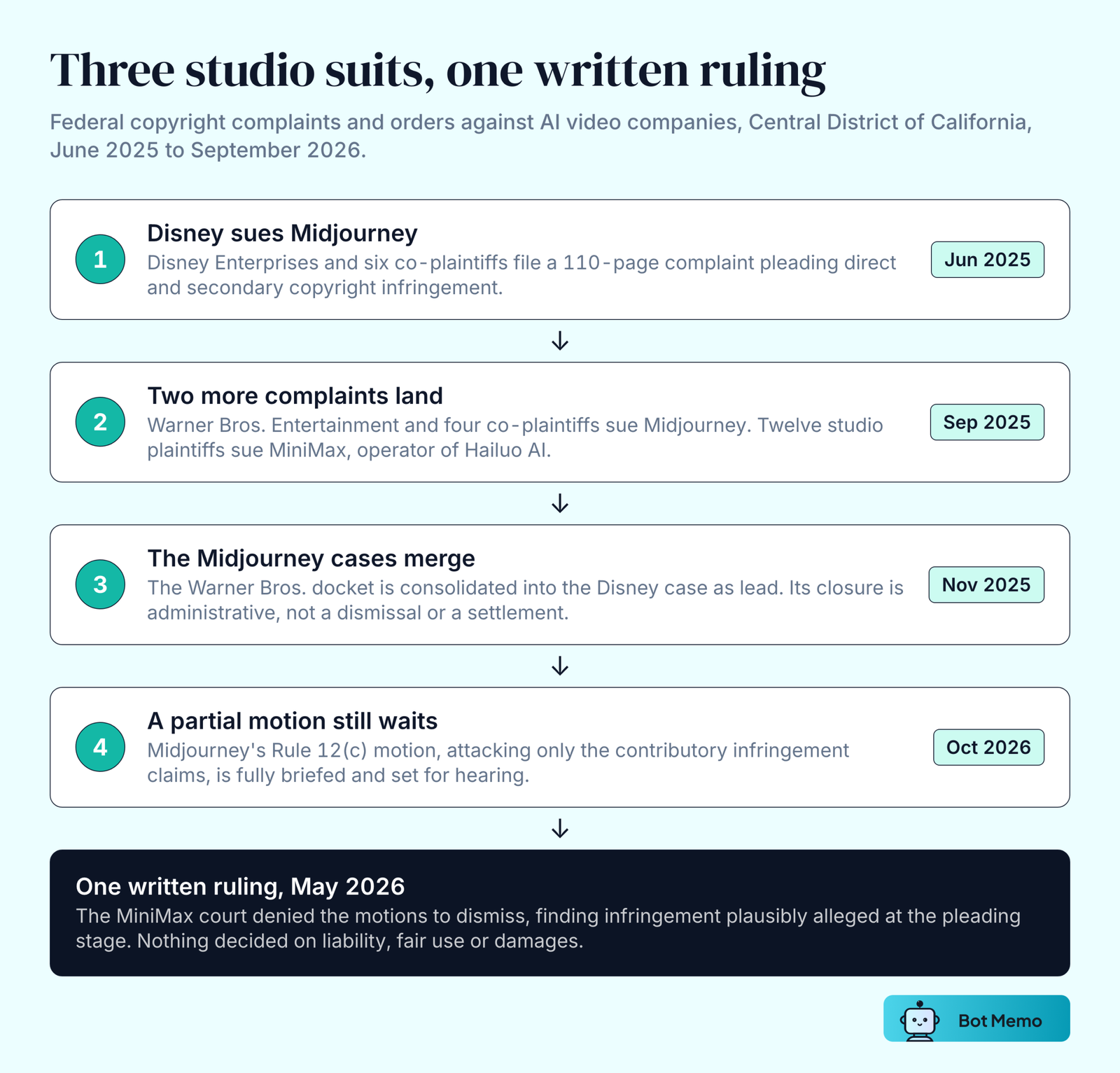
Disney Enterprises and six co-plaintiffs sued Midjourney on 11 June 2025 in the Central District of California, a 110-page complaint pleading two causes of action, direct and secondary copyright infringement. (Case No. 2:25-cv-05275-JAK-AJR)
-
The complaint calls Midjourney “the quintessential copyright free-rider and a bottomless pit of plagiarism.” (Disney v. Midjourney, paragraph 2)
-
The complaint’s $300 million revenue figure for Midjourney in 2024 is a pleaded allegation, hedged in the same filing at paragraph 74 as “reportedly.” It is not an audited number. (Disney v. Midjourney complaint)
-
Warner Bros. Entertainment and four co-plaintiffs filed an 87-page complaint against Midjourney on 4 September 2025 as Case No. 2:25-cv-08376-JAK-E, alleging the service removed video moderation protections that had previously blocked animation of its characters. (Warner Bros. complaint)
-
The two cases were consolidated on 4 November 2025, with the Disney case as lead. The Warner Bros. docket’s termination date is administrative closure on consolidation, not a dismissal or settlement. (Consolidation order, Dkt. 29)
-
Disney and eleven other studio plaintiffs sued MiniMax, operator of Hailuo AI, on 16 September 2025 in a 119-page complaint. It was the first complaint joining plaintiffs from Disney, Universal and Warner Bros. Discovery. (Case No. 2:25-cv-08768-SB-E)
What the Courts Have Actually Decided
-
In the MiniMax case, the court denied the defendants’ motions to dismiss on 22 May 2026, finding that “at the pleading stage, Plaintiffs have plausibly alleged direct infringement.” (Dkt. 57)
-
That order decides nothing about liability, fair use or damages, and it expressly declined to reach the extraterritoriality argument about AI training. (Dkt. 57) The defendants answered in June 2026 and filed a counterclaim, and no further substantive ruling had issued as of 20 September 2026.
-
In the Midjourney case, the defendant answered rather than moving to dismiss. Its Rule 12(c) motion filed 21 July 2026 is partial, attacking only the contributory infringement claims. It was fully briefed by late August 2026, the hearing was reset from 28 September to 26 October 2026, and no ruling had issued as of 20 September 2026. (Dkt. 139; reset order, Dkt. 143)
-
No Hollywood studio has sued Runway, Luma, Pika, Kling, OpenAI over Sora or Google over Veo. A party-name search of the federal docket archive returns no such case.
Reported actions by Paramount Pictures and Netflix against ByteDance over Seedance were cease-and-desist letters, which carry no docket and are not litigation of record.
Bot Memo’s Midjourney statistics page tracks the company at the center of two of these cases.
AI and Film Industry Jobs
Two sets of numbers are treated as interchangeable here and should not be. One is a 2024 forecast of task exposure built from executive plans. The other is measured payroll employment across California’s creative economy, with film, TV and sound broken out inside it.
Projected Job Disruption
-
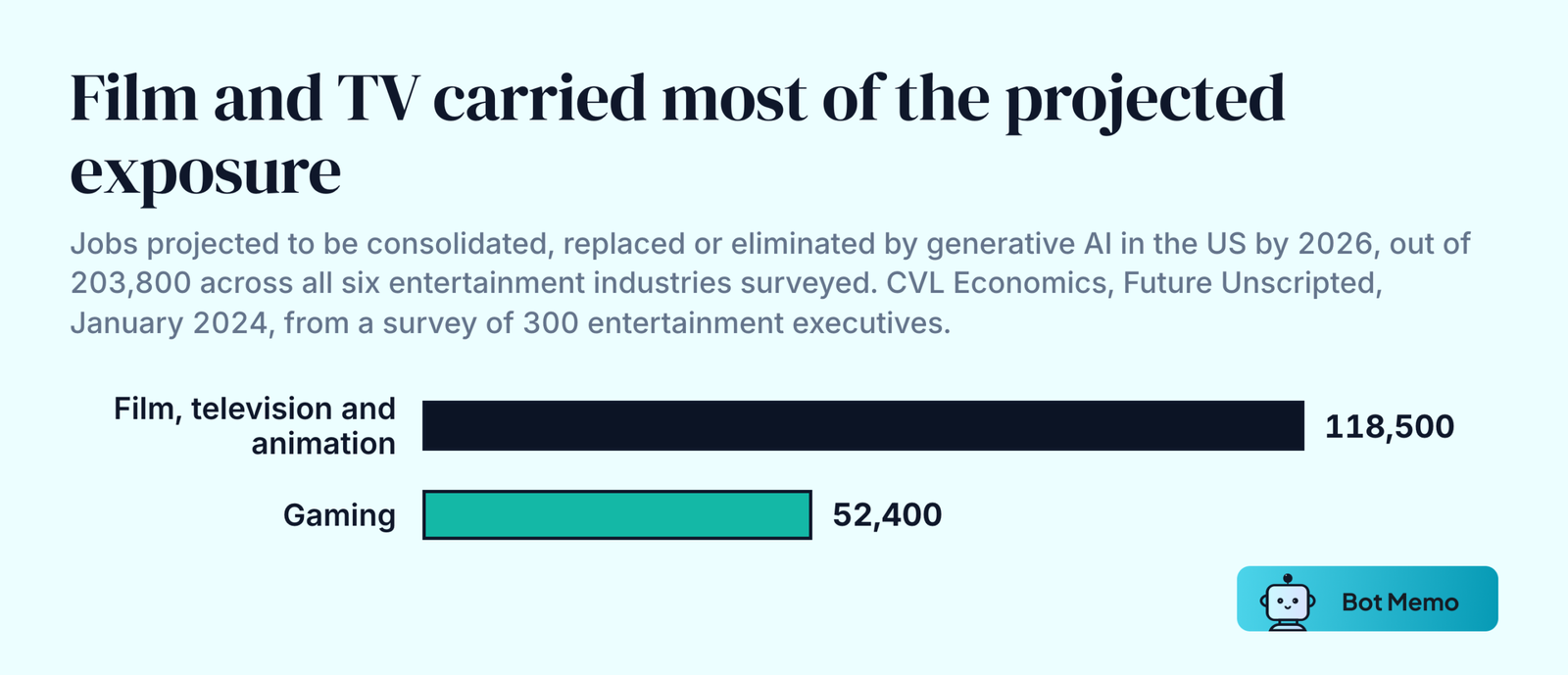
About 21.4% of US film, television and animation jobs, roughly 118,500, were projected to have “a sufficient number of tasks affected to be either consolidated, replaced, or eliminated” by generative AI by 2026. The unit is task exposure, not headcount cuts. (CVL Economics, Future Unscripted, January 2024)
-
Across all entertainment industries, the same study put the figure at nearly 203,800 payroll jobs, a 16.1% share. (CVL Economics)
-
The study surveyed 300 C-suite leaders, senior executives and mid-level managers across six entertainment industries between 17 November and 22 December 2023. It is an executive-expectation survey, not a measurement, and its 2026 horizon has now closed. (CVL Economics)
-
The US film, television and animation industry employs almost 550,000 workers, concentrated in California, New York, Georgia and New Mexico. The study’s own figures do not quite reconcile: 21.4% of 550,000 is about 117,700, and the 118,500 count implies a larger base, which the report’s own chart label gives as 555,000. (CVL Economics)
-
California was projected to see 39,500 film, television and animation jobs affected, New York 15,100. (CVL Economics)
-
Gaming was projected at 13.4% of jobs, or 52,400. (CVL Economics)
-
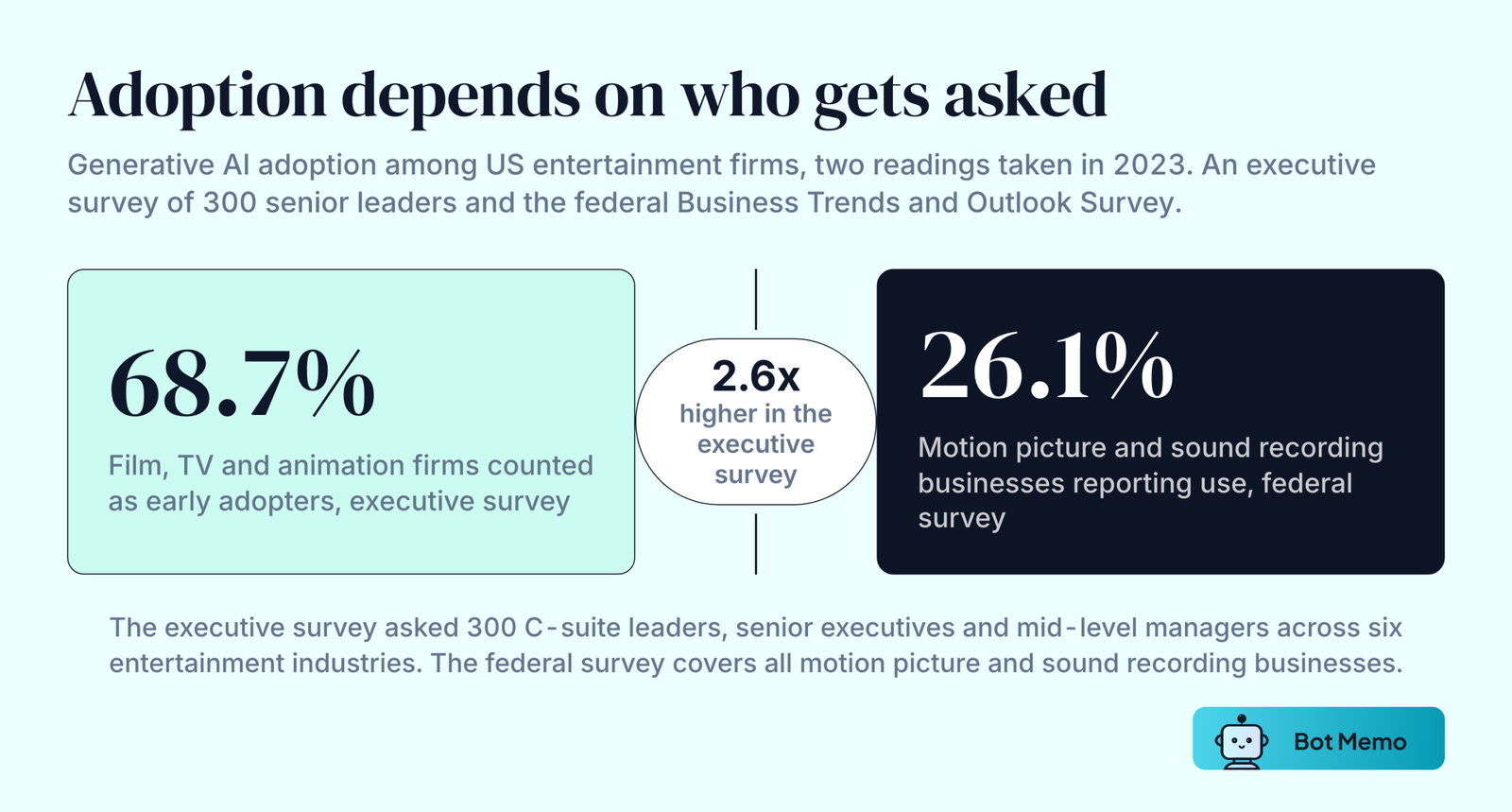
Seventy-two percent of firms surveyed counted as early adopters, and the film, television and animation sidebar prints 68.7% for 2023. The study’s own cross-check against the US Census Bureau Business Trends and Outlook Survey found 26.1% of motion picture and sound recording businesses had used generative AI, a much lower number from a much larger sample. (CVL Economics)
-
Roughly one in three film, television and animation leaders predicted displacement for sound editors and 3D modelers. Sound designer, compositor and graphic designer were flagged by roughly 25% of respondents. (CVL Economics)
-
The study excludes gig workers, so its own authors note the true affected count would be larger. (CVL Economics)
What Employment Data Actually Shows
-
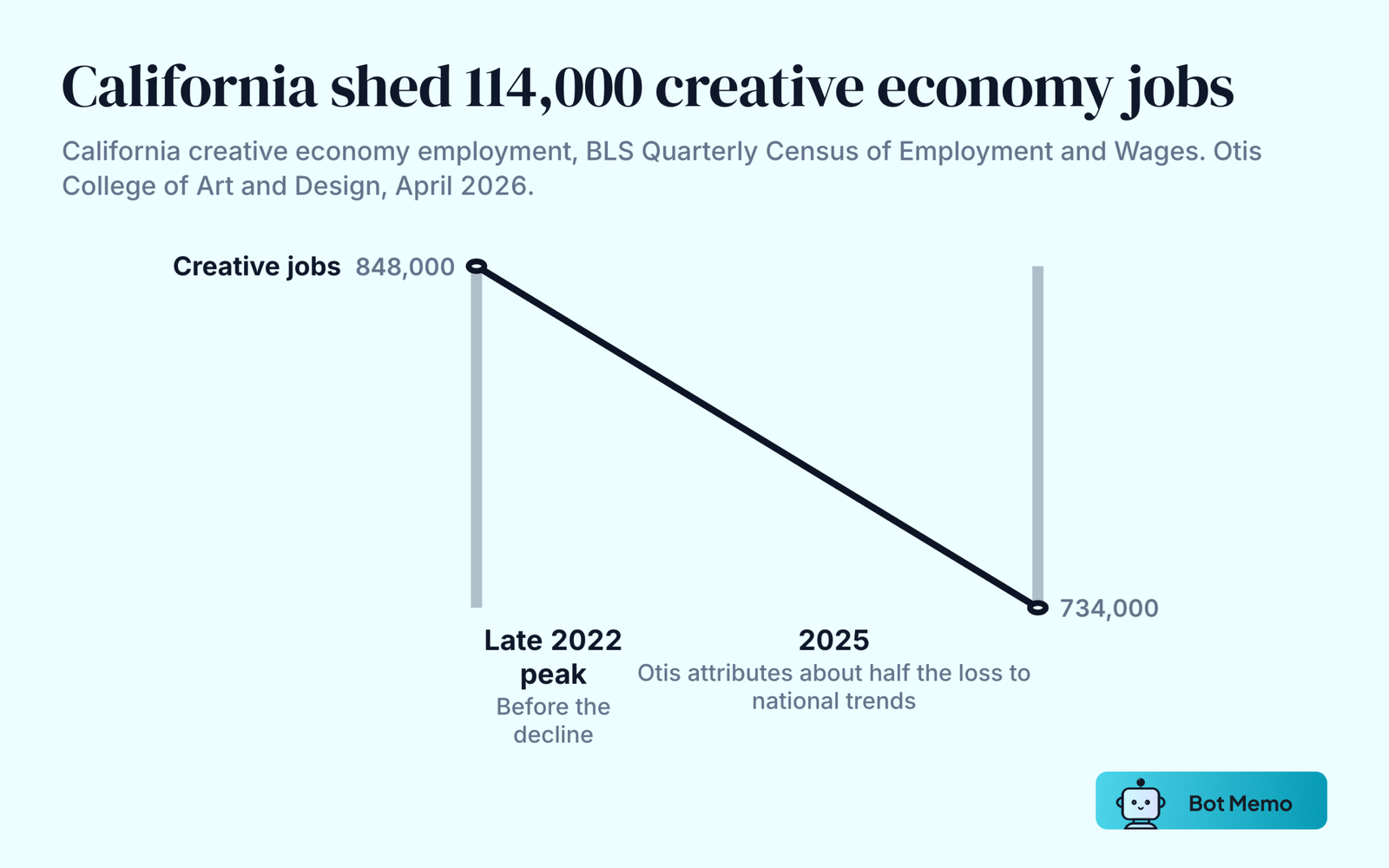
California has lost roughly 114,000 creative economy jobs since late 2022, a decline of about 14%, from a peak of 848,000 to approximately 734,000. (Otis College of Art and Design, Creative Disruption, April 2026)
-
Film, TV and sound employment fell 29.6% over that period, and traditional media fell 33.8%. (Otis College)
-
California lost 57,000 more jobs than it would have if it had tracked national trends and the broader national creative economy. (Otis College)
-
The report is titled “Creative Disruption: AI and California’s Creative Economy 2022-2025,” and its opening section is headed “California’s Creative Economy Is Shrinking, But Not Because of AI.” It attributes roughly half the losses to broader industry trends and half to California-specific conditions. Citing it as evidence of AI-driven job loss misreads it. (Otis College)
-
The employment figures come from the Bureau of Labor Statistics Quarterly Census of Employment and Wages, with a shift-share approach separating national trends from state dynamics. (Otis College)
Industry Scale and Production Volume
-
The American motion picture and television industry supports 2.01 million total jobs and $202 billion in total wages, including 787,000 direct jobs. (Motion Picture Association, 2024 reference year, published 10 February 2026)
-
The industry spans more than 162,000 businesses across every state, and 93% of them employ fewer than 10 people. (Motion Picture Association)
-
Direct jobs pay an average of $114,981 against a national average of $75,590, a 52% premium. (Motion Picture Association)
-
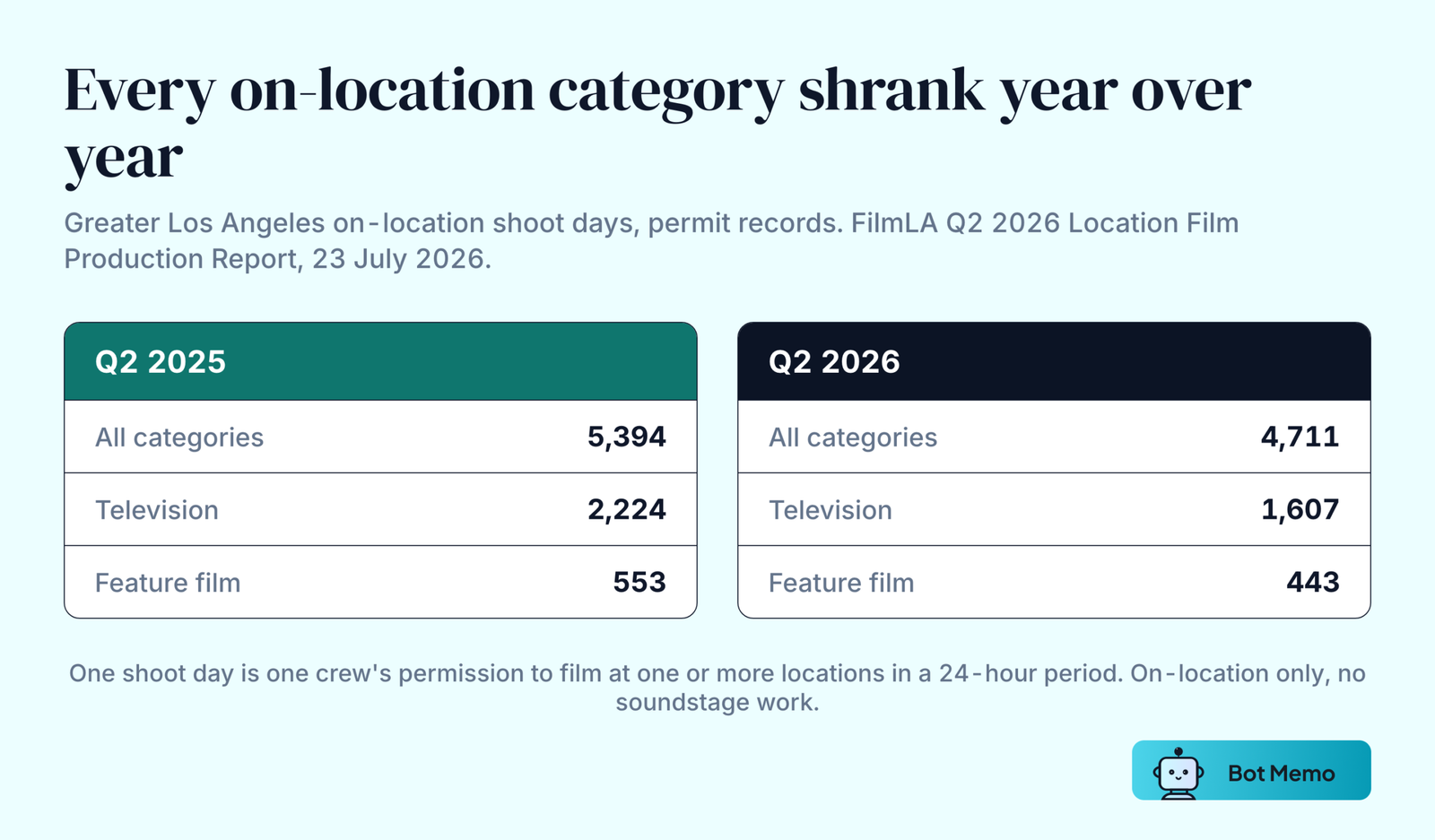
On-location production in Greater Los Angeles totalled 4,711 shoot days in Q2 2026, down 12.7% from 5,394 a year earlier. (FilmLA, 23 July 2026)
-
Television posted 1,607 shoot days in Q2 2026, up 34.4% on Q1 but down 27.7% from 2,224 a year earlier, with a decline in reality TV accounting for much of the difference. (FilmLA)
-
Feature films recorded 443 shoot days, down 19.9% from 553 a year earlier, with 33.0% of category shoot days coming from state-incentivized projects. (FilmLA)
-
Domestic box office reached $8,656,639,252 across 670 releases in 2025, an average of $12,920,357 per release, led by A Minecraft Movie. This is the box office performance these tools are entering against. (Box Office Mojo, read 20 September 2026)
-
Domestic box office for 2026 stood at $7,486,633,026 across 548 releases as of 20 September 2026, an average of $13,661,739 per release, led by Spider-Man: Brand New Day. The year is incomplete. (Box Office Mojo, read 20 September 2026)
What Audiences and Filmmakers Think About AI in Film
Consumer acceptance is the constraint named by the analyst quoted at stat 146, which makes it worth separating what audiences say from what they can actually detect.
Consumer Attitudes, 2024 to 2026
-
Seventy percent of US consumers said they would rather watch a TV show or movie written by a human than by generative AI. The data is Deloitte’s, from its 18th annual Digital Media Trends survey of 3,517 US consumers aged 14 and older, fielded in October 2023 and first reported in March 2024.
-
Twenty-two percent of the same sample said generative AI could write TV shows and movies more interesting than humans could. (Deloitte 18th Digital Media Trends)
-
That view ran highest among younger viewers: 30% of millennials and 25% of Gen Z. (Deloitte 18th Digital Media Trends)
-
Forty-two percent said generative AI and humans can each produce entertaining content. (Deloitte 18th Digital Media Trends)
-
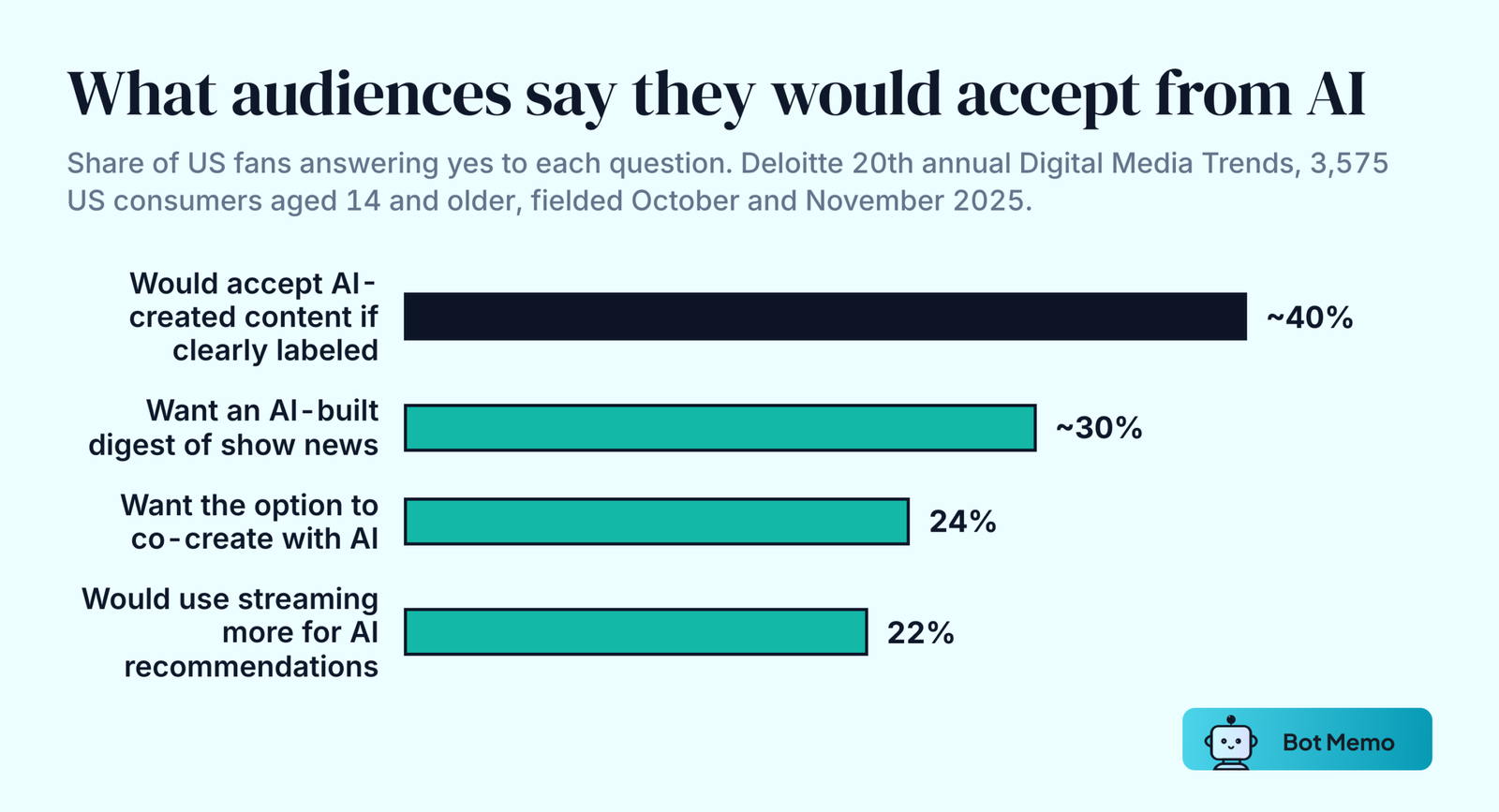
In Deloitte’s 2026 edition, nearly 40% of fans said they would accept AI-created content on streaming, social, music and games if it is clearly labeled. Sample 3,575 US consumers aged 14 and older, fielded October and November 2025. (Deloitte 20th Digital Media Trends, 25 March 2026)
-
Nearly a quarter, 24%, said they would like the option to co-create content with generative AI, such as alternative endings. (Deloitte 2026)
-
Twenty-two percent said they would use streaming video services more if the streamer used generative AI for more personalized recommendations. (Deloitte 2026)
-
Thirty-two percent of sports fans wanted personalized highlight reels and commentary. That subgroup is sports fans, not all respondents. (Deloitte 2026)
-
Almost 30% of fans said they would like generative AI to build a personalized digest of news about their favourite shows. Deloitte’s report and its own press release disagree on this one, printing “almost 30%” and 27% for the same finding. (Deloitte 2026)
Whether Audiences Can Tell AI Video Apart
-
Sixty percent of respondents incorrectly guessed that a human had generated the Big Sur video, one of four Sora clips shown alongside four real stock videos. The survey was conducted by HarrisX online from 1 to 4 March 2024 among more than 1,000 US adults. The 60% applies to that single clip, not to Sora video generally.
-
Reactions to Sora in the same survey ran curious 28%, uncertain 27%, open-minded 25%, anxious 18%, inspired 18% and fearful 2%. Respondents could pick more than one, so the shares do not total 100%. (HarrisX, March 2024)
What Filmmakers and Executives Say
These are the on-record positions the live page has carried since 2023, rechecked at source. Two of them are routinely quoted out of context, and the correction is noted with each.
-
Runway CEO Cris Valenzuela on the Everything Everywhere All at Once work: “It’s transformative because it frees up your time and costs to focus on the creative iterations and ideas. It translates days of work into minutes.” (22 February 2023)
-
Doug Shapiro’s position is that “the prevalence of GenAI in the production process will be gated by consumer acceptance, not technology.” (Doug Shapiro, 18 September 2023)
-
Ted Sarandos: “I think that the creators who learn to use these tools better than everyone else are gonna win…not companies who create, but people who create.” (13 March 2024)
-
James Cameron does not believe “a disembodied mind that’s just regurgitating what other embodied minds have said” can move an audience. (18 July 2023)
-
Ridley Scott called artificial intelligence “a technical hydrogen bomb.” The remark was about recursive self-improvement and the collapse of the global monetary system, not about AI in production. (24 November 2023)
-
Jonathan Taplin, director emeritus of the Annenberg Innovation Lab at USC: “The way they train their models is by ingesting everything on the internet, with no concern for copyright.” (19 June 2023)
-
Yves Bergquist, who directs the AI and Neuroscience in Media Project at USC’s Entertainment Technology Center: “It’s good at brainstorming ideas, but it will output only average content.” He adds that it is “nowhere near capable of the symbolic abstraction necessary for script development.” (19 June 2023)
-
Actors struck for 118 days in 2023 over compensation, residuals and AI protections, across 35 days of bargaining, and SAG-AFTRA ratified a multiyear TV and theatrical contract in December. (14 July 2024)
Key Takeaways
- Netflix is the one company putting a title count on the record. Roughly 300 titles as of its July 2026 letter, concentrated in post-production (stat 1). The rest of the adoption literature is survey or forecast.
- The three numbers people stack into a trend are not comparable. SAG-AFTRA’s contract excludes traditional CGI and VFX from generative AI, CVL Economics counts task exposure, and Netflix counts titles with a workflow anywhere in the lifecycle (stats 4, 85, 112).
- The rulebooks moved in 2026. The Academy added two new eligibility conditions, human performance for acting roles and human authorship for screenplays, Sundance made disclosure mandatory from 2027, and Cannes still has no AI provision at all (stats 65, 66, 67, 73).
- A film with AI-generated effects is copyrightable, per the Copyright Office. Prompts alone are not authorship (stats 88, 89).
- One written ruling exists across all three studio lawsuits, and it reaches only the pleading stage. There is no fair-use holding, no trial and no settlement (stats 108, 110).
- California’s creative economy lost about 114,000 jobs since late 2022, and the report measuring that decline attributes it to something other than AI (stats 121, 124).
Frequently Asked Questions
How Many Films Use AI?
There is no industry-wide count. The one company-stated figure comes from Netflix, which reported generative AI workflows in roughly 300 of its titles as of its July 2026 shareholder letter, a year-to-date count rather than a full-year total. The other adoption figures in circulation are projections or executive surveys rather than counts of films.
Is a Movie Made With AI Protected by Copyright?
A film that includes AI-generated special effects or background artwork is copyrightable, according to the US Copyright Office’s January 2025 report. Purely AI-generated material is not, and prompts alone do not make a user the author of the output. That guidance is the Office’s published position rather than binding law.
Will AI Replace Film Industry Jobs?
The widely quoted projection, from CVL Economics in January 2024, put 21.4% of US film, television and animation jobs at risk of consolidation or elimination by 2026. It surveyed 300 executives about their plans rather than measuring outcomes. The measured data, from Otis College, shows California lost about 114,000 creative economy jobs since late 2022, and that report attributes the decline to broader industry and state-specific conditions rather than AI.
Do the Oscars Allow AI-Generated Films?
AI tools are allowed; a fully AI-generated film is not. Generative AI tools neither help nor harm a nomination, but the 99th Academy Awards rules require acting roles to be performed by humans with their consent and screenplays to be human-authored, which a film generated end to end could not satisfy. The Academy can also ask for more information about how AI was used.
Do Film Festivals Require AI Disclosure?
Sundance requires it from the 2027 edition. Annecy requires any substantial AI use to be stated in its Mifa market submissions, and a statement of intent where AI has a significant impact on the work.
Tribeca bans generative AI in one program run with Universal. Cannes has no AI provision in its official selection regulations for 2025 or 2026.
What Is the AI in Film Market Worth?
The generative AI in movies segment is forecast at $4,490.7 million by 2033 at a 28.2% CAGR, from a 2024 base of $481.0 million. That forecast dates to April 2024 and has not been refreshed, so it should be read as a dated projection rather than a current reading.
Which AI Video Tools Do Filmmakers Use?
Google Flow reported over 275 million videos generated in its first five months. Runway’s Aleph handles object removal and angle generation, which are post-production tasks.
OpenAI’s Sora consumer app shut down in April 2026 and its API is scheduled to end in September 2026. Bot Memo tracks the companies behind these tools in its AI video statistics and AI statistics roundups.
Sources and Methodology
Every figure above was read at its own source. Most of them are first-party and auditable: shareholder letters and earnings transcripts, US Copyright Office reports, court complaints and orders, Academy rulebooks, union collective bargaining agreements and contract summaries, festival regulation PDFs, the Motion Picture Association economic contribution publication, FilmLA quarterly reports and Box Office Mojo. Vendor announcement pages supply specs, dates and company-stated funding only, never competitive superiority claims.
A second tier is published journalism, and it is the only record for the on-record quotes and for two surveys: the 2024 consumer figures, the Sora recognition test, the Everything Everywhere All at Once account, the Zone Out report and the interviews with James Cameron, Ridley Scott, Jonathan Taplin and Yves Bergquist. Those claims are linked to the article of record. The Ted Sarandos line at stat 147 is linked to the trade report that printed it, because the podcast page carries no transcript.
No figure here is sourced to another statistics roundup. Where two sources disagree, both readings are printed rather than one being chosen silently. All figures are in US dollars, as their sources state them.

About the author
Editorial Staff
The Editorial Staff at Bot Memo is a team of writers, analysts, and AI agents dedicated to mapping the global AI startup ecosystem. Led by Chintan Zalani, the team tracks thousands of funding rounds, classifies companies across verticals, and distills it all into actionable intelligence for investors and founders.