


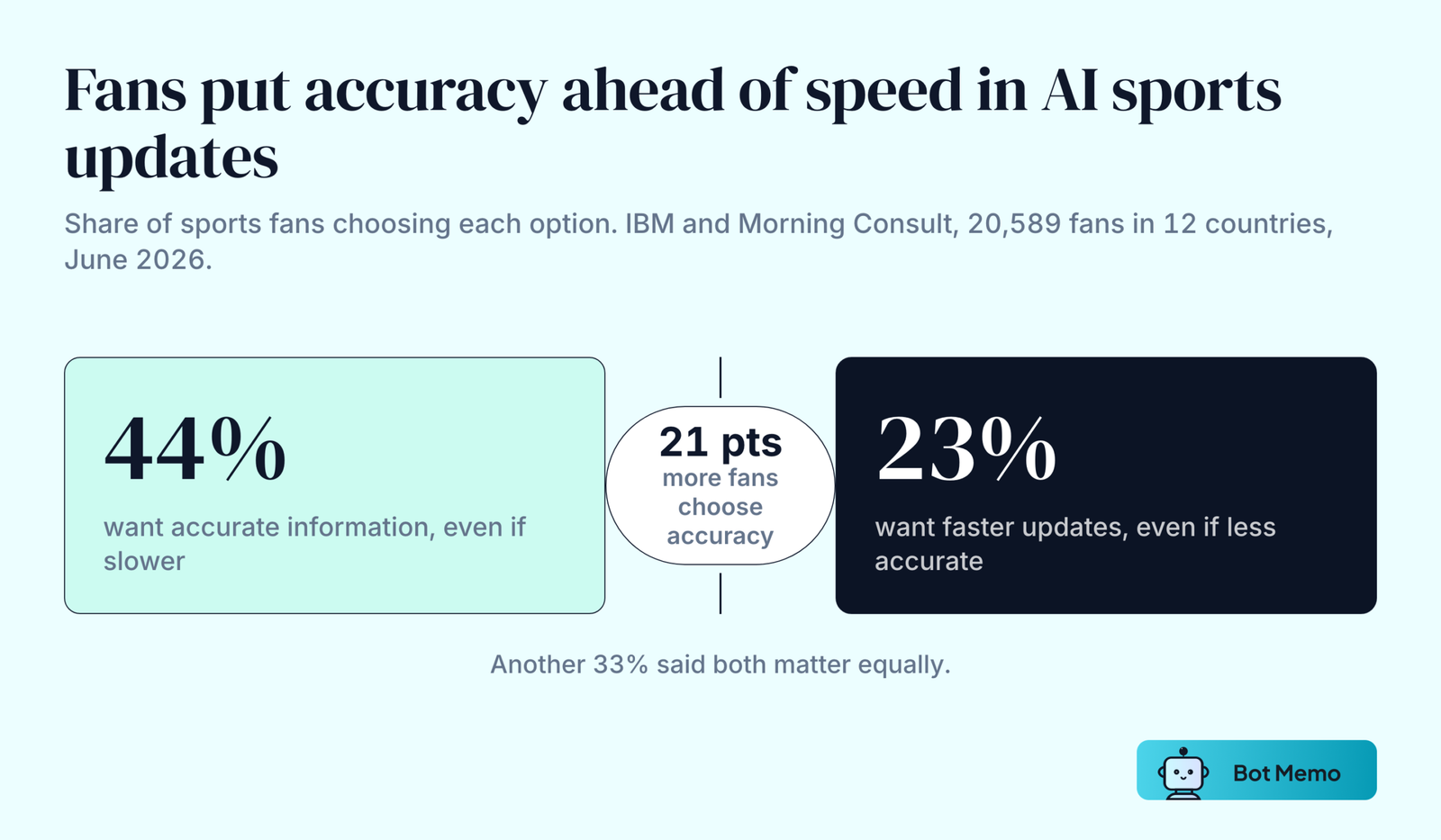
AI is now part of how most sports fans follow the game. IBM’s August 2026 survey of 20,589 fans in 12 countries found 69% use generative AI regularly or occasionally, while trust in AI-generated sports content slipped to 59% from 63% a year earlier. Fans say accuracy matters more than speed by nearly two to one.
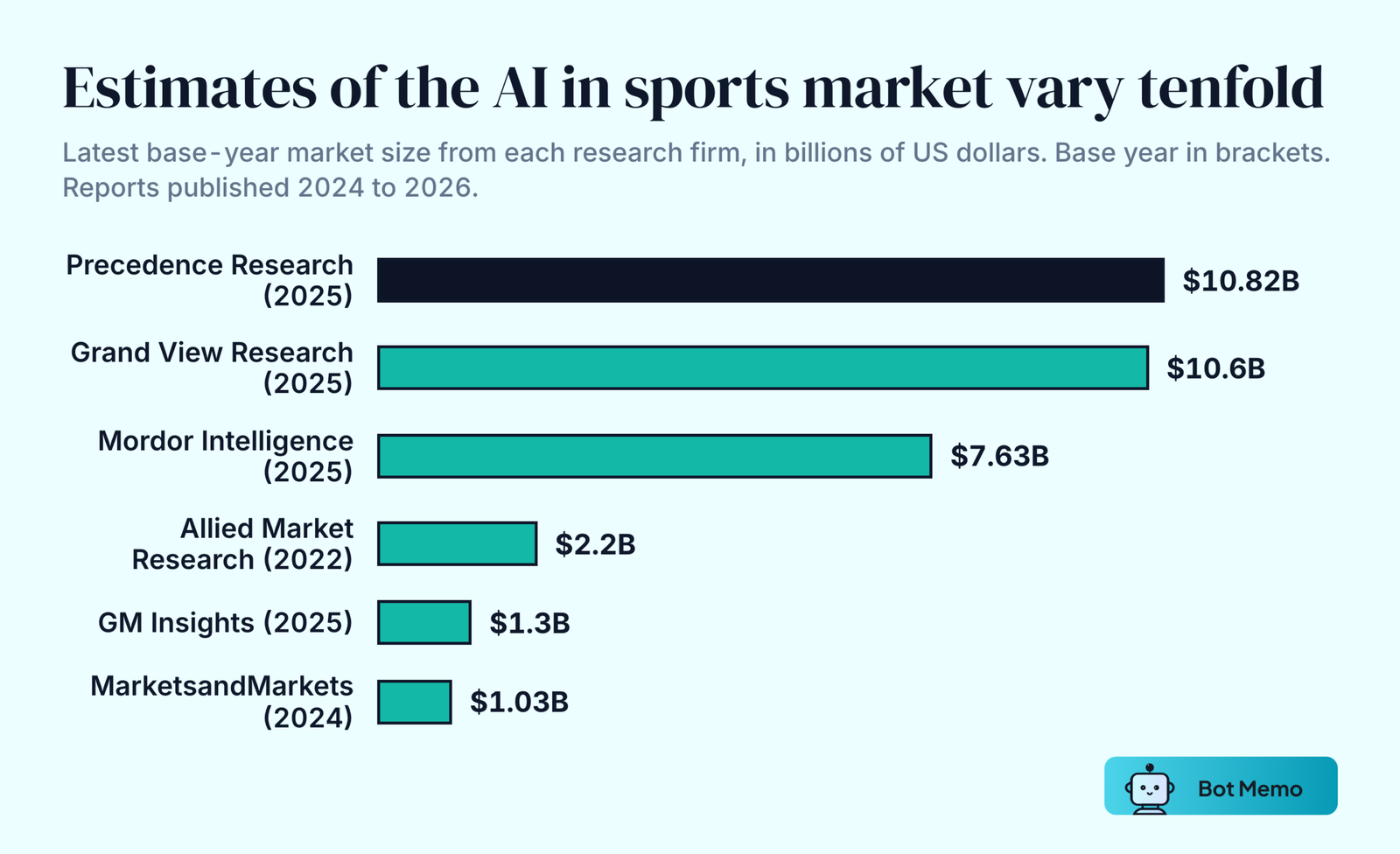
On the business side, AI priced 48% of the bets placed across Kambi’s sportsbook network in 2025, up from 4% in 2022. Wimbledon replaced its line judges with electronic calling in 2025, and Major League Baseball brought its automated ball-strike challenge system into regular-season play in 2026. Estimates of the AI in sports market for 2025 range from $1.3 billion to $10.82 billion, because research firms define the market differently.
This page collects AI in sports statistics for 2026 on market size, sports data companies, injury research, officiating, fans, media and betting. Each stat names its source and date. Figures from earlier versions of this page are kept where their source still supports them and shown next to the newer number where one exists. Figures that could not be confirmed are listed near the end with the reason.
On this page
- AI In Sports Market Size Statistics
- Sports Data And AI Company Statistics
- AI In Injury Prevention And Player Performance
- AI In Officiating Statistics
- AI And Sports Fans Statistics
- AI In Sports Media And Broadcasting
- AI In Sports Betting Statistics
- Sports Industry AI Readiness Statistics
- Key Takeaways
- Frequently Asked Questions
- Figures Corrected Or Removed From Earlier Versions
- Sources And Methodology
AI In Sports Market Size Statistics
Market Size Estimates
1. The global AI in sports market was valued at $10.6 billion in 2025. Grand View Research projects $12.7 billion in 2026 and $49.9 billion by 2033, a 21.6% compound annual growth rate from 2026 to 2033. (Grand View Research, June 2026)
2. Generative AI held the largest share of that market in 2025, at 52.1% of revenue. (Grand View Research, June 2026)
3. Precedence Research values the AI in sports market at $10.82 billion in 2025 and $13.10 billion in 2026, and forecasts about $70.16 billion by 2035, growing 20.56% a year from 2026. (Precedence Research, June 2026)
4. Mordor Intelligence puts the market at $7.63 billion in 2025 and $9.76 billion in 2026, reaching $33.32 billion by 2031 at a 27.85% annual growth rate. (Mordor Intelligence, July 2026)
5. An earlier forecast from Allied Market Research valued the market at $2.2 billion in 2022 and projected $29.7 billion by 2032, a 30.1% annual growth rate from 2023 to 2032. (Allied Market Research, February 2024)
6. GM Insights values the market at $1.3 billion in 2025 and forecasts $4.7 billion by 2034, growing 15% a year from 2026. An earlier version of this page quoted the firm’s older figures of $1.2 billion in 2024 and 14.7% growth. (GM Insights, accessed September 2026)
7. MarketsandMarkets estimates the market at $1.03 billion in 2024, rising to $2.61 billion by 2030 at a 16.7% annual growth rate. (MarketsandMarkets, November 2024)
Why The Estimates Differ
The estimates above differ by roughly ten times for the same year. The reports do not measure the same thing. Grand View, for example, counts solutions and services, generative and other AI, and individual sports, team sports and esports. Narrower reports count less. Use the estimate whose definition matches the question you are asking, and avoid comparing growth rates across firms with different base years and end years.
Wearable Technology Market
8. The global wearable technology market was valued at $86.78 billion in 2025. Fortune Business Insights projects $96.44 billion in 2026 and $231.43 billion by 2034, growing 11.6% a year. Then and now: an earlier edition, cited on this page before, valued the market at $93.28 billion in 2022 and forecast $931.31 billion by 2030 at 33.9% a year. The current end-point forecast is about three quarters lower than the earlier one, even though it runs four years further. (Fortune Business Insights, September 2026)
For AR and VR adoption more broadly, see our augmented reality statistics.
Sports Data And AI Company Statistics
Revenue Of Listed Sports Data Companies
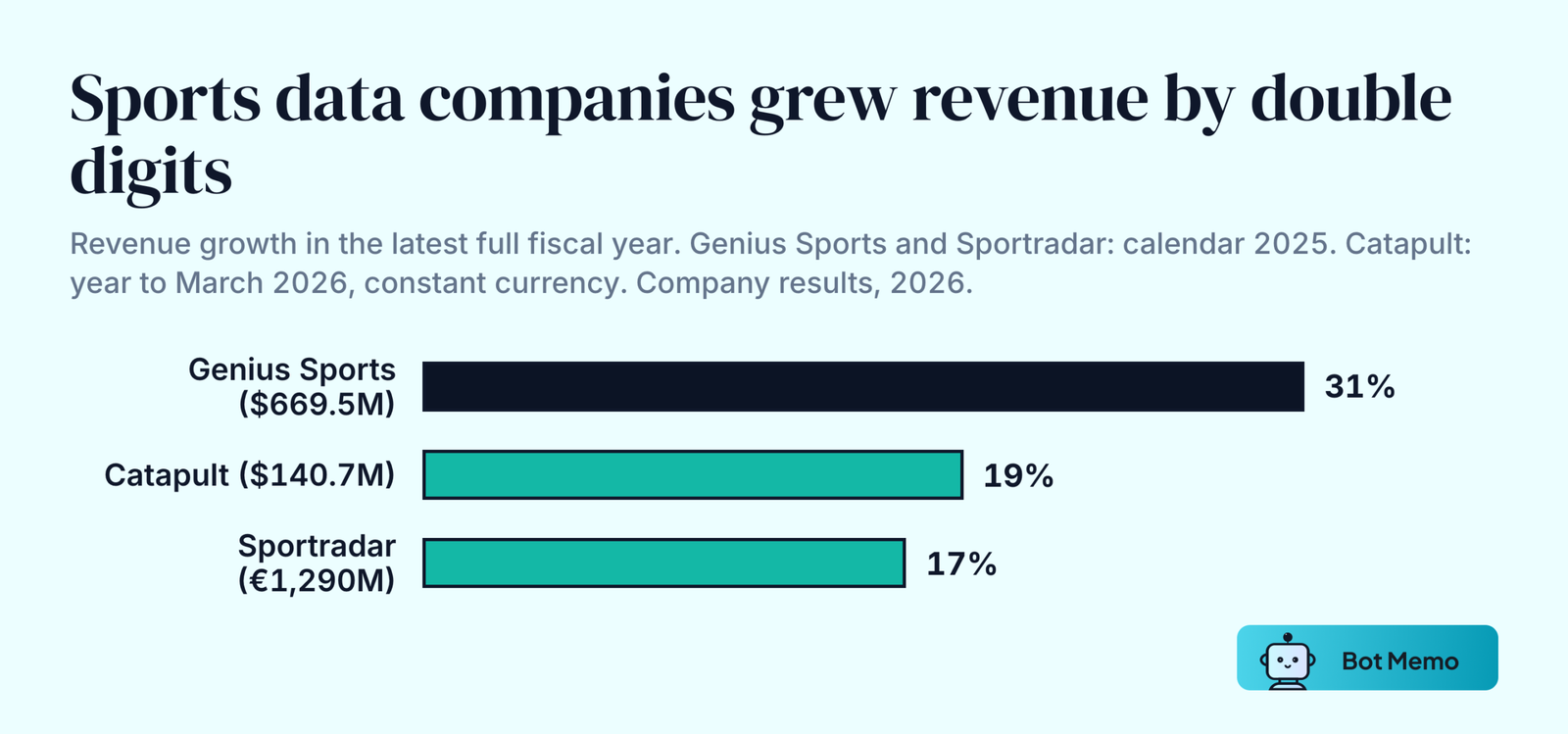
9. Sportradar’s revenue rose 17% to a record €1,290 million in 2025. Then and now: 2024 revenue was €1,107 million, up 26% on 2023. (Sportradar, March 2026)
10. Sportradar reported €724 million of revenue in the first half of 2026, up 15% from €629 million a year earlier. (Sportradar, August 2026)
11. Genius Sports’ group revenue grew 31% to $669.5 million in 2025. Then and now: 2024 revenue was $510.9 million, up 24%. (Genius Sports, March 2026)
12. Catapult, which sells wearables and video analysis to sports teams, reported record revenue of $140.7 million for the year to March 2026, up 19% in constant currency. Annualized contract value rose 28% in constant currency to $133.8 million. (Catapult results, via Proactive Investors, May 2026)
13. Two years earlier, Catapult passed $100 million in annual revenue for the first time, growing 20% in constant currency, and worked with more than 4,200 teams in more than 100 countries across 40 sports. (Catapult Annual Report, July 2024)
For the startups raising money in this space and elsewhere in AI, see our AI startup funding statistics.
Sports Data Volume And Tracking
14. Stats Perform’s Opta covers more than 500,000 matches a year across 3,900+ competitions, with more than 14 billion unique event data points in its feeds and 100+ global partnerships. (Stats Perform, accessed September 2026)
15. NFL Next Gen Stats on AWS processes more than 500 million data points per season using 75 machine learning models, and returns results in under a second. Then and now: in 2021, Amazon described the system as handling nearly 300 million data points per season. (AWS, accessed September 2026)
16. The NFL’s player-tracking system is accurate to within six inches in 99.9% of cases, and streams the position of all 22 players on the field 10 times a second. (Amazon Science, February 2021)
17. Genius Sports launched GeniusIQ on August 8, 2024, after fully integrating Second Spectrum. The platform combines machine learning, computer vision and sports data. (Genius Sports, August 2024)
18. The WNBA became the first US women’s professional league with leaguewide 3D tracking data when it named Second Spectrum, a Genius Sports company, as its optical tracking provider. (WNBA, March 2024)
19. Cricket South Africa signed Stats Perform to collect and deliver ball-by-ball event data to broadcasters, media and betting operators. National team coaches and analysts also got access to Stats Perform’s recruitment tool for player selection and opposition analysis. (Business Wire via AP News, July 2020)
AI In Injury Prevention And Player Performance
Injury Prediction Research
20. A 2024 review in the journal Diagnostics examined AI injury-risk prediction in sport. From more than 207 publications, it selected 27 studies published between 2014 and 2024. (Musat et al., Diagnostics, November 2024)
21. In one study from that review, a random forest model predicted lower-extremity musculoskeletal injury risk in student athletes with 79% accuracy. Hip strength and flexibility measures were among the strongest risk factors. (Musat et al., Diagnostics, November 2024)
22. NFL concussions fell to a historic low in 2024, down 17% from 2023 and 12% below the 2021 to 2023 average. (NFL, January 2025)
23. Time-loss lower-extremity strains in the NFL were down 14% in 2024 compared with 2021. The league credits a training-camp acclimation period and tools like the Digital Athlete, which helps clubs track player effort and injury risk. (NFL, January 2025)
Player Tracking And Performance Research
24. A LiDAR-based player tracking system measured velocity with a root mean square error of 0.04 to 0.14 metres per second and acceleration with an error of 0.16 to 0.7 metres per second squared in football-specific tasks. The authors concluded it gives valid measures of both. (Bampouras and Thomas, Sports Engineering, May 2022)
25. A recurrent neural network predicted whether an esports player would perform better or worse over the next 240 seconds with a ROC AUC score of 0.73, using data from physiological and in-game sensors. ROC AUC runs from 0.5, a coin flip, to 1.0, a perfect model. (Multimedia Tools and Applications, 2022)
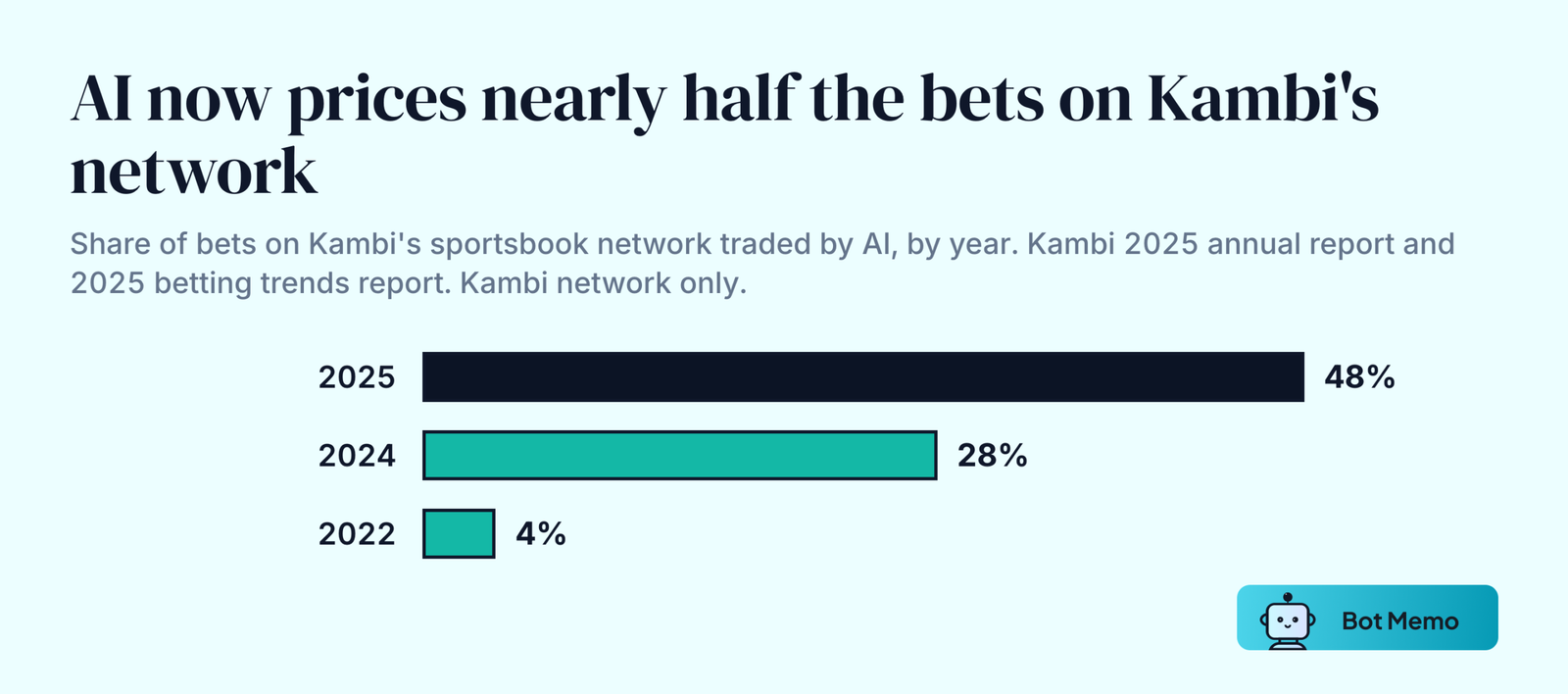
26. In a handball study on action recognition, the player-detection stage reached 76% accuracy and 98% precision. The authors say recognizing and analyzing actions can show athletes and coaches which parts of technique need work. (Host, Ivašić-Kos and Pobar, Springer, 2022)
AI is also used to rebuild opponents’ movements in virtual reality so athletes can train against them (Entertainment Computing, 2024). In tactical analysis, machine learning is mostly used to find patterns in play and to evaluate how well tactics work (IJERT, June 2024).
AI In Officiating Statistics
Football
27. For the 2022 World Cup in Qatar, FIFA introduced semi-automated offside technology. It used 12 tracking cameras under each stadium roof, following 29 data points on each player 50 times per second, and a ball sensor sending data 500 times per second. Applying AI to the combined data produced an automatic offside alert for video officials. An earlier version of this page described this as VAR; FIFA calls it an evolution of the VAR system. (FIFA, July 2022)
28. At the 2026 World Cup, each of the 16 stadiums had 16 optical tracking cameras, producing more than 150 million tracking data points per match. Every player was 3D-scanned so their digital avatar could be used in offside decisions. (FIFA, June 2026)
29. FIFA also gave all 48 World Cup teams Football AI Pro, a generative AI assistant for match analysis, replacing match reports that used to run to 50 or 60 pages. Referee body cameras, first used at the 2025 Club World Cup, returned with stabilized footage. (FIFA, June 2026)
Tennis
30. Wimbledon replaced line judges with electronic line calling on all 18 match courts in 2025, ending a role that had existed for 148 years. About 80 of its roughly 300 line judges stayed on as on-court match assistants. (Wimbledon, July 2025)
31. The ATP has used electronic line calling at every tour event since the start of the 2025 season, a change it announced in April 2023. (ATP Tour, April 2023)
32. Wimbledon’s first year of electronic calling had errors. The system was switched off by mistake for part of a fourth-round match, and a point was replayed in a quarterfinal because a ball kid was still crossing the court when the serve started. (CNN, July 2025)
American Football And Baseball
33. The NFL used Sony’s Hawk-Eye system for first-down measurements in every stadium from the 2025 season. Six 8K cameras per venue track the ball, and a measurement takes about 30 seconds, compared with more than a minute for the chain crew. (PetaPixel, April 2025)
34. Major League Baseball approved its Automated Ball-Strike Challenge System for all spring training, regular-season and postseason games from 2026. Each team starts a game with two challenges and keeps any it wins, and only the pitcher, catcher or batter can challenge. A challenge takes about 15 seconds. (MLB, September 2025)
AI And Sports Fans Statistics
How Many Fans Use And Trust AI
35. 69% of sports fans use generative AI regularly or occasionally, and usage rose in all 12 markets surveyed. It is highest in India (92%), the UAE (87%), Saudi Arabia (81%) and Brazil (81%), and among Gen Z fans (80%). IBM and Morning Consult surveyed 20,589 fans in June 2026. (IBM Sports Intelligence Report, August 2026)
36. 59% of fans trust AI-generated sports content, down from 63% in 2025. Trust is higher among F1 fans (66%) and tennis and golf fans (64% each), and fans who use AI regularly are nearly three times as likely to trust it as non-users. (IBM Sports Intelligence Report, August 2026)
37. 44% of fans want highly accurate information even if it arrives slower, compared with 23% who prefer faster updates that are occasionally less accurate. Another 33% say both matter equally. Accuracy is also the top driver of trust in AI sports insights, named by 45%. (IBM Sports Intelligence Report, August 2026)
38. In 2025, 85% of fans surveyed saw value in integrating AI into their sports experience. That survey covered 20,864 fans in 12 countries in June 2025. (IBM, August 2025)
What Fans Want From AI
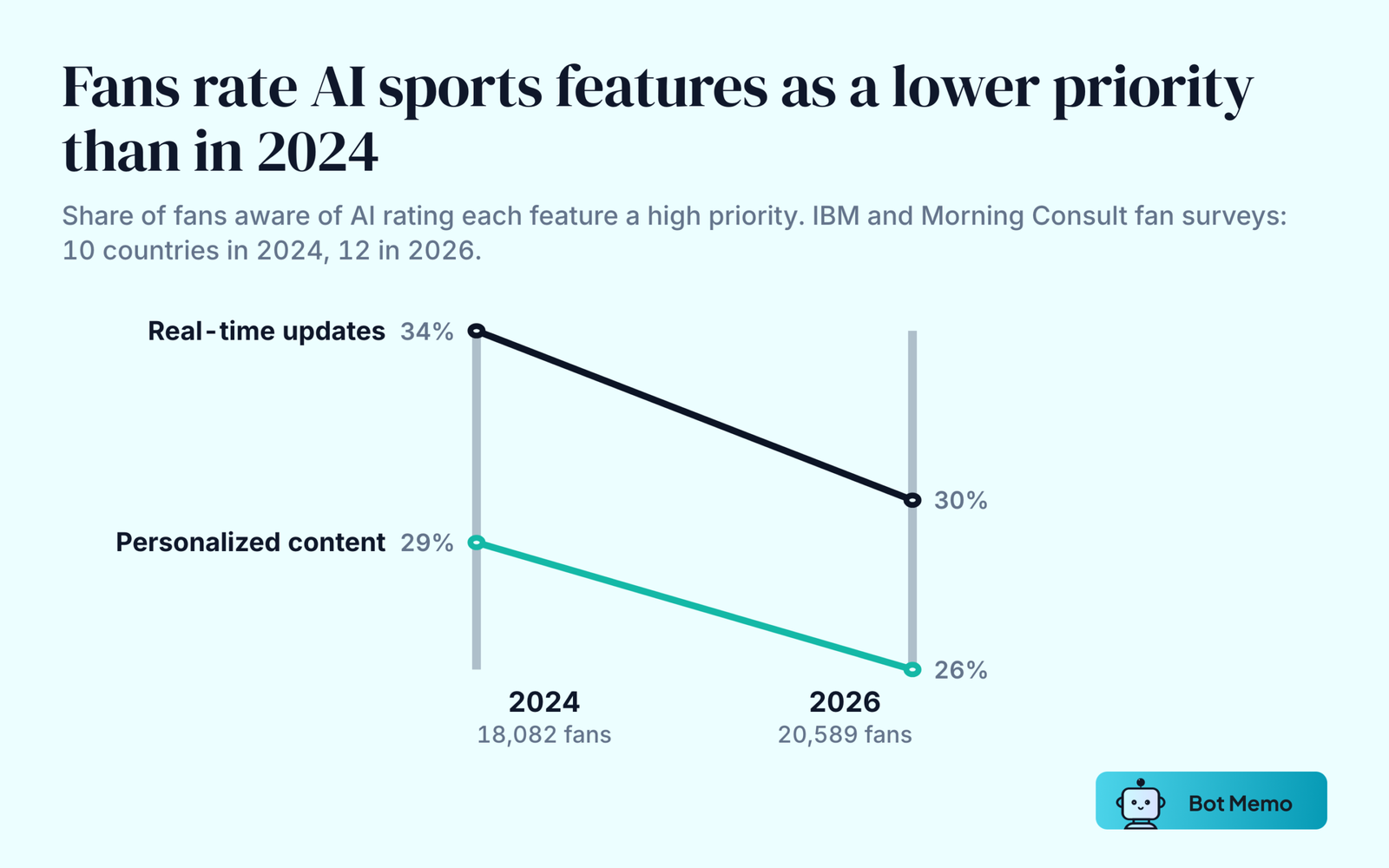
39. Real-time updates are the AI feature fans rate as a high priority most often, at 30%, followed by personalized content (26%), unique insights (26%), meaningful predictions (23%), voice interfaces (22%) and ways to engage with other fans (20%). The base is fans who have at least heard of AI. (IBM Sports Intelligence Report, August 2026)
40. Then and now: real-time updates were rated a high priority by 34% of fans in 2024 and 35% in 2025 (IBM, 2025), before falling to 30% in 2026 (IBM, 2026). Personalized content went from 29% to 30% to 26%. The 2024 survey covered 10 markets; the 2025 and 2026 surveys added Mexico and Brazil. (IBM and Morning Consult, 2024 to 2026)
41. When fans look for sports content beyond live games, they mostly want short media such as highlight clips and summaries that save time. The 2024 survey covered 18,082 fans in 10 countries. (IBM and Morning Consult, June 2024)
How Fans Rate Sports Technology
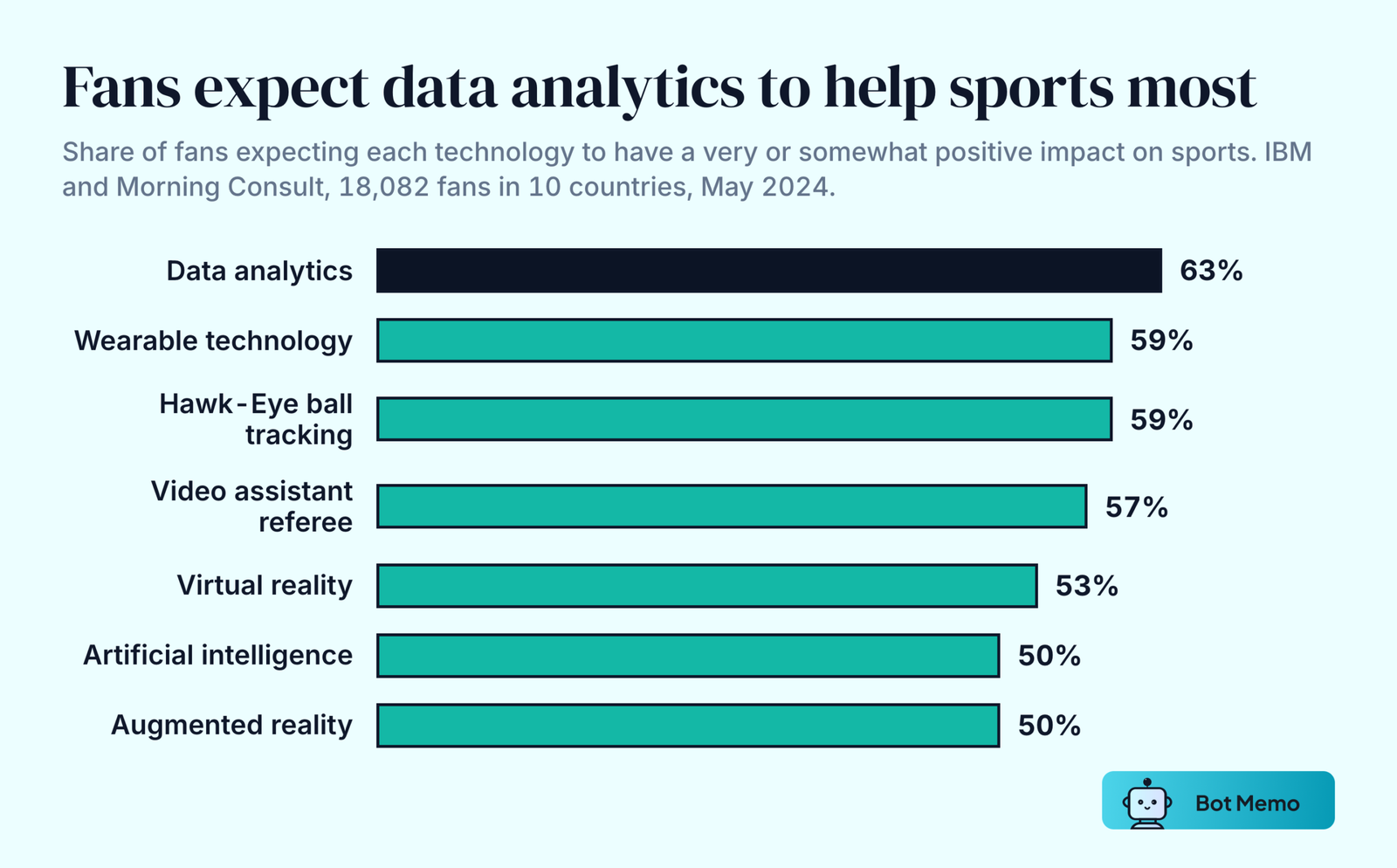
42. Fans see data analytics as the technology most likely to have a positive effect on sports (63%), followed by wearable technology (59%), Hawk-Eye ball tracking (59%), video assistant referees (57%), virtual reality (53%), AI (50%) and augmented reality (50%). (IBM and Morning Consult, June 2024)
43. Cricket fans were the most positive about data analytics (77%) and Hawk-Eye (74%). Golf fans rated both at 67% and rugby fans at 62%. An earlier version of this page said golf and rugby fans were the most optimistic, which is what the report’s page heading says, but its own table puts cricket first. (IBM and Morning Consult, June 2024)
44. Fans aged 55 and over are less enthusiastic about technology in sports overall. The UAE and Saudi Arabia are the exception: there, fans 55+ were the most positive age group, with 96% and 93% expecting data analytics to have a positive impact. (IBM and Morning Consult, June 2024)
45. In 2024, 55% of fans aged 18 to 29 used generative AI regularly or occasionally, compared with 42% of those aged 30 to 44, 35% of those aged 45 to 54 and 25% of those 55 and over. (IBM and Morning Consult, June 2024)
For fan-market context in the Gulf, see our coverage of AI in the UAE and Saudi Arabia.
AI In Sports Media And Broadcasting
AI Highlight Clips And Short Video
46. 10.2 million highlight clips were produced with WSC Sports’ AI platform in 2024, one every 3.1 seconds. The company served more than 530 clients in over 50 countries. (WSC Sports, December 2024)
47. WSC Sports clients created more than 8 million videos in the first half of 2025, up 52% year on year. Over 5 million were vertical videos, which made up 63% of all content for the first time. (WSC Sports, August 2025)
AI At Major Events
48. At the 2026 US Open, IBM’s Serve Quality feature analyzed serves across all 254 singles matches, tracking 21 data points on the body and racquet 50 times per second. That adds up to roughly 1.2 billion data points over the tournament. (IBM, August 2026)
49. 91% of tennis fans use sports apps during events, and 64% trust AI-powered sports content, according to the Morning Consult survey IBM released alongside its 2026 US Open features. (IBM, August 2026)
50. At the 2024 US Open, IBM’s watsonx and Granite model generated long-form post-match articles. USTA editors reviewed and updated them before publication. (IBM via PR Newswire, August 2024)
51. Wimbledon started using AI-generated commentary for highlight videos in 2023. IBM’s Kevin Farrar said at the time: “You can’t replace John McEnroe doing commentary, that human element always needs to be there. It’s very much supplementing and complementing.” (The Telegraph, June 2023)
52. AI was planned for at least four jobs at the Paris 2024 Olympics: tracking athlete performance, AI-restored multi-camera replays and 3D models, flagging abusive social media posts aimed at athletes, and cutting automated highlight reels. (Rubyroid Labs, August 2024)
For AI video tools used in film and TV, see our AI filmmaking statistics.
AI In Sports Betting Statistics
AI-Priced Bets
53. AI-driven trading accounted for 48% of bets across Kambi’s sportsbook network in 2025. (Kambi 2025 Annual Report, March 2026)
54. Then and now: AI traded 4% of bets on the Kambi network in 2022 and 28% in 2024, before reaching 48% in 2025. These figures cover Kambi’s network only, not the whole betting market. (Kambi, via Covers, January 2026)
Betting Data And AI Tools
55. Sportradar bought Vaix, a company that builds AI tools for the online gambling industry, in April 2022. (Sportradar, April 2022)
56. Broadcasters, sports media firms and analytics providers use AI models to produce real-time win probabilities, performance forecasts and automated game insights. An earlier version of this page linked this to sports betting and pose estimation; the source describes it as a media and fan-engagement use. (Allied Market Research, February 2024)
Sports Industry AI Readiness Statistics
Executive Strategy
57. 59% of sports executives did not yet have a plan for generative AI, and 16% did not see it as relevant to their business. PwC’s 8th Global Sports Survey had 411 responses from senior executives in 46 countries. (PwC, July 2024)
58. 81% of sports media executives had expanded their use of AI in the past year to gain efficiency and cut costs, in a Stats Perform survey of 675 executives at media companies, broadcasters, betting operators, teams, leagues and sponsors. (Stats Perform, November 2025)
Skills And Risks
Demand for real-time performance analytics is growing, but people who combine biomechanics knowledge with machine learning skills are scarce, and graduate programs are not keeping up (Mordor Intelligence, July 2026).
59. PwC wrote in 2019 that AI was affecting nearly every professional sport and filtering down to grassroots players. It listed privacy and data leakage, cyber security, regulatory compliance and third-party dependence as areas for sports boards to consider, and warned about in-game betting if athlete and game data is exposed. (PwC Australia, February 2019)
Key Takeaways
- Estimates of the AI in sports market for 2025 range from $1.3 billion to $10.82 billion because firms define the market differently. Grand View puts 2025 at $10.6 billion, with generative AI 52.1% of revenue.
- Listed sports data companies grew fast in 2025: Genius Sports revenue rose 31% to $669.5 million and Sportradar’s rose 17% to €1,290 million.
- 69% of fans use generative AI, but trust in AI sports content fell to 59% in 2026 from 63% in 2025. Fans prefer accuracy over speed, 44% to 23%.
- AI priced 48% of bets on Kambi’s network in 2025, up from 4% in 2022.
- Automated officiating is now used at Wimbledon, all ATP events, the World Cup, NFL first-down measurements and MLB ball-strike challenges.
- 59% of sports executives had no generative AI plan in PwC’s 2024 survey.
Frequently Asked Questions
How Big Is The AI In Sports Market?
It depends on the definition. Grand View Research values the market at $10.6 billion in 2025 and Precedence Research at $10.82 billion, while MarketsandMarkets puts it at $1.03 billion in 2024 and GM Insights at $1.3 billion in 2025. Forecasts range from $2.61 billion by 2030 to about $70 billion by 2035 (Grand View Research, Precedence Research, MarketsandMarkets, GM Insights).
How Many Sports Fans Use AI?
69% of sports fans used generative AI regularly or occasionally in June 2026, in IBM’s survey of 20,589 fans in 12 countries. Usage passed 90% in India (IBM).
Do Sports Fans Trust AI-Generated Content?
59% of fans trust AI-generated sports content a great deal or somewhat, down from 63% in 2025. Fans who use AI regularly are nearly three times as likely to trust it as non-users (IBM).
How Much Of Sports Betting Is Priced By AI?
On Kambi’s network, AI-driven trading accounted for 48% of bets in 2025, up from 28% in 2024 and 4% in 2022. These figures cover Kambi’s network only, not the whole betting market (Kambi, Covers).
Which Sports Use AI For Officiating?
Electronic line calling is used at Wimbledon and all ATP events. FIFA used semi-automated offside technology at the 2022 and 2026 World Cups, the NFL measures first downs with Hawk-Eye, and MLB uses automated ball-strike challenges from 2026 (FIFA, MLB).
Can AI Predict Sports Injuries?
Research is promising but uneven. A 2024 review of 27 studies found AI models can identify injury risk factors, with one random forest model reaching 79% accuracy for lower-extremity injuries in student athletes (Diagnostics).
Figures Corrected Or Removed From Earlier Versions
These figures appeared on earlier versions of this page or its draft updates. They were changed or removed because the cited source does not support them:
- The 37% cut in NBA soft-tissue injuries attributed to Kinexon, and its 72-hour prediction window: not found in the cited Kinexon article or any other Kinexon source. Removed.
- Injury-prediction figures attributed to the 2024 Diagnostics review (AUC 0.52 to 0.87, 87.5% random forest accuracy, 91% for video models, a 73% risk reduction and a 28% reinjury reduction): none appear in the paper. Replaced with the review’s actual 27-study scope and 79% figure.
- “700 fewer injury-related absences” in the 2023 NFL season: not found in any NFL or AWS source. Removed.
- 85% of fans seeing value in AI and 63% trusting AI content were attributed to a Stats Perform survey. They come from IBM’s 2025 fan survey and are now credited to IBM. A 38% figure for rights holders could not be found in either source and was removed.
- 7 million data points across 125,000 points at the 2024 US Open: not found in the cited IBM pages. Removed.
- Precedence Research’s $4.55 billion (2024) and $60.78 billion (2034) at 29.5%: the current edition shows $10.82 billion (2025) and $70.16 billion (2035) at 20.56%. Updated.
- WSC Sports serving “300+ rights holders” and NBA app engagement “tripling”: not in the cited WSC post, which says 530+ clients. Corrected.
- PwC’s 67% of teams, leagues and federations without a generative AI plan: not confirmed in PwC’s text. Removed; the overall 59% and 16% figures are kept.
- Sportradar serving “900+ operators”: Sportradar’s own figure for betting operators is about 800; the 900 figure refers to media companies. Removed.
- PwC 2019 ethical risks listed as “detecting thrown games”, “talent selection to reduce nepotism” and “compromised drone surveillance”: not in the PwC document. Replaced with the risks PwC actually lists.
- “Fans 55+ were less enthusiastic, particularly in the UAE and Saudi Arabia”: the reverse is true in those two countries. Corrected.
- The ROC AUC 0.73 study was about esports players, not traditional sports. Clarified.
- Golf and rugby fans “feel most optimistic” about AI analytics: this is the IBM report’s page heading, but its table shows cricket fans were the most positive. Corrected to the table values.
- AI and pose estimation used for sports betting, attributed to Allied Market Research: the source describes win probabilities and forecasts for broadcasters and media, not betting or pose estimation. Corrected.
- “AI-assisted referees ensured fairness” at the 2022 World Cup and “VAR combines AI and video”: FIFA’s source supports semi-automated offside technology, which it calls an evolution of VAR. It makes no fairness claim, and standard VAR is human video review. Corrected.
- Wearable market growth “set to propel demand for AI in sports”: the wearable report does not make this claim. Removed; the market figures are kept as then and now.
- AI “was used” in four areas at the Paris 2024 Olympics: the cited post, written before the Games, describes planned uses. Reworded to planned.
- Stats Perform described as “a widely known pioneer” with features for “richer analysis of media”, “on-field success” and “safer betting”: promotional wording with no figures behind it. Removed; Stats Perform’s Opta coverage figures are kept.
- Cricket South Africa described as “one of the major cricket leagues” using data for “commentaries”: it is the national governing body, and the source says data goes to broadcasters, media and betting operators. Corrected.
- The esports prediction model “could be used as a learning tool by players”: the study does not test this. Removed.
Sources And Methodology
Every statistic on this page links to the report, filing, study or official release it comes from, with its publication date. We favor primary sources: company results and filings, league and federation announcements, peer-reviewed papers and the survey publishers themselves. Where a source has published a newer edition, both the earlier and current figures are shown. Market-size estimates are reported as each firm defines its market and should not be compared directly across firms. Currency amounts are shown as reported. Figures were last checked in September 2026.

About the author
Editorial Staff
The Editorial Staff at Bot Memo is a team of writers, analysts, and AI agents dedicated to mapping the global AI startup ecosystem. Led by Chintan Zalani, the team tracks thousands of funding rounds, classifies companies across verticals, and distills it all into actionable intelligence for investors and founders.