


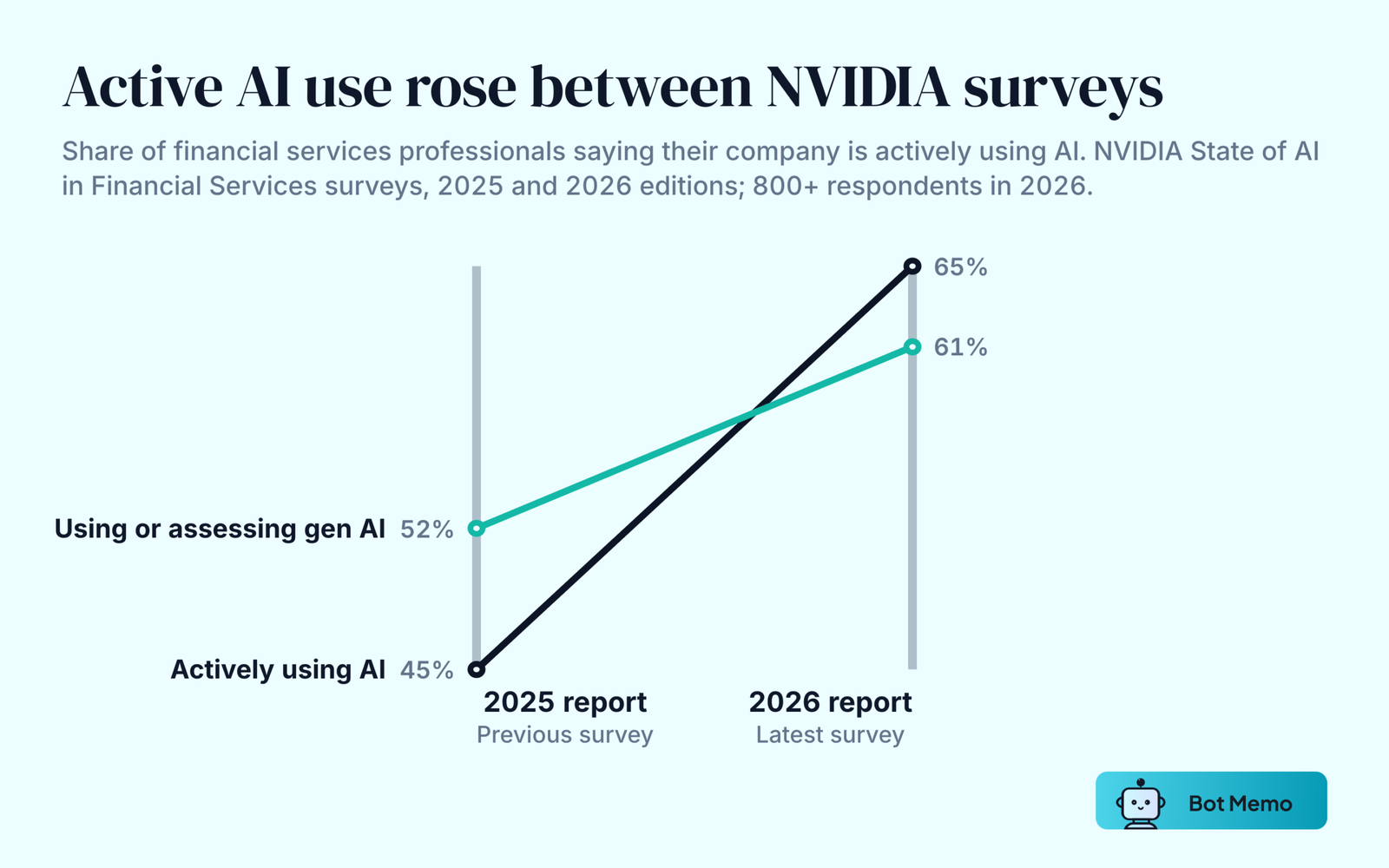
Recent surveys find AI in use at most of the financial firms they cover. In NVIDIA’s 2026 survey of more than 800 financial services professionals, 65% said their company is actively using AI, up from 45% a year earlier. The European Central Bank says more than 85% of the large banks it supervises use AI in some form.
The payoff is harder to find. Gartner found that 84% of finance organizations have implemented or plan to implement AI, yet only 7% report a high or very high impact from it. JPMorganChase expects to spend about $19.8 billion on technology in 2026, up 10% year on year.
This page collects AI in finance statistics for 2026 from the sources that publish them: analyst surveys, bank and insurer disclosures, central banks, regulators and market researchers. Each stat names its source and date. Figures from earlier versions of this page are kept where their source still supports them, and shown next to the newer number where one exists. Retired figures are listed at the end with the reason.
On this page
- How Big Is The AI In Finance Market
- AI Adoption In Financial Services Statistics
- How Banks Use AI In 2026
- AI Fraud Detection Statistics
- AI In Trading, Lending And Insurance
- AI And Finance Jobs Statistics
- AI Regulation And Financial Stability Statistics
- AI ROI And Investment Statistics For Finance
- Key Takeaways
- Frequently Asked Questions
- Sources And Methodology
How Big Is The AI In Finance Market
AI In Finance Market Size Forecasts
1. The AI in finance market is projected to grow from $38.36 billion in 2024 to $190.33 billion by 2030, a compound annual growth rate of 30.6%. (MarketsandMarkets, 2025)
2. Verified Market Research values the AI in finance market at $31.54 billion in 2024 and projects $249.53 billion by 2032, growing 34.3% a year from 2025. The two forecasts use different definitions and end years, so they are not directly comparable. (Verified Market Research, 2025)
3. The generative AI in financial services market was estimated at $2.21 billion in 2024 and $2.96 billion in 2025, and is projected to reach $25.71 billion by 2033, a 31.0% annual rate. (Grand View Research, 2025)
4. The market for AI agents in financial services was estimated at $490.2 million in 2024 and $691.3 million in 2025. It is forecast to reach $4.49 billion by 2030, growing 45.4% a year. (Grand View Research, 2025)
5. The AI in insurance market is projected to grow from $10.82 billion in 2025 to about $176.58 billion by 2035, a 32.21% annual rate. (Precedence Research, 2026)
AI And Technology Spending In Finance
6. Financial sector spending on AI was forecast to more than double to $97 billion in 2027, a 29% compound annual growth rate and the fastest of five major industries, according to a market research forecast reported by the IMF. (IMF, Finance and Development, December 2023)
7. JPMorganChase spent more than $15 billion a year on technology in 2023, according to the IMF. The bank put its 2025 technology spend at about $18 billion (JPMorganChase Investor Day, May 2025), and expects to spend about $19.8 billion in 2026, up 10% year on year. Then and now: more than $15 billion in 2023, about $19.8 billion in 2026. (JPMorganChase 2026 Company Update, February 2026)
8. 75% of CFOs are raising technology budgets for 2026, and 48% plan increases of 10% or more. Nearly 60% plan to raise AI investment in the finance function by 10% or more. Gartner surveyed more than 300 CFOs and finance leaders in October 2025. (Gartner, February 2026)
9. Business spend on AI-enabled financial fraud detection and prevention platforms was forecast to exceed $10 billion in 2027, up from just over $6.5 billion in 2022. Separately, Juniper forecast that the cost savings from these platforms would reach $10.4 billion in 2027, up from $2.7 billion in 2022. (Juniper Research, November 2022)
What AI Could Mean For Bank Profits
10. Generative AI could add $200 billion to $340 billion a year to global banking, equal to 9% to 15% of operating profits. The estimate draws on a McKinsey Global Institute analysis of 63 generative AI use cases across all industries. (McKinsey, 2023)
11. AI could lift the banking industry’s 2028 profits by 9%, or $170 billion, from just over $1.8 trillion to close to $2 trillion. (Citi GPS, AI in Finance, June 2024)
12. The risk runs the other way too. If banks do not respond to consumers using AI to make financial decisions, their profit pools could shrink by an average of 9% globally. Credit card lending and consumer deposits are most exposed, with potential drops of 34% and 27%. (McKinsey, January 2026)
13. Accenture projects that banks adopting generative AI early could see, over three years, a 22% to 30% improvement in productivity, a 600 basis point rise in revenue growth and a 300 basis point increase in return on equity. (Accenture, The Age of AI: Banking’s New Reality, 2024)
For the startups building these tools, see our AI startup funding statistics and the corporate VC AI investments breakdown.
AI Adoption In Financial Services Statistics
How Many Financial Institutions Use AI
14. 65% of financial services professionals said their company is actively using AI, up from 45% in the previous year’s survey. 61% are using or assessing generative AI, up from 52%. NVIDIA surveyed more than 800 industry professionals. (NVIDIA, State of AI in Financial Services, January 2026)
15. In NVIDIA’s 2024 edition, 91% of financial services companies were either assessing AI or already using it in production. (NVIDIA, State of AI in Financial Services, 2024)
16. More than 85% of the large banks directly supervised by the European Central Bank already use AI in some form, and adoption rates rise year after year, according to the ECB’s annual technology data collection. (ECB Banking Supervision, February 2026)
17. 75% of UK financial services firms were already using AI, and a further 10% planned to adopt it within three years, in a Bank of England and Financial Conduct Authority survey. (Bank of England and FCA, November 2024)
18. 99% of financial services leaders said their organizations were deploying AI in some manner. Skepticism was highest in insurance (24%), followed by wealth and asset management (21%) and banking and capital markets (17%). EY surveyed 300 leaders at firms with more than $2 billion in revenue in August 2023. (EY, December 2023)
19. In the newer IIF and EY survey of 61 institutions, including global systemically important banks, insurers and asset managers, every institution planning a change in its AI investment for 2025 planned an increase. The two EY studies use different samples and ask different questions. (IIF and EY, October 2025)
AI In The Finance Function
20. 39% of finance organizations were using AI or machine learning and another 29% planned to, for 68% in total. Gartner surveyed 133 finance leaders in May 2023 and found that organizations with a high level of AI acceptance report a high level of success. (Gartner, December 2023)
21. Later Gartner surveys found 58% of finance functions used AI in 2024, in a survey of 121 finance leaders (Gartner, September 2024), and 59% did in 2025, in a survey of 183 CFOs and senior finance leaders. Then and now: 39% in 2023, 59% in 2025. These are separate surveys with different samples, and Gartner’s 2025 release gives the 2023 baseline as 37%, so they are not a precise like-for-like trend. (Gartner, November 2025)
22. 84% of finance organizations have implemented or plan to implement AI, but only 7% report a high or very high impact from it, according to a Gartner survey of 183 CFOs in June 2025. (Gartner, June 2026)
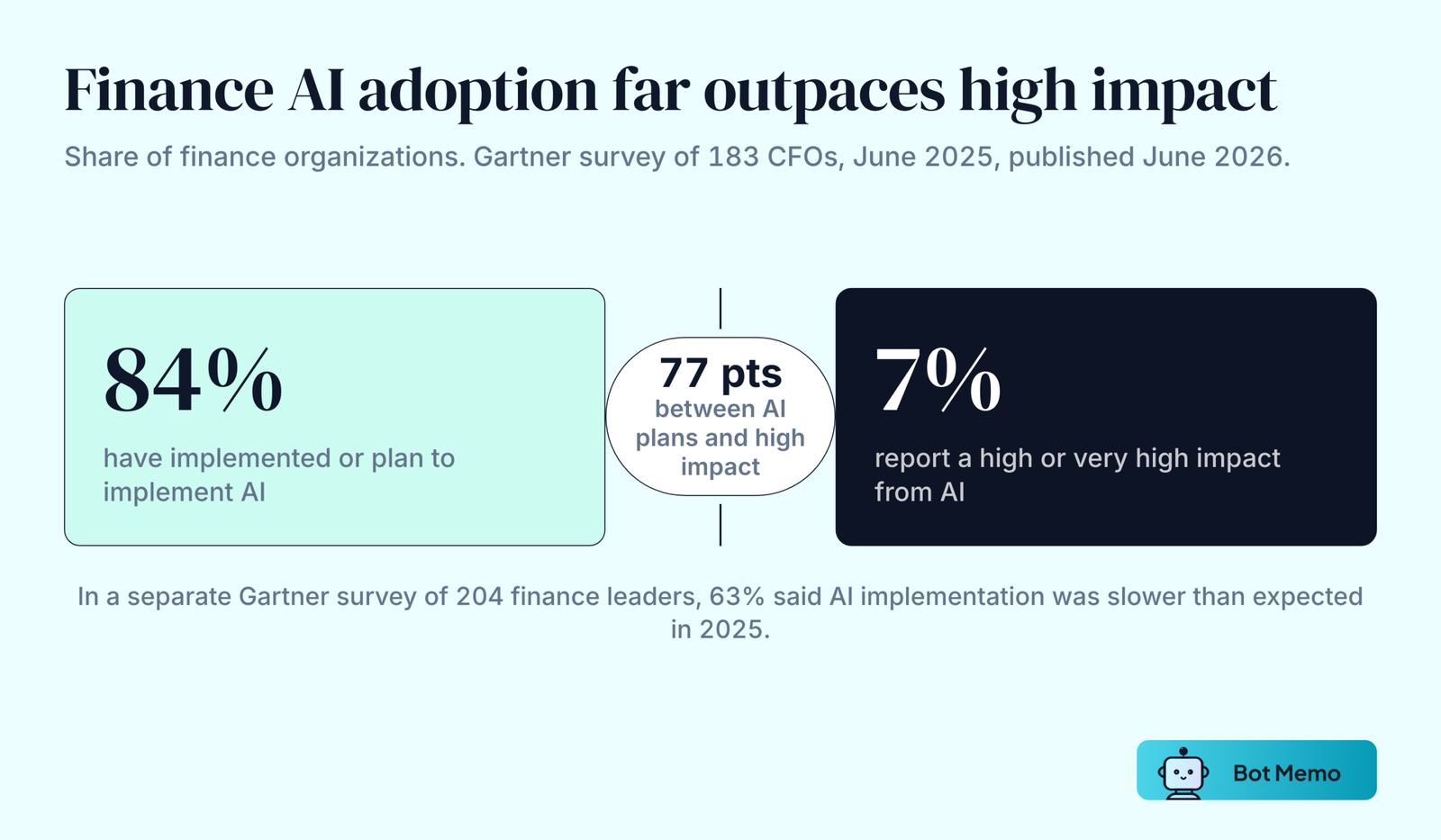
23. Among finance organizations that have adopted AI, 66% name greater efficiency and productivity as a top benefit, but 63% said AI implementation was slower than expected in 2025. Gartner surveyed 204 finance leaders in March 2026. (Gartner, May 2026)
24. 45% of finance AI investments lean toward productivity, while 20% lean toward better decision quality. (Gartner, July 2026)
25. Simple finance AI use cases such as data extraction, accounts payable and receivable automation, and report creation generally deliver returns within nine to 10 months. Gartner surveyed 160 senior finance leaders from January to April 2026 and names low AI literacy as the biggest barrier to value. (Gartner, September 2026)
Gartner also published a short explainer video on AI in finance: Gartner experts on AI in finance.
Early AI Adoption In European Financial Services
These figures come from PwC Germany’s first AI in financial services study, based on 151 executives at banks, insurers and fintechs in Germany, Austria and Switzerland, published in May 2020.
26. 45% of decision-makers considered AI an important innovation at the time. A larger share, 62%, expected AI to become fairly or very important in the financial industry over the next five years. (PwC Germany, May 2020)
27. 55% of executives were already using AI in new areas such as chatbots, automation and predictive marketing. (PwC Germany, May 2020)
28. 79% wanted AI to make their digital processes more efficient, 73% wanted general cost savings, and 50% expected AI to help them comply with regulations. (PwC Germany, May 2020)
29. On average, 7% of IT project budgets were assigned to AI, while 21% of change and innovation budgets were AI-focused. (PwC Germany, May 2020)
Which Banks Lead On AI
30. JPMorganChase ranked first in the 2024 Evident AI Index of 50 banks, followed by Capital One, Royal Bank of Canada, Wells Fargo and CommBank. (Evident Insights, October 2024)
31. In the 2025 index, JPMorganChase, Capital One and RBC held the top three places again. CommBank rose to fourth and Morgan Stanley jumped five places to fifth. Twice as many banks reported total return on investment across their AI use cases as a year earlier. Evident’s 2026 editions so far cover Latin America and the Middle East and Africa, not this ranking. (Evident Insights, October 2025)
32. In a study of 16 of the largest financial institutions in Europe and the US, more than 50% had chosen a centrally led operating model for generative AI. (McKinsey, March 2024)
33. 86% of executives planned to increase generative AI investment in 2025, and 80% expected AI’s value to exceed expectations. Only 34% of organizations had scaled AI for a core process. (Accenture Banking Blog, February 2026)
How Banks Use AI In 2026
AI Tools For Bank Employees
34. More than 200,000 JPMorganChase employees have access to LLM Suite, the bank’s generative AI platform. Some groups of users say it saves them several hours a week. (JPMorganChase Investor Day, May 2025)
35. JPMorganChase doubled the number of AI use cases in production in 2025, focusing on customer service, call center efficiency and software engineering. (JPMorganChase 2026 Company Update, February 2026)
36. Ten leading banks in the Evident AI Index, including JPMorganChase, Citi and Bank of America, have put AI tools in the hands of more than 800,000 employees, two-thirds of their combined workforce. New AI use cases launched by 50 of the largest financial firms doubled compared with the second half of 2024. (Banking Dive, citing Evident Insights, August 2025)
37. In 2025, 20.6 million users interacted with Bank of America’s virtual assistant Erica nearly 700 million times. Total client interactions since its 2018 launch have passed 3.2 billion. (Bank of America, March 2026)
38. PwC reached an agreement with OpenAI that made it the first reseller of ChatGPT Enterprise and the product’s largest user. (CFO.com, May 2024)
Agentic AI In Banking
39. In NVIDIA’s 2026 survey, 42% of respondents said their company was using or assessing agentic AI, and 21% said it had already deployed AI agents. (NVIDIA, State of AI in Financial Services, January 2026)
40. Nine of the 50 largest financial firms documented AI agents in pilot or production. BNY, Capital One and JPMorganChase were the only ones to disclose details of the architecture behind their agentic workflows. (Banking Dive, citing Evident Insights, August 2025)
41. Citi began rolling out agentic AI capabilities to 5,000 employees in September 2025. (Banking Dive, September 2025)
42. Goldman Sachs began testing Devin, an autonomous AI software engineer from Cognition, alongside its 12,000 human developers. Chief technology officer Marco Argenti told CNBC this kind of AI could raise productivity by up to three or four times the rate of earlier AI tools. (CNBC, July 2025)
How Banks Expect AI To Change Work
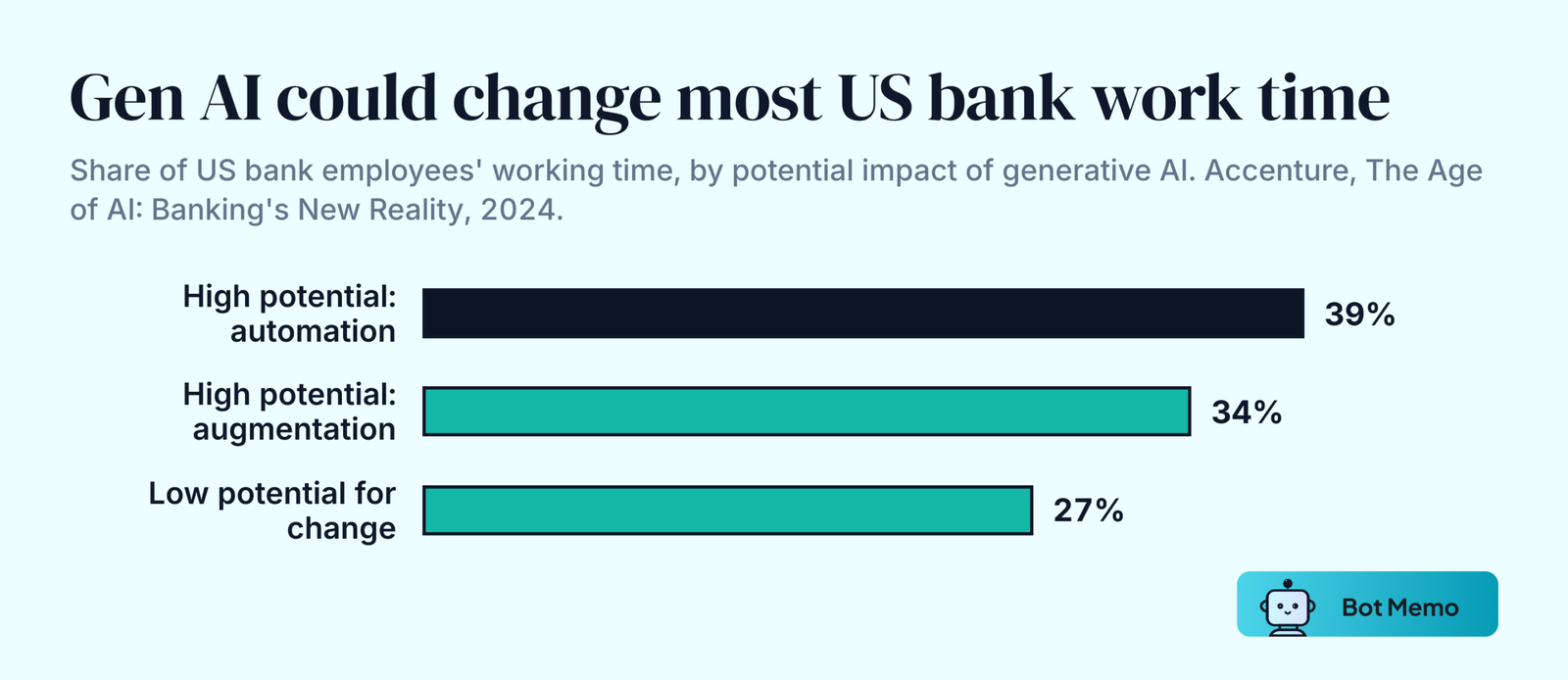
43. 73% of the time US bank employees spend working has a high potential to be affected by generative AI: 39% through automation and 34% through augmentation. Only 27% of their time has a low potential for change. (Accenture, The Age of AI: Banking’s New Reality, 2024)
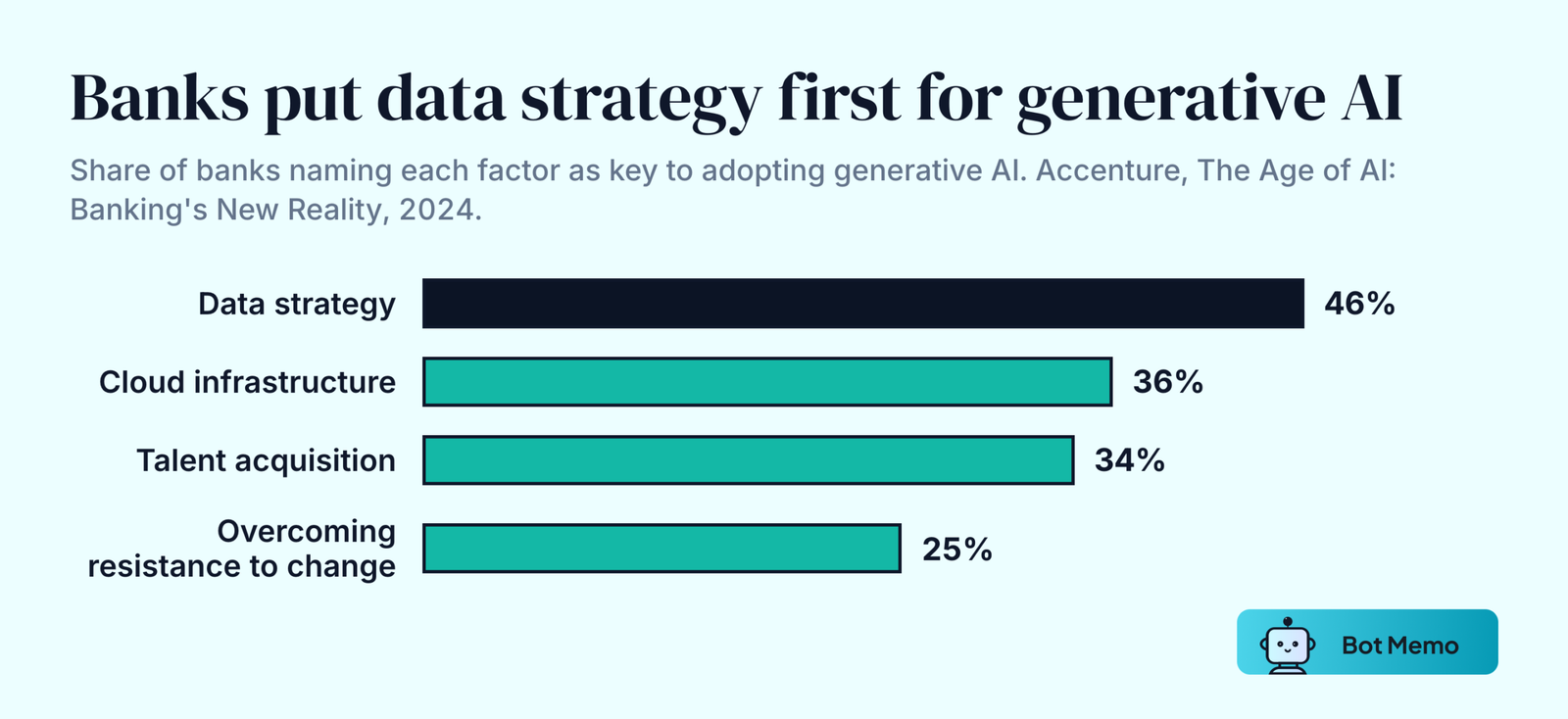
44. Banks named data strategy (46%), cloud infrastructure (36%), talent acquisition (34%) and overcoming worker resistance to change (25%) as the factors most important to adopting generative AI successfully. (Accenture, The Age of AI: Banking’s New Reality, 2024)
45. BBVA onboards customers in minutes using AI-based facial recognition and text analytics in its mobile app, and offers one-click loans that can fund the same day. Accenture says this contributed to 150% growth in new customers. Nearly 50 million BBVA customers use digital channels, seven in 10 sales are digital, and cost-to-income has fallen to 43%. (Accenture, The Age of AI: Banking’s New Reality, 2024)
46. AI in digital identity verification is forecast to save banks $900 million in operational costs by 2028 and 29 million onboarding hours, cutting the average onboarding check from more than 11 minutes in 2023 to under 8 minutes. (Juniper Research, November 2023)
Obstacles To AI Adoption In Finance
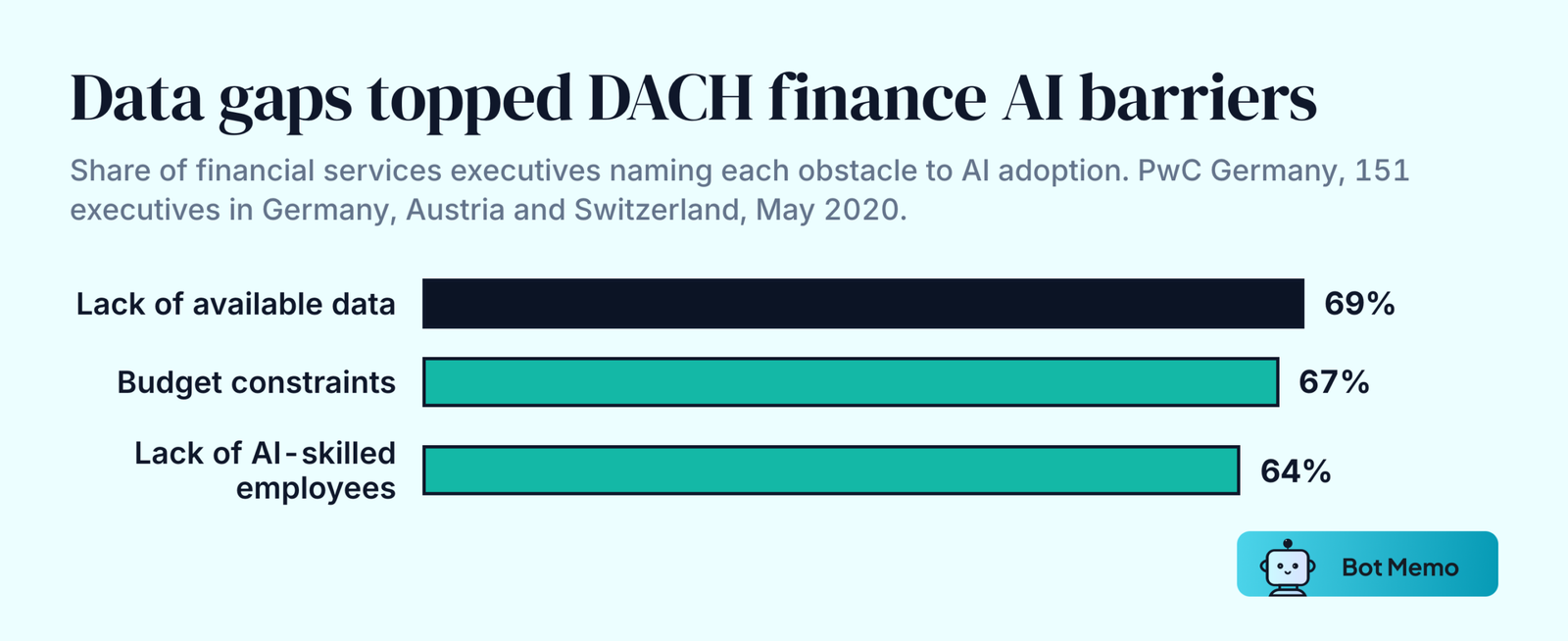
47. The biggest obstacles to AI adoption named by financial services executives were lack of available data (69%), budget constraints (67%) and lack of AI-skilled employees (64%). (PwC Germany, May 2020)
48. CFOs ranked building AI talent in the finance function as one of their two most challenging priorities for the next six months. Gartner surveyed 100 CFOs from January to February 2026. (Gartner, March 2026)
49. “There’s a war for talent,” said Alexandra Mousavizadeh, founder of Evident Insights. “Making sure you are ahead of it now is really life and death.” (IMF, Finance and Development, December 2023)
AI Fraud Detection Statistics
Fraud Stopped By Payment Networks
50. Mastercard’s AI-powered cybersecurity tools stopped more than $35 billion in fraud losses over the three years to mid-2023. (Mastercard, July 2023)
51. Mastercard’s Decision Intelligence scores 143 billion transactions a year. Mastercard’s initial modelling showed generative AI enhancements raise fraud detection rates by 20% on average and by as much as 300% in some cases, and its own analysis found false positives fell by more than 85%. (Mastercard, February 2024)
52. 42% of card issuers and 26% of acquirers have saved more than $5 million in fraud attempts over the past two years thanks to AI, according to Mastercard research with Financial Times Longitude. (Mastercard, February 2026)
53. Visa identified nearly $1 billion in scam-related activity from July to December 2025, making scams the largest category of consumer payment fraud. Visa’s Michael Jabbara said the rapid adoption of AI has lowered the barrier to entry for fraud. (Visa Biannual Threats Report, May 2026)
AI-Enabled Fraud Losses
54. For the first time, the FBI’s annual internet crime report included a section on AI: 22,364 complaints costing Americans nearly $893 million, out of nearly $21 billion in total cyber-enabled crime losses in 2025. (FBI, April 2026)
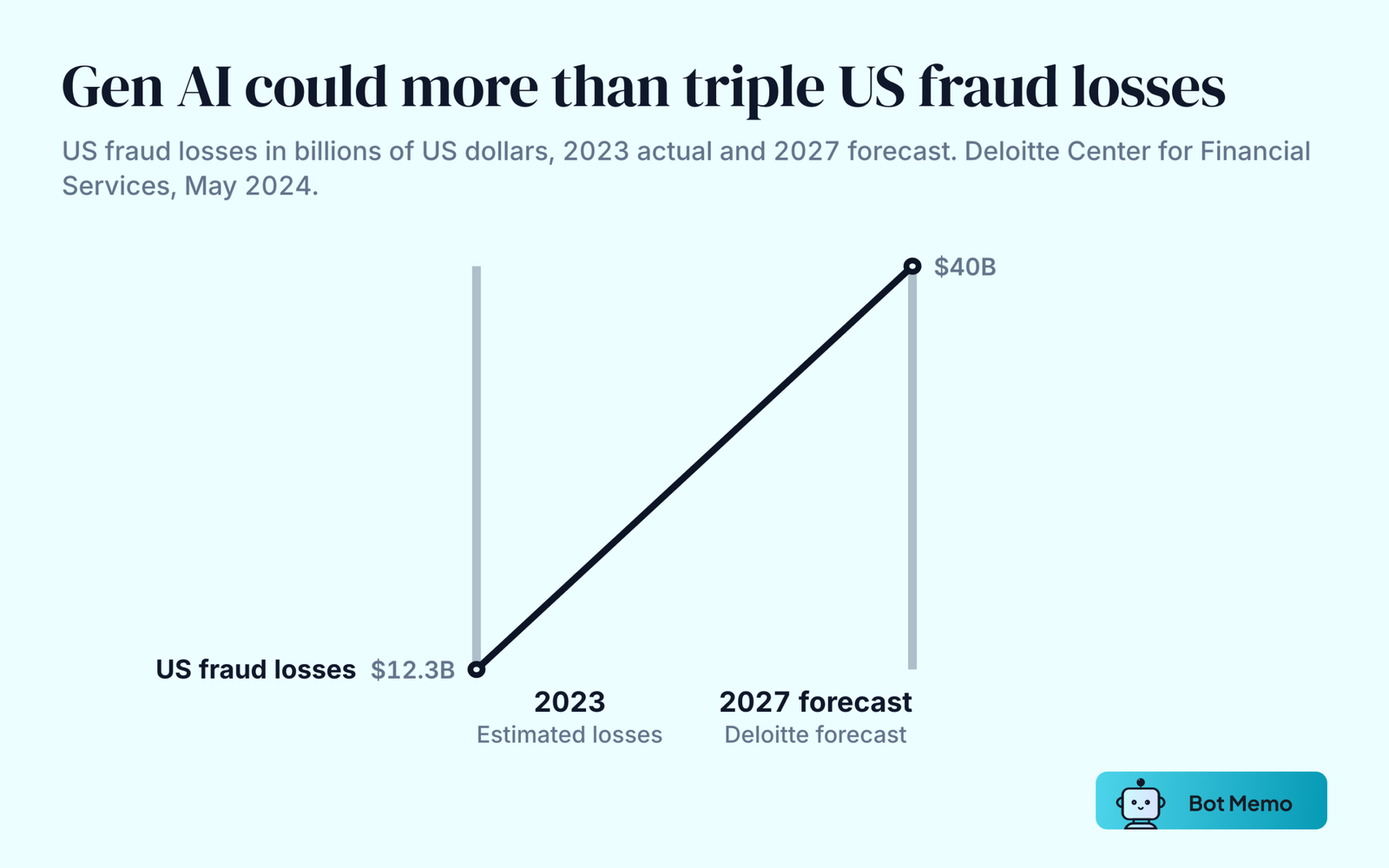
55. Generative AI could push US fraud losses to $40 billion by 2027, up from $12.3 billion in 2023, a 32% compound annual growth rate. (Deloitte Center for Financial Services, May 2024)
56. Deepfake fraud attempts seen by Pindrop rose by more than 1,300% in 2024, from an average of one a month to seven a day. (Pindrop, Voice Intelligence and Security Report, June 2025)
57. Resemble AI counted more than $200 million in documented financial damages from deepfake incidents worldwide in the first quarter of 2025. (Resemble AI, 2025)
The Cost Of Financial Crime Compliance
58. Financial crime compliance costs financial institutions more than $206 billion a year worldwide. (LexisNexis Risk Solutions, September 2023)
AI In Trading, Lending And Insurance
AI In Trading And Capital Markets
59. The share of AI content in patent applications related to algorithmic trading rose from 19% in 2017 to more than 50% each year since 2020. AI-driven ETFs turn over their holdings about once a month, while a typical actively managed equity ETF does so much less than once a year. (IMF, Global Financial Stability Report, October 2024)
60. The high-frequency trading market was valued at $10.36 billion in 2024 and is expected to reach $16.03 billion by 2030, growing 7.7% a year. (Grand View Research, November 2024)
AI In Credit And Lending
61. Upstart says its AI model approves 44.28% more borrowers than a traditional model at 36% lower APRs, based on its own October 2023 data. (Upstart, October 2023 data)
62. The CFPB’s 2019 update on Upstart’s no-action letter reported that the model approved 27% more applicants than a traditional model, with 16% lower average APRs. The CFPB said it did not replicate these simulations itself. Then and now: 27% more approvals in the 2019 CFPB update, 44.28% in Upstart’s own later figures. Both come from simulations run on Upstart’s data, so they are not a like-for-like trend. (CFPB, August 2019)
63. Upstart originated 455,788 loans in the fourth quarter of 2025, up 86% year over year. (Upstart, February 2026)
AI In Insurance
64. As of December 31, 2025, Lemonade’s claims bot took the first notice of loss without human intervention 96% of the time, and roughly 55% of claims were fully automated. (Lemonade annual report, February 2026)
AI In Financial Customer Service
65. Klarna said in February 2024 that its AI assistant handled 2.3 million conversations in its first month, two-thirds of its customer service chats, doing the work of 700 full-time agents. It estimated a $40 million profit improvement for 2024. (Klarna, February 2024)
66. By May 2025 Klarna was reinvesting in human customer service. “Really investing in the quality of the human support is the way of the future for us,” said CEO Sebastian Siemiatkowski. (Customer Experience Dive, May 2025)
More numbers on AI chat assistants are in our chatbot statistics and AI customer experience statistics.
AI And Finance Jobs Statistics
Finance Jobs Exposed To AI
67. 54% of jobs in banking have a high potential for AI-led automation, and another 12% for augmentation, according to Accenture data cited by Citi. Insurance follows at 48% for automation. (Citi GPS, AI in Finance, June 2024)
68. Across all industries, the World Economic Forum expects 170 million jobs to be created and 92 million displaced by 2030, a net gain of 78 million. (World Economic Forum, Future of Jobs Report 2025, January 2025)
Bank Headcount In 2026
69. The six largest US banks cut more than 5,000 jobs in the first quarter of 2026, with Wells Fargo leading at more than 4,000, even as they earned $47.3 billion in net income. The headcount figures cover cuts for all reasons, not only AI. (Bloomberg, April 2026)
70. Goldman Sachs describes its One GS 3.0 plan as “a new operating model propelled by artificial intelligence” and lists goals to optimize headcount, accelerate AI adoption across its employees and automate error-prone workflows. (Goldman Sachs fourth quarter 2025 results, January 2026)
For the wider labor picture, see our AI replacing jobs statistics.
AI Regulation And Financial Stability Statistics
EU AI Act Rules For Finance
71. The EU AI Act treats AI used to assess the creditworthiness of individuals and to price life and health insurance as high-risk. Its high-risk obligations were due to apply from August 2, 2026. An amending regulation published in July 2026 moved that date to December 2, 2027. Then and now: August 2026 originally, December 2027 today. AI used only to detect financial fraud is excluded from the credit category. (Regulation (EU) 2026/1744, Official Journal of the EU, July 2026)
72. Fines reach €35 million or 7% of worldwide annual turnover for prohibited AI practices, and €15 million or 3% for breaching most other obligations, including those for high-risk systems. (EU AI Act, Article 99, 2024)
US Securities Regulators
73. Then-SEC Chair Gary Gensler warned that AI could spark a financial crisis. “AI may heighten financial fragility, as it could promote herding,” he said. Gensler left the SEC on January 20, 2025 (SEC). (IMF, Finance and Development, December 2023)
74. The SEC withdrew its July 2023 proposal on conflicts of interest from predictive data analytics used by broker-dealers and investment advisers. The withdrawal notice was issued on June 12, 2025 and took effect on June 17. (SEC, June 2025)
Central Banks And Financial Stability
75. The Bank of England said US equity valuations were close to their most stretched since the dot-com bubble. About half of AI infrastructure investment is expected to be financed externally, mostly through debt, which could raise losses on lending if asset prices correct. (Bank of England, Financial Stability Report, December 2025)
76. Almost half of central banks intend to put at least 5% of their budget into AI and machine learning projects within three years, according to a 2024 Irving Fisher Committee survey of central banks cited in a BIS report to the G20. (BIS, October 2025)
AI ROI And Investment Statistics For Finance
Reported Returns From Financial Firms
77. 86% of financial services respondents reported a positive impact on revenue from AI and 82% a reduction in costs. 51% strongly agreed that AI would be important to their company’s future success, a 76% relative increase from the year before, and 97% planned to invest more in AI. (NVIDIA, State of AI in Financial Services, 2024)
78. Nearly 70% of respondents said AI raised revenue by 5% or more, and more than 60% said it cut annual costs by 5% or more. (NVIDIA, State of AI in Financial Services, February 2025)
79. 89% said AI is helping increase annual revenue and decrease annual costs. 29% saw revenue rise by more than 10%, and 25% saw costs fall by more than 10%. Nearly all expect their AI budgets to rise or stay the same. (NVIDIA, State of AI in Financial Services, January 2026)
Returns Across All Industries
80. 56% of CEOs say their companies have seen neither higher revenue nor lower costs from AI over the past 12 months. Only 12% have seen both. PwC surveyed 4,454 CEOs in 95 countries and territories. (PwC, 29th Global CEO Survey, January 2026)
81. 74% of business leaders say AI will remain a top investment priority even in a recession, and they plan to invest a weighted average of $186 million in AI over the next 12 months. KPMG polled 2,110 senior leaders in 20 countries. (KPMG Global AI Pulse Survey, March 2026)
Forecasts For Finance Teams
82. Gartner predicts that by 2029, CFOs whose organizations deploy AI and technology resources strategically will gain an additional 10 points of margin growth. (Gartner, April 2026)
Key Takeaways
- 65% of financial services professionals say their company actively uses AI, up from 45% in the previous survey (NVIDIA, 2026).
- 84% of finance organizations have implemented or plan to implement AI, but only 7% report a high or very high impact (Gartner).
- JPMorganChase expects to spend about $19.8 billion on technology in 2026, up from more than $15 billion in 2023.
- Generative AI could push US fraud losses to $40 billion by 2027, from $12.3 billion in 2023 (Deloitte).
- The EU AI Act’s high-risk rules for credit scoring and insurance pricing now apply from December 2, 2027, not August 2026.
- The six largest US banks cut more than 5,000 jobs in early 2026 while earning $47.3 billion in net income (Bloomberg).
Frequently Asked Questions
How Big Is The AI In Finance Market?
MarketsandMarkets projects the AI in finance market to grow from $38.36 billion in 2024 to $190.33 billion by 2030. Verified Market Research forecasts $249.53 billion by 2032. Financial sector AI spending was forecast to reach $97 billion in 2027.
How Many Financial Institutions Use AI?
65% of financial services professionals in NVIDIA’s 2026 survey said their company actively uses AI. The ECB says more than 85% of the large banks it supervises use AI in some form, and 75% of UK financial firms were using AI in 2024.
How Is AI Used In Finance?
Common uses include fraud detection, customer service assistants, employee productivity tools, credit decisions, trading and claims handling. Bank of America’s Erica handled nearly 700 million interactions in 2025, and more than 200,000 JPMorganChase employees have access to its generative AI platform.
How Much Fraud Does AI Prevent In Banking?
Mastercard says its AI tools stopped more than $35 billion in fraud losses over three years to 2023. 42% of card issuers say AI saved them more than $5 million in fraud attempts over two years.
Is AI Replacing Jobs In Finance?
Accenture data cited by Citi puts 54% of banking jobs at high potential for automation. The six largest US banks cut more than 5,000 jobs in the first quarter of 2026, a figure that covers cuts for all reasons, not only AI. Goldman Sachs separately lists headcount optimization as a goal of its AI-driven operating model.
What Is The ROI Of AI In Financial Services?
89% of respondents to NVIDIA’s 2026 financial services survey said AI is helping raise revenue and cut costs, but only 7% of finance organizations report a high or very high impact in Gartner’s research. Across all industries, PwC found 12% of CEOs saw both revenue and cost gains.
When Does The EU AI Act Apply To Banks?
Rules for high-risk AI, including credit scoring of individuals and life and health insurance pricing, apply from December 2, 2027 after a July 2026 amendment. They were originally due on August 2, 2026.
Sources And Methodology
Every statistic on this page names its publisher and publication date. Survey sample sizes and fieldwork dates are given in the sentence where the publisher discloses them. Forecasts are labeled as forecasts. Company figures such as fraud savings, automation rates and user counts are reported by the companies themselves. Market sizes are in US dollars as published, and EU fines in euros.
Figures from earlier versions of this page are kept only where their original source still supports them. Where a newer edition of the same research exists, both numbers are shown as then and now.
Figures Retired Or Corrected From Earlier Versions Of This Page
Earlier versions of this page carried the figures below. Each has been retired, corrected or relabeled for the reason given.
- “The finance sector has one of the highest adoption rates of AI”, “invested around $35 billion into AI in 2023” and “40%+ of financial institutions use generative AI” (Verified Market Research): none of the three appears on the cited page.
- 117% growth in BBVA’s new customers (Accenture, 2024): the source says 150%, shown above.
- AI fraud detection could “save costs of up to $10.4 billion” (Juniper, 2022): the figure is correct, but the release’s headline number is platform spend of more than $10 billion. Both are now shown and labeled.
- $900 million in operational savings (Juniper, 2023): now dated to 2028 and limited to identity verification during onboarding, as in the source.
- NVIDIA 2024 breakdowns (industry-leading 25%, middle of the pack 50%, laggard 24%; management 30%, 46%, 24%; non-management 20%, 55%, 24%; operations 48%, risk and compliance 45%, marketing 34%, sales 27%; data analytics 69%, data processing 57%; 29% strongly agreeing in 2022; neutral 12% vs 27%; strongly disagree 3% vs 4%): these sit in a gated report and could not be rechecked. The public findings from the same survey, including the 76% rise in strong agreement, are shown above.
- “All respondents said they were using generative AI in some capacity or planning to” (EY, 2023): the source says 99% were deploying AI in some manner, shown above.
- “Lowest skepticism in banking and asset management, 17%” (EY, 2023): 17% applies to banking and capital markets; wealth and asset management was 21%. Both are shown above.
- “75% consider their AI implementation industry-tier or middle of the pack” (NVIDIA): the source says industry-leading or middle of the pack.
- “SEC Chair Gary Gensler”: he left the SEC in January 2025 and is now described as then-SEC Chair.
- Evident AI Index 2024 ranking as the latest: the 2025 ranking is now shown beside it.
See more of our research on the Bot Memo insights page.

About the author
Editorial Staff
The Editorial Staff at Bot Memo is a team of writers, analysts, and AI agents dedicated to mapping the global AI startup ecosystem. Led by Chintan Zalani, the team tracks thousands of funding rounds, classifies companies across verticals, and distills it all into actionable intelligence for investors and founders.