


Customer service leaders are growing AI spending far faster than their budgets. A Gartner survey from mid-2026 found AI spending in service organizations up 38%, while the function’s total budget grew 2%. Nine in ten service leaders say executives are pushing them to deploy AI in customer service.
Customers have not moved as far. In SurveyMonkey’s December 2025 poll, 8% of Americans said they prefer AI to a human for customer service. Gartner found that 87% of customers want a guaranteed route to a person whenever a company uses generative AI for support.
Customer expectations are rising too. Zendesk found 74% of consumers now expect round-the-clock service because of AI.
This page collects the AI customer service statistics and customer experience statistics for 2026 that hold up at their source: analyst surveys, company disclosures, peer-reviewed research and regulator notices. Each stat names its source and date. Figures from the 2023 and 2024 editions of this page are kept where their source still supports them, and shown beside the newer number where one exists. Retired figures are listed at the end with the reason.
On this page
- How Big Is The AI Customer Service Market In 2026
- AI Customer Service Adoption Statistics
- AI Customer Service ROI And Cost Statistics
- Customer Preference Statistics For AI And Human Agents
- AI Transparency And Customer Expectations Statistics
- AI And Customer Service Jobs Statistics
- AI Customer Service Forecasts For Customer Interactions Through 2029
- Key Takeaways
- Frequently Asked Questions
- Sources And Methodology
How Big Is The AI Customer Service Market In 2026
Conversational AI Market Forecasts
1. The conversational AI market is projected to grow from $13.64 billion in 2025 to $17.12 billion in 2026, a compound annual growth rate of 25.6%. The same report puts it at $42.51 billion by 2030. (The Business Research Company, September 2026)
2. A conversational AI market report released through ReportLinker in April 2023 forecast growth from $10.7 billion in 2023 to $29.8 billion by 2028, a 22.6% annual rate, with expansion across Asian countries supporting growth. (ReportLinker via GlobeNewswire, April 2023)
3. Newer forecasts start from a bigger base. MarketsandMarkets sizes the conversational AI market at $17.05 billion in 2025 and $49.80 billion by 2031, a 19.6% annual rate. The two forecasts come from different publishers and end in different years, so they are not a like-for-like update of the 2023 figure. (MarketsandMarkets, May 2025)
Chatbot Market Forecasts
4. Precedence Research projected in January 2023 that the chatbot market would reach about $4.9 billion by 2032, growing 19.29% a year. In 2022, North America held 41% of the market, the bot-for-service segment 36%, the marketing segment 56% by product, and ecommerce more than 21% by vertical. (Precedence Research via GlobeNewswire, January 2023)
5. Precedence Research’s current edition extends the horizon to 2035 and a market of about $7.96 billion. Its segment shares for 2025 are unchanged from the 2022 split: North America 41%, bot-for-service 36%, marketing 56% and ecommerce 21%. (Precedence Research, updated August 2026)
Revenue And Valuations Of AI Customer Service Companies
6. Salesforce’s Agentforce passed $1.5 billion in annual recurring revenue in the quarter to July 31, 2026, up more than 240% year over year. (Salesforce Q2 FY27 results, August 2026)
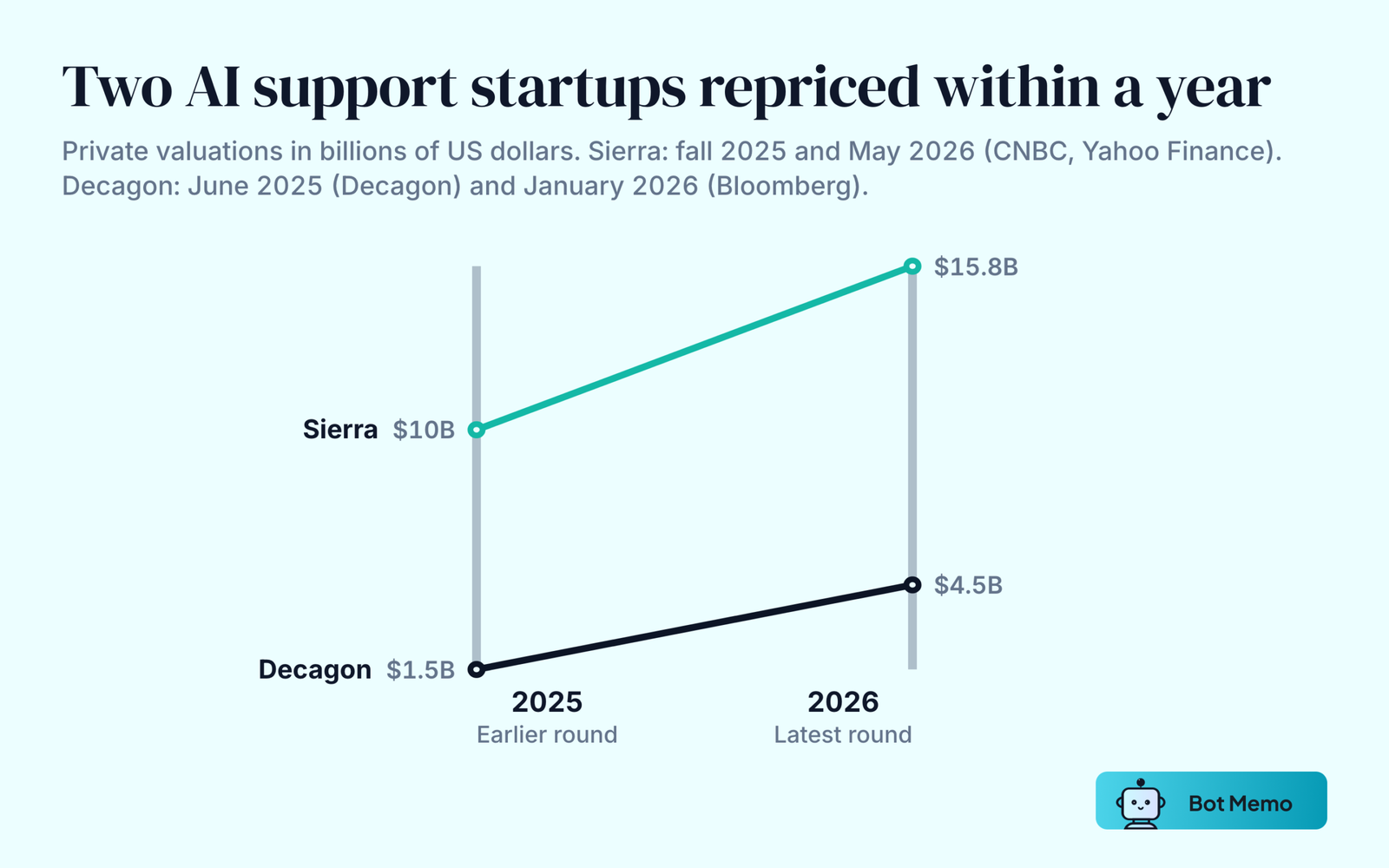
7. Sierra, the customer service AI company founded by Bret Taylor and Clay Bavor, raised a $950 million Series E in May 2026 at a $15.8 billion valuation, up from $10 billion in its previous round in fall 2025, as reported by CNBC. (Yahoo Finance, May 2026)
8. Sierra crossed $100 million in annual recurring revenue in November 2025, seven quarters after launching in February 2024, according to estimates by research firm Sacra. (Sacra, 2026)
9. Decagon, which builds AI agents for customer support, was valued at $1.5 billion in its June 2025 Series C of $131 million. (Decagon, June 2025)
10. Decagon’s valuation tripled to $4.5 billion in January 2026, when it raised $250 million. (Bloomberg, January 2026)
For the funding rounds behind these companies, see our AI agent startups funding guide and the wider AI startup funding statistics.
AI Customer Service Adoption Statistics
Pressure To Deploy AI In 2026
11. 91% of customer service and support leaders report pressure from executive leadership to implement AI in 2026. Gartner surveyed 321 service leaders in October 2025. (Gartner, February 2026)
12. 82% of senior customer service leaders say their teams invested in AI over the previous 12 months, and 87% plan to invest in 2026. (Intercom, 2026 Customer Service Transformation Report, January 2026)
13. 92% of organizations have implemented or piloted AI use cases in customer service, in a survey of 600 business decision-makers and 3,000 consumers in the US, UK and Germany. (Five9, June 2026)
14. Roughly one-third (33%) of customer experience budgets were expected to go to AI-powered technologies in 2025, according to 1,181 CX decision-makers in more than 16 countries surveyed in September and October 2024. (Genesys, State of Customer Experience, March 2025)
15. 40% of CX organizations already use agentic AI, and 82% of CX leaders expect autonomous AI agents to orchestrate customer experiences within three years. Genesys surveyed 5,811 consumers and 1,560 CX and business leaders in March and April 2026. (Genesys, 2026 State of Customer Experience, July 2026)
Agentic AI In Production
16. Only 17% of organizations have deployed AI agents, but more than 60% expect to within two years, according to Gartner’s 2026 CIO and Technology Executive Survey. (Gartner, Hype Cycle for Agentic AI, April 2026)
17. Gartner predicts 40% of enterprise applications will include task-specific AI agents by the end of 2026, up from less than 5% in 2025. (Gartner, August 2025)
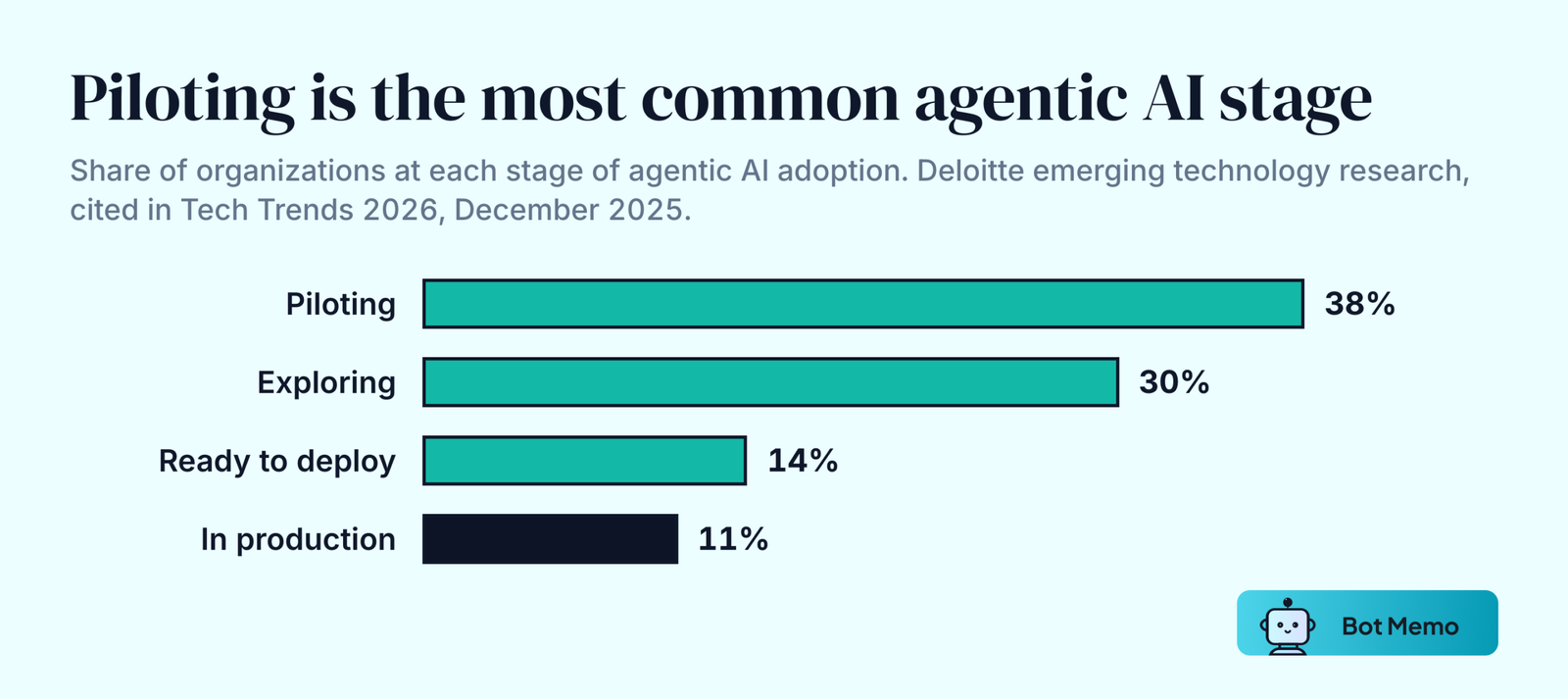
18. In Deloitte’s emerging technology research, 30% of organizations were exploring agentic AI, 38% were piloting it, 14% had solutions ready to deploy and 11% were using it in production. 42% were still developing an agentic strategy and 35% had none. (Deloitte, Tech Trends 2026, December 2025)
19. Only 21% of organizations have a mature governance model for agentic AI, according to Deloitte’s survey of 3,235 business and IT leaders in 24 countries, fielded in August and September 2025. (Deloitte, State of AI in the Enterprise 2026, 2026)
20. In McKinsey’s 2025 survey, 62% of organizations were at least experimenting with AI agents and 23% were scaling them somewhere. In any single business function, no more than 10% were scaling agents. (McKinsey, The State of AI in 2025, November 2025)
21. A year later, 40% of respondents at large organizations (more than $1 billion in revenue) report scaling AI agents, up from 27%. At smaller organizations the share stayed flat at 22%. The 2025 figure of 23% covered organizations of all sizes, so it is not directly comparable with the 2026 figure for large organizations. (McKinsey, The State of AI in 2026, August 2026)
How Businesses Planned To Use AI In 2023
These figures come from a Forbes Advisor survey of 600 US business owners using or planning to use AI, fielded by OnePoll from March 20 to April 5, 2023.
22. 73% of businesses use or plan to use AI-powered chatbots for instant messaging, 61% use AI to optimize emails, and 55% deploy AI for personalized services. (Forbes Advisor, April 2023)
23. 64% of business owners expect AI to improve customer relationships, and 60% expect it to drive sales growth. (Forbes Advisor, April 2023)
24. 46% of business owners use AI to write internal communications. (Forbes Advisor, April 2023)
25. 97% of business owners named at least one way ChatGPT would help their business. One in three planned to use it to write website content, and 44% to write content in other languages. (Forbes Advisor, April 2023)
AI Adoption By Industry
26. The industries adopting AI most at company level were computer software, entertainment, chemical and pharmaceutical, defense and insurance. Food, manufacturing, hospitality and travel, education and public service lagged. Dialpad surveyed 1,102 customer service and sales professionals in May 2023. (Dialpad, State of AI at Work, 2023)
27. Dialpad’s AI CSAT measure, which infers customer satisfaction from call transcripts, scored home services, construction, utilities and industrial highest. Pharmaceutical, insurance, legal and automotive scored lowest. (Dialpad, State of AI at Work, 2023)
The retail side of this story is covered in our AI ecommerce statistics, and chatbot usage in our chatbot statistics.
AI Customer Service ROI And Cost Statistics
AI Spending In Service Organizations
28. Spending on AI by customer service leaders rose 38%, while overall service and support budgets grew 2%. Gartner surveyed 199 service leaders in April and May 2026. (Gartner, August 2026)
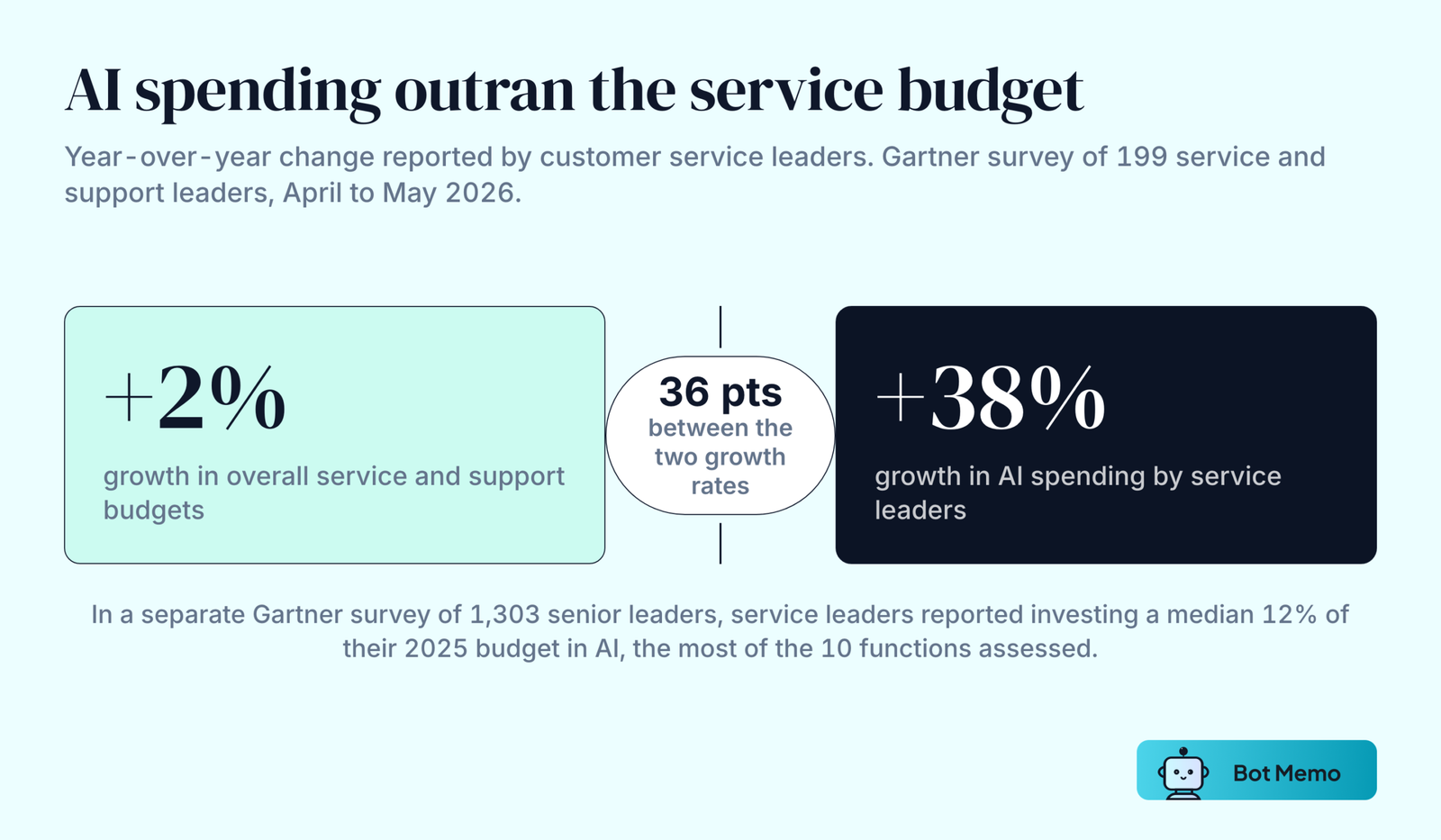
29. Service and support leaders invested a median 12% of their 2025 budget in AI, the highest of the 10 business functions Gartner assessed. (Gartner, July 2026)
30. Gartner predicts that by 2028 more than half of customer service organizations will double their technology spend without an equivalent reduction in staff. (Gartner, March 2026)
Measured Impact Of AI On Returns
31. Only 24% of service and support leaders could show positive financial returns across their AI use cases, in a Gartner survey of 1,303 senior leaders fielded from January to April 2026. (Gartner, July 2026)
32. Only 15% of AI decision-makers reported an EBITDA lift for their organization in the past 12 months. (Forrester, Predictions 2026, October 2025)
33. 62% of support teams report better customer service metrics since implementing AI. Among teams with mature AI deployments, the share rises to 87%. (Intercom, 2026 Customer Service Transformation Report, January 2026)
34. 75% of brands that use AI to personalize experiences report increased customer spend. Twilio surveyed 7,640 consumers and 637 business leaders across 18 countries. (Twilio, State of Customer Engagement, June 2025)
35. 42% of CX leaders name demonstrating AI return on investment as a top technology challenge. (Genesys, 2026 State of Customer Experience, July 2026)
Productivity And Cost Per Interaction
36. A peer-reviewed study followed 5,172 customer support agents at a Fortune 500 software company. Access to a generative AI assistant raised productivity, measured as issues resolved per hour, by 14% on average and by 34% for novice and low-skilled workers, while experienced agents saw little change. (Brynjolfsson, Li and Raymond, Quarterly Journal of Economics, 2025)
37. Salesforce says Agentforce handled 3 million support conversations on its own help site in just over a year. Support cases fell 8% year over year, more than 170,000 fewer cases, for $100 million in annualized cost savings. (Fortune, citing Salesforce, April 2026)
38. Intercom’s Fin AI agent reports an average resolution rate of 76% across more than 12,000 customers. The rate is reported by the vendor. (Fin, September 2026)
39. One Asian bank’s AI-enabled service overhaul doubled to tripled self-service use, cut service interactions by 40% to 50%, and reduced cost-to-serve by more than 20% within 12 months. (McKinsey case study, March 2023)
40. Teneo, which sells AI customer service agents, puts human agent costs at $4.00 to $8.00 per interaction in major markets and AI costs under $0.50. These are the vendor’s own figures from its client deployments. (Teneo, 2025)
41. Klarna said in February 2024 that its AI assistant handled 2.3 million conversations in its first month, two-thirds of its customer service chats, doing the work of 700 full-time agents. It estimated a $40 million profit improvement for 2024. (Klarna, February 2024)
Customer Preference Statistics For AI And Human Agents
How Many Customers Prefer A Human
42. 90% of consumers said they prefer to work with a human over a chatbot for customer support. SurveyMonkey surveyed 2,201 US consumers. (SurveyMonkey, CX and AI report, 2023)
43. In SurveyMonkey’s newer poll of 2,017 US adults, fielded December 10 to 11, 2025, 79% strongly prefer a human over an AI agent, 84% believe human agents are more accurate than AI, and 8% prefer AI over a human. Then and now: 90% preferring a human in 2023, 79% strongly preferring one in 2025. The two polls worded the question differently. (SurveyMonkey, February 2026)
44. 54% of US customers trust human agents more than AI for product or service recommendations, against 32% who trust AI more. Gartner surveyed 5,801 US customers in January and February 2025. (Gartner, April 2026)
45. 80% of consumers are willing to use AI-powered customer service, yet two-thirds still prefer a human. (Five9, June 2026)
46. 76% of consumers don’t care who resolves their issue, as long as it is solved quickly. 84% will give a virtual agent three attempts or fewer. (Genesys, 2026 State of Customer Experience, July 2026)
Why Customers Rate Human Agents Higher
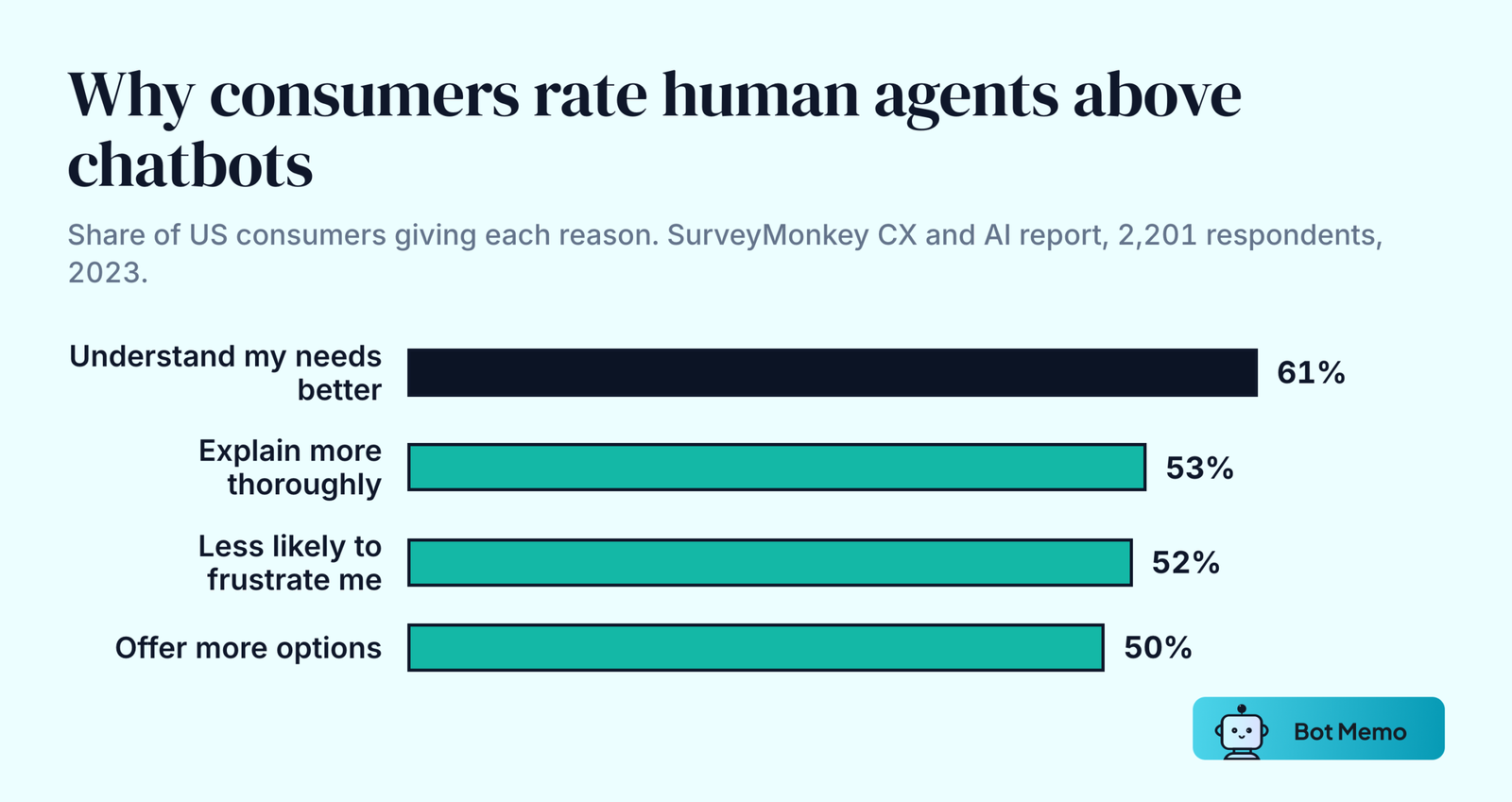
47. 61% of consumers say humans understand their needs better than AI, 53% say humans give more thorough explanations, 52% say humans are less likely to frustrate them, and 50% say humans offer more options to solve their problem. (SurveyMonkey, 2023)
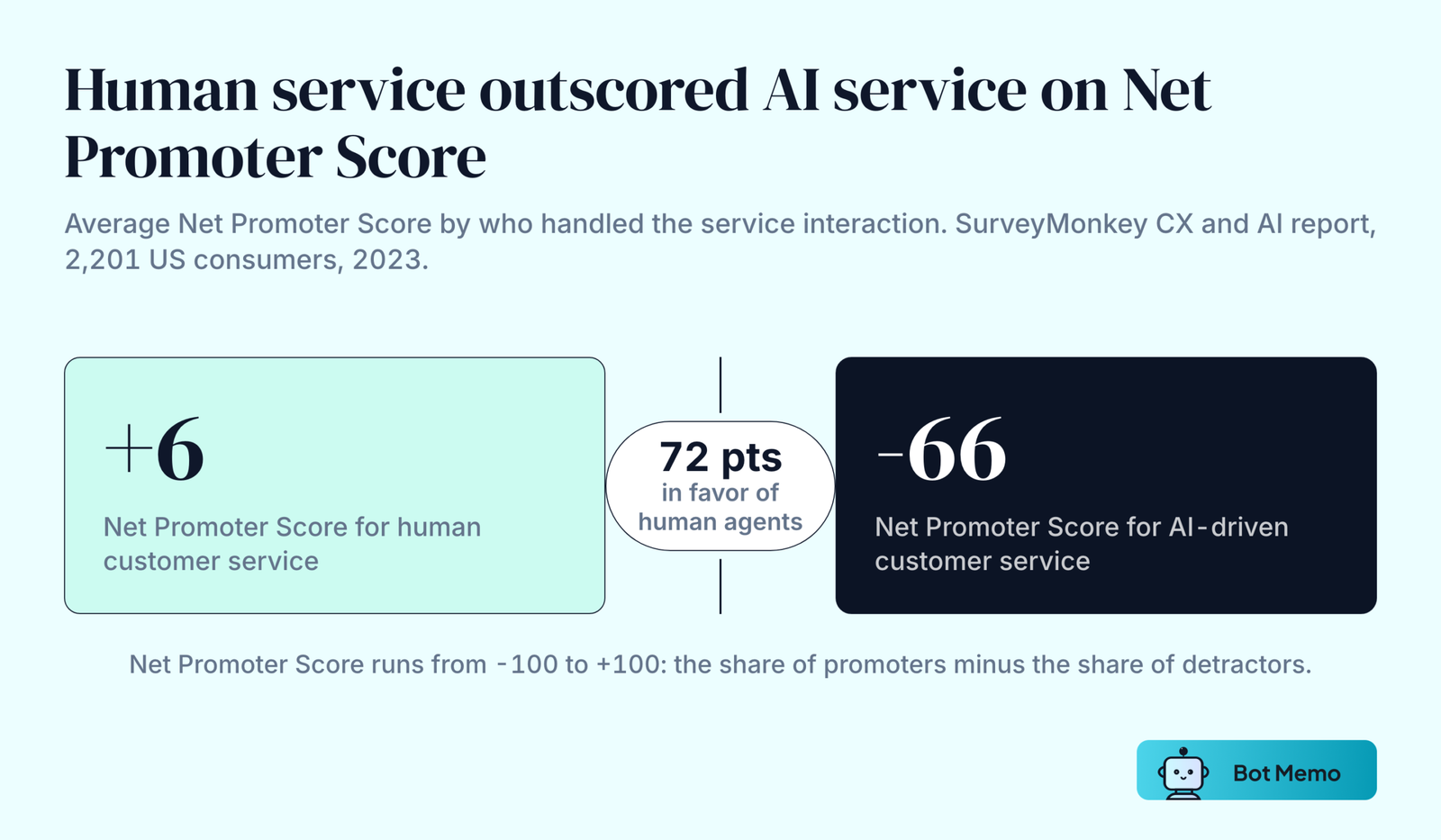
48. The average Net Promoter Score for human customer service was +6, against -66 for AI-driven service, a 72-point gap. Consumers said the AI ignored their specific needs, answered questions they had not asked, showed no empathy and could not handle complex issues. (SurveyMonkey, CX and AI report, 2023)
49. Only 41% of people under 34 felt negative about companies using AI in customer experience, compared with 72% of people over 65. (SurveyMonkey, CX and AI report, 2023)
When Customers Choose AI
50. Among consumers who prefer AI, the top reasons were better availability (41%), resolving issues faster (37%) and more accurate information (30%). (SurveyMonkey, CX and AI report, 2023)
51. Among Gen Z, 66% were interested in AI that helps them through a product or website, 63% liked the idea of personalized deals, and 56% wanted tailored product recommendations. (SurveyMonkey, CX and AI report, 2023)
52. Customers are about three times more likely to use third-party generative AI tools such as ChatGPT or Gemini than a company’s own chatbot to resolve a service issue. Gartner surveyed 3,566 B2B and B2C customers in February and March 2026. (Gartner, July 2026)
53. 58% of customers who use generative AI have used it to complete a task on their behalf, rising to 74% in B2B. (Gartner, July 2026)
54. 69% of US consumers say they would switch to automated service if it could fully resolve their issue, and 79% would switch to a competitor after a single bad service experience. Verint surveyed 5,000 US consumers in January and February 2026. (Verint, State of Customer Experience 2026, May 2026)
AI Transparency And Customer Expectations Statistics
Customer Expectations For AI Customer Support
55. 87% of customers say companies using generative AI for service must offer an option to reach a human agent, while 50% say their interactions are easier when companies use it. (Gartner, August 2026)
56. 74% of consumers now expect 24/7 service because of AI, and 95% expect a clear explanation when AI makes a decision that affects them. Zendesk surveyed 6,182 consumers and 5,115 business respondents in 22 countries. (Zendesk, CX Trends 2026, November 2025)
57. 85% of CX leaders call memory-rich AI critical to building personalized customer journeys. (Zendesk, CX Trends 2026, November 2025)
58. 71% of consumers say it is very or extremely important to know when they are talking to an AI agent. (Five9, June 2026)
Bias, Dependence And Data Concerns
59. 63% of consumers are concerned about potential bias and discrimination in AI algorithms and decision-making. Zendesk surveyed 2,818 consumers and 4,441 business respondents in 20 countries in July and August 2023. (Zendesk, CX Trends 2024, 2024)
60. 43% of business owners worry about becoming too reliant on AI, and 28% are concerned about bias errors in AI systems. (Forbes Advisor, April 2023)
61. 95% of consumers expect information to be remembered across channels, yet 48% of organizations do not automatically pass information between virtual and human agents. (Genesys, 2026 State of Customer Experience, July 2026)
Chatbot Disclosure Rules
62. From August 2, 2026, the EU AI Act requires that people be clearly told when they are interacting with an AI system such as a chatbot, AI agent or avatar, rather than a real person. (European Commission, August 2026)
AI And Customer Service Jobs Statistics
Headcount Changes So Far
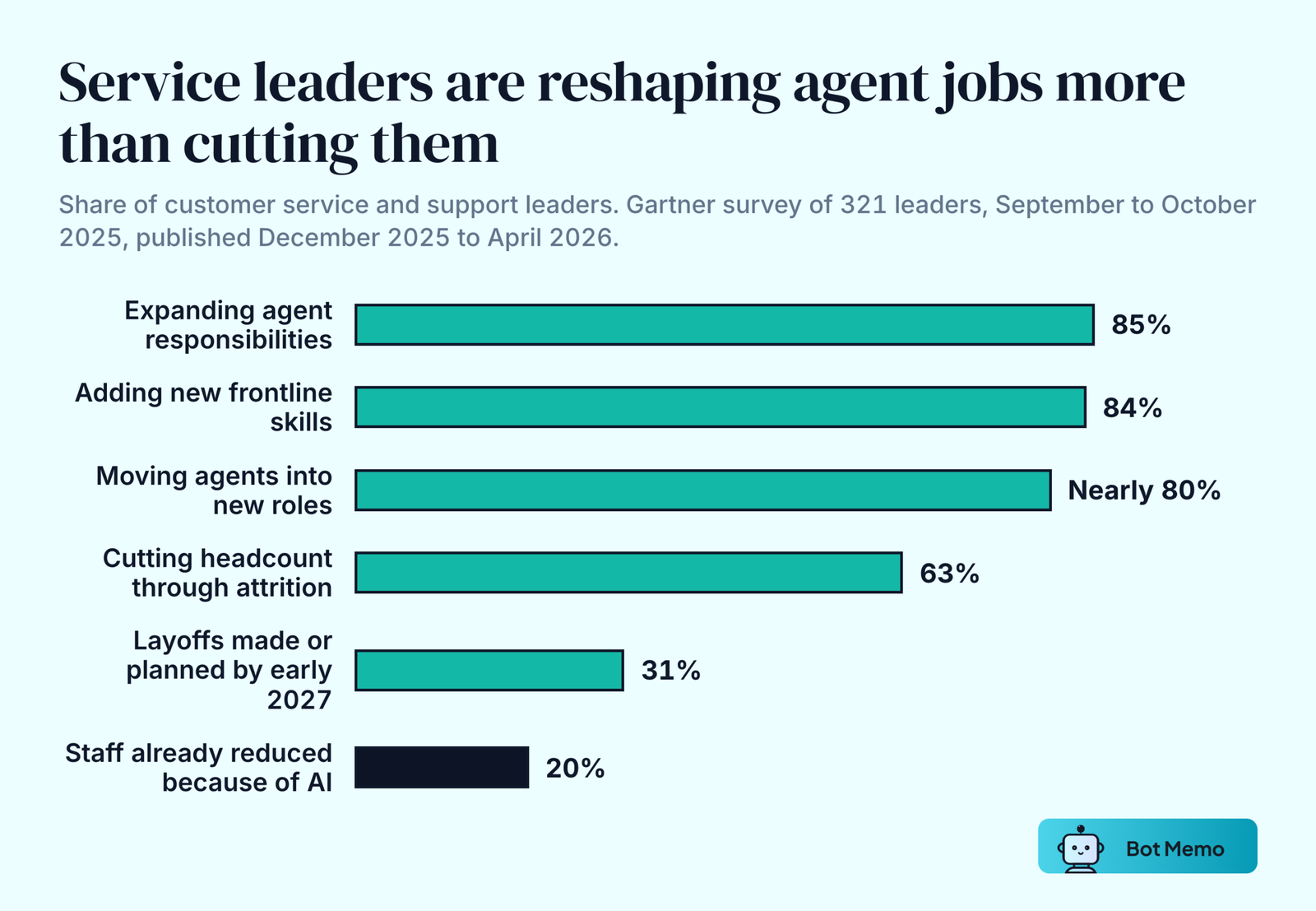
63. Only 20% of customer service leaders have reduced agent staffing because of AI, in Gartner’s October 2025 survey of 321 service leaders. (Gartner, December 2025)
64. 85% of service and support leaders are expanding human agent responsibilities as AI reduces contact volume. 31% have made or plan frontline layoffs in response to AI through the first quarter of 2027. (Gartner, April 2026)
65. 63% of service leaders are reducing frontline headcount gradually through attrition rather than layoffs. (Gartner, April 2026)
66. Nearly 80% of organizations plan to move at least some agents into new roles, and 84% plan to add new skills to frontline positions. (Gartner, March 2026)
Rehiring After AI Cuts
67. Gartner predicts that by 2027, half of the companies that cut customer service staff because of AI will rehire people to do similar work under different job titles. (Gartner, February 2026)
68. Klarna began reinvesting in human customer service staff in May 2025, after its CEO, Sebastian Siemiatkowski, said its focus on cost had produced lower quality service. (Customer Experience Dive, May 2025)
How Agents And CX Leaders See AI Tools
69. 78% of support leaders expect AI to transform customer support careers in the next five years, creating new opportunities and job roles. Intercom surveyed more than 1,000 support professionals. (Intercom, State of AI in Customer Service, June 2023)
70. Around 70% of customer service and sales professionals don’t fear that AI will take their job, and 79% of those using AI tools at work say it has improved their performance. Dialpad also found managers, directors and VPs used AI more than individual contributors. (Dialpad, State of AI at Work, 2023)
71. 37% of customer service and sales professionals said lack of budget was the reason AI tools were not used at work. (Dialpad, State of AI at Work, 2023)
72. 75% of CX leaders see AI as a force that amplifies human intelligence rather than replacing it, and 69% say forecasting future labor needs accurately remains a significant challenge. (Zendesk, CX Trends 2024, 2024)
73. 36% of customer service reps said the biggest benefit of AI tools is round-the-clock service, and 30% said AI reduces average handling time, for example by gathering customer details before a conversation. HubSpot surveyed more than 1,000 service professionals. (HubSpot, May 2024)
74. 86% of CRM leaders say AI makes customer correspondence more personalized. HubSpot surveyed 1,537 customer experience leaders in March 2024. (HubSpot, State of Service 2024, 2024)
For the wider labor picture, see our AI replacing jobs statistics.
AI Customer Service Forecasts For Customer Interactions Through 2029
Chatbots As A Primary Channel
75. In July 2022, Gartner predicted that by 2027 chatbots would become the primary customer service channel for roughly a quarter of organizations. “Chatbots and virtual customer assistants (VCAs) have evolved over the past decade to become a critical technology component of a service organization’s strategy,” said Uma Challa, Senior Director Analyst in the Gartner Customer Service and Support practice. (Gartner, July 2022)
Autonomous Resolution
76. Gartner predicts agentic AI will resolve 80% of common customer service issues without human help by 2029, cutting operational costs by 30%. (Gartner, March 2025)
77. Technology decision-makers expect 56% of their customer service interactions with technology vendors to run through agentic AI within 12 months, and 68% by 2028. Cisco surveyed 7,950 decision-makers in 30 countries. (Cisco, May 2025)
AI In Every Customer Interaction
78. Zendesk CEO Tom Eggemeier has said 80% of customer interactions with companies will go through AI within five years, and 100% will involve AI in some way. (CXOTalk interview, July 2025)
Key Takeaways
- AI spending in service organizations rose 38% while service budgets grew 2% (Gartner, 2026).
- 91% of service leaders feel executive pressure to deploy AI, but only 17% of organizations have deployed AI agents (Gartner).
- Only 24% of service leaders can show positive financial returns from AI, and 15% of AI decision-makers see an EBITDA lift (Gartner, Forrester).
- Only 8% of Americans prefer AI to a human for customer service, and 87% of customers want guaranteed access to a person (SurveyMonkey, Gartner).
- Just 20% of service leaders have cut staff because of AI, and 85% are expanding what human agents do (Gartner).
- A peer-reviewed study found a generative AI assistant raised productivity 34% for novice and low-skilled support agents and 14% on average.
Frequently Asked Questions
What Percentage Of Companies Use AI In Customer Service?
92% of organizations have implemented or piloted AI in customer service, according to Five9’s 2026 survey. Production use of AI agents is far lower: Gartner puts deployment of AI agents at 17% of organizations, and Deloitte found 11% using agentic AI in production.
How Much Does AI Reduce Customer Service Costs?
Results vary by deployment. Salesforce reports $100 million in annualized savings from Agentforce on its own help site, and a McKinsey bank case study found cost-to-serve fell more than 20%. Across the market, Gartner found only 24% of service leaders could show positive financial returns from AI.
Do Customers Prefer AI Or Human Customer Service?
Most prefer humans. SurveyMonkey found 79% of Americans strongly prefer a human and 8% prefer AI. Customers also turn to outside AI tools. Gartner found they are three times more likely to use tools such as ChatGPT than a company chatbot to solve a service issue.
How Big Is The Conversational AI Market In 2026?
The Business Research Company projects $17.12 billion in 2026, up from $13.64 billion in 2025. MarketsandMarkets forecasts $49.80 billion by 2031.
Is AI Replacing Customer Service Agents?
Not at scale so far. Only 20% of service leaders have reduced agent headcount because of AI, and Gartner predicts half of the companies that cut staff for AI will rehire by 2027 under new job titles.
What Is Agentic AI In Customer Service?
Agentic AI refers to AI systems that carry out customer service tasks on their own, instead of only answering questions. Gartner predicts it will resolve 80% of common service issues without human help by 2029.
Sources And Methodology
Every statistic on this page names its publisher and publication date. Survey sample sizes and fieldwork dates are given in the sentence where the publisher discloses them. Forecasts are labeled as predictions. Vendor figures such as resolution rates, savings and cost per interaction are reported by the companies themselves and use different definitions, so they are not directly comparable.
Figures from earlier versions of this page are kept only where their original source still supports them. Where a newer edition of the same research exists, both numbers are shown as then and now. Market sizes are in US dollars as published.
Figures Retired From Earlier Versions Of This Page
Earlier versions of this page carried the figures below. Each is no longer shown, for the reason given.
- 76% of CEOs worried about AI being a black box (PwC, 2024): the figure does not appear in the cited PwC report or in its later editions.
- 31% of service teams saying AI saves hours on manual tasks (HubSpot): the figure could not be found in any HubSpot State of Service material.
- 30% saying AI helps them respond better to customer requests (HubSpot): the source’s 30% measures reduced handling time and is shown above with that meaning.
- 51% saying humans give more options (SurveyMonkey, 2023): the source figure is 50%, shown above.
- 40% of business owners concerned about over-dependence on technology (Forbes Advisor, 2023): the source figure is 43%, shown above.
- “AI will eventually play a role in 100% of customer interactions” (Zendesk blog, 2024): the cited post does not attribute the line to anyone. Tom Eggemeier’s own prediction is quoted above.
- The 2024 dating of the SurveyMonkey consumer figures: the report is from 2023 and is now dated that way.
See more of our research on the Bot Memo insights page.

About the author
Editorial Staff
The Editorial Staff at Bot Memo is a team of writers, analysts, and AI agents dedicated to mapping the global AI startup ecosystem. Led by Chintan Zalani, the team tracks thousands of funding rounds, classifies companies across verticals, and distills it all into actionable intelligence for investors and founders.