

Domain-specialist AI startups raised $158.3B in equity from January to September 2026, 66% more than in the same months of 2025. Their share of all AI startup money still fell, from 49.8% to 30.8%, because the generalist side grew faster. OpenAI, Anthropic and xAI alone took $237B in four rounds, more than all specialists combined. So specialists still close four in five AI rounds and raise more each year, but the market’s dollars are moving to models and compute faster than to them.
On this page
The 2026 numbers in one view
Across 4,460 equity rounds by AI startups in the first nine months of 2026, specialists closed 3,563, or 79.9%. They also closed 343 of the 533 rounds of $100M or more, and 15 rounds of $1B or more. Their median round was $9.0M against $13.5M for generalist companies, so a typical specialist round is smaller, but the top of the market is no longer generalist-only.
Specialists took 64.4% of AI startup equity funding in January to September 2024 and 49.8% in the same months of 2025. In 2026 that fell to 30.8%. Specialist funding grew every year, from $75.9B to $95.6B to $158.3B, but the frontier labs and the compute behind them grew much faster.
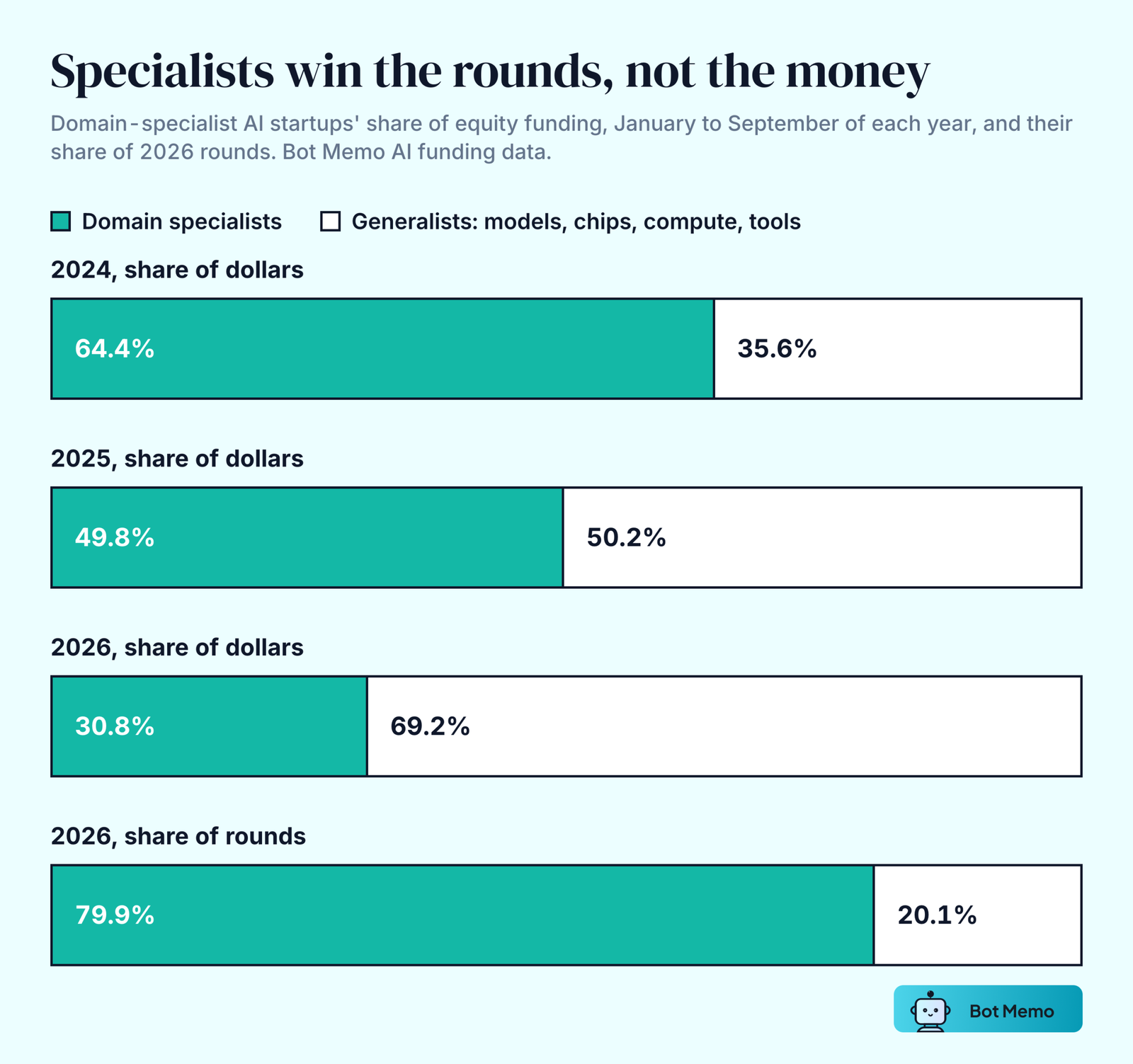
AI startup equity funding rose by $322B between the first nine months of 2025 and 2026. OpenAI, Anthropic and xAI took $175B of that increase. The rest of the generalist side, which covers other model labs, AI chip makers, compute and data center builders, developer tools and cross-industry software, took $85B, reaching $118.4B across 893 rounds. Specialists took $63B. Take the three big labs out of the count entirely and specialists still fall from 73.9% of the remaining money to 57.2%, so the shift is wider than three companies.
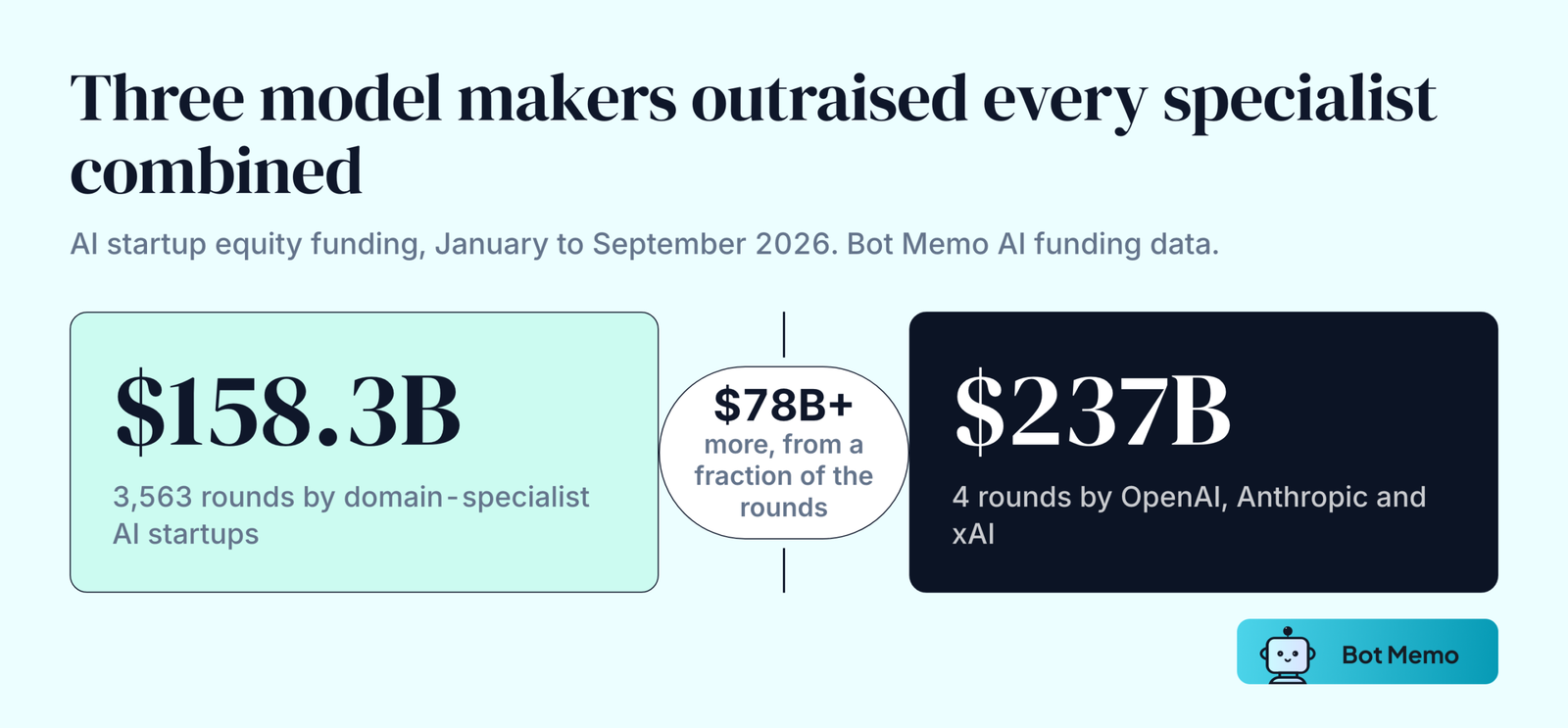
The four rounds are OpenAI’s $122B, Anthropic’s $30B Series G in February and $65B Series H in May, and xAI’s $20B Series E in January. Two of those totals need qualifying. OpenAI’s $122B round, which closed in March at an $852B post-money valuation, includes Amazon money that is reportedly tied to a public listing or a technical milestone. Anthropic’s Series H, at a $965B post-money valuation, includes $15B of compute partners’ investment that had been committed earlier. Take out the $35B of conditional Amazon money and the $15B of earlier commitments and the three labs still raised about $187B, more than every specialist combined.
What counts as vertical AI
A vertical AI company sells to one industry and builds around that industry’s data, rules and workflows. Harvey for law firms, Aidoc for radiology, Rogo for investment banks and Anduril for defense are all vertical. In this report “specialist” is a broad grouping. It covers industry specialists (health, finance, legal, defense, manufacturing) and also function specialists in cybersecurity, sales and customer service, and HR, because both sell a narrow job to a defined buyer. That is wider than the industry-only meaning most investors give “vertical AI”. Counting industry specialists alone, the share of AI startup equity funding was 54.7% in January to September 2024, 42.5% in 2025 and 27.0% in 2026, so the trend is the same either way.
Generalist, or horizontal, AI works the same way for any customer. That covers foundation model labs, AI chips, compute and data centers, developer tools and cross-industry business software. OpenAI, Anthropic, Databricks, Cerebras and Cursor sit on this side. By our convention, coding tools count as generalist even though software engineering is a job function, because they sit in the same developer and infrastructure layer as the models and compute they run on. Our AI vertical framework lists the 18 sectors behind the split.
Vertical AI also differs from vertical SaaS. Investor Andrew Oved described the gap in a November 2025 essay: vertical SaaS runs on fixed, predictable logic, while vertical AI uses models trained on data to make probabilistic calls. Products that complete measurable tasks may be able to charge per task rather than per seat.
The thesis: domain data plus workflow
The investor case for vertical AI rests on three claims.
The first is data. The argument is that a model trained and tested on one domain’s documents, outcomes and edge cases should beat a general model given a prompt and a retrieval step, because it has been graded against that domain’s idea of a right answer. Bessemer’s Building Vertical AI playbook (January 2026) says early success depends on high-quality, relevant data that compounds as the business grows, and that the edge comes from combining data types with workflow integration rather than from proprietary models alone.
The second is workflow. A general assistant lives in a browser tab. A vertical product lives inside the system the customer already runs, such as the document system at a law firm or the imaging workflow at a hospital. Once it drafts the first version of the work, replacing it can mean a migration rather than a feature comparison.
The third is accuracy in regulated work. Hospitals, banks, insurers and defense buyers do not accept outputs they cannot check. Aidoc’s radiology products go through FDA clearance, and a new entrant has to clear the same bar. Greylock’s vertical AI thesis (December 2023) called deep domain focus “a viable wedge to establish defensible moats”, and NEA’s Tomorrow’s Titans: Vertical AI argued that the next large software companies will be AI firms built for specific industries. Bessemer’s State of AI 2025 (August 2025) restated the firm’s view that vertical AI has the potential to eclipse even the most successful legacy vertical SaaS markets.
Enterprise spending data points the same way. Menlo Ventures’ 2024 State of Generative AI in the Enterprise (November 2024) put enterprise generative AI spend in healthcare at $500M and in legal at $350M. Its 2025 edition (December 2025) found vertical AI applications took $3.5B in 2025, nearly three times the $1.2B of 2024, with healthcare near $1.5B and legal at $650M. Horizontal applications were still larger at $8.4B, and departmental tools, which Menlo counts separately from vertical ones and which include coding, sales, support and HR products, reached $7.3B.
Where the specialist money went in 2026
Specialist funding is concentrated in a handful of sectors, and the biggest are physical and regulated industries rather than the office software categories that dominated early vertical AI pitches.
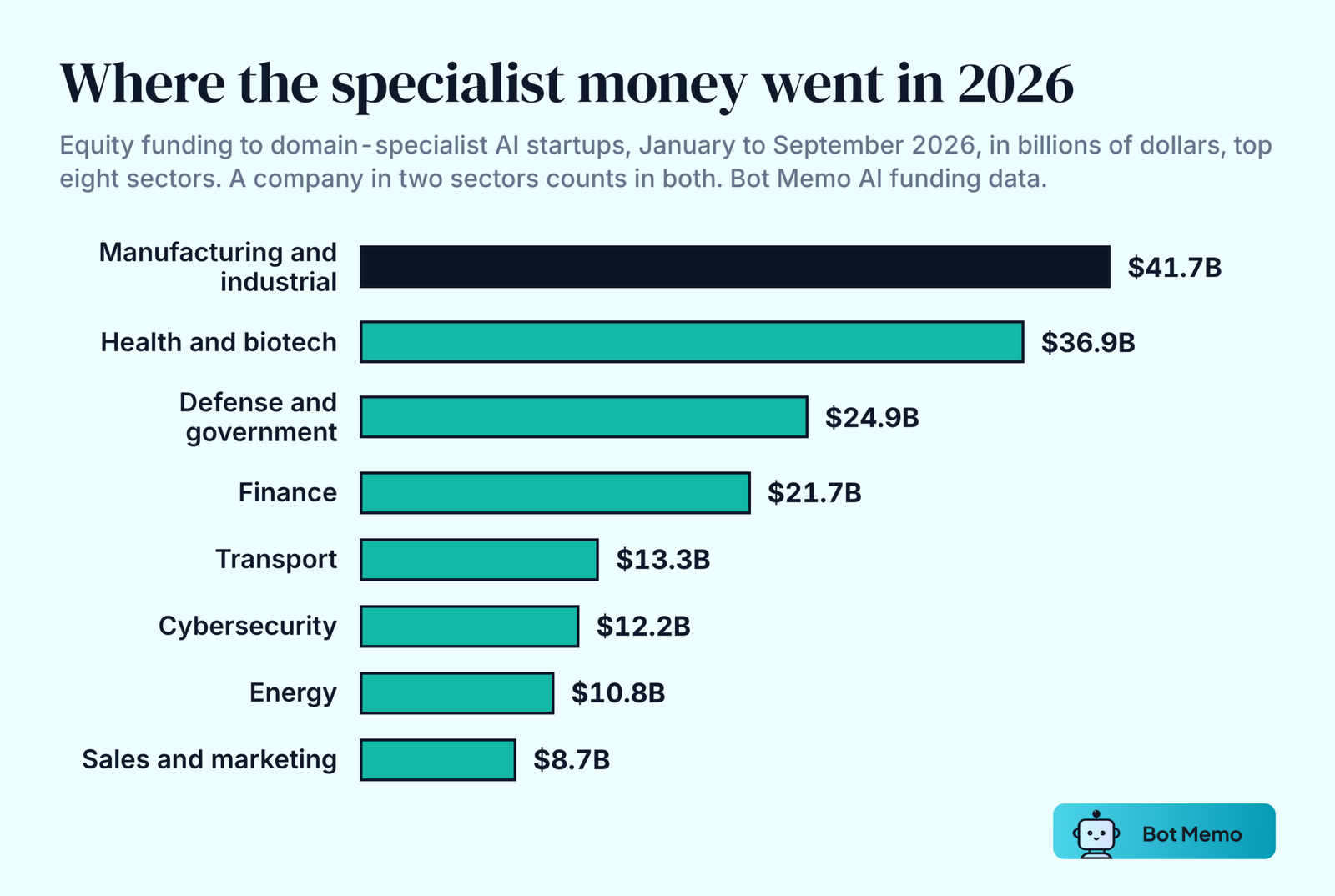
Manufacturing and industrial AI, which includes robotics, factory automation and engineering software, grew from $9.4B in January to September 2025 to $41.7B in 2026, more than four times as much. Defense and government more than doubled, from $11.0B to $24.9B, and so did transport, from $5.8B to $13.3B. Health and biotech rose 69% to $36.9B. Finance grew more slowly, up 21% to $21.7B. A company that sells into two sectors counts in both, so sector totals add up to more than the specialist total.
Manufacturing and robotics
Prometheus, the engineering and manufacturing AI company backed by Jeff Bezos, raised a $12B Series B at a $41B valuation in June, the largest specialist round of the year. Skild AI raised about $1.4B in a Series C led by SoftBank Group in January at a valuation above $14B, and Hadrian, which builds automated factories for defense and aerospace parts, raised a $1.37B Series D at $7.87B in August. More on the sector in our top AI robotics startups list.
Defense
Anduril raised a $5B Series H at $61B in May, led by Thrive Capital and Andreessen Horowitz. Saronic raised a $1.75B Series D at $9.25B in March, led by Kleiner Perkins. Helsing raised $1.8B in a Series E at $18B in July, and Shield AI closed a $1.5B Series G at $12.7B in March, co-led by Advent International and JPMorgan’s strategic investment group. Defense matches the thesis on each count. The buyer is a government, the accuracy bar is high, and new suppliers have to get through long procurement processes.
Health and biotech
Isomorphic Labs raised a $2.1B Series B in May, led by Thrive Capital. Chai Discovery raised a $400M Series C at $3.8B in July, led by Index Ventures. OpenEvidence, which answers clinical questions for doctors, raised a $250M Series D at $12B in January, co-led by Thrive Capital and DST Global. Aidoc raised a $150M Series E in April, led by the growth equity team at Goldman Sachs Alternatives. The full sector cut is in our top AI healthcare startups list.
Finance
Ramp raised a $750M Series F at $44B in June. Rogo, which automates analyst work at investment banks, raised a $160M Series D in April led by Kleiner Perkins at about $2B. Basis, which builds AI agents for accounting firms, raised a $100M Series B at $1.15B in February, led by Accel. Our top AI fintech startups list covers the wider sector.
Customer service
Customer service agents are a function specialty that sells across industries. Sierra raised $950M in a Series E in May, led by Tiger Global and GV, at a reported $15.8B. Decagon raised a $250M Series D at $4.5B in January, co-led by Coatue and Index Ventures, and Parloa raised a $350M Series D at $3B the same month, led by General Catalyst. Agent funding more broadly is in our AI agent startups guide.
Legal
Legal AI is the most cited example of the thesis, and its funding was flat. Legal tech startups raised $2.85B from January to September 2026 against $2.86B a year earlier, across 87 rounds against 95. Harvey and Legora took nearly half of it. Harvey raised $200M at $11B in March, co-led by GIC and Sequoia, then $550M at $15.5B in September, co-led by Diffusion and Lightspeed. Legora raised a $550M Series D at $5.55B in March, led by Accel, and added $50M to the same round in April at $5.6B. See our AI legal tech startups list for the rest of the field.
Where horizontal still wins
Generalists lead in three places.
There is no vertical substitute for foundation models, and most specialists build on models from the frontier labs. Each new model release raises the floor for what a thin wrapper can do, which squeezes specialists whose only edge was prompt work.
A developer at a bank and a developer at a hospital write code with the same tools, and a GPU cluster serves every industry. These businesses grow with total AI usage, whichever sector it comes from. The same goes for general productivity. Chat assistants and writing tools are often bought for individual users rather than for one workflow, and in Menlo’s 2025 numbers enterprise spending on horizontal applications was still more than twice the spending on vertical ones.
The thesis gives specialists the edge where the data is private, the work is regulated and the cost of a wrong answer is high, and gives generalists the edge where none of that applies. Funding totals alone cannot settle which side is right. Our AI Trends 2026: What’s Funded vs What’s Hyped covers the wider split, and our list of AI startups that raised $50M or more covers every large 2026 round.
What this means for founders
Pick a domain where your customers hold data no general model can see, and where a mistake costs real money. Those are the conditions in which customers are most likely to pay a premium. Build inside the customer’s existing systems early, and price on finished work rather than seats. Expect your model supplier to keep improving; if the next release would make your product redundant, the product is too thin.
The funding data also says where the large checks are. At least ten of the 15 specialist rounds of $1B or more from January to September 2026 went to defense, robotics and manufacturing companies, and none went to general office software. Founders in legal, HR and education AI are raising in markets where total funding was flat or down. HR tech fell 21% and education 16% from January to September 2026, compared with the same months of 2025.
What this means for investors
OpenAI, Anthropic and xAI took 46.1% of AI startup equity funding from January to September 2026, so a portfolio weighted to where AI money went is close to half a bet on three labs. Investors who want exposure to the application layer have to choose specialists on purpose, because the market-weighted default is generalist.
Stage matters by sector. In legal and customer service, Harvey, Legora, Sierra and Decagon all raised in 2026 at valuations above $4B. Defense and robotics now carry rounds above $1B, which prices out most early funds at the later stages. Food and education AI remain small, with three rounds of $100M or more each from January to September 2026. The company-level detail sits in our AI startup repository.
How we measured it
Figures cover equity rounds announced by AI startups from January to September of each year in Bot Memo’s AI funding data. Debt, convertible notes and grants are left out, as are rounds raised by units of larger companies, such as Waymo’s $16B round in February (most of it reportedly from its parent, Alphabet) and Kuaishou’s video model Kling AI. Each round is grouped by the sector of the company that raised it. A company in any industry or function sector counts as a specialist. Foundation model labs, AI chip makers, compute and data center builders, developer tools and general business software count as generalists, even when they sell mostly into one industry.
Frequently asked questions
What is vertical AI?
Vertical AI is software built for one industry, using that industry’s data and workflows. Harvey for law firms, Aidoc for radiology and Rogo for investment banks are examples.
What is the difference between vertical AI and horizontal AI?
Vertical AI targets one domain. Horizontal AI works the same way for any customer: foundation models, compute, developer tools and general assistants. Vertical companies rely on domain data and workflow depth. Horizontal companies rely on scale and capital.
How much funding did domain-specialist AI startups raise in 2026?
Domain-specialist AI startups raised $158.3B in equity from January to September 2026, up 66% from $95.6B in the same months of 2025. That was 30.8% of all AI startup equity funding in the period, down from 49.8%.
Why did domain specialists’ share of AI funding fall in 2026?
Because generalist funding grew faster. AI startup equity rose by $322B from January to September 2026 against a year earlier, and OpenAI, Anthropic and xAI took $175B of the increase while specialists took $63B. Even without those three labs, the specialist share fell from 73.9% to 57.2% as chip, compute and other model companies raised more.
Which sectors get the most vertical AI funding?
Manufacturing and industrial AI led 2026 with $41.7B from January to September, followed by health and biotech at $36.9B, defense and government at $24.9B and finance at $21.7B.
Is legal AI still growing?
Not in total funding. Legal tech startups raised $2.85B from January to September 2026, flat on a year earlier, and Harvey and Legora took nearly half of it.
Where does horizontal AI still beat vertical AI?
In foundation models, compute and developer tools, and general productivity products bought by individual users. Anywhere the data is not domain-specific and the workflow is the same across industries, generalists tend to win.

About the author
Editorial Staff
The Editorial Staff at Bot Memo is a team of writers, analysts, and AI agents dedicated to mapping the global AI startup ecosystem. Led by Chintan Zalani, the team tracks thousands of funding rounds, classifies companies across verticals, and distills it all into actionable intelligence for investors and founders.