
Defense AI funding reached $42.5 billion across 646 rounds in defense and government tech between January 2023 and August 2026. The first eight months of 2026 alone brought in $23 billion over 230 rounds, about twice the $11.7 billion raised in all of 2025 and 2.5 times the money raised in the same eight months of 2025.
The money is concentrated and mostly American. Eight rounds of $1 billion or more raised $16.6 billion of the $42.5 billion, and Anduril took three of them. Europe is catching up on round count: European rounds rose from 25 to 69 between January to August 2025 and the same months of 2026, while US rounds rose from 97 to 113. Europe still trails at Series B and later, and US investors joined 13 of the 15 largest European rounds.
On this page
- Defense AI Funding Market Overview
- Defense AI Funding by Year, 2023 to 2026
- Largest Defense AI Funding Rounds
- Defense AI Funding in Europe vs the US
- European Defense Tech Funding by Stage and Investor Base
- Defense AI Funding by Segment
- Defense Startup Valuations and Round Sizes
- Defense AI Funding by City
- Top Defense AI Companies and Investors
- Key Takeaways
- Frequently Asked Questions
- Methodology
Defense AI Funding Market Overview
| Metric | Value |
|---|---|
| Rounds, Jan 2023 to Aug 2026 | 646 |
| Total raised, Jan 2023 to Aug 2026 | $42.5B |
| Raised by year | 2023: $3.3B (104 rounds); 2024: $4.5B (131); 2025: $11.7B (181); 2026 Jan to Aug: $23B (230) |
| Rounds of $1B or more | 8, six of them in 2026 |
| Largest round | Anduril, $5B, May 2026 |
| Share of 2026 money in the six largest rounds | 55% ($12.6B of $23B) |
| Rank among 18 AI verticals by share of US and European rounds, 2026 | 8th (6.4%), up from 13th (2.9%) in 2023 |
| European rounds, Jan to Aug 2025 vs 2026 | 25 to 69 |
| Top city by money | Costa Mesa, $9B (all Anduril) |
| Top city by rounds | San Francisco, 44 |
- Defense and government tech startups raised $23 billion across 230 AI rounds from January to August 2026, against $9 billion across 133 rounds in the same months of 2025.
- Six of the eight defense AI rounds of $1 billion or more between January 2023 and August 2026 were announced in 2026.
- Anduril’s $5 billion round in May 2026 took 22% of all defense and government tech AI funding in the first eight months of 2026.
- European defense and government tech rounds nearly tripled, from 25 to 69, between January to August 2025 and January to August 2026, and European money rose from $1.2 billion to $5.7 billion.
- US-based investors joined 13 of the 15 European defense and government tech rounds of $100 million or more from January 2023 to August 2026.
- Drones and unmanned aircraft systems held 9% of defense and government tech rounds but took 30% of the money, $12.9 billion, from January 2023 to August 2026.
- The median US and European defense and government tech Series B round was $53 million from January 2023 to August 2026, against $37 million for all AI Series B rounds.
Defense AI Funding by Year, 2023 to 2026
The starting question for this report comes from Anduril’s president, Matthew Steckman. Asked on 20VC in March 2026 whether a Europe-only company could become the next big defense contractor, he said that you “basically can’t have a defense company if you don’t have a large US business.” Investors are backing both sides anyway. In May 2026 Anduril raised $5 billion. In July, Helsing raised $1.8 billion, the largest round yet for a European defense startup. Bot Memo looked at the 646 AI rounds in defense and government tech since January 2023 to test his claim.
By the end of August 2026, this year had already raised more than any full year in the window. Funding grew from $3.3 billion across 104 rounds in 2023 to $4.5 billion across 131 in 2024 and $11.7 billion across 181 in 2025, then reached $23 billion across 230 rounds from January to August 2026.
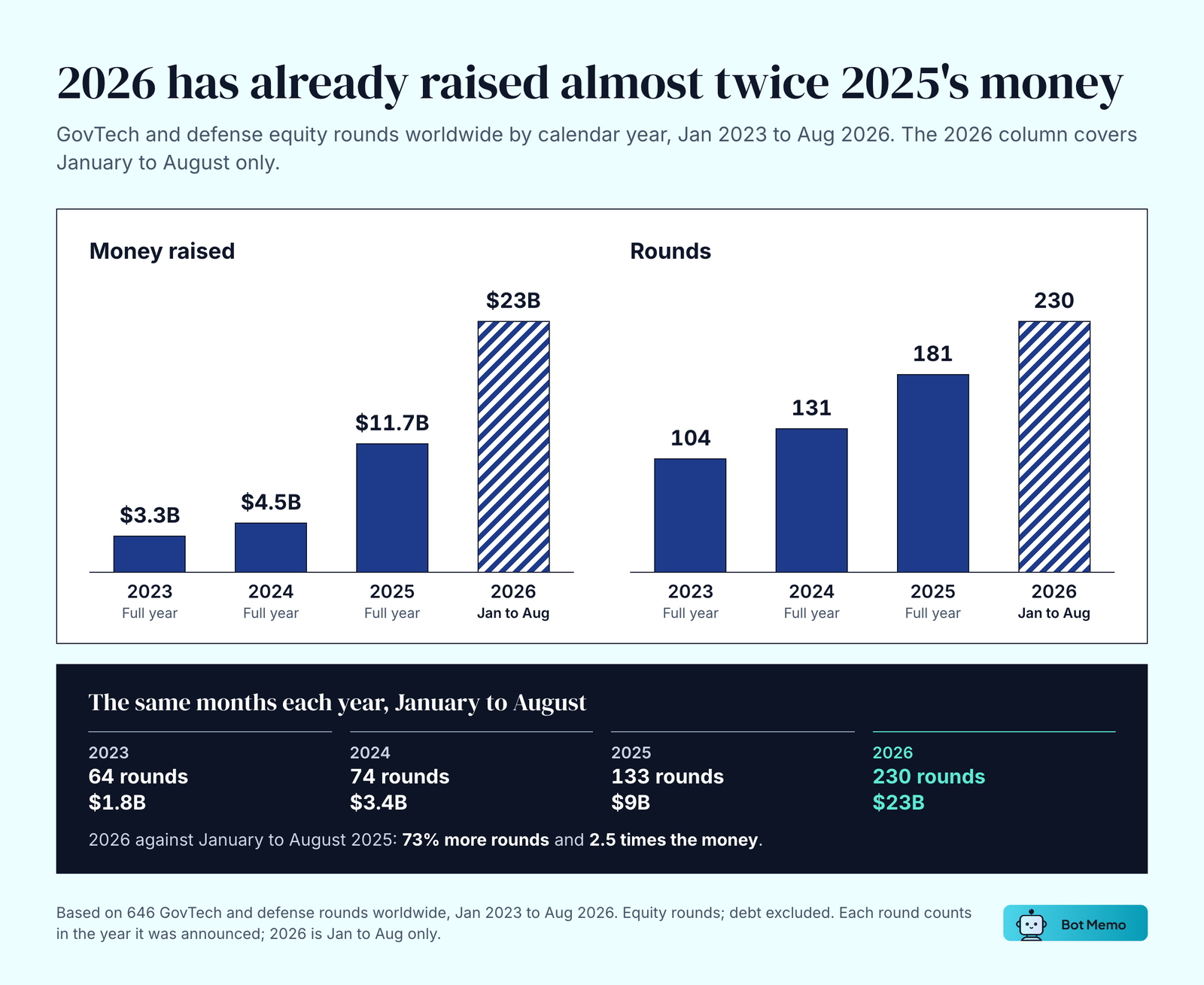
Measured over the same eight months each year, 2026 shows 73% more rounds than January to August 2025 and 2.5 times the money.
| Period | Rounds | Money raised |
|---|---|---|
| Jan to Aug 2023 | 64 | $1.8B |
| Jan to Aug 2024 | 74 | $3.4B |
| Jan to Aug 2025 | 133 | $9B |
| Jan to Aug 2026 | 230 | $23B |
That is a long way from 2017, when Anduril was founded. Its CEO wrote that defense at the time “was not a category that attracted significant venture investment.”
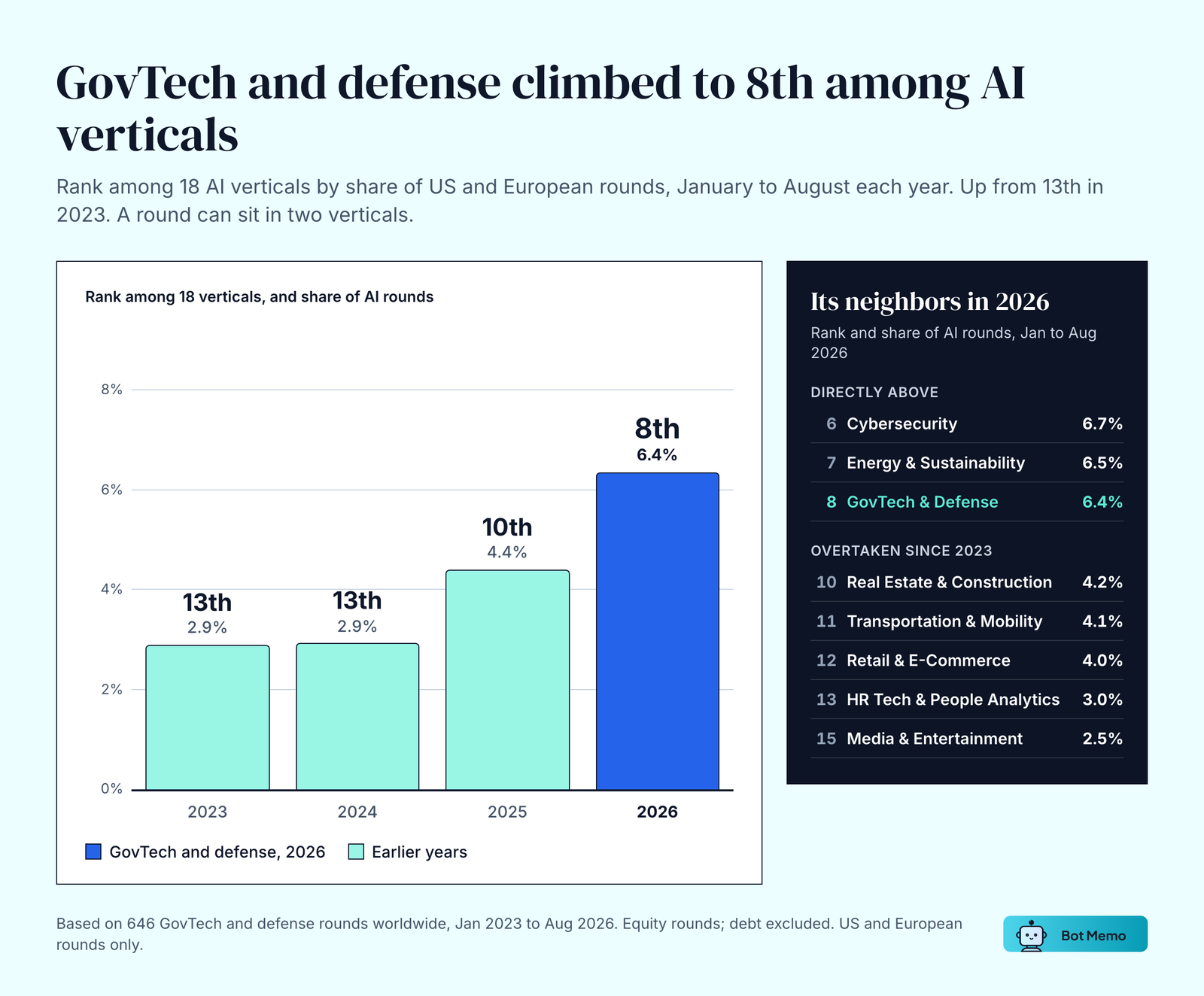
Defense tech also moved up the table of AI verticals. Ranked by share of US and European AI rounds from January to August each year, GovTech and defense sat 13th of 18 verticals in 2023 and 2024 with 2.9% of rounds, rose to 10th in 2025 with 4.4%, and reached 8th in 2026 with 6.4%. About one in every 16 US and European AI rounds is now a defense or government tech round.
Other industries have raised more AI money than defense, but 2026 is the year of billion-dollar defense rounds. Of the 567 rounds with a public size since January 2023, eight reached $1 billion or more, and six of those came in 2026.
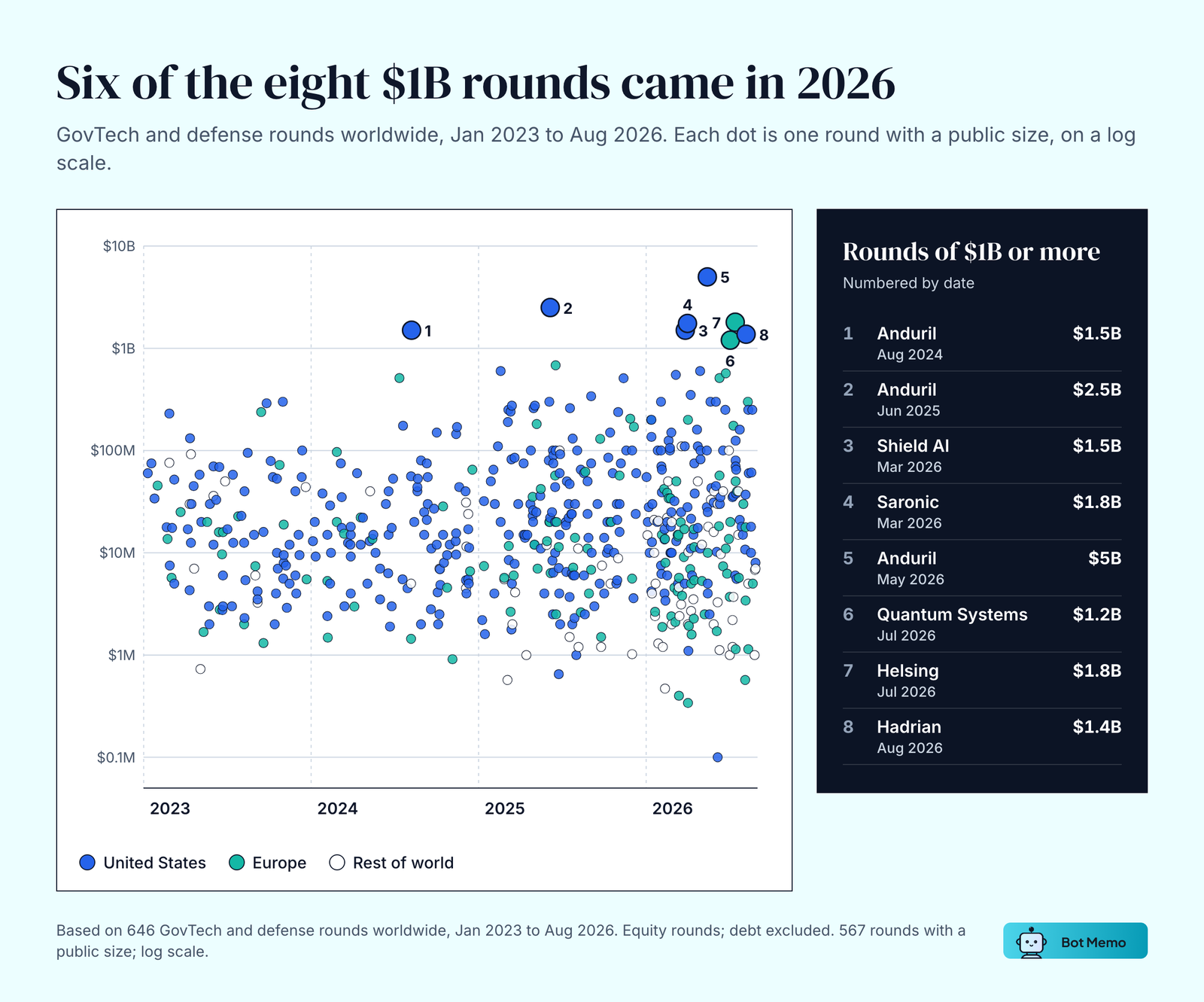
| Company | Round | Date |
|---|---|---|
| Anduril | $1.5B | Aug 2024 |
| Anduril | $2.5B | Jun 2025 |
| Shield AI | $1.5B | Mar 2026 |
| Saronic | $1.8B | Mar 2026 |
| Anduril | $5B | May 2026 |
| Quantum Systems | $1.2B | Jul 2026 |
| Helsing | $1.8B | Jul 2026 |
| Hadrian | $1.4B | Aug 2026 |
Largest Defense AI Funding Rounds
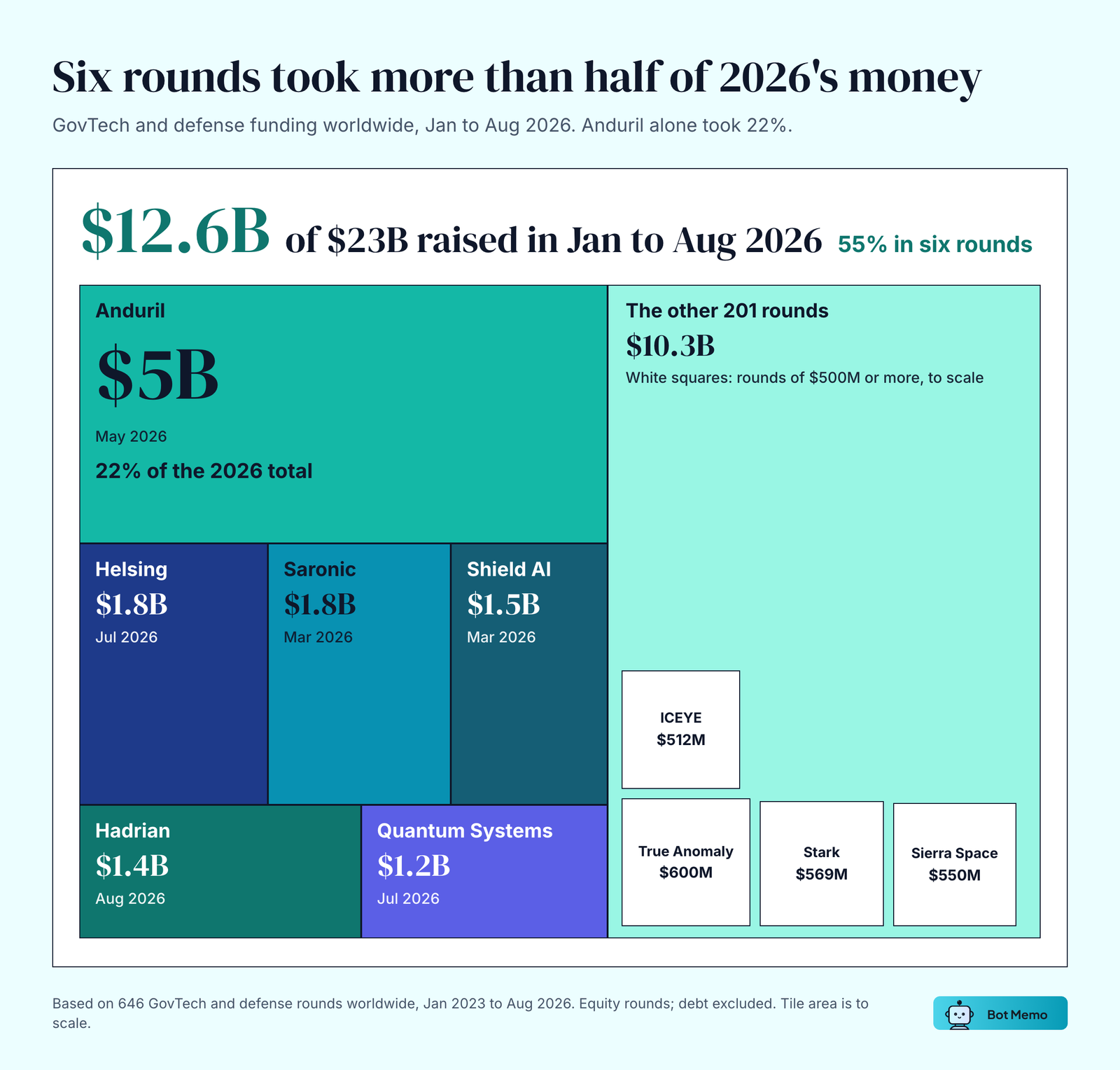
Power laws hold in defense AI. From January to August 2026, six rounds raised $12.6 billion of the $23 billion total, or 55%. Anduril’s $5 billion in May took 22% on its own. Every other 2026 round shared the remaining $10.3 billion; the largest of them was True Anomaly at $600 million.
Across the whole window, eight rounds raised $16.6 billion of the $42.5 billion, about two fifths. In the first 19 months, January 2023 to July 2024, the vertical raised only $4.9 billion across 141 rounds.
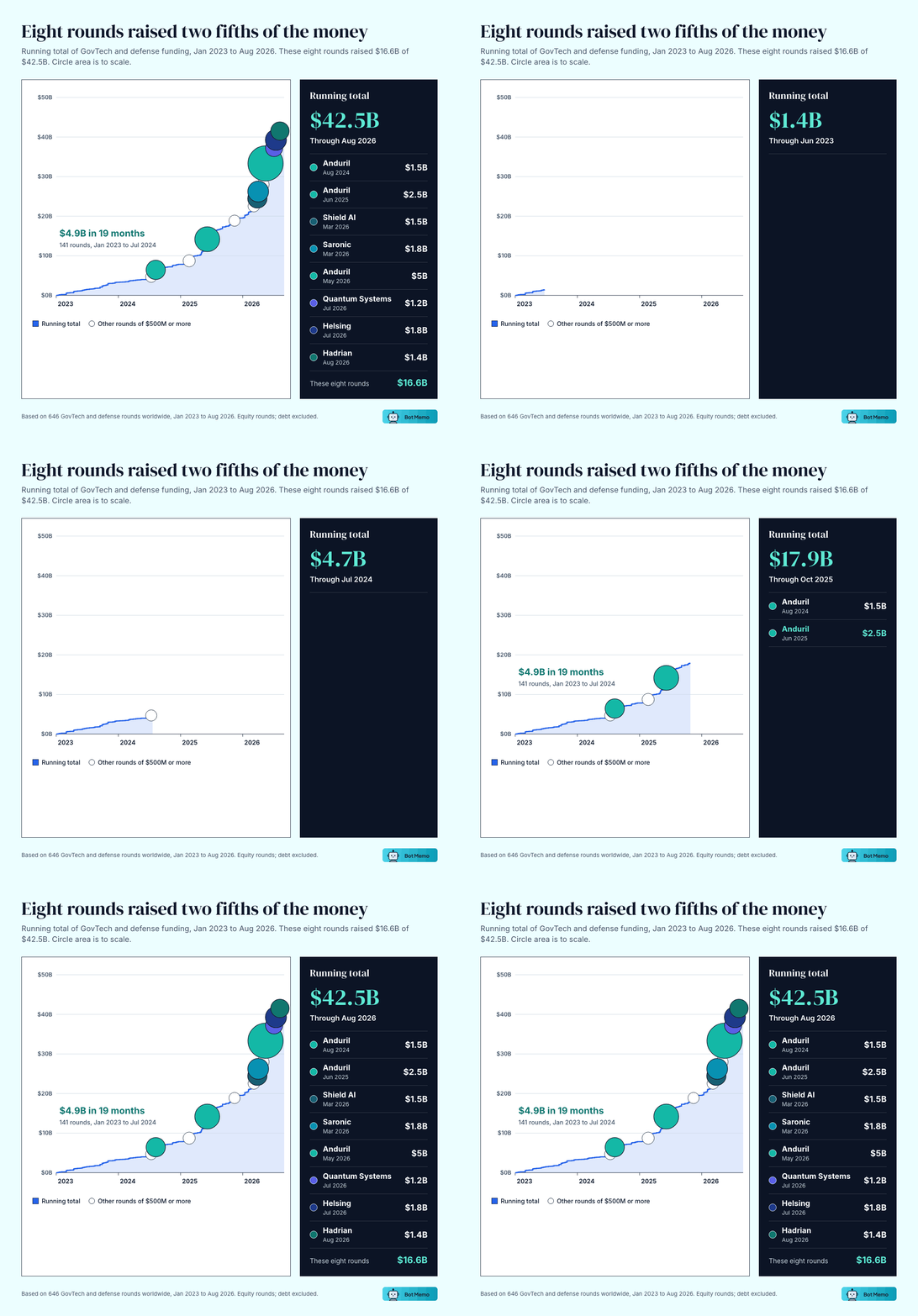
Helsing and Quantum Systems, both European, took two of those eight rounds. Most of the largest rounds went to American companies, which raises the question of where new rounds are coming from.
Defense AI Funding in Europe vs the US
Steckman’s case rests on where the budgets are. On 20VC he said: “So 50% of defense spending is in the US and 50% is in the rest of the world.”
European founders are building anyway. More than a third of this year’s US and European rounds in defense and government tech came from Europe. From January to August 2026, Europe closed 69 rounds against 25 in the same months of 2025, an increase of 44. US rounds rose from 97 to 113, an increase of 16 or about a sixth. European money rose from $1.2 billion to $5.7 billion.
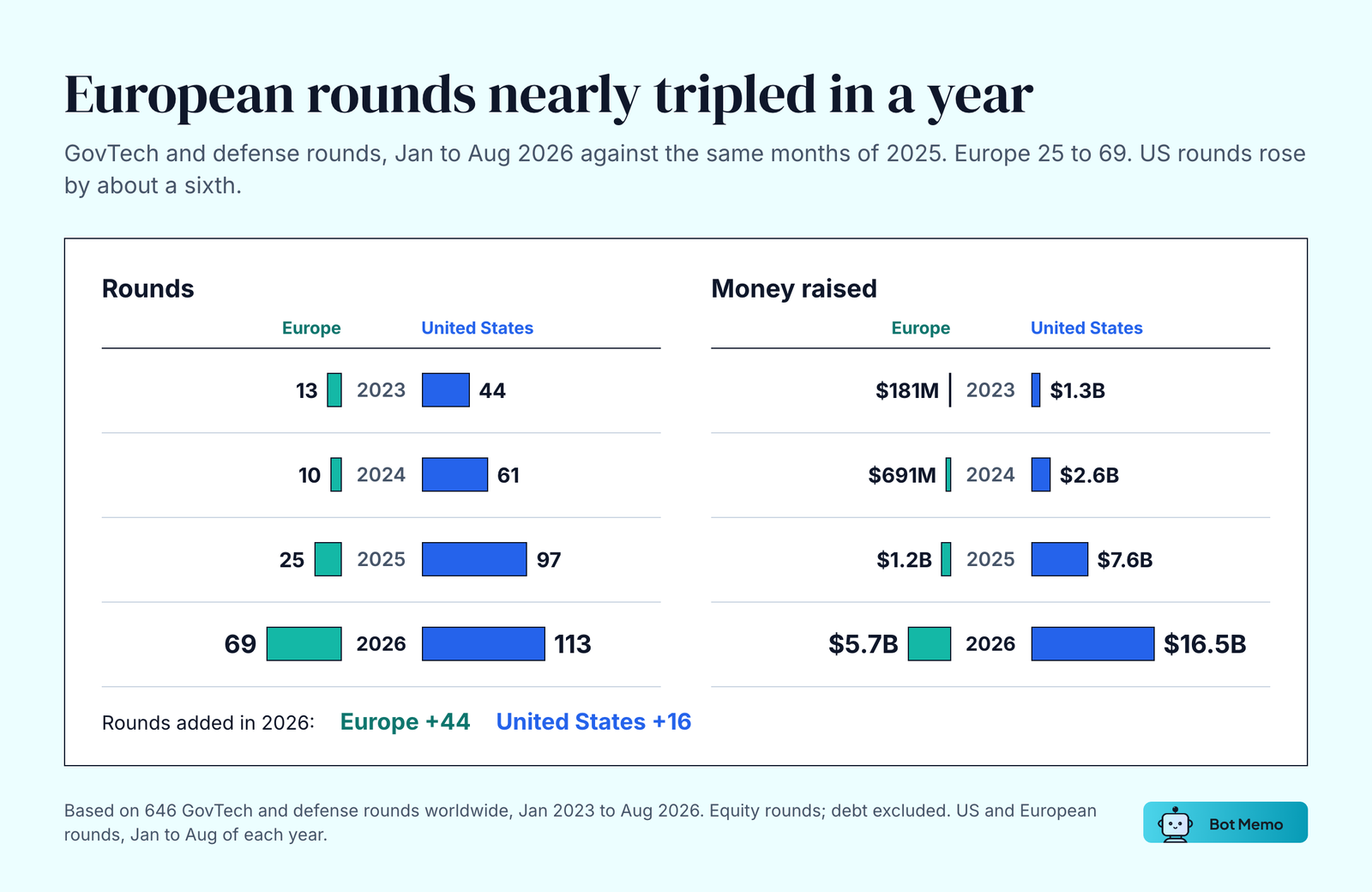
| Jan to Aug | Europe rounds | US rounds | Europe money | US money |
|---|---|---|---|---|
| 2023 | 13 | 44 | $181M | $1.3B |
| 2024 | 10 | 61 | $691M | $2.6B |
| 2025 | 25 | 97 | $1.2B | $7.6B |
| 2026 | 69 | 113 | $5.7B | $16.5B |
Most of Europe’s new rounds are small. The typical European defense and government tech round in 2026 was $11 million. The United Kingdom closed the most rounds, 23 against 10 a year earlier, and raised $1.0 billion. Germany closed 11 rounds and raised $3.7 billion, so the UK raised less than a third of Germany’s money.
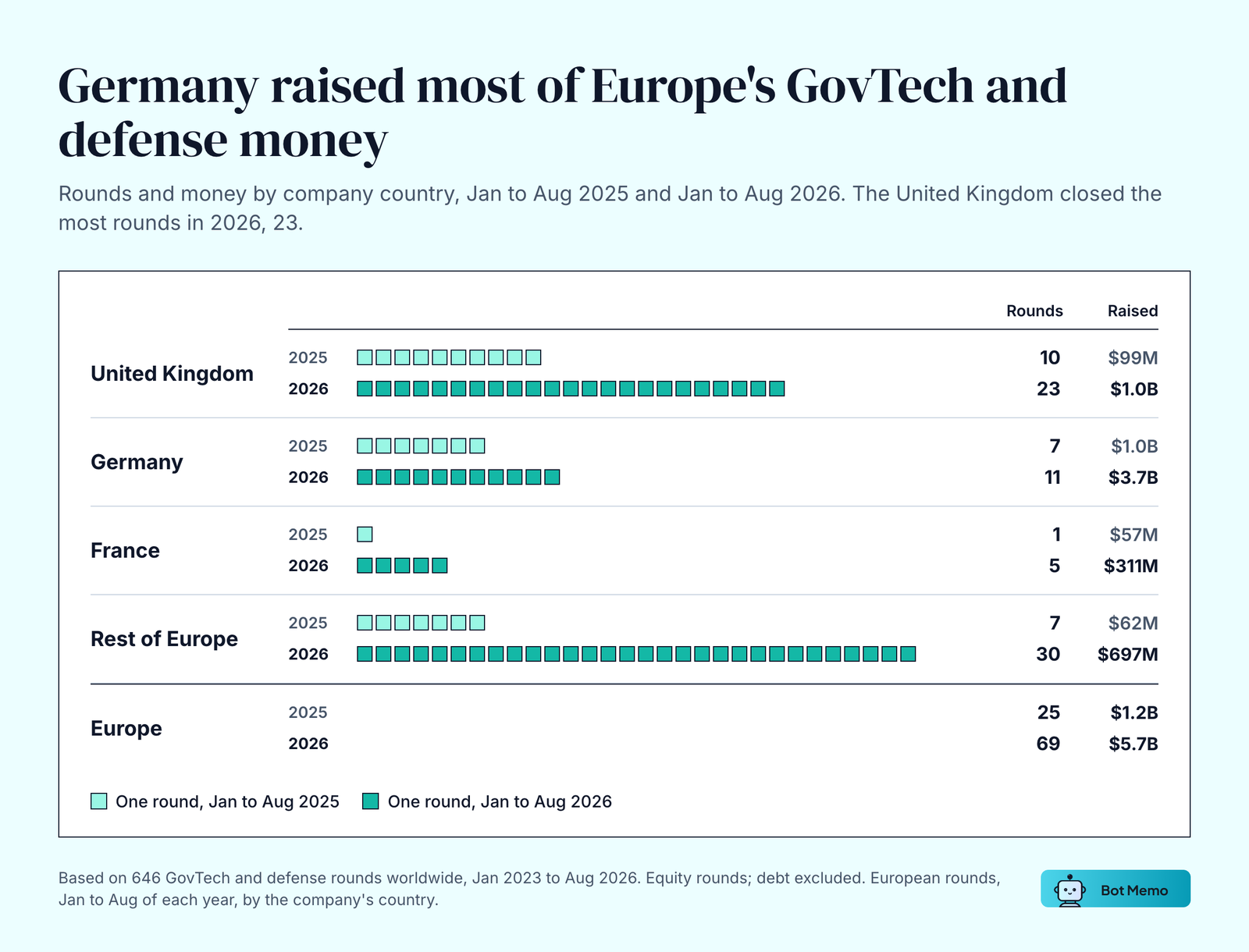
| Country | Rounds, Jan to Aug 2025 | Raised, 2025 | Rounds, Jan to Aug 2026 | Raised, 2026 |
|---|---|---|---|---|
| United Kingdom | 10 | $99M | 23 | $1.0B |
| Germany | 7 | $1.0B | 11 | $3.7B |
| France | 1 | $57M | 5 | $311M |
| Rest of Europe | 7 | $62M | 30 | $697M |
| Europe total | 25 | $1.2B | 69 | $5.7B |
Germany’s total is mostly Helsing and Quantum Systems, which took more than three quarters of it.
European Defense Tech Funding by Stage and Investor Base
Atomico’s State of European Tech 2025 report says European startups are “as likely to start strong as their US counterparts” but “far less likely to keep scaling in growth stage.” Defense fits that pattern over the whole window. From January 2023 to August 2026, the US closed almost six times as many Series B rounds as Europe. Pre-seed and seed made up 45% of European rounds and Series C or later 17%, against 32% and 26% in the US.
In 2026 the gap narrowed. Europe closed 30 pre-seed and seed rounds against 25 in the US, and its Series B and later rounds tripled against the same months of 2025. Europe still trails at every later stage: 14 Series A rounds against 30, 5 Series B rounds against 18, and 7 Series C or later rounds against 25.
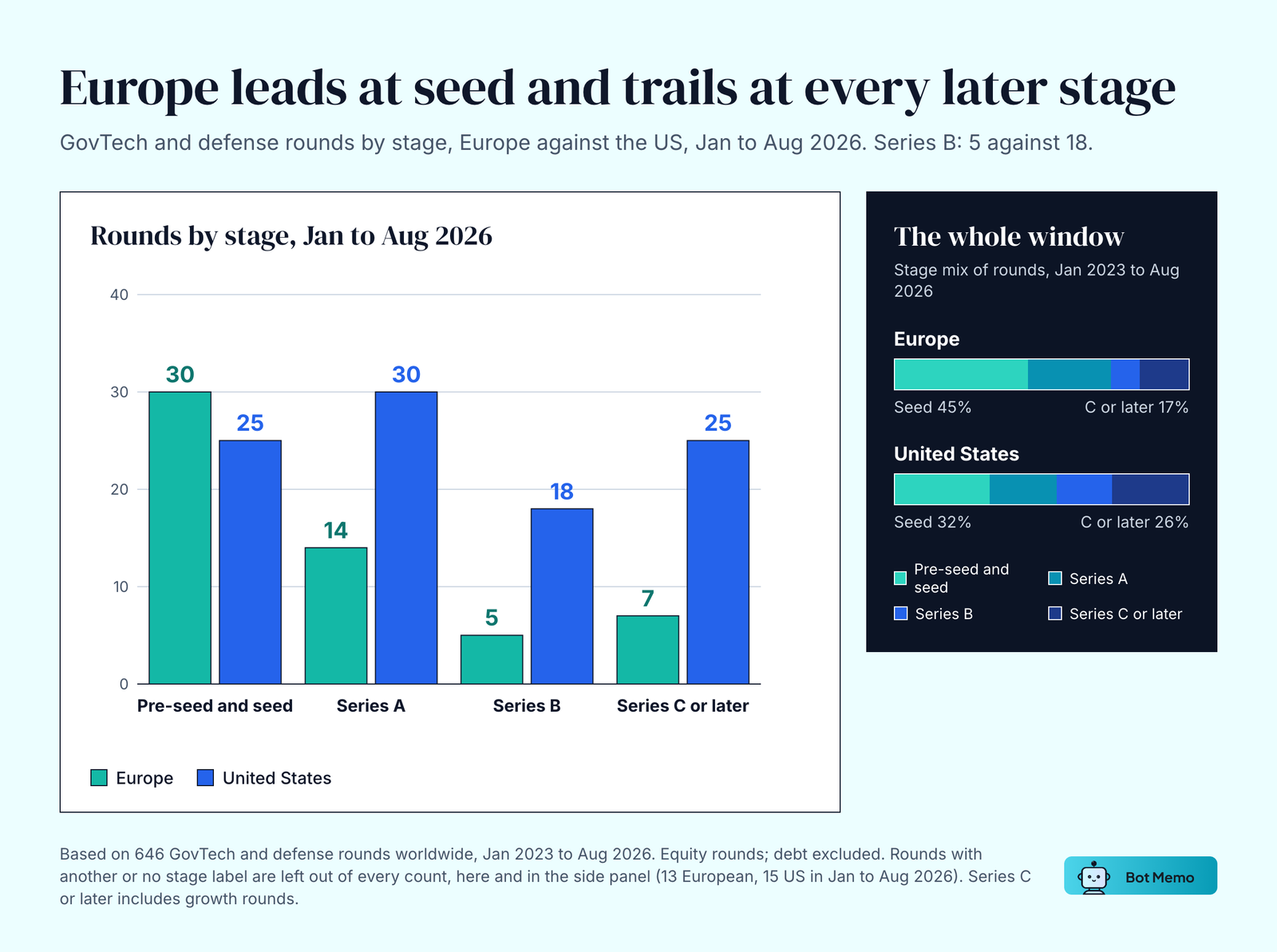
| Stage, Jan to Aug 2026 | Europe | United States |
|---|---|---|
| Pre-seed and seed | 30 | 25 |
| Series A | 14 | 30 |
| Series B | 5 | 18 |
| Series C or later | 7 | 25 |
Europe’s biggest rounds still carry American names. Of the 15 European defense and government tech rounds of $100 million or more since January 2023, US-based investors joined 13 and European investors joined 14. Only two, Quantum Systems’ $205 million in November 2025 and Harmattan AI’s $200 million in January 2026, had no US-based investor.
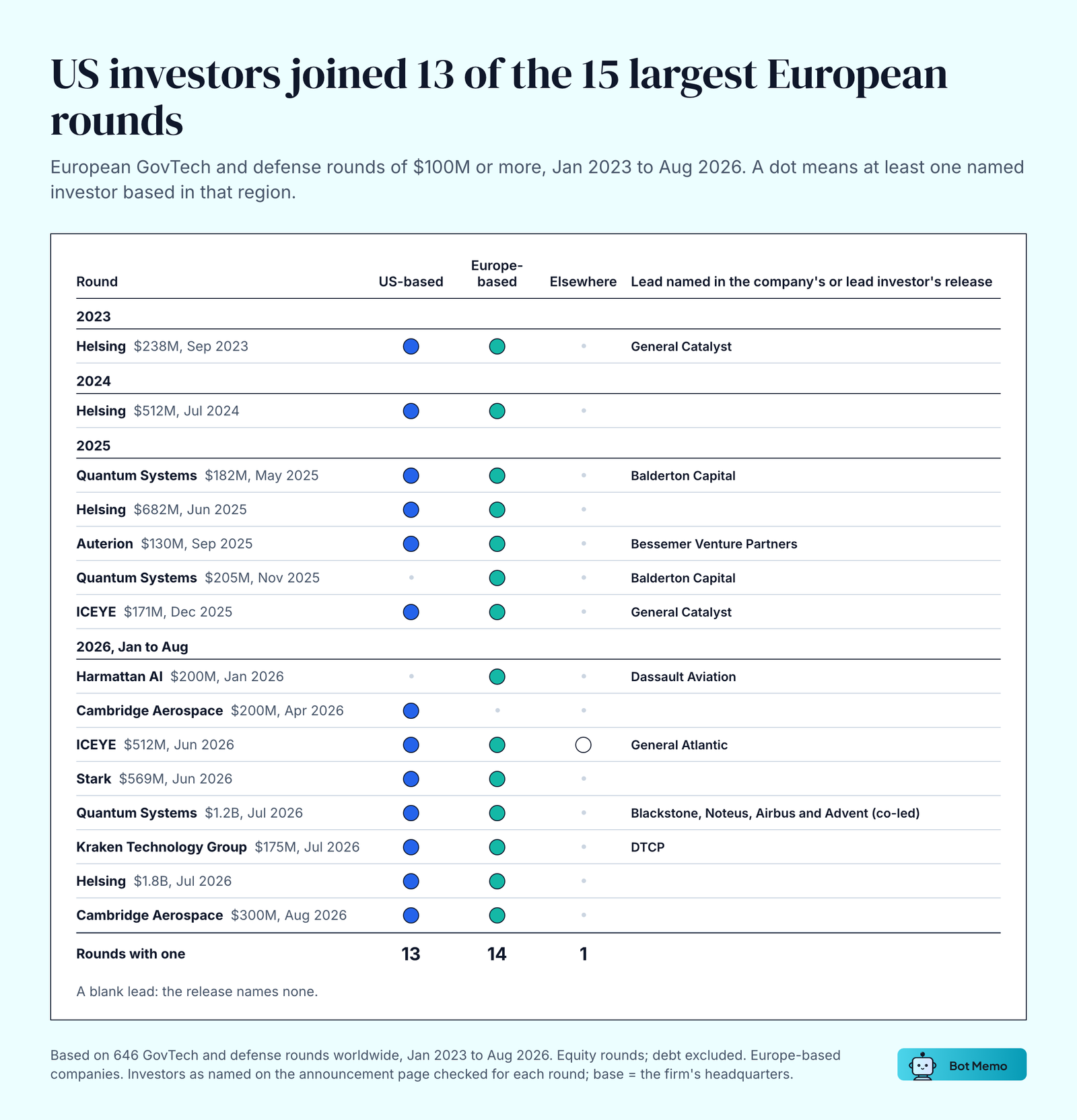
| Company | Round | Date | Named lead |
|---|---|---|---|
| Helsing | $238M | Sep 2023 | General Catalyst |
| Helsing | $512M | Jul 2024 | None named |
| Quantum Systems | $182M | May 2025 | Balderton Capital |
| Helsing | $682M | Jun 2025 | None named |
| Auterion | $130M | Sep 2025 | Bessemer Venture Partners |
| Quantum Systems | $205M | Nov 2025 | Balderton Capital |
| ICEYE | $171M | Dec 2025 | General Catalyst |
| Harmattan AI | $200M | Jan 2026 | Dassault Aviation |
| Cambridge Aerospace | $200M | Apr 2026 | None named |
| ICEYE | $512M | Jun 2026 | General Atlantic |
| Stark | $569M | Jun 2026 | None named |
| Quantum Systems | $1.2B | Jul 2026 | Blackstone, Noteus, Airbus and Advent (co-led) |
| Kraken Technology Group | $175M | Jul 2026 | DTCP |
| Helsing | $1.8B | Jul 2026 | None named |
| Cambridge Aerospace | $300M | Aug 2026 | None named |
Joining a round differs from leading it. Where the company said who led, European firms led four of these rounds and American firms led four. Quantum Systems’ $1.2 billion in July 2026 had co-leads from both sides. European money at that size often comes from defense, aerospace and industrial groups: Saab, Airbus, Hensoldt, Dassault, Rheinmetall or Nokia sat in eight of the 15 rounds.
For a European founder, the catch with American money is ownership, because ownership decides which defense contracts the company may bid for. Germany’s rules say any investor based outside Germany must file before taking 10% or more of a defense company’s votes. Under the European Defence Industry Programme, recipients may not be controlled from outside Europe and must keep design authority free of outside restrictions. Helsing says it “remains predominantly European-owned.”
Several European companies that took American money have also built a US base. Quantum Systems opened a facility in Moorpark, California, in June 2025. Tekever opened its first US office in Fayetteville, North Carolina, in May 2026.
The exit is the harder part. Bessemer led Auterion’s Series B, and its partner Alex Ferrara, who sits on Auterion’s board, told Resilience Media in October 2026: “One issue is that, unlike categories of enterprise software where there are many acquirers, in defense tech there are only a small number of strategic acquirers.”
Newfund, a French venture firm whose general partner is François Véron, wrote in May that “acquisition by a prime is currently the only exit path for most European defense startups.” Anduril agreed to buy Ireland’s Klas in 2025.
Some European investors want that growth money raised at home. Klaus Hommels, who founded and chairs Lakestar, an investor in Helsing and Auterion, told Tech.eu in October 2026: “Europe’s military leaders have been clear with us: if we want to build and retain critical defence capabilities in Europe, we also need sovereign European financing.”
Defense AI Funding by Segment
Each company in the vertical sits in one of twelve segments, set by what it sells. Drones and unmanned aircraft systems (UAS) held 55 rounds, 9% of the total, but raised $12.9 billion, 30% of the money, from January 2023 to August 2026. Anduril alone holds more than two thirds of the money raised by drone makers. Autonomy Software and AI Pilots raised $5.4 billion from only 12 rounds.
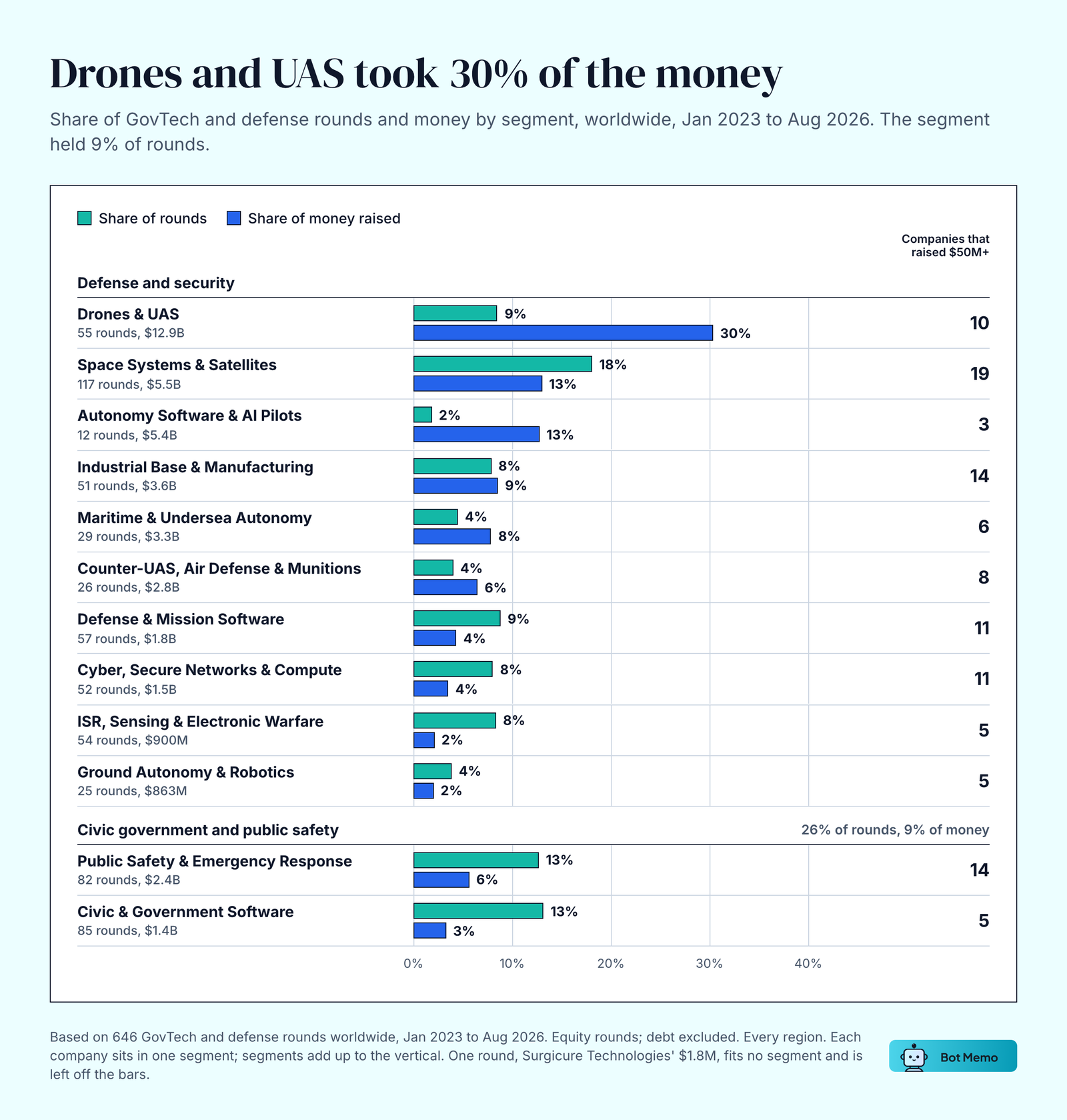
| Segment | Rounds | Money | Share of rounds | Share of money | Companies that raised $50M+ |
|---|---|---|---|---|---|
| Drones and UAS | 55 | $12.9B | 9% | 30% | 10 |
| Space Systems and Satellites | 117 | $5.5B | 18% | 13% | 19 |
| Autonomy Software and AI Pilots | 12 | $5.4B | 2% | 13% | 3 |
| Industrial Base and Manufacturing | 51 | $3.6B | 8% | 9% | 14 |
| Maritime and Undersea Autonomy | 29 | $3.3B | 4% | 8% | 6 |
| Counter-UAS, Air Defense and Munitions | 26 | $2.8B | 4% | 6% | 8 |
| Defense and Mission Software | 57 | $1.8B | 9% | 4% | 11 |
| Cyber, Secure Networks and Compute | 52 | $1.5B | 8% | 4% | 11 |
| ISR, Sensing and Electronic Warfare | 54 | $900M | 8% | 2% | 5 |
| Ground Autonomy and Robotics | 25 | $863M | 4% | 2% | 5 |
| Public Safety and Emergency Response | 82 | $2.4B | 13% | 6% | 14 |
| Civic and Government Software | 85 | $1.4B | 13% | 3% | 5 |
Ten drone makers have raised $50 million or more in all, Anduril plus nine others. Steckman expects the market to end with one. Asked on 20VC why there are so many drone companies, he answered: “There’ll be one that wins. Right? It’s gonna be really hard to pick it, I think is the problem, but there will definitely be one winner.”
Investors kept piling in. Against January to August 2025, US and European maritime and undersea autonomy rounds tripled in 2026, from 4 to 12. Counter-drone, air defense and munitions rounds also tripled, from 4 to 12, and drone rounds more than doubled, from 9 to 21. The whole vertical grew 1.5 times over the same months, from 122 US and European rounds to 182.
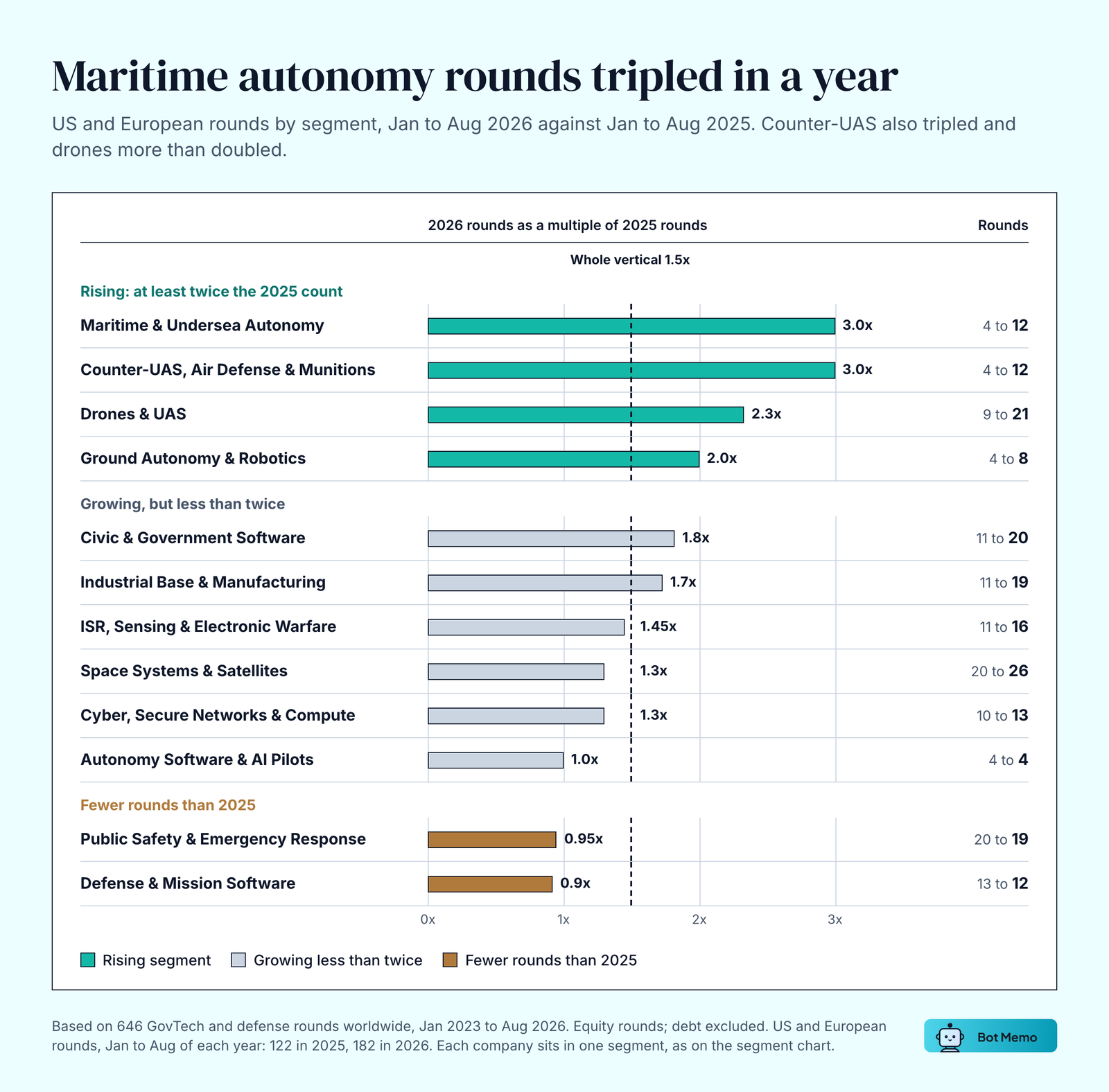
| Segment | Jan to Aug 2025 rounds | Jan to Aug 2026 rounds | Multiple |
|---|---|---|---|
| Maritime and Undersea Autonomy | 4 | 12 | 3.0x |
| Counter-UAS, Air Defense and Munitions | 4 | 12 | 3.0x |
| Drones and UAS | 9 | 21 | 2.3x |
| Ground Autonomy and Robotics | 4 | 8 | 2.0x |
| Civic and Government Software | 11 | 20 | 1.8x |
| Industrial Base and Manufacturing | 11 | 19 | 1.7x |
| ISR, Sensing and Electronic Warfare | 11 | 16 | 1.45x |
| Space Systems and Satellites | 20 | 26 | 1.3x |
| Cyber, Secure Networks and Compute | 10 | 13 | 1.3x |
| Autonomy Software and AI Pilots | 4 | 4 | 1.0x |
| Public Safety and Emergency Response | 20 | 19 | 0.95x |
| Defense and Mission Software | 13 | 12 | 0.9x |
Civic government and public safety software make up about a quarter of the vertical’s rounds, 26%, but take only 9% of the money.
Defense Startup Valuations and Round Sizes
Prices at the top moved fast. Twelve defense and government tech companies had a confirmed valuation of $1 billion or more by August 2026. Anduril was valued at $61 billion in May 2026, up from a reported $30.5 billion in June 2025, and is worth more than three times the next company. Saronic more than doubled, from $4 billion in February 2025 to $9.3 billion in March 2026.
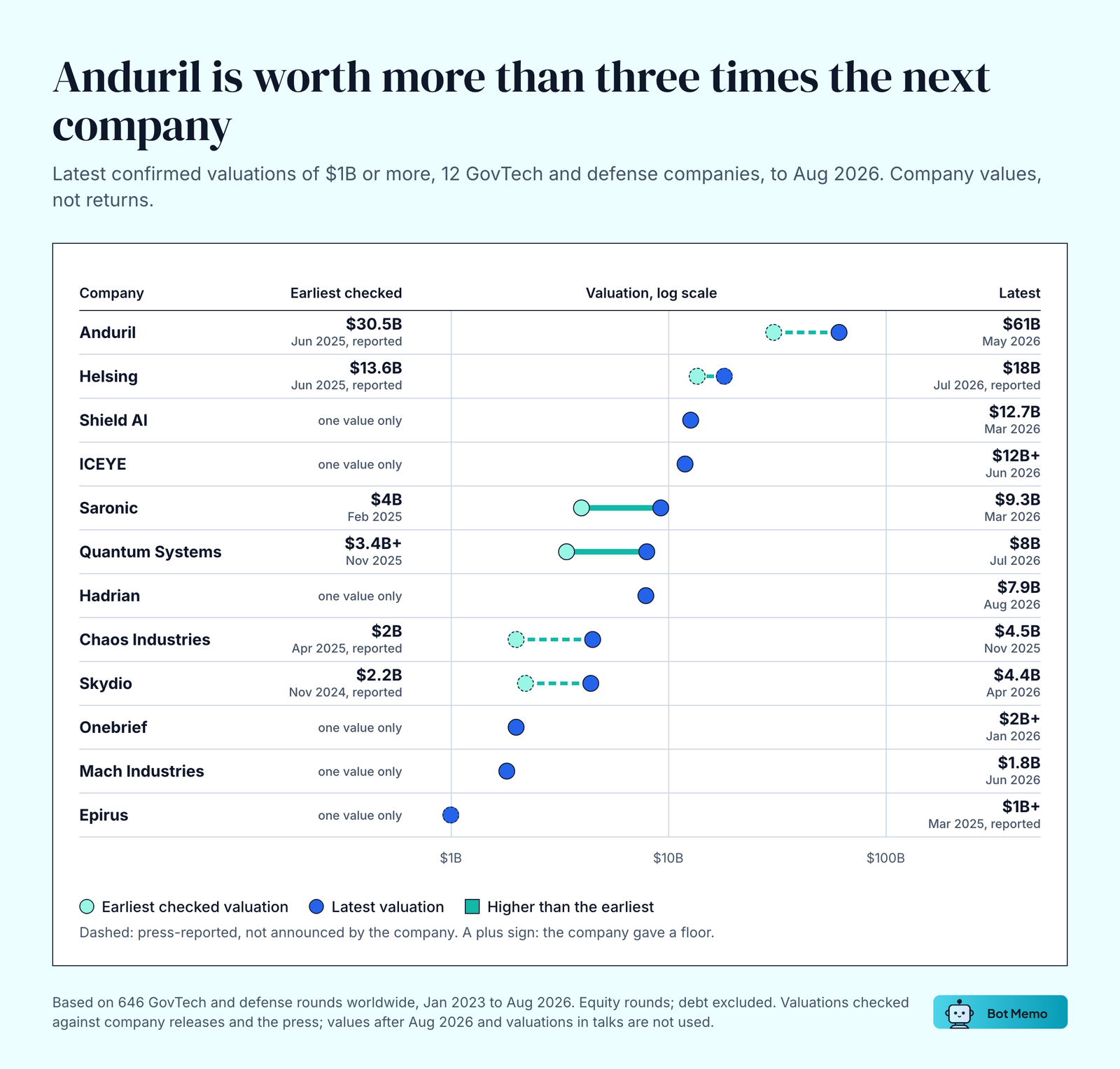
| Company | Earliest checked valuation | Latest valuation |
|---|---|---|
| Anduril | $30.5B, Jun 2025 (reported) | $61B, May 2026 |
| Helsing | $13.6B, Jun 2025 (reported) | $18B, Jul 2026 (reported) |
| Shield AI | One value only | $12.7B, Mar 2026 |
| ICEYE | One value only | $12B+, Jun 2026 |
| Saronic | $4B, Feb 2025 | $9.3B, Mar 2026 |
| Quantum Systems | $3.4B+, Nov 2025 | $8B, Jul 2026 |
| Hadrian | One value only | $7.9B, Aug 2026 |
| Chaos Industries | $2B, Apr 2025 (reported) | $4.5B, Nov 2025 |
| Skydio | $2.2B, Nov 2024 (reported) | $4.4B, Apr 2026 |
| Onebrief | One value only | $2B+, Jan 2026 |
| Mach Industries | One value only | $1.8B, Jun 2026 |
| Epirus | One value only | $1B+, Mar 2025 (reported) |
Mach Industries was valued at $1.8 billion in June 2026. After the window closed, it announced a further round at $3.7 billion.
Steckman says the valuations of some venture-backed defense companies are “just too high for us to justify the buy.” Anduril’s co-founder and CEO, Brian Schimpf, warned at a Fortune event in June 2026 about companies and investors chasing the leaders: “So, I do think there’s a bit of a bubble.” (Fortune, July 2026.)
Defense AI rounds are also larger than other AI rounds at every stage. Across US and European rounds from January 2023 to August 2026, the median defense and government tech Series B was $53 million against $37 million for all AI rounds, and the median Series C was $139 million against $65 million. Fewer rounds reach Series C, but those that do took 81% of this year’s US and European money in the vertical. Series C or later made up 18% of defense and government tech rounds from January to August 2026, against 15% for all AI rounds, and 25% against 18% in 2023.
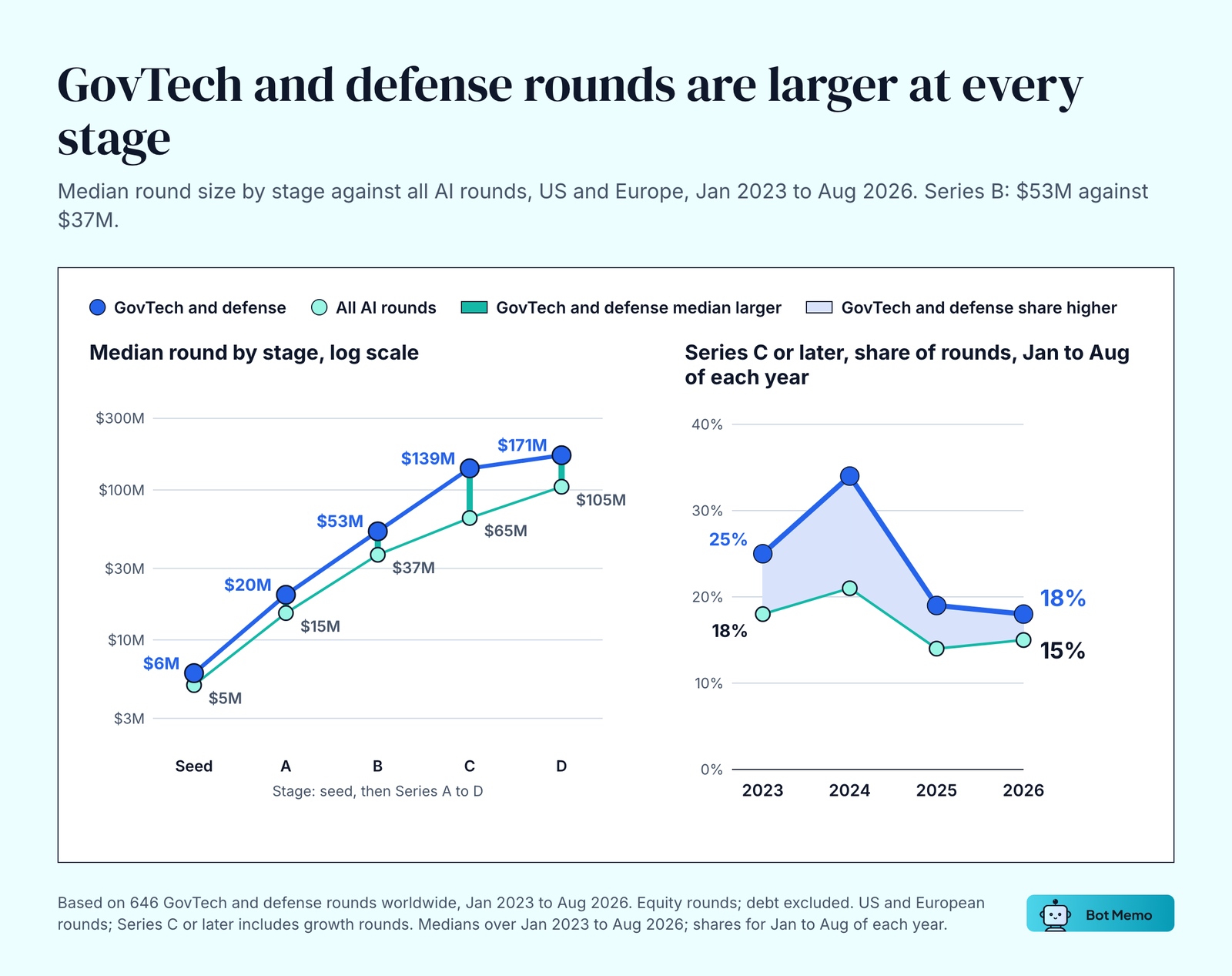
| Stage | Defense and government tech median | All AI rounds median |
|---|---|---|
| Seed | $6M | $5M |
| Series A | $20M | $15M |
| Series B | $53M | $37M |
| Series C | $139M | $65M |
| Series D | $171M | $105M |
Trae Stephens, who co-founded Anduril and is a partner at Founders Fund, puts it plainly: “The challenge is that there’s too much supply in venture capital.” (Trae Stephens, Fortune, July 2026.)
Defense AI Funding by City
Defense tech money does not follow the rest of AI to Silicon Valley. Costa Mesa leads with $9 billion from three rounds, all of it Anduril. Munich follows with $3.5 billion, $3.2 billion of it Helsing.
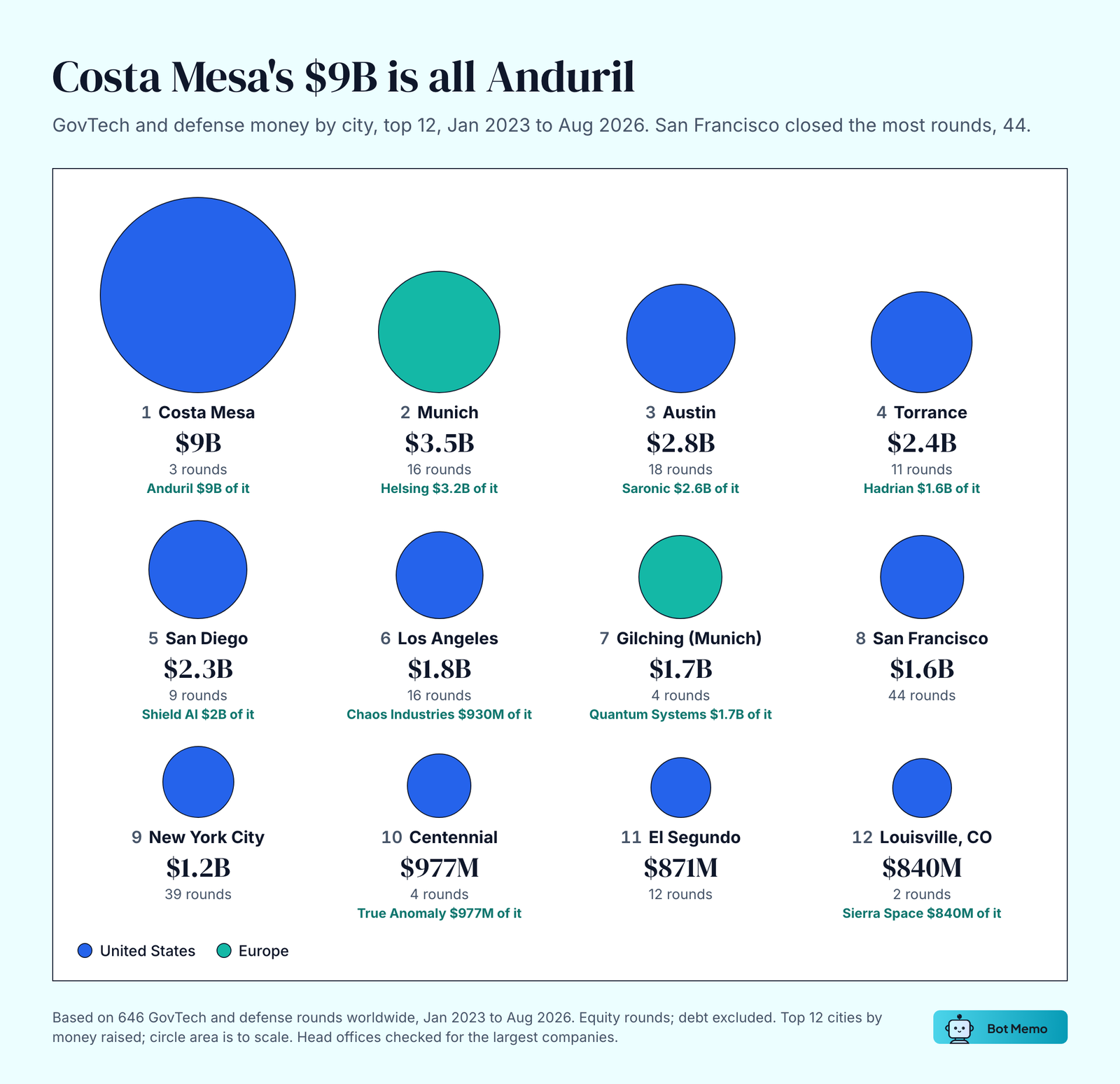
| Rank | City | Money raised | Rounds | Largest company’s share |
|---|---|---|---|---|
| 1 | Costa Mesa | $9B | 3 | Anduril $9B |
| 2 | Munich | $3.5B | 16 | Helsing $3.2B |
| 3 | Austin | $2.8B | 18 | Saronic $2.6B |
| 4 | Torrance | $2.4B | 11 | Hadrian $1.6B |
| 5 | San Diego | $2.3B | 9 | Shield AI $2B |
| 6 | Los Angeles | $1.8B | 16 | Chaos Industries $930M |
| 7 | Gilching (Munich) | $1.7B | 4 | Quantum Systems $1.7B |
| 8 | San Francisco | $1.6B | 44 | |
| 9 | New York City | $1.2B | 39 | |
| 10 | Centennial | $977M | 4 | True Anomaly $977M |
| 11 | El Segundo | $871M | 12 | |
| 12 | Louisville, CO | $840M | 2 | Sierra Space $840M |
The money sits in six cities, each with a single big company behind it: Anduril in Costa Mesa, Helsing in Munich, Quantum Systems in Gilching, Saronic in Austin, Hadrian in Torrance and Shield AI in San Diego. San Francisco closed the most rounds, 44, but ranks only eighth on money because its rounds are small. The typical San Francisco round was $20 million.
Top Defense AI Companies and Investors
The six largest segments by rounds each have a few companies that raised most of the money. Space Systems and Satellites has 117 rounds across 98 companies, led by True Anomaly and ICEYE. Drones and UAS has 55 rounds across 42 companies, led by Anduril and Quantum Systems.
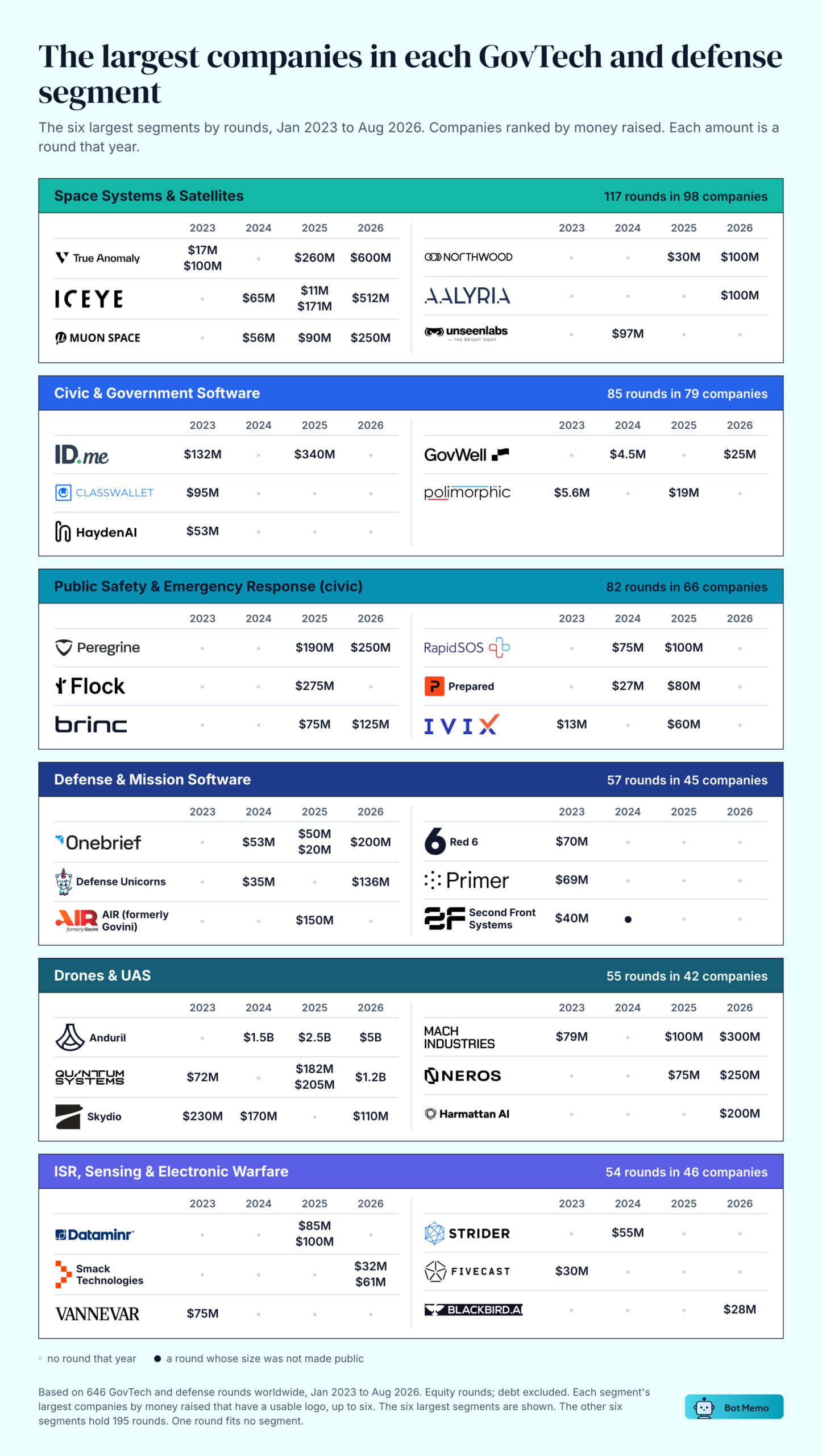
| Segment | Rounds (companies) | Selected companies and rounds |
|---|---|---|
| Space Systems and Satellites | 117 (98) | True Anomaly $600M (2026); ICEYE $512M (2026); Muon Space $250M (2026) |
| Civic and Government Software | 85 (79) | ID.me $340M (2025), $132M (2023); ClassWallet $95M (2023); HaydenAI $53M (2023) |
| Public Safety and Emergency Response | 82 (66) | Flock $275M (2025); Peregrine $250M (2026); Brinc $125M (2026) |
| Defense and Mission Software | 57 (45) | Onebrief $200M (2026); AIR (formerly Govini) $150M (2025); Defense Unicorns $136M (2026) |
| Drones and UAS | 55 (42) | Anduril $5B (2026); Quantum Systems $1.2B (2026); Mach Industries $300M (2026) |
| ISR, Sensing and Electronic Warfare | 54 (46) | Dataminr $100M and $85M (2025); Vannevar $75M (2023); Smack Technologies $61M (2026) |
Andreessen Horowitz co-led Anduril’s round in May 2026 and joined the most defense and government tech rounds of any investor, 27 from January 2023 to August 2026. Twelve of those 27 were Series C or later. General Catalyst is next with 22, then Alumni Ventures with 21 and Founders Fund with 18. Every investor named on a round is credited with the full round, so these figures count rounds joined.
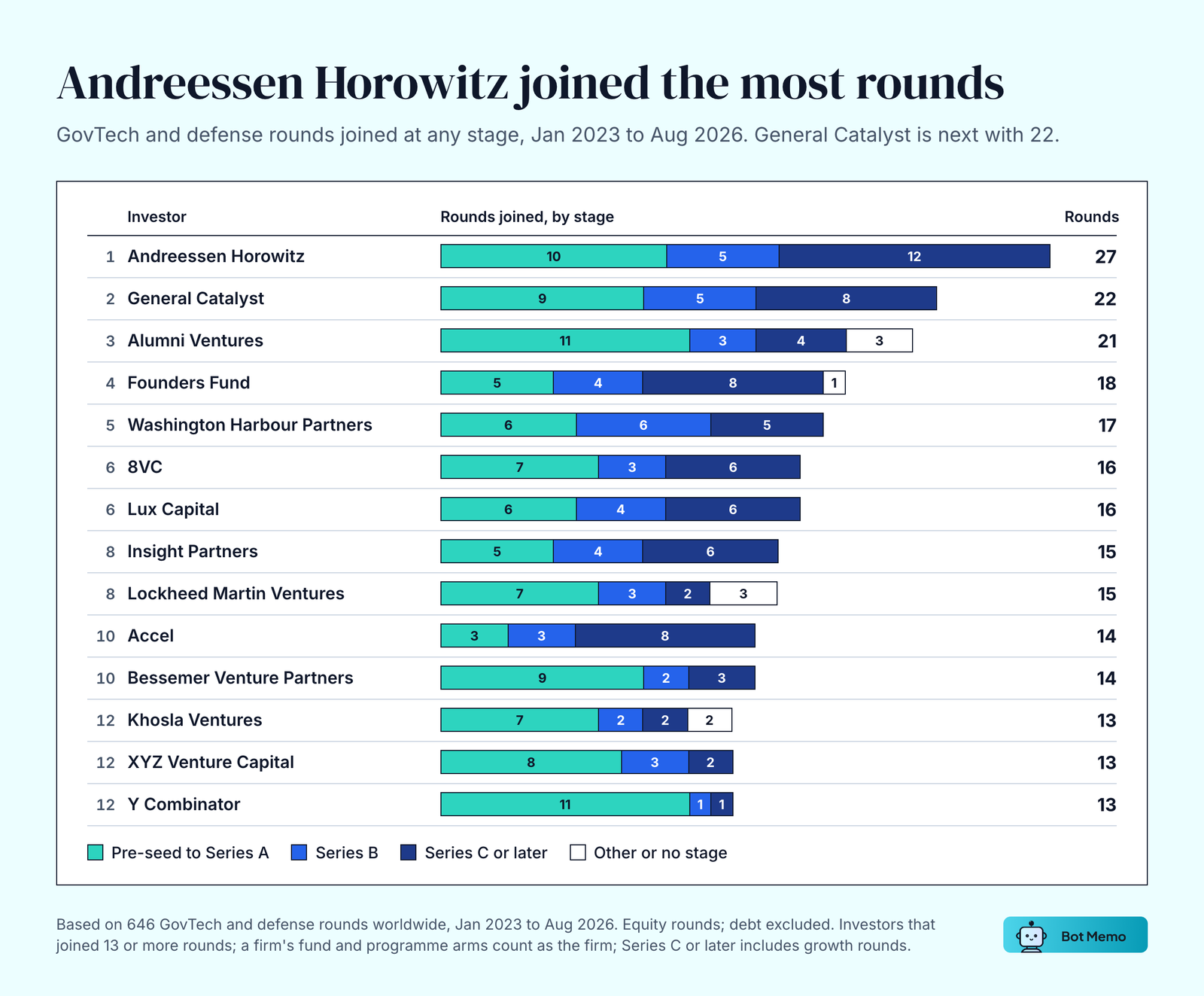
| Investor | Rounds joined | Pre-seed to Series A | Series B | Series C or later | Other or no stage |
|---|---|---|---|---|---|
| Andreessen Horowitz | 27 | 10 | 5 | 12 | 0 |
| General Catalyst | 22 | 9 | 5 | 8 | 0 |
| Alumni Ventures | 21 | 11 | 3 | 4 | 3 |
| Founders Fund | 18 | 5 | 4 | 8 | 1 |
| Washington Harbour Partners | 17 | 6 | 6 | 5 | 0 |
| 8VC | 16 | 7 | 3 | 6 | 0 |
| Lux Capital | 16 | 6 | 4 | 6 | 0 |
| Insight Partners | 15 | 5 | 4 | 6 | 0 |
| Lockheed Martin Ventures | 15 | 7 | 3 | 2 | 3 |
| Accel | 14 | 3 | 3 | 8 | 0 |
| Bessemer Venture Partners | 14 | 9 | 2 | 3 | 0 |
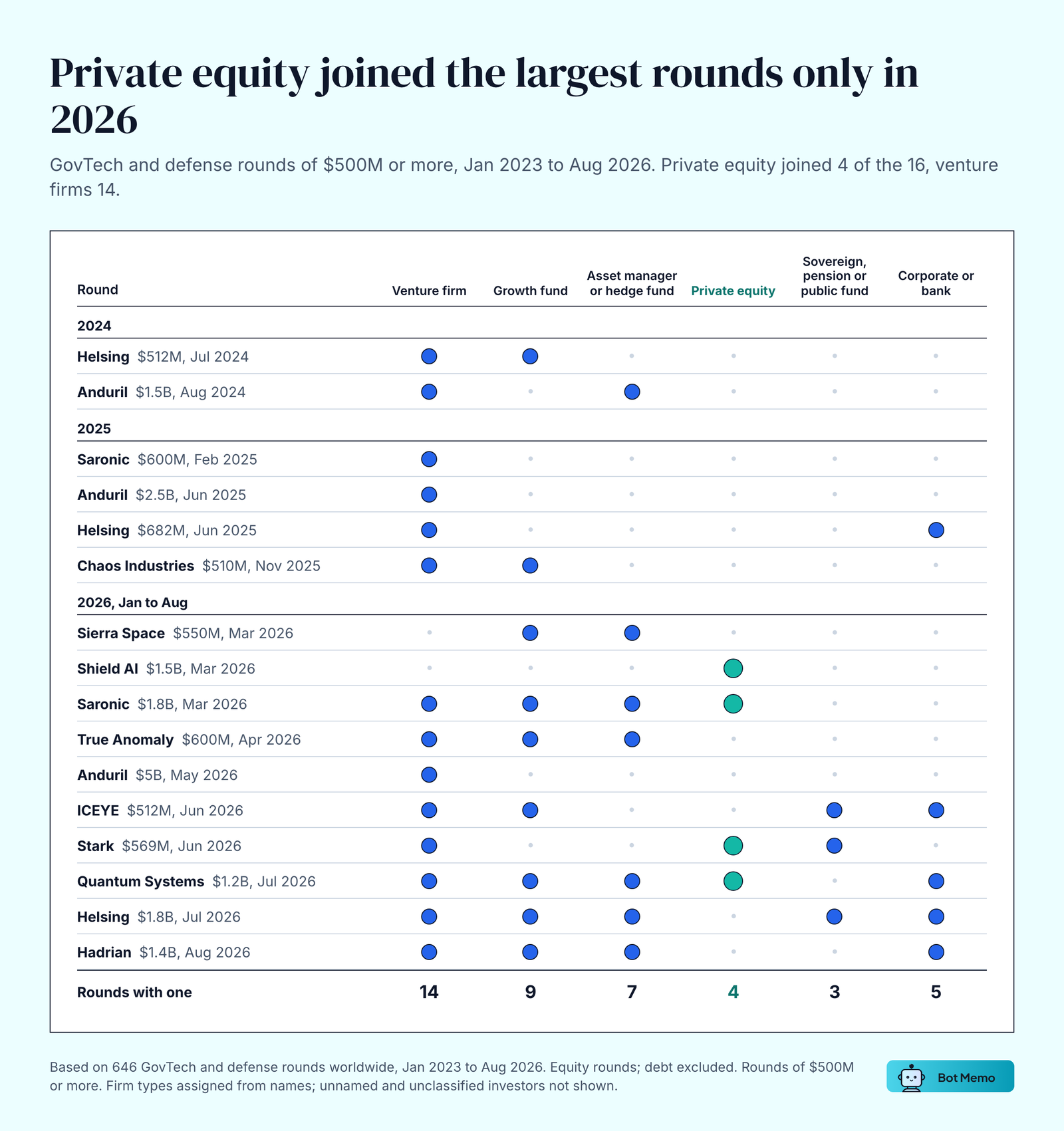
Private equity arrived on the biggest rounds only in 2026. Of the 16 defense and government tech rounds of $500 million or more since January 2023, venture firms joined 14, growth funds 9, asset managers or hedge funds 7, corporates or banks 5, private equity 4 and sovereign, pension or public funds 3. All four private equity rounds came in 2026: Shield AI’s $1.5 billion, Saronic’s $1.8 billion, Stark’s $569 million and Quantum Systems’ $1.2 billion. They came through two firms, Advent International and Blackstone.
Anduril’s own public figures give a sense of what investors are paying. Its revenue for 2025, as it reported, was $2.2 billion, and Anduril says revenue more than doubled that year. The May 2026 valuation of $61 billion is about 28 times that revenue. If revenue doubles again in 2026, the May price would still be about 14 times revenue.
Key Takeaways
- Defense and government tech AI startups raised $42.5 billion across 646 rounds from January 2023 to August 2026, and $23 billion of it came in the first eight months of 2026.
- Eight rounds of $1 billion or more raised $16.6 billion, about two fifths of all defense AI funding since January 2023; Anduril’s $5 billion in May 2026 was the largest.
- European rounds rose from 25 to 69 between January to August 2025 and the same months of 2026, but Europe closed only 5 Series B rounds in 2026 against 18 in the US.
- US-based investors joined 13 of the 15 European defense and government tech rounds of $100 million or more since January 2023.
- Drones and UAS took 30% of the money from 9% of rounds, and maritime autonomy and counter-drone rounds each tripled in 2026.
- Six cities, led by Costa Mesa at $9 billion, hold about half the money, while San Francisco closed the most rounds (44) with a typical round of $20 million.
Frequently Asked Questions
How much funding has defense AI raised since 2023?
AI startups in defense and government tech raised $42.5 billion across 646 rounds from January 2023 to August 2026. Annual funding rose from $3.3 billion in 2023 to $4.5 billion in 2024 and $11.7 billion in 2025, and reached $23 billion in the first eight months of 2026.
Which defense AI companies raised the most funding?
Anduril raised the most, with rounds of $1.5 billion in August 2024, $2.5 billion in June 2025 and $5 billion in May 2026. Helsing and Saronic each raised $1.8 billion in 2026, Shield AI $1.5 billion, Hadrian $1.4 billion and Quantum Systems $1.2 billion.
Is European defense tech funding growing?
Yes. European defense and government tech rounds rose from 25 to 69 between January to August 2025 and the same months of 2026, and money rose from $1.2 billion to $5.7 billion. Germany raised $3.7 billion of that, mostly through Helsing and Quantum Systems, while the United Kingdom closed the most rounds, 23.
Which investors are most active in defense AI?
Andreessen Horowitz joined the most defense and government tech rounds, 27 from January 2023 to August 2026, including 12 at Series C or later. General Catalyst joined 22, Alumni Ventures 21 and Founders Fund 18.
Are defense AI startup valuations too high?
Anduril was valued at $61 billion in May 2026, about 28 times its reported 2025 revenue of $2.2 billion. Anduril’s CEO Brian Schimpf said in June 2026 that he thinks “there’s a bit of a bubble,” and Steckman said some venture-backed defense companies are valued too high for Anduril to buy.
Methodology
- Basis: 646 GovTech and defense AI rounds worldwide, January 2023 to August 2026. All amounts are in USD.
- Data: verified AI venture rounds in defense and government tech from the Bot Memo repository.
- Scope: the vertical combines defense and security with civic government software such as public safety, identity and payments. Civic software holds 26% of its rounds and 9% of the money.
- Money: debt-only rounds are excluded. Round sizes are as announced; a few of the largest include some debt.
- Comparisons: Europe against the US uses the same months of each year, January to August. Series C or later includes growth rounds.
- Attribution: every investor named on a round is credited with the full round, so investor figures read as rounds joined and are never added across firms. An investor with offices in both the US and Europe counts as based in both.
- Valuations: announced by the company, or reported by the press where marked. They are company values, not returns.
- Segments: each company sits in a single segment, set by what it sells, so the twelve segments add up to the vertical. A segment counts as rising when its US and European rounds for January to August at least doubled against the same months a year earlier. The market map shows the six largest segments and the companies in each that raised the most.
- Cities: cities, not metro areas, based on each company’s head office or the city its round lists.

About the author
Editorial Staff
The Editorial Staff at Bot Memo is a team of writers, analysts, and AI agents dedicated to mapping the global AI startup ecosystem. Led by Chintan Zalani, the team tracks thousands of funding rounds, classifies companies across verticals, and distills it all into actionable intelligence for investors and founders.