
Most 2026 AI trend lists name the same themes: agents, voice AI, coding agents, humanoid robots, world models, sovereign AI. Sorting those themes by announced funding gives a different order. From January to September 2026, Bot Memo tracked 4,593 AI funding rounds with $558.7B in disclosed funding, up from 4,082 rounds and $209.6B in the same months of 2025. Frontier model labs took $262.6B of that, or 47.0%. Below them, AI compute and defense AI drew large, broad funding, while agents, coding agents and voice AI announced hundreds of rounds at small sizes.
This page covers ten themes: nine grouped as funded, rising, or busy but small, and one where activity fell. All Bot Memo figures cover January to September of each year. Funding figures are announced amounts, including conditional commitments that may be paid later. Round counts include rounds whose size was not disclosed; totals and medians use disclosed amounts only.
On this page
- Frontier model labs took almost half the money
- Funded trends: compute and defense AI
- Rising trends: humanoid robots, world models and sovereign AI
- Busy but small: agents, coding agents, voice AI
- The funded-vs-hyped matrix
- What this means for founders and investors
- How the themes are defined
- Frequently Asked Questions
Frontier model labs took almost half the money
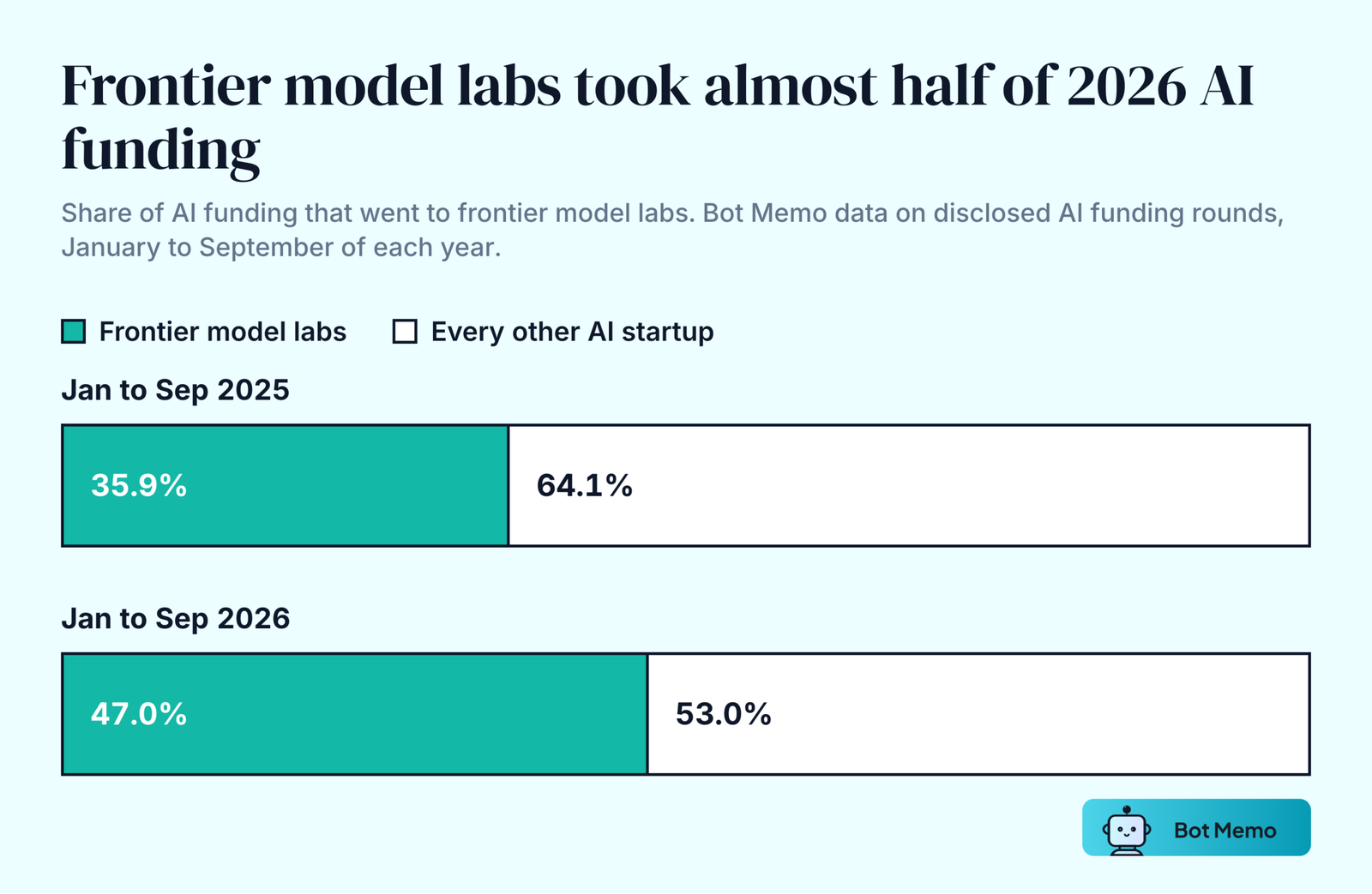
Fourteen rounds at frontier model labs raised $262.6B from January to September 2026, against $75.2B in the same months of 2025. The labs’ share of all AI funding rose from 35.9% to 47.0%.
Two companies hold most of it. OpenAI closed $122B on March 31, 2026 at an $852B post-money valuation. Anthropic raised a $30B Series G at $380B in February and a $65B Series H at $965B in May. Together OpenAI and Anthropic account for $217B, or 82.6% of the frontier-lab total. xAI added a $20B Series E in January, and Mistral raised a €3B Series D in September at more than €21B post-money.
Not all of these headline figures are cash in hand. Part of Amazon’s commitment to OpenAI depends on later milestones, and Anthropic’s Series H includes investment its cloud partners had committed earlier. Several other lab rounds, including those of DeepSeek, Safe Superintelligence and Moonshot AI, were reported by the press rather than announced by the companies. Even so, the model layer took close to one in every two AI dollars.
Funded trends: compute and defense AI
Two themes had large totals that were not dependent on one or two names.
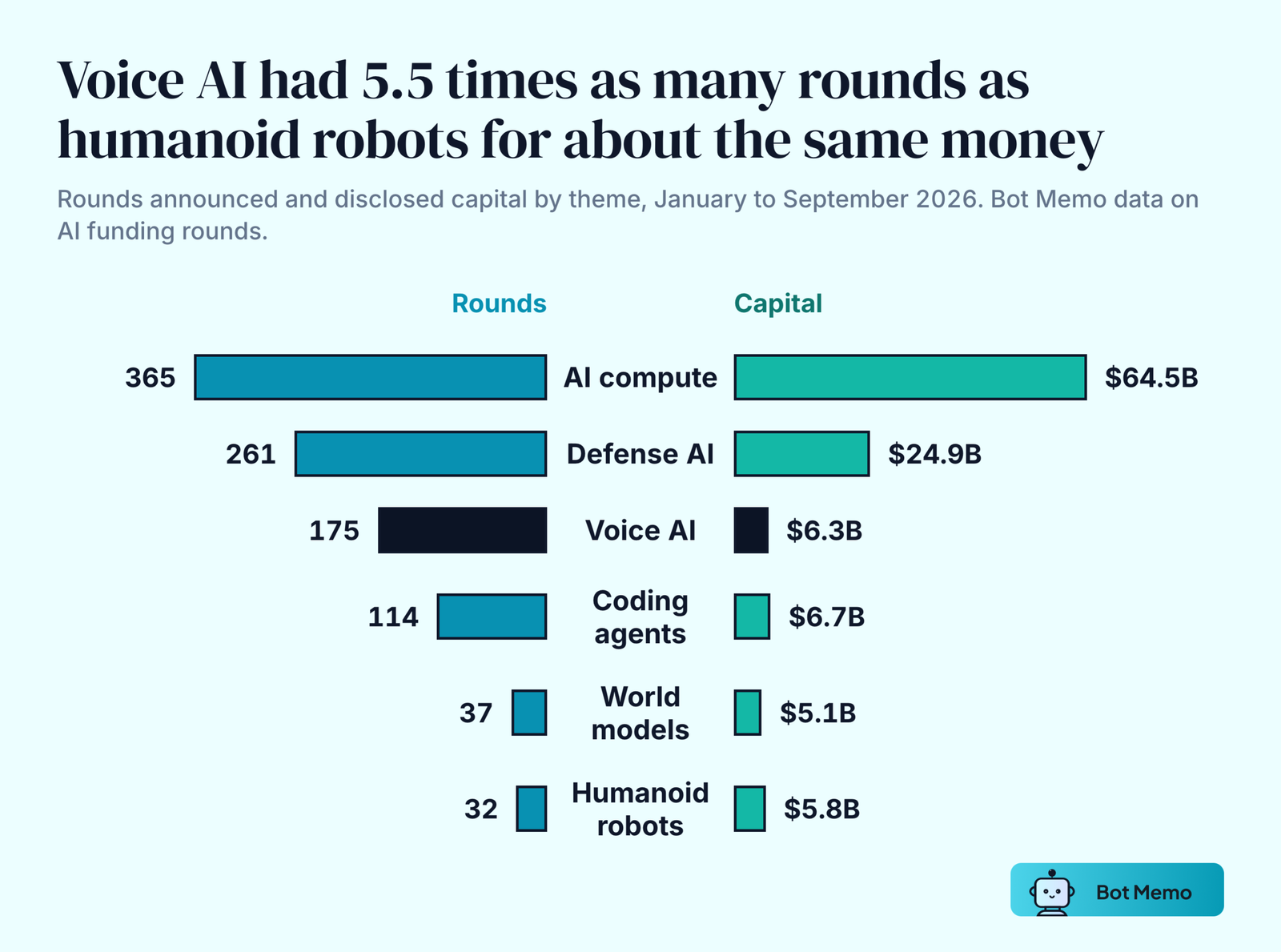
AI compute (chips, GPU cloud, inference and data centres, excluding the frontier labs) raised $64.5B across 365 rounds, up from $17.8B across 242 rounds in the first nine months of 2025. Fifteen of those rounds were $1B or more, and the two largest raisers together held less than 20% of the total. The figure includes debt and convertible notes, both common in this layer; for Nscale’s September notes we count only the part paid in at closing. Data platforms such as Databricks are not counted here. Named rounds include Crusoe’s $3.9B Series F in September, Nscale’s $2B Series C in March, and Firmus’s $2B equity round in August.
Defense AI raised $24.9B across 261 rounds, roughly double the $12.0B of January to September 2025. Five rounds were $1B or more: Anduril’s $5B Series H at $61B in May, Helsing’s $1.8B Series E in July, Saronic’s $1.75B Series D and Shield AI’s $1.5B Series G in March, and Quantum Systems’ €1B Series D in July. Below those five, the median disclosed defense round was $15.0M.
Rising trends: humanoid robots, world models and sovereign AI
Three themes are still small in total but more than doubled their funding.
Humanoid robots raised $5.8B across 32 rounds, up from $2.5B across 14. The median disclosed round was $144.8M, the highest among the themes here outside the frontier labs, and 20 of the 30 disclosed rounds were $100M or more. NEURA Robotics announced a Series C of up to $1.4B in June, with part of it tied to milestones. XPeng’s humanoid robot unit signed more than $900M in August, and China’s TARS closed a $455M Pre-A round in April. Bessemer’s April 2026 robotics outlook quotes partner Jeremy Levine: “There will be 100,000x more robots on Earth in the next 10-20 years.”
World models raised $5.1B across 37 rounds, against $0.8B across 12 a year earlier, with a $40.0M median. Wayve’s $1.2B Series D in February is the largest. Yann LeCun’s AMI raised $1.03B in March; we count it with the frontier labs, so it is not in the $5.1B. Fei-Fei Li’s World Labs, which raised $1B in February, sits in our spatial intelligence group and is not counted either.
Sovereign AI raised $9.5B across 48 rounds, up from $2.4B across 17. Debt financing made up about $5.7B of it, roughly three fifths.
Busy but small: agents, coding agents, voice AI
AI agents lead every theme here by round count, and coding agents and voice AI are also busy. Their typical round is small.
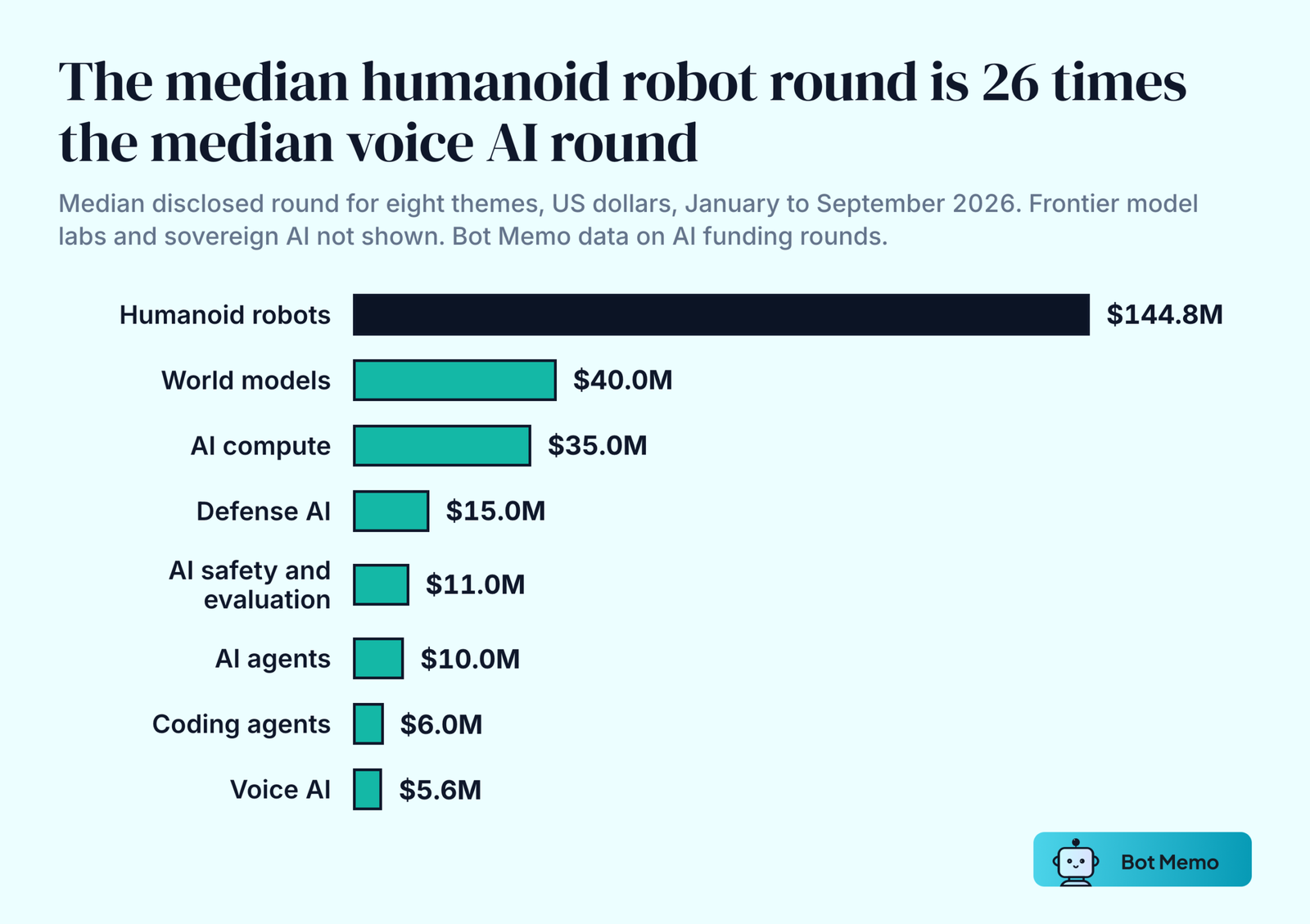
AI agents. 1,620 rounds from January to September 2026 went to companies building AI agents, 35% of all AI rounds and up from 1,075 a year earlier. The median disclosed round was $10.0M, and 65% of disclosed rounds were under $20M. Many of the largest of those rounds went to companies whose main business is something else, such as Anduril in defense. Gartner’s 2025 Hype Cycle for AI put AI agents at the Peak of Inflated Expectations, and in June 2025 Gartner predicted that over 40% of agentic AI projects will be canceled by the end of 2027. Our AI agent funding guide names the companies that did raise large rounds.
Coding agents. 114 rounds raised $6.7B, up from $3.1B, but the median round fell from $8.6M to $6.0M. Cognition alone took more than $3B across a Series D of just over $1B in May and a Series E of more than $2B in September, about 45% of the theme’s money. Replit’s $400M Series D in March and Lovable’s $400M Series C in August are the next tier. Two thirds of disclosed coding-agent rounds were under $20M.
Voice AI. 175 rounds raised $6.3B, with a $5.6M median, down from $6.9M in 2025; 71% of disclosed rounds were under $20M. The group is broad and includes customer-service agents that answer by phone. The large rounds went to a few companies, among them Sierra, which was reported in May to be raising $950M at $15.8B, ElevenLabs’ $500M Series D in February and Parloa’s $350M Series D in January.
AI safety and evaluation moved the other way. Rounds fell from 188 to 132, and funding slipped to $4.2B from $4.4B. The largest was Snorkel AI’s $350M Series E in September; LMArena raised a $150M Series A in January.
The funded-vs-hyped matrix
| Theme | Rounds, Jan to Sep 2026 | Capital | Median round | Rounds of $1B+ | Group |
|---|---|---|---|---|---|
| Frontier model labs | 14 | $262.6B | $3.4B | 11 | Funded, two names hold 83% |
| AI compute | 365 | $64.5B | $35.0M | 15 | Funded |
| Defense AI | 261 | $24.9B | $15.0M | 5 | Funded |
| Sovereign AI | 48 | $9.5B | $43.8M | 3 | Rising, mostly debt |
| Humanoid robots | 32 | $5.8B | $144.8M | 1 | Rising |
| World models | 37 | $5.1B | $40.0M | 1 | Rising |
| AI agents | 1,620 | n/a | $10.0M | n/a | Busy but small |
| Coding agents | 114 | $6.7B | $6.0M | 2 | Busy but small, one leader |
| Voice AI | 175 | $6.3B | $5.6M | 1 | Busy but small |
| AI safety and evaluation | 132 | $4.2B | $11.0M | 0 | Fewer rounds |
We leave out a capital total for AI agents because many of the largest rounds in the agents group belong to companies in other themes, such as Anduril in defense.
What this means for founders and investors
The funded themes run at a different scale. The median frontier-lab round was $3.4B, and Anduril, Helsing, Shield AI and Saronic are valued between $9.25B and $61B.
In voice AI and coding agents, two thirds or more of disclosed rounds were under $20M. A few companies, such as ElevenLabs, Cognition and Lovable, took the large rounds.
The rising themes are the ones to watch for the rest of 2026. Humanoid robots and world models had fewer than 40 rounds each but more than doubled their funding, and the median humanoid round was already above $100M. One example of how fast the numbers move: an April report said Jeff Bezos’s Project Prometheus was close to a $10B round; in June it announced $12B at a $41B valuation.
For a wider view, Stanford HAI’s 2026 AI Index puts global private AI investment in 2025 at $344.7B, up 127.5% from 2024. More on the year’s biggest deals is in our 2026 AI mega-rounds tracker and how AI startup valuations changed in 2026.
How the themes are defined
Each theme groups the technology categories on Bot Memo’s funding records. A round can count in more than one theme, so theme totals should not be added together. Frontier model labs are counted once, in their own row, and left out of every other theme. Themes cover the rounds we group under them and are not full market totals. Defense AI uses our GovTech and Defense sector. Totals include equity, debt, convertible notes and announced amounts, and leave out secondary share sales. Medians use disclosed round sizes only. Non-dollar rounds are converted to US dollars. The AI startup classifications page explains how companies are grouped.
Frequently Asked Questions
Which AI trends had the most funding in 2026?
Frontier model labs raised $262.6B from January to September 2026, 47.0% of all AI funding. AI compute followed with $64.5B across 365 rounds, then defense AI with $24.9B across 261 rounds.
Are AI agents overhyped?
Agents are the busiest theme, with 1,620 rounds and 35% of all AI rounds in the first nine months of 2026. The median round was $10.0M, and 65% of disclosed rounds were under $20M. Gartner predicted in June 2025 that over 40% of agentic AI projects will be canceled by the end of 2027.
Is humanoid robotics funded or hyped?
Humanoid robots raised $5.8B across 32 rounds, small in total, but the median round of $144.8M was the highest of the themes on this page outside the frontier labs. NEURA Robotics (up to $1.4B) and XPeng’s robot unit (over $900M) led.
How much did OpenAI, Anthropic and xAI raise in 2026?
OpenAI closed $122B in March at $852B post-money. Anthropic raised $30B in February at $380B and $65B in May at $965B. xAI raised a $20B Series E in January.
How many AI rounds of $1B or more were there in 2026?
Fifty-five from January to September 2026, against 18 in the same months of 2025. The 2026 count includes debt and announced amounts.

About the author
Editorial Staff
The Editorial Staff at Bot Memo is a team of writers, analysts, and AI agents dedicated to mapping the global AI startup ecosystem. Led by Chintan Zalani, the team tracks thousands of funding rounds, classifies companies across verticals, and distills it all into actionable intelligence for investors and founders.