
3,206 venture AI rounds closed between January and June 2026, worth $436.7B. Three companies took 54.3% of it.
Alumni Ventures, a firm that raises from individual accredited investors, backed more rounds this half than Kleiner Perkins did.
On this page
- How the half divides by kind of AI company
- What an investor's book says about the firm
- Where the dollars moved
- The tier that brand recognition misses
- Who came back for a second round
- Where AI Adjacent founders should look for money
- The growth-side book
- State money in Europe's early stage
- Three labs, and a more crowded market underneath
How the half divides by kind of AI company
Every company in our repository carries one of four AI classifications.
AI Platforms build the models everyone else rents. AI Native companies exist because of AI. AI Augmented companies added AI to a business that already worked. AI Adjacent companies sell what the boom consumes without building AI at all: data centers, chips, power, cooling.
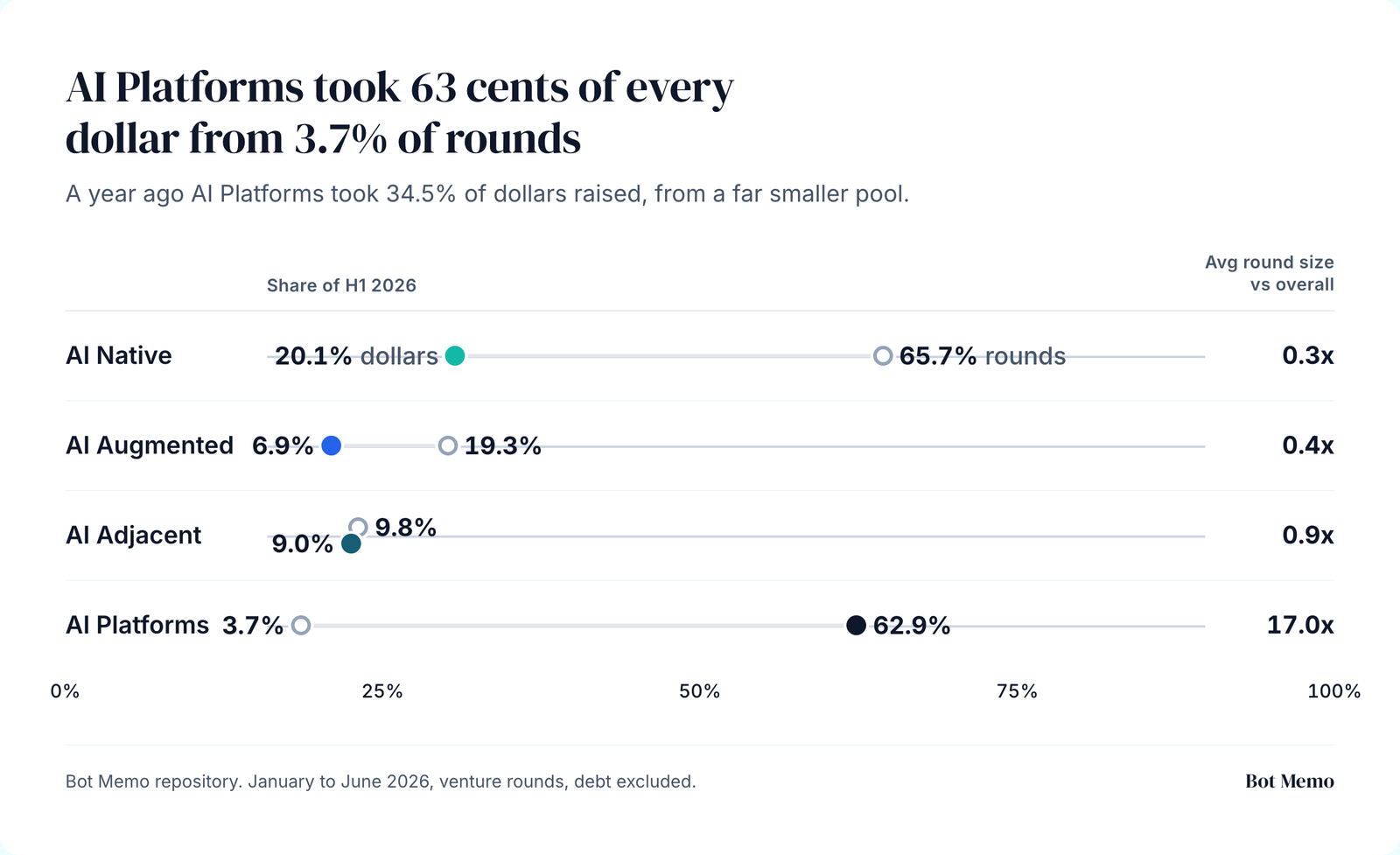
Sorted that way, the half is lopsided in a way the headline total hides. AI Platforms closed 119 rounds, 3.7% of all deals, and took 62.9 cents of every dollar.
AI Native companies were 65.7% of all rounds and collected 20.1% of the money. A year ago Platforms took 34.5% of a much smaller pool.
Check sizes follow the same ladder. Across all stages, the median AI Native round was $8.5M, against $17.4M for Augmented, $20M for Adjacent, and $120M for Platforms. Split that by stage and the gap opens at both ends.
The pattern holds at entry. A median seed-through-A round is $6M if the startup is AI Native and $10M if it’s a data-center, chip, or power company standing next to the boom. The market pays an entry premium for the businesses AI consumes, and it pays the most for the handful building the models.
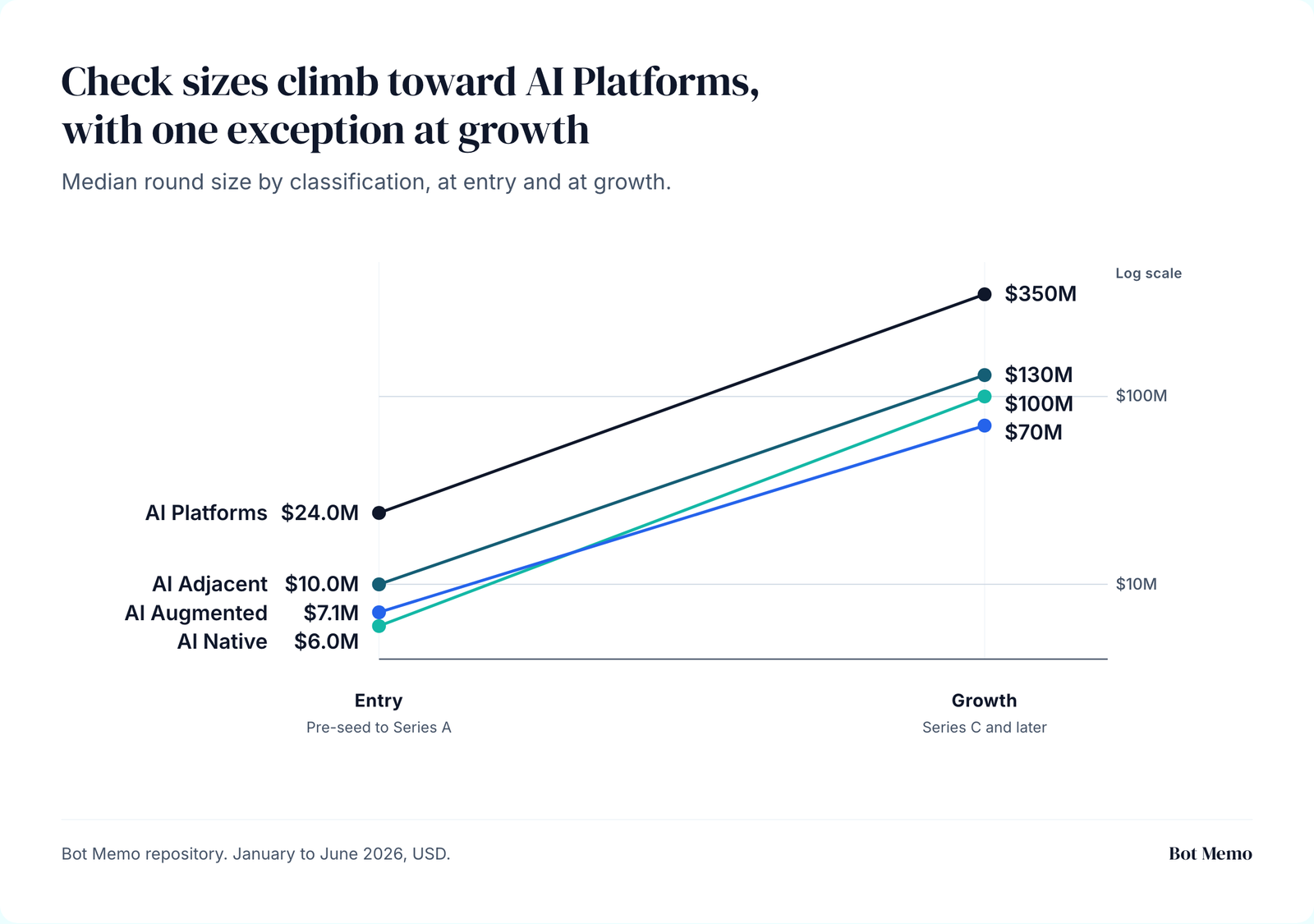
At the growth stage the ladder gets one twist worth knowing. AI Augmented companies, the ones that bolted AI onto an existing business, have the cheapest growth median at $70M, below Native at $100M and Adjacent at $130M. Growth investors are paying up for pure exposure in either direction, and paying less for retrofits.
What an investor’s book says about the firm
Sort investors by the classification mix of their H1 book and the firm types separate cleanly.
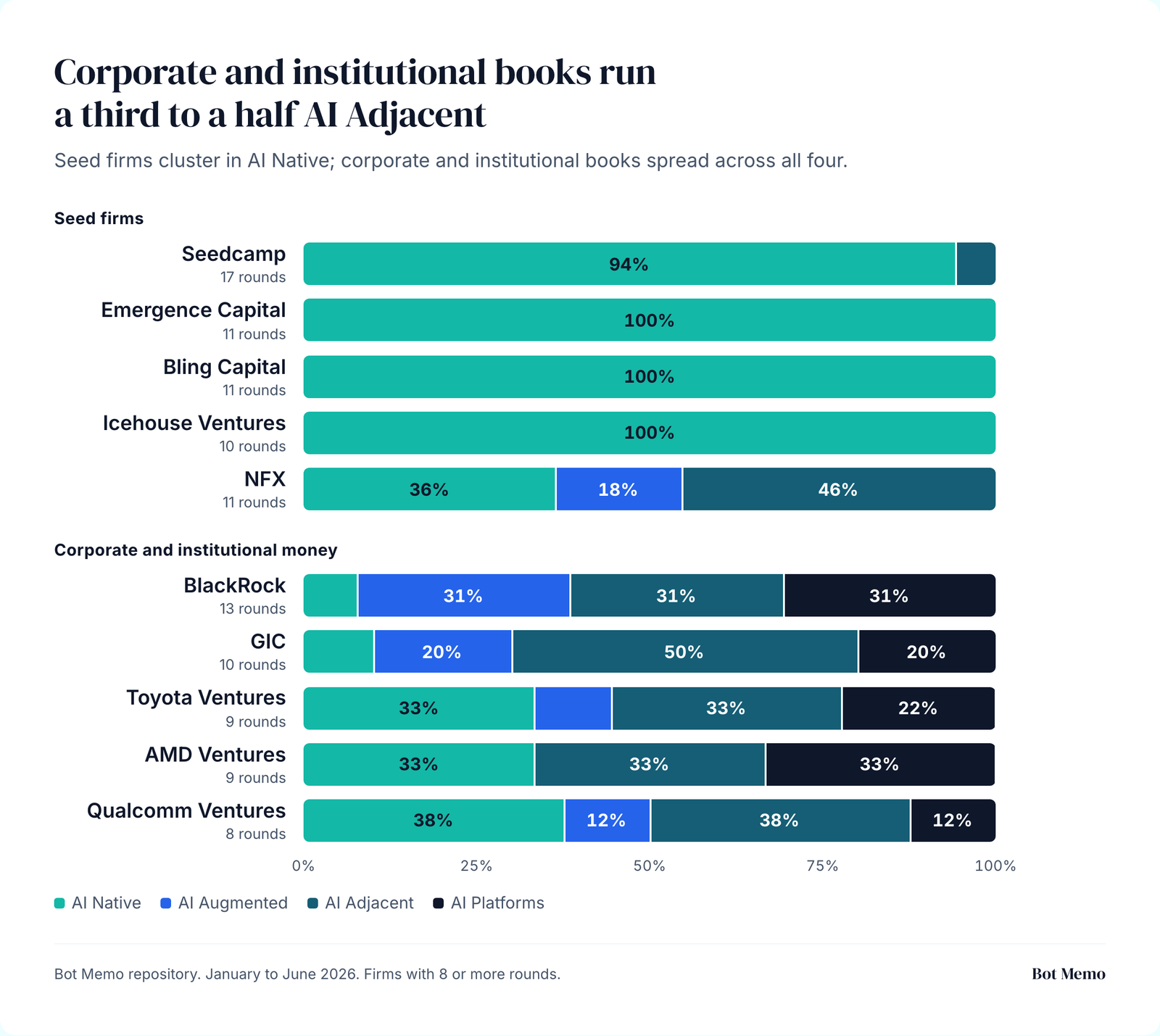
Classic seed firms run all-Native books. Emergence Capital and Bling Capital each backed 11 rounds this half, and every one was AI Native. Icehouse Ventures went 10 for 10, Northzone 9 for 9, and Susa Ventures, MMC Ventures, TLV Partners and EWOR all matched at 8 or 9. Seedcamp came in at 16 of 17.
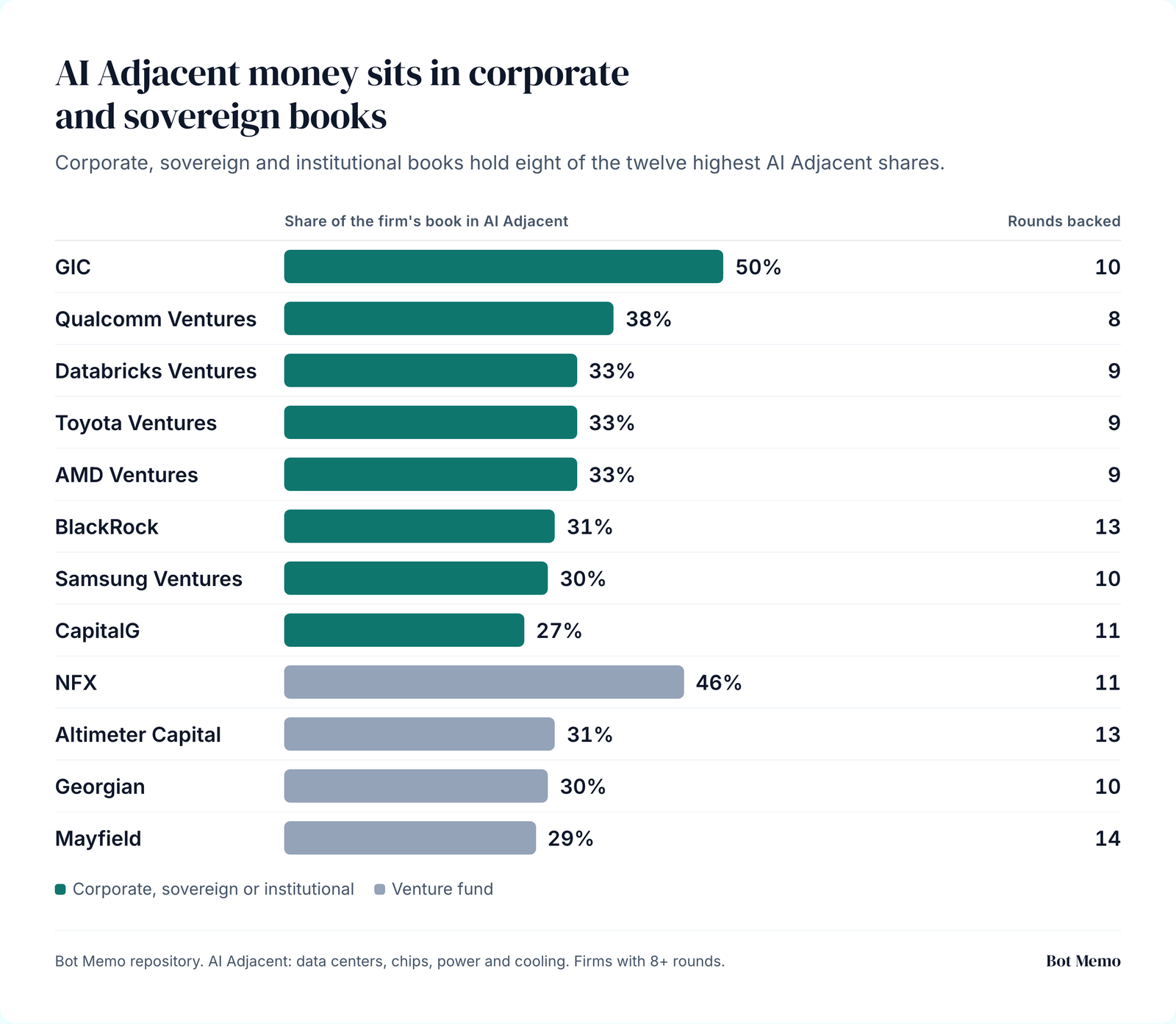
Corporate and institutional money runs the other way. Half of GIC’s ten positions were AI Adjacent. Qualcomm Ventures put 38% of its book there, Toyota Ventures and AMD Ventures a third each, BlackRock 31%. These firms are buying the buildout, not the model race.
The outlier is NFX, a seed firm with 46% of its 11 deals in Adjacent territory. No other seed firm on the list comes close.
Where the dollars moved
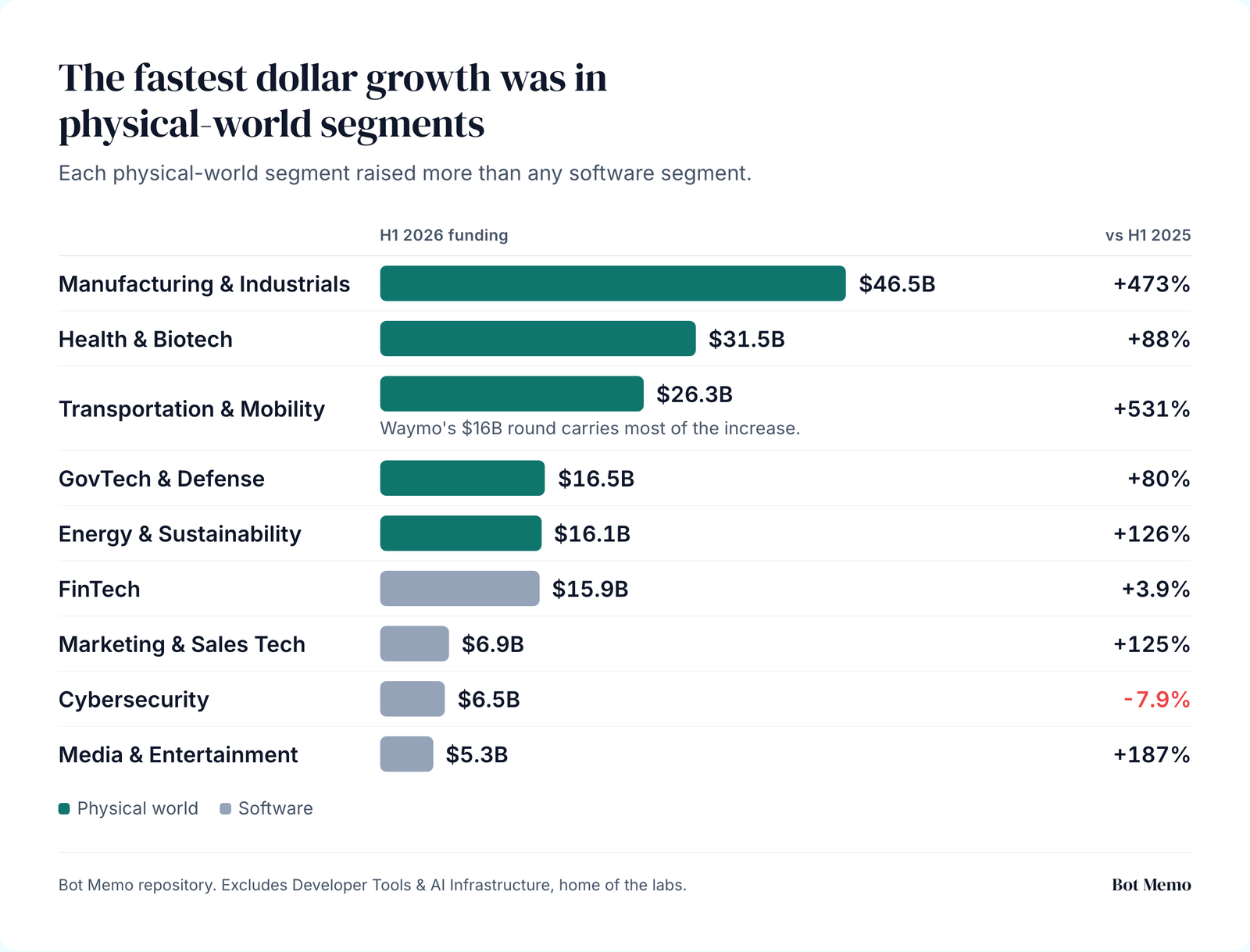
The money rotated toward companies that touch the physical world. Manufacturing and industrial AI raised $46.5B, up 473% year over year. Transportation and mobility rose 531% to $26.3B, most of it Waymo’s $16B round. Energy more than doubled. Defense deal count grew 73%.
The stalls are all in classic software categories. FinTech dollars grew 3.9% on 16.6% more deals. Cybersecurity was the only top-ten segment where dollars fell, down 7.9% to $6.5B.
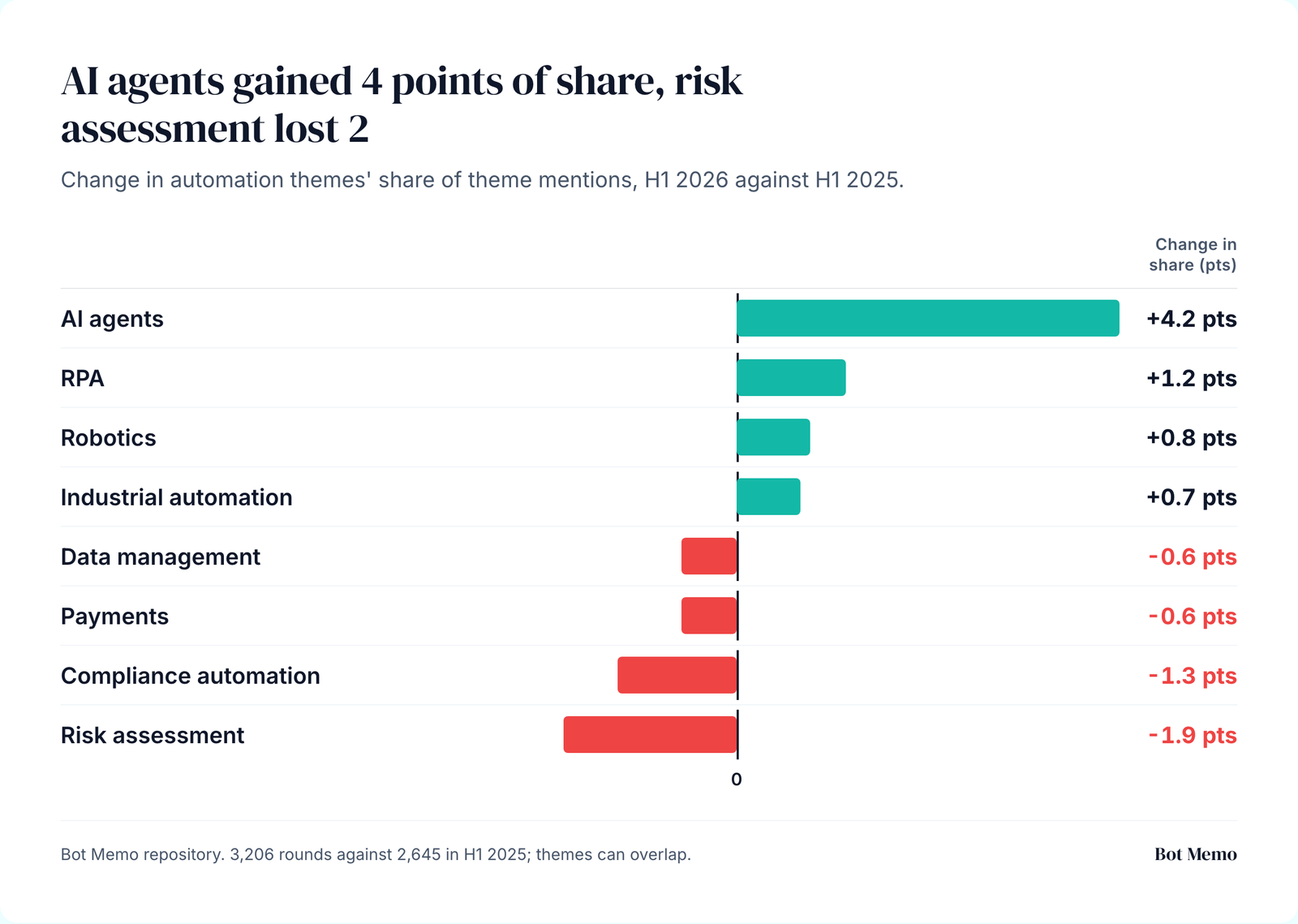
The theme data underneath sharpens it. Themes that describe software doing work gained share of the half’s deals. AI agents went from 8.0% of theme mentions to 12.2%, RPA quadrupled its share, robotics and industrial automation both climbed.
Risk assessment lost 1.9 points of share and compliance automation 1.3. Data management and payments slid too.
The doing-work themes also carry bigger checks. The median robotics round was $18M against $9M for document automation.
The tier that brand recognition misses
Y Combinator backed 135 rounds this half, Andreessen Horowitz 107, General Catalyst 82. The interesting tier sits under them.
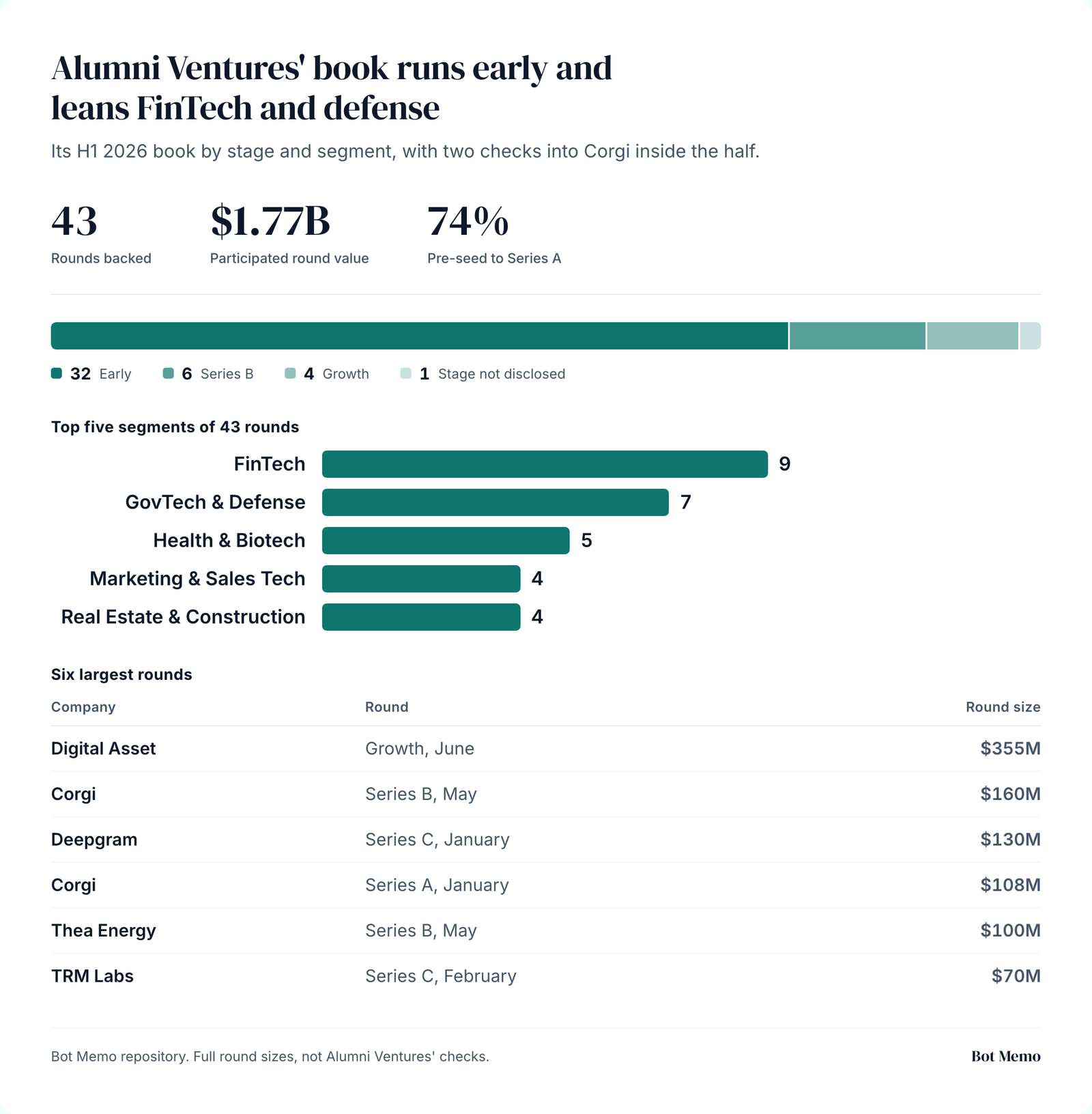
Alumni Ventures, the Manchester, New Hampshire firm that opens its venture funds to individual accredited investors, backed 43 rounds. That is more than Khosla at 41, Kleiner Perkins at 37, or Google Ventures at 35.
Its book runs 74% pre-seed through Series A and leans heavy on FinTech with 9 rounds and defense with 7, alongside checks into Deepgram, TRM Labs and Thea Energy.
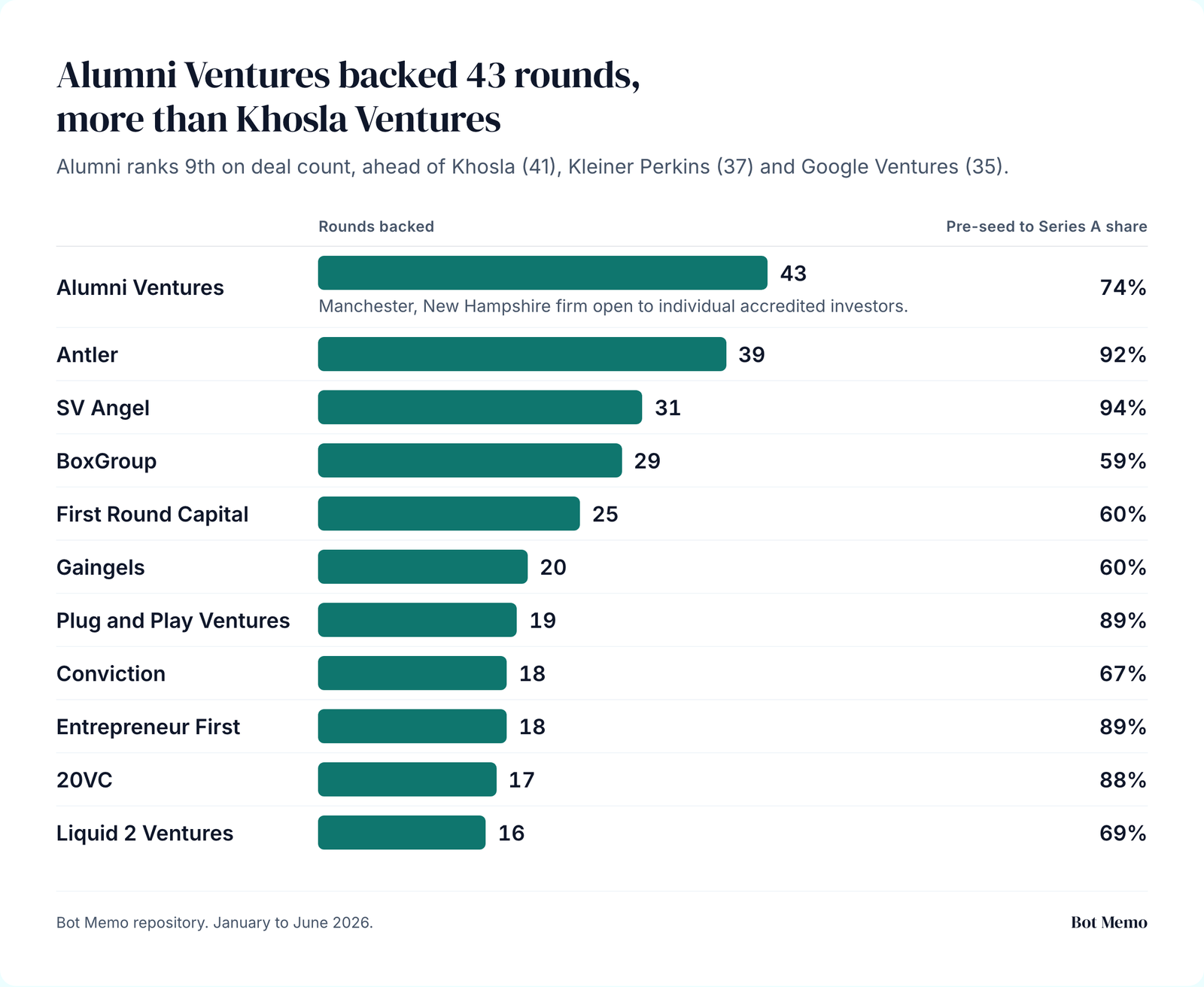
Antler ran 39 rounds at a $2.6M median, with 92% of its book at Series A or earlier. That is a pre-seed conveyor running in 12 countries at once.
The entry list is worth reading too. Prosus, the Amsterdam-listed arm of Naspers, showed up in 8 rounds after sitting out 2025 entirely. Paul Forster, who co-founded Indeed and now writes solo angel checks, appeared in 7 early rounds, four in the UK and mostly FinTech.
Mubadala and Hillhouse entered with 6 and 5 positions, Ontario Teachers’ Pension Plan with 5. Two operator angels turned up for the first time as well, Armis founder Yevgeny Dibrov and Opendoor chief executive Kaz Nejatian, at five rounds each.
Who came back for a second round
A better test than deal count is whether an investor writes into the same company twice.
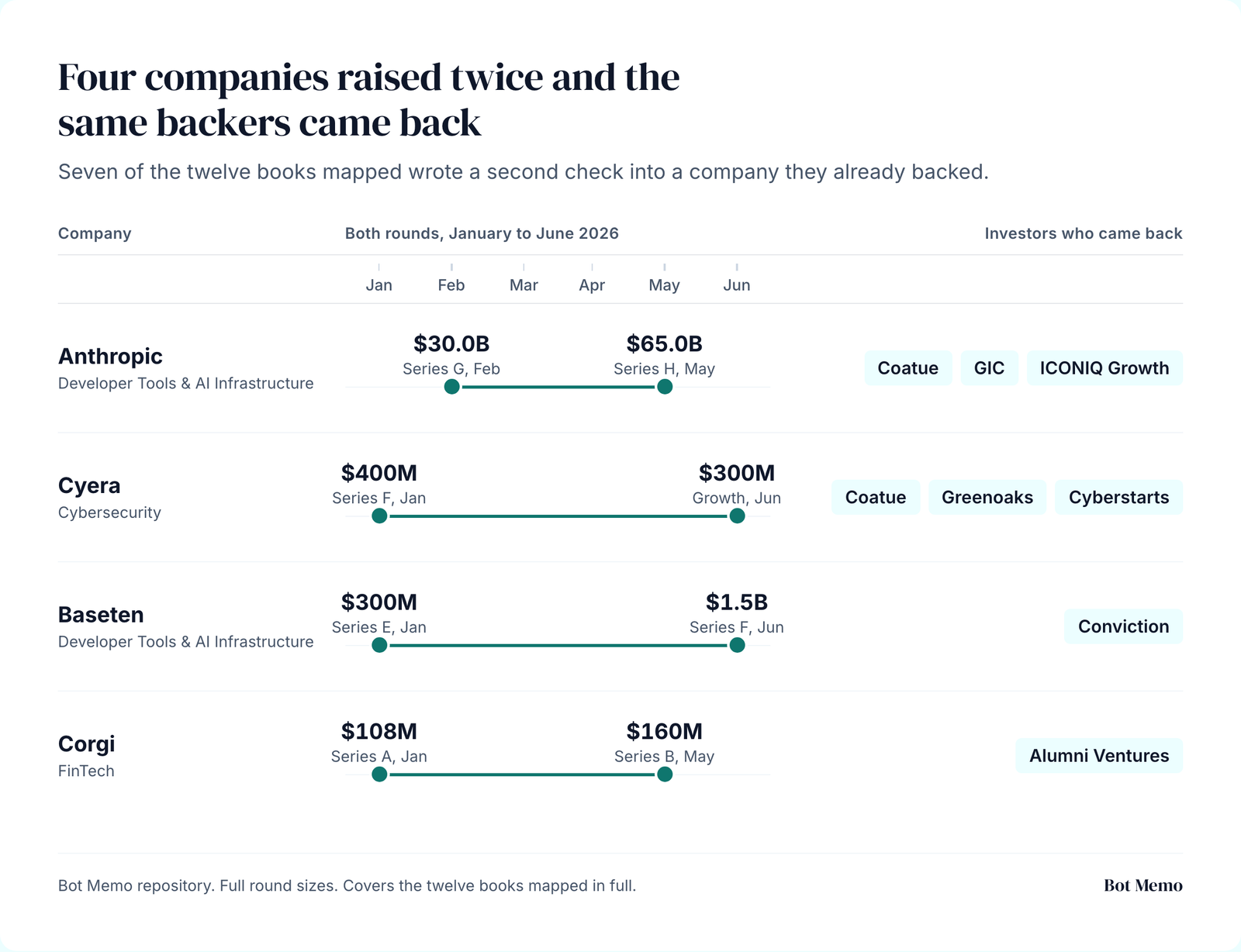
Across the twelve investor books in this report, seven did exactly that inside six months.
Anthropic drew three returning backers: Coatue, GIC and ICONIQ Growth all wrote into the February Series G and again into the May Series H. Conviction went back into Baseten at $300M in January and $1.5B in June. Alumni Ventures took the Corgi Series A in January and the Series B in May.
The one worth staring at is Cyera. Coatue, Greenoaks and Cyberstarts each re-upped inside the half, on a $400M January round and a $300M June round. Cyera sells cybersecurity, the only top-ten segment where funding fell all half. Three separate books doubled down on a company inside the one category the market was pulling away from.
Where AI Adjacent founders should look for money
If you are building the picks and shovels, the generalist top-VC list is the wrong target list. It skews Native.
Sort every firm with 8 or more rounds by what share of its own book went to AI Adjacent and the answer is corporate, sovereign and institutional money. GIC leads at 50%. Qualcomm Ventures sits at 38%, Databricks Ventures, Toyota Ventures and AMD Ventures at a third each, BlackRock and Samsung Ventures a shade under.
Two classic early-stage funds break into that list, NFX at 46% and Mayfield at 29%. The rest of it is corporate, sovereign, institutional or growth-stage money.
The growth-side book
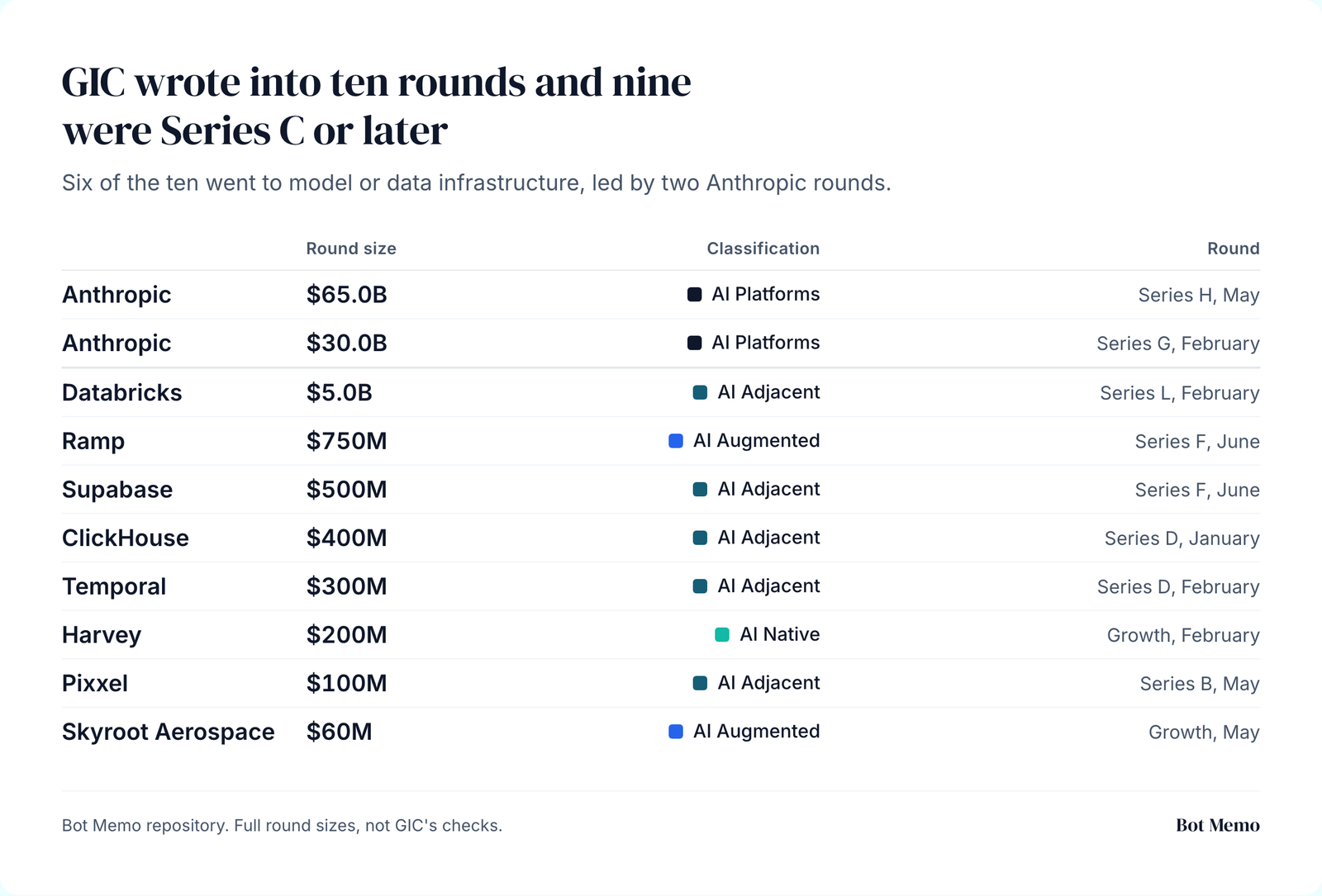
GIC, Singapore’s sovereign fund, shows how large institutions played this half. Ten positions, nine of them Series C or later, median round size $450M.
Six of the ten are model or data infrastructure: two Anthropic rounds, Databricks’ $5B Series L, ClickHouse, Temporal and Supabase. The other four are Harvey, Ramp, and two Indian space companies, Skyroot and Pixxel. Those ten rounds were worth $102.3B in total.
The same shape repeats down the growth tier. Coatue backed 23 rounds worth $109.3B, 70% of them growth. ICONIQ Growth backed 21 worth $98.7B, Greenoaks 14 at a $250M median.
And one early-stage brand keeps drifting upstream. Conviction, Sarah Guo’s fund, holds an 18-deal book with a $52.5M median. That is a seed-brand firm writing mid-cap checks.
State money in Europe’s early stage
European early-stage AI tripled. 622 seed-through-A rounds raised $13.8B, against $4.6B a year earlier. The UK led with 282 rounds across all stages, Germany 117, France 69.
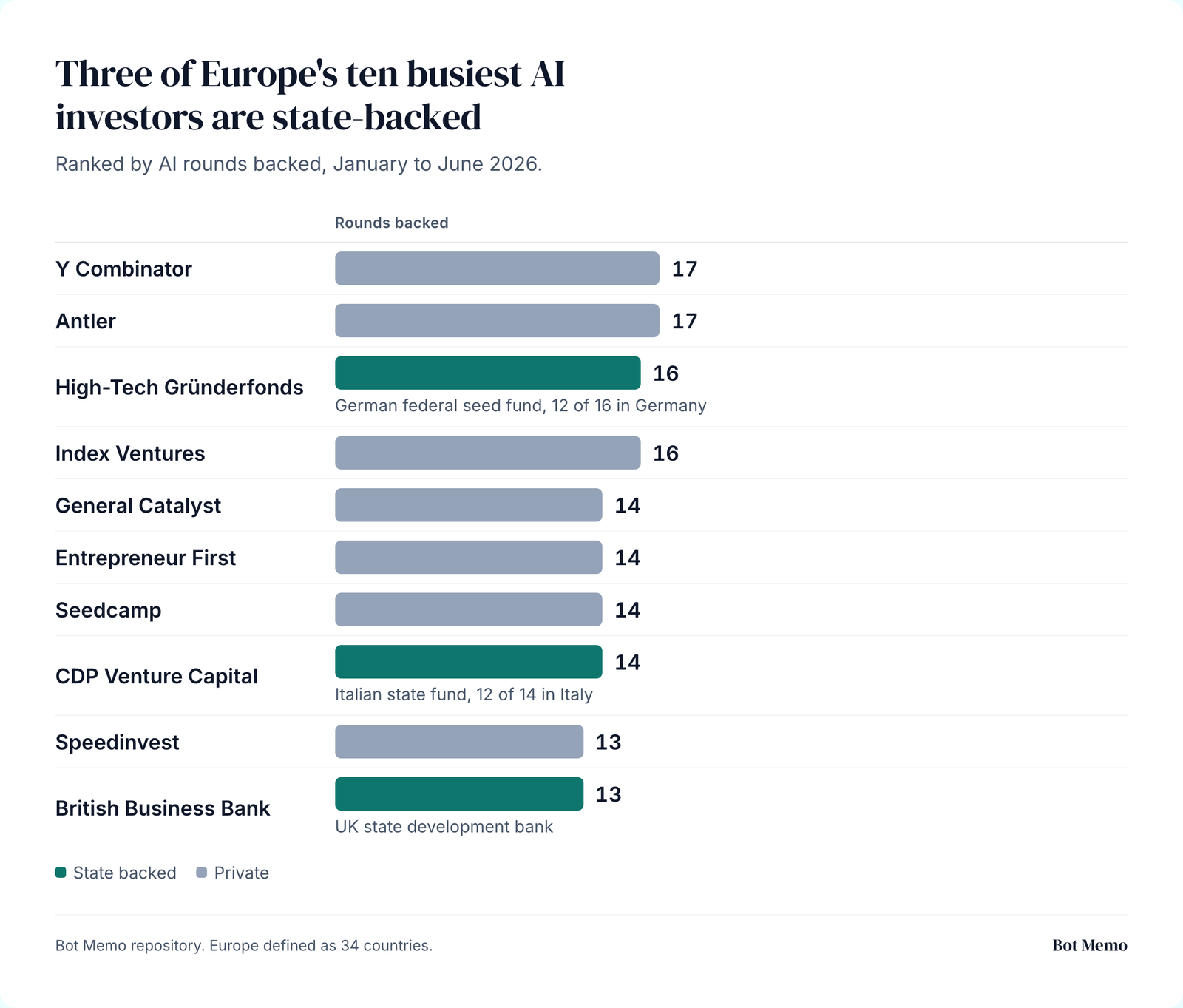
Look at who writes those European early checks and a pattern shows up with no US equivalent. State-backed funds sit beside YC and Index in the top ten.
Germany’s High-Tech Gründerfonds backed 16 rounds, all early-stage, 12 of them German, at a $3.3M median. Italy’s CDP Venture Capital did 14, twelve of them Italian. The British Business Bank backed 13 rounds. The European Innovation Council, which funds only in Europe, backed 8.
For a European founder that is a real fork. Take state money and you take its geography with it.
Three labs, and a more crowded market underneath
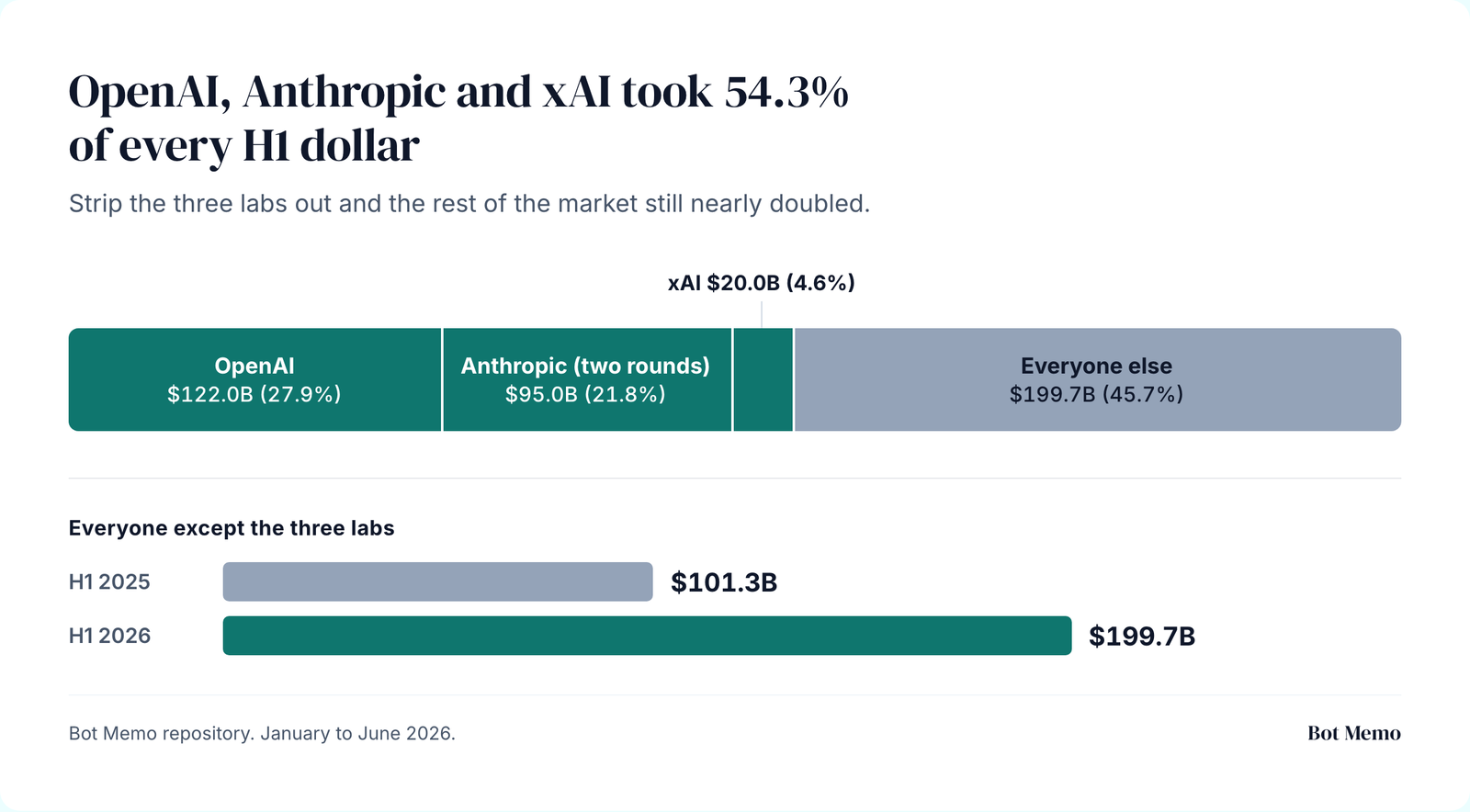
The concentration at the top hardened. OpenAI’s $122B round, Anthropic’s $95B across two rounds, and xAI’s $20B took 54.3% of all H1 dollars among three companies.
Everyone else raised $199.7B, still nearly double the prior year’s ex-labs total of $101.3B.
Rounds also stayed crowded. The average disclosed syndicate grew from 4.3 investors to 4.9, and solo rounds fell from 20.4% of deals to 13.9%.
The tightest repeat partnership of the half was Lightspeed and Sequoia at 16 shared rounds. Pioneer Fund appeared in 10 rounds alongside Y Combinator.
Data: Bot Memo repository, 3,206 venture AI rounds, January to June 2026, all amounts USD. Full round value is attributed to every participating investor, so participated totals are never summed to a market figure.

About the author
Editorial Staff
The Editorial Staff at Bot Memo is a team of writers, analysts, and AI agents dedicated to mapping the global AI startup ecosystem. Led by Chintan Zalani, the team tracks thousands of funding rounds, classifies companies across verticals, and distills it all into actionable intelligence for investors and founders.