
OpenAI (often written Open AI) closed a $122 billion funding round in March 2026 at an $852 billion post-money valuation, which makes it the most valuable private company ever assembled. Three years earlier the same company was worth $29 billion and told staff it had crossed a $1.3 billion revenue run rate.
The OpenAI statistics below each carry an issuer and a date. Where a 2023 or 2024 figure has since been overtaken, the original stays on the page next to the current one.
On this page
- OpenAI User Growth And Consumer Adoption Statistics
- ChatGPT Usage Patterns
- OpenAI Revenue Statistics
- OpenAI Valuation And Funding Statistics
- OpenAI Enterprise And Developer Statistics
- OpenAI Model And Pricing Statistics
- OpenAI Company Statistics
- OpenAI Market Share And Traffic Statistics
- Key Takeaways
- Frequently Asked Questions
- Sources And Methodology
OpenAI User Growth And Consumer Adoption Statistics
Weekly Active Users From 100 Million To 900 Million
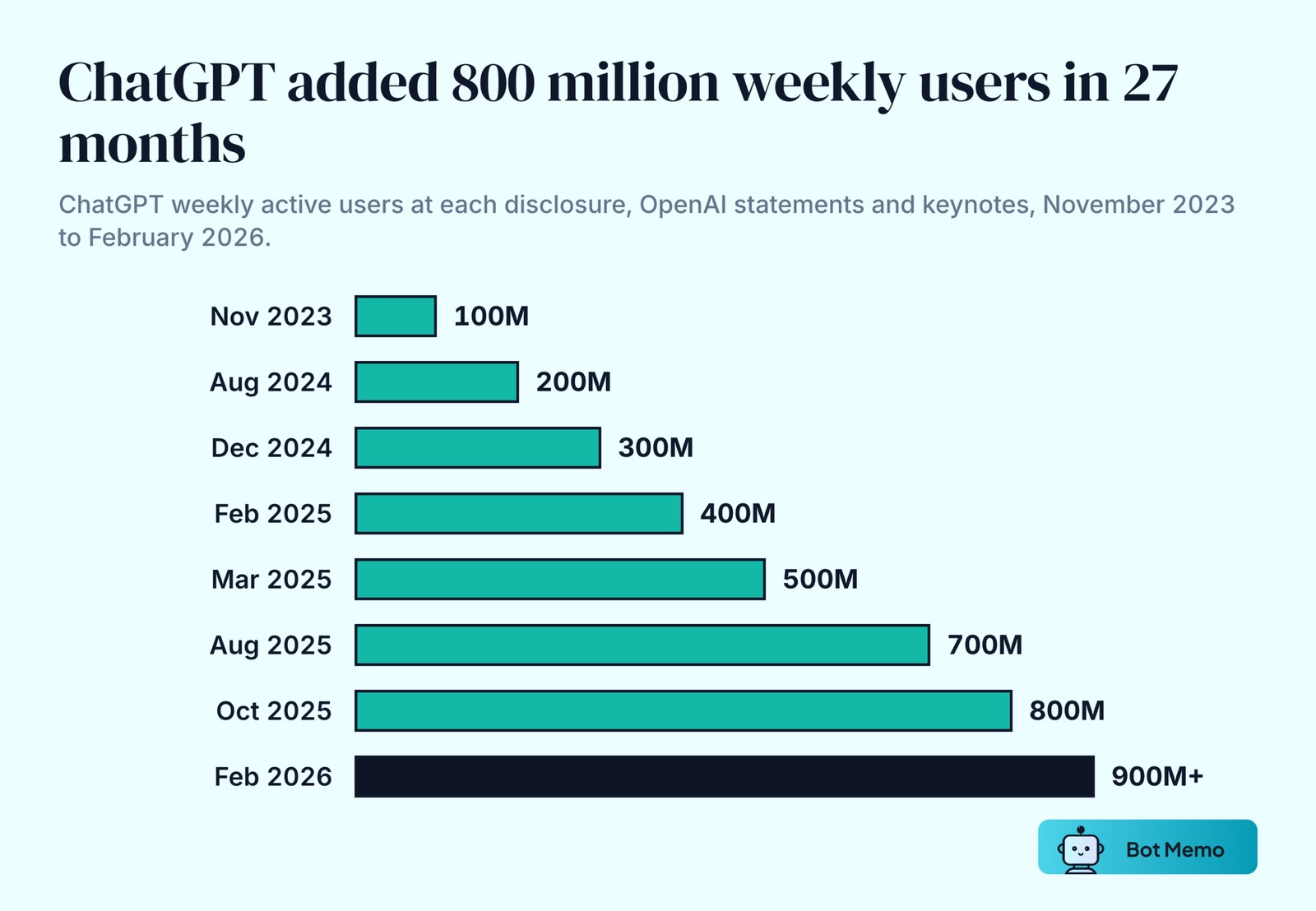
1. ChatGPT reached 100 million weekly active users by November 6, 2023, the figure Sam Altman gave on stage at OpenAI’s first DevDay. (OpenAI DevDay 2023)
2. Weekly active users hit 200 million by August 29, 2024, per an OpenAI statement to Axios. (Axios)
3. Altman put the count at “more than 300 million” weekly active users in his end-of-2024 essay, up from about 100 million a year earlier. (blog.samaltman.com)
4. ChatGPT passed 400 million weekly active users in February 2025, confirmed by an OpenAI spokesperson to Reuters. (Reuters)
5. OpenAI referred to “the 500 million people who use ChatGPT every week” in its March 31, 2025 funding update. (OpenAI)
6. Nearly 700 million people were using ChatGPT weekly as of August 7, 2025, the day GPT-5 shipped. (OpenAI)
7. More than 800 million people used ChatGPT every week as of October 6, 2025, and OpenAI was processing over 6 billion tokens per minute through its API. (Altman, DevDay 2025)
8. OpenAI reported more than 900 million weekly active users and more than 50 million consumer subscribers on February 27, 2026, alongside its $110 billion funding announcement. (OpenAI)
How Fast ChatGPT Reached Its First Users
9. ChatGPT crossed 1 million users five days after its November 30, 2022 launch. Altman posted the milestone on December 5, 2022; Greg Brockman confirmed the five-day framing the same day. (Sam Altman on X)
10. During the Ghibli-style image generation surge on March 31, 2025, Altman wrote that OpenAI “added one million users in the last hour,” against one million in five days at launch. (Sam Altman on X)
11. Altman told DevDay 2023 that 2 million developers were building with OpenAI’s tools. By DevDay in October 2025 that number was 4 million. (OpenAI DevDay)
How Many Americans Use ChatGPT
12. In January 2023, 46% of Americans said they were familiar with ChatGPT and 54% had not heard of it at all, per a YouGov survey of 1,000 US adults conducted January 24 to 27, 2023. (YouGov)
13. Only 6% of Americans said they had personally used ChatGPT in that same January 2023 YouGov survey. (YouGov)
14. About two-thirds of postgraduates were aware of ChatGPT in January 2023, the highest awareness of any education band YouGov measured. (YouGov)
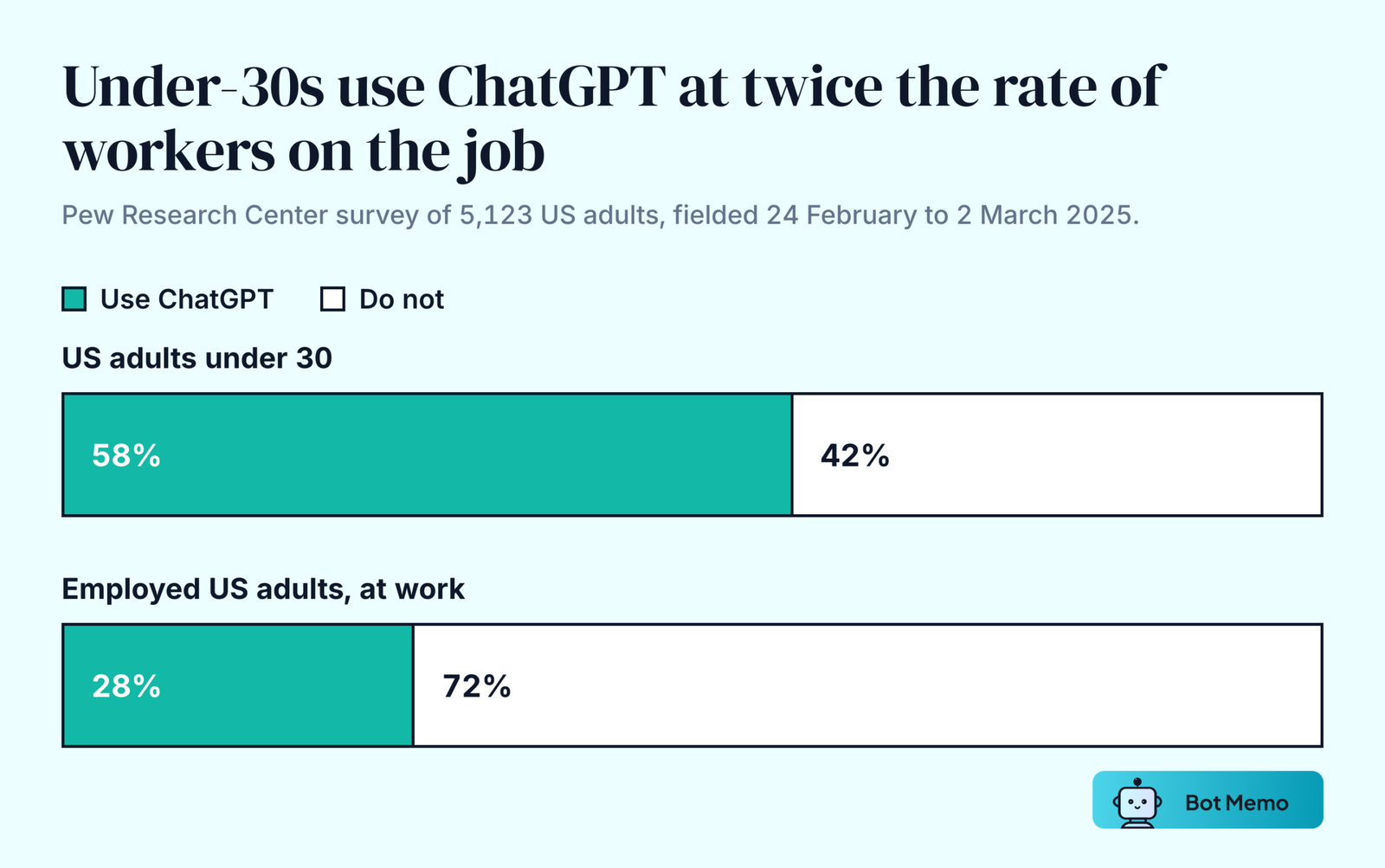
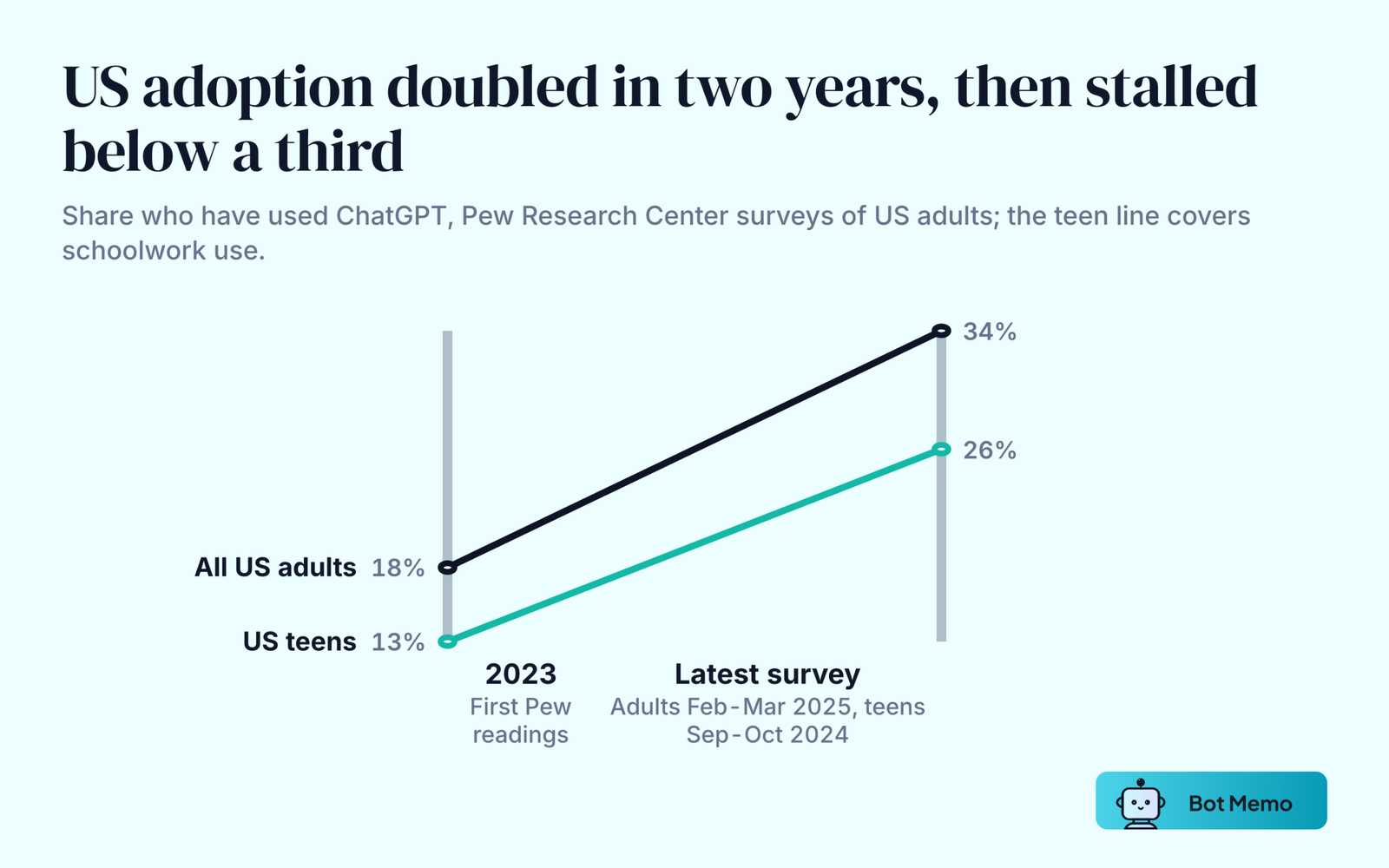
15. By 2025, 34% of US adults had used ChatGPT, roughly double the share in 2023, per a Pew Research Center survey of 5,123 adults fielded February 24 to March 2, 2025. Awareness reached 79%. (Pew Research Center)
16. 58% of US adults under 30 have used ChatGPT, per the same Pew survey. (Pew Research Center)
17. 28% of employed US adults use ChatGPT for work. (Pew Research Center)
18. 26% of US teens used ChatGPT for schoolwork as of Pew’s September to October 2024 survey, double the 13% recorded in 2023. (Pew Research Center)
Who Uses ChatGPT
19. A 2024 SimilarWeb snapshot put ChatGPT’s audience at 55.56% male and 44.44% female. The current SimilarWeb reading is 54.51% male and 45.49% female. (SimilarWeb)
20. That 2024 snapshot showed 25 to 34 year olds as the largest age band at 31.74%, followed by 18 to 24 at 25.28%, 35 to 44 at 18.78%, 45 to 54 at 12.20%, 55 to 64 at 7.32% and 65 and over at 4.69%. The 25 to 34 band still leads today. (SimilarWeb)
ChatGPT Usage Patterns
ChatGPT At Work Versus Personal Use
21. ChatGPT users sent 2.6 billion messages a day in June 2025, up from 451 million a day in June 2024. (OpenAI Economic Research)
22. Non-work messages rose from 53% of the total in June 2024 to 72.2% by June 2025, which means work-related use fell from 47% to 27.8%. (OpenAI Economic Research)
Top ChatGPT Use Cases
23. Practical guidance, information seeking and writing are the top three use cases, together accounting for about three-quarters of all ChatGPT conversations. (OpenAI Economic Research)
24. Writing is the single largest category at 28% of all conversations and 42% of work conversations. (OpenAI Economic Research)
25. Information seeking accounts for 24.4% of conversations overall and 13.5% of work conversations. (OpenAI Economic Research)
26. Decision-making and problem solving make up 14.9% of work-related conversations. (OpenAI Economic Research)
27. Sorted by intent, ChatGPT usage splits three ways: 49% of messages are Asking, 40% are Doing and 11% are Expressing. (OpenAI Economic Research)
Who Is Sending The Messages
28. Users with typically feminine names grew from about 37% of active users in January 2024 to roughly 52% by mid-2025, closing a gap that started near 80% male at launch. (OpenAI Economic Research)
29. 46% of users who disclosed their age were between 18 and 25. (OpenAI Economic Research)
OpenAI Revenue Statistics
Annual Recurring Revenue From $2 Billion To More Than $20 Billion
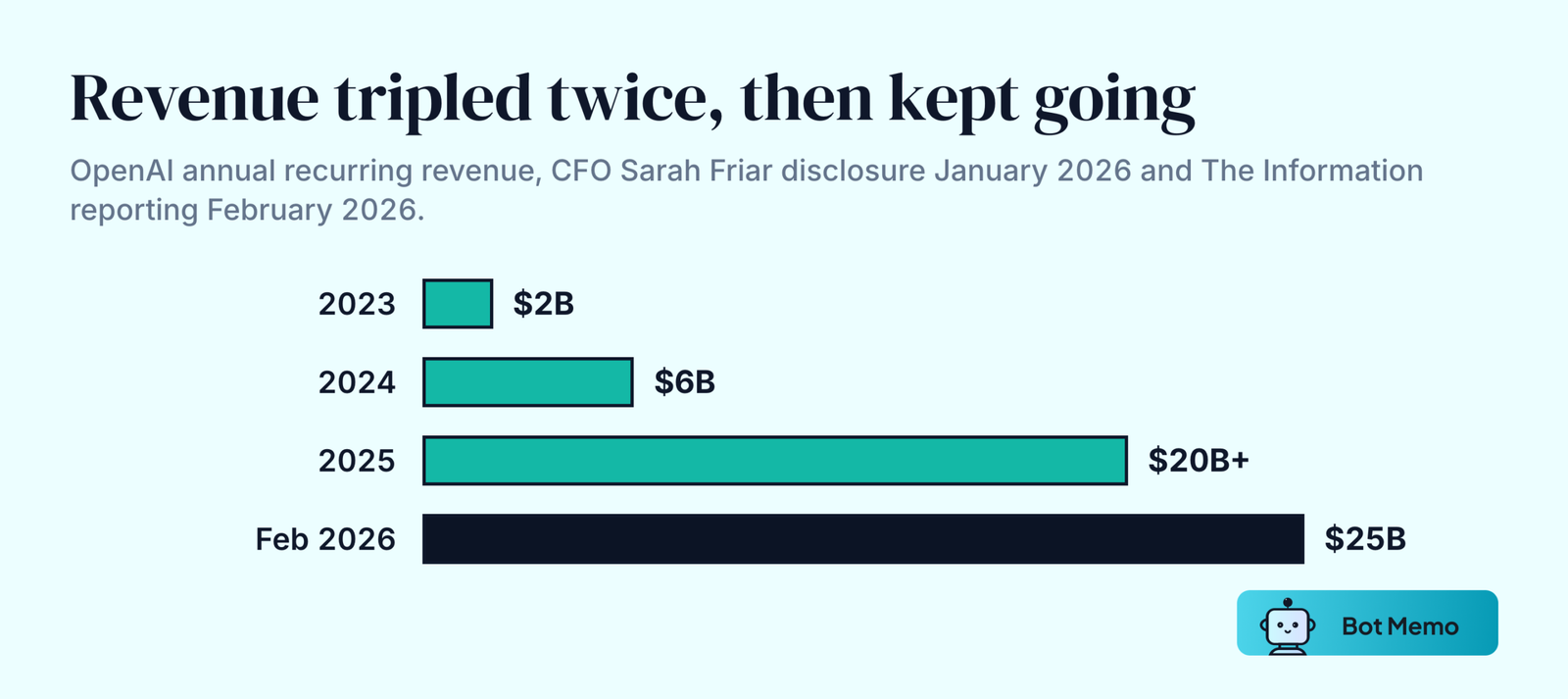
30. OpenAI CFO Sarah Friar published the company’s first on-the-record revenue figures on January 19, 2026: “$2B ARR in 2023, $6B in 2024, and $20B+ in 2025,” growing 3x year over year, or 10x across the two years. (OpenAI)
31. OpenAI disclosed revenue of $2 billion per month at the close of its March 2026 round, with the business segment accounting for 40% of that, up from roughly 30%. (OpenAI, via TechCrunch)
32. OpenAI topped $25 billion in annualized revenue by February 2026, having exited 2025 at $21.4 billion. (The Information)
33. Actual full-year 2025 revenue came in at $13.1 billion, more than triple 2024 and $100 million ahead of OpenAI’s own forecast. (The Information)
34. OpenAI’s advertising pilot passed $100 million in annualized recurring revenue in under six weeks. (OpenAI, March 2026)
What OpenAI Earned Before The Numbers Were Official
35. OpenAI generated $28 million in revenue in 2022 and lost $540 million that year. (Fortune, August 2023)
36. By August 2023 the company was earning about $80 million a month and was on track to pass $1 billion in annualized revenue. (Fortune)
37. Revenue crossed a $1.3 billion annualized rate in October 2023 and $1.6 billion by December 2023, both figures Altman gave to staff. (The Information)
38. Annualized revenue doubled to $3.4 billion by June 2024, split roughly $3.2 billion from products and $200 million from Microsoft licensing. (The Information)
39. OpenAI booked approximately $3.7 billion in revenue for 2024 while projecting a $5 billion operating loss, per financial documents shared with investors. (The New York Times, September 2024)
40. Bloomberg reported in March 2025 that OpenAI expected revenue to triple to $12.7 billion in 2025 and reach $29.4 billion in 2026, with the company not cash-flow positive until 2029. (Bloomberg)
41. OpenAI hit a $10 billion annualized revenue run rate by June 9, 2025, excluding licensing revenue, confirmed on the record by a spokesperson. (CNBC)
Subscription And App Revenue
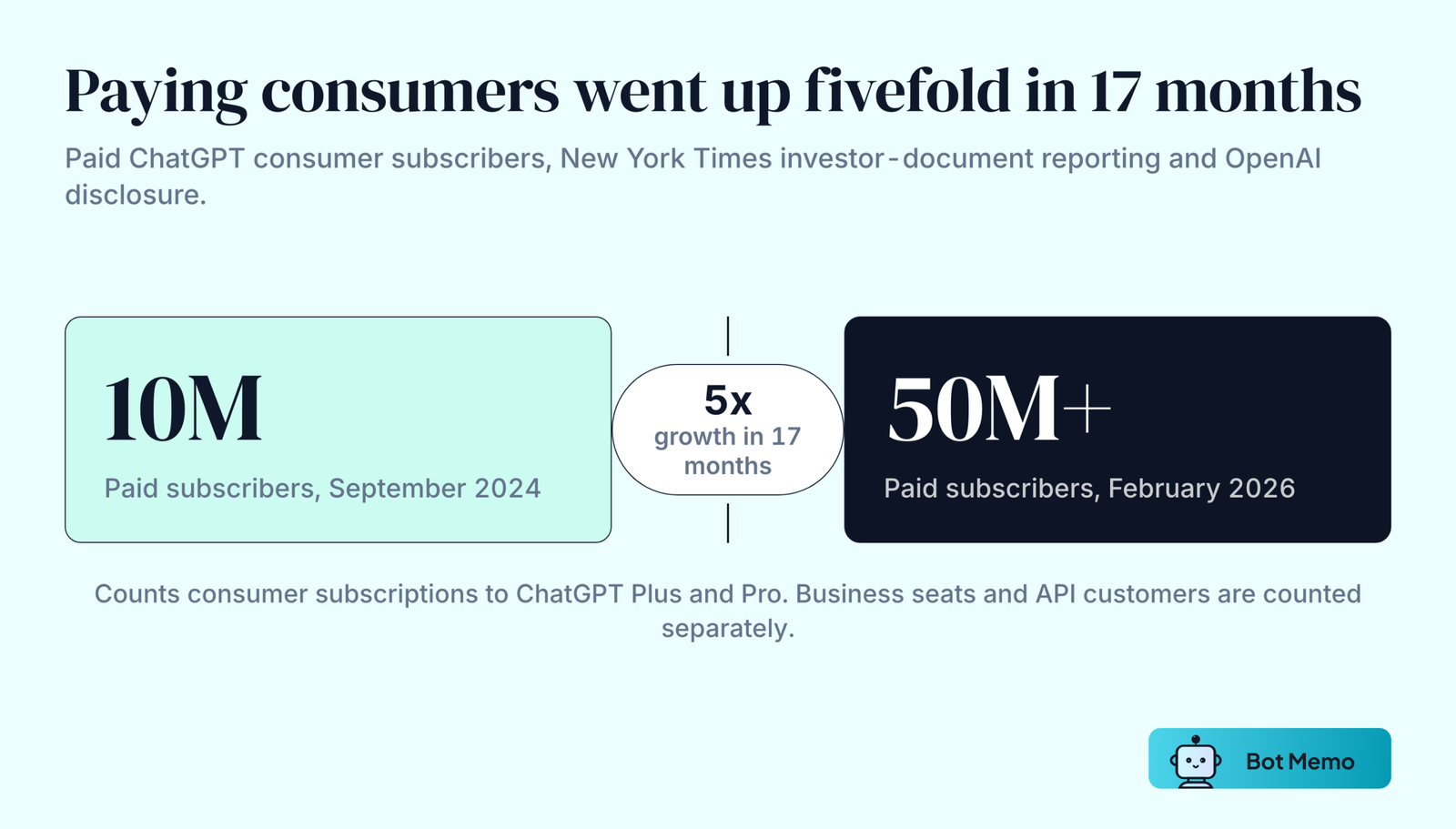
42. OpenAI had roughly 10 million paid ChatGPT subscribers as of September 2024 at $20 a month. That count passed 50 million consumer subscribers by February 2026. (The New York Times; OpenAI)
43. ChatGPT Plus costs $20 a month and ChatGPT Pro, launched December 5, 2024, costs $200 a month. (OpenAI)
44. Consumer spending inside the ChatGPT mobile app crossed $3 billion cumulatively through December 2025. (Appfigures)
45. App spending reached $2.48 billion in 2025 alone, up 408% from $487 million in 2024, with December 2025 monthly revenue at $338 million. (Appfigures)
46. ChatGPT Pro accounted for 5.8% of OpenAI’s US consumer sales as of January 1, 2025 while making up only 0.7% of paying customers, and ChatGPT Plus and Pro together held 62.5% of all paid consumer AI spending. (Earnest Analytics)
47. More than 89% of paying ChatGPT customers were still paying a quarter later, and 74% after three quarters, the strongest retention Earnest measured in the category. (Earnest Analytics)
OpenAI Valuation And Funding Statistics
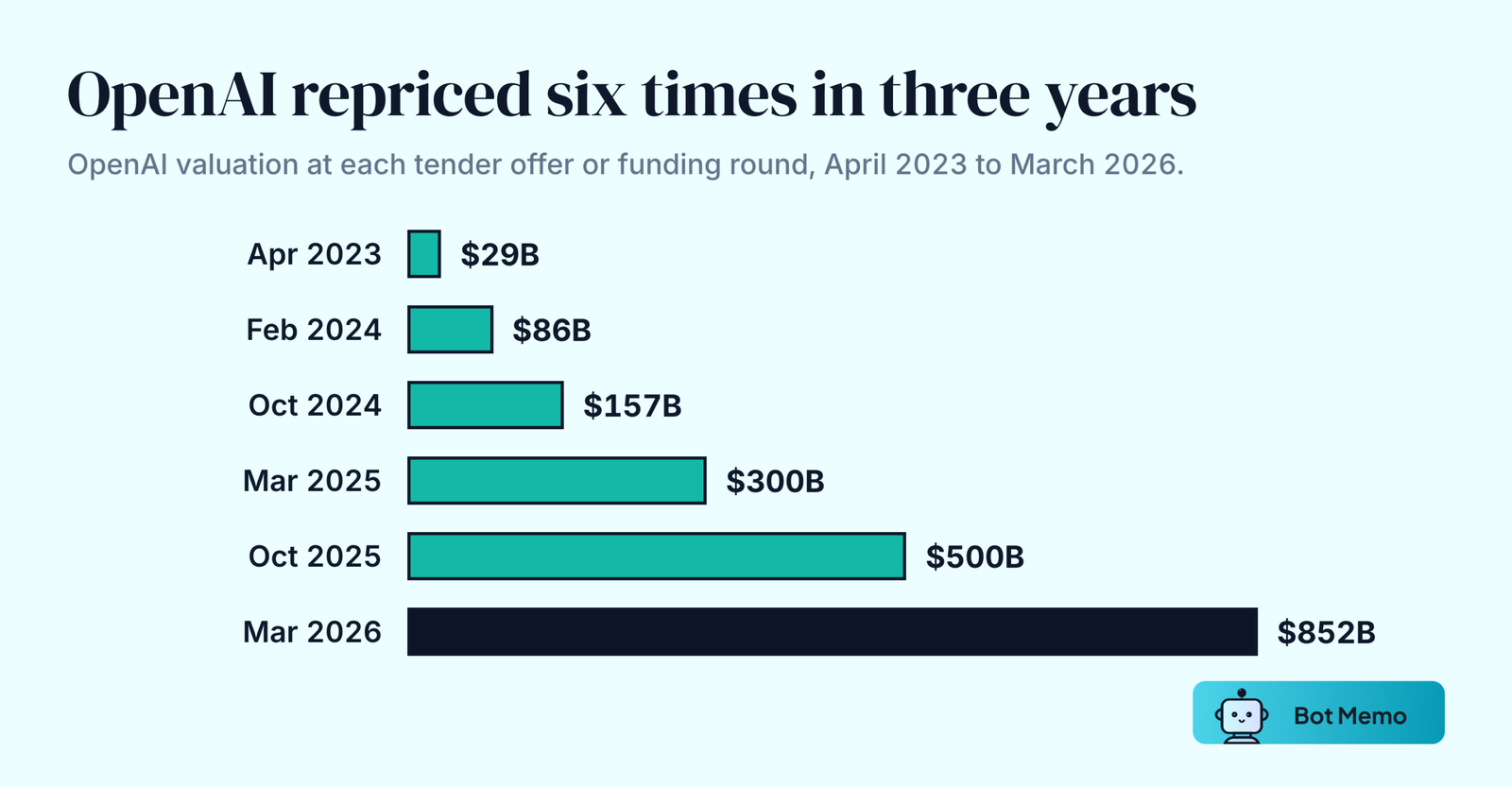
The Valuation Ladder From $29 Billion To $852 Billion
48. OpenAI was valued at up to $29 billion in an April 2023 tender offer of roughly $300 million, with Thrive Capital, Sequoia and Andreessen Horowitz buying employee shares. (TechCrunch)
49. A Thrive Capital-led employee tender offer valued OpenAI at $80 billion to $86 billion, first reported in late 2023 and completed in February 2024. This was an employee liquidity event, not a capital raise into the company. (Bloomberg, Forbes)
50. A $6.6 billion convertible-note round on October 2, 2024 set the valuation at $157 billion, with Thrive at about $1.3 billion, Microsoft about $750 million, SoftBank about $500 million and Nvidia $100 million. (CNBC)
51. The $40 billion round of March 31, 2025 valued OpenAI at $300 billion and was the largest private funding round on record, with SoftBank committing $30 billion and roughly $18 billion earmarked for Stargate. (OpenAI, Bloomberg)
52. A $6.6 billion secondary share sale on October 2, 2025 valued OpenAI at $500 billion, passing SpaceX as the most valuable private company. (Bloomberg)
53. The $122 billion round that closed March 31, 2026 valued OpenAI at $852 billion post-money. Amazon committed $50 billion, Nvidia and SoftBank $30 billion each, and roughly $3 billion came from individual investors through bank channels, an OpenAI first. (CNBC, Bloomberg, TechCrunch)
SoftBank, Microsoft And The Money Behind The Rounds
54. SoftBank’s total investment reached $41 billion for a stake of about 11%, with a $7.5 billion first close in April 2025 and the $22.5 billion balance wired in late December 2025. (SoftBank press release, December 31, 2025)
55. Microsoft disclosed “total funding commitments of $13 billion” to OpenAI in its 10-Q filed October 30, 2024. As of September 30, 2025, $11.6 billion of that had been funded. (Microsoft SEC filings)
56. Microsoft holds roughly 27% of OpenAI on a diluted basis after the October 2025 restructuring, and OpenAI committed to an additional $250 billion of Azure purchases. (Microsoft)
57. Microsoft recorded a $7.6 billion net gain from its OpenAI investment in the quarter ended December 2025, against a $939 million loss a year earlier. (Microsoft SEC filings)
58. Microsoft’s commercial remaining performance obligations reached $625 billion by January 2026, with about 45% attributable to OpenAI commitments. (Microsoft Q2 FY2026 earnings)
59. Early investors held returns capped at 100x under OpenAI’s original capped-profit structure. The October 2025 restructuring removed that cap and converted holders to conventional equity. (Sacra; OpenAI)
OpenAI Enterprise And Developer Statistics
Enterprise Adoption
60. More than 80% of Fortune 500 companies had registered ChatGPT accounts by August 28, 2023, measured by corporate email domains. That reached 92% of the Fortune 500 using OpenAI products by August 2024. (OpenAI)
61. OpenAI passed 1 million business customers and 7 million ChatGPT for Work seats by November 5, 2025, with seats up 40%. Paying business users passed 9 million by February 2026. (OpenAI)
62. ChatGPT Gov reached 90,000 users across more than 3,500 US government agencies, who sent 18 million messages. (OpenAI, January 2025)
63. Enterprise message volume grew about 8x year over year, custom GPT usage 19x, and reasoning tokens 320x per organization. (OpenAI, State of Enterprise AI 2025)
What Businesses Expect From ChatGPT
64. 97% of business owners identified at least one way ChatGPT would help their business, an early read on AI adoption intent, in a Forbes Advisor survey of 600 owners published April 24, 2023. (Forbes Advisor)
65. One in three of those owners planned to use ChatGPT to write website content, and 44% planned to use it to write content in other languages. (Forbes Advisor)
OpenAI Model And Pricing Statistics
Benchmark Results
66. OpenAI reported that its o1 reasoning model scored 83% on a qualifying exam for the International Mathematical Olympiad, against 13% for GPT-4o. OpenAI’s detailed results give the pair as 83.3% and 13.4%. (OpenAI, September 2024)
67. Stanford’s AI Index 2025 cites a separate evaluation of the same exam putting o1 at 74.4% and GPT-4o at 9.3%. The two sets of figures come from different evaluation runs and are reported here as each source published them. (Stanford HAI)
68. Stanford also found the Elo gap between the top model and the tenth-ranked model narrowed from 11.9% to 5.4% over 2024, and the gap between open and closed models narrowed from 8.04% to 1.70%. (Stanford HAI, AI Index 2025)
69. GPT-5 scored 94.6% on AIME 2025 without tools. (OpenAI, August 2025)
70. GPT-5.2 beats or ties top industry professionals on 70.9% of GDPval comparisons. (OpenAI, December 2025)
71. GPT-4.1 shipped with a 1 million token context window and scored 54.6% on SWE-bench against GPT-4o’s 33.2%. (OpenAI, April 2025)
API Pricing
72. OpenAI had cut per-token pricing by 95% since the GPT-4 launch by the time o3-mini shipped in January 2025. (OpenAI)
73. GPT-4o mini launched at 15 cents per million input tokens and 60 cents per million output tokens, more than 60% cheaper than GPT-3.5 Turbo. (OpenAI, July 2024)
74. GPT-5 launched in August 2025 at $1.25 per million input tokens and $10 per million output tokens. (OpenAI)
75. Training a GPT-3 class model could cost more than $4 million, with Nvidia’s data center workhorse chip priced around $10,000. (CNBC, March 2023)
Products
76. Users had created more than 3 million custom versions of ChatGPT by the GPT Store launch on January 10, 2024. (OpenAI)
77. OpenAI was reported in October 2024 to be preparing a model code-named Orion for a December release. Nothing shipped under that name. December 2024 brought the full o1 release, the $200 ChatGPT Pro tier and an o3 preview, and the model tied to the Orion codename launched as GPT-4.5 on February 27, 2025. (The Verge; OpenAI)
78. More than 1.5 million users were creating over 2 million images a day with DALL-E, and more than 100,000 were sharing work in OpenAI’s Discord, as of the September 28, 2022 post that removed the DALL-E waitlist. OpenAI has since set DALL-E 3 for retirement on May 12, 2026 in favour of GPT Image 1.5. (OpenAI)
OpenAI Company Statistics
Founding, Structure And People
79. OpenAI was founded on December 11, 2015. The founding group included Elon Musk, Sam Altman, Greg Brockman, Wojciech Zaremba, Ilya Sutskever and John Schulman, backed by Peter Thiel, Amazon Web Services, Infosys and YC Research. (OpenAI)
80. OpenAI is headquartered in San Francisco and its stated mission is to ensure that artificial general intelligence benefits all of humanity. Sam Altman is CEO and returned to the role in November 2023 after being removed by the board days earlier. (OpenAI)
81. Of the 11 original co-founders, only Altman and Wojciech Zaremba remained at the company as of late 2024. Mira Murati, Ilya Sutskever, Jan Leike and John Schulman all departed.
82. The OpenAI board removed Altman as CEO on November 17, 2023 and reinstated him within days. The reconstituted board was chaired by Bret Taylor alongside Larry Summers and Adam D’Angelo.
83. OpenAI does not publish headcount. The Wall Street Journal reported roughly 4,000 employees at the end of 2025. (The Wall Street Journal)
84. Average stock compensation at OpenAI ran to about $1.5 million per worker in 2025. (The Wall Street Journal)
85. Glassdoor listings in 2024 showed OpenAI software engineers averaging $121,000, senior software engineers $145,000 and researchers $75,000, against an Indeed average of $105,152 for US software engineers. Both sites now show materially higher figures. (Glassdoor, Indeed)
86. OpenAI hired about 1,000 remote contractors in the six months to January 2023, drawn from Latin America and Eastern Europe, with 60% working on data labelling and 40% generating software engineering training data. (Semafor)
87. The restructuring completed on October 28, 2025. The nonprofit became the OpenAI Foundation with a 26% stake worth roughly $130 billion, and the for-profit became OpenAI Group PBC, a Delaware public benefit corporation. (OpenAI, California Attorney General MOU)
Compute And Infrastructure
88. OpenAI’s compute grew from 0.2 GW in 2023 to 1.9 GW in 2025. (OpenAI, January 2026)
89. The Stargate Project, announced January 21, 2025 with SoftBank, Oracle and MGX, plans up to $500 billion of AI data center infrastructure by 2029. Five or more sites and nearly 7 GW of planned capacity were confirmed by September 2025. (OpenAI)
Safety And Governance Letters
90. Elon Musk signed the Future of Life Institute open letter of March 22, 2023, which called for an immediate pause of at least six months on training AI systems more powerful than GPT-4. The letter has since gathered more than 31,800 signatures. (Future of Life Institute)
91. Current and former OpenAI and Google DeepMind employees published the Right to Warn letter on June 4, 2024, arguing that AI companies “have strong financial incentives to avoid effective oversight” and “currently have only weak obligations to share some of this information with governments, and none with civil society.” (righttowarn.ai)
OpenAI Market Share And Traffic Statistics
Website Traffic
92. SimilarWeb recorded openai.com at 551.1 million views in September 2024, a 22.96% increase on August. A weekly reading from the same source in the week around September 23, 2024 showed visits at 40 million against 120 million the prior week. (SimilarWeb, 2024)
93. Device split for openai.com in 2024 ran 59.98% desktop to 40.02% mobile web, with an average visit of 1 minute 46 seconds, 2.18 pages per visit and a 57.47% bounce rate. (SimilarWeb, 2024)
94. The chat product, not the corporate site, is where the volume sits. SimilarWeb put chat.openai.com at about 1.8 billion visits in April 2024, the reading behind the widely quoted “nearly 2 billion” peak that placed it among the world’s 20 most visited sites. Traffic kept climbing after the May 2024 move to chatgpt.com, reaching 5.846 billion visits in August 2025. (SimilarWeb)
95. The top organic search terms sending traffic to openai.com in 2024 were “chatgpt” at 38.41% and “chat gpt” at 27.13%. Those two terms still rank first and second today. (SimilarWeb)
ChatGPT Market Share
96. ChatGPT accounted for 69% of all traffic to AI tools in August 2025, the largest share of any single system. (SimilarWeb)
97. ChatGPT captured 63% of all generative AI app revenue in the first half of 2025, twelve times the next highest earner. (Sensor Tower)
Mobile Downloads And Consumer Adoption
98. ChatGPT recorded 470 million global downloads in the first half of 2025, 3.7 times the next closest app. (Sensor Tower)
99. ChatGPT became the fastest app ever to reach 1 billion global downloads, hitting the mark in July 2025. (Sensor Tower)
100. ChatGPT was the second most downloaded app in the world in 2025, with downloads up 148%, in-app purchase revenue up 254% and total time spent up 426%. (Sensor Tower, State of Mobile 2026)
How OpenAI Compares On Revenue And Valuation
101. Anthropic reported run-rate revenue of $14 billion in February 2026, growing more than 10x annually for three straight years, alongside a $30 billion Series G at a $380 billion post-money valuation. (Anthropic)
102. Anthropic’s run rate had grown from $87 million at the start of 2024 to more than $5 billion by August 2025. (Anthropic)
103. Google’s Gemini app passed 750 million monthly active users, with 8 million paid Gemini Enterprise seats and Google Cloud on a $70 billion-plus annual run rate, up 48%. (Alphabet Q4 2025 earnings)
104. xAI closed a $20 billion Series E, upsized from a $15 billion target, and claimed roughly 600 million monthly active users across X and Grok. (xAI)
105. The generative AI market was forecast to compound at 34.2% a year through 2033 when that projection was published. Market.us has since revised the forecast to a 35.6% compound rate through 2035, reaching about $1.08 trillion. (Market.us)
Key Takeaways
OpenAI’s user base grew nine times over in roughly 27 months, from 100 million weekly actives in November 2023 to more than 900 million in February 2026. Revenue moved faster still, from a $2 billion run rate in 2023 to $25 billion annualized by February 2026, and the company now says it collects $2 billion a month.
The valuation has repriced six times in three years, from $29 billion to $852 billion, and the composition of who pays has shifted with it. Business revenue went from roughly 30% of the total to 40%, paid consumer subscribers went from about 10 million to more than 50 million, and business customers passed a million.
Adoption is still far from universal. Pew puts US adult usage at 34%, which means two in three American adults have not used the product that defines the category. That gap, more than any user milestone, is what the next round of spending is aimed at.
Frequently Asked Questions
How Many People Use ChatGPT?
More than 900 million people use ChatGPT every week, per OpenAI’s February 27, 2026 disclosure. That is up from 800 million in October 2025 and 100 million in November 2023.
How Much Revenue Does OpenAI Make?
OpenAI’s annualized revenue passed $25 billion by February 2026, and the company disclosed $2 billion in monthly revenue at the close of its March 2026 funding round. Full-year 2025 revenue came in at $13.1 billion.
What Is OpenAI Worth?
OpenAI was valued at $852 billion post-money in the $122 billion round that closed on March 31, 2026, making it the most valuable private company on record.
How Many People Work at OpenAI?
OpenAI does not publish headcount. Third-party reporting put it at roughly 4,000 employees at the end of 2025.
How Much of OpenAI Does Microsoft Own?
Microsoft holds roughly 27% of OpenAI on a diluted basis following the October 2025 restructuring, against total funding commitments of $13 billion.
Is OpenAI Profitable?
No. Bloomberg reported that OpenAI does not expect to be cash-flow positive until 2029. The company projected a $5 billion operating loss for 2024 against $3.7 billion of revenue.
Sources And Methodology
Figures on this page come from four kinds of source, and the difference between them matters when reading any single number.
Company disclosures from OpenAI, Microsoft, Anthropic, Alphabet, xAI and SoftBank carry the most weight. Microsoft’s SEC filings and Alphabet’s earnings materials are audited or filed under securities rules. OpenAI’s own posts are not, and the company published no on-the-record revenue figure until CFO Sarah Friar’s post of January 19, 2026.
Reported financials from The Information, The New York Times, Bloomberg, CNBC and Fortune are sourced to internal documents or executive remarks rather than statements. Every pre-2026 revenue figure on this page is an annualized run rate, meaning one month multiplied by twelve, not audited trailing revenue. Run rates flatter a company growing this fast.
Usage-pattern figures come from OpenAI’s Economic Research team working with Harvard economist David Deming, who analysed 1.5 million conversations and published the results as a National Bureau of Economic Research working paper in September 2025. That study covers consumer ChatGPT plans and excludes business and API traffic.
Survey data from Pew Research Center, YouGov and Forbes Advisor carries its own sample and field dates, given inline. Pew’s figures come from probability-based panels; the Forbes Advisor survey covers 600 business owners and is not nationally representative.
Analytics estimates from SimilarWeb, Sensor Tower, Appfigures and Earnest Analytics are modelled, not measured. None of these firms sees OpenAI’s server logs. SimilarWeb labels its own output as estimated data, Sensor Tower extrapolates from panels, and Earnest Analytics reads US card transactions only, so it misses corporate subscriptions and non-card payments.
The 2024 SimilarWeb readings quoted here describe openai.com, the corporate site, while the multi-billion visit figures describe chatgpt.com, the product. The two are different properties at very different scale, and conflating them is the single most common error in OpenAI traffic reporting.
Figures superseded since first publication are kept on the page with the original source and date, followed by the current number, so the record stays checkable.
For related numbers, see Bot Memo’s breakdowns of ChatGPT statistics, the generative AI market, Google Gemini, chatbot adoption, and how many AI companies exist worldwide.

About the author
Editorial Staff
The Editorial Staff at Bot Memo is a team of writers, analysts, and AI agents dedicated to mapping the global AI startup ecosystem. Led by Chintan Zalani, the team tracks thousands of funding rounds, classifies companies across verticals, and distills it all into actionable intelligence for investors and founders.