
Ask five sources how many AI companies exist and you get five answers that do not overlap. Tracxn counted 32,300 on 2 July 2026. CB Insights tracks more than 40,000. StartUs Insights says 212,230. China’s Qichacha corporate registry counted 1.67 million in the first half of 2024. Wikipedia’s list named 125 on 25 August 2026.
None of them is wrong. They are counting different things.
The total you get depends on four decisions each source makes before counting starts: whether AI has to be the company’s product or merely something it uses, whether the company must have raised outside money, whether inclusion is self-declared or checked by an analyst, and which countries the source can see at all. Change one of those and the answer moves by an order of magnitude.
This page collects the counts that are actually published, states the definition sitting behind each one, and marks where a figure has been superseded. Each number is traced to the report, filing, dashboard, or registry that published it, and the figures that could not be traced are named in Sources And Methodology.
On this page
How Many AI Companies Are There In 2026
The Counts Each Tracker Publishes
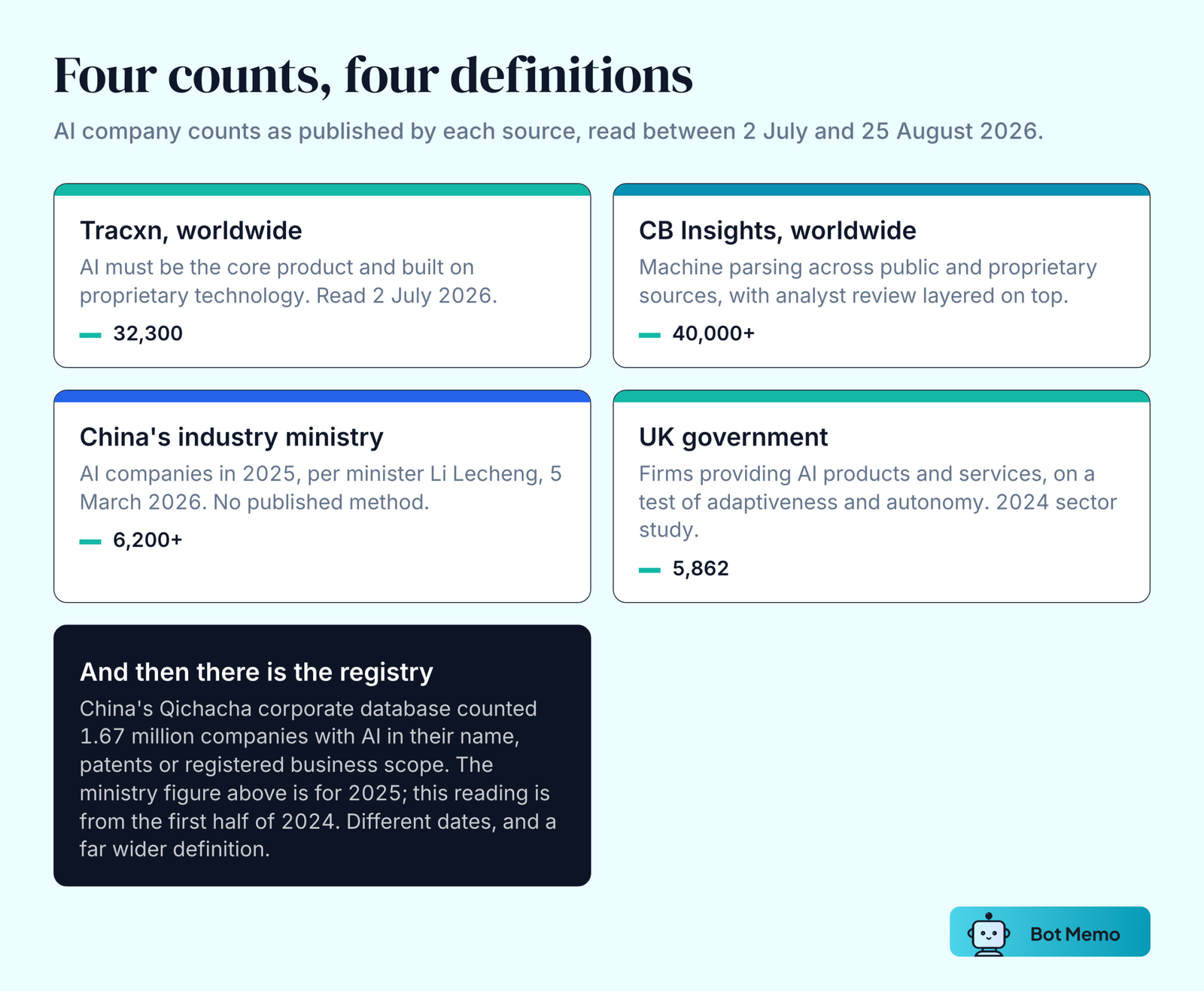
- Tracxn counts 32,300 companies in its Artificial Intelligence sector worldwide, 8,100 of them funded, as of 2 July 2026 (Tracxn).
- Those 8,100 funded companies had raised $798 billion in venture capital and private equity between them.
- 3,480 of them had reached Series A or later.
- The sector had produced 233 unicorns, alongside 888 acquisitions and 225 IPOs, on the same 2 July 2026 reading.
- That same page carried 24,900 companies, 152 unicorns, and $345 billion in cumulative funding when the earlier version of this article quoted it. Same counter, same address, read again on 2 July 2026.
- CB Insights offers live data on “40K+ AI companies” (CB Insights, State of AI 2025, published January 2026).
- Crunchbase caps its public AI hub at the top 10,000 companies and publishes no global total. The page title reads “List of top Artificial Intelligence (AI) Companies (Top 10K)”. Figures circulating as Crunchbase totals are outside estimates, not Crunchbase’s own number.
- PitchBook publishes no AI company count. Its artificial intelligence and machine learning vertical sits entirely behind a subscription, so there is no public figure to quote.
- StartUs Insights puts the total at 212,230 active AI companies, 62,184 of which it classifies as startups, growing 9.68% a year (StartUs Insights). That count comes from the firm’s own discovery platform.
- China’s Qichacha registry counted 1.67 million AI-related companies in the first half of 2024, after more than 237,000 registered in those six months alone. Qichacha counts any company with AI in its name, patents, or registered business scope.
- Wikipedia’s list of AI companies names 125 firms across 20 countries (read 25 August 2026), limited to companies that “primarily focus on artificial intelligence.”
- Y Combinator has funded 1,576 AI startups across its history (Y Combinator, August 2026).
Smallest published count to largest is a spread of roughly 13,000 times. Both ends are defensible. Neither answers the plain question on its own.
How Many AI Companies Get Funded Each Year
Annual funded-company counts sit on firmer ground than stock counts, because a funding event leaves a record.
- 3,499 AI companies were newly funded worldwide in 2025, per the 2026 AI Index Report from Stanford’s Institute for Human-Centered AI (Figure 4.2.4).
- That is a 70.8% rise on 2024, when the same series recorded 2,049 newly funded AI companies.
- 311 of the 2025 cohort were generative AI companies (Figure 4.2.5).
- Only companies that have raised more than $1.5 million since 2013 enter the series. Stanford’s data partner Quid applies that floor first, which excludes companies funded below that level and companies never funded at all.
- The OECD’s AI dataset now covers more than 33,000 AI firms and nearly 85,000 transactions between 2012 and 2025 (OECD, February 2026). Its earlier analysis, on the same Preqin source, covered about 8,300 firms through 2020.
Why The Counts Refuse To Converge
- China’s own two figures differ by 270 times. The Ministry of Industry and Information Technology put the number of AI companies at more than 6,200 in 2025; Qichacha’s registry sweep counted 1.67 million in the first half of 2024. Same country, different dates, different definitions.
- One tracker’s own count rose by 7,400 companies between two readings of the same page, from 24,900 to 32,300, with cumulative funding up from $345 billion to $798 billion and unicorns from 152 to 233. Tracker pages are live counters, so any figure taken from one is a reading on a date rather than a census.
Definitional drift is the whole story. Everything below makes each source’s definition explicit enough to compare.
What Counts As An AI Company
Core AI Versus AI As A Feature
- Tracxn requires AI to be both core and proprietary. Its stated test covers companies whose products are “built around AI, making it essential for their operation” and which “incorporate proprietary AI or machine learning technology.”
- Crunchbase’s Artificial Intelligence industry group is much wider, covering artificial intelligence, generative AI, intelligent systems, machine learning, natural language processing, predictive analytics, and robotic process automation. A company can carry the label as one of three to five industry categories it picks for itself.
- The UK government’s test is behavioural rather than commercial. Its sector study centres on adaptiveness and autonomy, meaning technology that operates on instructions learnt rather than programmed, and applies them without human direction.
Most of the disagreement lives between those three tests. A logistics firm running a demand-forecasting model passes Crunchbase’s test, fails Tracxn’s, and lands in the UK’s diversified bucket rather than its dedicated one. Where those lines fall in practice is the subject of two related reads, one on spotting AI washing and one on AI Native, AI Augmented, and AI Adjacent.
The Funding Filter
- The OECD defines an AI start-up as “a private company that researches and delivers all or part of an AI system or researches and delivers products and services that rely significantly on AI systems” (OECD.AI methodological note).
- That definition still excludes anything without venture backing. The series is built on Preqin private-capital records, so listed AI firms, bootstrapped ones, and state-funded institutes never enter it.
- Stanford’s $1.5 million floor does the same work. A company that raised $900,000 in pre-seed money and shipped a working product is, for counting purposes, absent.
Every venture-derived count is therefore a count of AI companies that raised money, not a count of AI companies.
Companies, Products, And AI Tools
Directories that count AI tools answer a different question again. They index products: AI models, AI agents, AI assistants, and the applications built on top of them. One company shipping six products appears six times.
Directory counts are not comparable to company counts. A tool is something you can use. A company is something you can fund, acquire, or register.
Self-Reported Labels Versus Analyst Review
- Crunchbase leans on self-classification. Companies choose their own industry labels, supported by community contributors, automated scanning, and an in-house data team.
- CB Insights runs machine parsing across public and proprietary sources at scale, then layers analyst review on top.
- Its 2026 AI 100 list, published 5 May 2026, picked 100 winners from more than 40,000 companies, judged on deal activity, partnerships, investor strength, hiring momentum, and two proprietary scores.
- PitchBook uses analyst curation backed by a data operations team of more than 1,800 people. More controlled than self-tagging, and invisible from outside the paywall.
- Stanford publishes its keyword filter but not its classifier. The AI Index appendix gives the search terms and the funding thresholds, while the step that decides which companies match them, Quid’s natural language processing across company descriptions, news, blogs, and patent records, stays proprietary.
Only one of these methods, self-classification, is fully visible from the outside. The rest disclose an input or two and keep the decision rule, which is why no two counts agree and why a reader cannot reconcile them.
AI Companies By Country
The United States
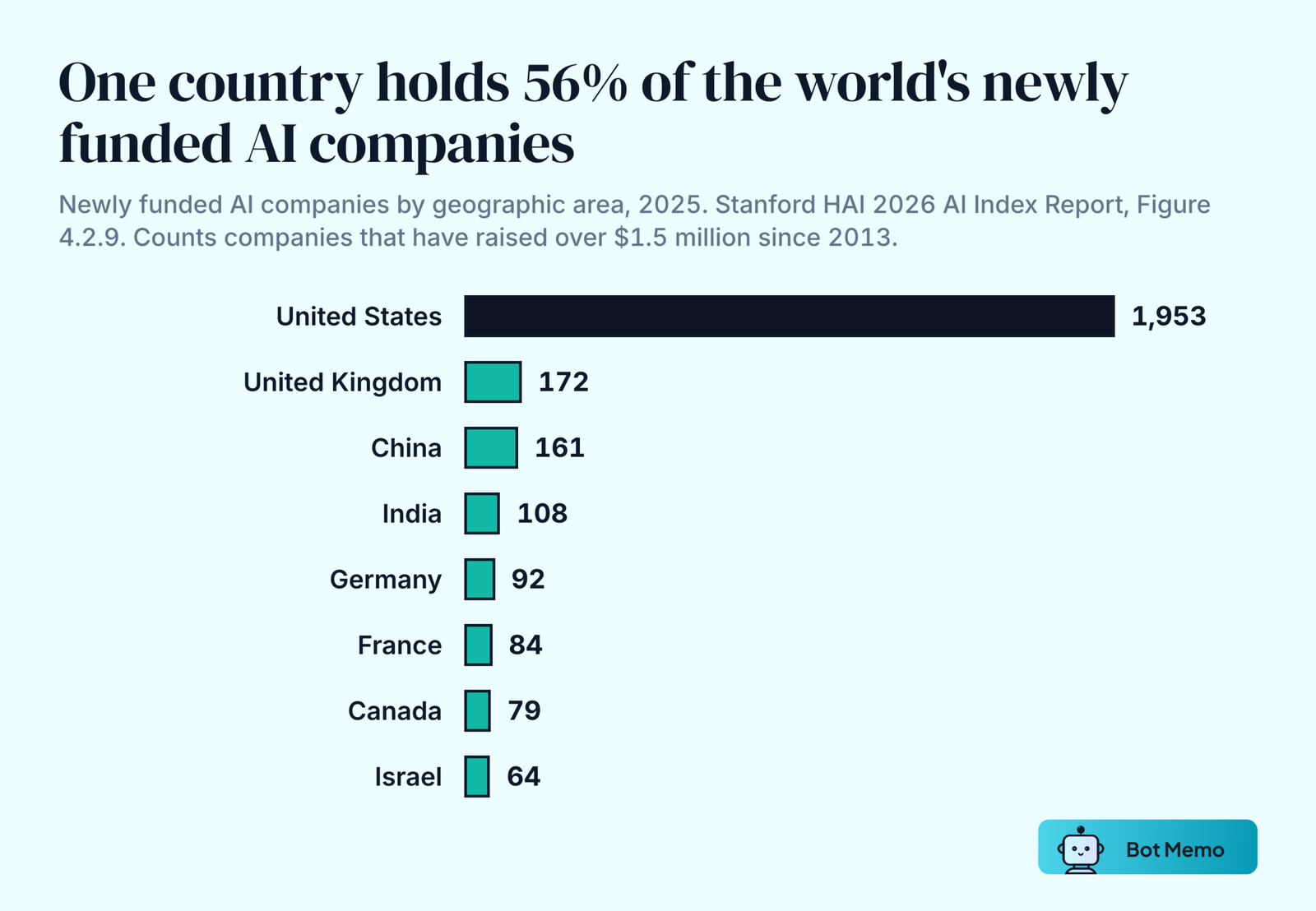
- 1,953 AI companies were newly funded in the United States in 2025 (Stanford HAI, Figure 4.2.9), 55.8% of the global cohort.
- 8,909 US AI companies have been newly funded since 2013 on the same series (Figure 4.2.13), more than five times China’s total and 8.4 times the United Kingdom’s.
- US private AI investment reached $285.9 billion in 2025, 23.1 times the amount invested in China.
- More than half of that, $163.6 billion, went to generative AI companies.
- A Census Bureau study identified 21,731 AI business applications filed in the US between 2004 and 2023, using an AI keyword dictionary against the text fields of IRS Form SS-4 (Dinlersoz, Dogan and Zolas, CES-WP-24-09R).
- Those applications were 0.035% of all US business applications over the same window. AI company formation is real, and at the scale of the whole economy it is still a rounding error.
- The same study found a sharp discrete jump in 2023, after steady growth from 2012 and acceleration from 2016.
- The United States ranks first among the top 20 AI nations for research capacity, a finding first published for 2023 and still standing in the fifth edition of Tortoise Media’s Global AI Index, published 19 September 2024.
China
- China’s Ministry of Industry and Information Technology put the number of AI companies above 6,200 in 2025, per minister Li Lecheng, speaking on the sidelines of the national legislature’s annual session on 5 March 2026. CAICT, a research institute under the ministry, later put it at more than 6,600 as of June 2026 (Xinhua, 4 August 2026).
- Chinese AI sector output reached 1.2 trillion yuan in 2025, which Xinhua converted to about $176.7 billion in its 4 August 2026 report (Xinhua).
- 161 Chinese AI companies were newly funded in 2025, and 1,766 since 2013 (Stanford HAI).
- Chinese private AI investment was $12.4 billion in 2025, up 32.2% on 2024.
- Tracxn separately counts 2,160 AI companies in China, 768 of them funded, holding $56.6 billion and 30 unicorns, as of 10 August 2026 (Tracxn).
Four sources, four Chinese totals: 2,160, more than 6,200 (more than 6,600 by June 2026), and 1.67 million on stock, 161 on annual funded flow. The MIIT figure carries no published methodology, which is worth holding in mind before treating it as the official number.
The United Kingdom And Europe
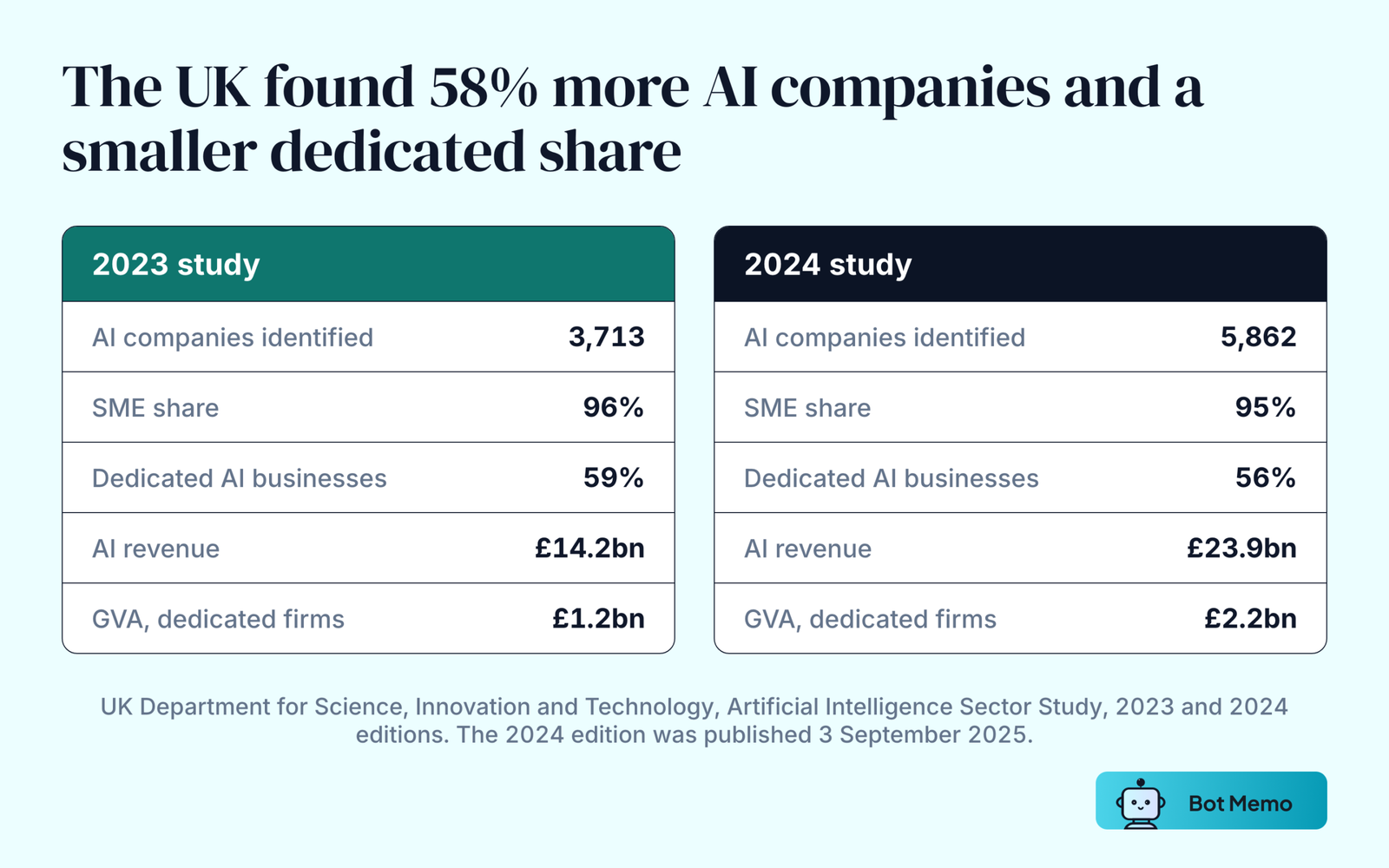
- The UK identified 5,862 AI companies in its 2024 sector study, published 3 September 2025 by the Department for Science, Innovation and Technology (gov.uk).
- That is a 58% increase on the 3,713 firms counted in the 2023 edition, which remains the correct figure for 2023 and is the number most external citations still carry.
- 95% of the 2024 cohort are SMEs.
- 56% are dedicated AI businesses and 44% diversified, against 59% and 41% a year earlier.
- UK AI revenue rose about 68% to roughly £23.9 billion, a gain of £9.7 billion.
- Gross value added among dedicated AI firms rose from £1.2 billion in 2023 to £2.2 billion in 2024, an 83% gain.
- AI-related employment reached 86,139, up 33%, or about 21,600 jobs.
- London, the South East, and the East of England still hold about 75% of registered office locations.
- 172 UK AI companies were newly funded in 2025, against 1,057 since 2013 (Stanford HAI).
- Europe as a whole funded 639 new AI companies in 2025. Our European AI funding review for the first half of 2026 breaks the continent down by country and round.
- There is still no EU-wide AI company count. The bloc has no equivalent of the UK sector study.
- The EU AI Act’s public database registers high-risk AI systems, not companies, across the eight high-risk domains listed in Annex III. Article 71 establishes the database; Article 49 places the registration duty on providers, and on public-authority deployers in defined cases.
- The high-risk requirements moved from 2 August 2026 to 2 December 2027 for standalone high-risk systems, and from 2 August 2027 to 2 August 2028 for high-risk AI embedded in regulated products, under the Digital Omnibus on AI (Regulation (EU) 2026/1744), in force since 27 July 2026. Those dates apply to the full high-risk requirement set, of which database registration is one part.
The Rest Of The World
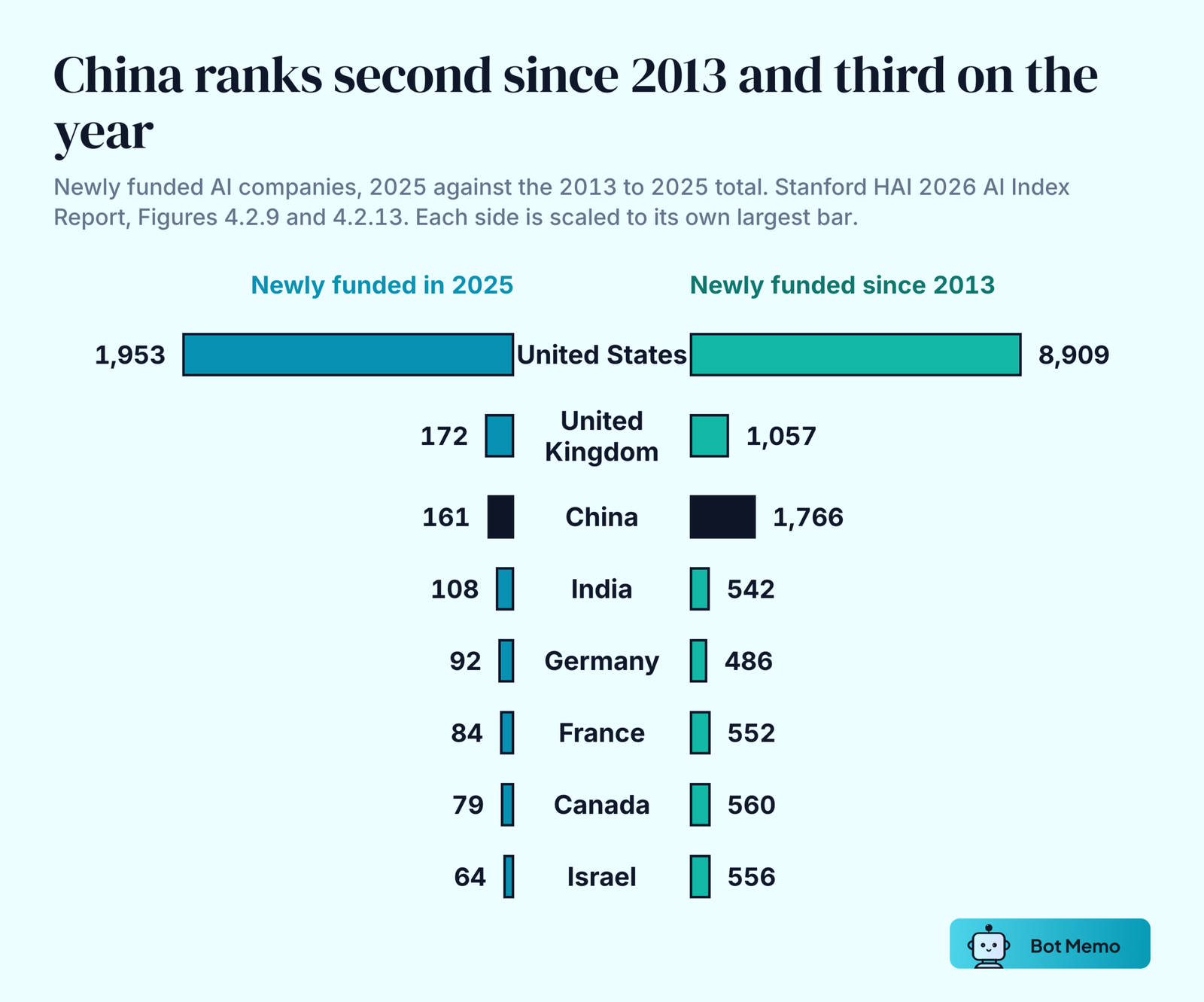
- India funded 108 new AI companies in 2025 and 542 since 2013.
- Germany funded 92 in 2025 and 486 since 2013.
- France funded 84 in 2025 and 552 since 2013.
- Canada funded 79 in 2025 and 560 since 2013.
- Israel funded 64 in 2025 and 556 since 2013, more over the period than India or Germany managed.
- South Korea funded 59, Japan 56, and Singapore 49 in 2025.
- Tracxn counts 2,900 AI companies in India, 605 funded, $6.57 billion raised, 8 unicorns, as of 10 August 2026 (Tracxn).
The Stanford figures in this section count companies that cleared a $1.5 million funding threshold, and the Tracxn country pages use their own inclusion rules. Places where AI companies are more often bootstrapped, grant-funded, or state-backed come out structurally undercounted, which is the main reason African, Latin American, and Southeast Asian totals read thin in every global series.
How Many Companies Use AI
Being an AI company and using AI are separate questions, and conflating them is where most published AI statistics go wrong.
What Official Statistics Show
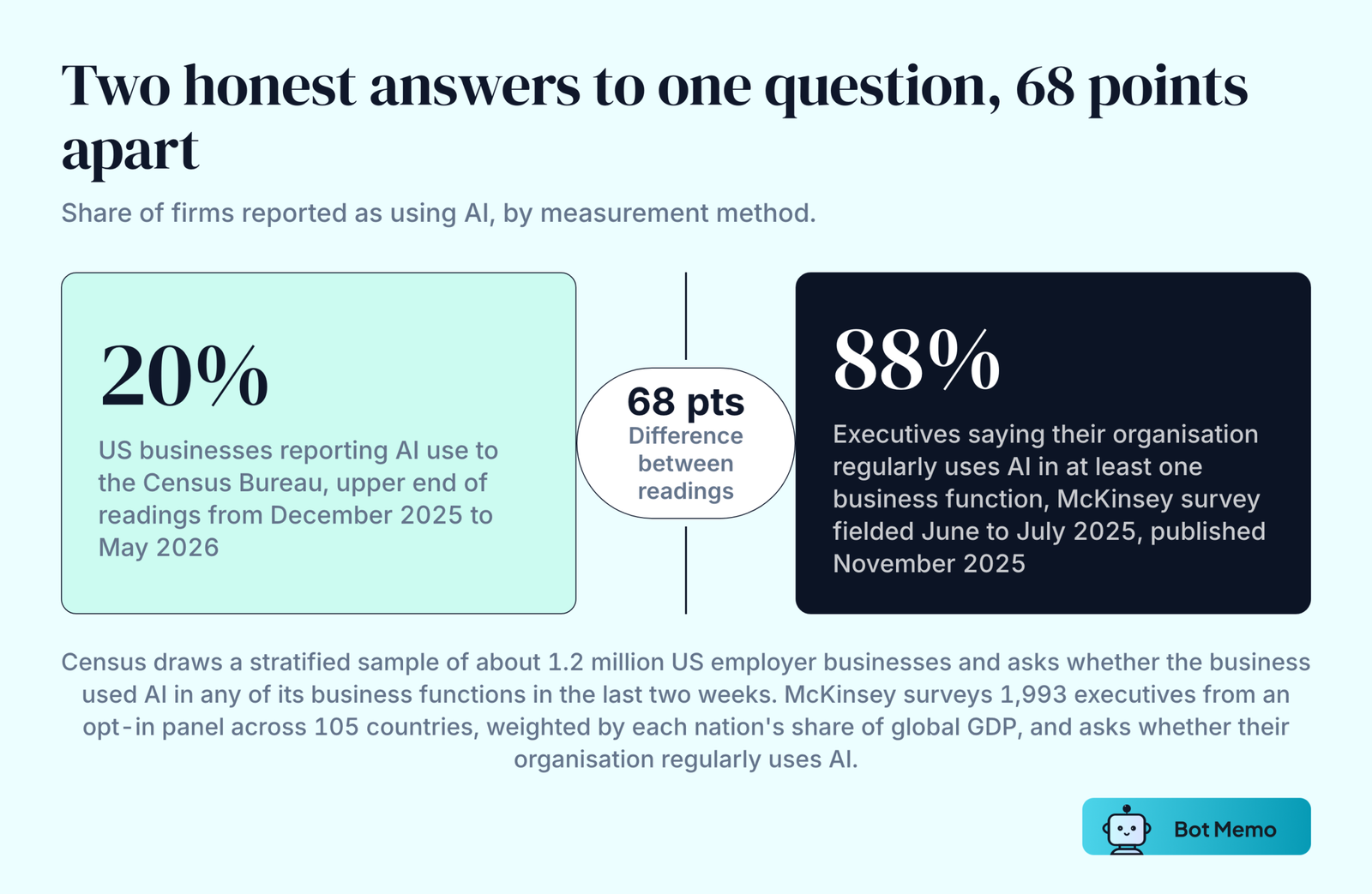
- Between 17% and 20% of US businesses reported using AI across the period 14 December 2025 to 3 May 2026 (US Census Bureau Business Trends and Outlook Survey).
- Between 20% and 23% expected to be using it within six months.
- 37% of firms with at least 250 employees reported using AI, against under 20% of firms with four or fewer employees.
- The information sector leads at 39.7%, with finance and insurance at 33.9% and retail trade near 14%, as of 3 May 2026.
- Fewer than 6% of US firms used any of five AI-related technologies in the 2018 Annual Business Survey, though weighted by employment the figure was just over 18% (McElheran, Li, Brynjolfsson and colleagues, NBER Working Paper 31788). AI adoption concentrated in large firms then, and still does.
What Executive Surveys Show
- 88% of organisations regularly use AI in at least one business function, up from 78% in 2024, on McKinsey’s State of AI survey (reproduced in Stanford’s 2026 AI Index, Figure 4.3.1).
- 79% report regular use of generative AI in at least one business function, up from 71% in 2024, on the same survey.
- 69% of firms actively use AI in a survey of nearly 6,000 business leaders across the US, UK, Germany, and Australia (Yotzov and colleagues, NBER Working Paper 34836, February 2026).
The gap between 20% and 88% is not a data-quality failure. Census draws a stratified sample of about 1.2 million US employer businesses from its own business register and asks whether the business used AI in any of its business functions in the last two weeks. McKinsey surveys 1,993 executives from an opt-in panel across 105 countries, weighted by each respondent’s nation and its share of global GDP, and asks whether their organisation regularly uses AI. The populations, the questions and the reference periods are all different. Both numbers are right for what they measure.
The Largest AI Companies
Which Artificial Intelligence Companies Lead
The companies most people picture when they ask this question are the frontier labs building large language models: OpenAI, Anthropic, Google DeepMind, Meta AI, and Mistral AI. Only some of them are countable at all. OpenAI, Anthropic, and Mistral AI are private and show up on venture-derived lists. Google DeepMind and Meta AI are divisions of public companies, so they are not independent startups and drop out of venture-derived counts.
The layer underneath them gets filed inconsistently. Microsoft Azure, Google Cloud, Amazon Web Services, Oracle, and Nvidia supply most of the compute that foundation models run on, and trackers file them across overlapping categories. Crunchbase lists Nvidia under artificial intelligence alongside semiconductors and cloud computing, while PitchBook’s primary industry for it is computers, parts and peripherals.
Open source widens the gap again. Whether a team shipping open-weights models appears in a count depends on the inclusion rule the source uses.
A ranking of top AI companies and a count of AI companies are answering different questions. The ranking selects for scale. The count admits whatever its definition allows.
The Forbes AI 50
- Forbes’ 2026 AI 50, published 16 April 2026, names 50 privately held companies applying AI to real-world problems.
- Anthropic sat at a $380 billion valuation on that list, as it stood in April 2026.
- The 2023 edition of the same list carried these funding totals: OpenAI $11 billion, Databricks $3.5 billion, Anduril Industries $2.4 billion, Insitro $700 million, Gong $584 million, Shield AI $520 million, AlphaSense $520 million, Clari $496 million, Eightfold AI $424 million. Anthropic’s valuation on the 2026 list alone is larger than every one of those raises put together.
- Microsoft was described as a frontrunner in the AI race in the Forbes coverage this page cited alongside the 2023 list. Forbes’ 2026 write-up frames the field differently, around OpenAI and Anthropic and a move away from Big Tech dependence.
- The AI 50 covers privately held companies only, so Nvidia, Microsoft, Alphabet, Amazon, and Meta never appear on it. Any ranking of “the biggest AI companies” is a ranking of whichever slice its compiler chose to include.
Where The Unicorns Are
- 75 new AI unicorns were created in 2025, 61% of all new unicorns that year, up from 52% in 2024 (CB Insights).
- 782 AI companies were acquired in 2025, more than 1.5 times the 2024 count.
- Tracxn’s AI sector held 233 unicorns in total, alongside 225 IPOs, as of 2 July 2026.
How Concentrated The Money Is
- 28 private AI funding events exceeded $1 billion in 2025, up from 15 in 2024 (Stanford HAI).
- The average private AI investment event reached $66.5 million, a 46% rise on 2024.
- Rounds above $1 billion took roughly half of all AI venture value in 2025, and mega deals, meaning rounds over $100 million, about 73% (OECD).
- AI firms building IT infrastructure and hosting drew $109.3 billion in 2025, the largest single vertical in the OECD series.
Tens of thousands of AI companies exist, and rounds above $1 billion took roughly half of 2025’s AI venture funding. That is the finding the headline counts obscure in both directions.
AI Company Funding And Market Size
How Much AI Companies Raised
- Global private AI investment reached $344.7 billion in 2025, a 127.5% increase on 2024 (Stanford HAI, Figure 4.2.2).
- Generative AI companies took $170.9 billion of that, nearly half the total and more than triple the 2024 figure.
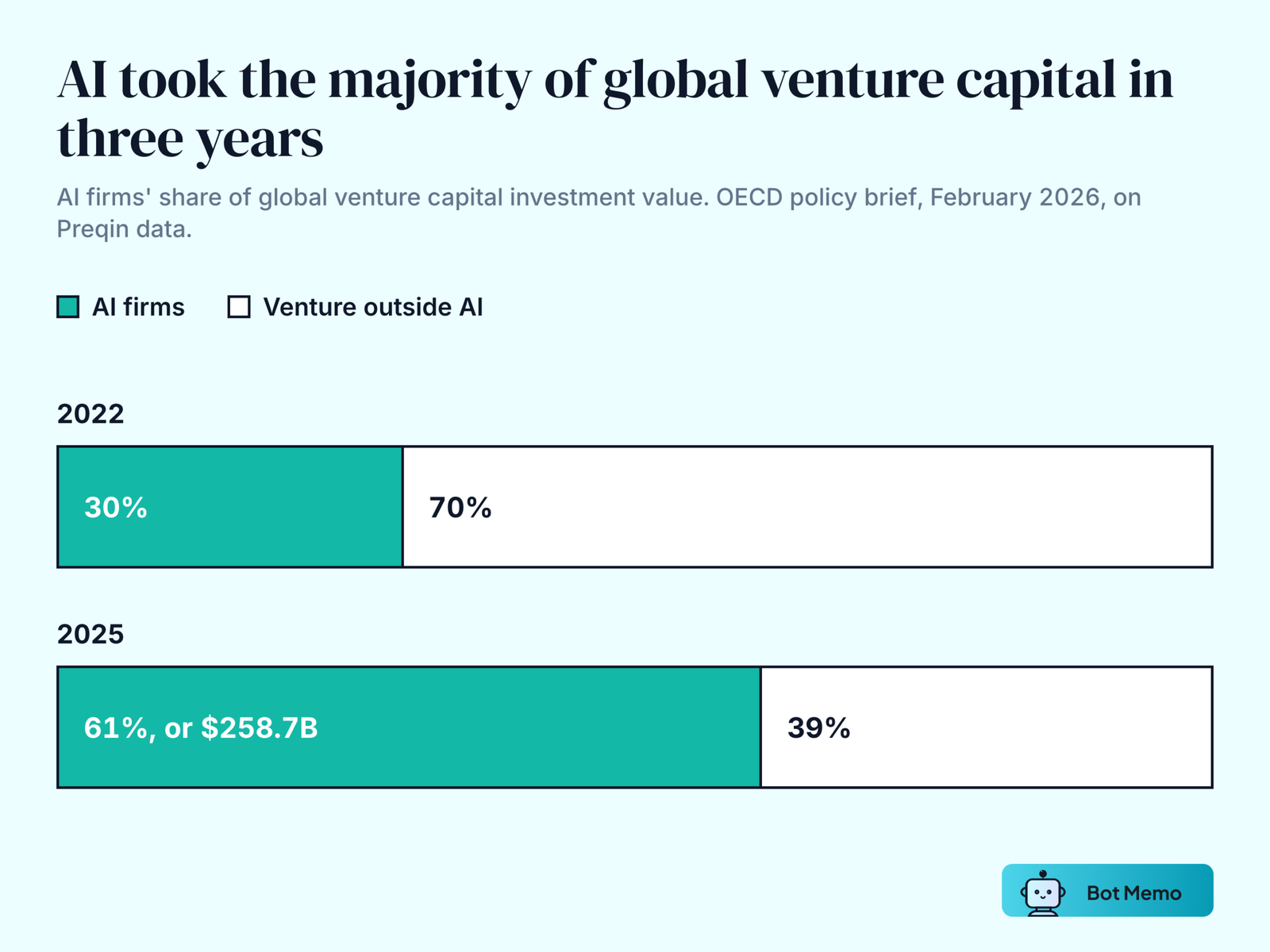
- The OECD’s venture-only series puts 2025 AI VC at $258.7 billion, or 61% of the $427.1 billion invested across all venture globally.
- AI’s share of global venture capital has doubled since 2022, when it was 30%.
- AI venture funding has risen from about $8.3 billion in 2012 to the 2025 figure.
- CB Insights, counting differently again, records $225.8 billion in 2025 private AI funding, which it describes as nearly double its 2024 total.
- Among investments with at least one identified investor country, US investors accounted for about 56% of outgoing AI venture value in 2025 at $124 billion, followed by the UK at 9% ($20.7 billion), China at 8% ($17.2 billion), and EU27 investors at 7% ($14.5 billion).
Three credible sources, three 2025 totals: $225.8 billion, $258.7 billion, and $344.7 billion. The spread comes down to whether debt, secondaries, and corporate rounds count as private investment. Round-level detail on AI funding sits on our AI startup funding statistics page.
Market Size Forecasts
Forecasts are the least reliable numbers on this page and the most widely quoted, so each one is shown with the vintage it was published under. That vintage is usually the detail missing when these figures get cited.
- MarketsandMarkets projected the AI market at $407 billion by 2027, from a projected $86.9 billion in 2022, in an August 2022 release.
- The same firm now puts the market at $439.36 billion in 2025 and $3,638.08 billion by 2033, on a 29.3% CAGR from 2026 to 2033. One re-forecast four years later, on a longer horizon and nearly nine times the size.
- Grand View Research projected a 37.3% compound annual growth rate for AI from 2023 to 2030.
- Allied Market Research projected the AI market at $3,636 billion by 2033, on a 37.3% CAGR from 2024.
- PwC estimated AI would add 14.5% to North American GDP by 2030, part of a $15.7 trillion global estimate, in its 2017 Sizing the Prize study. PwC has not reissued those percentages since.
- MarketsandMarkets projected the self-driving car market growing from 20.3 million units in 2021 to 62.4 million by 2030, alongside a projection that 10% of vehicles would be driverless by 2030.
- A Forbes Advisor survey of 600 business owners found 64% expect AI to improve customer relationships and increase productivity.
- UpCity reported that 50% of US consumers use voice search daily, from a 2022 survey of 600 respondents.
Where The Money Went In Earlier Years
- AI startups raised $42.5 billion across about 2,500 equity rounds in 2023 (CB Insights), a 10% year-on-year fall against a 42% collapse in venture funding overall. Set that against 2025’s $225.8 billion on the same source and the recovery is more than fivefold.
- North America drew $31.8 billion in seed-through-growth venture funding in the second quarter of 2023 (Crunchbase). That is every sector, not AI alone.
- China drew $43.4 billion on KPMG’s Venture Pulse count for the first half of 2023, again across every sector, and a six-month total rather than a single quarter.
- The UK, India, Israel, and Canada each attracted between $1 billion and $2 billion, on the reading carried in the earlier version of this page.
- Autonomous driving drew $5 billion to $7 billion, healthcare AI $4 billion to $6 billion, and enterprise AI $7 billion to $10 billion on that same earlier reading, which stated no period.
- Khosla Ventures, Index Ventures, and Sequoia Capital were among the most active AI investors across seed through growth stages, on the reading this page originally carried. Our most active AI investors page carries the current ranking.
Key Takeaways
- Published global counts of AI companies run from 125 to 1.67 million. Both ends are honestly derived, and neither answers the question alone.
- The most useful stock figures start near 32,000 and run past 40,000. All of them come from commercial trackers applying a core-AI test.
- Annual funded-company counts are the firmest series available: 3,499 worldwide in 2025, up 70.8%, with 1,953 of those in the United States.
- Government counts are smaller. The UK’s 5,862 arrives with a published method; China’s more than 6,200 does not.
- Building AI and using AI are different measurements. Up to 20% of US firms report using AI, against 88% of McKinsey survey respondents who say their organisation does.
- Venture-derived counts omit companies that have not taken qualifying private investment, including those running on grants or state support, which is why regions outside the US and Europe read as thin.
Frequently Asked Questions
How Many AI Companies Are There In The World?
Around 32,000 to 40,000-plus under the strictest commercial definitions, where AI has to be the core product. Tracxn counted 32,300 on 2 July 2026 and CB Insights offers live data on more than 40,000. Widen the test to any company with AI in its registered business scope and China alone accounted for 1.67 million in the first half of 2024.
How Many AI Companies Are There In The United States?
The Census Bureau identified 21,731 AI business applications filed between 2004 and 2023. On funding-based counts, 8,909 US AI companies have been newly funded since 2013, including 1,953 in 2025 alone.
How Many AI Startups Get Funded Each Year?
3,499 worldwide in 2025, up 70.8% on 2024’s 2,049. That series counts only companies that have raised more than $1.5 million since 2013, so the true formation rate is higher.
Who Are The Biggest AI Companies?
It depends on the list. Forbes’ 2026 AI 50 covers privately held companies only and put Anthropic at a $380 billion valuation. Public companies including Nvidia, Microsoft, Alphabet, Amazon, and Meta are excluded from that list. In 2025 the sector produced 75 new unicorns, and 28 individual rounds cleared $1 billion.
Why Do AI Company Counts Vary So Much?
Four choices drive nearly all the variance: whether AI must be the product or can be a feature, whether outside funding is required, whether inclusion is self-declared or analyst-checked, and which countries the source covers. China’s own two counts, more than 6,200 for 2025 and 1.67 million from the first half of 2024, differ by 270 times on definition and date.
Are There Too Many AI Companies?
The numbers point to concentration rather than saturation. In 2025 rounds above $1 billion took roughly half of all AI venture value, and 75 new unicorns accounted for 61% of all new unicorns that year. Tens of thousands of AI companies exist, and the money is not spread across them.
Sources And Methodology
Figures on this page come from the organisation that published them: the Stanford Institute for Human-Centered AI 2026 AI Index Report (Economy chapter, Figures 4.2.2 to 4.2.14), the OECD’s February 2026 policy brief on venture capital investments in artificial intelligence and the OECD.AI methodological note, the UK Department for Science, Innovation and Technology Artificial Intelligence Sector Study 2024, the US Census Bureau’s Business Trends and Outlook Survey and Center for Economic Studies working paper CES-WP-24-09R, NBER working papers 31788 and 34836, McKinsey’s State of AI survey, CB Insights’ State of AI 2025 report, Forbes’ AI 50, and the live Tracxn, Crunchbase, and Y Combinator platform pages. Publication and reading dates are stated where they are established.
Several exclusions are worth stating plainly. PitchBook’s AI company count is not public, so no figure is quoted for it. Crunchbase publishes no global AI total, so external estimates circulating under its name are not used. Qichacha’s 1.67 million is the most recent aggregate available and dates to the first half of 2024; China’s registration pace since then means the current figure is higher, but no updated number has been published.
Statistics 91 through 104 are carried forward from the earlier version of this page with their original figures and attributions intact, because outside sites cite them. Where a newer equivalent exists it appears alongside the original rather than replacing it. Several of those entries need a note. The 10% driverless-vehicle share in statistic 96 could not be located in any MarketsandMarkets publication, though the unit forecast beside it can; the share is reproduced as it was originally stated. The Forbes Advisor finding in statistic 97 combines customer relationships and productivity in a single response option rather than measuring productivity alone. Statistics 100 and 101 are genuine Crunchbase and KPMG figures for total venture funding rather than AI funding, and are labelled as such in the text. Statistics 102 and 103 carry no traceable published source and are reproduced as they stood. Statistic 104 names no period, deal count, or ranking method, and is reproduced as it stood. The 2023 Forbes AI 50 behind statistic 74 no longer has its own address on forbes.com, where every AI 50 link now resolves to the current edition, so those nine funding totals are reproduced as this page carried them. The Microsoft characterisation in statistic 75 could not be located in any Forbes AI 50 coverage still online, and is reproduced with its original attribution rather than dropped. The Grand View Research and Allied Market Research forecasts in statistics 93 and 94 are quoted at the vintage under which they were issued rather than refreshed.
Two sourcing notes apply to earlier readings. Statistic 38 was originally attributed to Statista, which hosts the chart; the underlying research is Tortoise Media’s Global AI Index, named here directly. Statistic 5 reflects a Tracxn page that updates continuously and carries no fixed vintage, so the reading this article previously quoted is shown alongside the 2 July 2026 reading rather than a single figure.

About the author
Editorial Staff
The Editorial Staff at Bot Memo is a team of writers, analysts, and AI agents dedicated to mapping the global AI startup ecosystem. Led by Chintan Zalani, the team tracks thousands of funding rounds, classifies companies across verticals, and distills it all into actionable intelligence for investors and founders.