
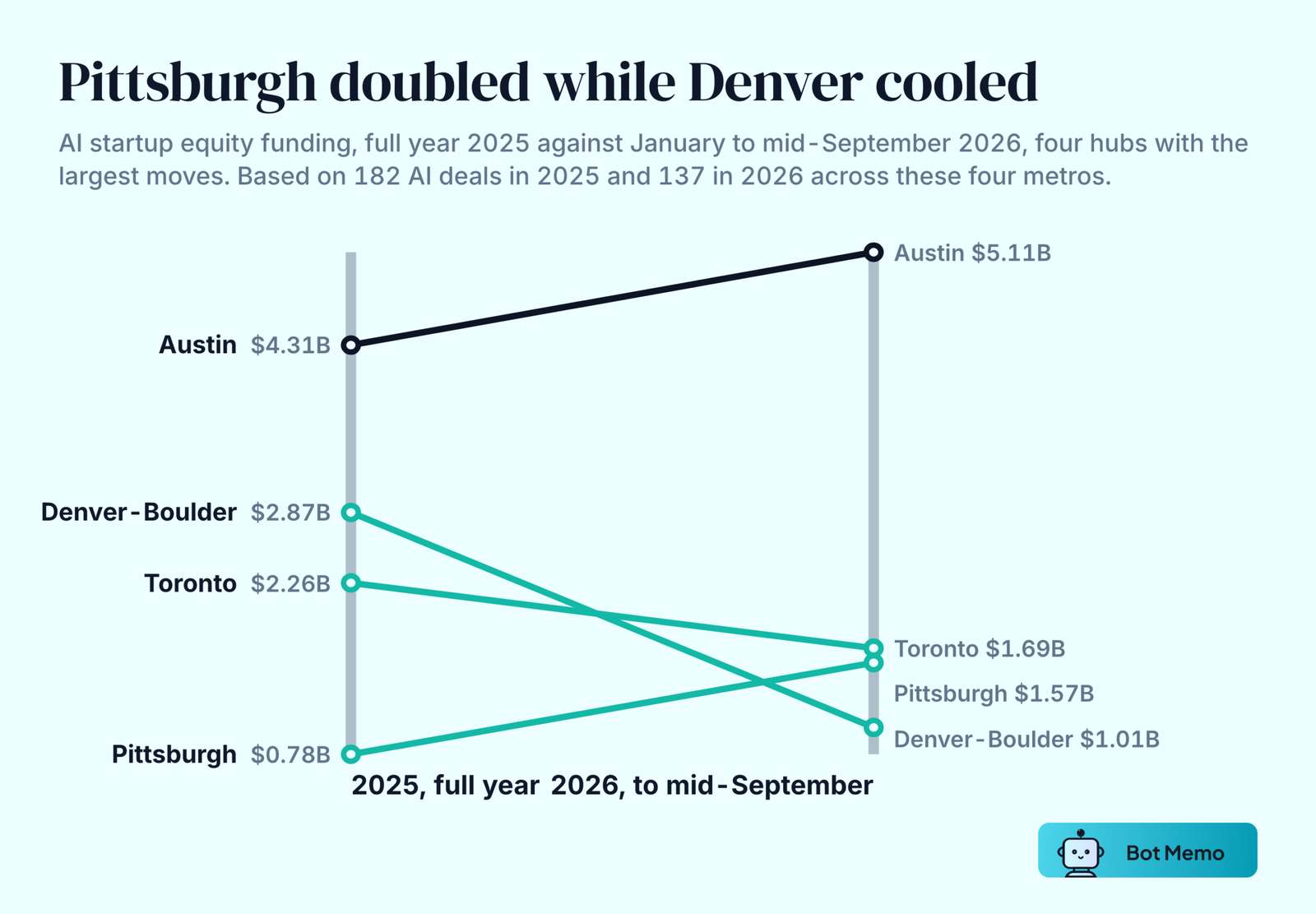
AI companies outside Silicon Valley raised $16.31B in equity across 377 deals in 2025, counting just eight tier-2 hubs. Austin led with $4.31B, well ahead of the Seattle metro ($2.96B) and Denver-Boulder ($2.87B). By mid-September 2026, Austin had already passed its full 2025 total, and Pittsburgh had doubled its 2025 figure on the back of one robotics round.
This ranking covers Austin, Denver-Boulder, the Seattle metro, Toronto, Chicago, the Miami metro, Pittsburgh and Atlanta. Toronto is the one hub outside the US. The ranking counts equity rounds only. Credit facilities, GPU-backed loans and other debt are left out, because in several of these cities a single loan would otherwise outrank every venture round of the year.
On this page
- AI Companies Outside Silicon Valley: The 2025 Ranking and 2026 So Far
- Austin: Defense, Robotics and Chips Keep Stacking
- Denver-Boulder: A Crusoe Year, Then a Reset
- Seattle Metro: The Deepest Bench of Mid-Size Rounds
- Toronto: Many Small Rounds and a Few Very Large Ones
- Chicago: Health AI Leads a Steady Market
- Miami Metro: FinTech by Deal Count, Health AI by Dollars
- Pittsburgh: Clinical AI in 2025, Robotics in 2026
- Atlanta: FinTech Leads, and 2026 Has Been Quiet
- What the Numbers Say About Tier-2 AI Hubs
- Frequently Asked Questions
AI Companies Outside Silicon Valley: The 2025 Ranking and 2026 So Far
The table puts full-year 2025 next to 2026 through mid-September. The lead sector is the one with the most deals in 2025, counted after the generic enterprise software label is set aside wherever a company has a more specific sector.
| Metro | 2025 Equity Funding | 2025 Deals | 2025 Median Round | 2026 to Mid-September | 2026 Deals | Lead Sector by 2025 Deals |
|---|---|---|---|---|---|---|
| Austin | $4.31B | 73 | $13.0M | $5.11B | 65 | Health & Biotech and Cybersecurity (tied, 14 each) |
| Seattle metro | $2.96B | 74 | $15.0M | $2.54B | 51 | Developer Tools & AI Infrastructure (13) |
| Denver-Boulder | $2.87B | 46 | $11.0M | $1.01B | 26 | Health & Biotech (12) |
| Toronto | $2.26B | 50 | $6.0M | $1.69B | 36 | FinTech (13) |
| Chicago | $1.52B | 45 | $12.7M | $0.67B | 27 | Health & Biotech (9) |
| Miami metro | $0.89B | 51 | $12.0M | $0.90B | 28 | FinTech (16) |
| Pittsburgh | $0.78B | 13 | $11.6M | $1.57B | 10 | Health & Biotech (6) |
| Atlanta | $0.73B | 25 | $20.0M | $0.38B | 8 | FinTech (8) |
Medians use rounds with a disclosed amount.
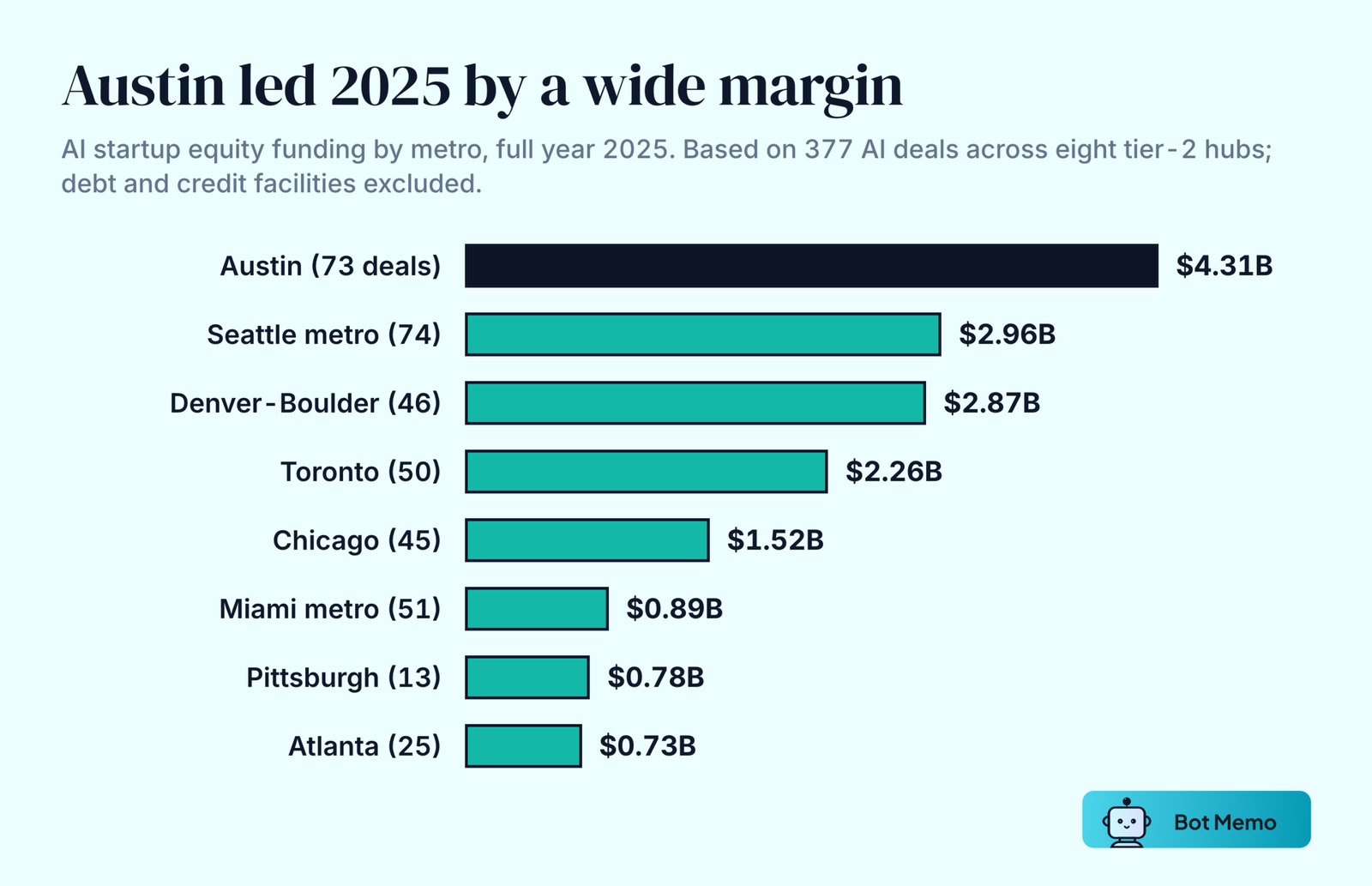
Three findings stand out. Austin, Pittsburgh and the Miami metro have already passed their full 2025 totals, Miami by less than 1%. Austin is at $5.11B with three and a half months still to go. Pittsburgh’s 2026 total is double its 2025 total, and one company accounts for almost all of it. Denver-Boulder has fallen from third place to fifth, because its 2025 total leaned on a single $1.375B round.
For a comparison with AI companies in Silicon Valley, see our breakdown of AI startups in San Francisco and the full AI startup funding by city ranking.
Austin: Defense, Robotics and Chips Keep Stacking
Austin raised $4.31B across 73 AI deals in 2025, with a $13.0M median round. Base Power’s $1B Series C in October was the largest, followed by Saronic’s $600M Series C, NinjaOne’s $500M Series C extension, Apptronik’s $403M Series A and Ontic’s $230M Series C. Health and biotech tied with cybersecurity for the most deals, at 14 each.
2026 is bigger. Saronic closed a $1.75B Series D at a $9.25B valuation in March, the largest round in any of these eight hubs this year. Apptronik added a $520M Series A extension, Fab2 (formerly Atomic Semi) raised a $500M Series A, NinjaOne added $400M and Ollin Biosciences raised a $330M Series B. Austin’s 2026 total stands at $5.11B across 65 deals, and manufacturing and industrials now leads its deal count with 11.
The mix points to physical AI: autonomous vessels, humanoid robots, home batteries and chip fabrication. Our list of top AI robotics startups covers several of these companies.
Denver-Boulder: A Crusoe Year, Then a Reset
Denver-Boulder raised $2.87B across 46 AI deals in 2025, with an $11.0M median. Crusoe’s $1.375B Series E in October made up 48% of that. Crusoe describes itself as headquartered in both San Francisco and Denver, and the round is counted here.
The rest of the 2025 list is broad. Boom Supersonic raised $300M, Strive Health a $300M Series D, and True Anomaly a $260M Series C out of Centennial. Enveda in Boulder took a Sanofi investment in February that brought its Series C to $150M, then raised a $150M Series D in September that made it a unicorn. Health and biotech led the deal count with 12, followed by govtech and defense with 7.
In 2026 the metro has raised $1.01B in equity across 26 deals. True Anomaly’s $650M Series D (about $600M of it equity) is 59% of that. The area’s largest 2026 financing overall was a $2B data center credit facility, which this ranking excludes.
Seattle Metro: The Deepest Bench of Mid-Size Rounds
Counted as a metro that includes Bellevue, Redmond, Kirkland, Everett and Woodinville, Seattle raised $2.96B across 74 AI deals in 2025. That was the most deals of any hub on this list, and its $15.0M median was the second-highest after Atlanta’s.
The top of the 2025 list was spread out. Group14 raised $463M in Woodinville, Helion $425M in a Series F in Everett, and Chainguard a $356M Series D. Temporal raised a $146M Series C, and Umoja Biopharma and Statsig each raised $100M. Developer tools and AI infrastructure led the deal count with 13, and health and biotech followed with 12.
2026 has continued in the same pattern: $2.54B across 51 deals, with no single round above 22% of the total. Temporal raised a $550M Series E at a $12.55B valuation in September. Helion added a $465M Series G. Redmond’s Starcloud, which is building data centers in orbit, raised a $170M Series A in March and a $250M extension in August. Brinc ($125M), XBOW ($120M Series C) and Overland AI ($100M) round out the list. See our list of top AI infrastructure startups for more of this category.
Toronto: Many Small Rounds and a Few Very Large Ones
Toronto raised $2.26B across 50 AI deals in 2025. Its $6.0M median was the lowest of the eight hubs. Wealthsimple’s C$750M equity round (about $535M) and Cohere’s $500M Series D led the year. Cohere, which builds large language models for enterprises, is headquartered in Toronto and San Francisco. Beacon Software ($250M Series B), StackAdapt ($235M), Tailscale ($160M Series C) and Blue J ($122M Series D) followed.
FinTech led Toronto’s 2025 deal count with 13, and health and biotech followed with 9. The federal government also committed C$42.5M in 2025 to expand AI compute at the University of Toronto.
In 2026 Toronto has raised $1.69B across 36 deals. Waabi’s $750M Series C in January is 44% of that. Beacon returned for a $225M Series C, chip startup Taalas raised $169M and Veeda AI launched with $90M. Developer tools and AI infrastructure leads the 2026 deal count.
Chicago: Health AI Leads a Steady Market
Chicago raised $1.52B across 45 AI deals in 2025, with a $12.7M median. Two rounds made up 57% of that total: Nerdio’s $500M Series C and Pathos AI’s $365M Series D. Pathos was spun out of Tempus. After those two, the next largest were Raise ($63M), Fay ($50M Series B) and Kin ($50M). Health and biotech led the deal count with 9, and FinTech followed with 6.
In 2026 Chicago has raised $675M across 27 deals, and the median has risen to $17.0M. CADDi, which is headquartered in both Chicago and Tokyo, raised a $114M Series D in September. Zarminali Pediatrics raised a $110M Series A, Chowbus an $81M Series E and EDX Markets a $76M Series C. Health and biotech still leads with 8 deals. Chicago is the only Midwest hub in this ranking. For the category view, see our list of top AI healthcare startups.
Miami Metro: FinTech by Deal Count, Health AI by Dollars
The Miami metro, which includes Boca Raton and Palm Beach Gardens, raised $0.89B in AI equity across 51 deals in 2025. That is the third-highest deal count of the eight, but only the sixth-largest dollar total. FinTech made up 16 of the 51 deals, more FinTech deals than any other hub here.
OpenEvidence’s $200M Series C in October was the largest 2025 equity round, and it came as the company moved its headquarters to Miami. Cast AI raised a $108M Series C and Felix Pago a $75M Series B. Flex announced $225M in March, but $200M of that was a credit facility, so only its $25M of equity counts here.
In 2026 the metro has raised $0.90B across 28 deals, which already just tops its 2025 total. OpenEvidence raised a $250M Series D at a $12B valuation in January, eMed raised $200M in March and GPU infrastructure company Hydra Host raised a $100M Series A in June. Felix Pago’s September Series C paired about $87M of equity with a credit line. Health and biotech now leads the deal count with 7, just ahead of FinTech with 6. See our list of top AI fintech startups for the sector nationally.
Pittsburgh: Clinical AI in 2025, Robotics in 2026
Pittsburgh raised $777M across 13 AI deals in 2025, with an $11.6M median across the 10 rounds that disclosed an amount. Abridge accounted for $550M of it through two rounds: a $250M Series D in February and a $300M Series E in June. Gecko Robotics raised a $125M Series D that made it a unicorn, and Peptilogics raised $78M. Health and biotech led with 6 deals, and manufacturing and industrials followed with 5.
Skild AI raised its $300M Series A in July 2024, so that round is not in the 2025 count. In January 2026 Skild raised a $1.4B Series C at a valuation of about $14B. That one round is 89% of Pittsburgh’s $1.57B 2026 total. Efficient Computer ($60M Series A), Gather AI ($40M Series B) and Gray Swan ($40M Series A) are the next largest. Five of the city’s 10 deals in 2026 are in manufacturing and industrials.
Atlanta: FinTech Leads, and 2026 Has Been Quiet
Atlanta raised $726M across 25 AI deals in 2025. Its $20.0M median, across 22 disclosed rounds, was the highest of the eight hubs. Flock Safety’s $275M Series F was the largest. Airia announced $100M and OnPay raised a $63M Series B. FinTech made up 8 of the 25 deals (32%).
The ranking leaves out QumulusAI’s $500M in October 2025. That money was a GPU-backed financing facility, and counting it would have lifted Atlanta’s total by 69%.
2026 has been slow so far: 8 deals and $382M, with only four amounts disclosed. Stord’s $250M Series F in May is two-thirds of that total, and Altesa BioSciences raised a $75M Series B.
What the Numbers Say About Tier-2 AI Hubs
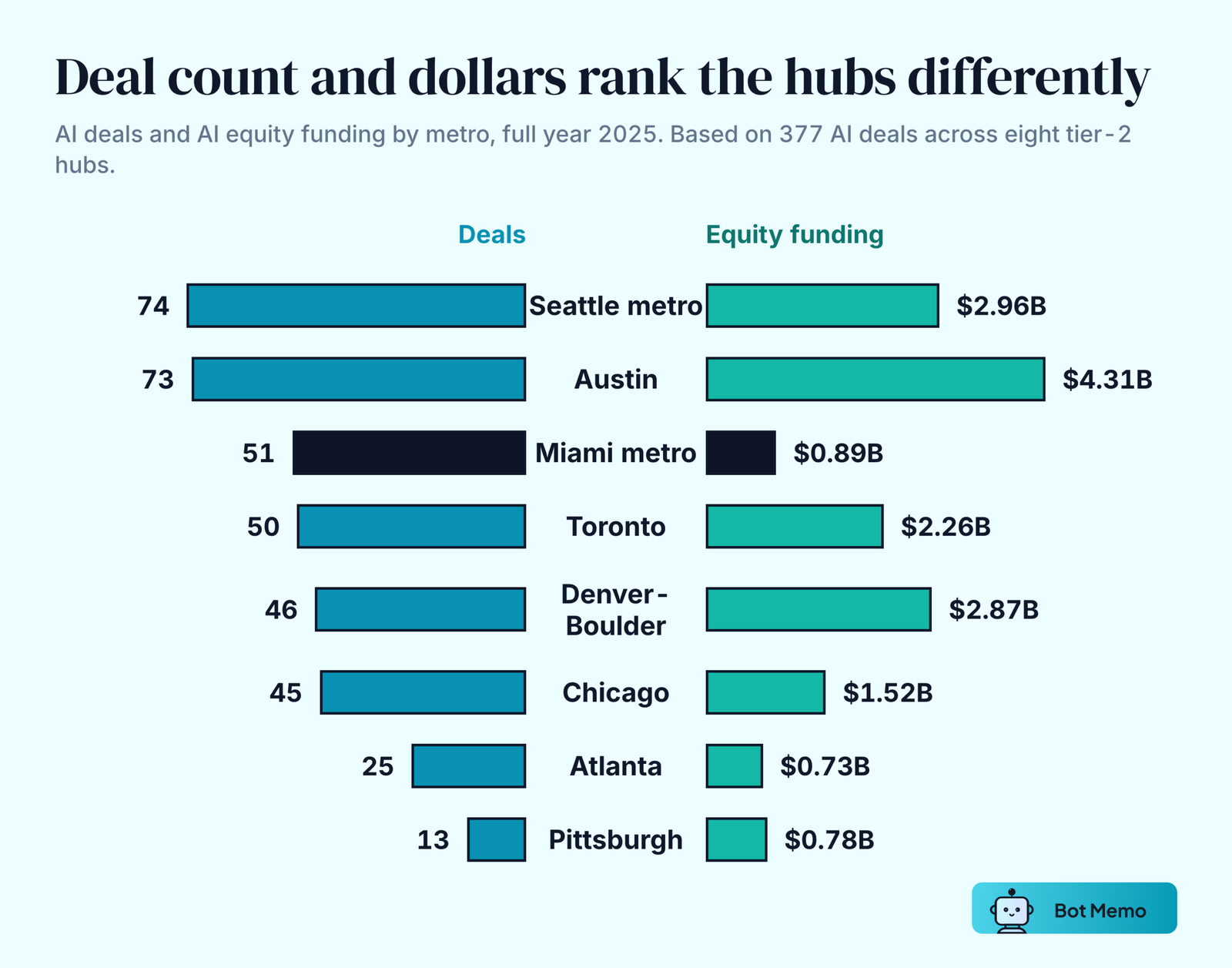
Deal count and dollars rank these cities differently. Miami closed 51 AI deals in 2025, more than Toronto or Denver-Boulder, but raised about a third of Denver-Boulder’s dollars. Pittsburgh closed 13 deals and still out-raised Atlanta.
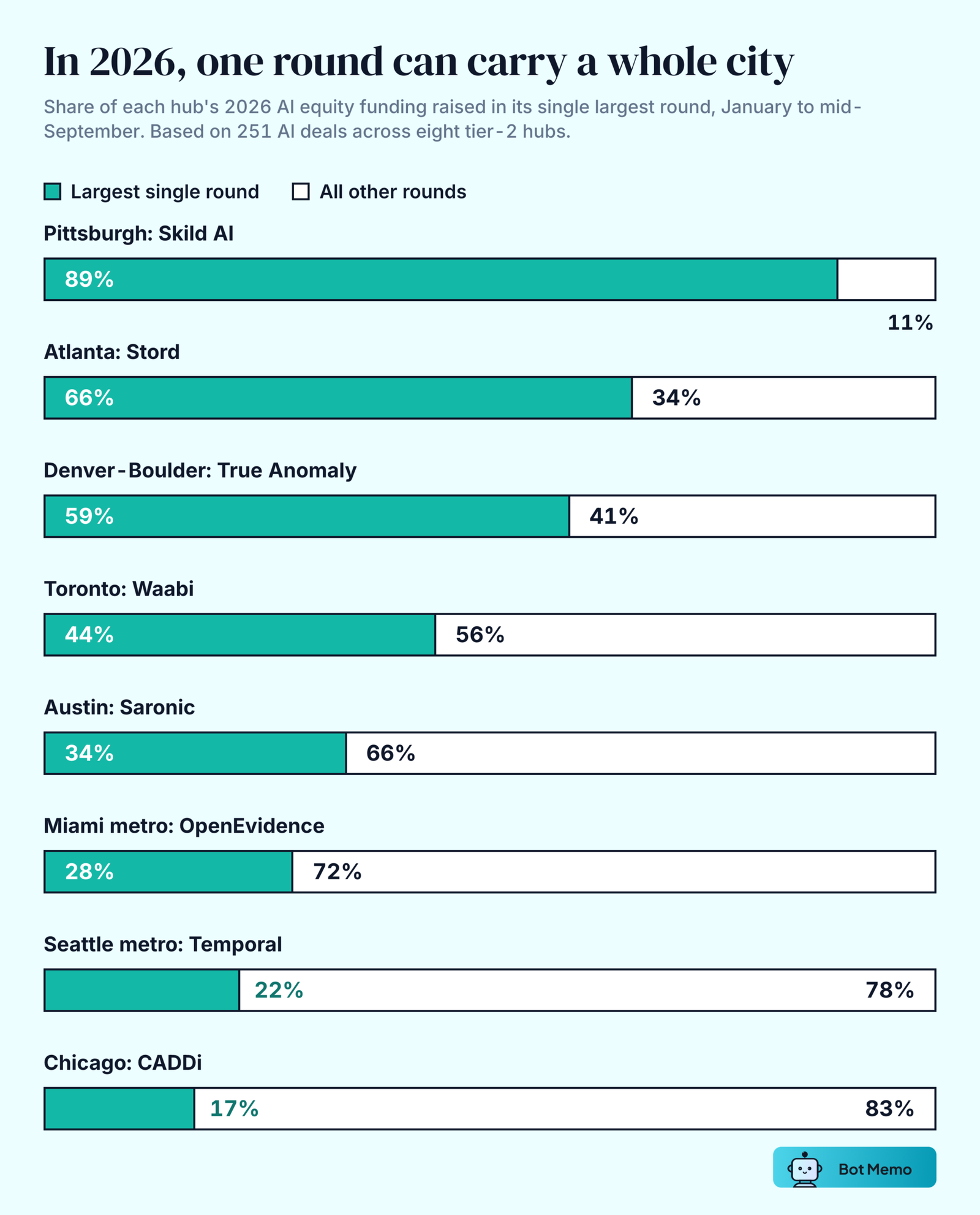
In most of these hubs, the yearly total depends on one or two companies. In 2026 the largest single round makes up 89% of Pittsburgh’s total, 66% of Atlanta’s and 59% of Denver-Boulder’s. Seattle (22%) and Chicago (17%) are the least dependent on a single deal. For an investor, a city’s annual ranking often says more about one company’s fundraise than about the local market.
Each hub also has a specialty. Austin and Pittsburgh lead on robotics and hardware. Seattle leads on developer tools and infrastructure. Miami and Toronto have the most fintech deals, and fintech also leads Atlanta’s count. Health AI runs through almost every city on the list, leading the 2025 deal count in Denver-Boulder, Chicago and Pittsburgh and tying for first in Austin. The AI power rankings track the companies behind these rounds.
Frequently Asked Questions
Which Cities Outside Silicon Valley Get the Most Artificial Intelligence Funding?
Among these eight tier-2 hubs, Austin led 2025 with $4.31B in AI equity across 73 deals. The Seattle metro ($2.96B), Denver-Boulder ($2.87B) and Toronto ($2.26B) followed. For 2026 through mid-September, the order is Austin ($5.11B), Seattle ($2.54B), Toronto ($1.69B) and Pittsburgh ($1.57B).
Which Tier-2 AI Hub Is Growing Fastest in 2026?
Pittsburgh’s 2026 total is already double its 2025 total, but Skild AI’s $1.4B Series C accounts for 89% of it. Austin’s growth is broader: $5.11B across 65 deals, ahead of its full 2025 total of $4.31B.
Is Pittsburgh the AI Robotics Capital of the US?
Pittsburgh is home to Skild AI, which is building a general-purpose robot foundation model and raised a $1.4B Series C in January 2026, and to Gecko Robotics, which raised a $125M Series D in 2025. But its largest 2025 funding came from clinical AI: Abridge raised $550M across two rounds. Austin is the other robotics center on this list, with Apptronik’s $403M Series A in 2025 and its $520M extension in 2026.
Which Tier-2 City Has the Most AI Fintech Startups?
By 2025 deal count, the Miami metro led with 16 FinTech deals out of 51, followed by Toronto with 13 and Atlanta with 8. As a share of each city’s own deals, Atlanta was highest at 32% (8 of 25), with Miami at 31%.
Why Did Denver’s AI Funding Drop in 2026?
In 2025, Crusoe’s $1.375B Series E made up 48% of Denver-Boulder’s $2.87B total. Nothing that size has closed there in 2026. True Anomaly’s $650M Series D, about $600M of it equity, is the largest round so far. The metro’s biggest 2026 financing overall was a $2B data center credit facility, which this ranking excludes.
Is Toronto a Serious AI Hub?
Yes. Toronto raised $2.26B across 50 AI deals in 2025 and $1.69B across 36 deals in 2026 through mid-September. It has the lowest median round of the eight hubs ($6.0M in 2025), alongside some of the largest single rounds, including Waabi’s $750M Series C and Cohere’s $500M Series D.
What Is the Best AI Hub in the Midwest?
Chicago is the only Midwest city in this ranking. It raised $1.52B across 45 AI deals in 2025, led by Nerdio and Pathos AI, and $675M across 27 deals so far in 2026.
How we counted. Figures cover equity rounds for artificial intelligence startups, dated within each period and assigned to the company’s headquarters metro. Companies that list two of these metros count in both. Debt, credit facilities, asset-backed financings and financings by public companies are excluded. For rounds that combined equity and credit, only the equity portion counts. The Seattle metro includes Bellevue, Redmond, Kirkland, Everett and Woodinville. Denver-Boulder includes Boulder, Centennial and Golden. The Miami metro covers South Florida. Amounts are in US dollars, and 2026 figures run through mid-September 2026. Because only equity counts, some city totals here are lower than headline figures that include credit lines. More detail is on our data methodology page.

About the author
Editorial Staff
The Editorial Staff at Bot Memo is a team of writers, analysts, and AI agents dedicated to mapping the global AI startup ecosystem. Led by Chintan Zalani, the team tracks thousands of funding rounds, classifies companies across verticals, and distills it all into actionable intelligence for investors and founders.