
Israeli artificial intelligence companies raised $12.66B across 435 funding rounds between January 2023 and mid-September 2026. That is 1.08% of the $1.17T raised by AI companies worldwide over the same window, from a country holding about 0.12% of the world’s population.
The total hides where the money goes. Sort the same rounds by sector and one line separates Israel from every other market its size. Cybersecurity took $4.31B across 139 deals, 34.1% of every dollar Israeli AI companies raised. Against global AI cybersecurity funding of $42.23B, Israel holds 10.2%. A market that takes 1.08% of all AI capital takes 9.4 times that share of the money going into computer security.
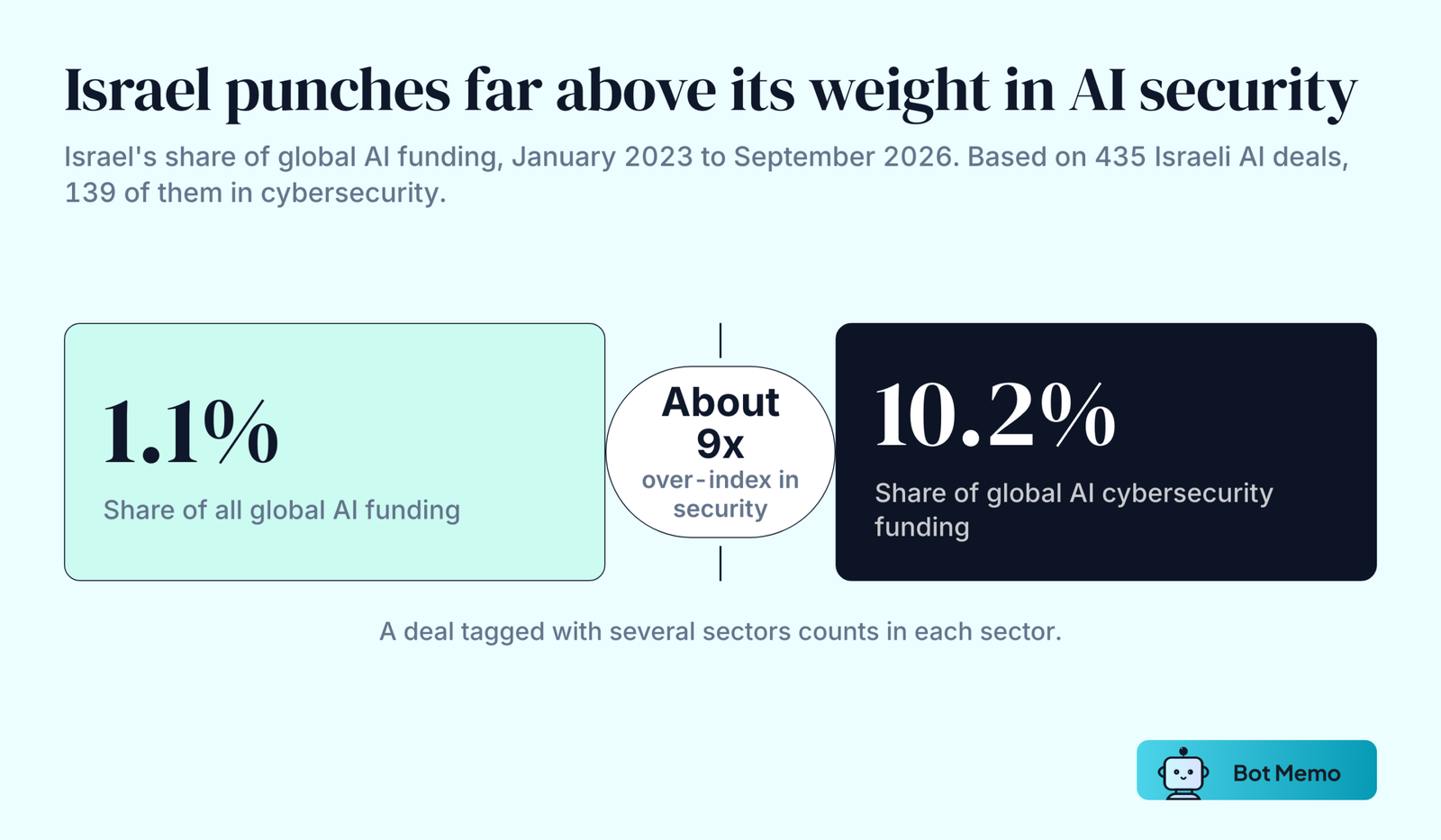
AI in Israel is narrow by design. Most of the money goes to security software, data center infrastructure and health companies, and very few Israeli companies raise to build models. This page covers what Israeli AI startups raised, which sectors and cities the money went to, how round sizes compare with the global market, and which funds show up most often.
On this page
- How Much Have Israeli AI Companies Raised?
- Cybersecurity Is Where Israel Over-Indexes
- What Israeli AI Companies Build
- Defense and Dual-Use AI
- Largest Israeli AI Funding Rounds
- Tel Aviv Holds 80% of the Money
- Israeli AI Funding by Stage
- Israeli AI Funding in 2026 So Far
- Most Active Investors in Israeli AI
- How Israel Compares With Other AI Markets
- AI Companies in Israel: Common Questions
- Methodology
How Much Have Israeli AI Companies Raised?
| Year | Funding | Deals | Median round | Share of global AI funding |
|---|---|---|---|---|
| 2023 | $2.91B | 112 | $12.0M | 2.55% |
| 2024 | $2.48B | 115 | $15.0M | 1.23% |
| 2025 | $3.58B | 121 | $15.0M | 1.27% |
| 2026 (to Sep 17) | $3.69B | 87 | $20.0M | 0.65% |
Deal count sat between 112 and 121 a year from 2023 to 2025, and dollars moved between $2.48B and $3.58B. Neither line looks like a boom. The movement is in the middle of the distribution: the median Israeli AI round went from $12.0M in 2023 to $20.0M so far in 2026.
Set that against the global median and the gap widens. Worldwide, the median AI round was $10.5M in 2023 and $11.5M in 2026. Israel started a little above the world and now writes rounds at 1.7 times the global midpoint. Fewer companies get funded per dollar, and the ones that clear the bar clear it higher.
The share column tells the other half. Israel’s slice of global AI dollars fell from 2.55% in 2023 to 0.65% in 2026, while its own totals held steady or grew. The world’s AI funding total has multiplied on the back of a few model-lab rounds measured in tens of billions, and Israel does not write those. Mean round size across the full period is $30.5M against a median of $15.0M, and the gap comes from a short list of large rounds covered below.
Cybersecurity Is Where Israel Over-Indexes
| Sector | Funding | Deals |
|---|---|---|
| Cybersecurity | $4.31B | 139 |
| Developer Tools & AI Infrastructure | $2.46B | 67 |
| Manufacturing & Industrials | $1.38B | 30 |
| Health & Biotech | $1.11B | 49 |
| FinTech | $1.08B | 37 |
| Marketing & Sales Tech | $677.5M | 27 |
| Media & Entertainment | $465.4M | 18 |
| Real Estate & Construction | $410.6M | 14 |
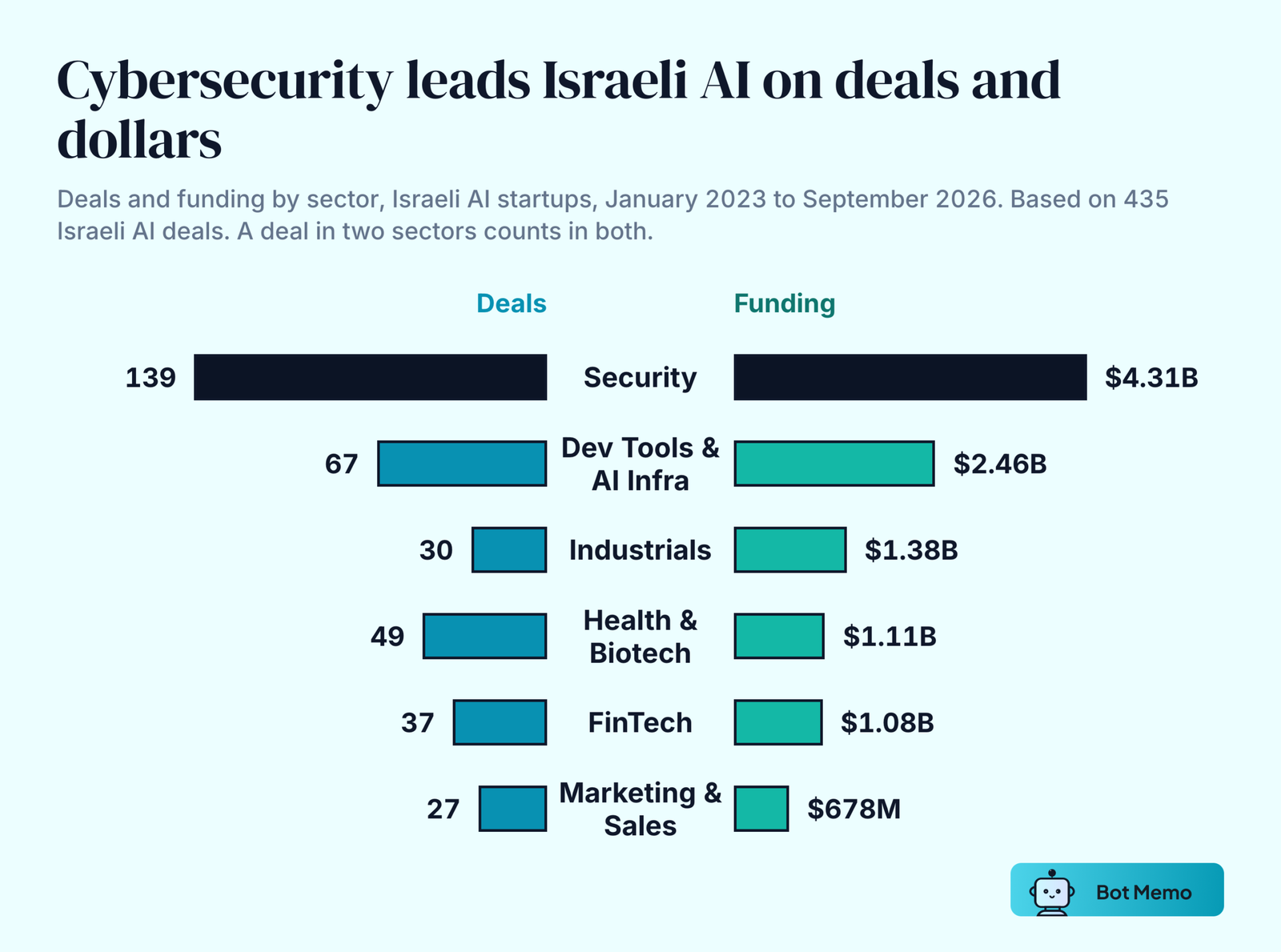
Cybersecurity is the largest sector by dollars and by deal count, and few markets concentrate this way. Cybersecurity and healthcare together carry 188 of the 435 rounds, 43% of the total. Israel’s 10.2% share of global AI cybersecurity funding comes from 139 rounds, against a 1.08% share of AI funding overall.
The share moved year to year: 27.0% of Israeli AI dollars in 2023, 29.4% in 2024, 47.6% in 2025, then 29.7% so far in 2026. The 2025 peak came from a handful of large security rounds landing in one year, led by Cato Networks. The 2026 reading is lower because chips and infrastructure grew around it. Our AI cybersecurity list covers the companies in that layer globally.
Developer Tools and AI Infrastructure sits second at $2.46B across 67 deals, carried by DriveNets, Xsight Labs, Decart and AI21. Manufacturing and Industrials ranks third by dollars on only 30 deals, because quantum and chip companies such as Xsight Labs, Quantum Machines and Hailo land there. Health and Biotech ran 49 rounds for $1.11B, third by deal count. Its median round is $15.0M, exactly the national median, so the sector funds a lot of companies at ordinary prices rather than a few at large ones.
What Israeli AI Companies Build
| Niche | Funding | Deals |
|---|---|---|
| Threat Detection | $3.97B | 117 |
| AI Agents | $3.48B | 114 |
| Cloud Computing | $2.39B | 49 |
| Network Security | $2.23B | 60 |
| Identity Management | $1.46B | 39 |
| Risk Assessment | $1.10B | 43 |
| Compliance Automation | $1.10B | 49 |
| Inference Optimization | $965.5M | 8 |
| Generative AI | $897.2M | 27 |
Threat detection is the single largest capability across Israeli AI companies, at 117 deals and $3.97B. These are AI systems built for enterprise security teams, not consumer AI tools. Add network security, identity management and risk assessment and four of the nine largest niches are security work. That is the same concentration the sector table shows, seen one level down.
Agentic AI comes second at 114 deals and $3.48B, spread across security, sales and clinical workflows rather than sitting in one sector. Zenity’s $125.0M Series C in August 2026, for securing AI agents inside large companies, sits where those two lines cross. Generative artificial intelligence is smaller than the volume of coverage would suggest, at 27 deals and $897.2M. Israeli companies building on large language models tend to apply them to an existing security or clinical problem rather than selling a model directly. AI21 is the exception: its $208.0M Series C in November 2023 remains the largest round an Israel-based company has raised to build language models of its own.
Underneath the niche labels the technical work is conventional. Threat detection and risk assessment run on machine learning trained against network telemetry, identity products lean on the same, and the diagnostics companies use deep learning on images. Natural language processing shows up mostly inside security and sales tooling rather than as AI applications of their own. Inference optimization is the newest line: 8 rounds worth $965.5M, led by DriveNets’ data center networking and the chipmakers Hailo and NeuReality, with Decart’s real-time video models on the software side.
Health and biotech runs on a different set of capabilities. Drug discovery appears on 19 rounds worth $318.5M and precision medicine on 20 worth $403.6M. The cheques are a fraction of the security rounds on a similar pace of deals.
CytoReason raised $80.0M in July 2024 for computational disease models used in drug development. Insightec raised $150.0M in June 2024 for MR-guided focused ultrasound, which treats brain disorders without an incision. ForSight Robotics raised a $125.0M Series B in June 2025 for surgical robotics in eye surgery. Ibex Medical Analytics took $55.0M for cancer pathology diagnostics, and QuantHealth a $45.0M Series B in August 2026 for clinical trial simulation.
Defense and Dual-Use AI
Israel’s reputation for military technology barely shows up in venture rounds. GovTech and defense AI accounts for 6 rounds and $150.5M since 2023. XTEND raised a $40.0M Series B in May 2024 for its drone systems, D-Fend Solutions raised $31.0M in December 2024 for counter-drone technology, and ASIO raised $15.0M in July 2026, its first outside round, for GPS-independent navigation, autonomy and command systems. Israel’s largest defense developers, Elbit Systems, Rafael and Israel Aerospace Industries, are a listed company and two state-owned firms, so their AI work sits outside venture figures. Much of the dual-use work that does raise venture money files under cybersecurity instead.
Largest Israeli AI Funding Rounds
| Company | Amount | Date | Round | City |
|---|---|---|---|---|
| DriveNets | $410.0M | Jun 2026 | Series D | Ra’anana |
| Cato Networks | $359.0M | Jun 2025 | Series G | Tel Aviv |
| Decart | $300.0M | May 2026 | Series C | Tel Aviv |
| Xsight Labs | $300.0M | Jul 2026 | Growth | Tel Aviv |
| eToro | $250.0M | Mar 2023 | Growth | Bnei Brak |
| Cato Networks | $238.0M | Sep 2023 | Growth | Tel Aviv |
| AI21 | $208.0M | Nov 2023 | Series C | Tel Aviv |
| Quantum Machines | $170.0M | Feb 2025 | Series C | Tel Aviv |
| HiBob | $166.0M | Sep 2026 | Growth | Tel Aviv |
| HiBob | $150.0M | Sep 2023 | Growth | Tel Aviv |
| Insightec | $150.0M | Jun 2024 | Growth | Haifa |
| Wonderful | $150.0M | Mar 2026 | Series B | Tel Aviv |
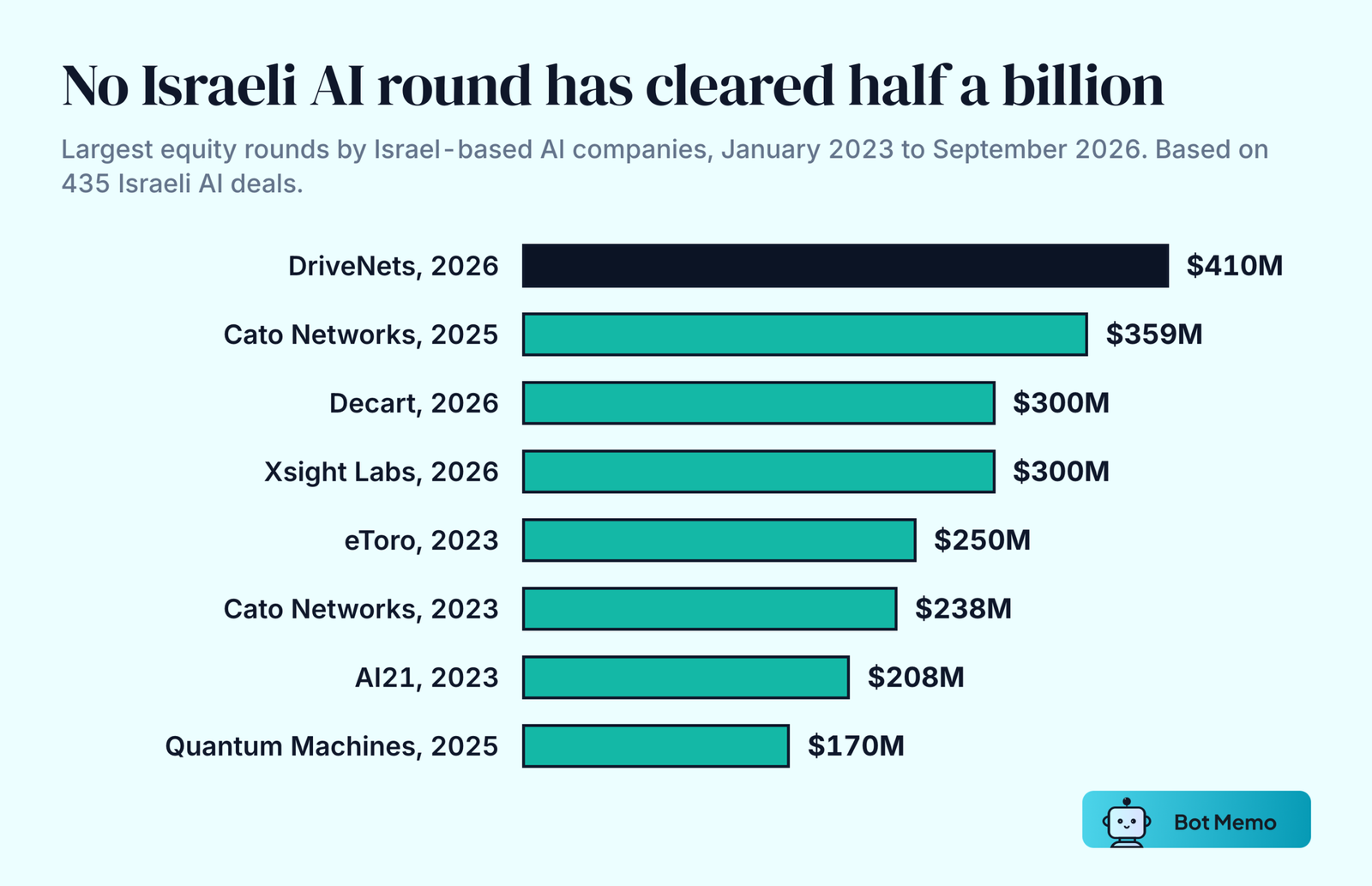
The table lists equity rounds only. PayEm’s $220.0M in January 2023 was a $20.0M Series A plus a $200.0M credit facility, so it sits in the debt line of the stage table below rather than here.
Two names appear twice. Cato Networks raised $238.0M in September 2023 and a $359.0M Series G in June 2025, $597.0M between them and 13.8% of everything Israeli AI cybersecurity raised. HiBob, the HR software company founded in 2015, raised $150.0M in September 2023 and $166.0M in September 2026.
The ceiling is the thing to notice. The largest AI round by an Israel-based company since 2023 is DriveNets’ $410.0M Series D in June 2026, for the network fabric that links GPUs inside AI data centers. Worldwide, 266 rounds over the same period matched or beat it, and the fiftieth largest was $2.0B. Part of the reason is where Israeli founders base their companies once rounds get large. Wiz and Cyera were both founded by Israelis, both announce their rounds from New York, and each has raised more than $500M in a single round. Wonderful’s $150.0M Series B in March 2026 counts in Israel, but it announced its $550M Series C in September 2026 from Amsterdam, so that round counts there. Rounds count toward the city a company names as headquarters when it announces them.
Tel Aviv Holds 80% of the Money
| City | Funding | Deals | Share |
|---|---|---|---|
| Tel Aviv | $10.18B | 345 | 80.4% |
| Ra’anana | $441.0M | 2 | 3.5% |
| Ness Ziona | $329.6M | 7 | 2.6% |
| Ramat Gan | $256.5M | 15 | 2.0% |
| Haifa | $251.4M | 9 | 2.0% |
| Bnei Brak | $250.0M | 1 | 2.0% |
| Yokneam Illit | $221.0M | 5 | 1.7% |
| Petah Tikva | $108.4M | 6 | 0.9% |
| Jerusalem | $93.7M | 7 | 0.7% |
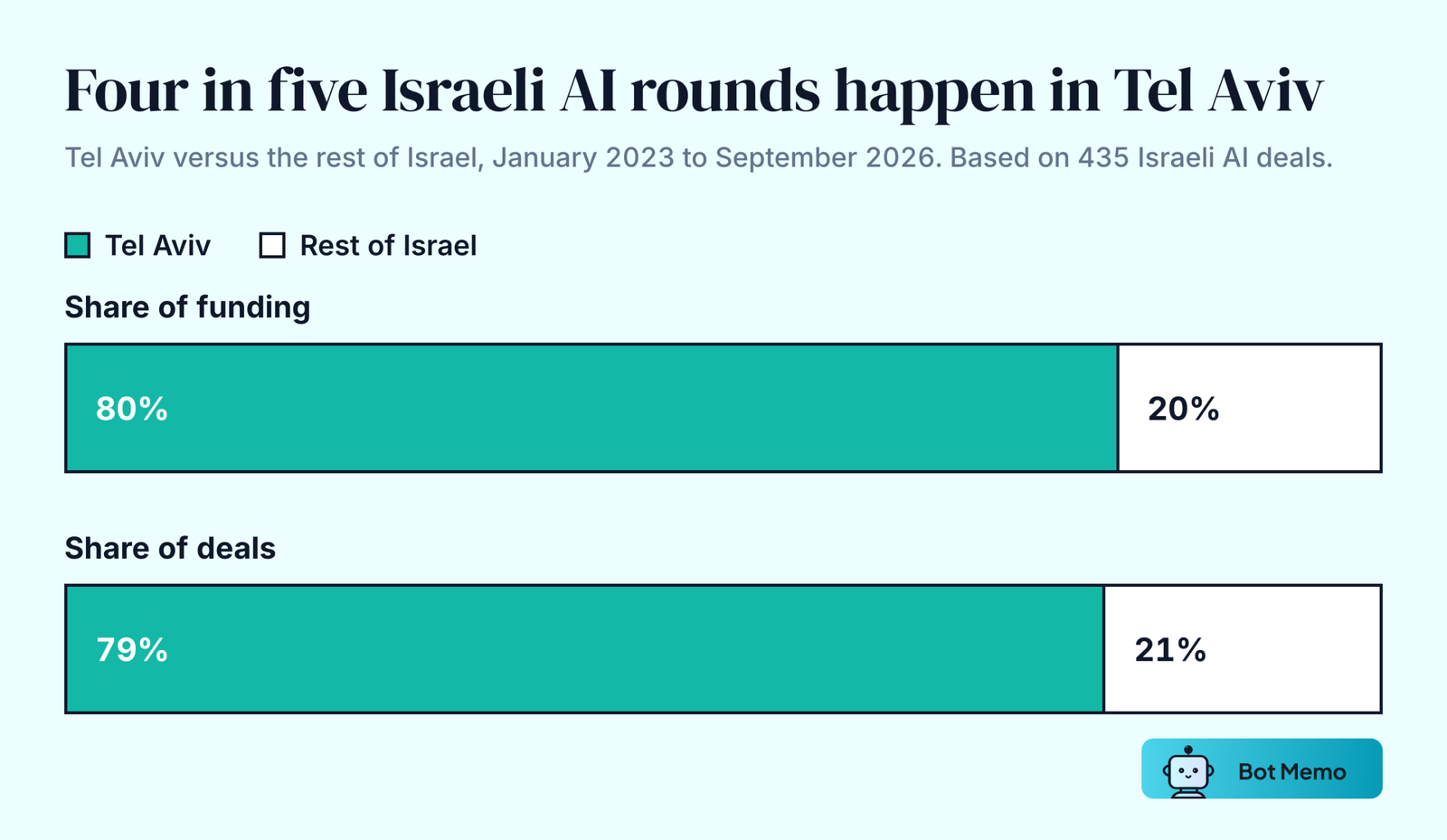
Tel Aviv took 80.4% of Israeli AI capital across 345 of 435 rounds. Ra’anana appears on two deals, one of which is DriveNets, and Bnei Brak on a single one, eToro. Haifa, home to the Technion and to Insightec, ran 9 rounds for $251.4M, and Jerusalem ran 7 for $93.7M.
Very few countries concentrate this hard. For comparison across markets, our funding by city breakdown tracks how metros rank globally.
Israeli AI Funding by Stage
| Stage | Funding | Deals | Median |
|---|---|---|---|
| Series A | $2.79B | 119 | $19.5M |
| Seed | $2.05B | 166 | $8.1M |
| Series C | $1.91B | 26 | $55.0M |
| Series B | $1.84B | 44 | $35.0M |
| Growth | $1.68B | 22 | $55.0M |
| Series D | $1.13B | 8 | $54.0M |
| Debt | $698.0M | 12 | $50.0M |
| Other | $385.1M | 21 | $17.5M |
| Series E, Strategic, Convertible | $143.4M | 5 | n/a |
| Pre-Seed | $39.1M | 12 | $2.7M |
Seed ran 166 rounds, more than any other stage, at a median of $8.1M. Series A ran 119 at a median of $19.5M. Those two stages carry 285 of 435 Israeli rounds, and the pipeline narrows sharply after them: 44 Series B, 26 Series C, 8 Series D.
Pre-seed barely registers at 12 rounds and $39.1M. Israeli companies tend to appear at seed with a real cheque rather than at pre-seed, which is why the pre-seed line looks thin against 166 seed rounds. Our funding stage breakdown sets out how each stage is defined and what a normal round looks like at each step.
Israeli AI Funding in 2026 So Far
Through September 17, 2026, Israeli AI companies raised $3.69B across 87 rounds. That already passes the full 2025 total of $3.58B, on 72% of the deals. The same market is putting more money into fewer companies.
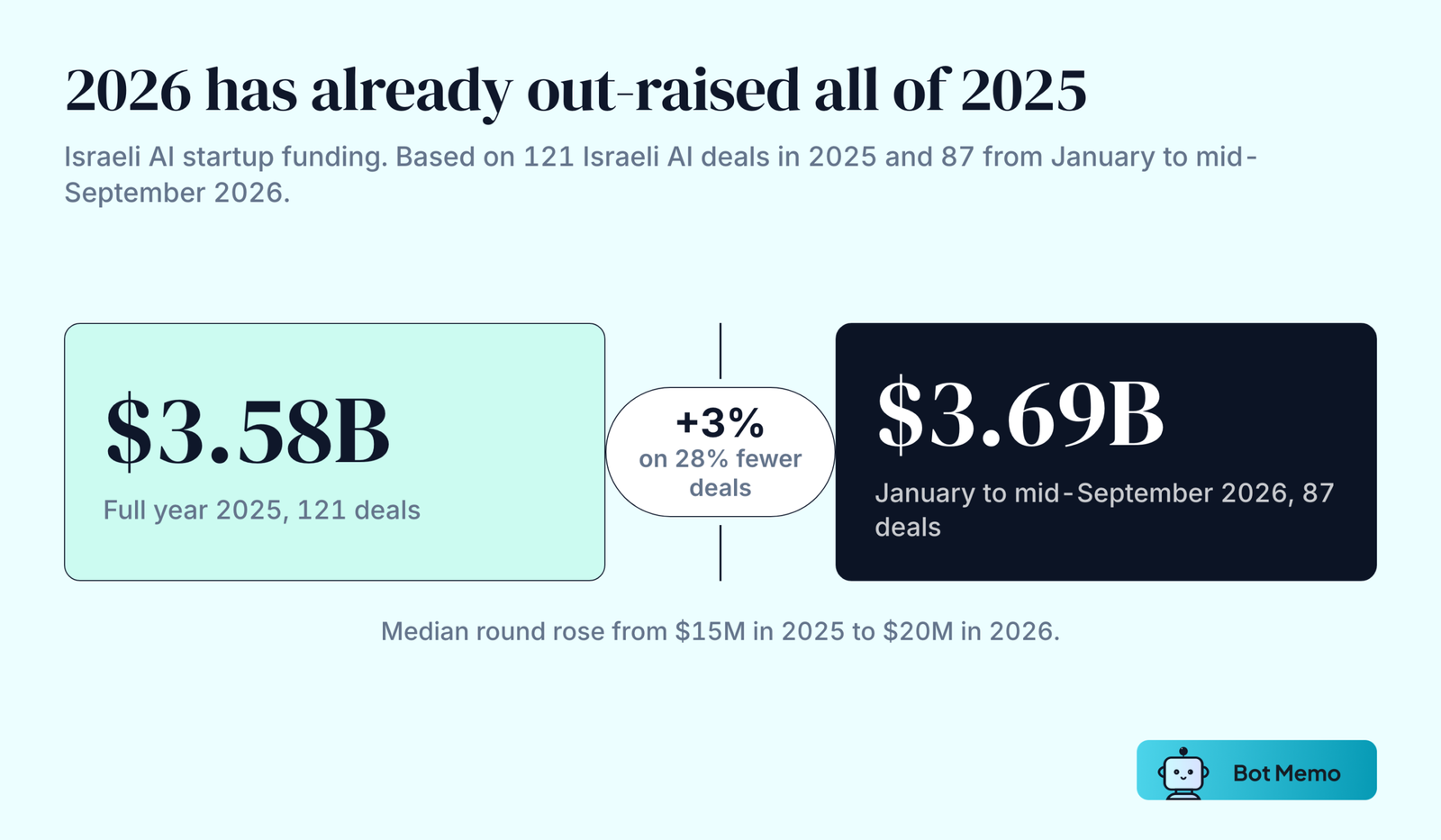
July 2026 alone carried 14 rounds worth $802.0M, with Xsight Labs taking $300.0M of it at a $2.8B valuation. Zenity’s $125.0M Series C in early August continued the security pattern, and September has 12 rounds worth $517.0M so far, including HiBob’s $166.0M. DriveNets’ $410.0M Series D in June is the largest Israeli AI round of the year and of the whole period since 2023.
Security’s share of Israeli funding fell to 29.7% in 2026 from 47.6% in 2025. Infrastructure and semiconductor work took the difference, through DriveNets, Decart and Xsight Labs. The concentration is loosening at the top of the market while the deal count runs a little behind last year’s pace.
Most Active Investors in Israeli AI
| Investor | Deals | Participated in deals worth |
|---|---|---|
| Team8 | 21 | $585.0M |
| TLV Partners | 20 | $492.5M |
| Glilot Capital Partners | 19 | $694.0M |
| Bessemer Venture Partners | 17 | $1.27B |
| Lightspeed Venture Partners | 17 | $1.25B |
| Insight Partners | 16 | $661.5M |
| Grove Ventures | 14 | $394.0M |
| Jibe Ventures | 14 | $365.0M |
| Entrée Capital | 14 | $334.0M |
These are participation counts. A round with six investors counts once for each of them, and the dollar column is the full size of the rounds an investor appeared in, not the amount that investor put in. The columns do not sum to a market total.
The top three are local. Team8, TLV Partners and Glilot Capital Partners appear on 56 distinct Israeli AI rounds between them, and Team8, which builds companies in-house as well as investing, appears on more Israeli rounds than any international fund. The local funds’ rounds average $24.6M to $36.5M. Bessemer and Lightspeed appear on fewer deals at much larger sizes, participating in deals worth $1.27B and $1.25B across 17 rounds each, averages of $74.9M and $73.4M. For global rankings, see our most active AI investors page.
How Israel Compares With Other AI Markets
Israel is not trying to be a general-purpose AI market and the numbers say it is not one. Artificial intelligence companies based in Israel take 1.08% of global AI capital, have raised no single round above $410.0M since 2023, and put a third of everything they raise into security software. The United States and China both fund model labs with single rounds above $1B. Israel’s tech sector funds the layer that sells to a security operations centre, and increasingly the network and chip layer underneath AI data centers.
That focus is what makes the market legible. An investor scanning AI startups in Israel is mostly scanning one category, priced at a $15.0M median, concentrated in one city, and most often backed by three local funds.
AI Companies in Israel: Common Questions
How many AI startups in Israel have raised funding since 2023?
435 rounds from January 2023 to mid-September 2026, worth $12.66B. Deal count held between 112 and 121 a year from 2023 to 2025, and 2026 has 87 so far.
What do artificial intelligence companies in Israel actually build?
Mostly security software. Threat detection, network security, identity management and risk assessment carry four of the nine largest niches. Network and chip infrastructure for AI data centers took the largest rounds of 2026, and health diagnostics and drug discovery form a third cluster at smaller cheque sizes.
What is the average AI funding round in Israel?
The mean is $30.5M and the median is $15.0M, counting rounds with a disclosed amount. The median is the more useful figure, and it rose from $12.0M in 2023 to $20.0M in 2026.
Which sector raises the most in Israel?
Cybersecurity, at $4.31B across 139 deals, or 34.1% of Israeli AI funding. Israel holds 10.2% of global AI cybersecurity funding against 1.08% of AI funding overall.
What was the largest Israeli AI funding round?
DriveNets’ $410.0M Series D in June 2026, followed by Cato Networks’ $359.0M Series G in June 2025 and two $300.0M rounds in 2026, from Decart and Xsight Labs.
Which investors back AI companies in Israel?
Three local funds lead on volume: Team8 on 21 rounds, TLV Partners on 20 and Glilot Capital Partners on 19. Bessemer Venture Partners, Lightspeed Venture Partners and Insight Partners appear on fewer rounds at larger sizes.
Where are Israeli AI companies based?
Tel Aviv accounts for 80.4% of the capital and 345 of 435 rounds. Ra’anana, Ness Ziona, Ramat Gan and Haifa follow well behind.
Methodology
Figures cover AI technology companies headquartered in Israel at the time of each round, announced between January 1, 2023 and September 17, 2026: 435 rounds worth $12.66B. A company that names a headquarters outside Israel when it announces a round counts in that location. Acquisitions, public-company share sales and IPOs are excluded; debt and credit facilities are included and shown in their own stage line. Amounts are converted to US dollars. Medians and means use rounds with a disclosed amount. Companies working across several sectors are counted in each, so sector deal counts sum above 435. Investor rows count participation in a round rather than money deployed.
Research and development spending, headcount and revenue are outside what these figures cover; every number above is money raised. Israel is tracked separately from the Gulf states, so nothing here overlaps our Middle East AI report, which covers the UAE, Saudi Arabia, Qatar, Kuwait, Oman and Bahrain. For wider context see our AI startup funding statistics and the European AI startups list.

About the author
Editorial Staff
The Editorial Staff at Bot Memo is a team of writers, analysts, and AI agents dedicated to mapping the global AI startup ecosystem. Led by Chintan Zalani, the team tracks thousands of funding rounds, classifies companies across verticals, and distills it all into actionable intelligence for investors and founders.