
OpenAI shipped a browser on 21 October 2025 and switched it off on 9 August 2026. Chrome held around two thirds of worldwide browser traffic the whole way through, and finished August 2026 on 69.39%.
That is the AI browser market as it stands. A wave of launches, then a wave of shutdowns and acquisitions, and a market share table that reads the same as it did before any of it started. The real movement happened somewhere else, in crawler traffic and in the browsers that already had the users.
The AI browser statistics below are current as of 3 September 2026.
On this page
- AI Browser Statistics 2026: The Headline Numbers
- Browser Market Share Statistics
- AI Browser Adoption And Search Demand
- AI Browser Market Size Estimates
- AI Agent And Browser Automation Statistics
- AI Browser Traffic Statistics
- AI Browsers And Online Shopping
- Key Takeaways
- Frequently Asked Questions
- Sources And Methodology
AI Browser Statistics 2026: The Headline Numbers
The Figures Worth Knowing First
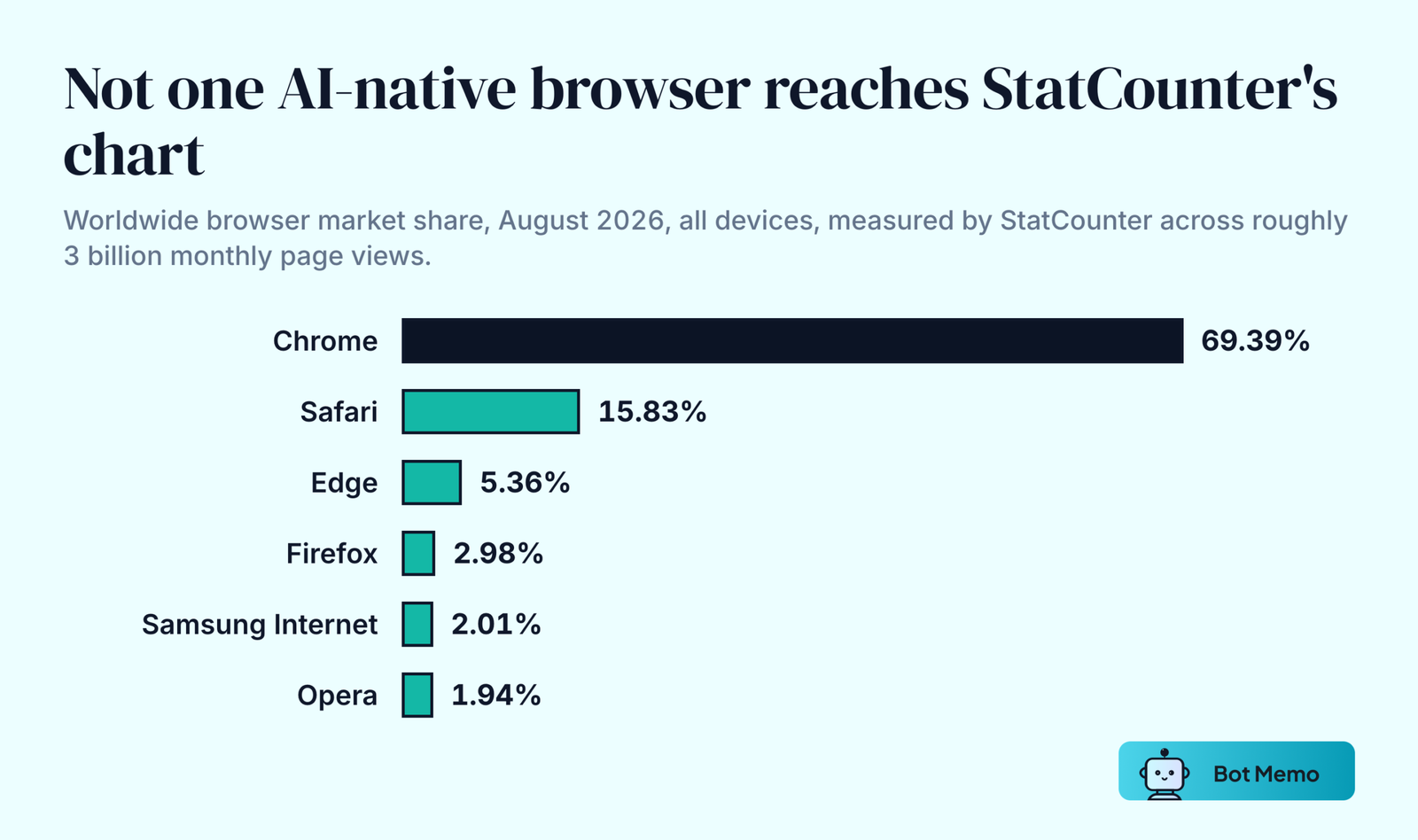
1. Chrome held 69.39% of worldwide browser market share in August 2026, per StatCounter, which measures roughly 3 billion page views a month.
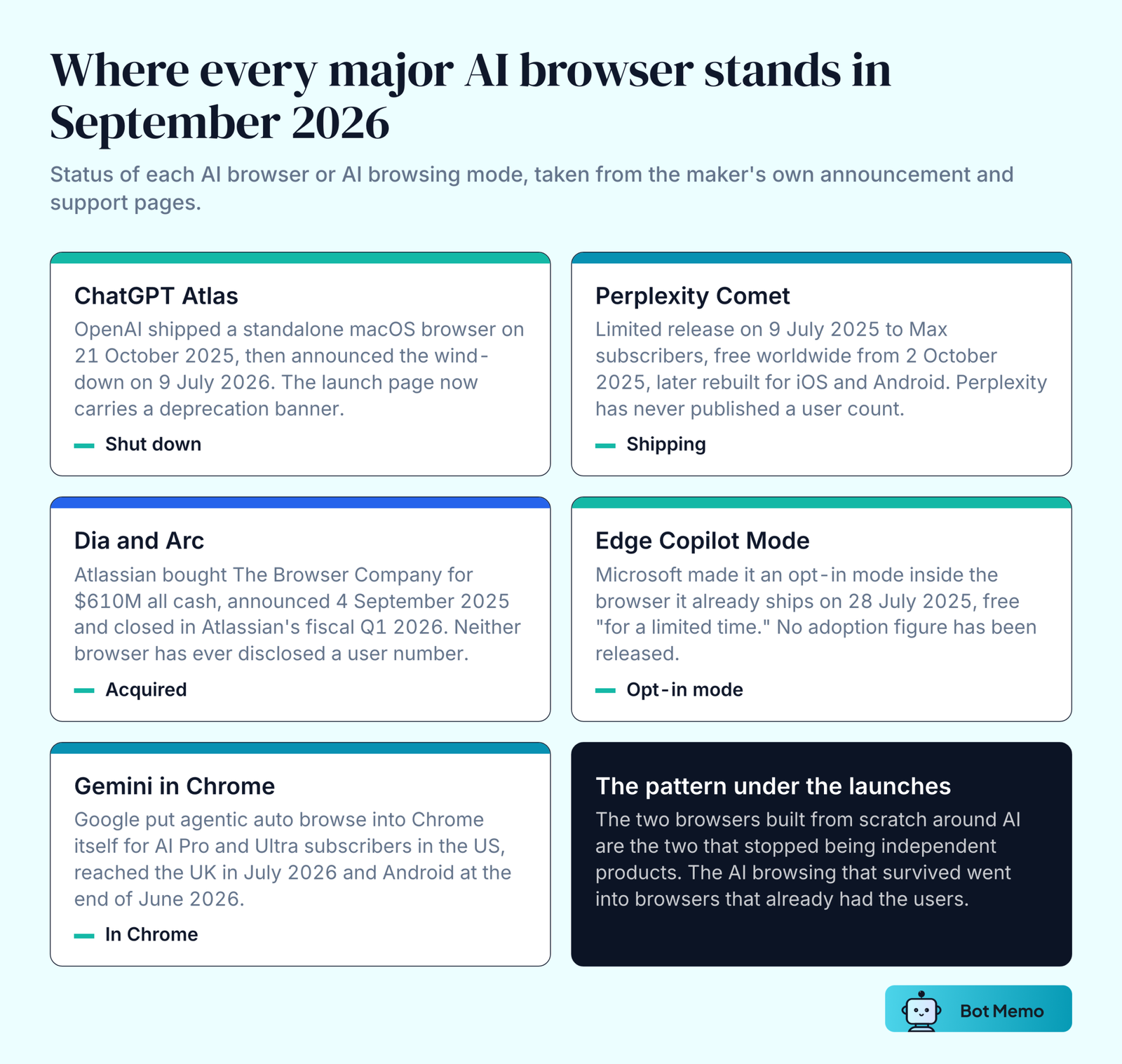
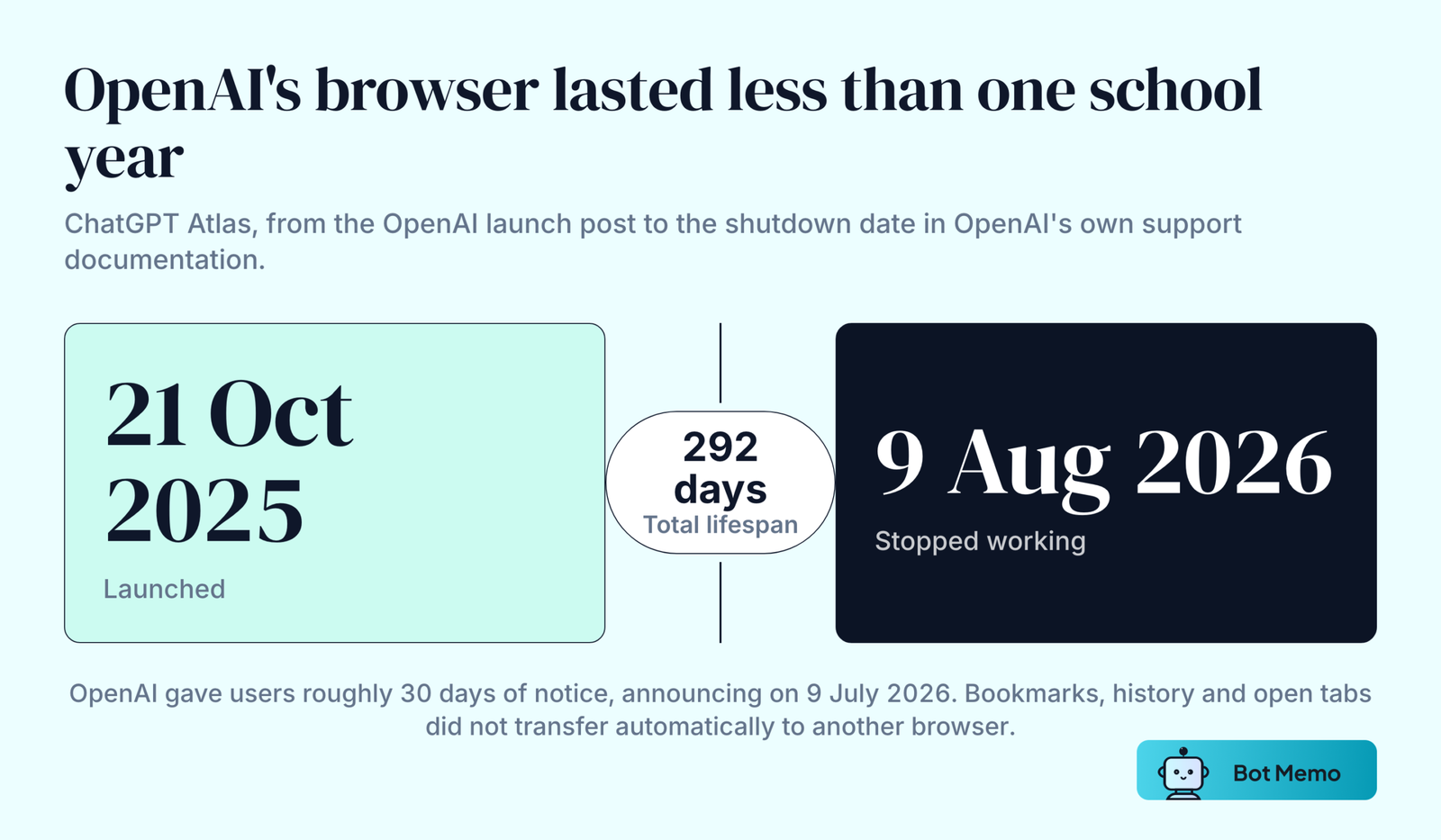
2. ChatGPT Atlas ran for 292 days. OpenAI launched it on 21 October 2025, announced the wind-down on 9 July 2026 and set 9 August 2026 as the date it stopped working.
3. Atlassian paid $610 million in cash for The Browser Company of New York, makers of Arc and Dia, announced 4 September 2025.
4. Perplexity released Comet to Max subscribers on 9 July 2025 and made it free worldwide on 2 October 2025.
5. More than 50% of internet traffic is now non-human, per Cloudflare’s July 2026 network report.
6. Anthropic measured a 23.6% prompt injection attack success rate against browser-using Claude across 123 test cases, before mitigations.
7. US Google searches for “atlas browser” fell from 135,000 in October 2025 to 2,400 in July 2026, a drop of 98.2%.
8. Claude Opus 4.8 completed 20.6% of tasks on OSWorld 2.0, a June 2026 benchmark of 108 long-horizon computer-use workflows.
What No One Has Published
9. Atlas user numbers. OpenAI released no download, daily active or monthly active figure for the browser across its entire 292-day life.
10. Comet user numbers. Perplexity’s own posts say “millions of people now use Comet every day” and attach no figure. The company has published no installed base, DAU or MAU.
11. Dia and Arc user numbers. The Browser Company disclosed none before the acquisition, and Atlassian has disclosed none since.
12. AI browsers’ share of total browser traffic. No measurement panel publishes it. StatCounter does not break Atlas, Comet or Dia out separately, and Chromium-based browsers that report a Chrome user agent land inside Chrome’s number.
Browser Market Share Statistics
Global Browser Market Share In August 2026
13. Chrome: 69.39% of worldwide traffic across all devices (StatCounter, August 2026).
14. Safari: 15.83%.
15. Edge: 5.36%.
16. Firefox: 2.98%.
17. Samsung Internet: 2.01%.
18. Opera: 1.94%.
Where AI Browsers Sit In The Rankings
19. Nowhere on that list. Atlas, Comet, Dia and Arc have never appeared as named entries in StatCounter’s worldwide browser table.
20. StatCounter counts page views, not users, and samples from sites that run its pixel. A browser used heavily by a small professional audience registers faintly even when its users are active.
21. The measured winner of the AI browser wave is Chrome. Google put Gemini into the browser that already held two thirds of the market rather than shipping a second one.
Mobile Browser Statistics
22. Perplexity built Comet for iOS and Android as separate products rather than porting the desktop app, and states in its Android launch post that it “redesigned the mobile web browser” for the platform.
23. Google brought Gemini in Chrome, including auto browse, to Chrome for Android on select devices running Android 12 or higher in the US, starting at the end of June 2026.
24. Atlas never shipped on mobile. OpenAI listed Windows, iOS and Android as “coming soon” at launch and shut the product down before any of them arrived.
AI Browser Adoption And Search Demand
Search Interest Since The Launch Wave
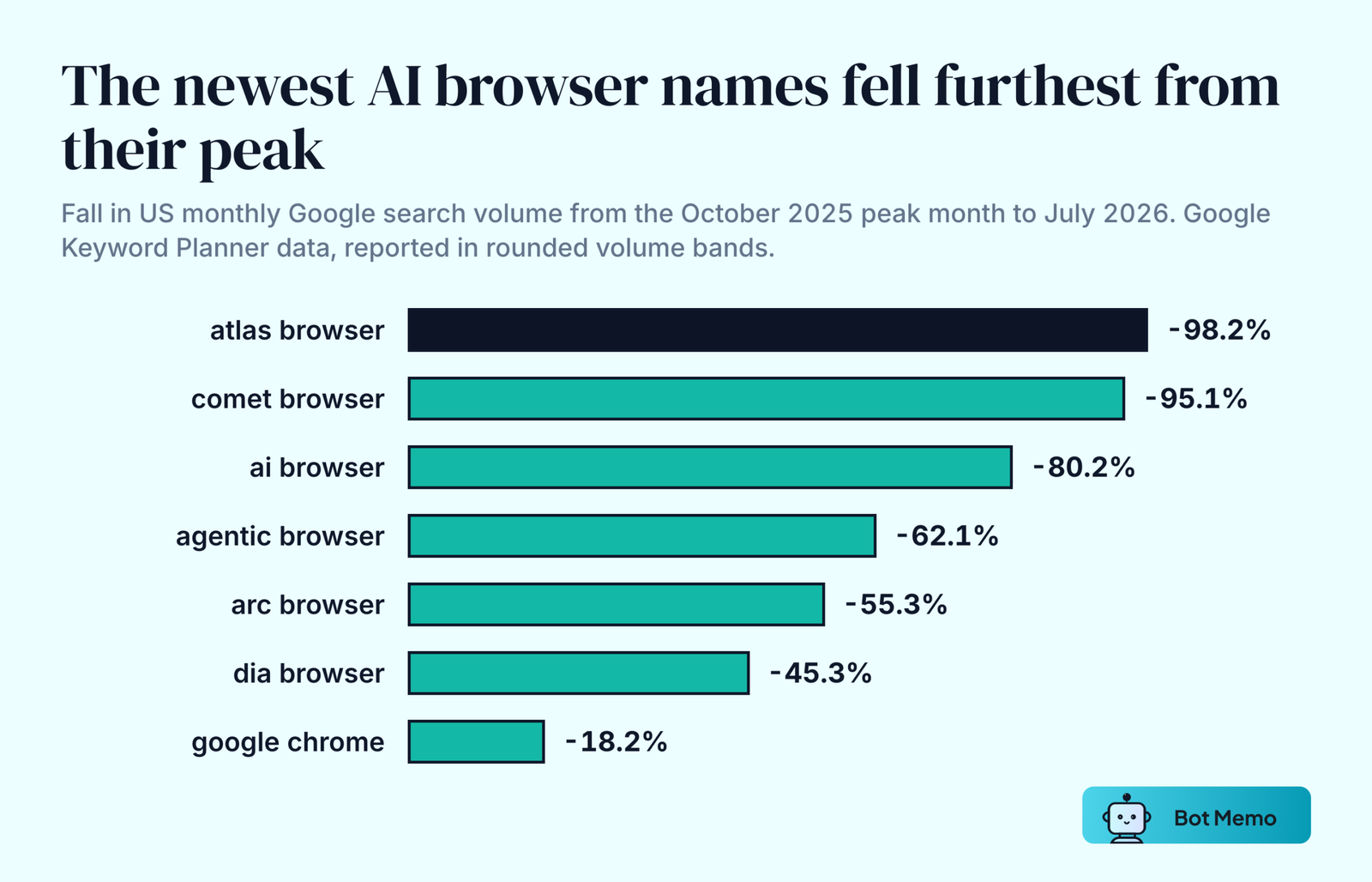
Bot Memo pulled US monthly Google search volume for every major AI browser name from Google’s own Keyword Planner data. The figures come in rounded volume bands, so treat the shape rather than the last digit.
25. “atlas browser” ran at 135,000 US searches in October 2025 and 2,400 in July 2026, down 98.2%.
26. “comet browser” ran at 135,000 in October 2025 and 6,600 in July 2026, down 95.1%.
27. “ai browser” ran at 22,200 in October 2025 and 4,400 in July 2026, down 80.2%.
28. “agentic browser” fell from 1,900 to 720, down 62.1%.
29. “arc browser” fell from 33,100 to 14,800, down 55.3%.
30. “dia browser” fell from 14,800 to 8,100, down 45.3%.
31. “google chrome” fell from 823,000 to 673,000 over the same window, down 18.2%. That is the control. Every AI browser name fell faster, from Dia at 2.5 times the rate to Atlas at 5.4 times.
ChatGPT Atlas From Launch To Shutdown
32. Atlas launched worldwide on macOS on 21 October 2025 to Free, Plus, Pro and Go users, in beta for Business.
33. Agent mode in Atlas launched in preview for Plus, Pro and Business users only, and could not run code, download files, install extensions or reach the file system.
34. OpenAI’s own announcement post now carries the line “Atlas has since been deprecated” above the original text.
35. Users got roughly 30 days of notice. OpenAI’s support page states the planned announcement date was 9 July 2026 and the shutdown 9 August 2026.
36. Bookmarks, browsing history and open tabs did not transfer automatically. OpenAI told users to export bookmarks to an HTML file and import them into Chrome.
Perplexity Comet, Dia And Copilot Mode
37. Perplexity reported that when its users first downloaded Comet, “the number of questions they asked increased by 6-18X in the first day.” That is the only usage figure the company has attached to the browser.
38. Comet Plus costs $5 a month standalone and is bundled into Perplexity Pro and Max. Perplexity says it distributes that revenue to participating publishers, minus its compute costs.
39. Comet Plus allocates publisher revenue across three traffic types: human visits, search citations and agent actions.
40. Microsoft took the opposite route. Copilot Mode launched on 28 July 2025 as an opt-in mode inside Edge, in every Copilot market, rather than a separate download. Microsoft made it free “for a limited time,” has not said when that ends, and has published no adoption figure for it.
41. Google’s Chrome auto browse runs on Gemini 3 and is in preview for Google AI Pro and Ultra subscribers in the US. Gemini in Chrome reached UK desktop users on 14 July 2026.
AI Browser Market Size Estimates
What The Market Research Firms Project
42. The figure in circulation is $76.8 billion by 2034, from $4.5 billion in 2024, a 32.8% compound annual growth rate. It comes from Market.us, a commercial market-research publisher.
43. That projection carries the whole “AI browser market size” conversation. It ranks on the first page of Google for the term and gets requoted by the write-ups above and below it. It is a vendor forecast sold as a report, not a measurement.
44. No AI browser maker has published revenue for its browser. Comet Plus at $5 a month is the one price attached directly to an AI browsing product, and Perplexity says most of it goes to publishers. Chrome auto browse sits behind a Google AI subscription, and Edge Copilot Mode is free for now.
Why No Panel Measures AI Browser Share
45. StatCounter, the source the whole category cites for browser share, has no Atlas, Comet, Dia or Arc row. The honest statement is that their combined share sits below its reporting threshold.
46. The one confirmed dollar figure in the category is an exit, not a market. Atlassian’s $610 million for The Browser Company is the largest disclosed transaction, and it bought a team and two browsers with no published user count.
47. Any “AI browsers hold X% of the market” claim traces back to a modelled estimate. Ask which panel measured it and the answer is that none did.
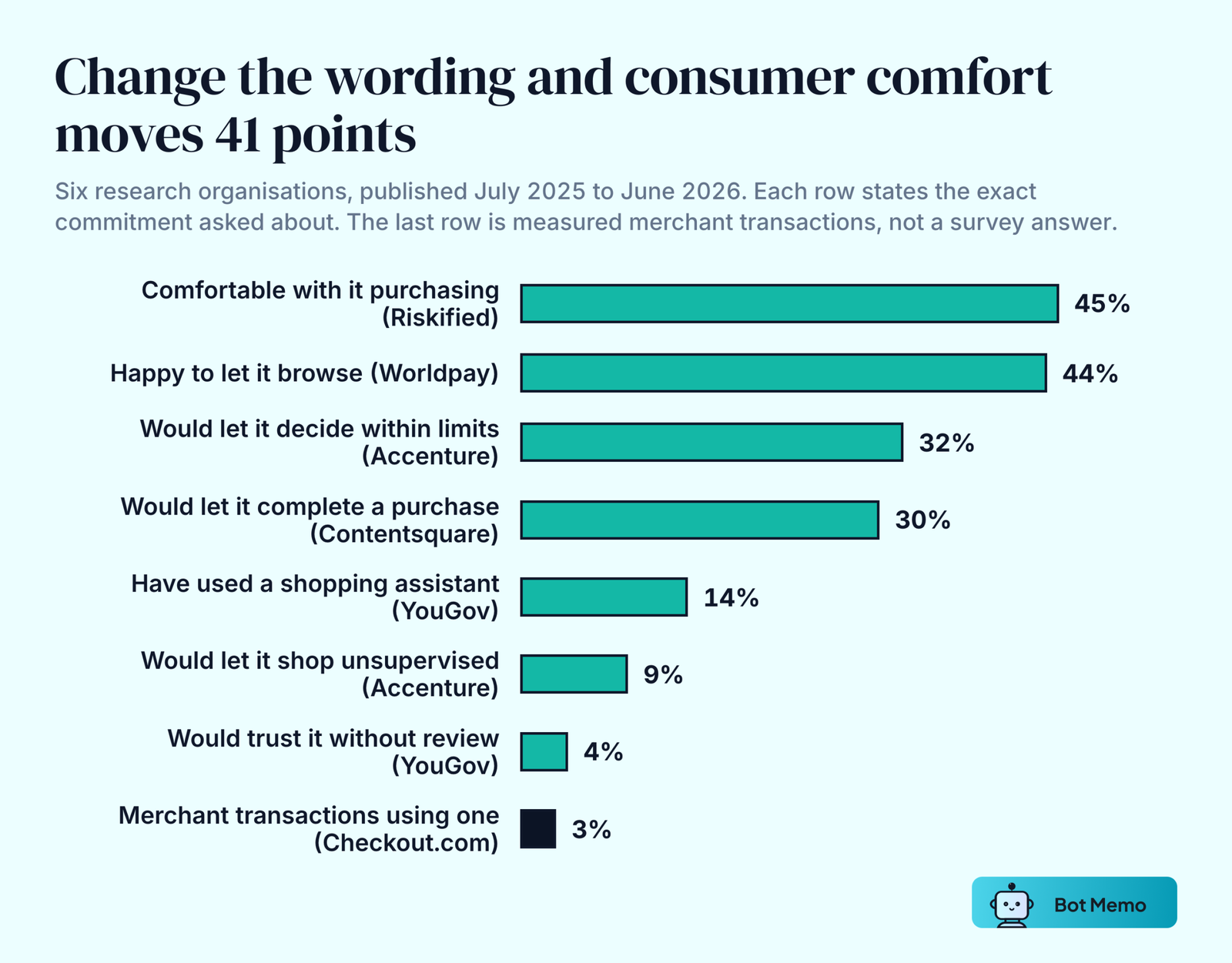
AI Agent And Browser Automation Statistics
Benchmark Scores For Browser Agents
48. The original WebArena paper put the best GPT-4 agent at 14.41% end-to-end task success against a human rate of 78.24% across 812 tasks.
49. OSWorld’s April 2024 publication put the best evaluated model at 12.24% against a human rate of 72.36% across 369 tasks.
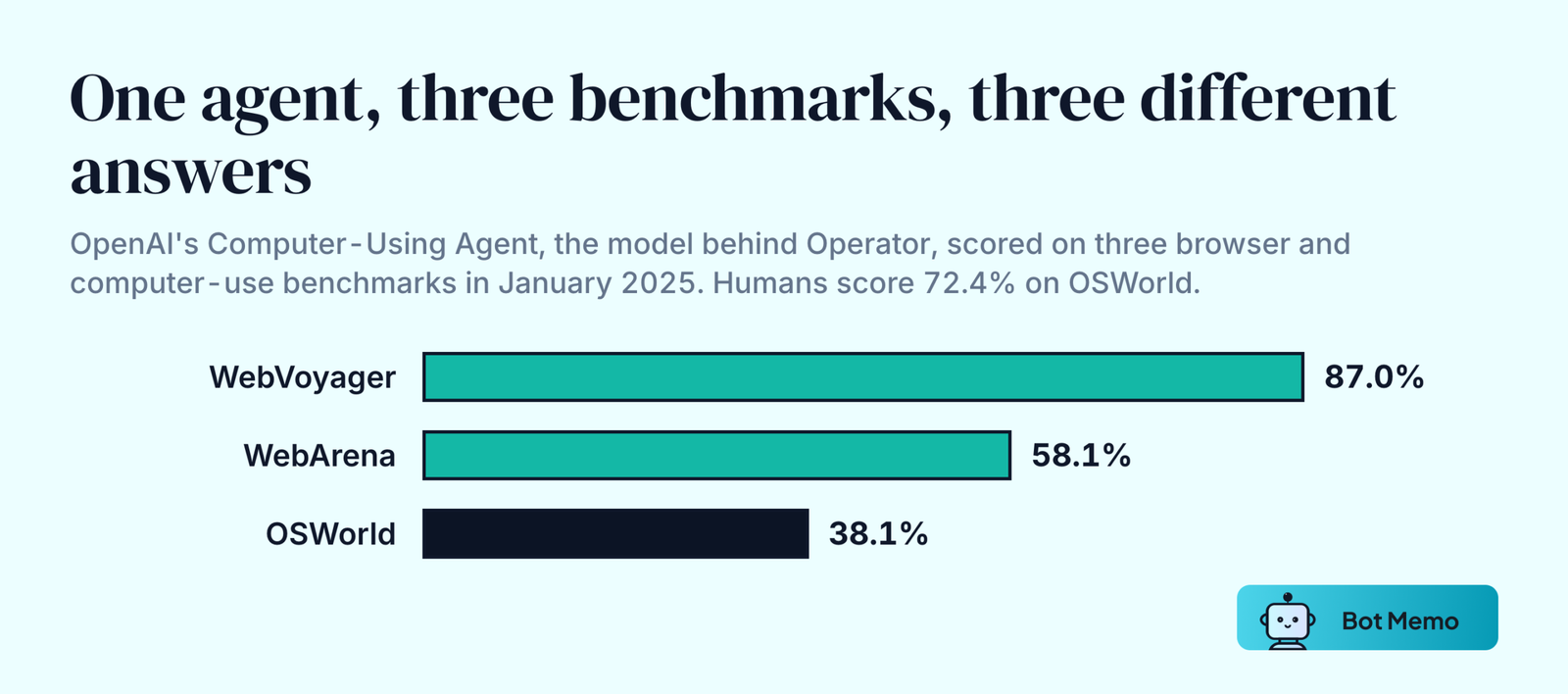
50. OpenAI’s Computer-Using Agent, the model behind Operator, reported 87% on WebVoyager, 58.1% on WebArena and 38.1% on OSWorld in January 2025.
51. OSWorld 2.0, published in June 2026, raised the difficulty to 108 long-horizon workflows. Claude Opus 4.8 with maximum thinking scored best at 20.6% full task completion and a 54.8% partial score. GPT-5.5 plateaued near 13%.
52. On REAL, a benchmark of 112 tasks running against deterministic replicas of real e-commerce, travel and professional sites, frontier models reached at most 41% success.
53. On ShoppingBench, a benchmark built around e-commerce shopping intent, the best model scored below 50%.
How Long Browser Agents Take
54. OSWorld-Human measured leading agents taking 2.7 to 4.3 times more steps than the human-determined path needs, with large model calls for planning, reflection and judging accounting for most of the latency.
55. Each successive step in a task can take about three times as long as steps at the start, so a long task degrades as it runs.
Prompt Injection And Browser Agent Security
56. Anthropic’s own red team measured a 23.6% attack success rate across 123 test cases covering 29 prompt-injection scenarios, before mitigations were applied.
57. Anthropic capped the first Claude for Chrome pilot at 1,000 Max-plan users. Three months of testing later, on 24 November 2025, it opened to all Max subscribers, and on 18 December 2025 to every paid plan.
58. Brave’s security team published working indirect prompt injection attacks against Perplexity Comet, including one triggered by clicking the browser’s own “Summarize the current webpage” button, and a follow-up showing the same class of attack delivered through screenshots.
59. Brave’s conclusion after the second round was that indirect prompt injection “is not an isolated issue, but a systemic challenge facing the entire category of AI-powered browsers.”
60. OpenAI shipped Atlas carrying the same warning in its launch post. Agents “are susceptible to hidden malicious instructions,” and “our safeguards will not stop every attack.”
AI Browser Traffic Statistics
Crawl To Refer Ratios
61. Anthropic’s crawl-to-refer ratio hit 500,000:1 at points in 2025, then settled between 25,000:1 and 100,000:1, per Cloudflare’s 2025 year in review.
62. Anthropic’s Claude crawled about 38,000 pages per HTML referral in July 2025, down from 286,930:1 in January 2025, after Anthropic added web search and citations.
63. OpenAI’s ratio reached 3,700:1 in March 2025. Perplexity ran the lowest of the major platforms. Google started just over 3:1 and climbed to 30:1 by April.
What Share Of Bot Traffic Is AI
64. More than 50% of internet traffic is now non-human, per Cloudflare’s July 2026 report.
65. 52% of crawler requests were for AI training as of June 2026, up from 22% in spring 2025.
66. Googlebot generated over 28% of verified bot traffic in 2025, more than every AI crawler combined. GPTBot followed at about 7.5% and Bingbot at 6%.
67. AI “user action” crawling, meaning bots executing tasks for an active user, grew more than 15 times over 2025.
68. AI bots made up 47.9% of all commerce traffic across Akamai’s global network as of December 2025, per research Akamai published on 15 July 2026.
69. Fastly reported AI requests on its network growing about 30% between January and May 2026, roughly 6.5 times faster than human traffic, and split 85% crawlers to 15% fetchers in May.
70. Under 9% of human requests need an origin fetch on Fastly’s network, against 51% of AI requests. Agent traffic is far more expensive to serve.
How Publishers Responded
71. AI crawlers were the most frequently fully disallowed user agents in robots.txt files in 2025, with GPTBot, ClaudeBot and CCBot drawing the most full-site blocks.
72. Cloudflare flipped AI crawler access from opt-out to opt-in on 1 July 2025 and asks new domains at registration whether AI bots may scrape. Cloudflare serves about 20% of the web.
73. From 15 September 2026, Cloudflare blocks training and agent bot categories by default on ad-monetised pages for new domains, while leaving search crawlers allowed.
74. Google still accounts for about 88% of referral traffic, so the discovery side of the trade has barely moved.
75. Some of the most heavily crawled site categories have seen human traffic fall as much as 40% in under a year.
AI Browsers And Online Shopping
Consumer Willingness To Let An Agent Buy
76. 44% of US adults said they would be happy to let an AI agent browse on their behalf, rising to 59% among 18 to 34 year olds (Worldpay, 8,000 global consumers, published November 2025).
77. Only 6% would trust an AI to buy without checking in first, in the same study. 44% want to review every purchase.
78. 30% of US consumers said they would let an AI agent complete a purchase (Contentsquare with Pollfish, 1,300 US consumers, December 2025). 76% still start shopping with traditional search.
79. 45% of consumers were comfortable with AI agents purchasing on their behalf, the inverse of the 55.0% who were not (Riskified, 2,000 US and UK online purchasers, April 2026).
80. 32% would let an agent make the final purchase decision within set boundaries, and only 9% would let one shop fully autonomously (Accenture, 25,590 consumers across 16 countries, June 2026).
81. 14% of Americans have used an AI shopping assistant, against 43% who are aware of them. Gen Z runs highest at 24%, baby boomers lowest at 7% (YouGov, 1,414 US adults, July 2025).
82. 4% would trust AI to complete a purchase without their final review, in the same YouGov panel.
Where The Surveys Disagree
83. The spread runs from 45% to 4% on what looks like the same question. “Happy to let it browse,” “willing to let it complete a purchase” and “would trust it without review” are three different commitments, and the wording moves the answer by 41 points.
84. Riskified recorded comfort with agent purchasing falling from about 70% in Q4 2025 to 45% in Q1 2026. A swing that large in one quarter is a question-wording signal as much as a behaviour signal.
85. Pew Research Center found about half of US adults use AI chatbots and 42% use them for information searching, in a survey of 5,119 US adults fielded February 2026. Pew’s report carries no shopping or payment-trust figures.
86. Only 3% of merchant transactions currently involve an AI agent, against 89% of merchants saying they are preparing for agentic commerce (Checkout.com, June 2026).
What The Measured Data Shows
87. AI-referred traffic to US retail sites was up 62% year over year in July 2026, and up 1,219% against the October 2024 baseline (Adobe Analytics).
88. That traffic converted 60% better than non-AI traffic, the eleventh consecutive month AI conversion pulled ahead. Visitors spent 59% more time on site, added to cart at a 28% higher rate and bounced 33% less.
89. Adobe’s monthly growth rate is decelerating even as the cumulative multiple climbs. AI traffic grew 138% year over year in May 2026 and 62% in July.
90. Salesforce reported agentic search growing 200% year over year in July 2026, with AI-chat-referred traffic up between 150% and 428% across the quarters it measured.
91. Amazon sued Perplexity in November 2025 over Comet’s agent shopping on customer accounts. A federal judge granted a preliminary injunction on 9 March 2026. The Ninth Circuit vacated it on 4 August 2026, holding that the user, not Perplexity, is the party accessing Amazon’s computers.
92. Dow Jones’s suit against Perplexity in the Southern District of New York is still in discovery, with a pretrial conference set for 14 December 2026 and no ruling on the merits.
Key Takeaways
- The AI-native browser got absorbed. OpenAI shut Atlas down and folded browser agents into ChatGPT, Atlassian bought Arc and Dia, and Google put agentic browsing inside Chrome. Perplexity’s Comet is the only one still shipping as an independent product.
- Nobody publishes user numbers for any of them. Every “AI browsers have X users” claim in circulation traces to a model, an estimate or a company line without a figure attached.
- Search demand for the category peaked in October 2025 and has not recovered. Atlas and Comet both lost more than 95% of their US search volume by July 2026, while Chrome lost 18.2%.
- Agents are still well under half reliable on realistic tasks. The best score on OSWorld 2.0’s long-horizon workflows is 20.6%, and the best on real-website replicas is 41%, even as narrower benchmarks report 87%.
- The measurable change is on the infrastructure side, not the browser side. Non-human traffic passed half of all internet traffic, AI training crawling reached 52% of crawler requests, and from 15 September 2026 Cloudflare blocks training and agent bots by default on ad-monetised pages for new domains.
Frequently Asked Questions
What Is An AI Browser?
A browser with a language model built into the interface rather than bolted on as an extension, able to read across open tabs and, in the agentic versions, click and type on the user’s behalf. The category covers standalone products like Perplexity Comet, AI modes inside existing browsers like Edge Copilot Mode, and agentic features inside Chrome.
How Many People Use AI Browsers?
No maker has published a number. Perplexity says millions use Comet daily without giving a figure, OpenAI never disclosed Atlas usage, and The Browser Company never disclosed Dia or Arc. No measurement panel breaks them out either.
What Is The AI Browser Market Share In 2026?
Below StatCounter’s reporting threshold. Chrome held 69.39% of worldwide browser traffic in August 2026, Safari 15.83% and Edge 5.36%. No AI-native browser appears as a named entry.
Is ChatGPT Atlas Still Available?
No. OpenAI announced the deprecation on 9 July 2026 and Atlas stopped working on 9 August 2026. Browser-based agentic work moved into the ChatGPT desktop app and the ChatGPT Chrome extension.
Are AI Browsers Safe To Use?
They carry a risk ordinary browsers do not. Anthropic measured a 23.6% prompt injection success rate against its own browser agent before mitigations, Brave published working attacks against Comet, and OpenAI’s own Atlas launch post said its safeguards would not stop every attack. Agent modes that can act on logged-in sites raise the stakes further.
How Good Are AI Browser Agents At Real Tasks?
Better than in 2024, still unreliable. The best agent completes 20.6% of OSWorld 2.0’s long-horizon workflows and at most 41% of tasks on deterministic replicas of real shopping and travel sites. Narrower benchmarks report much higher numbers on much shorter tasks.
Do AI Browsers Send Traffic To Publishers?
Very little relative to what they take. Anthropic’s crawl-to-refer ratio settled between 25,000:1 and 100,000:1 in 2025, and Google still accounts for about 88% of referral traffic. Cloudflare begins blocking training and agent bots by default on ad-monetised pages for new domains from 15 September 2026.
Sources And Methodology
Every figure on this page carries its source and its date, grouped by source class. Product launch dates, prices, availability and shutdown dates come from the maker’s own announcement or support documentation.
Network traffic figures come from the operator that measured them, named in the text. Benchmark scores come from the paper, leaderboard or vendor model card that published them, with the model and date attached. Survey figures carry the research organisation, the sample and the fielding or publication date.
Primary sources used: OpenAI’s ChatGPT Atlas launch post and its Atlas deprecation support article; Perplexity’s Comet, Comet Plus and Comet for Android posts; Anthropic’s Claude for Chrome announcement; Microsoft’s Copilot Mode launch post; Google’s Chrome, Gemini in Chrome and auto browse announcements; Atlassian’s acquisition announcement; StatCounter Global Stats; Cloudflare’s 2025 Radar year in review, its crawl-to-click research and its July 2026 network report; Akamai and Fastly network reporting; Adobe Analytics and Salesforce commerce data; the WebArena, OSWorld, OSWorld 2.0, OSWorld-Human, REAL and ShoppingBench papers on arXiv; Brave’s published prompt-injection research; Pew Research Center; Worldpay, Contentsquare, YouGov, Riskified, Accenture and Checkout.com survey releases; and the court records in Dow Jones v. Perplexity and Amazon v. Perplexity.
Bot Memo’s own contribution is the search demand series. US monthly Google search volume for each browser name was pulled from Google Keyword Planner data for October 2025 and July 2026. Keyword Planner reports volume in rounded bands rather than exact counts, so the percentage changes describe the shape of the fall rather than a precise measurement.
Exclusions: several widely circulated figures were left out because no primary source carries them. There is no published figure for AI browsers’ share of global browser traffic, no published Atlas or Comet user count, and no traceable survey behind the “24% of consumers are comfortable with AI agents shopping for them” line that appears across the category.
Ten-year market-size projections are labelled as the commercial research publications they are. Where a number could only be found on an aggregator citing another aggregator, it was dropped.
Related Bot Memo research: ChatGPT statistics, OpenAI statistics, Google Gemini statistics, AI SEO statistics, AI cybersecurity statistics and the AI agent market map.

About the author
Editorial Staff
The Editorial Staff at Bot Memo is a team of writers, analysts, and AI agents dedicated to mapping the global AI startup ecosystem. Led by Chintan Zalani, the team tracks thousands of funding rounds, classifies companies across verticals, and distills it all into actionable intelligence for investors and founders.