
Data: Primary-source court filings, regulatory instruments, company disclosures, and academic research on the generative AI art market
AI art statistics for 2026 now tell a very different story than adoption charts alone suggest. On March 2, 2026, the U.S. Supreme Court denied certiorari in Thaler v. Perlmutter, leaving intact the D.C. Circuit holding that the Copyright Act requires human authorship. Adobe has disclosed that Firefly generated 24 billion assets since launch. And the Hollywood studios behind the copyright case against Midjourney are two months from a summary-judgment deadline.
Adoption is no longer the story. Litigation and labor are.
On this page
- Key AI Art Statistics for 2026
- Copyright and Legal Rulings in 2026
- Disney, Universal, and the Midjourney Lawsuit
- Market Size and Growth Trajectory
- How Many AI Images Are Generated Each Day
- Creator Adoption and Tool Usage
- Economic Impact on Illustrators and Designers
- Midjourney by the Numbers
- What to Watch for the Rest of 2026
- Frequently Asked Questions
- Methodology
Key AI Art Statistics for 2026
Three shifts define AI art in 2026: a settled U.S. authorship doctrine after the Supreme Court cert denial, the largest copyright case in generative AI history heading toward summary judgment, and creator adoption above 85% on two separate surveys.
Market Size at a Glance
The global AI image generator market was $349.6 million in 2023 and an estimated $406.4 million in 2024, per Grand View Research, with a projection to $1.08 billion by 2030 at a 17.7% compound annual growth rate (CAGR). North America held 40.34% of that market in 2025, and 41.00% of the AI video generator market, per Fortune Business Insights.
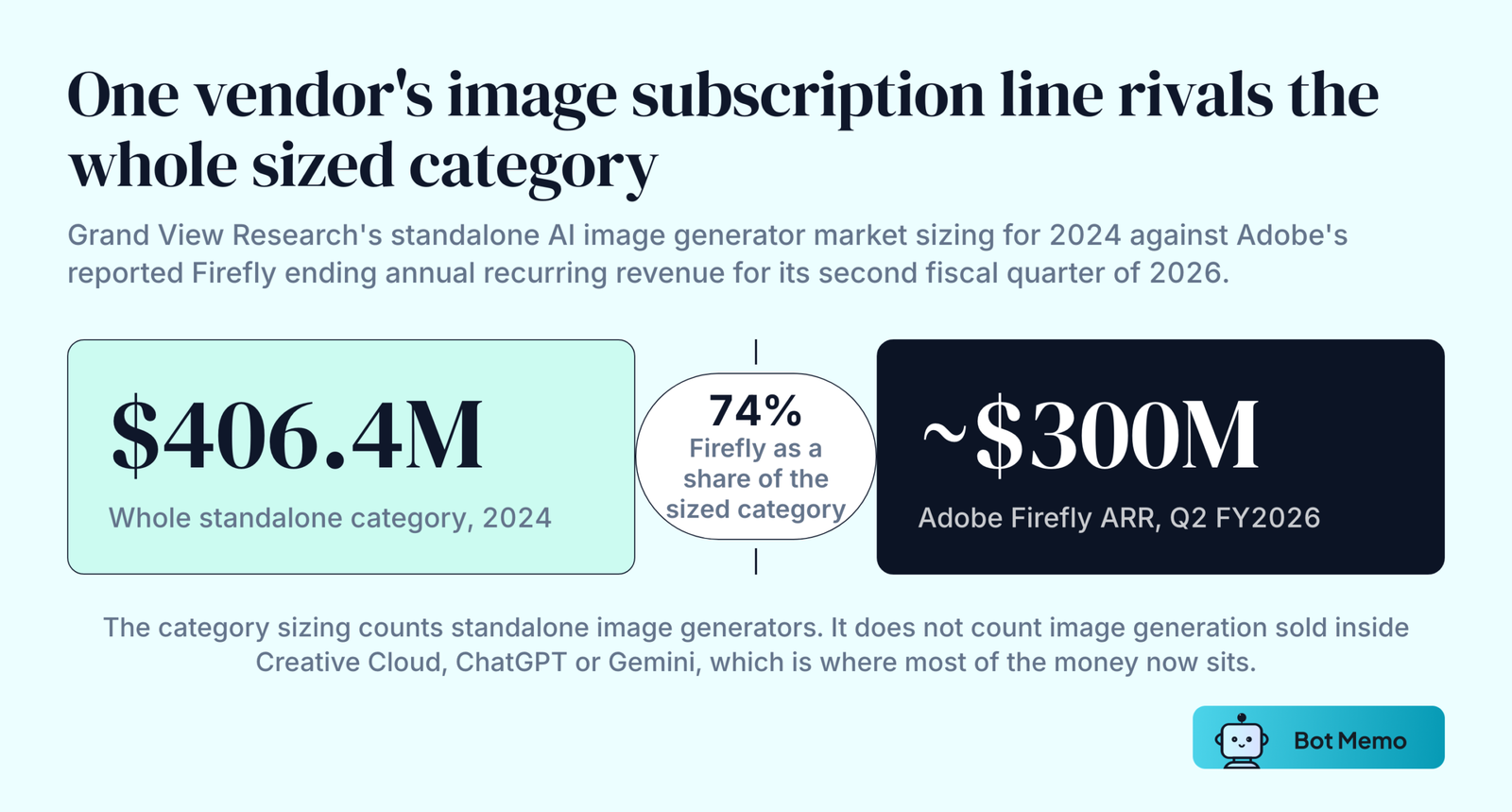
Hold that number against a single vendor’s results. Adobe reported Firefly ending annual recurring revenue approaching $300 million in its second fiscal quarter of 2026, and AI-first ARR above $500 million, triple the prior year. One company’s image-AI subscription line is now within reach of the entire standalone category as the research firms size it.
Volume at a Glance
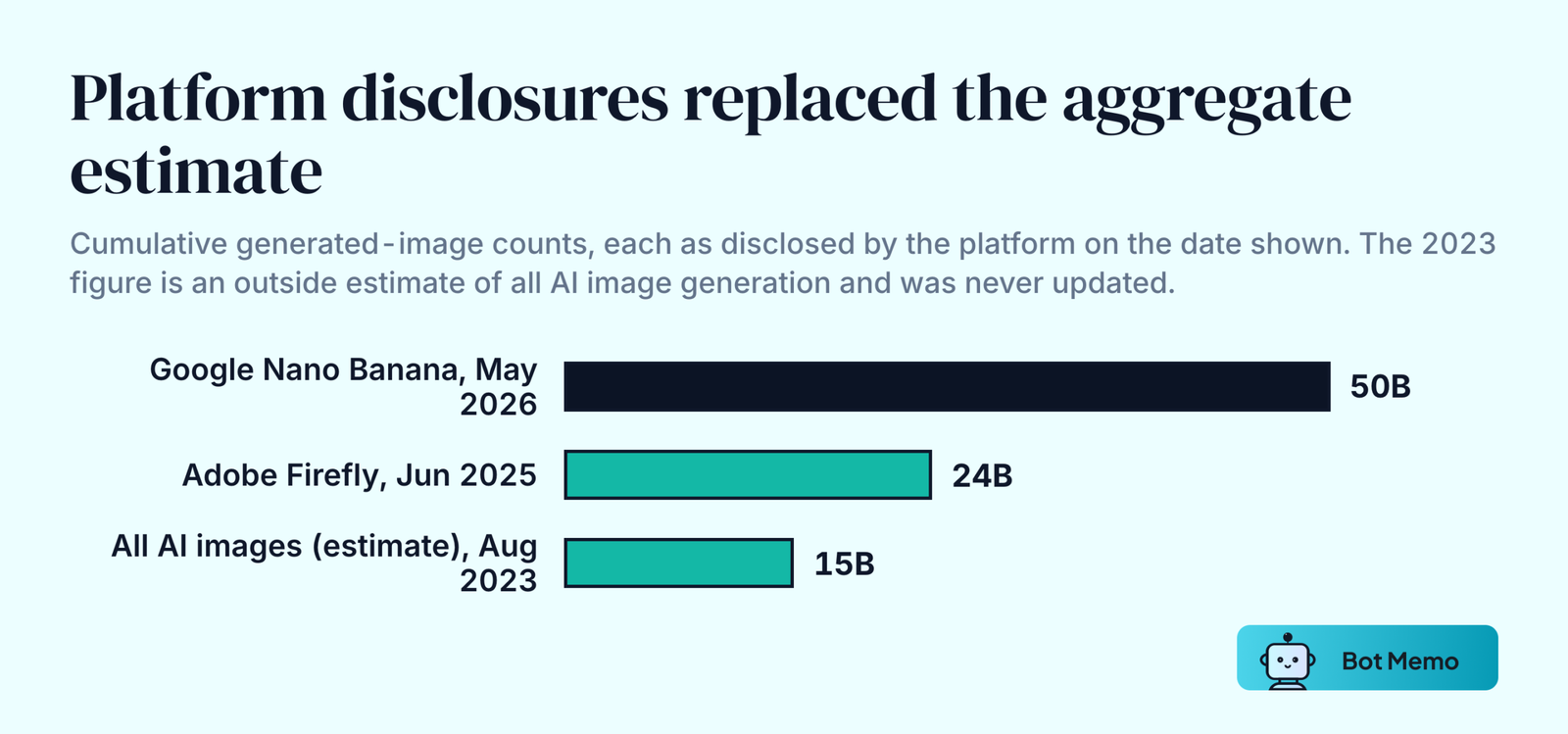
The generation counts dwarf the revenue figures. Adobe’s Firefly reached 24 billion cumulative generated assets by June 2025. OpenAI’s GPT Image 1 generated 700 million images in the week after its March 25, 2025 launch. At Google I/O in May 2026, Sundar Pichai said more than 50 billion images had been generated with the Nano Banana models since their August 2025 launch, against a Gemini app that had passed 900 million monthly users.
Adoption Against Labor
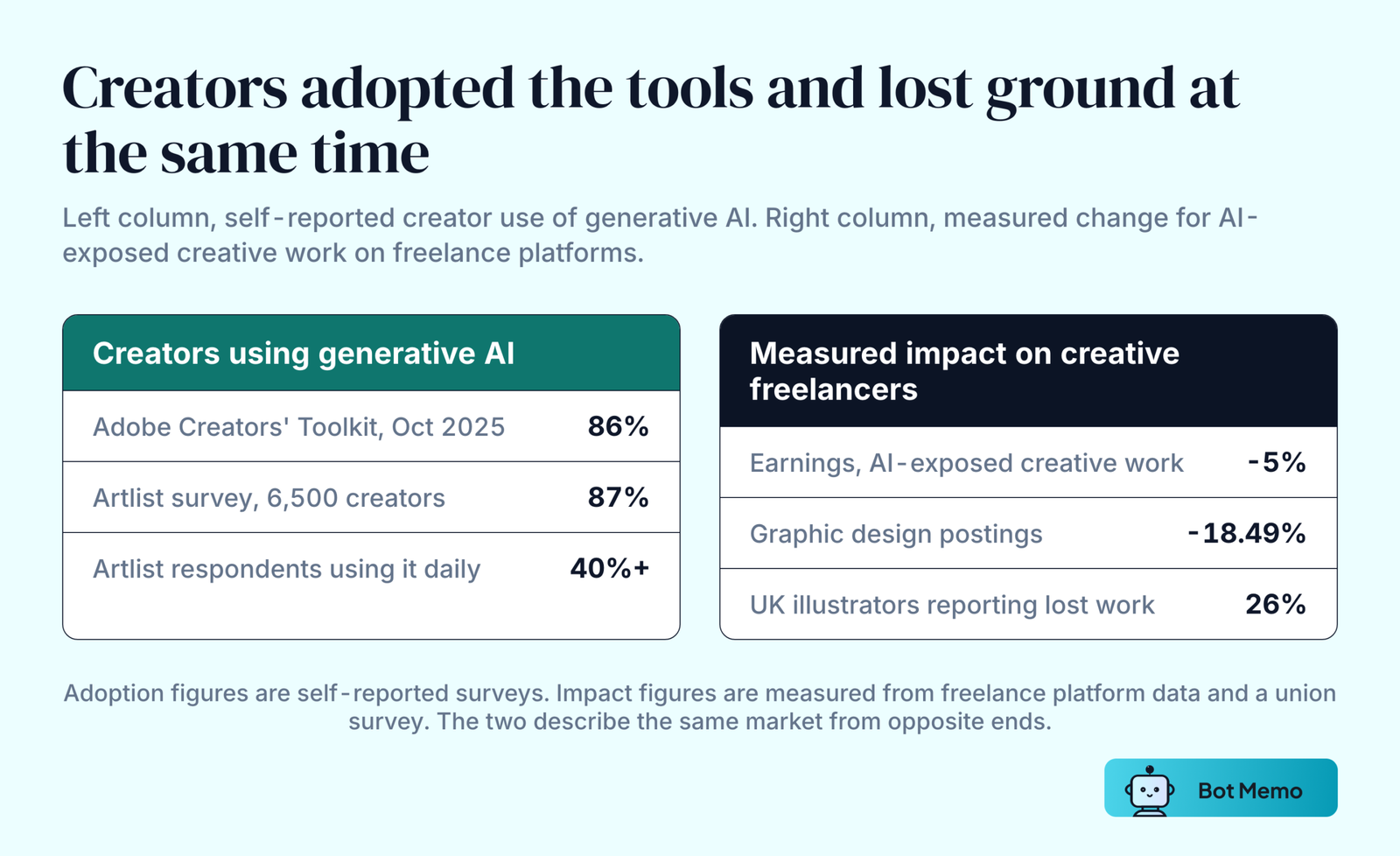
On creator workflows, 86% is the number to hold in mind. The Adobe Creators’ Toolkit Report (October 2025) put global creator use of generative AI at 86%. A separate Artlist survey of 6,500 creators put it at 87%, with 40%+ using AI daily.
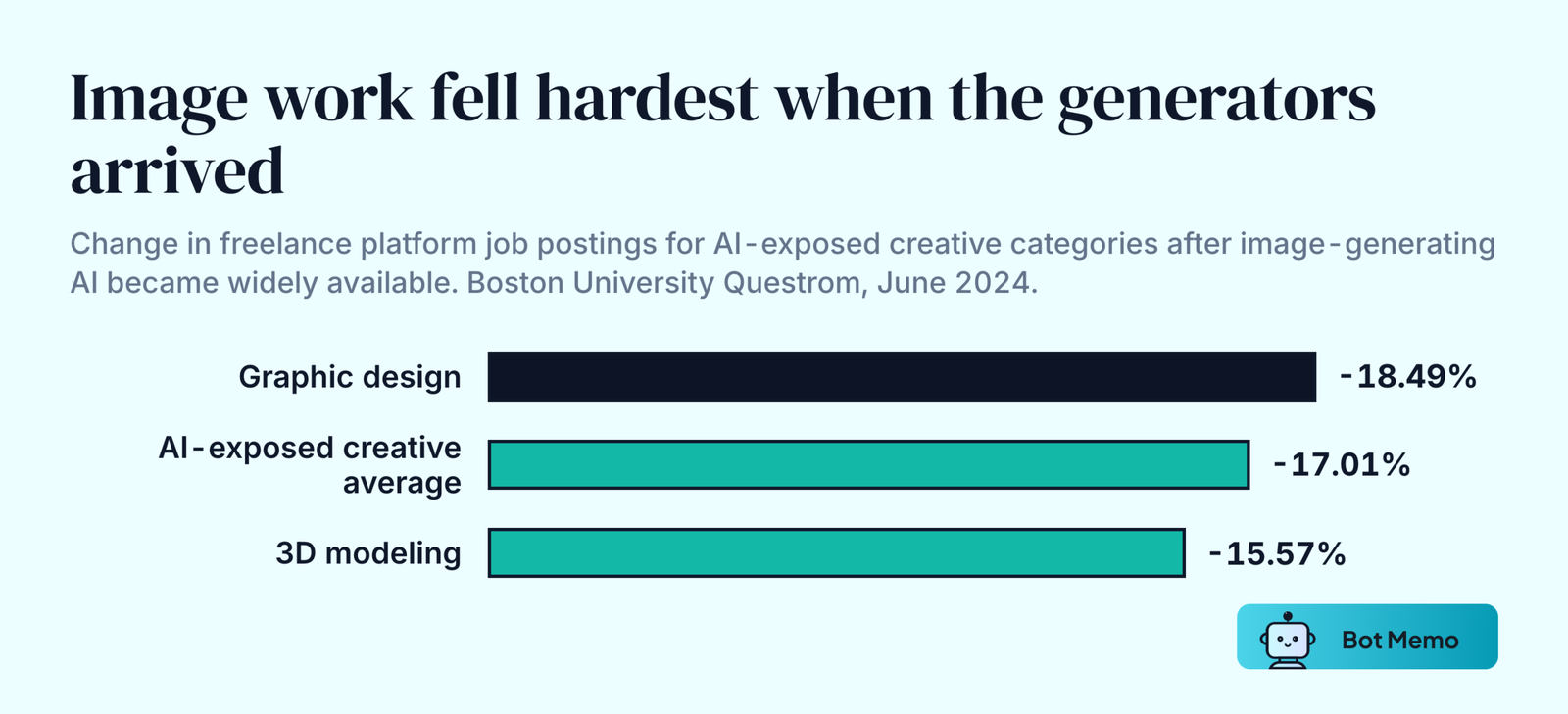
Now read those adoption numbers against the labor data. Of UK illustrators surveyed by the Society of Authors, 26% reported losing work to generative AI. Earnings on a major freelance platform for AI-exposed creative workers fell 5% after ChatGPT launched. Graphic design postings on the same class of platform dropped 18.49%.
Copyright and Legal Rulings in 2026
The Supreme Court Settles U.S. Authorship
The Supreme Court’s March 2, 2026 cert denial in Thaler v. Perlmutter (Docket No. 25-449) is the legal headline of the year for AI art. The denial leaves the D.C. Circuit ruling intact: the Copyright Act requires human authorship, and AI cannot be listed as the sole author of a copyrighted work. What had been U.S. Copyright Office policy is now settled at the appellate level, with no further review coming.
The practical read: purely AI-generated outputs remain uncopyrightable in the U.S. Works with meaningful human authorship contribution can still secure registration, which is the line the Copyright Office has been drawing for two years.
The Copyright Office Report That Never Finalized
The U.S. Copyright Office’s Part 3 report on Generative AI Training pushed in a specific direction: endorse licensing markets, and treat blanket fair use arguments for training skeptically. It is the third in a three-part series following earlier reports on digital replicas and copyrightability.
It was released on May 9, 2025 as a pre-publication version, and sixteen months later it is still the pre-publication version. The Office’s own AI policy page says the final version will follow without substantive change to the analysis or conclusions. Courts have been citing a draft.
The UK Ruling and the Appeal Behind It
The UK has produced the first Western common-law ruling on generative AI training. On November 4, 2025, Mrs Justice Joanna Smith DBE of the UK High Court ruled in Getty Images v. Stability AI that Stability AI did not commit primary copyright infringement. Getty abandoned its primary copyright claims at trial. The court also rejected secondary copyright infringement, concluding that Stable Diffusion models do not store reproductions of training works. Getty won narrow trademark infringement findings on a small set of outputs.
The judgment is not the last word. In December 2025 the trial judge granted Getty permission to appeal the dismissal of its secondary copyright claim, so the question of whether distributing a trained model can itself infringe returns to the Court of Appeal.
What Changed in Brussels in August 2026
Two EU AI Act dates are routinely conflated, and the distinction matters for anyone shipping an image model into Europe. Obligations for providers of general-purpose AI models (Articles 51 to 56) have applied since 2 August 2025. The Article 50 transparency obligations are separate and applied from 2 August 2026.
One carve-out survived. Article 50(2), the machine-readable marking requirement for synthetic content, is the provision that forces image generators to label their own output. Under the Digital Omnibus agreed between the Council and Parliament on 7 May 2026, that marking duty was deferred to 2 December 2026. The rest of Article 50 went live on schedule and national market surveillance authorities can enforce it now.
The Policy Stack for AI Art Companies
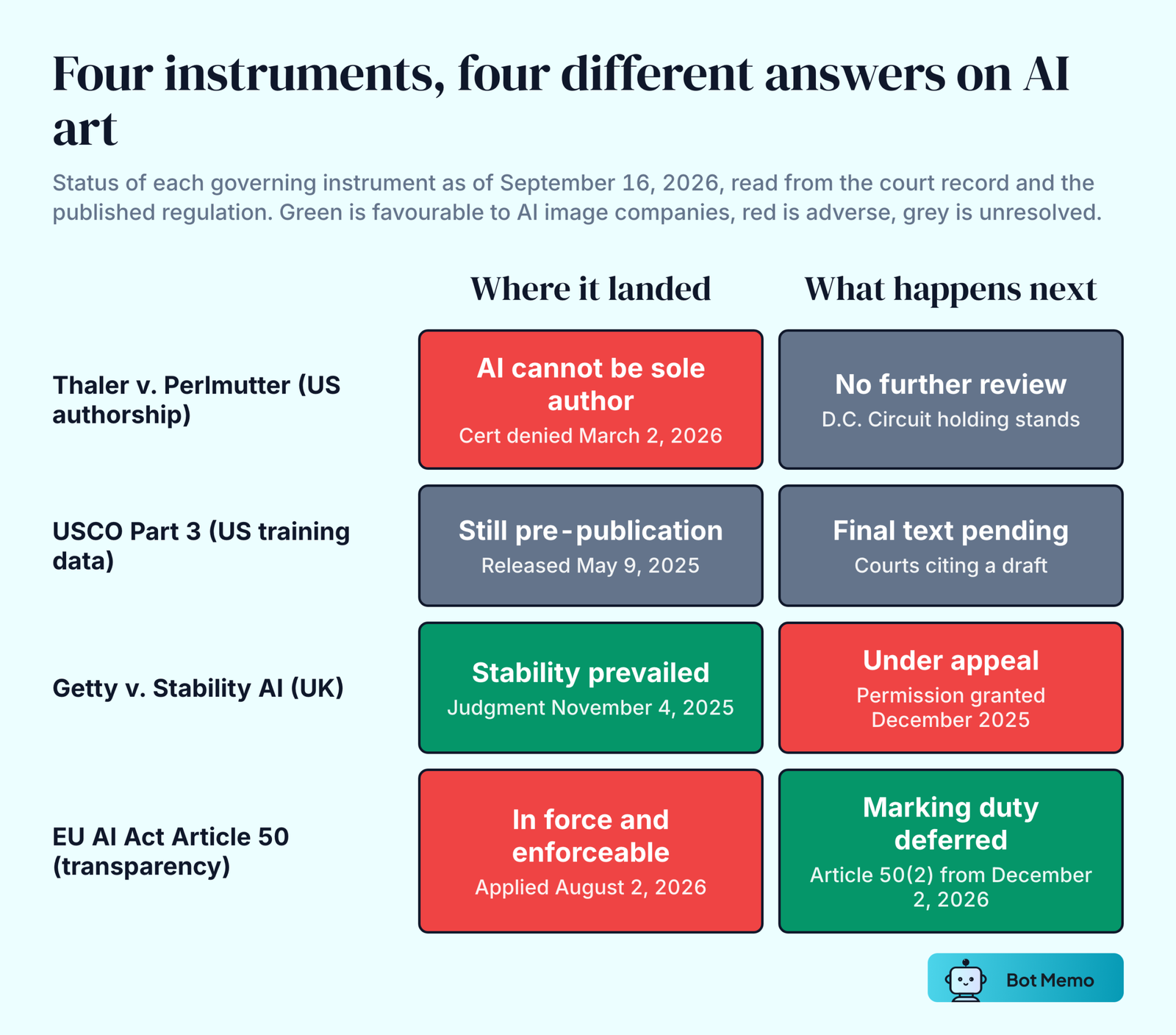
Where each instrument sits in September 2026:
| Jurisdiction | Instrument | Status |
|---|---|---|
| United States | Thaler v. Perlmutter (human authorship) | Cert denied March 2, 2026; D.C. Circuit ruling stands |
| United States | USCO Part 3 (training data) | Still the May 2025 pre-publication text; licensing endorsed |
| United Kingdom | Getty v. Stability AI | Stability prevailed Nov 4, 2025; Getty appealing the secondary claim |
| European Union | AI Act Articles 51 to 56 (GPAI) | Applied since 2 August 2025 |
| European Union | AI Act Article 50 (transparency) | Applied 2 August 2026; Article 50(2) marking deferred to 2 December 2026 |
Source: Primary court and regulatory filings cited inline.
Disney, Universal, and the Midjourney Lawsuit
The Complaint
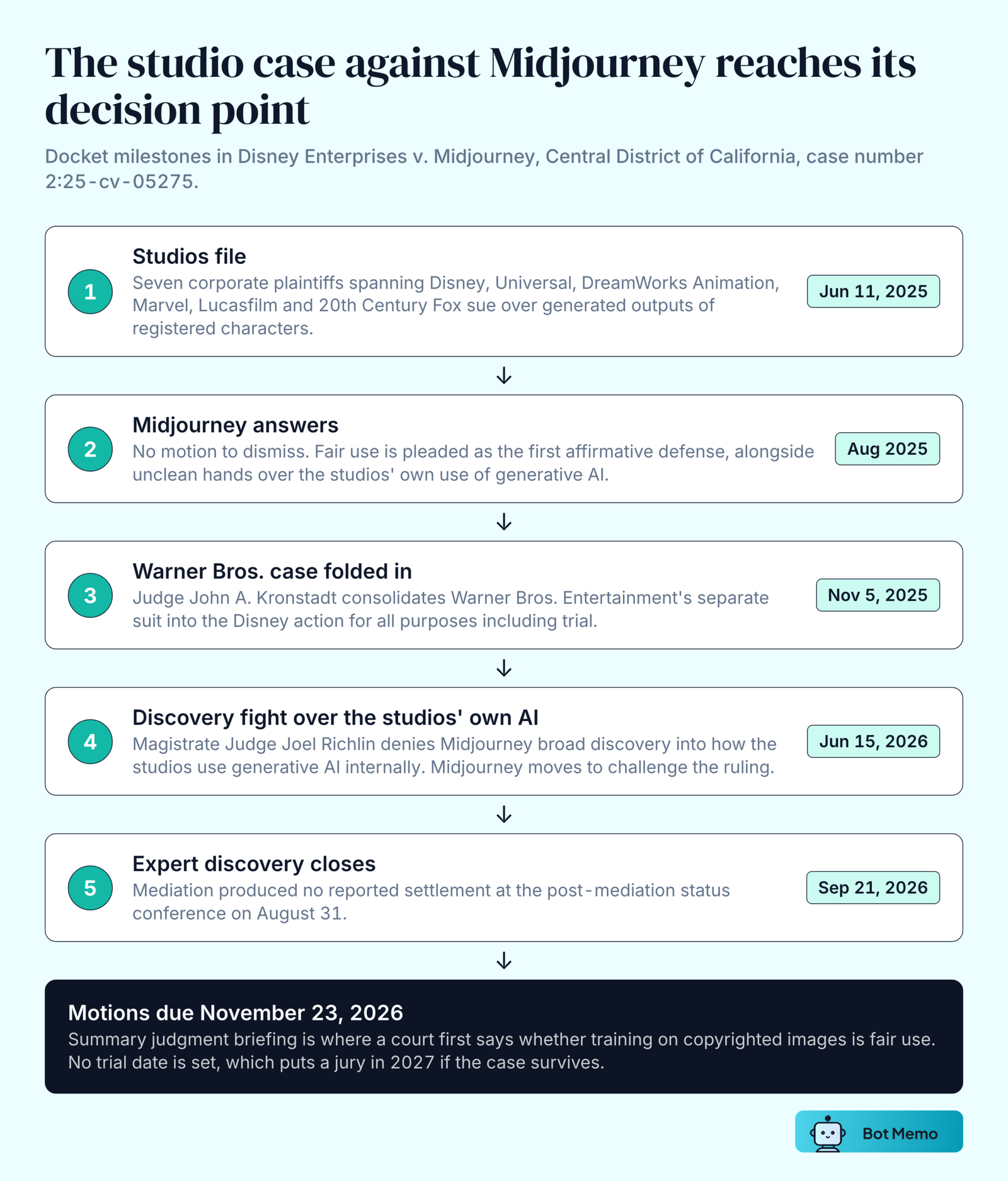
Case No. 2:25-cv-05275 in the Central District of California is the largest copyright action the AI art category has seen, measured by the size of the plaintiff group and the catalogue it asserts. It was filed on June 11, 2025 by seven corporate plaintiffs across six studios: Disney, Universal, DreamWorks Animation, Marvel, Lucasfilm, and 20th Century Fox. The defendant is Midjourney. The complaint cites generated outputs resembling Elsa, Darth Vader, Shrek, and the Minions, and it seeks statutory damages of up to $150,000 per infringed work.
The case grew. On November 5, 2025, Judge John A. Kronstadt consolidated Warner Bros. Entertainment’s separate suit against Midjourney (Case No. 2:25-cv-08376) into the Disney action for all purposes including trial, which put Star Wars, Marvel, Pixar, DC, and Hanna-Barbera characters in front of one jury.
Where the Case Stands
Midjourney answered rather than moving to dismiss, and pleaded fair use as its first affirmative defense. It also pleaded unclean hands, arguing that the studios use generative AI internally themselves, and it has spent 2026 trying to prove it. In June 2026 Magistrate Judge A. Joel Richlin mostly denied that bid, limiting Midjourney to the studios’ consumer-facing AI products and refusing the broader demands as irrelevant to whether Midjourney infringed. Midjourney has asked the district judge to reverse him.
The schedule is now the thing to watch. Per the case docket, expert discovery closes on September 21, 2026 and all motions, summary judgment included, are due November 23, 2026. The parties held a post-mediation status conference on August 31, 2026 without a reported settlement. No trial date has been set, which puts a jury in 2027 if the case survives summary judgment.
Why Midjourney and Not a Larger Lab
Transparency is part of the answer. The Stanford CRFM 2025 Foundation Model Transparency Index scored Midjourney at 14 out of 100, tied with xAI for the lowest in the cohort. Stable Diffusion had published its training data. Adobe Firefly had asserted licensed-training provenance for its commercial model. Midjourney has disclosed neither a training dataset nor a licensing program. That asymmetry is what the studios chose to litigate against.
The outcome will shape U.S. precedent on training-data liability for generative AI. A fair use win for Midjourney would entrench the current permissionless-training regime. A plaintiff win could force the economics of AI art into a licensing model, and the statutory ceiling of $150,000 per work, available only on a finding of willful infringement, is what makes a studio-sized catalogue an existential number rather than a cost of doing business.
Our analysis of AI startup classifications tracks Midjourney as AI Native, a category where the product could not exist without generative AI. That designation is also what makes the copyright exposure existential.
Market Size and Growth Trajectory
What the Research Firms Measure
Grand View Research sized the global AI image generator market at $349.6 million in 2023 and $406.4 million in 2024, with a projected $1.08 billion by 2030 at a 17.7% CAGR. Fortune Business Insights puts North America at 40.34% of the image generator market and 41.00% of the video generator market in 2025.
What They Miss
These figures track standalone image generators. They do not isolate image generation that is embedded in broader products: Adobe Firefly inside Creative Cloud, GPT Image inside ChatGPT, Gemini image output inside Google Workspace. Revenue attribution for image generation inside a $20 per month consumer AI subscription is not clean.
Adobe’s own disclosure shows the size of the gap. Firefly ending ARR approaching $300 million in the second fiscal quarter of 2026 sits against a $406.4 million figure meant to cover the whole standalone category two years earlier. Either the category is far larger than the standalone sizing implies, or the sizing is measuring a different thing from what the market has become. Both readings point the same way: treat the headline market number as a floor on a narrow slice, not a measure of AI image generation as an industry.
Where the Venture Money Went
Venture capital has continued to fund at the model layer despite the legal overhang. Black Forest Labs, the FLUX model team, closed a $300 million Series B at a $3.25 billion valuation in December 2025, co-led by Salesforce Ventures and Anjney Midha at Andreessen Horowitz. That round closed roughly six months after the Disney complaint against Midjourney, which signals that investors are pricing the legal risk into valuations rather than exiting the category.
For context on the broader AI funding environment, our AI startup funding statistics covers the full market backdrop.
How Many AI Images Are Generated Each Day
The Aggregate Number Is Dead
The most cited number on daily AI image volume has not been updated in three years. Everypixel Journal, in August 2023, estimated 34 million AI images generated per day and 15 billion cumulative since the category began in 2022. For context, traditional photography took 149 years to reach 15 billion images. AI reached the same milestone in 1.5 years.
No credible aggregated daily figure has been published since, and the 2023 estimate understates 2026 volume by an order of magnitude. Treat it as a historical marker, not a current benchmark. Any 2026 article quoting a refreshed “images per day” figure attributed to Everypixel is restamping the old number.
What the Platforms Actually Disclose
Platform-specific disclosures are the only defensible source:
- Google Nano Banana: more than 50 billion images generated since the models launched in August 2025, per Sundar Pichai’s Google I/O 2026 keynote on May 19, 2026.
- Adobe Firefly: 24 billion cumulative generated assets by June 2025. Adobe reported 7 billion at April 2024 and 16 billion at December 2024 (8 months to more than double), then 24 billion by June 2025. Adobe has published no newer cumulative count.
- OpenAI GPT Image 1: 700 million images in the first week after its March 25, 2025 launch, across 130 million-plus users, per Brad Lightcap (OpenAI COO).
- Midjourney Discord: 18,598,214 members on September 16, 2026 per Discord’s public invite page, still the largest server on the platform.
The Sora Consolidation
OpenAI reorganised the category in 2026. ChatGPT Images 2.0 launched on April 21, 2026, moving image generation into the main ChatGPT surface on the GPT Image 2 model. Sora’s web and app experiences shut down on April 26, 2026, with the Sora API scheduled to follow on September 24, 2026. DALL-E 2 and DALL-E 3 were retired on May 12, 2026. The volume implications of that consolidation have not yet surfaced in an OpenAI disclosure.
Creator Adoption and Tool Usage
Two Surveys, One Number
Two surveys landed within six weeks of each other in fall 2025 and agreed on a number. Adobe’s Creators’ Toolkit Report (October 2025) put global creator use of generative AI at 86%. An Artlist survey of 6,500 creators (September 2025) put it at 87%, with more than 40% reporting daily use. The Artlist figure ran as sponsored content, so weight it as vendor-commissioned research that happens to corroborate Adobe’s number rather than as an independent replication.
The Tools in Use
- Adobe Firefly: embedded across Photoshop, Illustrator, and Premiere. Commercial safety positioning based on licensed training data.
- Midjourney: Discord-native, now with a web app. Aesthetic-leader positioning despite the studio litigation.
- Stable Diffusion and FLUX (from Black Forest Labs): open-weights models for developer and enterprise deployment.
- GPT Image 2 from OpenAI: embedded in ChatGPT, the default tool for hundreds of millions of consumer users since the DALL-E line was retired.
- Google’s Nano Banana models inside Gemini: the volume leader by the only public cumulative count.
Adoption at this level means generative AI is no longer a standalone workflow. It’s a feature inside existing tools. That shift is what makes the standalone market-size figures narrow.
Adoption among creators is not the same as creators being the economic winners.
Economic Impact on Illustrators and Designers
Three pieces of empirical research point the same direction.
Earnings: Brookings
Brookings Institution (August 2024) studied freelance platform data pre- and post-ChatGPT launch. Workers in AI-exposed creative occupations saw a 5% drop in earnings and a 2% drop in contracts. That’s controlled for platform-wide effects.
Demand: Boston University Questrom
Boston University Questrom (June 2024) looked at the supply side: job postings on freelance platforms for AI-exposed creative work. Postings fell an average of 17.01% after image-generating AI became widely available. The breakdown: graphic design -18.49%, 3D modeling -15.57%. Writing postings also fell, though by less than image-related categories.
Self-Reported Loss: Society of Authors
The Society of Authors UK survey (April 2024) reported that 26% of UK illustrators had lost work due to generative AI. Translators showed higher displacement at 36%.
The pattern holds across three methodologies: platform-side demand signals, platform-side earnings data, and self-reported impact from a union survey. High creator adoption and measurable freelance displacement are the same story told from opposite ends. Tools that amplify output at the top end are cannibalizing the commodity end of the same market.
One gap worth flagging: BLS occupational employment statistics for illustrators and fine artists through 2025 are not yet integrated into these datasets. The numbers here capture freelance-platform labor, not full occupational labor. That distinction matters because the freelance market is where displacement surfaces first.
Midjourney by the Numbers
Midjourney is the most-watched private company in AI art in 2026 because of its compressed legal risk exposure rather than its size. Our Midjourney statistics page carries the full source-by-source breakdown; the figures that matter for the art category are below.
What Is Actually Disclosed
Capital structure: self-funded, with no outside venture capital, which is unusual for a company operating at this scale with a consumer-facing product.
Discord community: 18,598,214 members on September 16, 2026, the largest server on Discord. The count is falling: our Midjourney statistics page recorded roughly 19.4 million in March 2026 and 18.68 million in August 2026.
Transparency: 14 out of 100 on the Stanford CRFM 2025 Foundation Model Transparency Index, tied with xAI for the lowest score across the measured models.
Hardware move: in November 2025, Butterfly Network filed an 8-K disclosing a five-year ultrasound-on-chip co-development and licensing agreement with Midjourney: $15 million upfront, a $10 million annual licence paid quarterly, and up to $9 million in milestones, capped payments worth up to $74 million over the five-year term, plus uncapped revenue sharing on top. It is the best-sourced Midjourney financial disclosure in existence, and it is not about images.
What Is Not Disclosed
Revenue: Midjourney has never published a figure. The Information reported the company was on pace for $200 million in 2023, sourced to a person close to the company, and that is the only original reporting. TIME’s 2025 profile of founder David Holz wrote that the company “reportedly made $300 million” in 2024 and named no source; the Disney complaint quotes the same figure from press coverage. Treat every Midjourney revenue number in circulation as an extrapolation from one 2023 briefing.
Training data: no dataset disclosure, no licensing program, which is the gap the Transparency Index scored and the studios are litigating.
Litigation exposure: defendant in the studio copyright action described above, now consolidated with Warner Bros. Entertainment’s suit, with summary judgment briefing due November 23, 2026.
What to Watch for the Rest of 2026
- Summary judgment in Disney v. Midjourney. Motions are due November 23, 2026. The first judicial signals on how a court will treat training-data claims in this case arrive with that briefing, and a fair use ruling would be the most consequential decision in the category.
- EU AI Act Article 50(2). The machine-readable marking duty for synthetic content takes effect 2 December 2026 after its Digital Omnibus deferral. Watch whether the major image generators ship compliant provenance marking by then.
- Getty’s appeal in the UK. The Court of Appeal will revisit whether distributing a model trained on infringing copies is itself secondary infringement, the question the High Court answered in Stability’s favour.
- The final USCO Part 3 report. Sixteen months after the pre-publication version, courts are still citing a draft. A final text, or any follow-on guidance on training-data licensing, would carry weight.
- A published images-per-day benchmark. Google’s 50 billion cumulative figure is the first real volume disclosure since 2023. A comparable number from OpenAI or Adobe would let the category be measured rather than estimated.
Frequently Asked Questions
How many AI art images are generated each day?
No credible aggregated daily figure exists for 2026. The last one was 34 million per day from Everypixel Journal in August 2023, with a 15 billion cumulative total since 2022, and it was never updated. Platform disclosures show the floor is far higher: Google reported more than 50 billion cumulative images from its Nano Banana models by May 2026, and OpenAI’s GPT Image 1 alone generated 700 million images in the week after its March 2025 launch.
Can AI-generated art be copyrighted in the United States?
Purely AI-generated works cannot be registered. The Supreme Court denied certiorari in Thaler v. Perlmutter on March 2, 2026, leaving the D.C. Circuit ruling intact: the Copyright Act requires human authorship. Works with meaningful human contribution can still be registered under existing Copyright Office guidance.
What is the AI art market size in 2026?
Grand View Research sized the global AI image generator market at $349.6 million in 2023 and $406.4 million in 2024, projected to reach $1.08 billion by 2030 at a 17.7% CAGR. Fortune Business Insights puts North America at 40.34% of the image generator market in 2025. Those figures cover standalone generators, not image features embedded in broader AI products, which is why Adobe alone reported Firefly ARR approaching $300 million in its second fiscal quarter of 2026.
How much revenue does Midjourney make?
Midjourney has never published a revenue figure. The Information reported it was on pace for roughly $200 million in 2023, the only original reporting on the company’s finances. TIME’s 2025 profile wrote that it “reportedly made $300 million” in 2024 without naming a source. The company is self-funded and has raised nothing from outside investors.
What percentage of creators use AI in their workflow?
86% per the Adobe Creators’ Toolkit Report (October 2025), and 87% per the Artlist survey of 6,500 creators (September 2025), with 40%+ reporting daily use in the Artlist data. Both are vendor research, and the Artlist survey ran as sponsored content, so read them as two vendors arriving at the same number rather than as independent replication.
Which companies are suing Midjourney?
Seven corporate plaintiffs across six studios (Disney, Universal, DreamWorks Animation, Marvel, Lucasfilm, and 20th Century Fox) filed Case No. 2:25-cv-05275 in the Central District of California on June 11, 2025. Warner Bros. Entertainment filed a separate suit that Judge John A. Kronstadt consolidated into the Disney action on November 5, 2025. The complaint seeks statutory damages of up to $150,000 per infringed work. Summary judgment motions are due November 23, 2026.
What did the Supreme Court rule about AI copyright?
The Supreme Court denied certiorari in Thaler v. Perlmutter on March 2, 2026, which means the Court declined to review the case. The effect is that the lower D.C. Circuit ruling stands: the Copyright Act requires human authorship, and AI cannot be the sole author of a registered work.
Methodology
This analysis is built on primary court filings, regulatory instruments, company investor-relations releases, academic research, and published industry reports. It covers the AI art category as a whole rather than a single funding slice, so the figures here come from public sources rather than Bot Memo’s own repository.
Data sources: U.S. Supreme Court docket (Thaler v. Perlmutter, No. 25-449), U.S. Copyright Office Part 3 pre-publication report, CourtListener dockets for Disney Enterprises v. Midjourney (2:25-cv-05275) and Warner Bros. Entertainment v. Midjourney (2:25-cv-08376), UK High Court judgment in Getty Images v. Stability AI [2025] EWHC 2863 (Ch), the EU AI Act and the 2026 Digital Omnibus agreement, Adobe press releases, surveys and quarterly earnings materials, OpenAI and Google company disclosures, Discord’s public invite page, TechCrunch, The Information, TIME, Variety, Brookings Institution, Boston University Questrom School of Business, Stanford CRFM Foundation Model Transparency Index 2025, Grand View Research, Fortune Business Insights, Society of Authors UK, and Everypixel Journal.
Time period: data points span August 2023 through September 2026, with emphasis on 2025 and 2026 disclosures. Court schedule figures are current as of September 16, 2026.
Currency: all monetary figures in USD. Where originally reported in other currencies, standard spot-rate conversions apply.
Limitations: the Grand View market-size figures track standalone image generators and do not isolate revenue from image generation embedded in broader AI subscriptions, which is why it reads smaller than a single vendor’s current ARR. The 34 million images per day figure is from August 2023 and understates 2026 volume by an order of magnitude; no replacement aggregate has been published. BLS occupational data for illustrators and fine artists through 2025 is not yet integrated; labor-impact figures here are drawn from freelance-platform data and union surveys, which capture displacement earlier than occupational employment statistics. Litigation schedules move, and the Disney case dates above reflect the docket as of September 16, 2026.
Sources
- Thaler v. Perlmutter case file (SCOTUSblog)
- U.S. Copyright Office Part 3 report
- Disney Enterprises v. Midjourney docket
- Variety on Midjourney’s discovery motion
- Getty Images statement on UK ruling
- Latham & Watkins on Getty v. Stability AI
- EU AI Act Article 50
- Gibson Dunn on the EU AI Act Digital Omnibus
- Grand View Research AI image generator market
- Fortune Business Insights AI image generator market
- Fortune Business Insights AI video generator market
- Everypixel Journal AI image statistics
- Adobe Firefly 24 billion assets release
- Adobe Q2 FY2026 financial results
- Adobe MAX 2025 creators survey
- Sundar Pichai’s Google I/O 2026 keynote
- Artlist creators survey via TechCrunch
- Society of Authors UK survey coverage
- Brookings on freelance-market impact of generative AI
- BU Questrom paper on freelance platform postings
- Midjourney Discord invite page
- Statista Discord top servers ranking
- The Information on Midjourney revenue
- TIME 100 AI profile of David Holz
- TechCrunch on GPT Image 1 first-week volume
- Black Forest Labs Series B announcement
- Stanford CRFM Foundation Model Transparency Index
- Butterfly Network 8-K filing with SEC
- OpenAI ChatGPT Images 2.0 launch page
- OpenAI on the Sora discontinuation
- U.S. Copyright Office AI policy page

About the author
Editorial Staff
The Editorial Staff at Bot Memo is a team of writers, analysts, and AI agents dedicated to mapping the global AI startup ecosystem. Led by Chintan Zalani, the team tracks thousands of funding rounds, classifies companies across verticals, and distills it all into actionable intelligence for investors and founders.