
AI writing tools are now part of ordinary work, school and publishing. Writing accounted for 40% of work-related messages on consumer ChatGPT plans in July 2025, according to a study by OpenAI and Harvard researchers. In Siege Media’s 2026 survey of 353 marketing professionals, 97% said their content marketing programs use AI. And in December 2025, 94% of UK undergraduates said they use generative AI for assessed work.
The text is showing up on the open web as well. Pew Research Center found significant signs of AI authorship on 10% of a random sample of English-language webpages in July 2026, and on more than a third of pages published after ChatGPT’s release. Readers are less comfortable with it. Only 12% of people across six countries say they are comfortable with news made entirely by AI, compared with 62% for news made entirely by people.
Below are the latest AI writing statistics for 2026, grouped by how much of the web AI writes, chatbot and tool use, marketing, productivity, accuracy, detection, students, writers and jobs, trust, and market size. Where a newer study has replaced an older figure, both numbers are shown.
On this page
- Key AI Writing Statistics for 2026
- How Much of the Internet Is Written by AI?
- How People Use ChatGPT and AI Writing Tools
- AI Writing Statistics for Marketers
- AI Writing Productivity Statistics
- AI Writing Accuracy and Hallucinations
- Can AI Writing Be Detected?
- Students and AI Writing
- AI and Writing Jobs
- Trust in AI-Written Content
- AI Writing Market Size
- Key Takeaways
- Frequently Asked Questions
- Sources and Methodology
Key AI Writing Statistics for 2026
- 10% of English-language webpages in a July 2026 sample showed significant signs of AI authorship, and more than a third of pages published after ChatGPT’s release did (Pew Research Center, 2026).
- Primarily AI-generated articles made up 50.9% of new English-language articles in Q4 2025 and 49.9% in Q1 2026 (Graphite, 2026).
- 74.2% of 900,000 English-language webpages first detected in April 2025 contained some AI-generated content, and 2.5% were entirely AI (Ahrefs).
- Writing was 40% of work-related messages on consumer ChatGPT plans in July 2025, and about two-thirds of writing requests asked ChatGPT to modify text the user supplied (OpenAI and Harvard researchers, NBER, 2025).
- 97% of marketers in Siege Media’s 2026 survey say their content marketing programs use AI, up from 83% in 2024 (Siege Media).
- 89% of B2B marketers use AI tools to create or optimize written marketing content (Content Marketing Institute, 2026).
- Professionals using ChatGPT spent 40% less time on writing tasks, and their work was rated 18% higher in quality (MIT).
- Turnitin’s detector flagged about 15% of English-language essay submissions between October 2025 and February 2026 as containing at least 80% AI-generated writing, up from about 3% in 2023 (Turnitin).
- 69% of authors surveyed by the Authors Guild think generative AI threatens their careers (Authors Guild).
- Only 12% of people are comfortable with news made entirely by AI (Reuters Institute, 2025).
How Much of the Internet Is Written by AI?
Several large studies have run web text through AI detectors. The detectors are not perfect on any single page, so these figures are best read as estimates across large samples.
Pew Research Center: 10% of Webpages Show Signs of AI Authorship
Pew Research Center analyzed about 490,000 English-language webpages from the Common Crawl archive, collected between January 2021 and July 2026, using the open-weight Pangram detection model. In the July 2026 snapshot, 10% of all pages showed significant signs of AI editing or authorship. Among pages published after ChatGPT’s release, the share was more than a third.
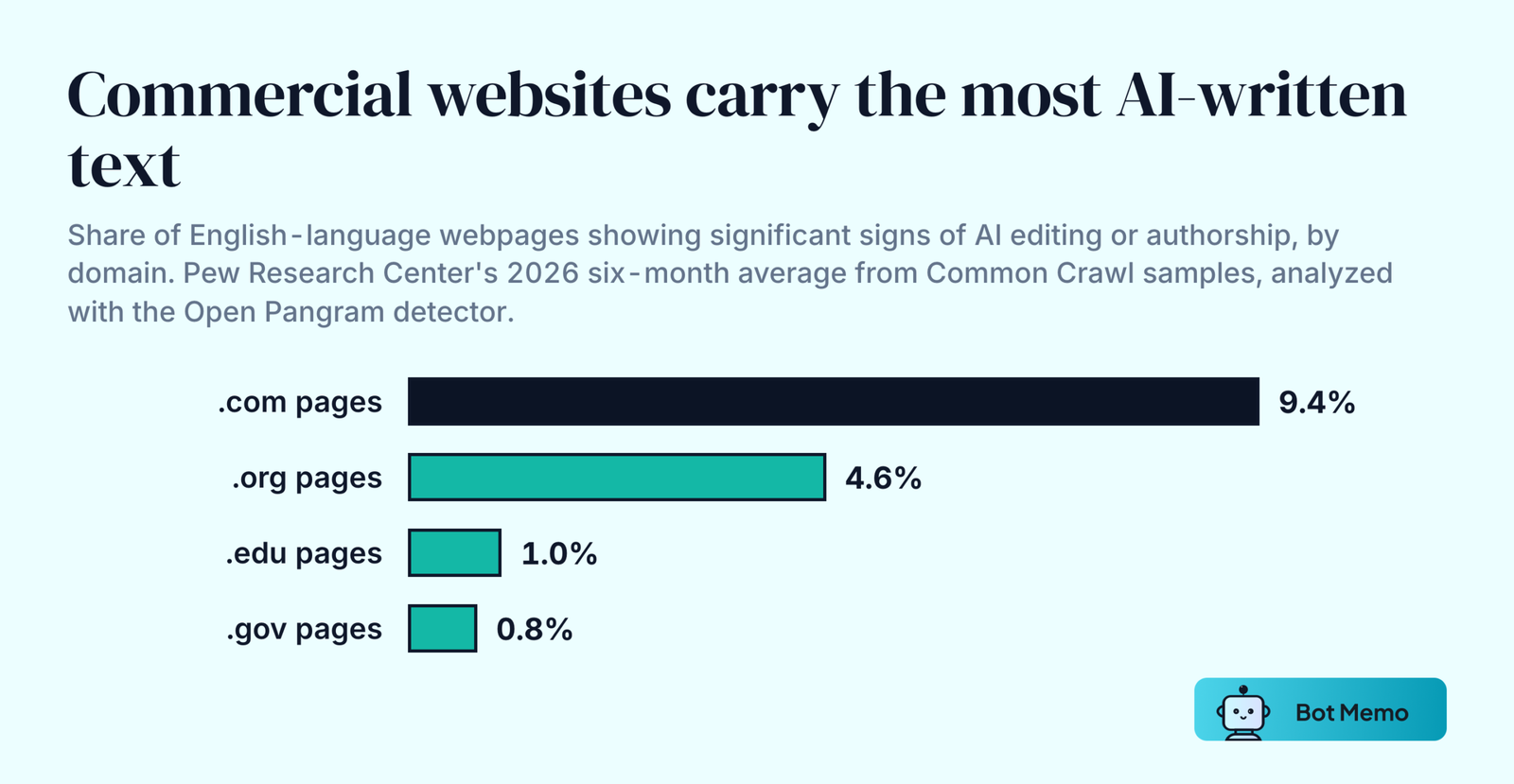
AI text is concentrated on commercial sites. In 2026 samples, 9.4% of .com pages showed signs of AI authorship, compared with 4.6% of .org pages and about 1% of .edu and .gov pages. In January 2021, before ChatGPT, the rate was about 1% on .com pages (Pew Research Center).
Pew also tracked writing habits that AI models favor. Compared with 2023, em dashes appear about twice as often on the web, Oxford commas are up 63%, and a set of words that AI models tend to overuse appears more than twice as often (Pew Research Center).
Graphite: AI Articles Now Match Human Articles
Graphite checked 55,400 English-language articles from Common Crawl with three AI detectors. Primarily AI-generated articles were 49.6% of new articles in Q1 2025, reached 50.9% in Q4 2025 and were 49.9% in Q1 2026 (Graphite).
Ahrefs: Most New Pages Include Some AI Text
Ahrefs analyzed 900,000 English-language webpages first found by its crawler in April 2025, one page per domain. 74.2% contained AI-generated content: 2.5% were classified as pure AI, 71.7% as a mix of AI and human writing, and 25.8% as pure human writing. In a separate survey of 879 content marketers, 87% said they use AI to create or help create content (Ahrefs).
Does AI Content Rank in Google?
Mostly human pages still hold most top positions, but fully AI pages do rank. Ahrefs studied top-ranking pages from 100,000 Google searches collected in June 2026 and published the results in July 2026. Among pages ranking in positions 1 to 3, 54.7% had less than 20% AI content and 5.3% were 100% AI-generated, and pages with less than 50% AI content held 82.2% of those rankings. The average AI share rose only slightly from position 1 (27.1%) to position 10 (30.9%) (Ahrefs, 2026).
Semrush ran 42,000 blog pages that ranked on the first page of Google in November 2025 through GPTZero. Pages classified as purely AI-generated held the top spot 9% of the time, and human-written pages 80% of the time. In a companion survey of 224 SEO professionals, 72% of those using AI content said it performs at least as well as human-written content in search, up from 64% in 2024. 70% named faster production as the main benefit, but only 19% said AI improves content quality (Semrush).
How People Use ChatGPT and AI Writing Tools
ChatGPT Users and Writing Requests
ChatGPT had 900 million weekly active users in February 2026, up from 800 million in October 2025, and 50 million paying subscribers (TechCrunch).
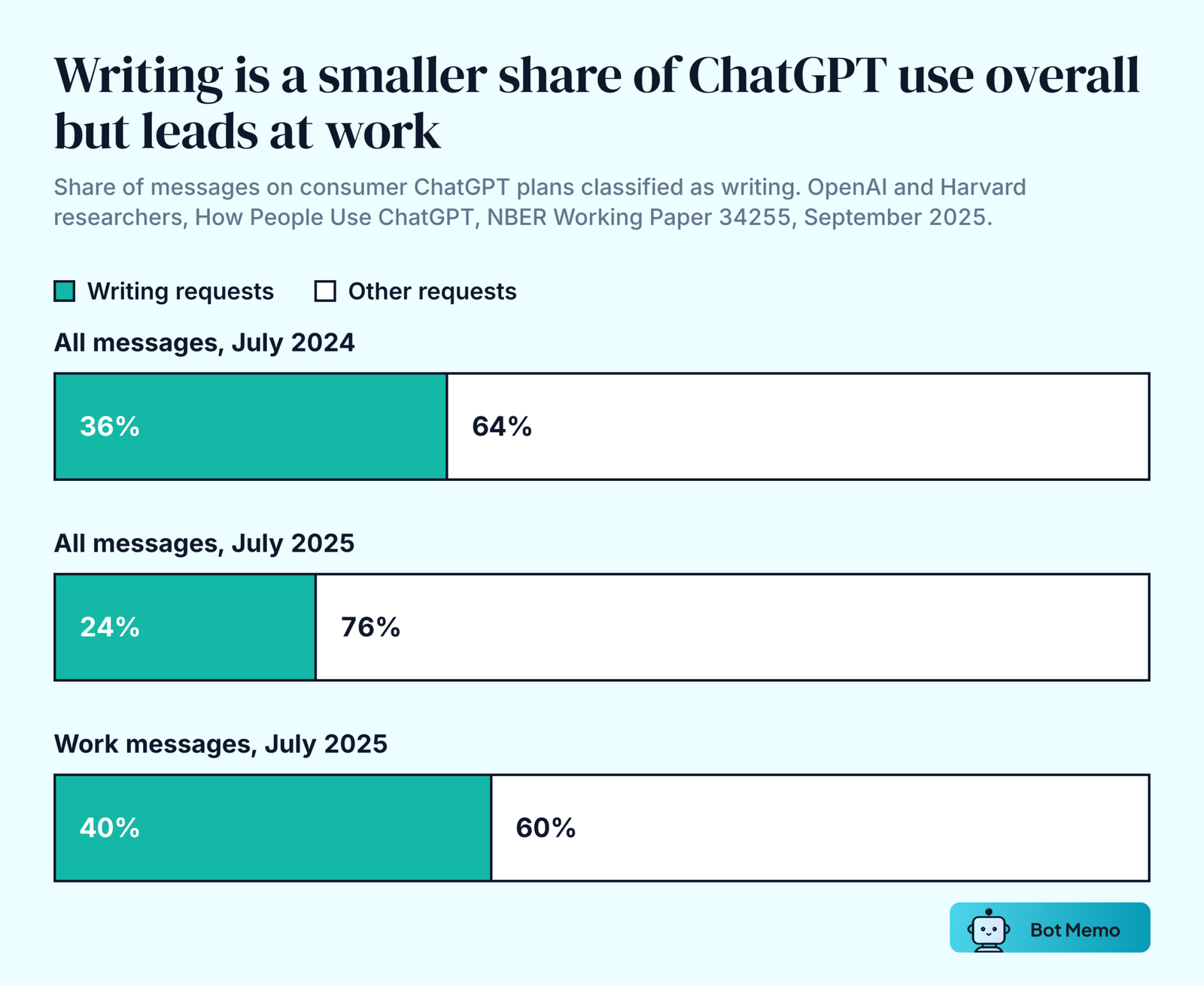
A study by OpenAI and Harvard economists of about 1.1 million sampled conversations on consumer plans found that users sent 18 billion messages a week by July 2025. Writing fell from 36% of all messages in July 2024 to 24% in July 2025, as information-seeking grew. At work, writing stays the top use: 40% of work-related messages in July 2025 were writing requests. About two-thirds of all writing messages asked ChatGPT to modify text the user supplied, such as editing, critiquing, summarizing or translating it, rather than write something new (NBER Working Paper 34255).
Grammarly
More than 40 million people use Grammarly every day, and it serves 50,000 organizations. In May 2025 the company reported annual revenue of more than $700 million (Grammarly). Its 2024 report with The Harris Poll found knowledge workers spend 88% of their workweek communicating (Grammarly).
Jasper, Frase and Claude
Jasper, a marketing writing platform, now describes its product as more than 100 specialized marketing agents, replacing its earlier template library (Jasper). Its API lets companies bring on-brand AI writing into their own platforms and is designed for 99.99% uptime (Jasper API). Frase, an SEO writing tool, reads the pages already ranking for a topic and lays out how each is built, including its structure, length and headings, so a writer can plan a brief (Frase).
Anthropic says Claude 3 was the first Claude model trained for “character”, with the goal of traits such as curiosity, open-mindedness and thoughtfulness (Anthropic). At Claude’s launch, Quora’s head of people and communications, Autumn Besselman, said users describe its answers as “detailed and easily understood” (Anthropic).
AI Writing Statistics for Marketers
How Many Content Marketers Use AI?
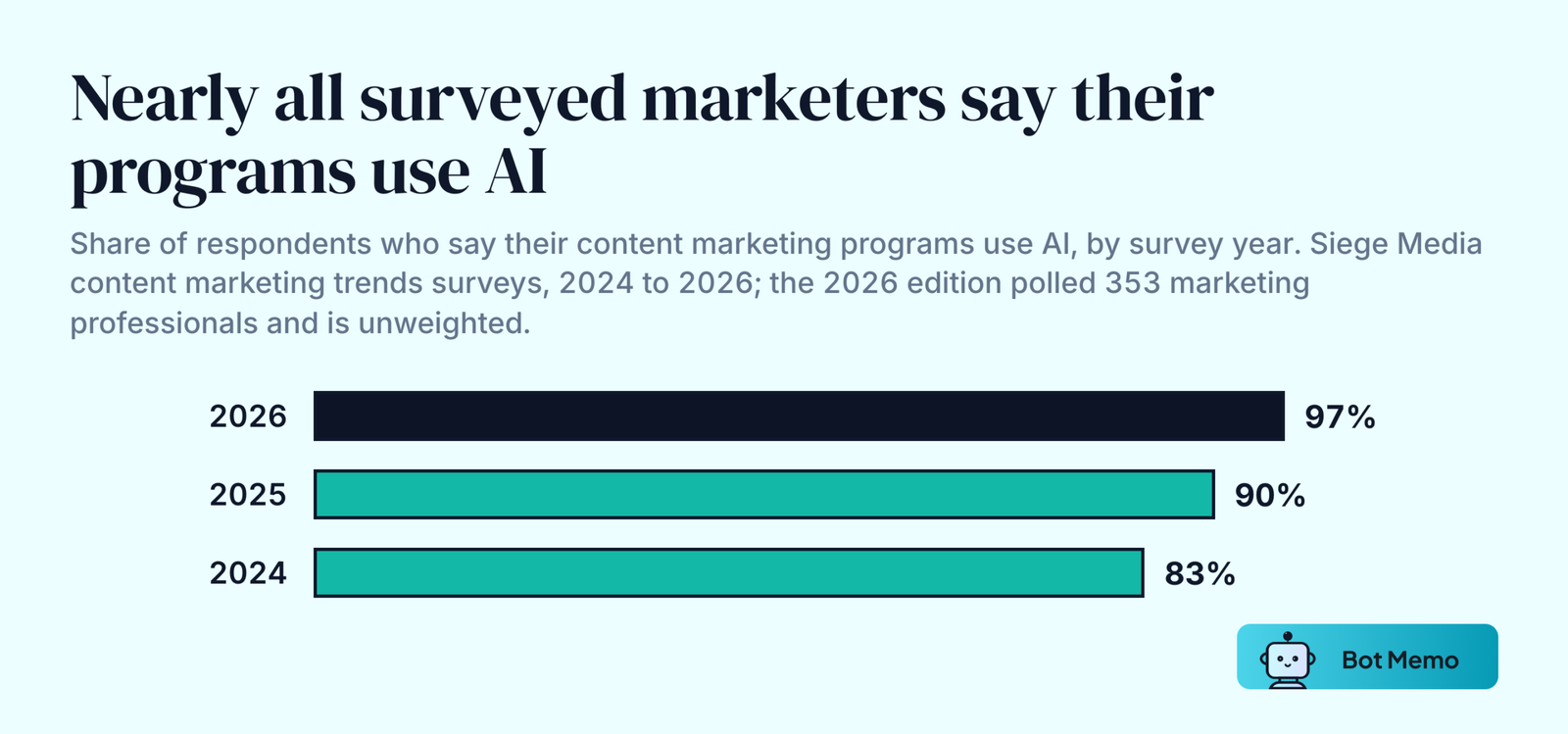
In Siege Media’s annual survey, the share of marketers saying their content marketing programs use AI rose from 83% in 2024 to 90% in 2025 and 97% in 2026. The 2026 edition polled 353 marketing professionals in November and December 2025, and its results are unweighted. The most common answer, from 48%, is that AI touches about 11% to 40% of their work, and only 1% say their work is 100% AI.
How teams use AI has shifted. In 2026, 74% of content marketers use it for content ideation, 55% for strategy work such as audience personas, and 38% for editing, up from 19% in 2025. Use for brainstorming and outlining fell from 72% in 2025 to 61% in 2026. 80% of content marketers name ChatGPT as the most reliable AI tool for their work, while the share naming Claude among the most reliable rose from 28% to 55%, and Gemini from 16% to 44% (Siege Media, 2026).
The 2024 edition of the survey found that AI use did not guarantee better results. 43.8% of marketers using AI reported above-average success, compared with 48.6% of those not using AI. 20.9% of non-users called their strategy very successful, against 12% of AI users. Spending mattered more. Businesses spending more than $4,000 per post were about 2.6 times as likely to call their strategy very successful as those spending $0 to $500. About 20% of businesses spending $0 to $500 said their strategy underperformed slightly, and none of those spending at least $4,000 did. At the time, 54.5% planned to spend more on content marketing in 2024 than in 2023, businesses were spending more per month overall though fewer spent more than $45,000 a month, and about 70% used AI to brainstorm content such as outlines (Siege Media, 2024). By 2026, 97% of respondents called their program at least somewhat successful, and 31% budgeted $15,000 to $45,000 a month for content marketing (Siege Media, 2026).
B2B Marketers
In the Content Marketing Institute’s survey of 1,015 B2B marketers for 2026, 95% said their organizations use AI-powered applications and 89% use AI tools to create or optimize written marketing content. 68% said they are still exploring or developing their AI approach. Among those using AI for content creation, 58% said their content quality has improved, 21% saw no change and 12% said it got worse (Content Marketing Institute).
HubSpot and Salesforce Surveys
HubSpot’s 2025 State of AI survey found content creation was the most common AI use case for marketers (55%), followed by research (47%). Only 7% of marketers use AI to create entire pieces without editing, 56% heavily revise AI text or change it completely, and 38% make minor changes. 43% said AI produces inaccurate information, and nearly 80% said generative AI has a positive return on content writing tasks (HubSpot).
Salesforce surveyed 1,029 marketers in the US, UK and Australia in May 2023. Those using generative AI used it for content creation (76%) and writing copy (76%). Marketers estimated it would save them more than five hours a week (Salesforce).
Authority Hacker’s Survey of 3,812 Digital Marketers
Authority Hacker’s 2023 survey of 3,812 digital marketers, with the report updated in 2024, found 75.7% using AI tools for work and 49.5% using them several times a week or more. Among AI users, 30.3% used AI daily, 33.8% several times a week, and 85.1% used it for article or blog writing. 32.9% of businesses had already replaced some human tasks with AI. 65.8% of respondents thought AI content was equal to or better than human writing, and 63% named bias and inaccuracies in AI-generated content as their biggest challenge. Of respondents using AI for keyword research, only 14.03% trusted the keyword data it gave them (Authority Hacker, archived).
Social Media, Small Business and Creative Teams
- 89.7% of social media marketers use AI at least several times a week, and 45.9% use it to write captions and post copy (Sociality.io, 2026).
- 58% of US small businesses use generative AI, up from 40% in 2024 (U.S. Chamber of Commerce, 2025).
- 94% of creative professionals surveyed by Adobe in March 2026 said they produce content faster with AI, saving 17 hours a week on average. The survey covered more than 400 creative professionals and more than 400 marketers (Adobe).
Forbes Councils members list ideation, research, brainstorming, phrasing and formatting among the main business uses of AI writing tools, while warning that AI output can be wrong and needs checking (Forbes, 2023).
AI Writing Productivity Statistics
MIT: 40% Less Time on Writing Tasks
In a study published in Science, MIT researchers gave 453 college-educated professionals, including marketers, grant writers, consultants and managers, two writing tasks. Those given ChatGPT spent 40% less time on the tasks, finishing about 11 minutes sooner than the control group, and independent graders rated their work 18% higher in quality (MIT).
Harvard and BCG: Faster and Better Inside AI’s Limits
In an experiment with 758 Boston Consulting Group consultants, those using GPT-4 on 18 realistic consulting tasks completed 12.2% more tasks, worked 25.1% faster and produced results rated more than 40% higher in quality. On a task chosen to fall outside the model’s abilities, consultants using AI were 19 percentage points less likely to reach a correct answer (Dell’Acqua et al., Harvard Business School working paper).
Customer Support Writing
A study of 5,172 customer support agents, published in the Quarterly Journal of Economics in 2025, found an AI assistant raised issues resolved per hour by 15% on average. Agents in the lowest skill group gained 36%, while the most skilled saw no significant change. An earlier working paper version had reported 14% and 34% (Brynjolfsson, Li and Raymond).
AI Writing Accuracy and Hallucinations
AI writing tools can state false facts or cite sources that do not exist. Tests of AI search and news answers show how often this happens.
- The Tow Center for Digital Journalism asked eight AI search tools to identify the source of 200 news excerpts. Together they gave incorrect answers to more than 60% of queries. Perplexity was wrong 37% of the time and Grok 3 94% (Columbia Journalism Review, 2025).
- In a study by 22 public service media organizations in 18 countries, 45% of 2,709 AI assistant answers about the news had at least one significant issue, and 31% had significant sourcing problems (EBU and BBC, 2025).
- 43% of marketers say AI produces inaccurate information (HubSpot, 2025).
Can AI Writing Be Detected?
Detectors can work well on narrow, known types of text. Across mixed real-world writing, they are less reliable, and they can wrongly flag human writers.
Detection Accuracy in Studies
University of Kansas researchers built a detector that told academic science writing from ChatGPT text with more than 99% accuracy on their test set, using articles from the journal Science. It misassigned 1 of 372 full documents, while OpenAI’s GPT-2 Output Detector misassigned 20 (Cell Reports Physical Science, 2023).
Broader tests are less positive. A study of 14 detection tools, including Turnitin, found none reached 80% accuracy and only 5 exceeded 70% (Weber-Wulff et al., International Journal for Educational Integrity, 2023). Stanford researchers found seven detectors labeled essays written by non-native English speakers for the TOEFL test as AI-generated 61.22% of the time on average, while essays by US eighth graders were classified almost perfectly (Liang et al., 2023).
How Accurate Is Turnitin’s AI Detector?
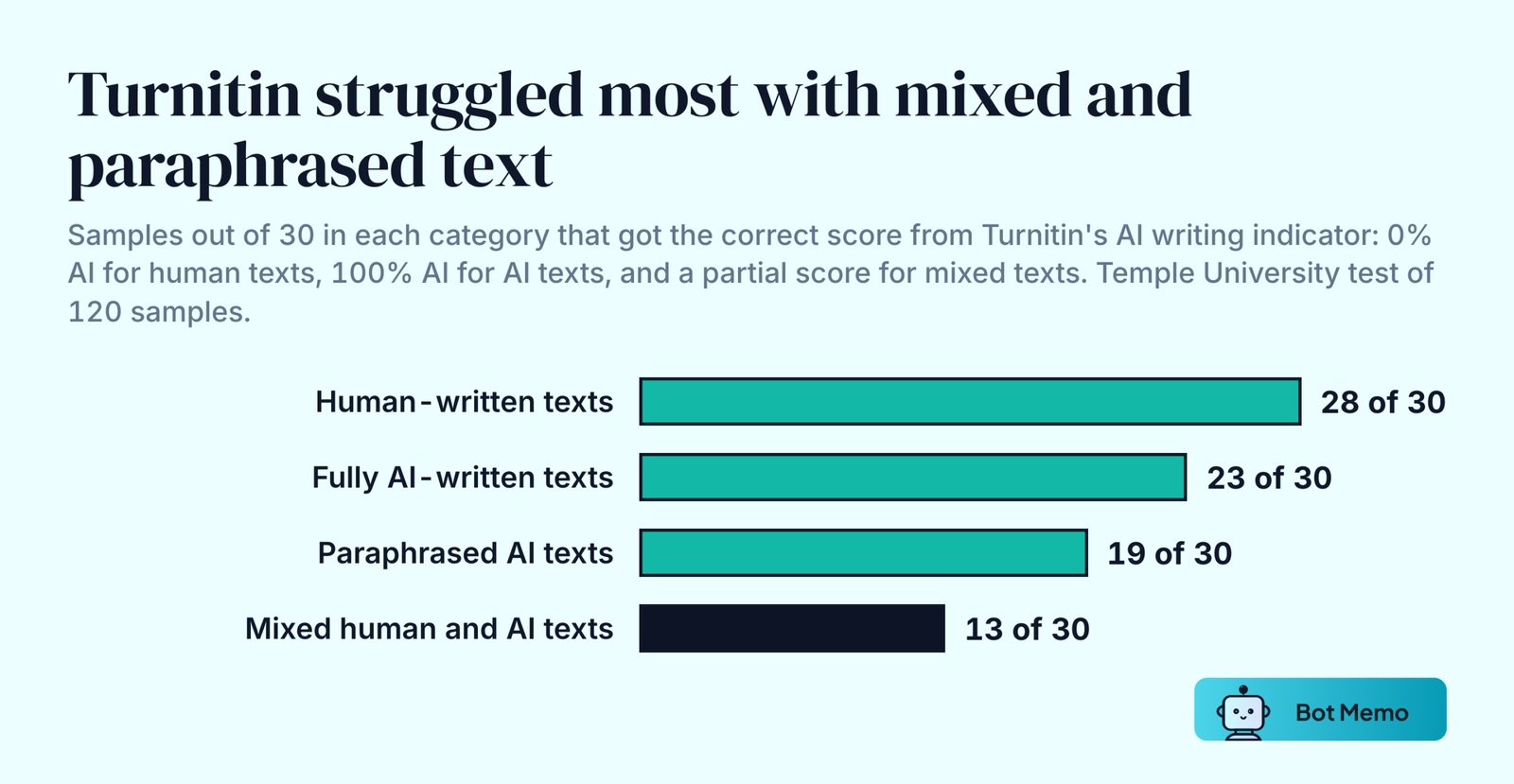
Temple University tested Turnitin’s AI indicator on 120 samples. It gave the correct score to 28 of 30 human-written texts (93%) and scored 23 of 30 fully ChatGPT-written texts as 100% AI (77%). It did worse on AI text run through a paraphrasing tool (19 of 30 scored as 100% AI, 63%) and on hybrid human and AI texts, where 13 of 30 (43%) got a score between fully human and fully AI. Across all 90 samples containing AI text, it flagged at least some AI in 77 (86%). Seven samples could not be rated because of file requirements (Temple University).
Some universities turned the feature off. Vanderbilt disabled Turnitin’s AI detector in August 2023, noting that at Turnitin’s stated 1% false positive rate, about 750 of the 75,000 papers it submitted in 2022 could have been wrongly flagged (Vanderbilt University).
Students and AI Writing
Turnitin Data on AI in Student Papers
In its first year, Turnitin’s AI detector reviewed more than 200 million papers. It flagged more than 22 million, about 11%, as having at least 20% AI writing, and more than 6 million, about 3%, as having at least 80% (Turnitin, 2024). Wired, reporting on the same data, noted that traces of chatbots have even been found in peer-reviewed academic writing (Wired).
The share has since risen. Between October 2025 and February 2026, Turnitin’s updated detector flagged 14.8% of English-language submissions as having 80% or more AI-generated writing, compared with 3.3% for its original detector between April and August 2023 (Turnitin, 2026).
How Many Students Use AI for Schoolwork?
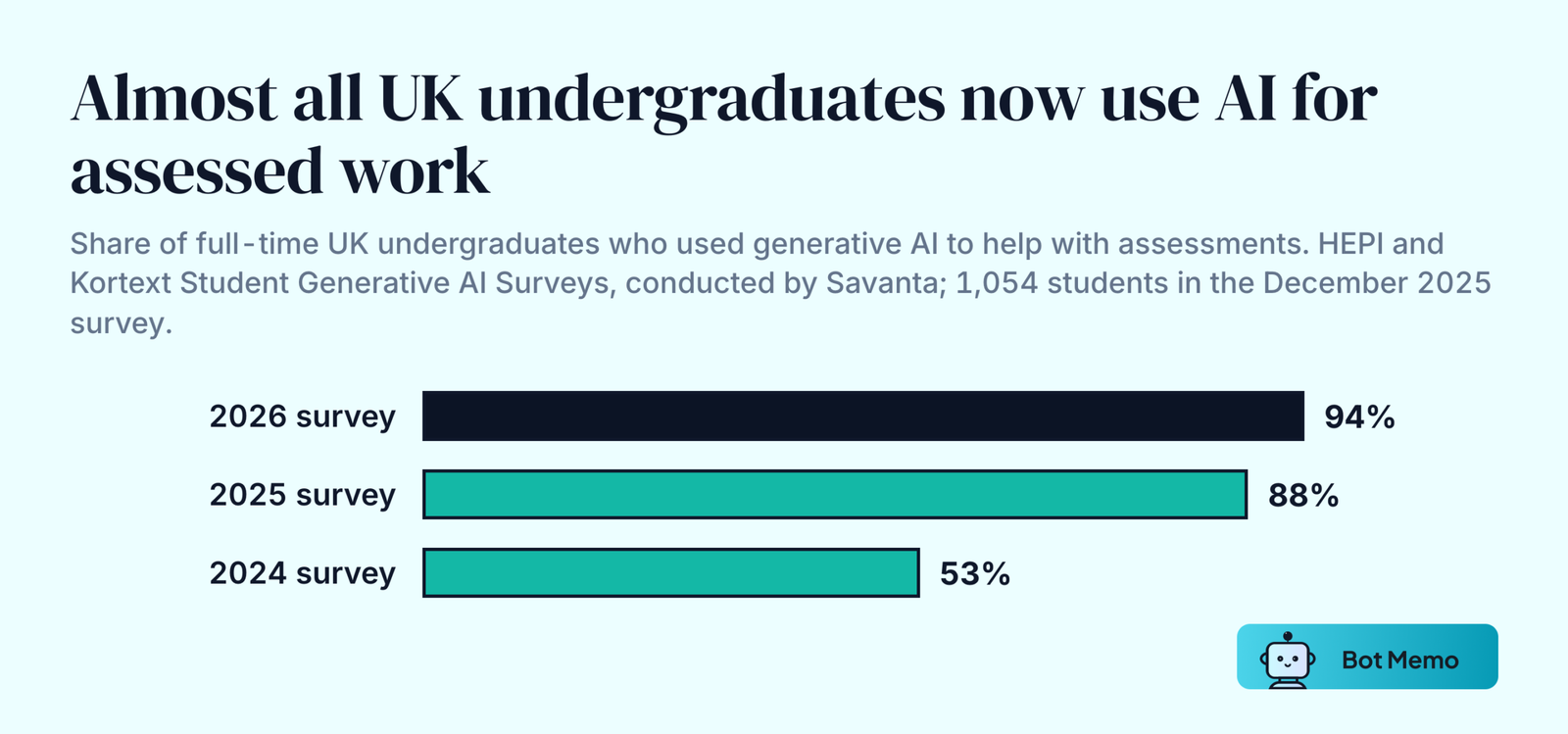
- 94% of UK undergraduates used generative AI to help with assessed work in December 2025, up from 88% in the 2025 survey and 53% in the 2024 survey. 95% used AI in at least one way. The survey covered 1,054 full-time students (HEPI and Kortext, 2026).
- 54% of US teens ages 13 to 17 have used chatbots for help with schoolwork. 10% do all or most of their schoolwork with chatbot help, 21% some and 23% a little (Pew Research Center, 2026). In an earlier Pew survey, 26% of teens said they had used ChatGPT for schoolwork in 2024, up from 13% in 2023 (Pew Research Center, 2025).
- In a January 2023 Study.com survey, 89% of more than 1,000 students said they had used ChatGPT to help with a homework assignment. 34% of educators thought ChatGPT should be banned in schools and universities, while 66% supported student access (Study.com).
In a March 2023 BestColleges survey of 1,000 US college students, among those who had used AI tools for schoolwork, 50% used them for some parts but did most of the work themselves, 30% used AI for most of an assignment, and 17% used AI to complete an assignment and turned it in with no edits (BestColleges). When BestColleges repeated the survey with 1,000 students from September 29 to October 5, 2023, 56% said they had used AI on assignments or exams (BestColleges, 2023).
AI and Writing Jobs
Freelance Writing Jobs
An analysis of about 5 million Upwork job posts from November 2022 to February 2024 found writing jobs fell 33%, translation jobs 19% and customer service jobs 16% after ChatGPT’s release. Jobs for building chatbots rose 2,000% (Bloomberry).
Peer-reviewed research finds smaller effects. Freelancers in occupations most exposed to generative AI, such as copyediting and proofreading, saw about 2% fewer contracts and about 5% lower monthly earnings after ChatGPT’s release (Brookings). Another study of a leading freelancing platform found job posts for automation-prone writing and coding work fell 21% within eight months of ChatGPT’s launch, compared with jobs needing manual-intensive skills (Demirci, Hannane and Zhu).
The platform itself kept growing. Upwork’s revenue grew 14% year over year to $183.9 million in the fourth quarter of 2023 and 11% to $689.1 million for the full year (Upwork).
What Freelance Writers Report
In Jennifer Gregory’s May 2023 survey of freelance writers, 82.4% were a little concerned or optimistic about the future of freelancing, 32% were optimistic and 15.4% were very concerned. 81% had not lost a single client to AI writing tools between January and May 2023. 61.7% were earning the same or more so far in 2023 than at the same point in 2022, and almost 20% were earning a lot more. Among writers working more than 25 hours a week, 63.2% averaged more than $5,000 a month (Jennifer Gregory, May 2023). By her October 2023 follow-up, 40% were optimistic, 12.1% were very concerned, and 56.5% expected to earn the same or more in 2023 than in 2022 (Jennifer Gregory, October 2023). For comparison, the mean annual wage for all US occupations was $65,470 in May 2023 (US Bureau of Labor Statistics).
The US Bureau of Labor Statistics projects little or no change in employment for writers and authors from 2025 to 2035, with about 11,900 openings a year. Their median pay was $76,910 in May 2025 (BLS).
Authors, Translators and Illustrators
- 69% of more than 1,700 authors surveyed by the Authors Guild in 2023 think generative AI threatens their careers, 90% say writers should be paid when their work trains AI, and 91% say readers should know when AI created all or part of a work (Authors Guild, May 2023). In a December 2023 follow-up of more than 2,400 authors, 96% said writers’ consent should be required and they should be paid when their work trains AI, 87% said they do not use generative AI in their writing, and 6% knew they had lost work to AI (Authors Guild, December 2023).
- In a UK Society of Authors survey with 787 responses, 36% of translators and 26% of illustrators had already lost work because of generative AI, and 43% of translators said their income had lost value (European Writers’ Council, 2024).
- About 45% of 1,229 authors surveyed by BookBub use generative AI in their work, while 48% do not and do not plan to (BookBub).
Noa Eshed, owner of the agency Bold Digital Architects, wrote in Forbes that AI may first reduce demand for conventional content writing roles, advising writers to “double down on your editing skills and make AI your friend” (Forbes, 2024).
Trust in AI-Written Content
News Readers
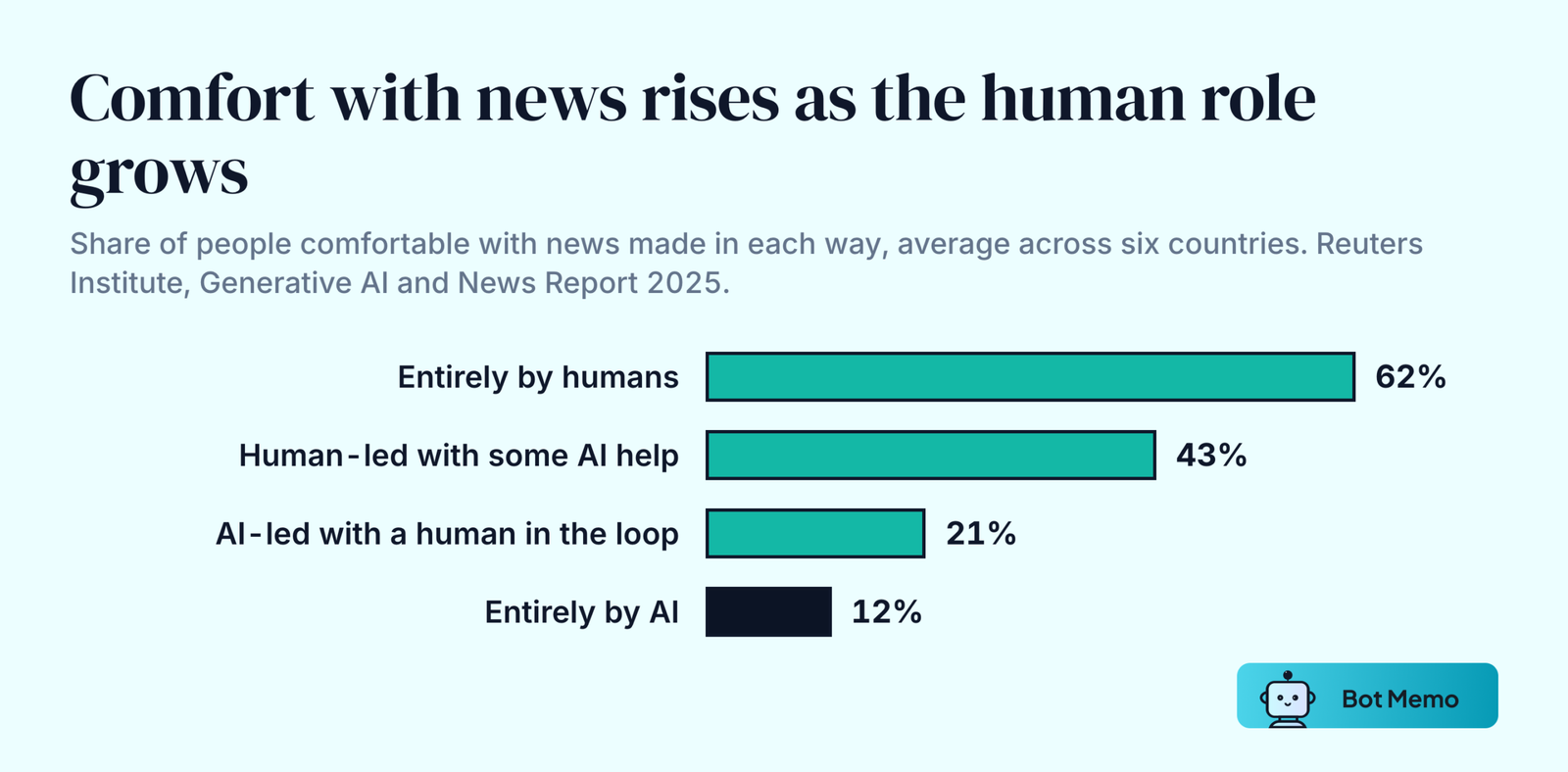
Across six countries surveyed by the Reuters Institute, 12% of people are comfortable with news made entirely by AI. Comfort rises to 21% with a human checking the work, 43% when a human leads with some AI help, and 62% for news made entirely by humans (Reuters Institute, 2025).
Journalists use AI mostly for supporting work. In a Reuters Institute survey of 1,004 UK journalists, 22% use AI at least monthly for story research, 16% for idea generation, and 10% for first drafts of articles (Reuters Institute).
Consumers
- 53% of US consumers distrust or lack confidence in AI search results and summaries, and 61% want an option to turn AI summaries off, in a Gartner survey of 377 consumers (Gartner, 2025).
- In a survey of 1,000 people each in the US, UK and Germany, only 20% said they trust AI itself and 25% think they can recognize AI-generated content. In a follow-up experiment, ads labeled as AI-generated were rated less natural and less useful than identical ads labeled as made by people (Nuremberg Institute for Market Decisions).
AI Writing Market Size
Research firms define these markets differently, so their estimates do not add up to one another.
- Market.us expects the global generative AI in content creation market to reach $175.3 billion by 2033, from $11.6 billion in 2023, a 31.2% annual growth rate. It names OpenAI, IBM, NVIDIA, Adobe, Microsoft and Google among the main companies (Market.us).
- Grand View Research estimated the AI text generator market at $392 million in 2022 and projects $1.40 billion by 2030, growing 17.3% a year (Grand View Research).
- Bloomberg Intelligence now forecasts a $2.3 trillion generative AI market by 2032. Its June 2023 forecast was $1.3 trillion by 2032, up from $40 billion in 2022 (Bloomberg, 2023), and it raised that to $1.8 trillion in March 2025 (Bloomberg Intelligence, June 2026).
- Market Research Future values the natural language processing market at $42.12 billion in 2025 and projects $231.77 billion by 2035 (Market Research Future). Its earlier edition valued the market at $50.9 billion in 2021 and $64.94 billion in 2022 and projected $357.7 billion by 2030, a 27.6% annual growth rate, with auto-coding, text analytics, pattern and image recognition, and speech analytics as its technology segments (Market Research Future, archived 2024).
For AI company funding and valuations, see the AI startup funding statistics and the broader AI statistics page. For accuracy test results by model, see ChatGPT accuracy rate statistics.
Key Takeaways
- AI writing is widespread at work. Writing was 40% of work-related consumer ChatGPT messages in July 2025, and 97% of marketers in Siege Media’s 2026 survey said their programs use AI.
- Much of the use is editing and support work. About two-thirds of consumer ChatGPT writing requests modify text the user supplied. Among marketers surveyed by HubSpot, only 7% publish AI content without editing it.
- On the web, estimates range from 10% of all sampled pages (Pew) to about half of newly published articles (Graphite), depending on what is counted.
- In controlled experiments, AI cut time on writing and consulting tasks by 25% to 40%, but accuracy problems remain common in AI answers about the news.
- Detectors are least reliable on edited, paraphrased and non-native English writing.
- Readers remain wary. Across six countries, only 12% of people are comfortable with news made entirely by AI.
Frequently Asked Questions
What Percentage of Writers Use AI?
It depends on the group. 97% of marketers in Siege Media’s 2026 survey said their content marketing programs use AI, and 89% of B2B marketers use AI tools for written content (Content Marketing Institute). Among book authors, about 45% of 1,229 authors surveyed by BookBub use generative AI in their work.
How Much of the Internet Is Written by AI?
Pew Research Center found significant signs of AI authorship on 10% of English-language webpages sampled in July 2026, and on more than a third of pages published after ChatGPT’s release. Graphite estimates primarily AI-generated articles were 50.9% of new English-language articles in Q4 2025.
Does Google Rank AI-Written Content?
Yes, but mostly human pages hold most top positions. In Ahrefs’ June 2026 data, 5.3% of pages ranking in positions 1 to 3 were 100% AI-generated and 54.7% had less than 20% AI content. Semrush found purely AI-generated pages held the number one spot 9% of the time.
How Much Time Does AI Save on Writing?
In an MIT study of 453 professionals, those using ChatGPT spent 40% less time on writing tasks and got 18% higher quality ratings. BCG consultants using GPT-4 worked 25.1% faster on tasks within the model’s abilities.
Can Teachers Detect AI Writing?
Detection software is not reliable enough to settle a case on its own. In Temple University’s test, Turnitin gave the correct 100% AI score to 77% of fully AI-written texts, and gave a partial score to only 43% of texts that mixed human and AI writing. A study of 14 detectors found none above 80% accuracy.
How Many Students Use AI to Write Assignments?
94% of UK undergraduates used generative AI for assessed work in December 2025 (HEPI). In the US, 54% of teens have used chatbots for schoolwork help (Pew). Turnitin’s detector flagged about 15% of English-language essay submissions between October 2025 and February 2026 as at least 80% AI-written.
Is AI Replacing Writers?
AI has reduced some writing work but has not removed the occupation. Upwork writing job posts fell 33% after ChatGPT’s release in one analysis, and exposed freelancers saw about 2% fewer contracts in peer-reviewed research. The US Bureau of Labor Statistics projects little or no change in employment for writers and authors from 2025 to 2035.
Sources and Methodology
This page collects published figures from research centers, peer-reviewed journals, universities, survey firms, government agencies and companies. Each statistic links to the report or page that published it, with the sample, geography and date where the publisher states them. Figures were checked against those publications on September 16, 2026. Where a survey has a newer edition, both results are shown, and company-reported figures are labeled with the company’s name. AI detection figures are estimates from detection models, which can misclassify individual texts.
Main sources:
- Pew Research Center (web content analysis, 2026; teen surveys, 2025 and 2026)
- Graphite, Ahrefs and Semrush web and search studies
- OpenAI and Harvard researchers, “How People Use ChatGPT” (NBER, 2025)
- Siege Media, Content Marketing Institute, HubSpot, Salesforce, Authority Hacker and Sociality.io marketing surveys
- MIT, Harvard Business School and BCG, and NBER productivity studies
- Tow Center for Digital Journalism, EBU and BBC accuracy studies
- Turnitin, Temple University, University of Kansas, Stanford and International Journal for Educational Integrity detection research
- HEPI, Pew Research Center, Study.com and BestColleges student surveys
- Authors Guild, Society of Authors, BookBub, Jennifer Gregory, Bloomberry, Brookings and US Bureau of Labor Statistics
- Reuters Institute, Gartner and Nuremberg Institute for Market Decisions trust research
- Market.us, Grand View Research, Bloomberg Intelligence and Market Research Future

About the author
Editorial Staff
The Editorial Staff at Bot Memo is a team of writers, analysts, and AI agents dedicated to mapping the global AI startup ecosystem. Led by Chintan Zalani, the team tracks thousands of funding rounds, classifies companies across verticals, and distills it all into actionable intelligence for investors and founders.