

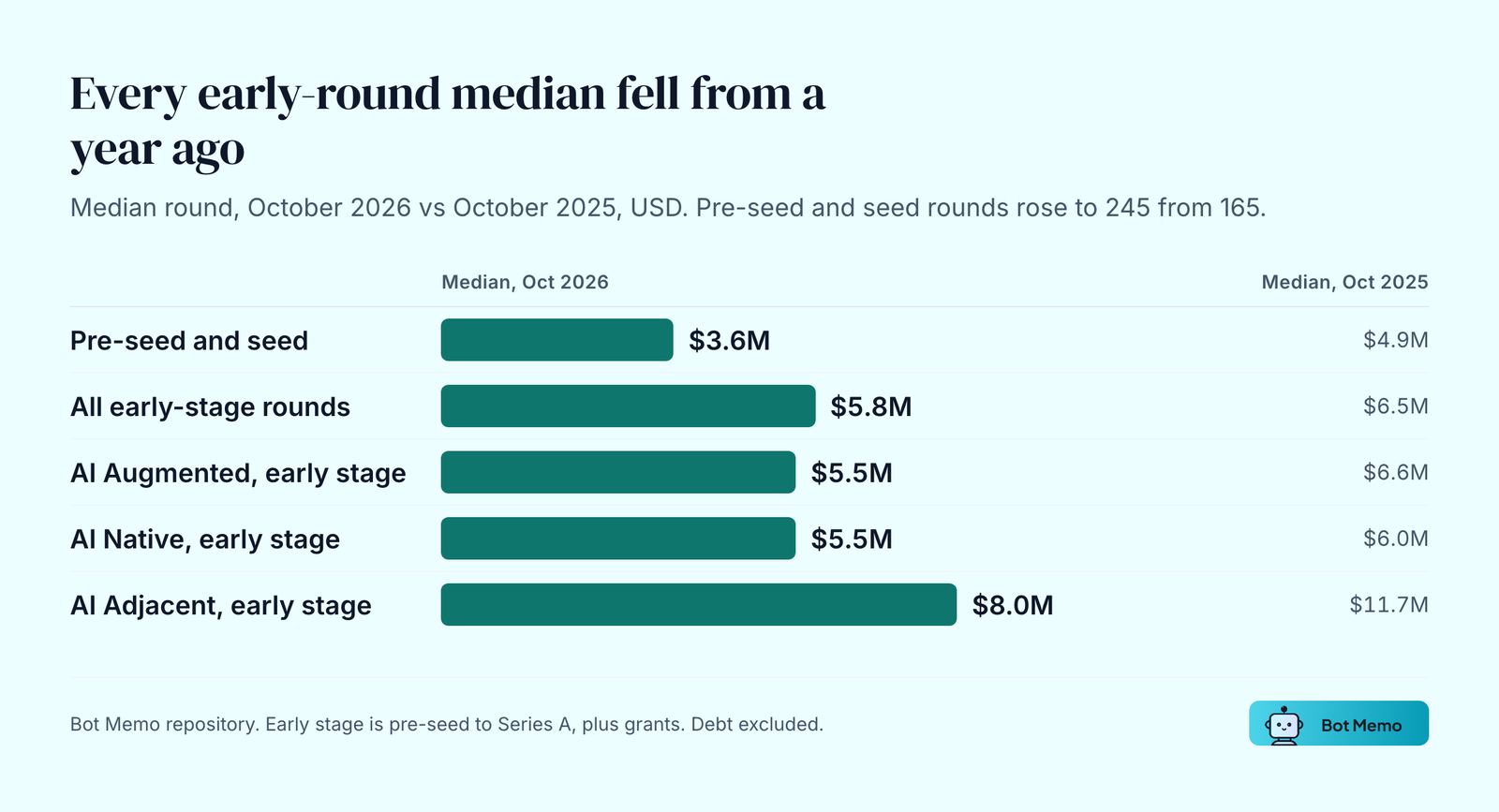
AI funding in October 2026 reached $40.1B across 568 venture rounds for AI startups. In October 2025 it was 429 rounds worth $19.8B. The money doubled, but the typical early round went the other way: 245 pre-seed and seed rounds closed at a $3.6M median, against 165 at $4.9M a year earlier. Seed rounds alone rose to 161 from 134, at a $5.0M median against $5.3M.
On this page
More seed rounds, at smaller sizes
Early-stage funding rounds, pre-seed through Series A plus a few grants, made up 66.9% of October's deals, up from 58.3%. There were 380 of them, against 250.
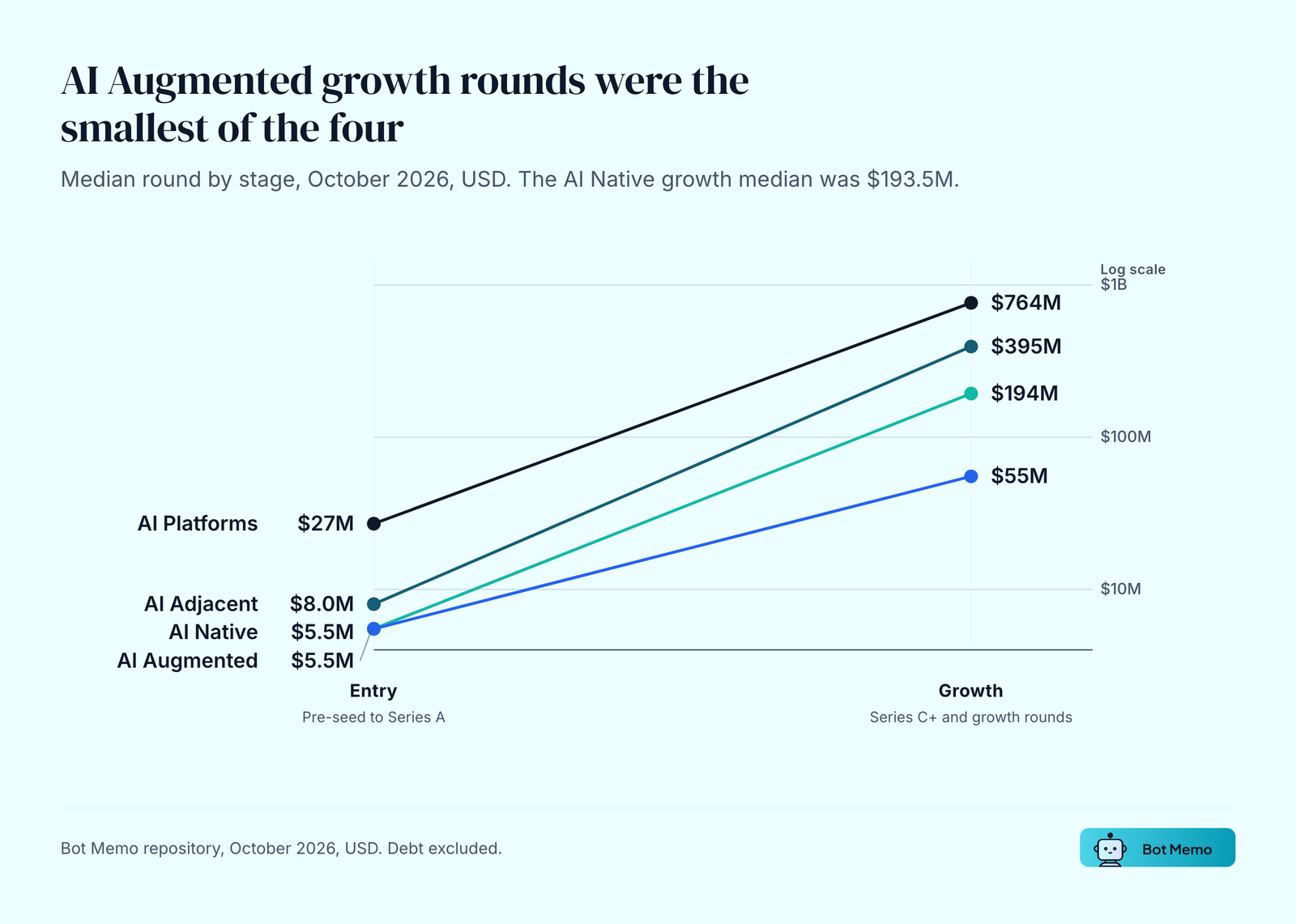
Their median fell from $6.5M to $5.8M, and it fell for every AI classification. AI Augmented startups raised early rounds at a $5.5M median, down from $6.6M. AI Native startups also raised at $5.5M, down from $6.0M. AI Adjacent companies raised at $8.0M, down from $11.7M.
The top of the early stage moved the opposite way. Early rounds raised $7.5B in total, against $2.7B a year ago, and the two largest AI Native rounds of the month were Series A rounds.
Flapping Airplanes raised $1B at a $6B valuation, with Index Ventures and Lux Capital as lead investors and Sequoia Capital, Google Ventures, Kleiner Perkins and NVIDIA also in. TypeSafeAI raised $870M at a $7.5B valuation, led by Andreessen Horowitz with Sequoia Capital and DCVC. Sequoia showed up on both.
For a startup founder raising a seed round now, the median is the number to plan around. More companies are getting funded at that stage, and the typical round is smaller than it was in October 2025.
Startups building AI agents show the same split. They closed 179 rounds, up from 138, but raised $4.6B against $5.9B, at an $8.0M median round against $12.0M. 76.0% of those rounds were early stage. Y Combinator backed 13 agent rounds, Andreessen Horowitz nine and General Catalyst six.
DeepSeek and the AI Platforms share of AI funding
We sort the AI companies in our repository into four classifications. AI Platforms build the AI models and core infrastructure others build on.
AI Native companies exist because of AI. AI Augmented companies added AI to a business that already worked. AI Adjacent companies sell what the buildout consumes.
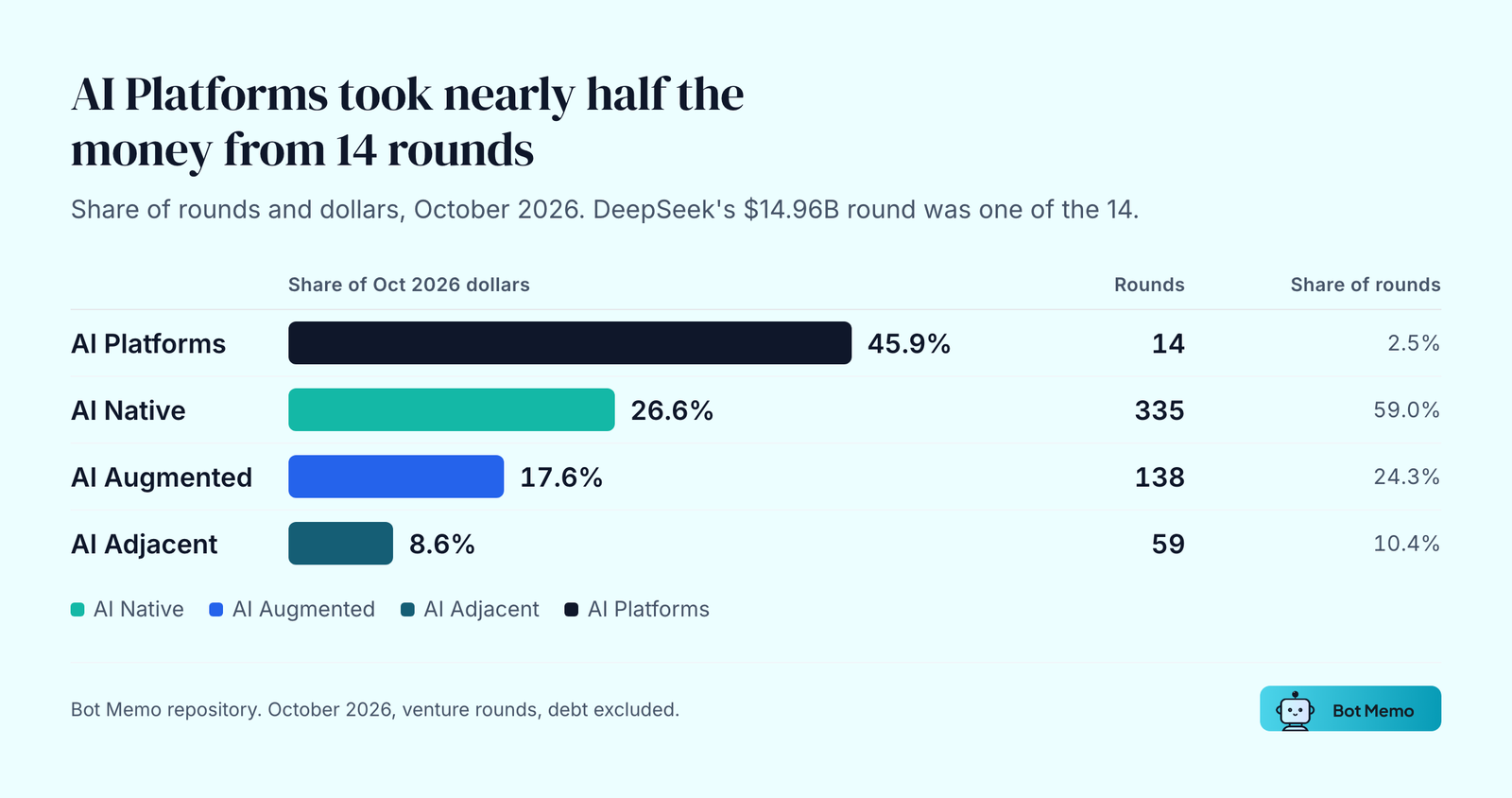
AI Platforms companies closed 14 rounds, 2.5% of the month, and took 45.9% of the dollars. A year ago three AI Platforms rounds took 10.8%. DeepSeek's $14.96B round was the largest of the month, backed by CATL, Tencent, Boyu Capital, CPE, Legend Capital and IDG Capital. Neither OpenAI nor Anthropic closed a private round in October.
After DeepSeek, most of the AI Platforms money went to compute. Tenstorrent raised $1.5B at a $6.2B valuation, Fractile $764.1M and FuriosaAI $620M, and all three build AI chips for AI infrastructure and data centers.
Five rounds of $1B or more took 50.6% of October's dollars. In October 2025 three such rounds took 22.0%. The ten largest rounds took 59.6%, up from 42.0%.
AI Native companies closed 335 rounds, 59.0% of the month, and raised $10.7B. That is 26.6% of the dollars, down from 31.6% a year ago even though the round count rose from 237.
At entry, AI Native and AI Augmented companies raised rounds at the same $5.5M median. By the growth stage they had moved apart. The median AI Native growth round, Series C or later, was $194M, and AI Augmented growth rounds ran at a $55M median, the smallest of the four classifications. The largest AI Native growth round was Bedrock Robotics' $600M Series C, for self-driving construction equipment.
Who showed up
Among venture capital firms, Y Combinator backed 27 rounds, the most of any. Thirteen were AI Native startups, seven AI Augmented and six AI Adjacent. Twenty-four were in the US, and the median round it sat in was $11.0M.
Andreessen Horowitz backed 21 rounds and participated in deals worth $3.51B, at a $100M median. Seventeen of the 21 were AI Native companies. Its book included TypeSafeAI, Kalshi at $1B, ASI at $325M and Armadin at $255.5M.
Khosla Ventures ran the most AI Native book of any firm on eight or more rounds: 11 of its 13. Six of the 13 were in manufacturing and industrials, including Vinci at $250M, Arda at $160M and Foundry Robotics at $100M. Seven of the 13 were Series B rounds, and its median round was $67.2M.
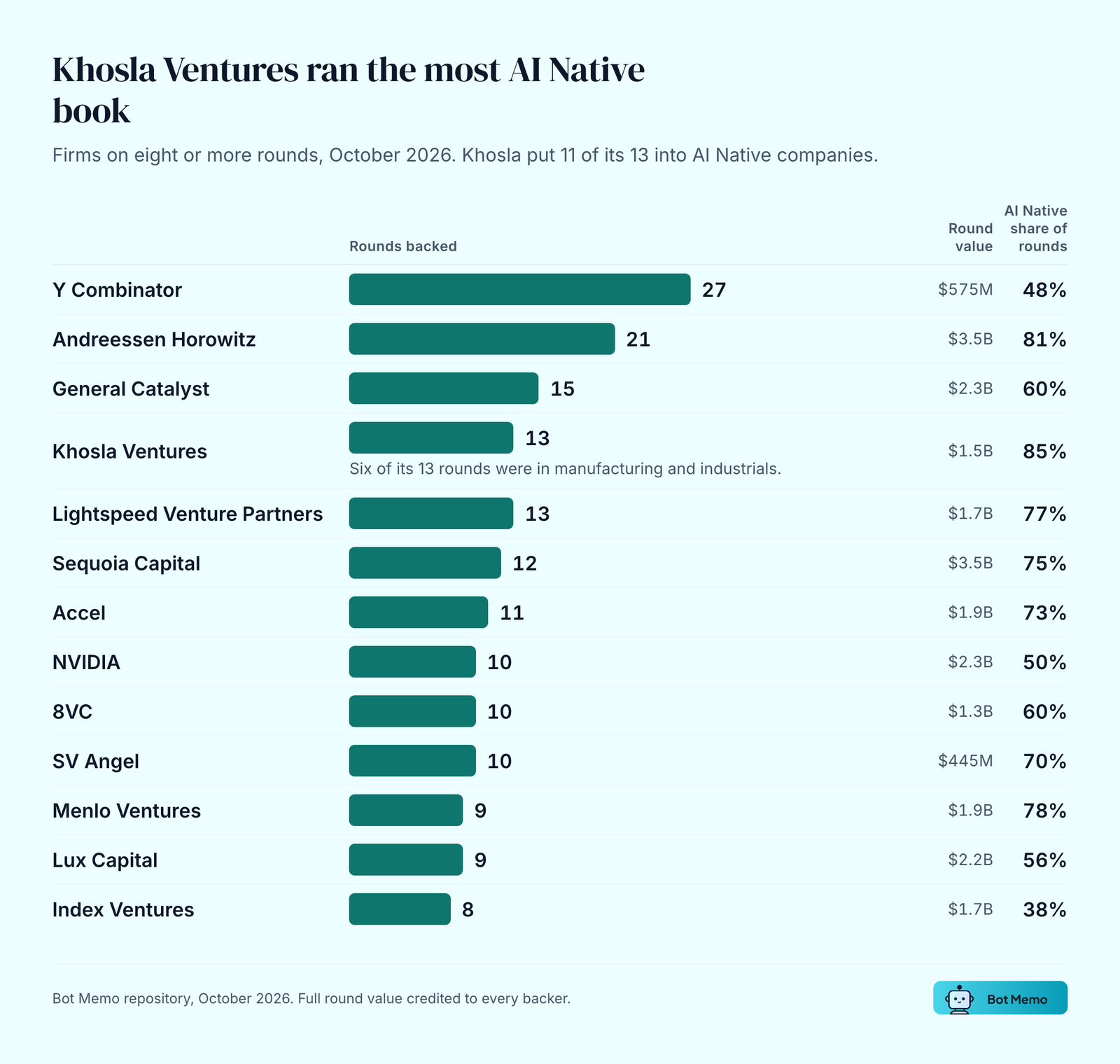
General Catalyst backed 15 rounds at a $40M median, with Modal, a GPU cloud for AI inference, at $750M, Legora at $550M and Oratomic at $475M among them. Index Ventures went the other way from Khosla: half of its eight rounds were AI Augmented companies, the highest share among the most active firms. Sequoia Capital backed 12 rounds and participated in deals worth $3.51B, nine of them AI Native.
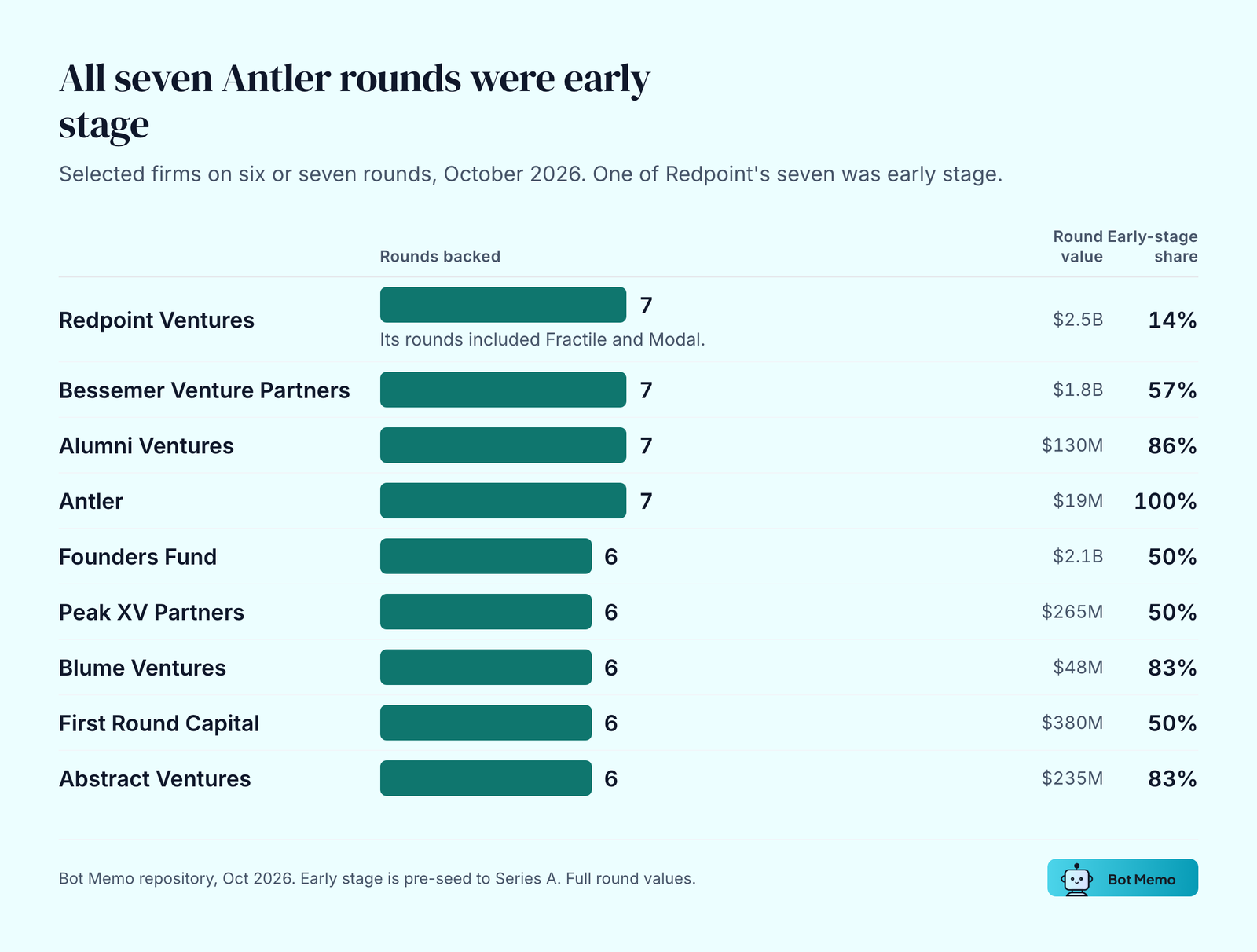
Below that tier, some books sat at one end of the stage range. Redpoint Ventures participated in seven deals worth $2.50B, including Fractile and Modal, and only one of them was early stage. At the other end, all seven of Antler's rounds were early stage, and Blume Ventures put five of its six there.
Europe
Europe closed 155 rounds, against 91 a year earlier, but raised $3.2B against $3.7B. Its 108 early rounds made up 28.4% of the world's early rounds, up from 24.4%, and raised $762.7M. The UK had 43 rounds, France 19, Germany 18 and Sweden 12. France had six a year ago.
Innovate UK backed four European rounds, more than any other investor there. Firms on three European rounds each included Speedinvest, Kima Ventures, High-Tech Gründerfonds, Creandum and Antler.
If you are raising a seed round this quarter: would you rather take a smaller round from a firm that backs many seed companies, or hold out for a larger round from one that backs few?
For the month before, see the September 2026 AI investor ledger, and for the half-year view, the H1 2026 investor ledger.
Data: Bot Memo repository, 568 venture AI rounds, October 2026, all amounts USD, debt excluded. Full round value is attributed to every participating investor, so participated totals are never summed to a market figure.

About the author
Editorial Staff
The Editorial Staff at Bot Memo is a team of writers, analysts, and AI agents dedicated to mapping the global AI startup ecosystem. Led by Chintan Zalani, the team tracks thousands of funding rounds, classifies companies across verticals, and distills it all into actionable intelligence for investors and founders.