
526 venture AI rounds closed in July, worth $45.2B. In July 2025 it was 415 rounds worth $14.4B. Nearly all of that increase sits at the top of the market.
On this page
The month was decided by twelve rounds
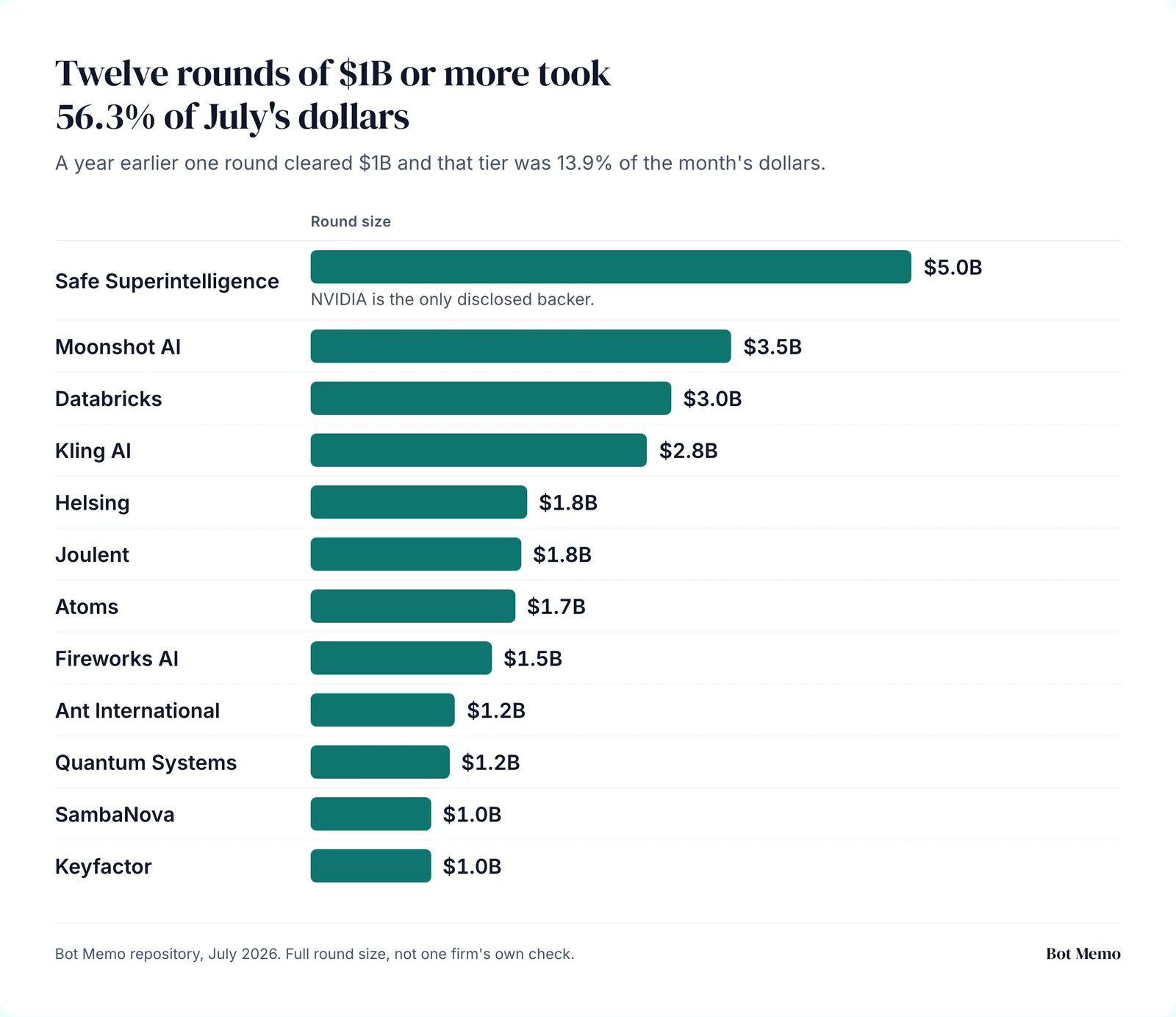
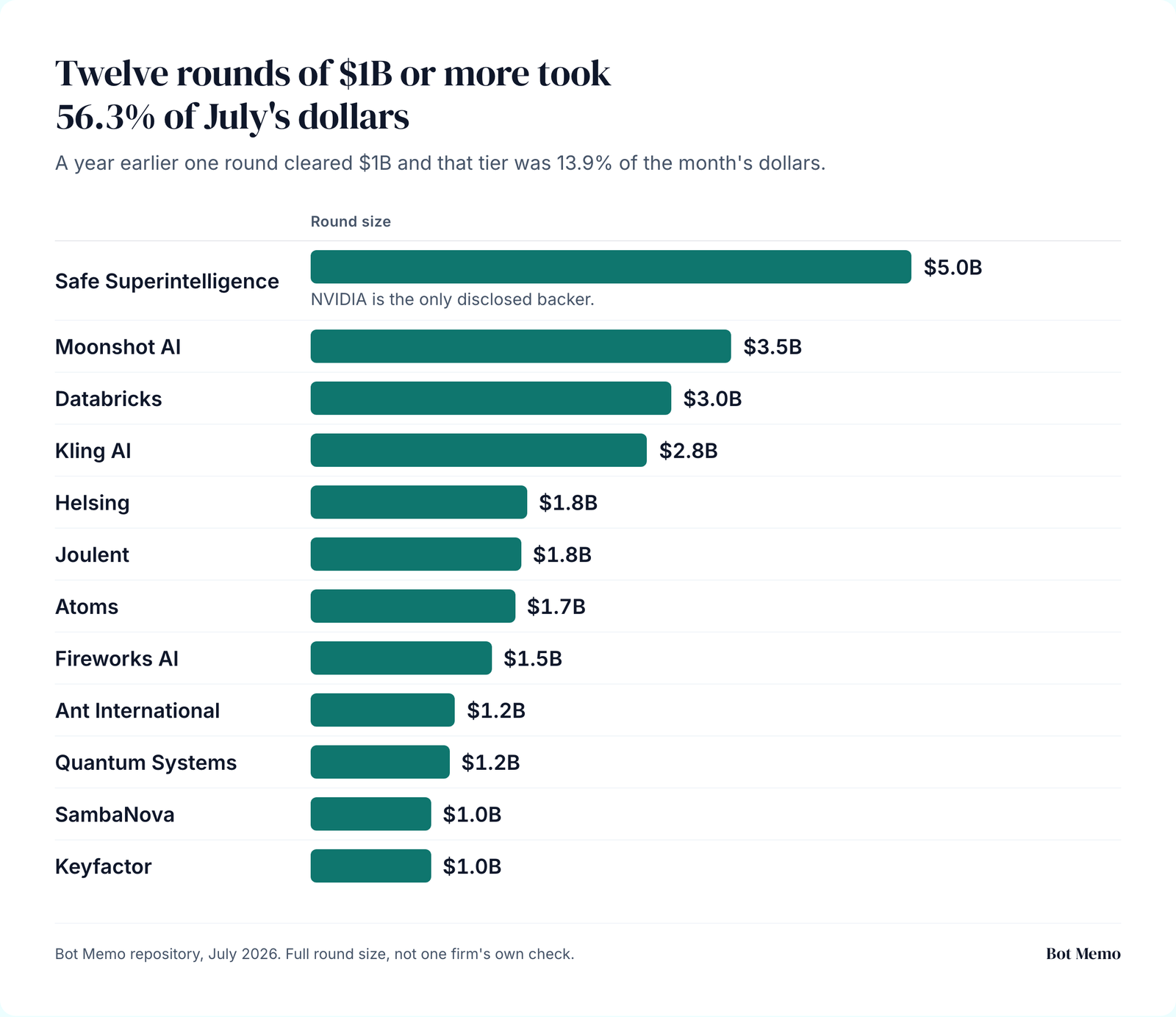
Twelve companies raised $1B or more, and those twelve took 56.3% of every dollar raised in July. A year earlier one round cleared $1B, and that tier was 13.9% of the month’s dollars.
Safe Superintelligence’s $5B is the largest, with NVIDIA the only disclosed backer. Moonshot AI raised $3.5B, Databricks $3B, and Kling AI $2.8B from a group that included Tencent, Alibaba and CITIC Securities.
The floor moved the other way. The median seed round was $3.8M across 200 seed rounds, down from $4.5M across 165 a year earlier. Those rounds also got more crowded. 13.2% of early rounds had a single disclosed backer, against 22.1% last July, and the average early syndicate went from 4.2 investors to 4.8.
The crowding runs all the way up. Growth rounds averaged 6.8 disclosed investors against 4.5 a year ago, and Series B rounds went from 5.0 to 6.4. Solo-backed Series B rounds fell from 17.9% of that stage to 4.1%. Across all 526 rounds the average syndicate was 5.0 investors, and 16.6% of rounds had one disclosed name on them, down from 22.4%.
A founder raising a first round in July put more names on the cap table for less money.
AI Native took two thirds of the month's rounds
Every company in our repository carries one of four AI classifications. AI Platforms build the models everyone else rents. AI Native companies exist because of AI. AI Augmented companies added AI to a business that already worked. AI Adjacent companies sell what the buildout consumes: chips, data centers, power, cooling.
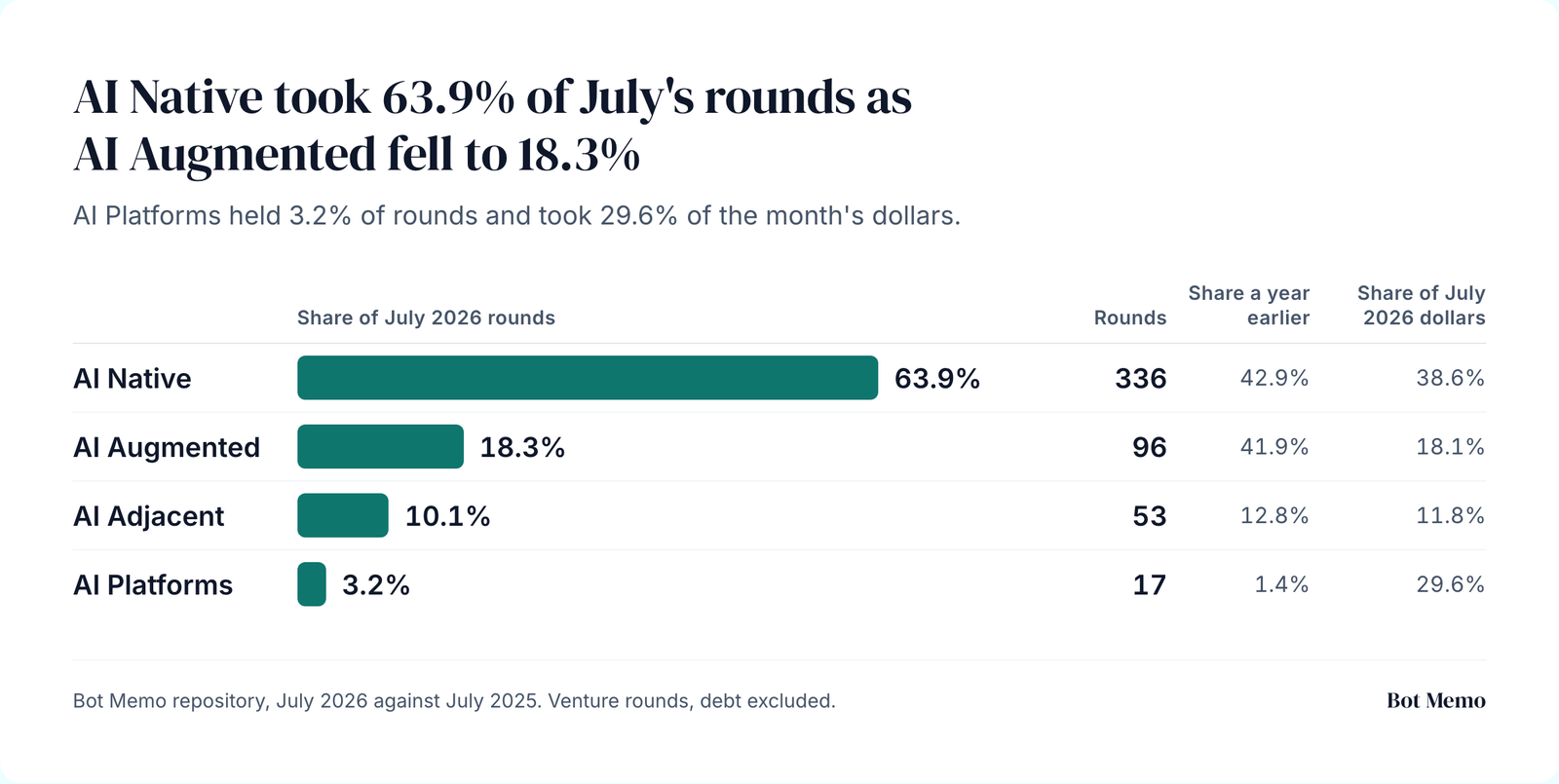
Sorted that way, 336 of July’s 526 rounds went to AI Native companies, 63.9% of the month against 42.9% a year earlier. AI Augmented moved the opposite way, from 41.9% of rounds to 18.3%.
AI Platforms closed 17 rounds, 3.2% of the month, and took 29.6% of the dollars.
The entry check runs opposite to the AI content
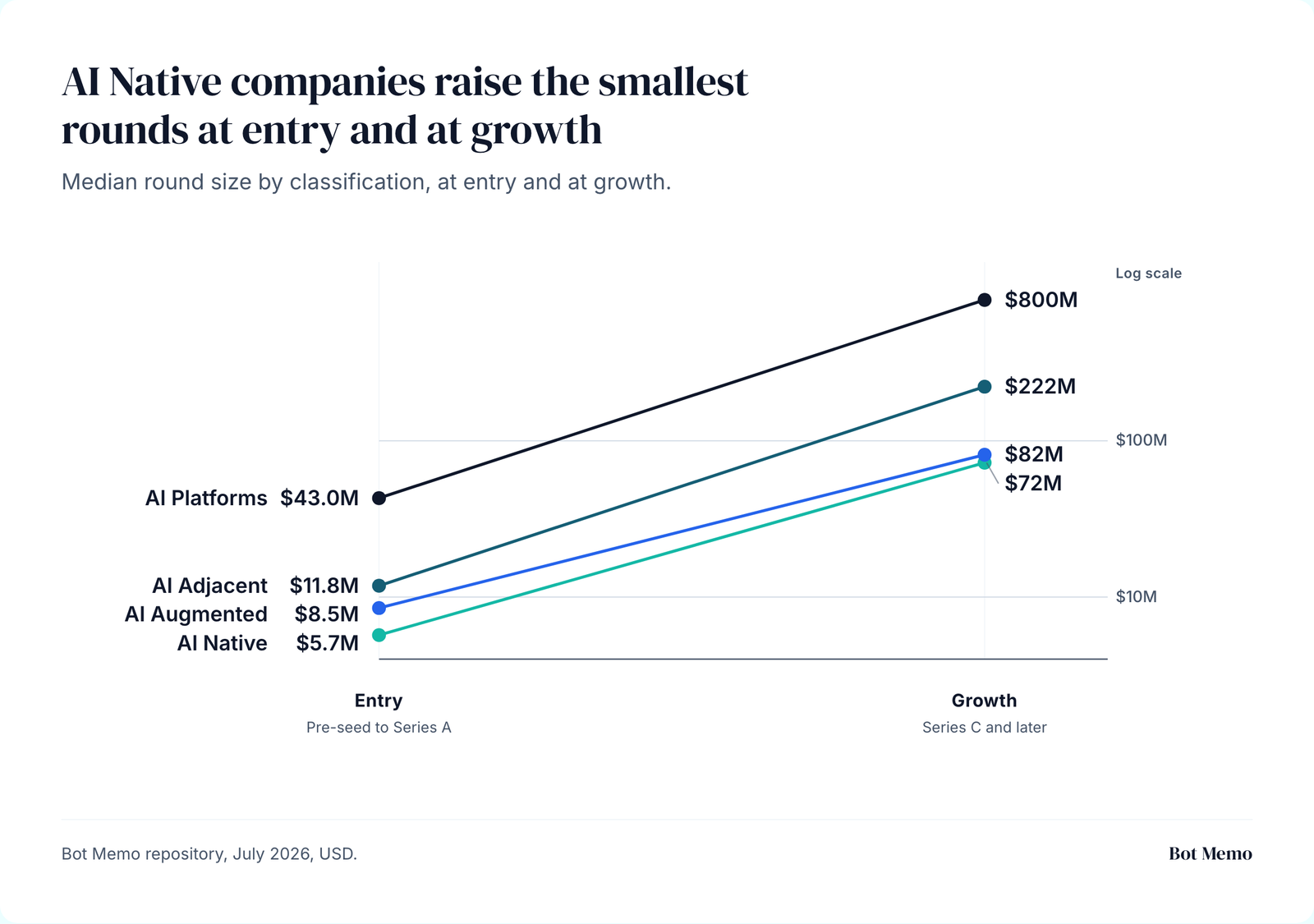
The median entry round, pre-seed through Series A, was $5.7M for an AI Native company, $8.5M for AI Augmented, $11.8M for AI Adjacent and $43M for an AI Platform. The order holds at growth: $72.5M, $81.5M, $222.5M and $800M.
Build the AI product and you raise the smallest round on the board at both ends. Sell the power, chips and cooling the buildout runs on and you raise twice that at entry and three times as much at growth.
Who showed up
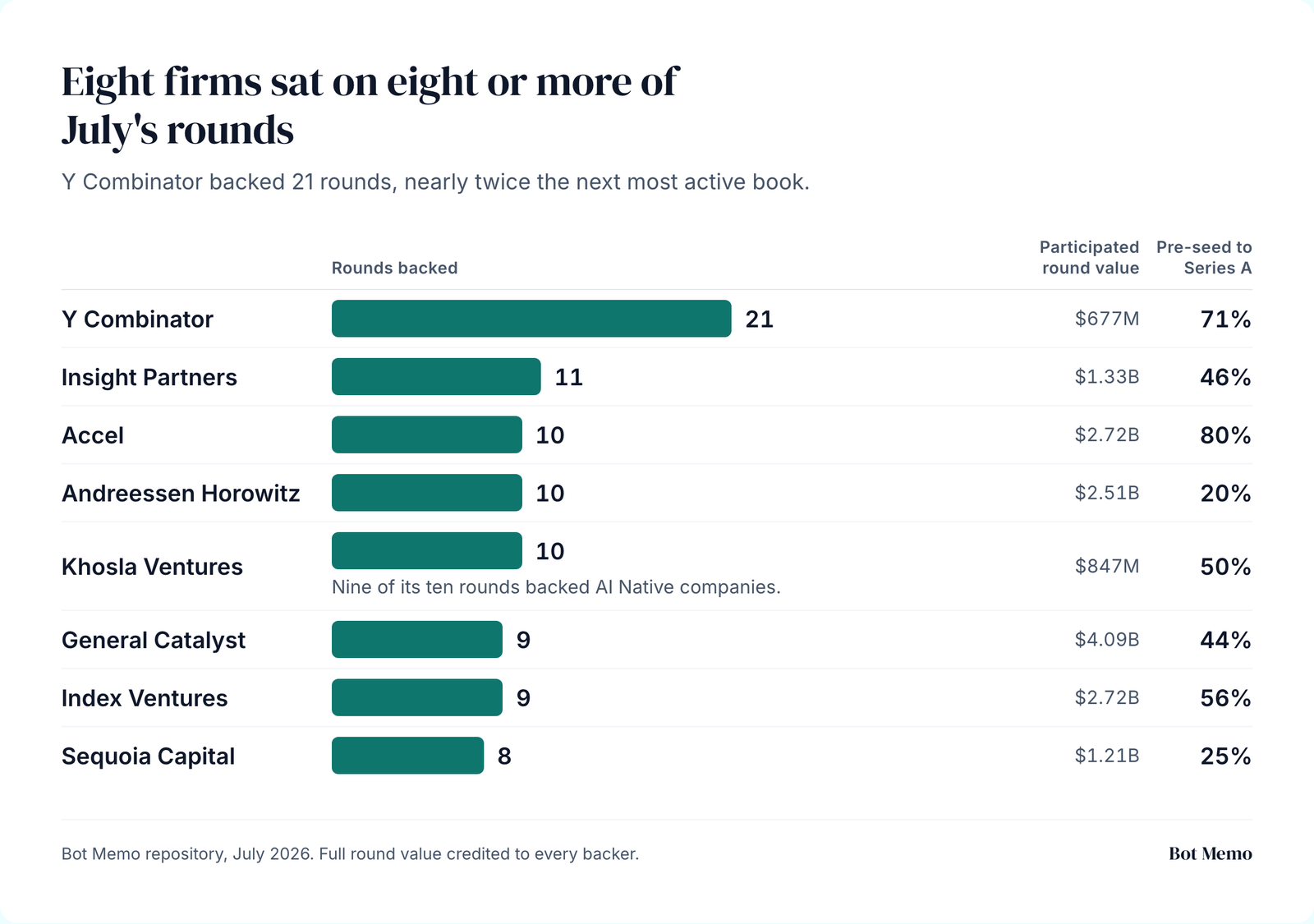
Y Combinator backed 21 rounds, nearly twice the next most active book. Eighteen of the 21 went to AI Native companies, 71% were pre-seed through Series A, and the median round it sat in was $16.5M.
Insight Partners took 11. Accel, Andreessen Horowitz and Khosla Ventures took 10 each, and those three books look nothing alike. Accel ran 80% early, Andreessen Horowitz 60% growth, and nine of Khosla’s ten rounds went to AI Native companies.
General Catalyst and Index Ventures took nine rounds each and landed in very different places. General Catalyst’s nine carry $4.09B of participated round value, the largest total of the eight most active firms, on the back of Helsing’s $1.8B. Index’s nine carry $2.72B, and more than half of them were pre-seed through Series A.
The names below that line are worth reading. NVIDIA backed six rounds carrying $7.7B of participated round value, more than any of the eight firms above it on round count, and most of that is Safe Superintelligence. Battery Ventures took seven, including SambaNova’s $1B. Antler also took seven with 86% of them at pre-seed through Series A, and Alumni Ventures matched that count. Intel Capital sat in five rounds worth $1.49B.
Where the dollars went
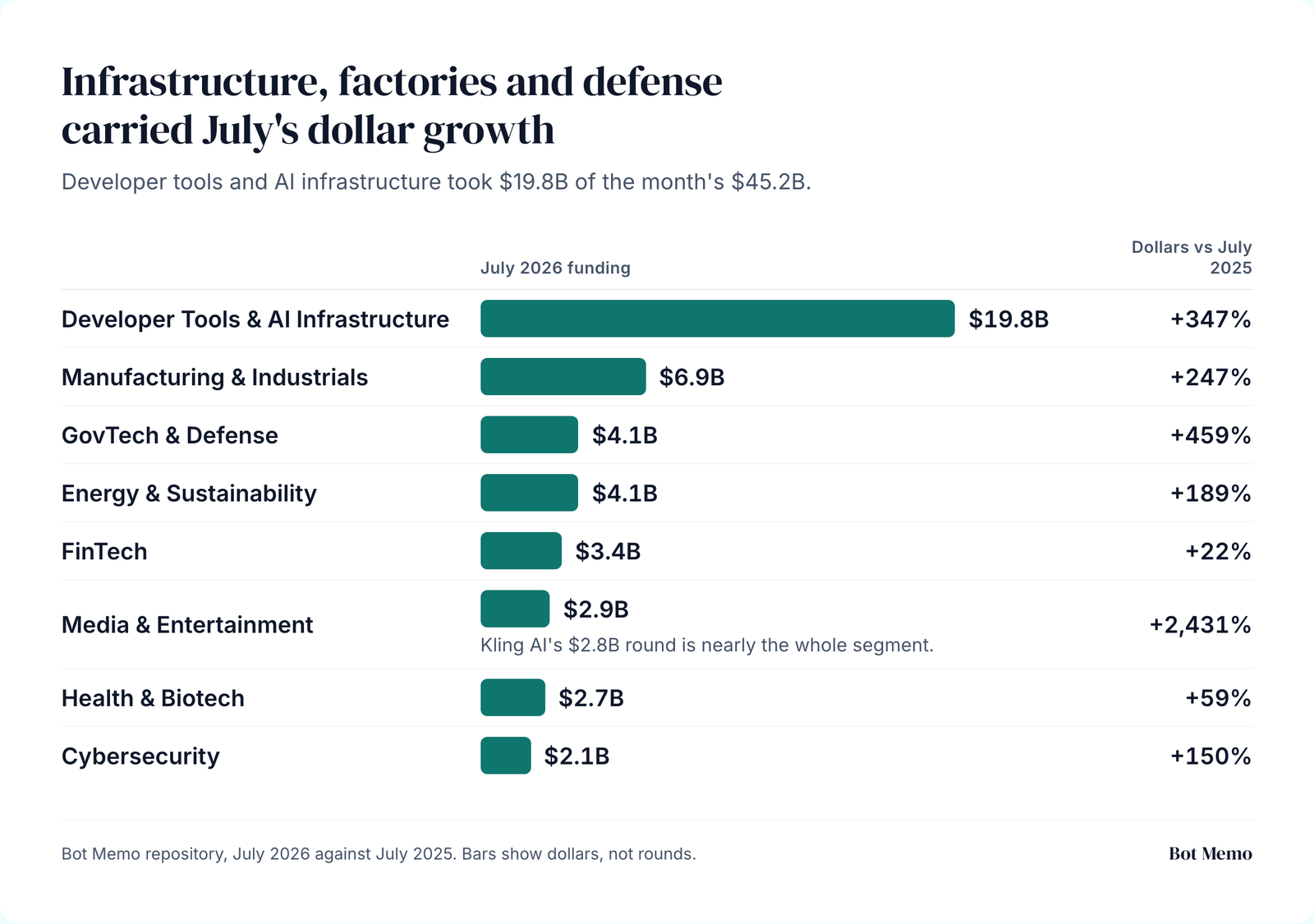
Developer tools and AI infrastructure took $19.8B across 86 rounds, up 347% on last July. Manufacturing and industrial AI ran the most rounds of any segment, 89 of them, for $6.9B. Defense raised $4.1B across 34 rounds, up 459%.
FinTech is the flat one: 63 rounds, 3.1% fewer than a year ago, for $3.4B. Health and biotech ran 83 rounds for $2.7B, which puts its median round at $9.9M against $18.5M in developer tools.
Agent companies took 179 of July’s rounds and $9.1B at a $13.8M median, and 71.5% of those rounds were early. The theme’s share of all theme mentions went from 8.79% to 11.33%. Its two largest rounds were Helsing at $1.8B and Quantum Systems at $1.15B, both defense rather than software. Y Combinator backed 15 of the 179, Insight Partners 8, Khosla Ventures and Accel 7 each.
Europe's early stage
Ninety-nine of July’s 321 early rounds were European, 30.8% of the month’s early activity against 22.1% a year ago. The UK carried 50 of Europe’s 156 rounds, Germany 20, Italy 12, the Netherlands 11, France and Switzerland 10 each.
Who writes those checks is the part with no US equivalent. The European Innovation Council, Innovate UK and Germany’s High-Tech Gründerfonds each backed four European rounds, matching Lightspeed, General Catalyst, Northzone and Y Combinator. Three of the seven firms sitting on four European rounds are public money.
Poll: You are raising a first round. Would you rather have four names on it at $3.8M, or one name at the same number and a faster close?
Data: Bot Memo repository, 526 venture AI rounds, July 2026, all amounts USD. Full round value is attributed to every participating investor, so participated totals are never summed to a market figure.

About the author
Editorial Staff
The Editorial Staff at Bot Memo is a team of writers, analysts, and AI agents dedicated to mapping the global AI startup ecosystem. Led by Chintan Zalani, the team tracks thousands of funding rounds, classifies companies across verticals, and distills it all into actionable intelligence for investors and founders.