

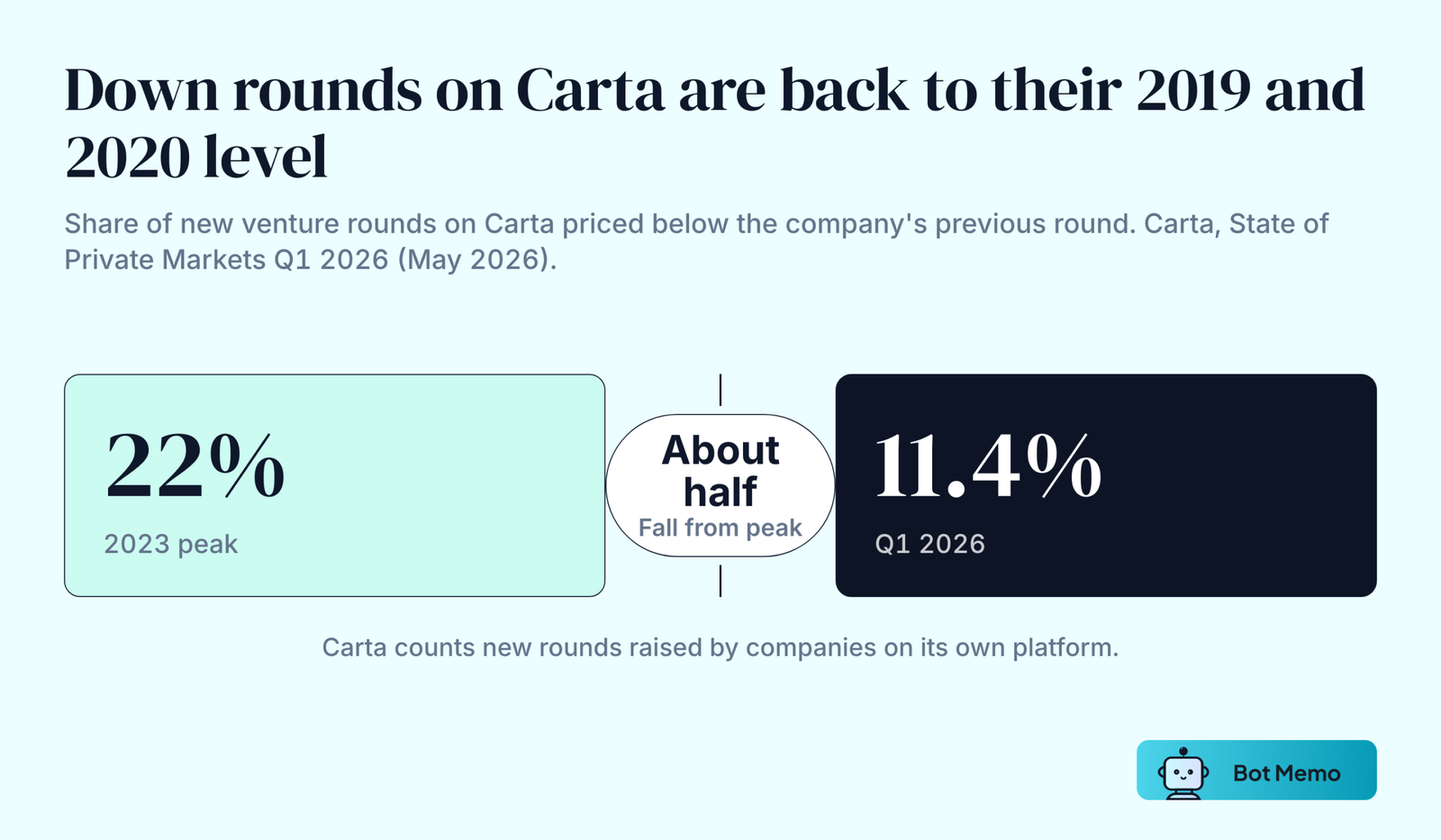
On Carta, down rounds have fallen back to their pre-2021 rate, but AI companies have not escaped them. Carta says 11.4% of new rounds on its platform in Q1 2026 were priced below the company’s previous round, and puts the 2023 peak at 22%. Since early 2025, Groq, Instabase and Nuro have raised at lower valuations, while Humane, Inflection AI and Builder.ai showed other ways a high valuation can unwind without a priced round: a sale, a licence deal or insolvency.
This page lists reported AI down rounds, plus licence-and-hire deals, asset sales, rescue rounds and collapses after high private valuations, with the source and date for each figure.
On this page
Key numbers at a glance
- Carta (May 2026): 11.4% of new rounds on Carta in Q1 2026 were down rounds, back in line with 2019 and 2020. The peak was 22% in 2023.
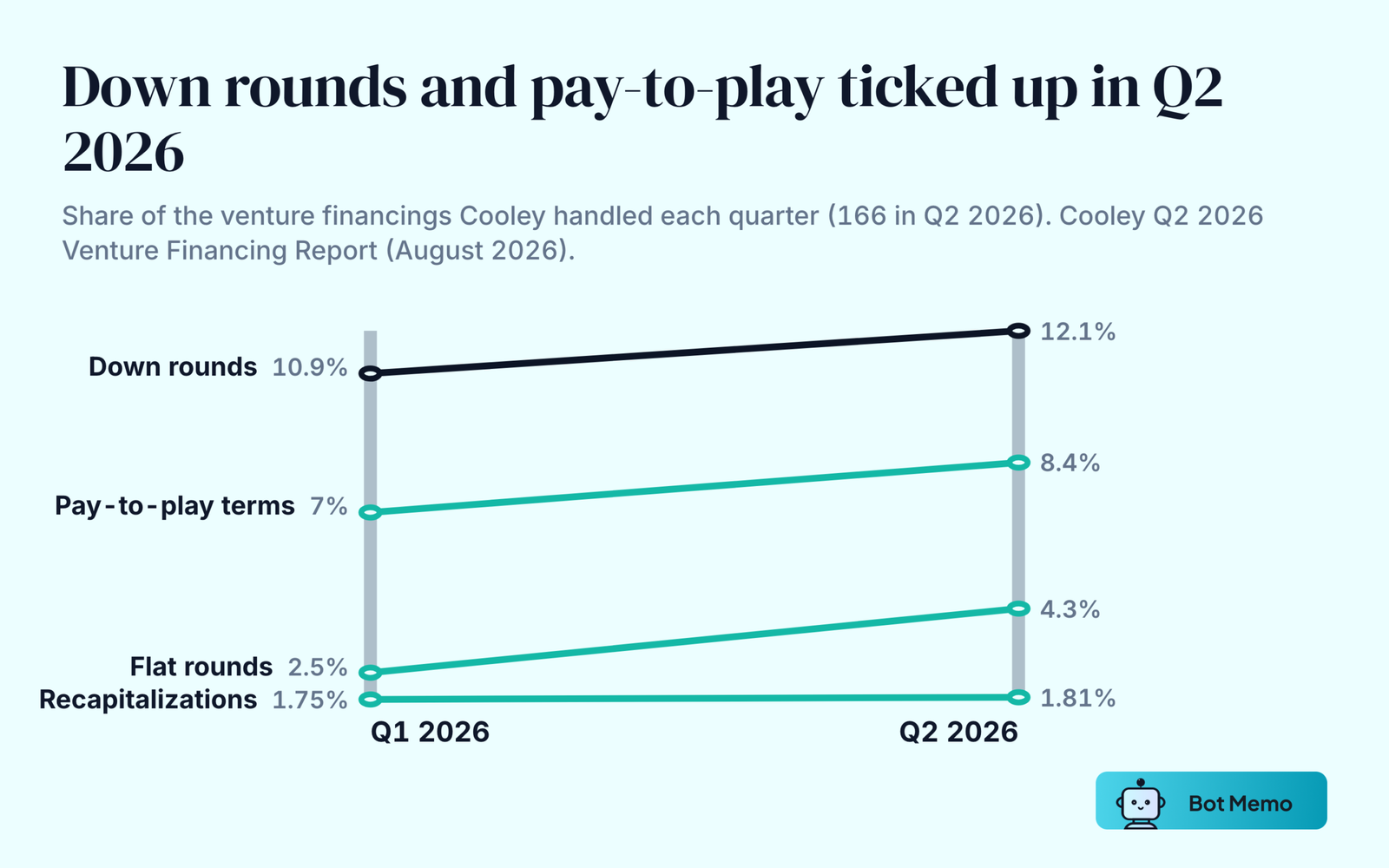
- Cooley (August 2026): down rounds were 12.1% of the 166 financings the law firm handled in Q2 2026, up from 10.9% in Q1.
- PitchBook, via Fortune (August 2025): 15.9% of venture-backed deals in 2025 to that point were down rounds, a decade high, and 29.3% of those down rounds were in AI and machine learning.
- Groq raised $350M at a $3.5B valuation in August 2026, about half its last disclosed valuation of $6.9B in September 2025, after a licence deal with Nvidia and a $650M June 2026 raise with no disclosed valuation (TNW, Mobile World Live).
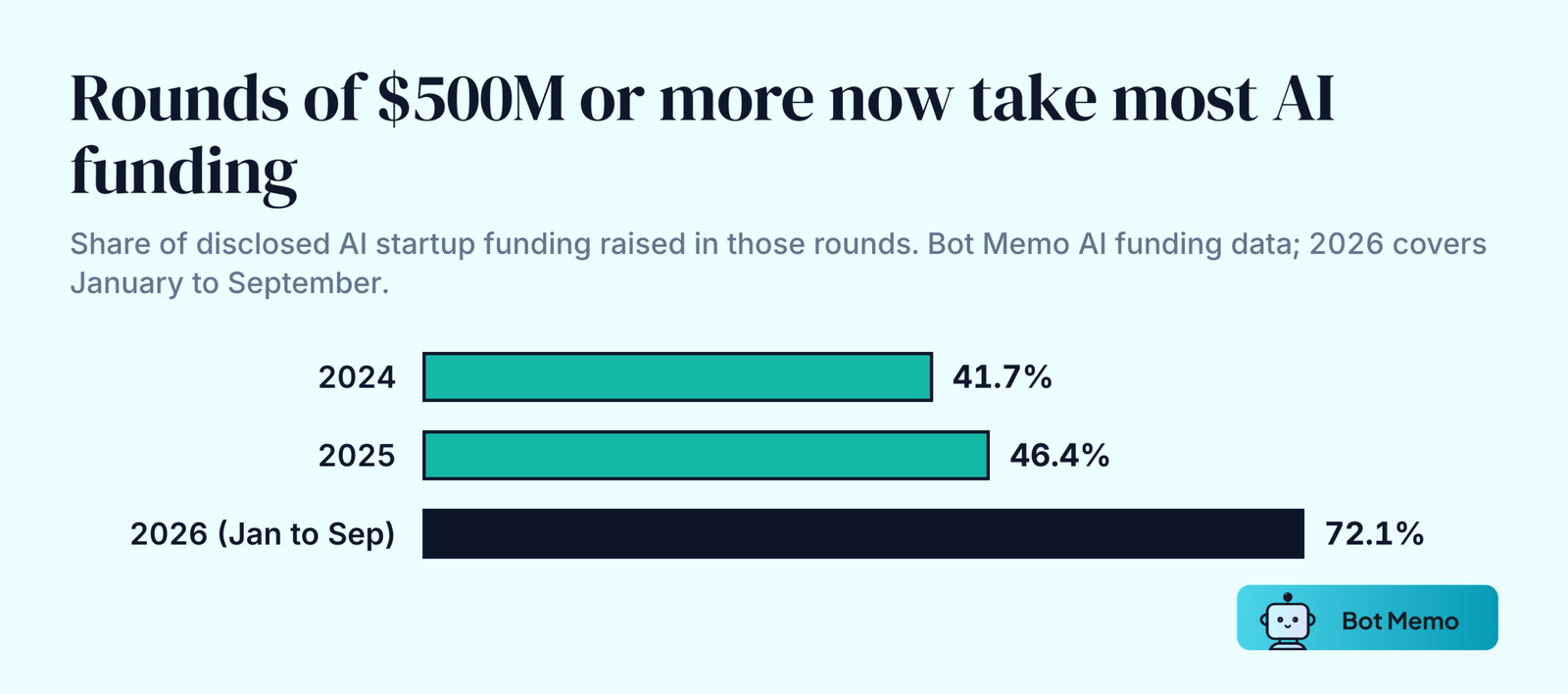
- Bot Memo data: rounds of $500M or more took 72.1% of disclosed AI startup funding from January to September 2026.
What counts as a down round
A down round is a financing in which a company sells shares at a lower price per share than in its previous round. That is the definition Cooley GO uses. A lower headline valuation is usually the visible sign, but the legal trigger is the share price. Most reporting gives only the headline valuation, so the companies below are listed on that basis.
Three other events often get called down rounds. This page keeps them apart from priced down rounds:
- A flat round prices at the same share price as the previous round. There is no markdown, and usually no anti-dilution adjustment.
- A licence-and-hire deal, where a large tech company licenses a startup’s technology and hires its founders and staff, leaving a smaller company behind. Inflection AI, Adept, Character.AI and Groq have all been through one. The deal value can sit far below, or above, the last private valuation.
- An asset sale or insolvency, where there is no new round at all. Humane, Olive AI and Builder.ai are in this group.
The numbers: down-round rates since 2025
In August 2025, PitchBook data reported by Fortune put down rounds at 15.9% of venture-backed deals in 2025 to date, the highest share in a decade. The same data showed 29.3% of those down rounds in PitchBook’s AI and machine learning category.
Separately, the rate on Carta’s platform fell quickly. Just over 19% of new rounds in Q1 2025 were down rounds. That dropped to about 17% in Q3 2025, the lowest quarterly rate in nearly three years, and to less than 14% in Q4 2025. By Q1 2026 it was 11.4%, which Carta says is back in line with 2019 and 2020. The PitchBook and Carta figures are not directly comparable because their deal universes and periods differ.
Cooley’s deal data comes from a smaller sample: the firm handled 166 reported financings in Q2 2026. It shows a small rise in the second quarter. Down rounds were 10.9% of the deals the firm handled in Q1 2026 and 12.1% in Q2 2026, according to its Q2 2026 Venture Financing Report. Flat rounds rose from 2.5% to 4.3%, while up rounds were still 83.6% of deals.
Inside AI, the picture was mixed before the fall. PitchBook reported in November 2025 that the share of European AI deals closing at a valuation cut rose from 14.3% in 2024 to 15% at the end of Q3 2025, even as the median European AI valuation reached €8.8M, more than 20% above 2024. Those figures cover Europe only.
Reported AI down rounds and structured exits, 2023 to 2026
The table lists AI companies whose new round or deal value was reported below their last private valuation, plus licence deals, rescue rounds and shutdowns that followed a high valuation where the terms were not disclosed. Figures are as reported by the sources linked; where a company did not disclose a value, the table says so.
| Company | What it does | Type | Last private valuation | New price or outcome | Change in valuation | Source |
|---|---|---|---|---|---|---|
| Groq | AI inference chips | Priced round after a licence deal | $6.9B (Sept 2025, last disclosed) | $3.5B on a $350M round, Aug 2026; a $650M June 2026 round disclosed no valuation | About -49% vs last disclosed | TNW, Mobile World Live |
| Instabase | AI document processing | Down round | $2B (Series C, 2023) | $1.24B on a $100M Series D, Jan 2025 | About -38% | TechCrunch (citing Bloomberg) |
| Nuro | Self-driving technology | Down round | $8.6B (2021) | $6B on a $106M round, Apr 2025 | About -30% | Bloomberg, via Claims Journal |
| Humane | AI Pin wearable | Asset sale | $850M (reported by The Information, 2023) | HP bought most assets for $116M, Feb 2025 | Not a round; sale price vs reported valuation | TechCrunch, TechCrunch |
| Builder.ai | AI-branded app building | Insolvency | Over $1B (“AI unicorn”); $250M+ Series D, May 2023, valuation not disclosed | Insolvency proceedings, May 2025, after restating revenue | Not a round | Tech.eu, Tech.eu |
| Inflection AI | Large language models | Licence and hire | $4B ($1.3B round, 2023) | Reportedly about $650M from Microsoft for a licence and legal waiver, Mar 2024 | Not a round; licence fee vs valuation | TechCrunch, The Batch |
| Adept | AI agents | Licence and hire | About $1B | Amazon licence and hiring of founders, Jun 2024; terms not disclosed | Not disclosed | TechCrunch |
| Stability AI | Generative image models | Rescue round | About $1B (reported) | Reportedly about $80M (WSJ, unconfirmed by the company), Jun 2024, with a new CEO; valuation not disclosed | Not disclosed | The Register, The Register (April 2024) |
| Olive AI | Healthcare automation | Shutdown and asset sale | $4B (2021) | Units sold to Waystar and Humata Health, Oct 2023; terms not disclosed | Not disclosed | Fierce Healthcare |
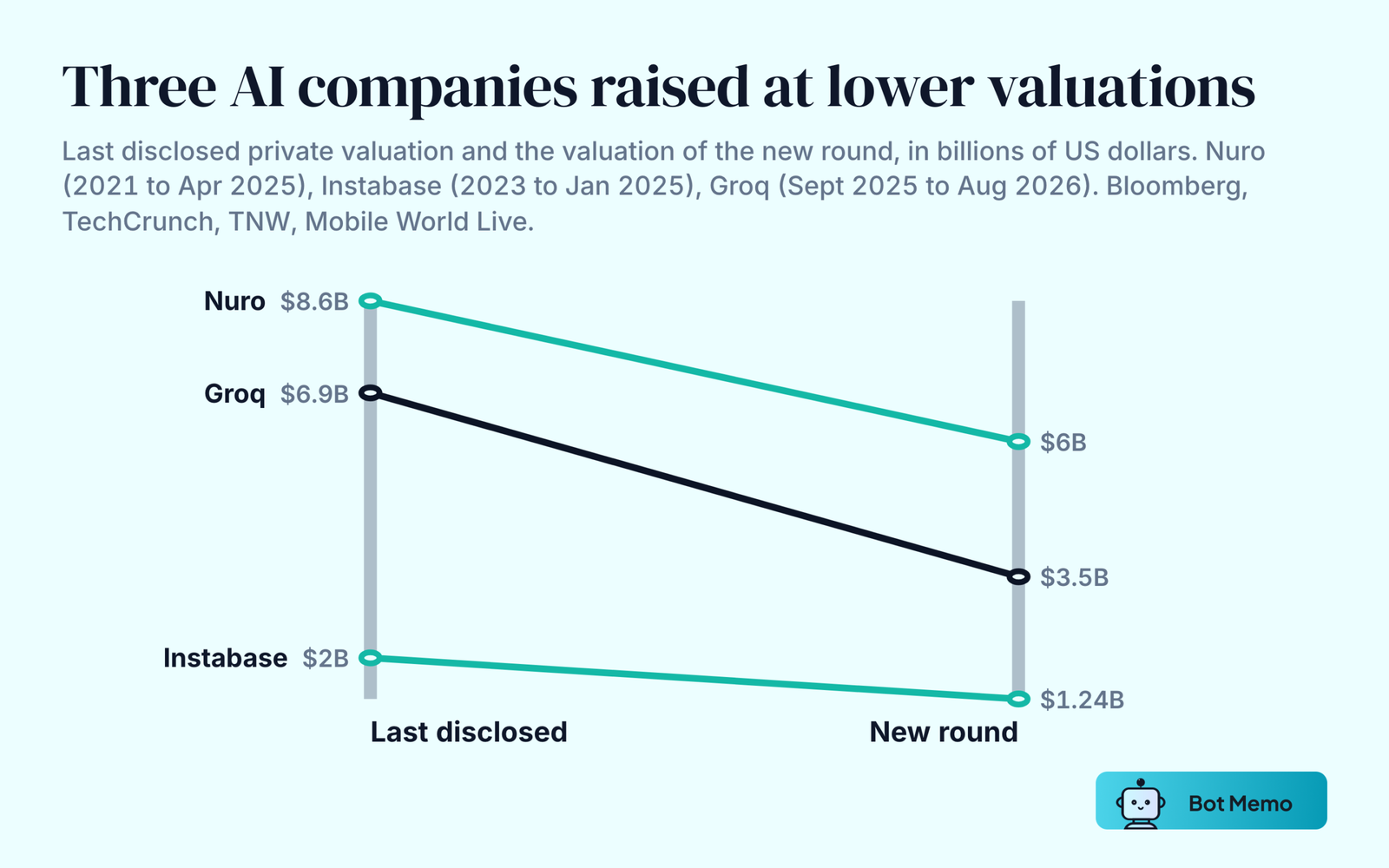
Groq is the most recent case, with a caveat. Its August 2026 round followed a licensing deal in late 2025 in which Nvidia took rights to Groq’s chip technology and hired founder Jonathan Ross and much of the senior team, a deal TNW says was widely reported at around $20B. Groq also raised $650M in June 2026 without disclosing a valuation, so the August round is the first disclosed valuation since September 2025 (Mobile World Live). The company valued at $3.5B is a smaller one than the company valued at $6.9B. Nvidia joined the new round.
Instabase and Nuro were both reported as down rounds. Instabase’s $100M Series D in January 2025 valued it at $1.24B, down from $2B in 2023, according to Bloomberg as cited by TechCrunch. Nuro raised $106M in April 2025 at $6B, down from $8.6B after its 2021 round (Bloomberg, via Claims Journal).
Character.AI is often listed as a markdown, but Google’s August 2024 deal bought out investors at $88 a share, roughly two and a half times the price of the round that valued the company at $1B, according to The Batch.
Where AI funding is concentrated
Bot Memo data shows where AI money went from 2024 onward. Rounds of $500M or more took 41.7% of disclosed AI startup funding in 2024, 46.4% in 2025 and 72.1% from January to September 2026.
Across the wider market, Carta reported that more than 60% of venture capital raised by companies on its platform in Q1 2026 went to AI, and foundation model companies alone took 14.2% of all capital.
Some of the marks now being reset were set when prices were higher. Nuro’s $8.6B valuation dates from 2021 and Instabase’s $2B from 2023. Hardware companies are exposed too. Humane raised more than $230M for the AI Pin and sold most of its assets for $116M (TechCrunch).
Licence-and-hire deals can unwind a high valuation without setting a new one. Groq later raised at a lower disclosed valuation; Inflection’s deal did not set a valuation. At Inflection, Microsoft reportedly paid about $650M, mostly for a licence, against the $4B valuation of its 2023 round. According to The Information, as reported by TechCrunch, early investors were set to get 1.5 times their money and later investors 1.1 times.
Carta’s 2025 review shows a related shift. It counted 396 tender offers on its platform in 2025, up 62% from 2024, and said late-stage bridge funding is becoming more common as exits stay scarce.
How companies handle a lower price
When a company can’t raise at its last price, founders and investors have a short list of options. The terms matter as much as the headline number.
Pay-to-play terms generally require existing preferred investors to take part in a new round to keep their preferred rights, or lose some or all of them, typically through conversion to common stock, according to Gibson Dunn. Cooley saw pay-to-play terms in 8.4% of its Q2 2026 deals, up from 7% in Q1.
Preferred stock sometimes carries anti-dilution protection, which adjusts earlier investors’ conversion rate when a later round prices lower. Cooley GO’s example of a full ratchet: an investor who paid $10 a share for 1,000 preferred shares would see them convert into 2,000 common shares if the next round priced at $5. Weighted-average protection gives a smaller adjustment that depends on how much is raised at the lower price.
Liquidation preferences decide who is paid back first, and how much, when the company is sold. In Cooley’s Q2 2026 data, 95.8% of deals had a 1x liquidation preference and 96.4% used non-participating preferred stock, so multiple or participating preferences were rare.
Bridges and rescue rounds come next. Insiders can fund a bridge on notes or SAFEs that convert later, which avoids setting a new price for now. A rescue round goes further. Stability AI’s June 2024 round, reportedly about $80M, with investors including Greycroft, Coatue and Sean Parker, came with a new CEO and with suppliers reportedly agreeing to forgive about $100M of debt (The Register). No valuation was disclosed.
What to watch in late 2026
- Whether Cooley’s small Q2 rise in down rounds and pay-to-play continues, or Carta’s Q1 low holds when its Q2 2026 figures arrive.
- More licence-and-hire deals. Each one leaves a remaining company that may raise at a lower value, as Groq did.
- Hardware and autonomy companies valued in 2021, where Nuro has already reset its price.
- How concentrated AI funding stays in rounds of $500M or more.
For related data, see AI startup funding statistics, round-size trends, OpenAI statistics, and the AI startup glossary.
Frequently asked questions
What is a down round?
A down round is a financing in which a company sells shares at a lower price per share than in its previous round. It usually means a lower valuation, and it can trigger anti-dilution protections held by earlier investors (Cooley GO).
How common are down rounds in 2026?
On Carta, they are back to roughly their 2019 and 2020 level. Carta put the rate at 11.4% of new rounds in Q1 2026, down from a 22% peak in 2023. Cooley’s deal data showed a small rise from 10.9% in Q1 2026 to 12.1% in Q2 2026.
Which AI startups raised at lower valuations in 2025 and 2026?
Groq raised $350M at $3.5B in August 2026, about half its last disclosed valuation of $6.9B in September 2025; the round followed Nvidia’s licence deal and a $650M June 2026 raise with no disclosed valuation. Instabase raised $100M at $1.24B in January 2025, down from $2B. Nuro raised $106M at $6B in April 2025, down from $8.6B.
What is an example of a down round?
Nuro’s April 2025 round is a straightforward example. The self-driving company raised $106M at a $6B valuation, down from $8.6B after its 2021 round, according to Bloomberg.
Was Character.AI a down round?
No. Google’s 2024 licensing deal bought out investors at about two and a half times the share price of the round that valued Character.AI at $1B.
What is the difference between a down round and a flat round?
A down round prices below the previous round’s share price. A flat round prices at the same share price. Flat rounds usually don’t trigger anti-dilution adjustments. Cooley counted flat rounds in 4.3% of its Q2 2026 deals.
What is a pay-to-play round?
A round in which existing preferred investors must take part to keep their preferred rights, or lose some or all of them, typically through conversion to common stock (Gibson Dunn). Cooley saw these terms in 8.4% of its Q2 2026 deals.
What happens to employees in a down round?
Earlier investors with anti-dilution protection can be entitled to a larger share of the company after a down round, which dilutes common shareholders, including employees (Cooley GO).

About the author
Editorial Staff
The Editorial Staff at Bot Memo is a team of writers, analysts, and AI agents dedicated to mapping the global AI startup ecosystem. Led by Chintan Zalani, the team tracks thousands of funding rounds, classifies companies across verticals, and distills it all into actionable intelligence for investors and founders.