

Startup investment set a record in the first half of 2026, and most of it went to AI. Crunchbase counted $510 billion of global venture funding in H1 2026, the most for any half-year and more than the $440 billion invested in all of 2025. More than 70% of second-quarter capital went to AI companies. OpenAI and Anthropic alone took $217 billion, or 43% of everything invested in startups during the half.
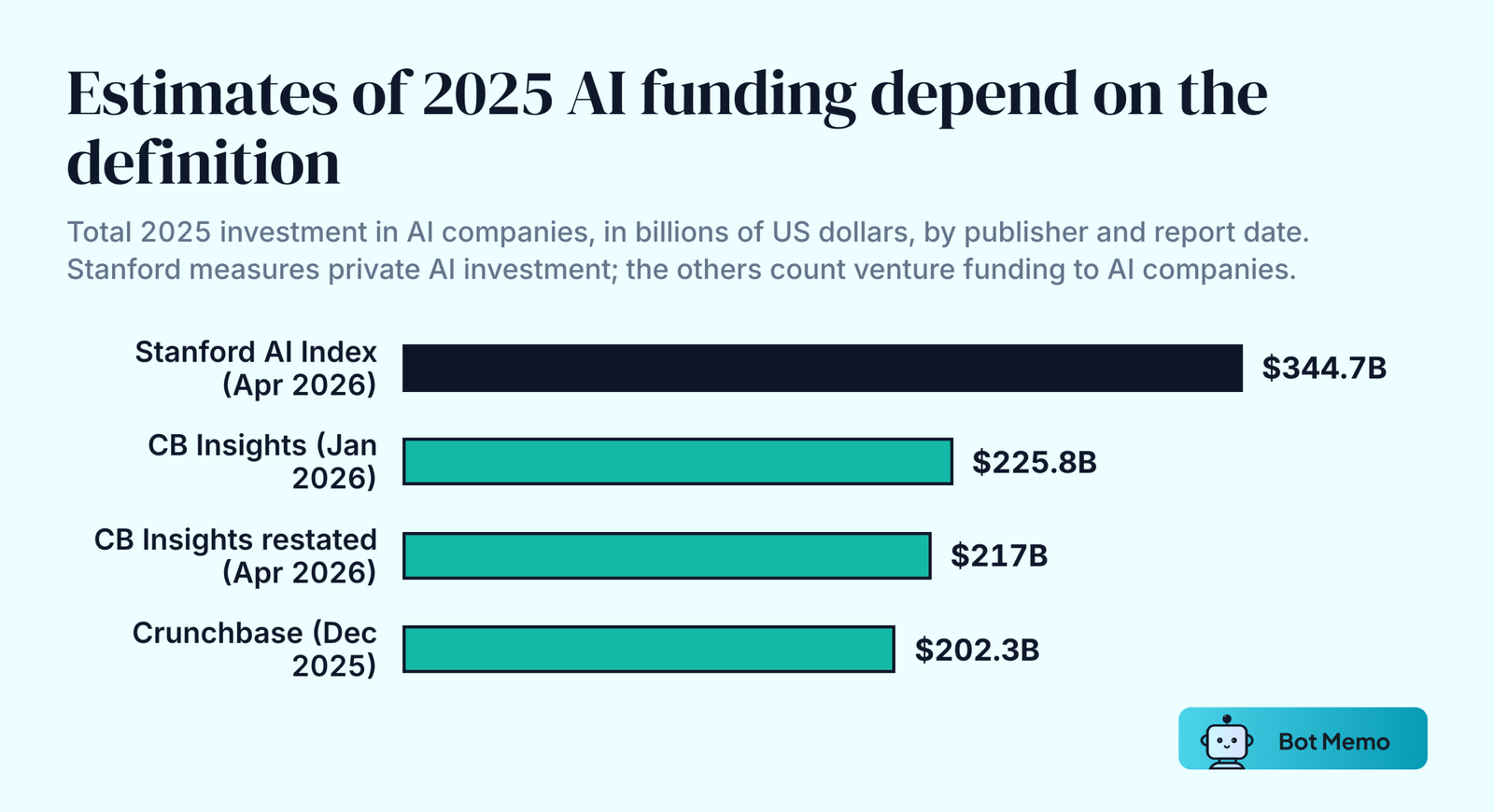
The 2025 totals depend on who is counting. Crunchbase put AI funding at $202.3 billion in mid-December 2025, CB Insights at $225.8 billion, and Stanford’s AI Index at $344.7 billion of private AI investment. Each uses a different definition, so the figures below always name their source.
This page collects AI startup statistics for 2026 on funding, the largest rounds, valuations and revenue, startup counts, geography, exits and failure rates. Figures from earlier versions of this page are kept where their source still supports them and shown next to the newer number where one exists. Figures that could not be confirmed are listed near the end with the reason. Statistics 81 to 92 come from Bot Memo’s own record of AI funding rounds.
On this page
- AI Startup Funding Statistics
- Largest AI Funding Rounds And Valuations
- How Many AI Startups Are There
- Where AI Funding Goes By Country
- AI Startup Exits
- AI Startup Failure And Enterprise Adoption Statistics
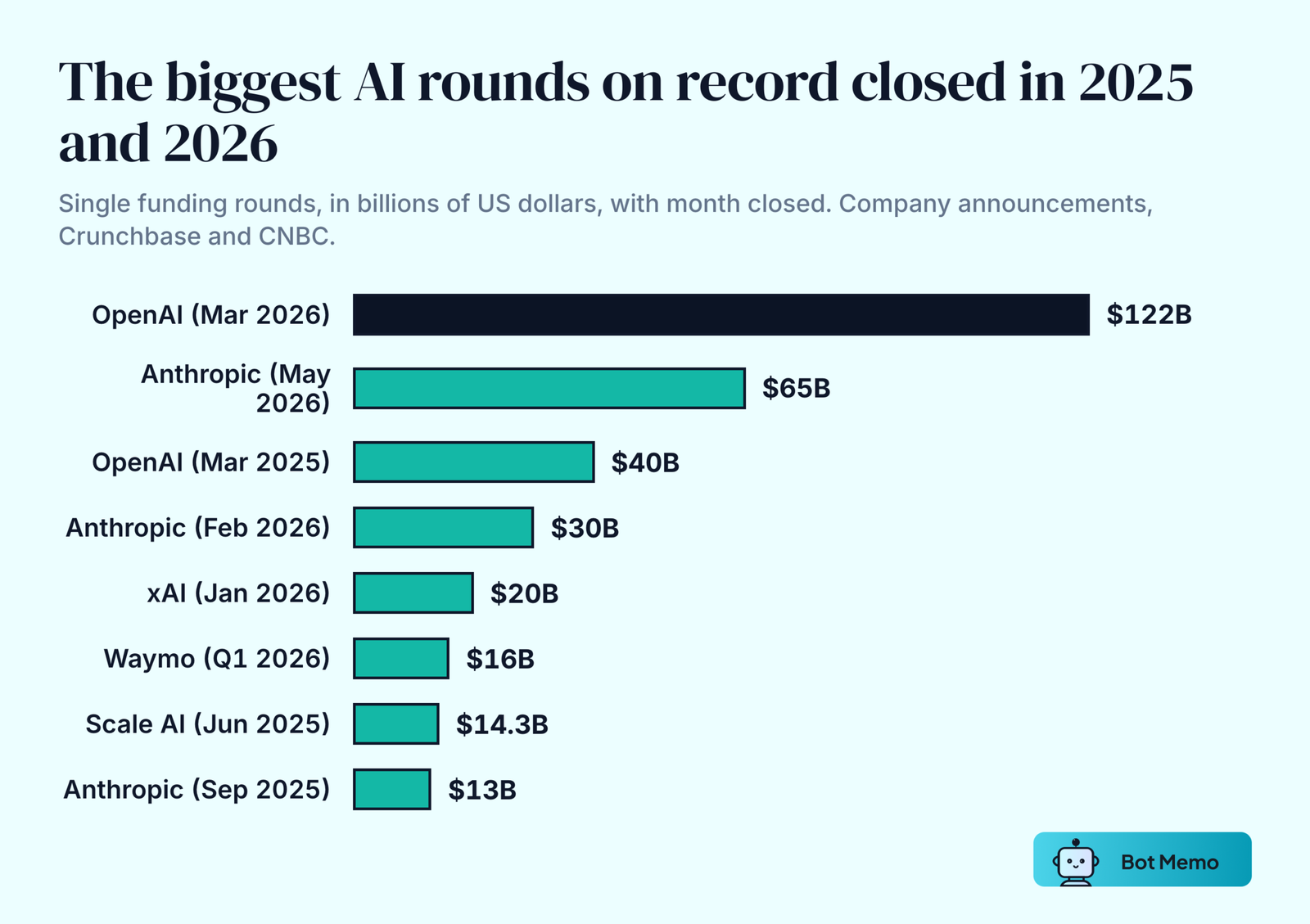
- AI Market Size Statistics
- AI Startup Case Study: Anthropic
- Bot Memo Analysis Of AI Funding Rounds In 2025 And 2026
- Key Takeaways
- Frequently Asked Questions
- Figures Corrected Or Removed From Earlier Versions
- Sources And Methodology
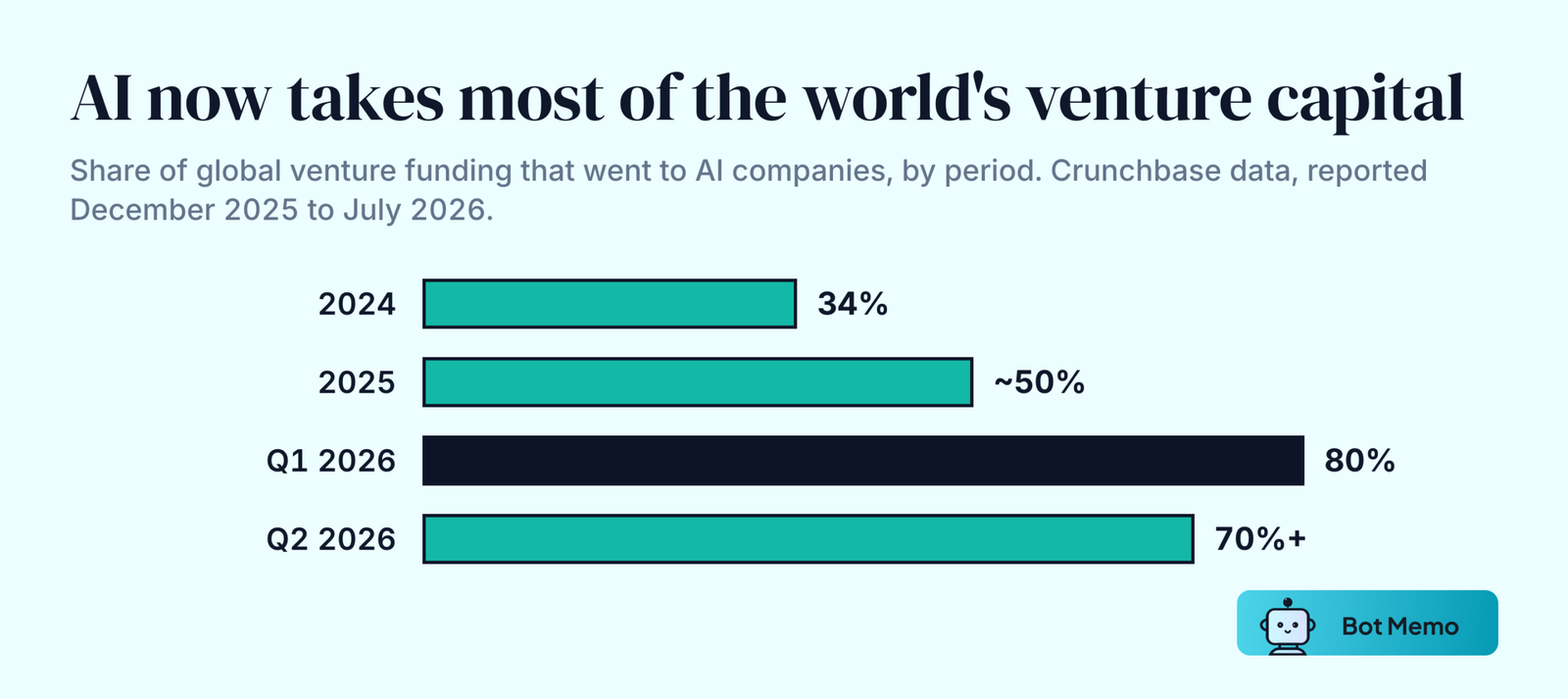
AI Startup Funding Statistics
Global AI Funding In 2025
1. Crunchbase counted $202.3 billion invested in AI companies in 2025 as of mid-December, up more than 75% from $114 billion in 2024. Its count covers the whole stack: AI infrastructure, foundation labs and applications. (Crunchbase News, December 2025)
2. CB Insights reported that private AI companies raised a record $225.8 billion in 2025, nearly double 2024, with $83.2 billion in the fourth quarter alone. Its Q1 2026 report later restated the 2025 total at $217 billion and Q4 2025 at about $72 billion. (CB Insights, January 2026; CB Insights, April 2026)
3. Stanford’s 2026 AI Index puts global private investment in AI at $344.7 billion in 2025, up 127.5% from 2024. Total corporate AI investment, which adds mergers, acquisitions and minority stakes, reached $581.69 billion. (Stanford HAI AI Index 2026, April 2026)
4. Generative AI companies drew $170.9 billion of that private investment in 2025, nearly half the total and up more than 200% from the 2026 edition’s revised 2024 figure. The 2025 edition had reported $33.9 billion for 2024. (Stanford HAI AI Index 2026, April 2026; Stanford HAI AI Index 2025, April 2025)
5. Foundation model companies raised $80 billion in 2025, 40% of global AI funding, up from $31 billion (about 27%) in 2024. OpenAI and Anthropic alone captured 14% of all global venture investment in 2025. (Crunchbase News, December 2025)
6. LLM developers took 41% of AI funding in 2025, and OpenAI, Anthropic and xAI together raised $86.3 billion, 38% of the total. (CB Insights, January 2026)
7. 58% of 2025 AI funding came in megarounds of $500 million or more. (Crunchbase News, December 2025)
8. The average private AI investment in 2025 was $66.5 million, up 46% from 2024. There were 28 private AI investments above $1 billion, up from 15. (Stanford HAI AI Index 2026, April 2026)
AI Funding In 2026 So Far
9. Investors put $300 billion into about 6,000 startups worldwide in Q1 2026, the largest quarter on record, and $242 billion of it (80%) went to AI companies. Crunchbase later revised the quarter to $305 billion. (Crunchbase News, April 2026)
10. Four of the five largest venture rounds ever closed in Q1 2026: OpenAI ($122 billion), Anthropic ($30 billion), xAI ($20 billion) and Waymo ($16 billion). Together they raised $188 billion, 65% of the quarter’s global venture funding. (Crunchbase News, April 2026)
11. Global venture funding reached $510 billion in H1 2026, above the $440 billion invested in all of 2025. Q2 2026 brought in $205 billion across more than 5,000 startups. (Crunchbase News, July 2026)
12. OpenAI and Anthropic accounted for $217 billion of H1 2026 startup funding, 43% of the total. Anthropic’s $65 billion round alone was close to a third of Q2 funding. (Crunchbase News, July 2026)
13. 16 companies raised rounds of $1 billion or more in Q2 2026, totaling $108.6 billion, or 53% of the quarter’s funding. Seven of them were frontier labs, including DeepSeek, StepFun and Moonshot AI in China. (Crunchbase News, July 2026)
14. CB Insights counted $226 billion raised by private AI companies in Q1 2026, more than it recorded for all of 2025. OpenAI’s $122 billion round made up 54% of that. In Q2 2026, 89% of AI funding went to 142 mega-rounds. (CB Insights Q1 2026, April 2026; CB Insights Q2 2026, July 2026)
15. Venture investors put $42 billion into just over 1,500 startups in August 2026, up 122% from August 2025. The largest round was Databricks’ $5 billion at a $190 billion valuation. (Crunchbase News, September 2026)
AI’s Share Of Venture Capital
16. By early September 2024, 35% of US startup investment that year had gone to AI-related companies, the highest share Crunchbase had recorded. (Crunchbase News, September 2024)
17. Globally, AI’s share of venture funding rose from 34% in 2024 to close to 50% in 2025, then to 80% in Q1 2026 and more than 70% in Q2 2026. (Crunchbase News, December 2025; Crunchbase News, July 2026)
18. In the US, AI companies took $355.9 billion in H1 2026, 86% of all venture dollars, according to PitchBook and the NVCA. (PitchBook-NVCA Venture Monitor Q2 2026, July 2026)
Generative AI Funding Before The Boom
19. Generative AI funding grew 5x in 2023 compared with 2022, and deal count rose 66%. Equity funding reached $21.8 billion across 426 deals. (CB Insights, February 2024)
20. The five largest generative AI rounds of 2023 were OpenAI ($10 billion corporate minority round from Microsoft), Inflection AI ($1.3 billion), Anthropic ($1.8 billion across two corporate rounds), Databricks ($504 million Series I) and Aleph Alpha ($500 million). (CB Insights, February 2024)
Largest AI Funding Rounds And Valuations
Frontier Lab Rounds
21. OpenAI closed a $122 billion round at an $852 billion post-money valuation on March 31, 2026, the largest venture round on record. Amazon committed up to $50 billion, and Nvidia and SoftBank $30 billion each. (OpenAI, March 2026; CNBC, March 2026)
22. A year earlier, OpenAI raised $40 billion led by SoftBank at a $300 billion post-money valuation, then the largest venture round ever. In October 2025 a $6.6 billion employee share sale valued it at $500 billion. (Crunchbase News, January 2026; CNBC, October 2025)
23. Anthropic’s valuation rose from $61.5 billion in March 2025 to $183 billion (Series F, $13 billion, September 2025), $380 billion (Series G, $30 billion, February 2026) and $965 billion (Series H, $65 billion, May 2026). (Crunchbase News, January 2026; Anthropic, September 2025; Anthropic, February 2026; Anthropic, May 2026)
24. The Series H priced Anthropic at $900 billion before the new money, a 157.1% step-up from $350 billion three months earlier. That left its post-money valuation above OpenAI’s. (PitchBook-NVCA Venture Monitor Q2 2026, July 2026)
25. xAI raised a $20 billion Series E in January 2026, then combined with SpaceX in February 2026. (xAI, January 2026; CNBC, February 2026)
26. Meta invested $14.3 billion in Scale AI in June 2025 at a $29 billion valuation, and Scale’s founder Alexandr Wang joined Meta. Project Prometheus, the physical AI lab co-led by Jeff Bezos, launched with $6.2 billion in November 2025. (Crunchbase News, January 2026)
27. 15 companies raised venture rounds of $2 billion or more in 2025, together more than $100 billion. (Crunchbase News, January 2026)
For the full list of 2025 rounds, see our 2025 global AI funding report. Quarter-level detail for 2026 is in our Q1 AI funding rounds breakdown.
Earlier Landmark Rounds
28. xAI raised a $6 billion Series B in May 2024. It has since raised $20 billion in a Series E (January 2026). (xAI, May 2024; xAI, January 2026)
29. Mistral AI raised €600 million ($645 million) at a $6 billion valuation in June 2024, three times the roughly $2 billion valuation reported for its $415 million round in December 2023. (CNBC, June 2024; PYMNTS, December 2023)
30. Wiz raised $1 billion at a $12 billion valuation in May 2024, led by Andreessen Horowitz, Lightspeed Venture Partners and Thrive Capital. (Wiz, May 2024)
31. Databricks was valued at $43 billion in its September 2023 Series I. That rose to $134 billion in a Series L of more than $4 billion in December 2025, and to $190 billion in a $5 billion round in August 2026. (Databricks, September 2023; Crunchbase News, January 2026; Crunchbase News, September 2026)
Revenue And Revenue Multiples
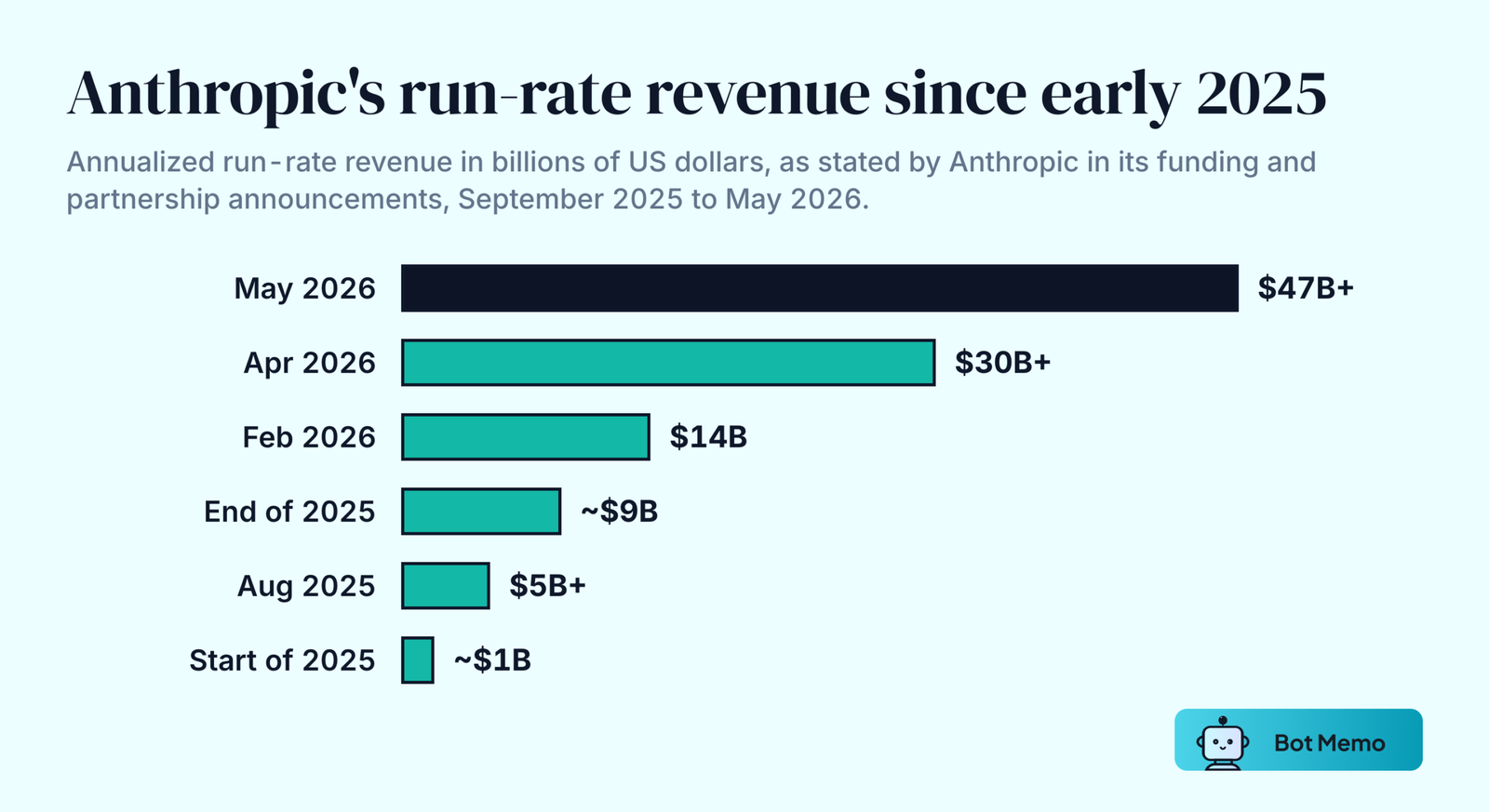
32. Anthropic’s run-rate revenue was about $1 billion at the start of 2025, passed $5 billion by August 2025 and reached about $9 billion by year-end. It was $14 billion in February 2026, above $30 billion in April and above $47 billion in May 2026. (Anthropic, September 2025; Anthropic, February 2026; Anthropic, April 2026; Anthropic, May 2026)
33. Claude Code, released to the public in May 2025, had run-rate revenue above $2.5 billion by February 2026. (Anthropic, February 2026)
34. Hugging Face had one of the highest revenue multiples in the 2024 CB Insights AI 100, at 150x: $30 million of 2023 revenue against a $4.5 billion valuation. Sacra’s profile shows the same valuation on roughly $30 million of annualized revenue in August 2023. In August 2026, Nvidia announced plans to acquire Hugging Face for $12.9 billion. (CB Insights, 2024; Sacra; Crunchbase News, September 2026)
35. Perplexity was valued at 65x revenue in the same list, based on a 2023 valuation of $520 million and $8 million of 2024 annual recurring revenue. (CB Insights, 2024)
36. Most AI companies trade at 10x to 50x revenue, with a median of about 20x to 30x, according to fundraising adviser Qubit Capital. It puts legal tech below 16x and LLM vendors as high as 44.1x. (Qubit Capital, updated July 2026)
37. Sakana AI had the highest valuation per employee in the 2024 AI 100, at $67 million. It had three employees when it reached a $200 million valuation in early 2024. (CB Insights, 2024)
How Many AI Startups Are There
Counting AI Companies
38. Tracxn listed more than 90,000 companies in the AI space in 2024. Its AI sector page now counts 36,300 companies whose core product is built around proprietary AI, of which 9,060 are funded and together have raised $842 billion. (Tracxn, accessed September 2026)
39. About 3,499 AI companies received new funding worldwide in 2025, up 70.8% from 2024. (Stanford HAI AI Index 2026, April 2026)
What counts as an AI startup changes these numbers a lot. Our AI startup classifications guide explains how companies that build models differ from those that add AI to an existing product.
AI Unicorns
40. 75 new AI unicorns were created in 2025, 61% of all new unicorns, up from 52% in 2024. (CB Insights, January 2026)
41. AI produced 37 new unicorns in Q2 2026, the most in a quarter since Q2 2022. (CB Insights, July 2026)
42. 195 companies of all kinds joined the Crunchbase Unicorn Board in H1 2026, more than the 193 minted in all of 2025. Robotics and AI labs were the leading sectors. (Crunchbase News, August 2026)
43. The 2024 CB Insights AI 100 included 19 unicorns valued at $1 billion or more, about a fifth of the cohort. (CB Insights, 2024)
AI Startups By Country
44. Between 2013 and 2023, the US had 5,509 newly funded AI startups, followed by China (1,446), the UK (727) and Israel (442), counting companies that raised more than $1.5 million. (Visual Capitalist, using Quid data from Stanford’s 2024 AI Index, May 2024)
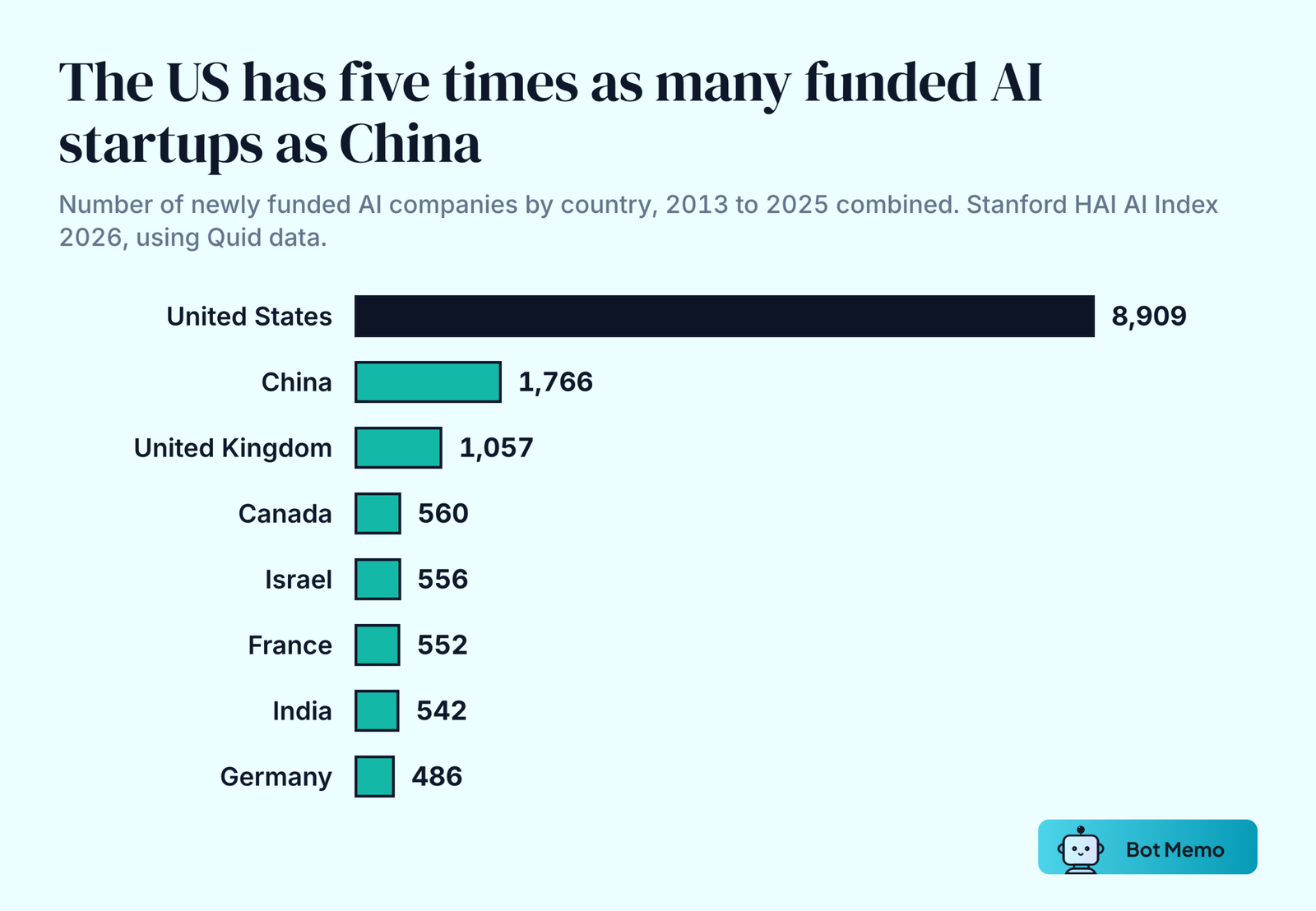
45. With 2024 and 2025 added, the 2013 to 2025 totals are US 8,909, China 1,766, UK 1,057, Canada 560, Israel 556, France 552, India 542 and Germany 486. (Stanford HAI AI Index 2026, April 2026)
46. In 2025 alone, 1,953 newly funded AI companies were based in the US, compared with 172 in the UK and 161 in China. (Stanford HAI AI Index 2026, April 2026)
47. Israel has more than 2,300 active AI startups, about a quarter of the country’s technology companies, according to a report by Google Israel and RISE Israel. (Google Cloud, May 2024)
48. Of Tech in Asia’s top 50 AI startups in Asia (companies at Series E or later), 24 were Chinese, 10 Indian, and 4 each from Japan and South Korea. (Business Korea, April 2024)
49. SenseAI Ventures managing partner Rahul Agarwalla predicts India will produce at least 100 AI unicorns within a decade. (SenseAI Ventures on LinkedIn, 2024; Founder Thesis, September 2025)
Where AI Funding Goes By Country
The US And China
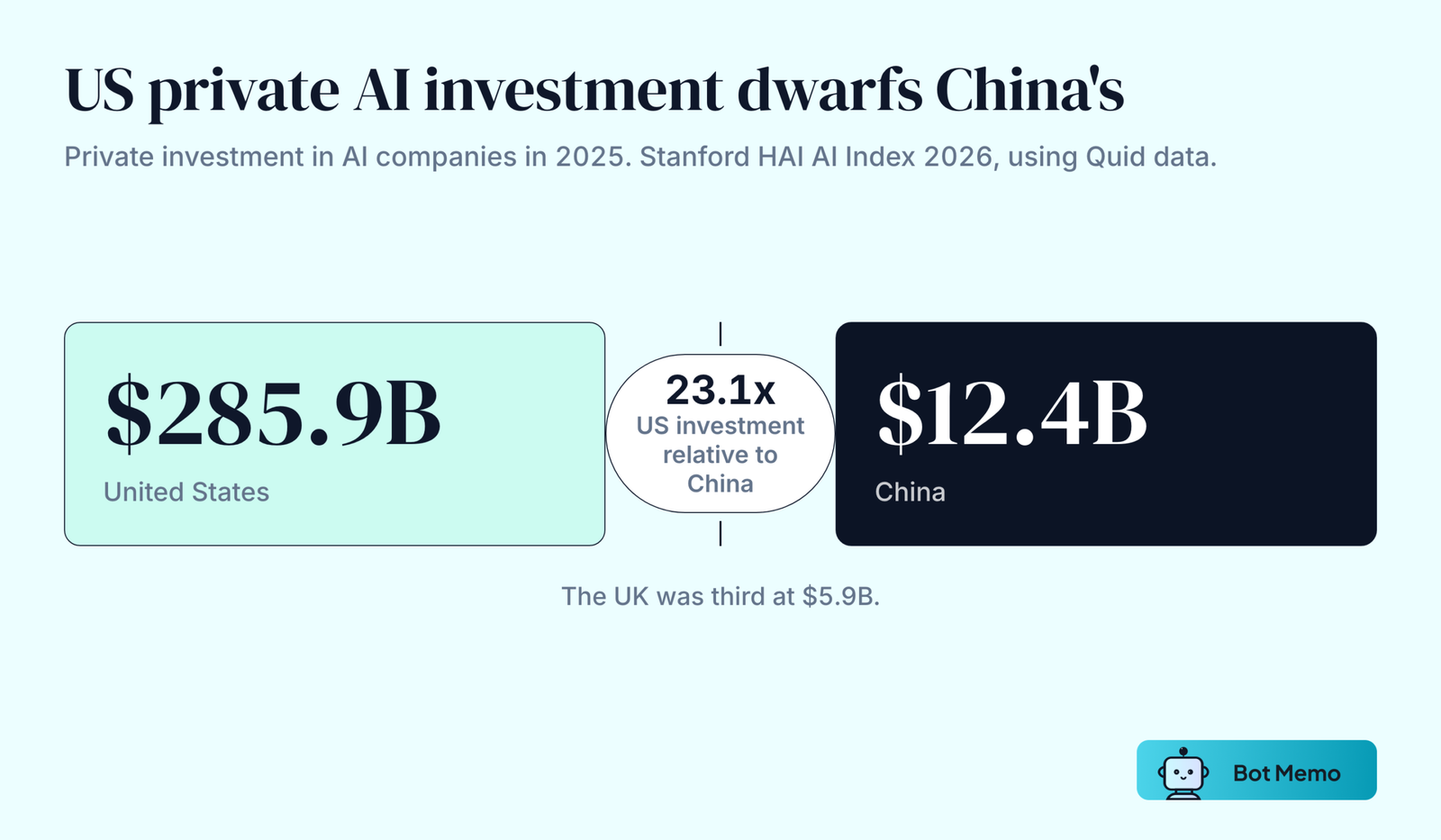
50. US private AI investment reached $285.9 billion in 2025, 23.1 times China’s $12.4 billion and 48.5 times the UK’s $5.9 billion. Stanford notes that private figures likely understate China’s total AI spending because of government guidance funds. (Stanford HAI AI Index 2026, April 2026)
51. In 2024 the gap was smaller: $109.1 billion in the US, about 12 times China’s $9.3 billion, and 24 times the UK’s $4.5 billion. (Stanford HAI AI Index 2025, April 2025)
52. US-based companies raised $159 billion of AI funding in 2025, 79% of the global total. (Crunchbase News, December 2025)
US Cities And States
53. The San Francisco Bay Area raised $122 billion of AI funding in 2025, more than three quarters of the US total. (Crunchbase News, December 2025)
54. California accounted for $218 billion of private AI investment in 2025, over 75% of the US total, followed by Colorado ($19 billion), New York ($13 billion) and Florida ($6 billion). (Stanford HAI AI Index 2026, April 2026)
Our AI startup funding by city page ranks the metros behind these totals, and our top European AI startups list covers the largest rounds outside the US.
Funding In 2026 By Country
55. US companies raised $250 billion, 83% of global venture capital, in Q1 2026. China was second with $16.1 billion and the UK third with $7.4 billion. (Crunchbase News, April 2026)
56. The US share fell back to two thirds of global startup capital in Q2 2026, in line with Q2 2025. (Crunchbase News, July 2026)
Patents And Research
57. China was granted about 35,315 AI patents in 2022, more than every other country combined. The US was granted 12,077. (Stanford AI Index 2024, April 2024; Visual Capitalist, 2024)
58. “China is on a par with or ahead of the U.S. on many predictors of AI performance,” Huey-Meei Chang, senior China science and technology specialist at Georgetown’s CSET, told The Diplomat. (The Diplomat, July 2024)
AI Startup Exits
IPOs
59. CoreWeave listed on Nasdaq on March 28, 2025 at $40 a share and raised $1.5 billion, the largest US tech IPO since 2021 at the time. (CNBC, March 2025)
60. Cerebras dropped its 2025 IPO plans and refiled in April 2026, reporting $510 million of 2025 revenue, up almost 76%. It priced 30 million shares at $185 on May 13, 2026, and its market value reached $95 billion after a 68% first-day rise. (CNBC, April 2026; Cerebras, May 2026; CNBC, May 2026)
61. SpaceX, which now includes xAI, went public in Q2 2026 at a value of $1.77 trillion and raised $75 billion, the largest IPO ever for a venture-backed company. 32 companies went public at values above $1 billion in that quarter. (Crunchbase News, July 2026)
62. Anthropic confidentially submitted a draft S-1 to the SEC on June 1, 2026. PitchBook and the NVCA report that OpenAI has also filed confidentially. (Anthropic, June 2026; PitchBook-NVCA Venture Monitor Q2 2026, July 2026)
63. Two Chinese foundation model companies, Z.ai and MiniMax, listed in Hong Kong in Q1 2026, each valued at more than $6 billion. (Crunchbase News, April 2026)
Acquisitions
64. 782 private AI companies were acquired in 2025, more than 1.5 times the 2024 count. AI accounted for 7.5% of venture-backed exits, up from 4.9%. (CB Insights, January 2026)
65. 24 venture-backed companies were acquired for $1 billion or more in Q2 2026, a record $113 billion in value. The largest was SpaceX’s planned $60 billion purchase of Anysphere, the company behind the Cursor coding tool. (Crunchbase News, July 2026)
AI Startup Failure And Enterprise Adoption Statistics
Startup Failure Rates
66. 92% of AI and tech startups fail, according to AI4SP, which bases the figure on its 2023 research and a July 2024 survey of 100 US tech founders. 38% of founders cited no market need and 54% operational problems. (AI4SP, September 2024)
Enterprise AI Projects
67. In 2018 Gartner predicted that through 2022, 85% of AI projects would deliver erroneous outcomes because of bias in data, algorithms or the teams managing them. (Gartner, February 2018)
68. About 95% of corporate generative AI pilots deliver little or no measurable profit and loss impact, according to MIT NANDA’s 2025 report, based on 150 interviews, a survey of 350 employees and 300 public deployments. (Fortune, August 2025)
69. 42% of companies abandoned most of their AI initiatives in 2025, up from 17% in 2024, according to S&P Global Market Intelligence survey data. (WorkOS, July 2025)
Common Challenges
70. Oracle lists 11 common challenges for AI startups, including security and privacy of training data, the volume of data needed, computing capacity and data quality. (Oracle, January 2024)
AI Market Size Statistics
Market Forecasts
71. Statista projects the global AI market at $617.62 billion in 2026, growing 14.82% a year to $1.42 trillion by 2032, with the US the largest market at $414.89 billion in 2026. An earlier version of this page quoted Statista’s 2024 edition: $184 billion in 2024, 28.46% annual growth and $826.7 billion by 2030, with the US at $50.16 billion. (Statista, accessed September 2026)
72. KBV Research forecasts the multimodal AI market will reach $8.4 billion by 2030, growing 32.3% a year from 2023. (KBV Research)
Public Market Views
73. AI data center and power stocks returned 33% in 2025 up to September 25, compared with 14% for the S&P 500, according to J.P. Morgan. AI capital spending was 1.05% of US GDP, below the telecom peak of 2.67% before the dot-com crash. (J.P. Morgan, September 2025)
74. J.P. Morgan says the price-to-earnings multiples of the largest AI companies are below their 10-year average, and it continues to recommend AI as an investment theme. (J.P. Morgan, September 2025)
AI Startup Case Study: Anthropic
Founding And Early Funding
75. Anthropic was founded in 2021 by former OpenAI researchers including Dario Amodei and his sister Daniela Amodei. Its stated aim: “Anthropic is dedicated to building systems that people can rely on and generating research about the opportunities and risks of AI.” (CNBC, May 2023; Anthropic)
76. Anthropic launched its first model, Claude, on March 14, 2023. (Anthropic, March 2023)
77. In May 2023 Anthropic raised a $450 million Series C led by Spark Capital, with Google and Salesforce Ventures participating. (Anthropic, May 2023)
78. Amazon invested $1.25 billion in Anthropic in September 2023 and $2.75 billion in March 2024, completing a $4 billion commitment, then another $4 billion in November 2024, for $8 billion in total. (Amazon, March 2024; Amazon, November 2024)
From Projections To Run-Rate
79. In late 2023, The Information reported that Anthropic projected at least $850 million of annualized revenue by the end of 2024, and that some people close to the company thought it could reach $1 billion. (The Information, December 2023)
80. Anthropic’s own figures show run-rate revenue of about $1 billion at the start of 2025 and more than $47 billion by May 2026. More than 1,000 business customers were each spending over $1 million a year by April 2026, double the count in February. (Anthropic, April 2026; Anthropic, May 2026)
Bot Memo Analysis Of AI Funding Rounds In 2025 And 2026
The Typical AI Round Has Not Grown
81. Bot Memo recorded 5,325 AI funding rounds dated in 2025, up 14.9% from 4,634 in 2024. Counting every kind of financing, including equity, debt, secondary and strategic rounds, the disclosed amounts across 2025 come to $287.7 billion. (Bot Memo analysis, 29 September 2026)
82. The median AI round with a disclosed amount was $12.0 million in 2025, against $10.9 million in 2024. Across the first half of 2026 it was $11.4 million, measured on the 3,058 first-half rounds that disclosed an amount. Dollars rose 42.7% between 2024 and 2025 while the middle of the market moved by $1.1 million. (Bot Memo analysis, 29 September 2026)
83. The entry stages are where nothing much moved. The Seed median held at $5.0 million across 2025 and the first half of 2026, and pre-seed at $1.9 million, while Series A went from $15.9 million to $16.5 million. Later rounds did grow: the Series B median went from $40 million to $45 million and Series C from $70 million to $76 million. (Bot Memo analysis, 29 September 2026)
Where The Capital Concentrates
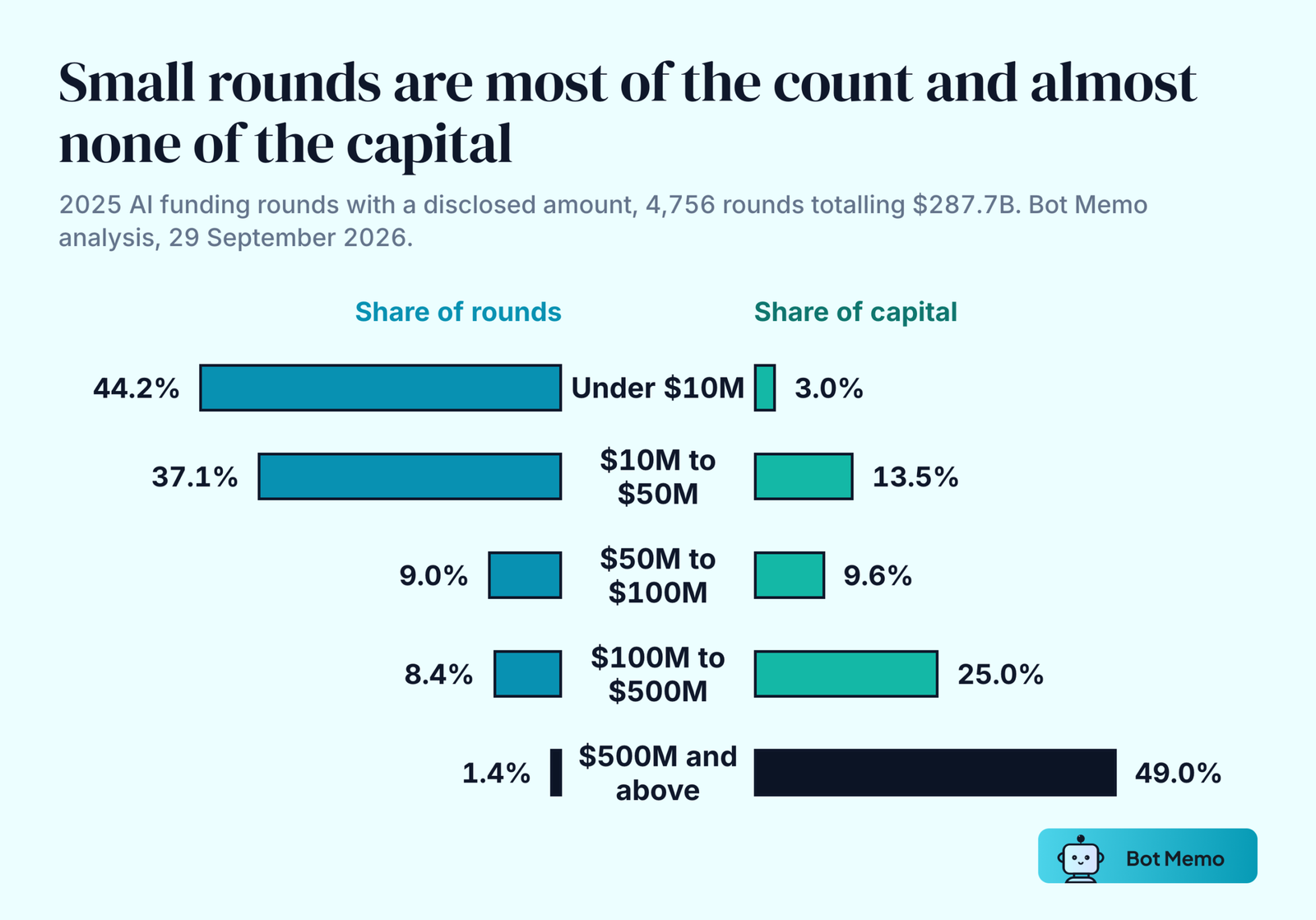
84. Rounds of $100 million or more were 463 of the 4,756 rounds that disclosed an amount in 2025, 9.7% of them, and they took 74.0% of the dollars. In 2024 that band was 8.8% of disclosed rounds and 69.5% of dollars. (Bot Memo analysis, 29 September 2026)
85. Concentration tightened in 2026. Across the first half, 407 rounds of $100 million or more were 13.3% of disclosed rounds and took 90.3% of the dollars. (Bot Memo analysis, 29 September 2026)
86. Five rounds carried 54.9% of every dollar disclosed in the first half of 2026: OpenAI at $122 billion, Anthropic at $65 billion and again at $30 billion, xAI at $20 billion and Waymo at $16 billion. The five largest rounds of 2025 came to 27.3% of that year’s total. (Bot Memo analysis, 29 September 2026)
Early Rounds Are The Count, Not The Capital
87. Pre-seed, seed and Series A together were 3,012 of the 5,325 AI rounds in 2025, 56.6% of the count, and $46.4 billion of the money, 16.1%. (Bot Memo analysis, 29 September 2026)
88. Companies headquartered in the United States raised 3,063 of the 2025 rounds, 57.5%, and 79.4% of the dollars. Europe, counting the UK, took 25.4% of rounds and 11.8% of dollars. (Bot Memo analysis, 29 September 2026)
89. The San Francisco Bay Area took 64.6% of US AI dollars in 2025 across 1,112 rounds, with New York City second at 11.2% on 592 rounds. Across the first half of 2026 the Bay Area share reached 81.9%, and that figure rests on three companies: take out OpenAI, Anthropic and xAI and it falls to 51.1%. A company with more than one US headquarters city counts in each metro, so metro shares can exceed 100%. (Bot Memo analysis, 29 September 2026)
Which Sectors Draw Rounds And Which Draw Dollars
90. Health and biotech drew the most AI rounds in 2025, 931 of 5,325, for 13.0% of the dollars. Developer tools and AI infrastructure took 42.6% of the dollars on 599 rounds, though seven rounds raised by OpenAI, Anthropic, xAI and Scale AI account for 66.1% of that sector’s money. Without them the sector is 14.4% of the 2025 total. A round can carry more than one sector, so sector shares can exceed 100%. (Bot Memo analysis, 29 September 2026)
91. Companies whose product exists because of AI, which Bot Memo classifies as AI Native, were 2,835 of the 2025 rounds, 53.2%, and 28.0% of the dollars. The 75 rounds that went to AI platform companies were 1.4% of the count and 29.4% of the dollars. (Bot Memo analysis, 29 September 2026)
92. Y Combinator appeared on more 2025 AI rounds than any other investor, 192, ahead of General Catalyst at 130 and Andreessen Horowitz at 105. These are rounds a firm took part in, not the amount any one firm supplied. (Bot Memo analysis, 29 September 2026)
Key Takeaways
- AI companies raised $202.3 billion (Crunchbase) to $344.7 billion (Stanford AI Index) in 2025, depending on the definition.
- H1 2026 venture funding reached $510 billion, more than all of 2025, and more than 70% of Q2 capital went to AI.
- OpenAI and Anthropic took $217 billion, 43% of all startup funding, in H1 2026.
- US private AI investment was 23.1 times China’s in 2025, and the Bay Area raised $122 billion of AI funding.
- Anthropic’s valuation went from $61.5 billion in March 2025 to $965 billion in May 2026, and its run-rate revenue from about $1 billion to more than $47 billion.
- 75 new AI unicorns were minted in 2025 and 37 in Q2 2026 alone; 782 AI companies were acquired in 2025.
- Exits reopened in 2026 with the Cerebras and SpaceX IPOs and confidential filings from Anthropic and OpenAI.
- Bot Memo’s own records put the median AI round at $12.0 million in 2025 and $11.4 million in the first half of 2026, while rounds of $100 million or more went from 74.0% of the dollars to 90.3%.
Frequently Asked Questions
How Much Funding Did AI Startups Raise In 2025?
Between $202.3 billion and $344.7 billion, depending on the source. Crunchbase counted $202.3 billion by mid-December 2025, CB Insights reported $225.8 billion (later restated at $217 billion), and Stanford’s AI Index measured $344.7 billion of private AI investment.
How Much Have AI Startups Raised In 2026?
AI companies raised $242 billion in Q1 2026, 80% of the $300 billion invested in startups worldwide that quarter, and took more than 70% of the $205 billion invested in Q2, according to Crunchbase. Total global venture funding for the first half was $510 billion.
How Many AI Startups Are There?
Tracxn counts about 36,300 companies built around proprietary AI, of which about 9,060 are funded. Stanford’s AI Index counted 3,499 AI companies that received new funding in 2025 alone.
How Many AI Unicorns Were Created In 2025?
CB Insights counted 75 new AI unicorns in 2025, 61% of all new unicorns, and 37 more in Q2 2026.
What Percentage Of AI Startups Fail?
AI4SP puts the failure rate for AI and tech startups at 92%, based on a 2024 survey of 100 founders. On the buyer side, MIT NANDA found about 95% of corporate generative AI pilots deliver little or no measurable profit impact.
Which Country Has The Most AI Startups?
The US, by a wide margin. It had 8,909 newly funded AI companies between 2013 and 2025, against 1,766 in China and 1,057 in the UK, according to Stanford’s AI Index.
Figures Corrected Or Removed From Earlier Versions
- “In 2024, 35% of every dollar invested in American startups went to AI”: Crunchbase’s figure was year-to-date as of September 4, 2024. Reworded.
- “The US ranks highest with 4,643 AI startups as of 2022”: no source contains this figure. Replaced with Stanford and Quid counts.
- OpenAI “$14 billion in equity funding, valued at about $90 billion”, Anthropic “$4.2 billion, valued at $4.6 billion” and Databricks “$4 billion”: the cited CB Insights page lists OpenAI $10 billion, Anthropic $1.8 billion and Databricks $504 million for 2023. Corrected; Databricks’ $43 billion valuation is now cited to Databricks.
- Startup Genome “around 90% of startups fail”: not found on Startup Genome’s site. Removed.
- “AI startups have a 15% success rate”: no source. Removed.
- Tracxn’s 90,000+ AI companies (2024): the page now counts about 36,300 under a narrower definition. Shown as then and now.
- Statista’s 2024 market figures: replaced by the 2026 edition. Shown as then and now.
- xAI’s “current valuation of $24 billion” after its May 2024 Series B: xAI’s own announcement gives no valuation, and xAI has since raised a $20 billion Series E and merged with SpaceX. Removed.
- The xAI, Mistral and Wiz rounds were cited to a YouTube video. They are now cited to the companies and CNBC, and Mistral’s round is shown as closed ($645 million) rather than planned ($600 million).
- Hugging Face “more than 100x” revenue: CB Insights puts it at 150x. Corrected.
- Sakana AI “$66.7 million per employee” was cited to Sakana’s blog; the figure is CB Insights’ ($67 million). The Mistral ($62.5 million) and Anthropic ($58.4 million) per-employee figures could not be found in that source and were removed.
- J.P. Morgan figures from March 2024 (AI stocks 30% ahead of indexes, forward P/E of 34x against 59x in 2000, earnings growth of 42% against 30%): the cited page now carries J.P. Morgan’s September 2025 analysis and no longer shows them. Replaced with the current figures. The “$2 trillion Nvidia GPU demand” figure was not in the source and was removed.
- “Israel has the most startups per capita” refers to startups in general, not AI startups. The Nvidia Israel-1 supercomputer is not mentioned in the cited Google post and was removed.
- Anthropic “has published over 15 AI safety research papers”: not on the cited page. Removed.
- Anthropic “enterprise valuation of $15 billion” (The New York Times, February 2024): could not be checked at the source. Replaced with Anthropic’s own round announcements.
- The multimodal AI quote from Mirella Lapata, the AWS blog on multimodal agents and the Y Combinator podcast advice were commentary rather than statistics and were removed.
Sources And Methodology
Every statistic links to the report, filing, announcement or article it comes from, with its date. Funding totals from Crunchbase, CB Insights, PitchBook and Stanford use different definitions of an AI company and of private investment, so they should not be compared directly. Run-rate revenue is annualized from a recent period and is not the same as reported annual revenue. Figures are as published by each source as of September 2026.
Statistics 81 to 92 come from Bot Memo’s own record of AI funding rounds, verified, deduplicated and AI-classified, as it stood on 29 September 2026. Rounds whose company is classified as non-AI are left out. Amounts in other currencies are converted to US dollars. Medians and round-size bands cover rounds that disclosed an amount, so their denominators are smaller than the full round counts. A round listing more than one sector counts in each, and a company with more than one US headquarters city counts in each metro, so those shares can exceed 100%. Investor figures are the number of rounds a firm took part in, not the amount it supplied. A year’s total moves as individual rounds are corrected, so these figures are stated as of the date above rather than as a fixed number.

About the author
Editorial Staff
The Editorial Staff at Bot Memo is a team of writers, analysts, and AI agents dedicated to mapping the global AI startup ecosystem. Led by Chintan Zalani, the team tracks thousands of funding rounds, classifies companies across verticals, and distills it all into actionable intelligence for investors and founders.