
Last updated: October 14, 2026. Data: Bot Memo records of AI funding rounds, January 2025 to September 2026.
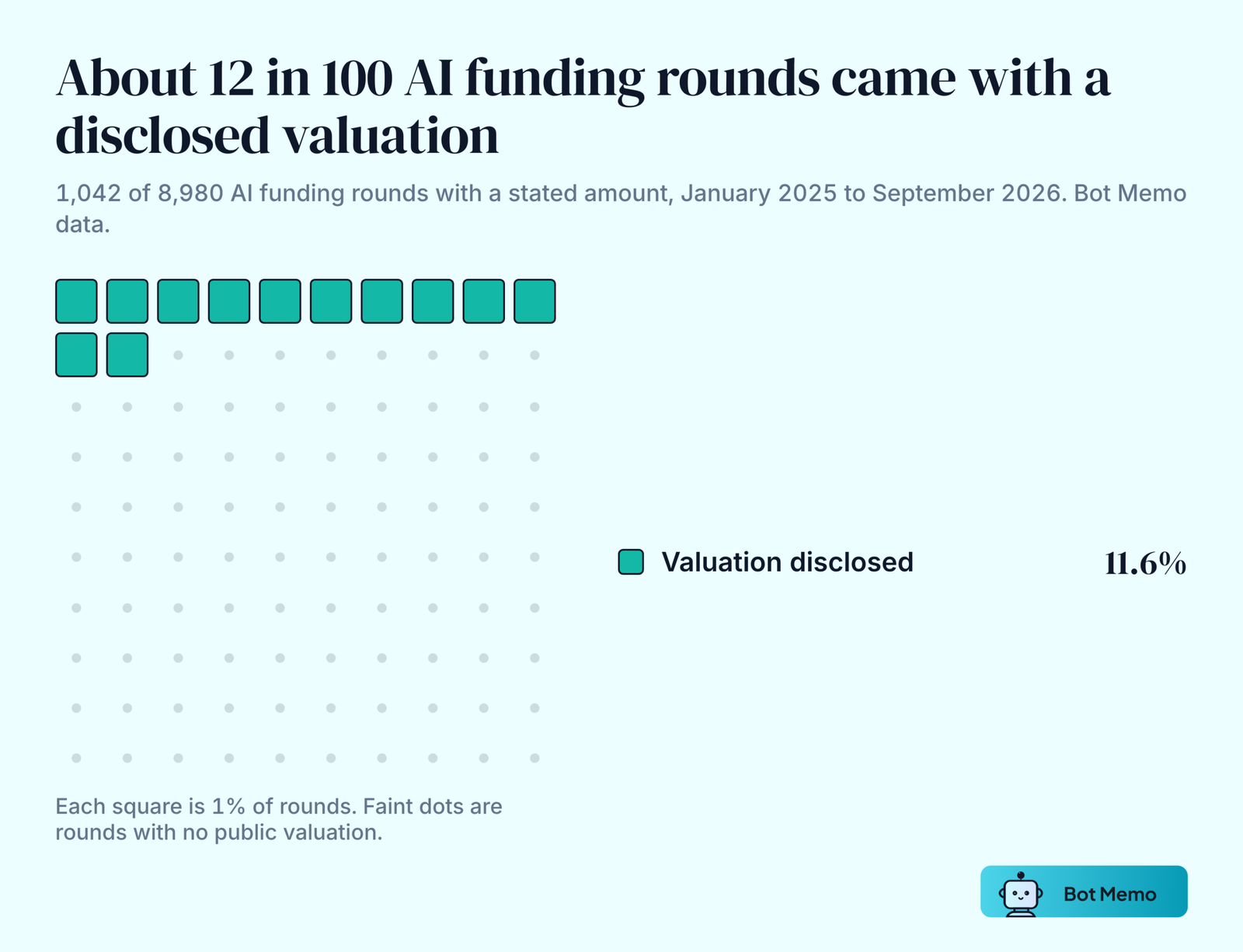
Bot Memo recorded 8,980 AI funding rounds with a stated amount between January 2025 and September 2026. Only 1,042 of them, or 11.6%, came with a valuation. The other 7,938 rounds told the market how much money changed hands and nothing about the price.
That gap matters to anyone who uses AI startup valuation data. Founders benchmark their raise against it, investors use it to judge whether a price is rich, and analysts build market models on top of it. All of them are working from about one round in nine, the rounds where a valuation became public, and those rounds are not typical.
This article breaks down which rounds disclose, why most don’t, and how to read valuation benchmarks with that bias in mind. For total funding by year and sector, see our AI startup funding statistics.
On this page
- Only 11.6% Of AI Funding Rounds Disclose A Valuation
- Disclosure By Funding Stage: Series E And Later Lead At 81.3%
- Bigger Rounds, More Disclosure
- AI Platforms Disclose About Four Times As Often As AI Native Startups
- The Disclosed Valuations Are Not A Fair Sample
- Why Most AI Startups Keep Their Valuation Private
- What This Means If You Use AI Valuation Data
- FAQ: AI Startup Valuation Data
- Methodology
Only 11.6% Of AI Funding Rounds Disclose A Valuation
The disclosure rate rose from 2025 to 2026.
| Year | Rounds | Valuation disclosed | Rate |
|---|---|---|---|
| 2025 | 4,690 | 400 | 8.5% |
| 2026 (January to September) | 4,290 | 642 | 15.0% |
| Total | 8,980 | 1,042 | 11.6% |
Source: Bot Memo data. AI funding rounds with a stated amount. Secondary share sales and financings of listed companies are excluded.
Two things moved at once. Rounds of $100 million or more grew from 9.8% of all rounds in 2025 to 13.7% in 2026, and big rounds disclose far more often. Disclosure also rose inside both size groups: from 46.3% to 59.6% for rounds of $100 million or more, and from 4.4% to 7.9% for smaller rounds.
The largest rounds show how a valuation usually reaches the public. The first figure is often a press report before the close, and the final terms differ from it.
- OpenAI. On February 19, 2026, TechCrunch reported that OpenAI was finalizing a raise of more than $100 billion at a valuation that could exceed $850 billion. OpenAI closed the round on March 31, 2026 at $122 billion and an $852 billion post-money valuation.
- Anthropic. In January 2026, TechCrunch reported a planned $10 billion raise at a $350 billion valuation. The Series G that closed in February was $30 billion at $380 billion post-money. In May 2026, Anthropic raised a $65 billion Series H at $965 billion post-money.
- xAI. When xAI announced a $20 billion Series E on January 6, 2026, it gave no valuation. A figure came out four weeks later through a different deal. SpaceX’s all-stock merger with xAI valued xAI at $250 billion, according to a person familiar with the matter (Reuters, February 3, 2026).
Disclosure By Funding Stage: Series E And Later Lead At 81.3%
| Funding stage | Rounds | Valuation disclosed | Rate |
|---|---|---|---|
| Series E and later | 96 | 78 | 81.3% |
| Series D | 256 | 136 | 53.1% |
| Series C | 436 | 158 | 36.2% |
| Series B | 977 | 189 | 19.3% |
| Growth | 327 | 58 | 17.7% |
| Series A | 2,063 | 166 | 8.0% |
| Seed | 2,685 | 114 | 4.2% |
| Pre-seed | 848 | 15 | 1.8% |
Source: Bot Memo data, January 2025 to September 2026. Rounds with no stage stated, debt, strategic and convertible rounds are in the overall total but not in this table: 1,292 rounds, 128 of them with a disclosed valuation.
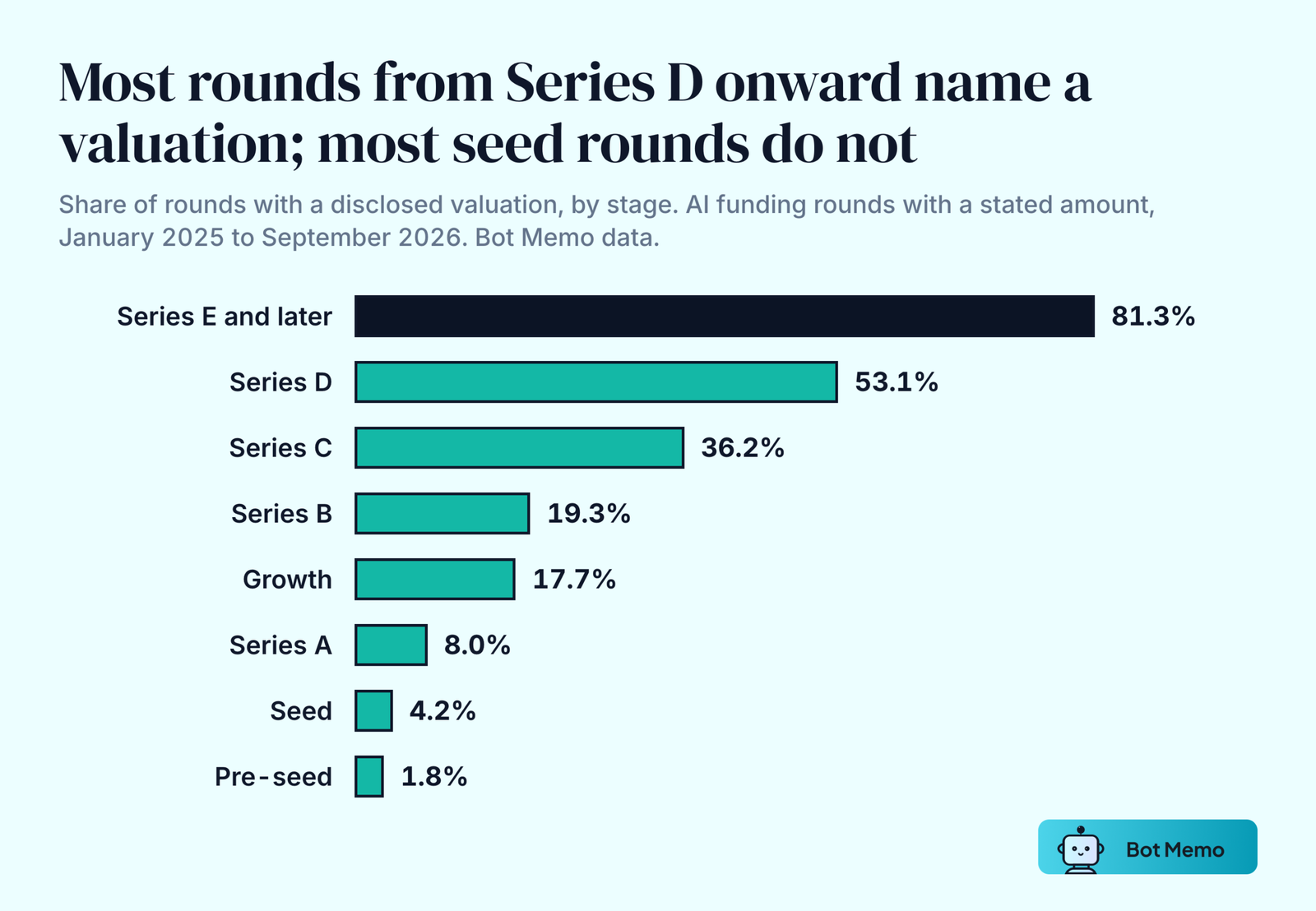
Disclosure climbs with every lettered stage, from pre-seed to Series E and later. Pre-seed rounds named a valuation 1.8% of the time. At Series E and later, four rounds in five did. Growth rounds, which sit outside the lettered series, disclosed at 17.7%.
Databricks shows the late-stage pattern. TechCrunch reported in December 2025 that it was raising more than $4 billion in a Series L at a $134 billion valuation, with a revenue run-rate above $4.8 billion. In August 2026 it closed a $5 billion round at $190 billion, 42% above the $134 billion price of the round it closed in February, with its revenue run-rate past $7 billion and growing more than 80% a year. Both announcements came with revenue figures, so outsiders could work out the multiple.
At pre-seed the incentives run the other way. A small round draws little press, and a stated price becomes an anchor the next round has to beat. Our breakdown of AI Series B startups in 2026 shows where the middle stages sit.
Bigger Rounds, More Disclosure
| Round size | Rounds | Valuation disclosed | Rate |
|---|---|---|---|
| $500M or more | 177 | 125 | 70.6% |
| $100M to $500M | 868 | 437 | 50.3% |
| $50M to $100M | 781 | 145 | 18.6% |
| $10M to $50M | 3,143 | 204 | 6.5% |
| Under $10M | 4,011 | 131 | 3.3% |
Source: Bot Memo data, January 2025 to September 2026. Round sizes in US dollars.
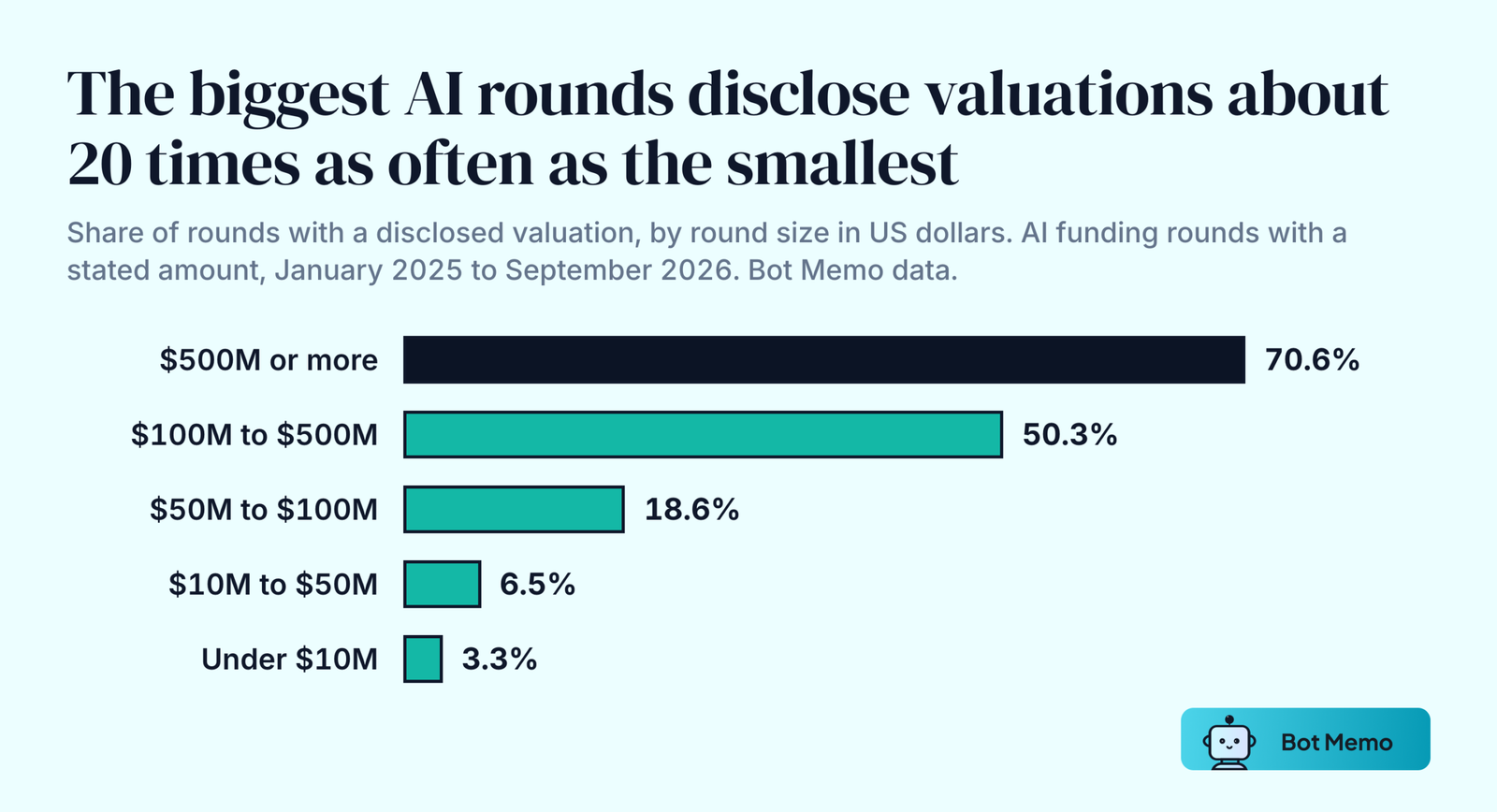
Of rounds of $500 million or more, 70.6% named a valuation. Of rounds under $10 million, 3.3% did, a gap of more than 20 times. Big rounds draw press coverage and involve many investors, which can make the price hard to keep private.
Figure AI is a typical example from the top band. In September 2025 it announced a Series C that “exceeded $1 billion” at a $39 billion valuation, led by Parkway Venture Capital with Brookfield Asset Management, Nvidia and Intel Capital among the participants. Below $10 million, many announcements give the amount, the lead investor and the product, and stop there. Our list of AI mega-rounds in 2026 covers the top band in detail.
AI Platforms Disclose About Four Times As Often As AI Native Startups
| AI type | Rounds | Valuation disclosed | Rate |
|---|---|---|---|
| AI Platforms | 231 | 94 | 40.7% |
| AI Adjacent | 1,013 | 153 | 15.1% |
| AI Augmented | 2,627 | 303 | 11.5% |
| AI Native | 5,109 | 492 | 9.6% |
Source: Bot Memo data, January 2025 to September 2026.
Bot Memo groups AI companies into four types by how central AI is to the product. AI Platforms, the companies that train their own foundation models, design AI chips or sell GPU clusters as AI compute, disclosed a valuation in 40.7% of rounds. AI Native startups, whose products would not exist without AI, disclosed in 9.6%.
Round size explains much of that gap. The AI Platforms group includes OpenAI, Anthropic and xAI, and its median round was $120 million, against $8.9 million for AI Native startups. The 40.7% rate largely reflects how big these rounds are.
The Disclosed Valuations Are Not A Fair Sample
Rounds that name a valuation are bigger than rounds that don’t, even at the same stage. The median Series A round that disclosed a valuation was $33.0 million. The median Series A round that did not was $15.8 million. At Series B the figures were $90.0 million and $38.0 million.
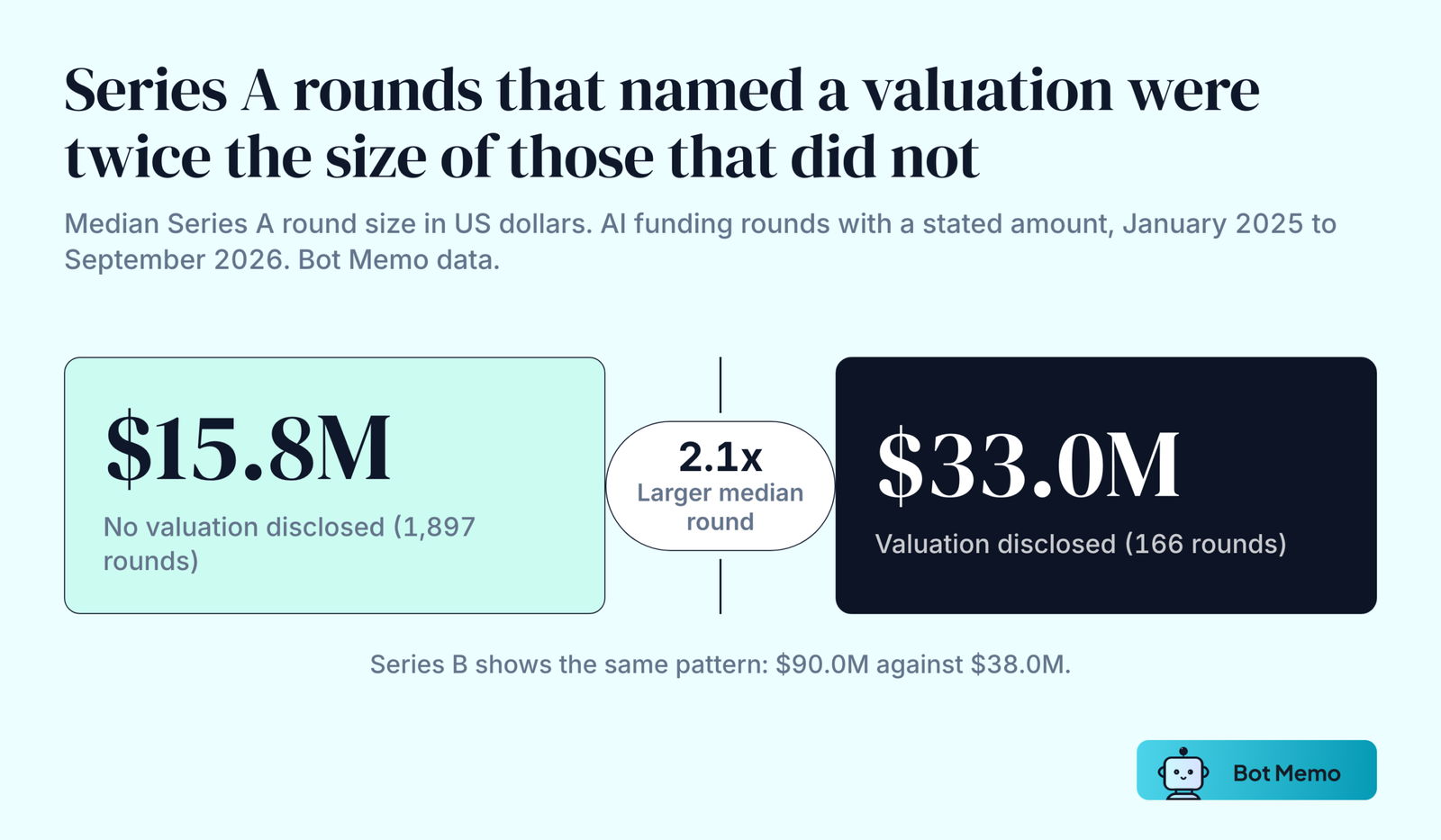
That skews any benchmark built from disclosed valuations. The table below shows the median valuation of rounds that named one, using only rounds where both the valuation and the round amount were reported in US dollars, including approximate figures.
| Funding stage | Rounds with a disclosed valuation | Median disclosed valuation |
|---|---|---|
| Seed | 88 | $72.5M |
| Series A | 141 | $300M |
| Series B | 178 | $1.0B |
| Series C | 151 | $1.45B |
Source: Bot Memo data, January 2025 to September 2026.
A $300 million median Series A describes rounds that were twice the typical Series A size and whose companies chose to publish their price. It tells you little about what a typical AI Series A is priced at.
Why Most AI Startups Keep Their Valuation Private
- No legal requirement. A US private company only has to register with the SEC and start public reporting once it has more than $10 million in total assets and a class of equity held of record by 2,000 people, or by 500 people who are not accredited investors (SEC, 2016). Many venture-backed startups pass the asset test but stay under the holder limits, because their shares sit with a relatively small number of funds and accredited investors, and employees who hold equity through compensation plans are not counted. So they can raise large sums without publishing a price.
- Down-round risk. A company that raised at $500 million and now prices at $350 million gains nothing by saying so. Leaving the valuation out lets it announce the money without the comparison. Our AI down rounds tracker follows the cases that do become public.
- Investor preference. A published price lets outsiders work out ownership stakes and revenue multiples. Many funds prefer to keep their entry prices private.
- Signalling. A valuation that looks high invites questions about whether the company can grow into it. One that looks low suggests trouble. Saying nothing avoids both readings.
- Headline prices can mislead. TechCrunch reported in March 2026 that some AI startups sell the same equity at two prices in one round, giving top-tier VCs a discount while other investors in the same round pay a much higher price. The headline valuation reflects the higher price, so the blended price is lower than the published number, and the next round has to clear the headline figure to avoid a down round.
What This Means If You Use AI Valuation Data
Treat any valuation benchmark as a sample of the rounds that chose to talk. In our data that is 11.6% of rounds overall, 8.0% at Series A and 4.2% at seed.
Check the population behind a multiple. Finro’s Q1 2025 AI valuation dataset covers 417 companies (290 private, 32 public and 95 involved in M&A deals) and reports average revenue multiples of 20.8x at seed and 39.0x at Series A. Finro notes that early rounds carry inflated multiples, “often because revenue is low or nonexistent.”
Listed companies trade at far lower multiples. Finerva’s February 2026 report, based on the holdings of the Global X Robotics & Artificial Intelligence ETF, found the median revenue multiple rose from 2.5x in Q1 2025 to 3.4x by Q4 2025. That sample is listed robotics and AI companies, so it is a reference point, not a like-for-like comparison with private rounds.
Ask for the disclosure rate. When a source quotes a median Series B valuation, ask how many Series B rounds in its sample named a price. In our data, 189 of 977 did.
FAQ: AI Startup Valuation Data
What share of AI funding rounds disclose a valuation?
In Bot Memo’s data, 11.6% of AI funding rounds with a stated amount between January 2025 and September 2026 named a valuation, 1,042 of 8,980. The rate was 8.5% in 2025 and 15.0% in the first nine months of 2026.
Which AI rounds are most likely to disclose a valuation?
Large, late rounds. 81.3% of Series E and later rounds and 70.6% of rounds of $500 million or more named a valuation, against 1.8% of pre-seed rounds and 3.3% of rounds under $10 million.
Do private companies have to disclose their valuation?
No. A US private company only begins public SEC reporting once it passes the Section 12(g) thresholds: more than $10 million in total assets and a class of equity held of record by 2,000 people, or by 500 people who are not accredited investors. Employees who received shares through compensation plans are not counted. Most venture-backed startups stay under the holder limits, so a valuation becomes public only if the company or its investors share it, or it leaks.
What are typical revenue multiples for AI startups?
They vary widely by stage and by sample. Finro’s Q1 2025 dataset reports averages of 20.8x revenue at seed and 39.0x at Series A, while listed robotics and AI companies traded at a median 3.4x by Q4 2025, according to Finerva. Private multiples come from the small, self-selected set of rounds that disclose a price.
Why are the biggest AI valuations so widely reported?
Rounds the size of OpenAI’s $122 billion raise or Anthropic’s $65 billion Series H involve many investors, and reporters often have the numbers before the close. OpenAI’s and Anthropic’s first 2026 rounds were both reported before they closed, and in both cases the final terms differed from the first reports.
Methodology
This analysis covers AI funding rounds in Bot Memo’s database announced between January 1, 2025 and September 30, 2026 that state a round amount, 8,980 rounds in total. Secondary share sales and financings of already-listed companies are excluded. Amounts in other currencies are converted to US dollars.
A round counts as disclosed when a specific pre-money or post-money valuation was reported with the funding. Approximate figures and floors such as “more than $100 billion” count as disclosed; text that says the valuation was not disclosed does not. Where a valuation was first reported after the round, as with xAI, the round is counted as disclosed.
Stages follow the round label in the announcement. Growth covers rounds described as growth, late-stage or pre-IPO. AI type follows Bot Memo’s four categories: AI Native, AI Augmented, AI Adjacent and AI Platforms. The median valuation table uses only rounds where both the valuation and the round amount were reported in US dollars.

About the author
Editorial Staff
The Editorial Staff at Bot Memo is a team of writers, analysts, and AI agents dedicated to mapping the global AI startup ecosystem. Led by Chintan Zalani, the team tracks thousands of funding rounds, classifies companies across verticals, and distills it all into actionable intelligence for investors and founders.