
Microsoft, Alphabet, Amazon and Meta expect to spend about $733 billion on capital expenditure in 2026, taking the midpoint of each company’s latest guidance from the July 2026 earnings round. That is roughly 77% more than the $413 billion they spent in 2025. The money pays for servers, chips, networking gear and data centers to meet AI and cloud demand. Below, we follow that money from the four buyers to the chip makers and cloud operators that sell to them, then to the startups that investors backed in 2026 to serve the same demand.
On this page
The 2026 capex guidance, company by company
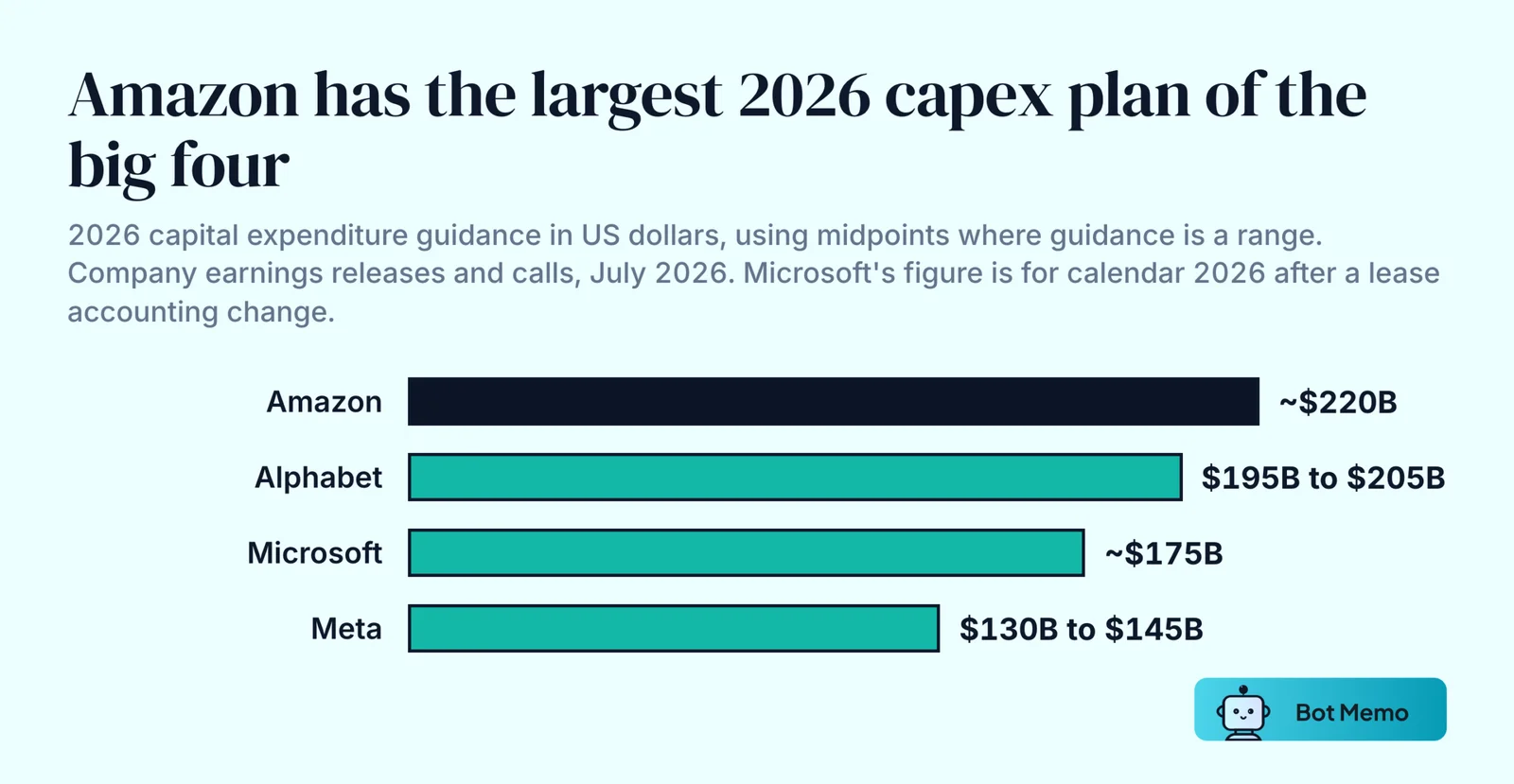
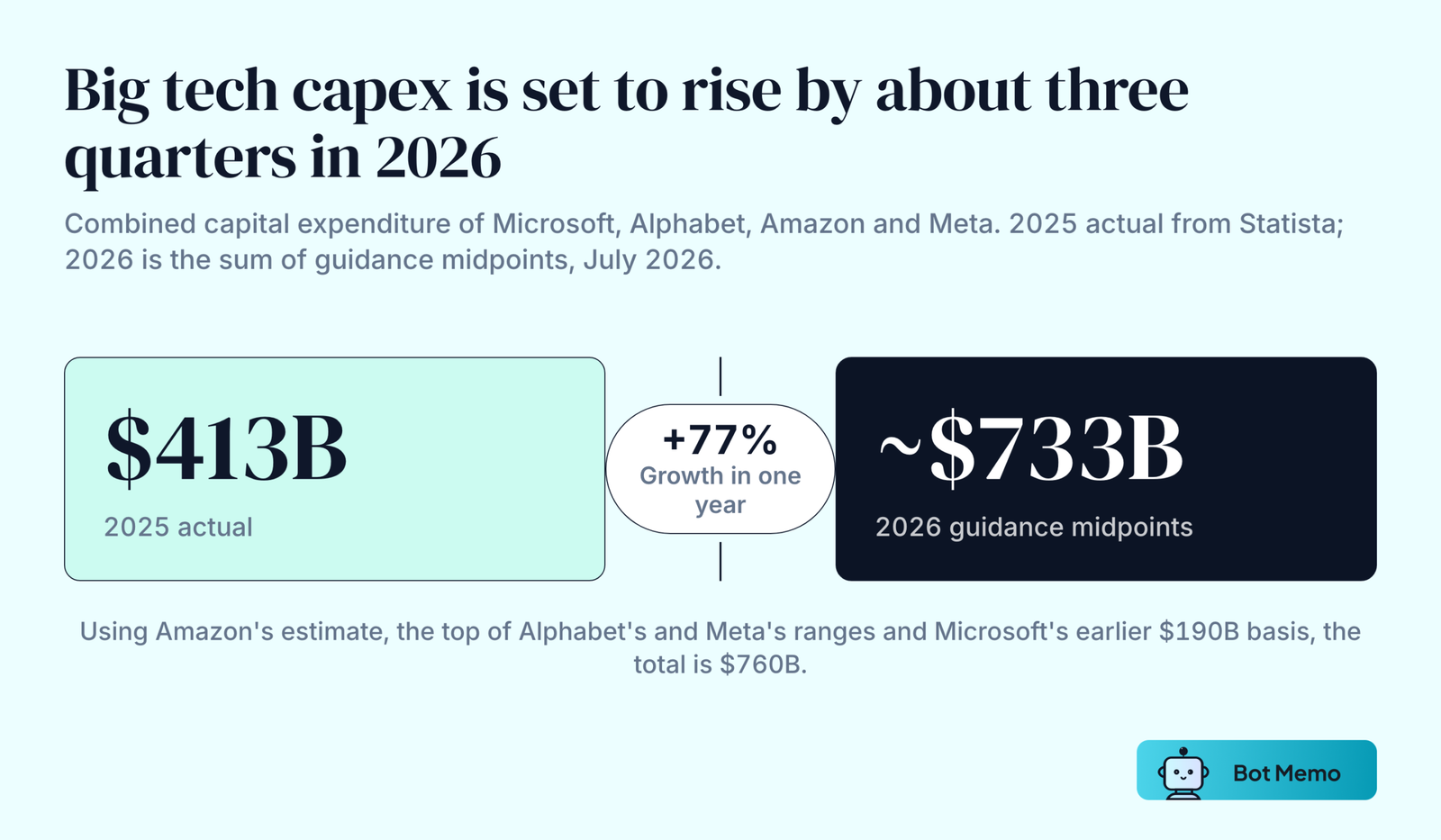
Each figure below comes from guidance the company gave investors in July 2026. Amazon and Alphabet raised their plans, Meta raised the bottom of its range, and Microsoft kept its spending plan while changing how part of it is counted.
- Amazon expects about $220 billion in cash capex for 2026, up from its earlier estimate of about $200 billion. CEO Andy Jassy said on the second-quarter call that the higher cost of memory pushed the number up, and that even at that amount Amazon would not have enough capacity to meet all of its 2026 demand.
- Alphabet raised its range to $195 billion to $205 billion, from $180 billion to $190 billion, on July 22. In the same quarter it spent $44.9 billion on property and equipment and reported free cash flow of negative $5.9 billion.
- Microsoft now expects about $175 billion for calendar 2026. In April it had guided to roughly $190 billion, including about $25 billion from higher component prices. In July it said its spending plans were unchanged and that the lower figure reflects a shift from finance leases to operating leases, an accounting change with no cut to spending.
- Meta expects $130 billion to $145 billion including principal payments on finance leases, narrowed from $125 billion to $145 billion. Its second-quarter capex on the same basis was $31.08 billion.
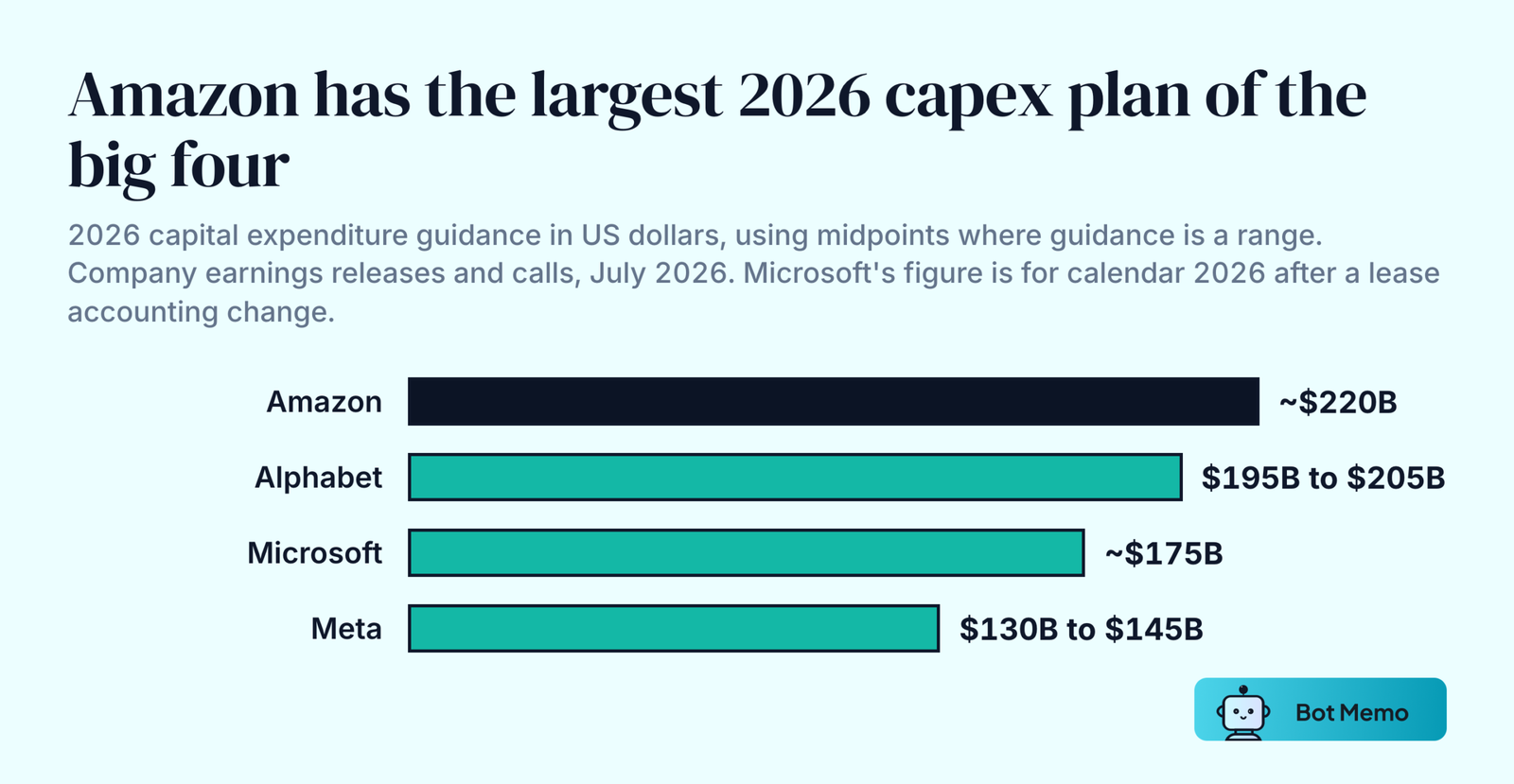
The four do not measure capex the same way. Amazon gives a cash figure, Meta includes finance lease principal, and Microsoft’s new number excludes leases it has reclassified. So totals published elsewhere differ. Statista’s July 31 chart puts the four at $760 billion, which matches Amazon’s estimate, the top of Alphabet’s and Meta’s ranges, and Microsoft’s earlier $190 billion basis. A May column in FXStreet summarizing Morgan Stanley research put US hyperscaler capex, a wider group than these four, at more than $800 billion in 2026 and about $1.1 trillion the following year.
The companies do not report an AI line inside capex. Introl, a data center services firm, estimated in January that about 75% of 2026 capex at the five largest hyperscalers, including Oracle, was tied to AI. Alphabet gave one split on its July call: about 60% of its second-quarter technical infrastructure spend went to servers and 40% to data centers and networking equipment.
Where the money lands first: chips
Nvidia reported data center revenue of $89.0 billion for the quarter ended July 26, 2026, up 117% from a year earlier, and guided to $108 billion of total revenue for the following quarter. For the full fiscal year that ended in January 2026, Nvidia’s revenue was $215.9 billion, and data center revenue was $193.7 billion.
Broadcom’s AI semiconductor revenue was $16.7 billion in the quarter reported on September 2, up 221% year over year, and it guided to $21.7 billion for the next quarter. In the quarter it reported in March, the same line was $8.4 billion.
TSMC is the largest contract chip maker. TrendForce put its second-quarter 2026 revenue at about $40.2 billion, a 72.5% share of the top 10 foundries’ revenue, with its 5/4nm and 3nm capacity fully booked by demand for AI server GPUs and custom accelerators.
The neoclouds: renting out GPUs
Neoclouds are companies that buy GPUs in bulk and rent the compute to AI labs and to the hyperscalers themselves. Meta’s CoreWeave contract below is one example of a hyperscaler buying capacity from a neocloud.
CoreWeave, which went public in 2025, reported a revenue backlog of about $104 billion at June 30, 2026, not counting more than $25 billion of new customer commitments signed early in the third quarter. Three of its 2026 deals show how the money moves:
- In January, Nvidia invested $2 billion in CoreWeave stock at $87.20 a share.
- In March, CoreWeave closed an $8.5 billion loan facility secured by its computing infrastructure and a customer contract, which it described as the first investment-grade financing of its kind.
- In April, Meta signed a $21 billion expansion of its CoreWeave capacity agreement, running through 2032.
CoreWeave describes its cloud as built on Nvidia infrastructure, so Nvidia is both a supplier and a shareholder, while CoreWeave borrows against its hardware and customer contracts to add capacity. We track Nvidia’s own startup investments in our August 2026 investor ledger and corporate venture activity in corporate VC AI investments.
The startups raising on the back of the build-out
Venture investors have backed the same demand in the layers that sell to hyperscalers and AI labs: GPU clouds, inference chips, optical interconnects and data center developers. These are among the largest 2026 funding rounds in that group, each announced by the company or reported by a named outlet.
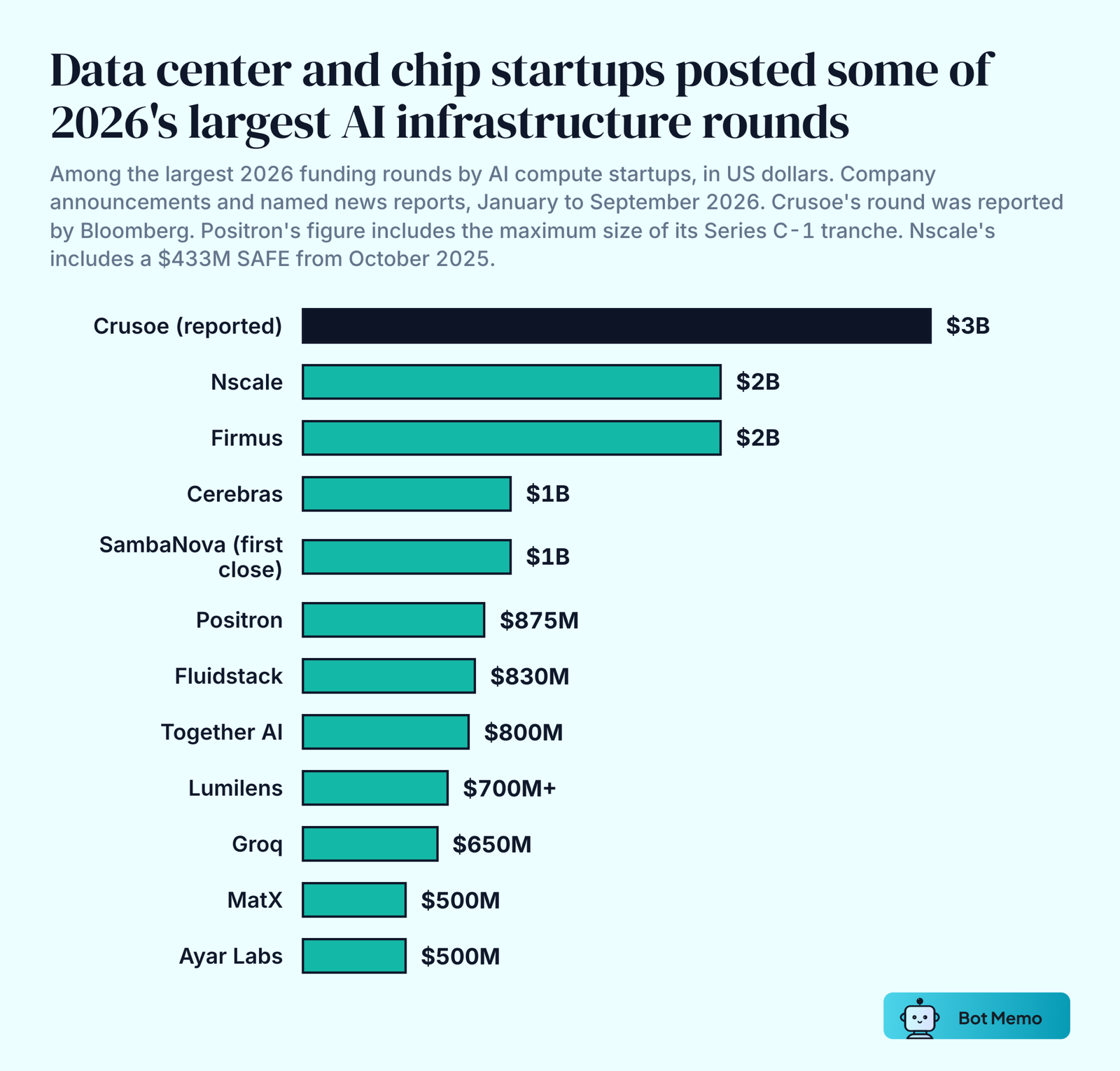
- Crusoe, a data center developer whose customers include Meta, Microsoft and OpenAI, raised $3 billion at a $30 billion valuation in September, according to Bloomberg, in a round co-led by Atreides Management and Valor Equity Partners.
- Nscale, a UK data center and GPU cloud company, raised a $2 billion Series C at a $14.6 billion valuation in March, led by Aker and 8090 Industries, with Nvidia participating. The total includes a $433 million SAFE from October 2025.
- Firmus, an Australian AI data center operator, raised $2 billion in August from investors including Blackstone, Coatue and Nvidia, at a post-money valuation above $10.5 billion.
- Cerebras raised a $1 billion Series H in February, then went public in May, selling 30 million shares at $185 to raise $5.55 billion.
- SambaNova completed a first close of $1 billion at an $11 billion valuation in July, led by General Atlantic.
- Positron announced $875 million in September: a $375 million Series C at a $3.5 billion pre-money valuation plus a follow-on tranche of up to $500 million.
- Fluidstack raised an $830 million Series A at a $7.5 billion valuation, led by Situational Awareness. The round closed in January and was announced in July.
- Together AI raised an $800 million Series C at an $8.3 billion valuation in July, led by Aramco Ventures.
- Lumilens, which makes optical links for data centers, came out of stealth in August with a Series C of more than $700 million, bringing its total funding past $900 million.
- Groq raised $650 million in June. Six months earlier Nvidia had signed a non-exclusive licensing deal for Groq’s technology, reported at about $20 billion, and hired its CEO.
- MatX raised a $500 million Series B led by Jane Street and Situational Awareness in February, and Ayar Labs closed a $500 million Series E led by Neuberger Berman in March.
Valuations moved fast. Etched closed a $300 million Series C at $10.3 billion in July, about double the $5 billion valuation of its previous round in December. For a wider list of companies in this layer, see our top AI infrastructure startups.
Power runs on longer timelines
The big buyers are signing power contracts years before the plants deliver.
- Constellation signed a 20-year power purchase agreement with Microsoft in September 2024 to restart Three Mile Island Unit 1, now the Crane Clean Energy Center. The plant is due to return to operation in 2027 and has not restarted yet.
- Meta signed an agreement with Oklo in January 2026 supporting a 1.2 GW nuclear campus in Pike County, Ohio.
- Valar Atomics, a nuclear microreactor startup, raised a $1 billion Series B led by Sequoia in August.
Epoch AI, a research group, projects that the largest single frontier training runs in 2030 will likely draw 4 to 16 gigawatts of power.
OpenAI’s Stargate project also depends on new power and sites. It launched in January 2025 as a plan to spend $500 billion over four years on 10 gigawatts of compute, and in September 2025 OpenAI named five new US sites with Oracle and SoftBank, alongside a $300 billion cloud contract with Oracle.
The revenue gap
In June 2024 David Cahn of Sequoia published AI’s $600B Question. He took Nvidia’s data center revenue run-rate, doubled it to cover the full cost of a data center, and doubled it again to allow for a 50% gross margin for the businesses buying the compute. The result was the yearly AI revenue needed to pay for the build-out, around $600 billion. Actual AI revenue was far below it.
Writer Philipp Dubach estimated direct AI revenue at $40 billion to $60 billion in 2025 against about $300 billion of AI-specific capex, a coverage ratio of about 0.15. Revenue at the largest labs is now climbing quickly. OpenAI booked $13.07 billion of revenue in 2025, according to audited figures cited by Quartz, and Quartz reported, citing Axios, that its annualized revenue was nearing $70 billion by late September 2026. The same report said Anthropic’s annualized revenue had reached roughly $65 billion by July. Run-rates extrapolate recent months, but even the two labs’ figures combined equal less than a fifth of one year of big-four capex. Our OpenAI statistics page tracks its revenue and funding.
What would slow the cycle
Three signals would show the spending is slowing:
- A guidance cut. None of the four cut its underlying 2026 spending plan in July; Microsoft’s headline number fell only because of the lease change. A lower number from any of them on a future earnings call would mean fewer orders for chip makers and neoclouds.
- Free cash flow. Alphabet’s second-quarter free cash flow was negative $5.9 billion, and in June it raised $49.6 billion in net proceeds from stock and mandatory convertible preferred shares, for general corporate purposes including AI infrastructure.
- Lab funding. OpenAI signed a $300 billion cloud contract with Oracle in 2025. A lab that cannot raise enough money to cover contracts of that size would put its suppliers, and the lenders behind them, at risk.
Frequently asked questions
How much are big tech companies spending on AI capex in 2026?
Microsoft, Alphabet, Amazon and Meta expect about $733 billion of capital expenditure in 2026 at the midpoints of their July 2026 guidance, up from $413 billion in 2025. The companies do not break out an AI-only figure; Introl estimated in January that about 75% of 2026 capex at the five largest hyperscalers, including Oracle, was tied to AI.
Which company is spending the most?
Amazon, at about $220 billion in cash capex for 2026, followed by Alphabet at $195 billion to $205 billion.
Why did Microsoft’s capex guidance fall from $190 billion to $175 billion?
Microsoft said its spending plans were unchanged. The lower number reflects moving some data center leases from finance leases to operating leases, which changes how they are counted.
Which suppliers are tied to AI capex?
Nvidia’s data center revenue was $89.0 billion in its latest quarter, and Broadcom’s AI semiconductor revenue was $16.7 billion. Others tied to the spending include manufacturers such as TSMC, GPU cloud operators such as CoreWeave, and startups selling chips, optics and data center capacity.
What is the $600 billion question?
It is a June 2024 essay by Sequoia’s David Cahn estimating how much yearly AI revenue the industry needs to justify its infrastructure spending. His answer was around $600 billion, far above actual AI revenue at the time.
What is circular financing in AI?
The term describes deals where a supplier invests in a company that also buys its products. Nvidia’s $2 billion investment in CoreWeave, whose cloud is built on Nvidia infrastructure, is one example.

About the author
Editorial Staff
The Editorial Staff at Bot Memo is a team of writers, analysts, and AI agents dedicated to mapping the global AI startup ecosystem. Led by Chintan Zalani, the team tracks thousands of funding rounds, classifies companies across verticals, and distills it all into actionable intelligence for investors and founders.