
AI startups raised $25.5 billion across 849 Series A rounds between January and August 2026. That is 75% more money than in the same eight months of 2025, when 710 rounds raised $14.6 billion, and it already tops the $22.4 billion raised in all of 2025. The typical round grew too, but far more slowly. The median AI Series A was $18.0 million this year, up from $15.6 million.
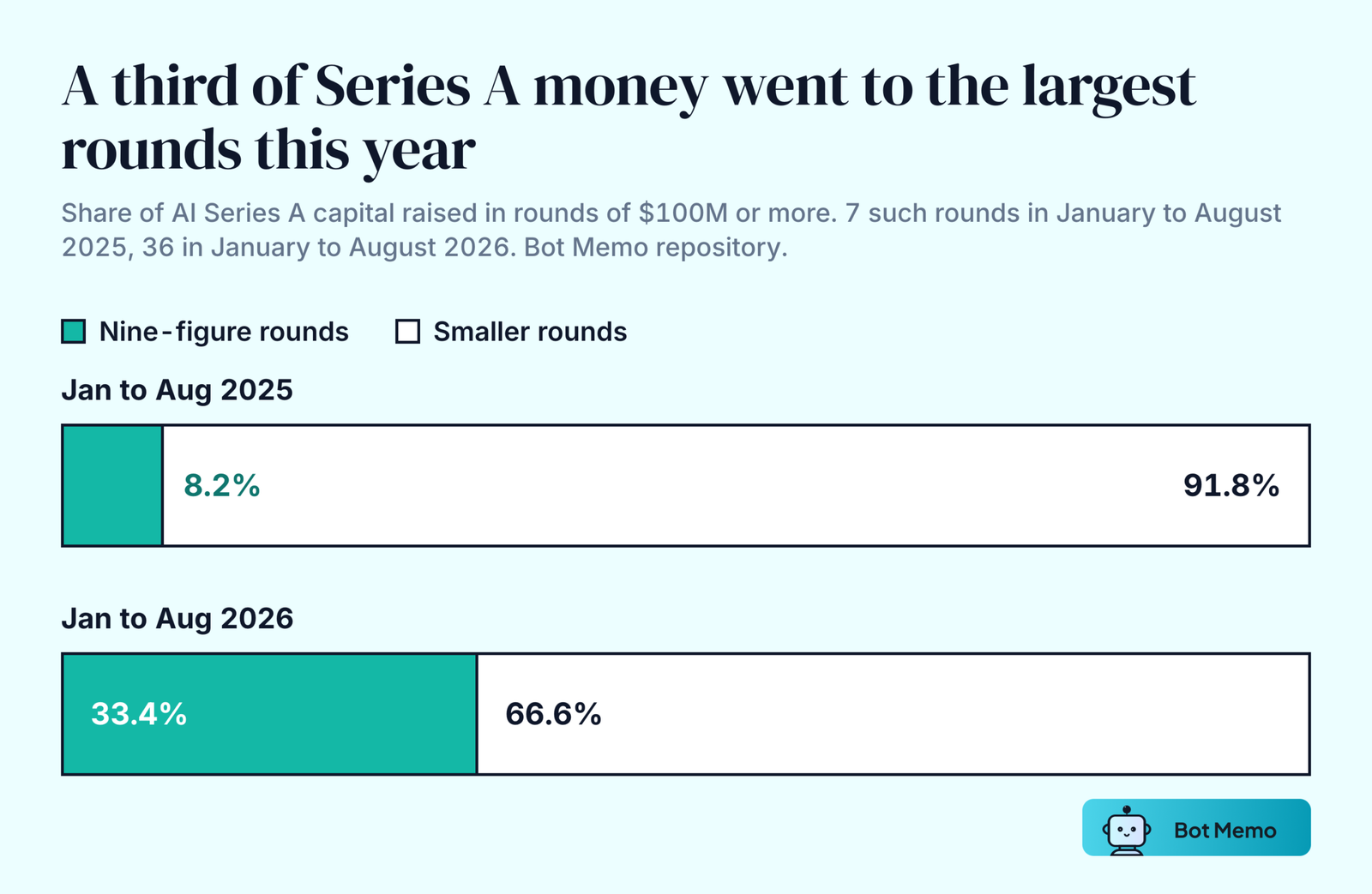
The gap between those two growth rates comes from a jump in very large Series A rounds. Thirty-six rounds of $100 million or more were announced in the first eight months of 2026, against seven a year earlier, and they took 33.4% of all Series A capital. For most founders the market moved less than the headline total suggests.
On this page
- AI Series A Funding in 2026 at a Glance
- How Big Is a Typical AI Series A Round in 2026?
- Why Did Series A Funding Grow Faster Than the Median?
- AI Series A Funding by Quarter
- Which Sectors Raise the Largest AI Series A Rounds?
- Where Do AI Series A Rounds Happen?
- Which Investors Back the Most AI Series A Rounds?
- What the 2026 Numbers Mean for Founders Raising a Series A
- Frequently Asked Questions
- Methodology
AI Series A Funding in 2026 at a Glance
| Metric | Jan to Aug 2026 | Jan to Aug 2025 | Full year 2025 |
|---|---|---|---|
| Series A rounds | 849 | 710 | 1,045 |
| Total raised | $25.5B | $14.6B | $22.4B |
| Median round | $18.0M | $15.6M | $16.0M |
| Middle half of rounds | $10M to $30M | $11M to $25M | $11M to $25M |
| Top 10% of rounds start at | $52M | $39M | $40M |
| Rounds of $100M or more | 36 | 7 | 14 |
| Share of capital in $100M+ rounds | 33.4% | 8.2% | 10.0% |
Medians and percentiles use the rounds with a disclosed amount: 834 of 849 in 2026 and 680 of 710 in the 2025 window.
How Big Is a Typical AI Series A Round in 2026?
The median AI Series A round is $18.0 million in 2026. Half of all rounds fall between $10 million and $30 million, and one round in ten is $52 million or larger. In the first eight months of 2025 the middle half ran from $11 million to $25 million and the top tenth started at $39 million.
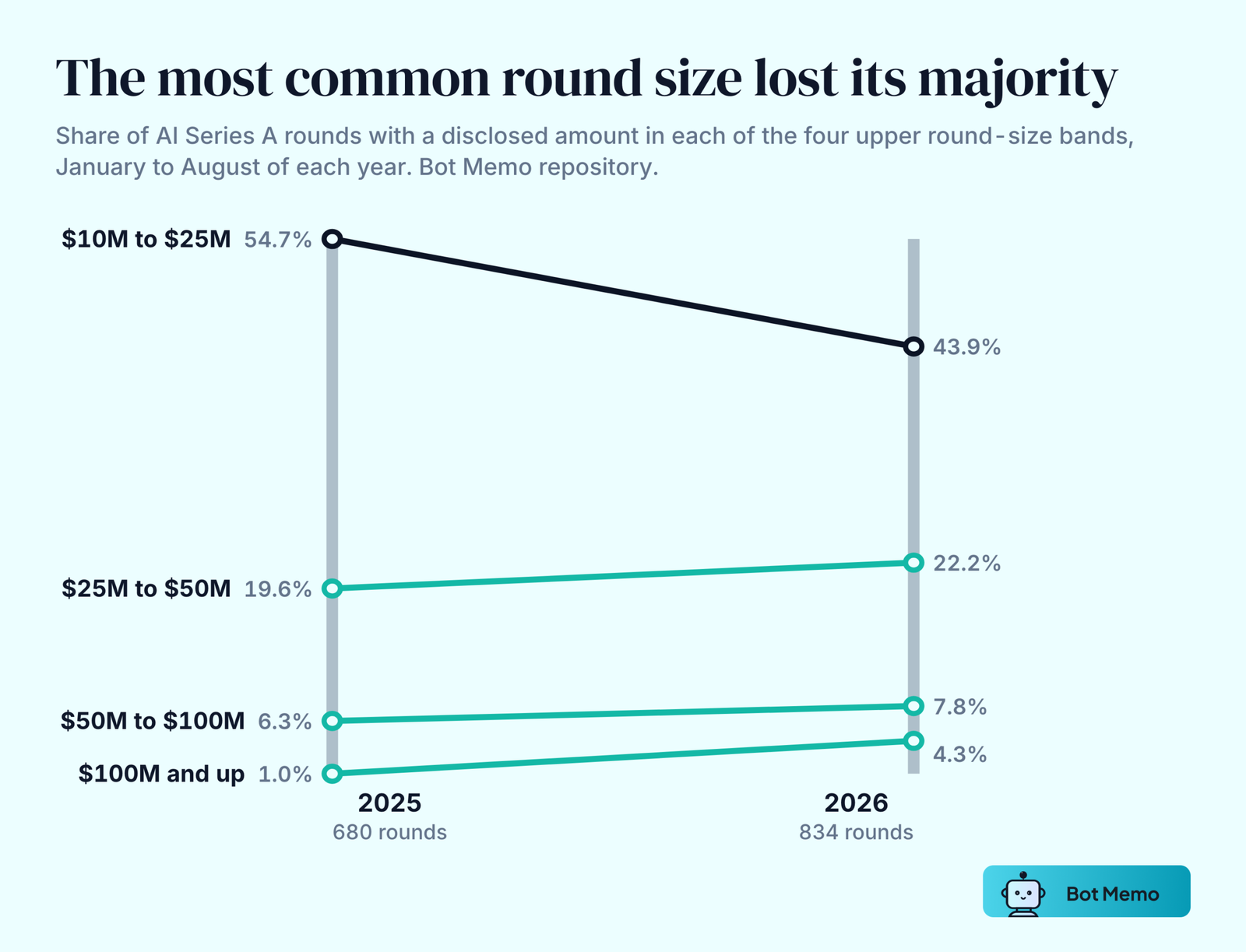
The middle of the range lost share. The $10 million to $25 million band, which held 54.7% of rounds in early 2025, now holds 43.9%. Rounds of $25 million and up gained: $25 million to $50 million went from 19.6% to 22.2% of rounds, $50 million to $100 million from 6.3% to 7.8%, and $100 million and up from 1.0% to 4.3%.
| Round size | Rounds, Jan to Aug 2026 | Share of rounds | Share of capital | Share of rounds, Jan to Aug 2025 |
|---|---|---|---|---|
| Under $5M | 54 | 6.5% | 0.7% | 3.5% |
| $5M to $10M | 128 | 15.3% | 3.6% | 14.9% |
| $10M to $25M | 366 | 43.9% | 23.0% | 54.7% |
| $25M to $50M | 185 | 22.2% | 23.6% | 19.6% |
| $50M to $100M | 65 | 7.8% | 15.8% | 6.3% |
| $100M and up | 36 | 4.3% | 33.4% | 1.0% |
For a wider view of how round sizes move from seed to later stages, see our round size trends and AI startups by funding stage.
Why Did Series A Funding Grow Faster Than the Median?
Rounds of $100 million or more raised $8.5 billion from January to August 2026, about seven times the $1.2 billion such rounds raised in the same months of 2025. Take them out and the rest of the market still grew, from $13.4 billion to $17.0 billion, a rise of 27%. The median of those sub-$100 million rounds went from $15.4 million to $17.0 million.
Seven of the eleven largest rounds went to companies building compute, chips or robots, and three went to AI research labs. The eleventh, Fundamental, builds AI models for large business datasets.
| Company | Series A amount | Announced | What it builds |
|---|---|---|---|
| Fluidstack | $830M | July 2026 | AI data centers and compute |
| Hark | $700M | May 2026 | Personal intelligence AI lab |
| Recursive Superintelligence | $650M | May 2026 | Self-improving AI research |
| Apptronik | $520M (extension) | February 2026 | Humanoid robots |
| Mind Robotics | $500M | March 2026 | AI-driven industrial robots |
| Rhoda AI | $450M | March 2026 | AI-powered robots |
| General Intuition | $320M | June 2026 | AI agents trained on gameplay video |
| Ricursive Intelligence | $300M | January 2026 | AI for semiconductor design |
| Starcloud | $250M (extension) | August 2026 | Data centers in orbit |
| Fundamental | $225M | February 2026 | AI models for large tabular data |
| Olix | $220M | February 2026 | Photonic chips for AI |
The ten largest rounds alone raised $4.7 billion, 18.6% of all AI Series A capital this year. In the first eight months of 2025 the ten largest took 10.1%, and the biggest single round was Apptronik’s $403 million.
AI Series A Funding by Quarter
| Quarter | Rounds | Total raised | Median round | Rounds of $100M+ |
|---|---|---|---|---|
| Q1 2025 | 279 | $6.0B | $15.3M | 4 |
| Q2 2025 | 270 | $5.1B | $15.3M | 2 |
| Q3 2025 | 260 | $5.6B | $16.9M | 3 |
| Q4 2025 | 236 | $5.6B | $17.0M | 5 |
| Q1 2026 | 347 | $10.7B | $19.0M | 14 |
| Q2 2026 | 339 | $9.5B | $17.0M | 13 |
| July and August 2026 | 163 | $5.3B | $20.0M | 9 |
The step up came at the turn of the year. Every quarter of 2025 raised between $5.1 billion and $6.0 billion. The first quarter of 2026 raised $10.7 billion. July and August together raised $5.3 billion, already more than the second quarter of 2025, and their 9 rounds of $100 million or more are nearly twice as many as 2025 produced in any full quarter.
Which Sectors Raise the Largest AI Series A Rounds?
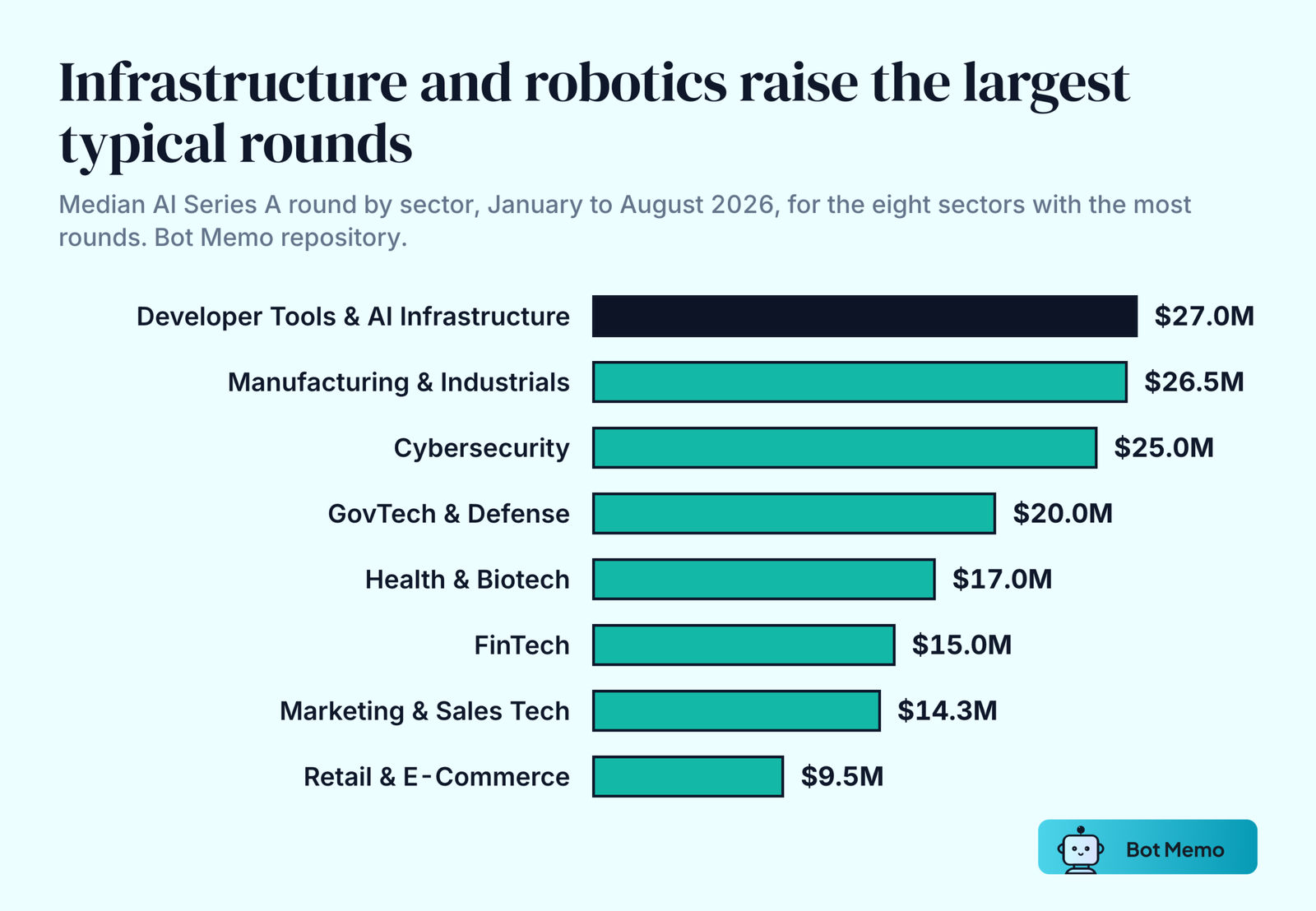
Health and biotech has the most AI Series A rounds, with 159 this year. Developer tools and AI infrastructure added the most, going from 72 rounds in the first eight months of 2025 to 126, and its median rose from $20.0 million to $27.0 million, the highest of any large sector. Manufacturing and industrials, where most robotics companies sit, moved the same way, from 68 rounds to 106 and from a $20.0 million median to $26.5 million.
| Sector | Rounds, Jan to Aug 2026 | Rounds, Jan to Aug 2025 | Median, 2026 | Median, 2025 |
|---|---|---|---|---|
| Health & Biotech | 159 | 138 | $17.0M | $19.0M |
| Developer Tools & AI Infrastructure | 126 | 72 | $27.0M | $20.0M |
| FinTech | 117 | 110 | $15.0M | $15.1M |
| Manufacturing & Industrials | 106 | 68 | $26.5M | $20.0M |
| Marketing & Sales Tech | 73 | 60 | $14.3M | $14.0M |
| Cybersecurity | 65 | 56 | $25.0M | $15.0M |
| GovTech & Defense | 53 | 32 | $20.0M | $20.0M |
| Retail & E-Commerce | 53 | 24 | $9.5M | $11.0M |
| Energy & Sustainability | 37 | 54 | $20.2M | $13.9M |
| Transportation & Mobility | 30 | 28 | $10.7M | $13.3M |
Cybersecurity is another big mover. Its median rose from $15.0 million to $25.0 million while its round count grew by nine. A company that sits in two sectors counts in both, so the sector counts add up to more than the 849 total.
Where Do AI Series A Rounds Happen?
US companies raised 456 of the 849 AI Series A rounds this year, 53.7%, and took 68.0% of the capital. Their median round was $21.0 million. Companies in Europe, counting the UK, raised 189 rounds at a median of $17.0 million.
| Country | Rounds, Jan to Aug 2026 | Total raised | Median round |
|---|---|---|---|
| United States | 456 | $17.4B | $21.0M |
| India | 84 | $752M | $6.9M |
| United Kingdom | 71 | $2.4B | $20.0M |
| Germany | 27 | $471M | $13.9M |
| France | 25 | $510M | $17.9M |
| Israel | 18 | $484M | $20.5M |
| China | 15 | $573M | $28.7M |
| Singapore | 15 | $179M | $10.0M |
| Canada | 11 | $227M | $12.0M |
| Australia | 10 | $224M | $20.5M |
An Indian AI company’s Series A has a median of $6.9 million, roughly a third of the US figure. UK rounds, at a $20.0 million median, sit close to the US.
Inside the US, the San Francisco Bay Area had 165 AI Series A rounds at a median of $27.0 million, and New York had 128 at $20.0 million. Boston followed with 21. A company with offices in two metros counts in both. Our US AI funding report for H1 2026 and Europe AI funding report for H1 2026 cover every stage in those regions.
Which Investors Back the Most AI Series A Rounds?
Y Combinator appears in 53 AI Series A rounds this year, more than any other investor. Andreessen Horowitz took part in 34, Accel in 27, General Catalyst in 25 and Lightspeed Venture Partners in 23.
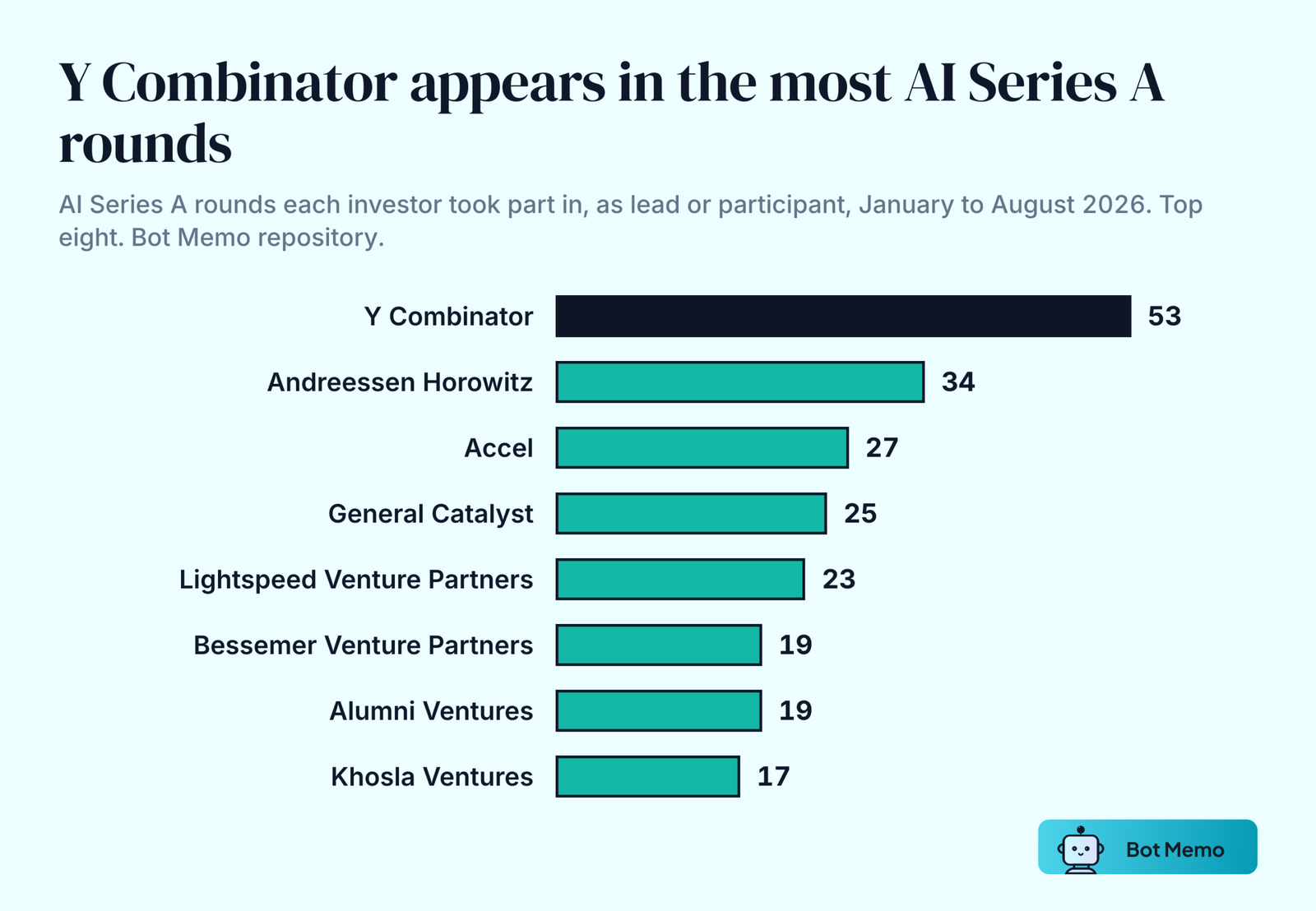
These counts include every named investor in a round, lead or not. Khosla Ventures took part in 17 rounds worth $1.3 billion in total, more than the rounds General Catalyst or Lightspeed Venture Partners joined. Its largest were Rhoda AI’s, General Intuition’s and Scaled Cognition’s. For the full ranking across stages, see our list of the most active AI investors.
What the 2026 Numbers Mean for Founders Raising a Series A
Benchmark a raise against your sector and country rather than the headline total. The overall median is $18.0 million, but it is $27.0 million in developer tools and AI infrastructure against $15.0 million in FinTech, and $21.0 million in the US against $6.9 million in India. You can compare a planned raise against rounds like yours with our AI funding benchmark.
A $10 million to $25 million raise is still the most common Series A by a wide margin, at 43.9% of rounds, and about one round in five is under $10 million.
The nine-figure rounds are a poor guide to pricing your own. The 36 rounds of $100 million or more are 4.3% of all rounds, and the largest of them went to compute, chip, robotics and research lab companies.
Frequently Asked Questions
What is the median Series A round for AI startups in 2026?
The median AI Series A round is $18.0 million for rounds announced from January to August 2026, up from $15.6 million in the same months of 2025. Half of all rounds fall between $10 million and $30 million.
How much did AI startups raise in Series A funding in 2026?
AI startups raised $25.5 billion across 849 Series A rounds from January to August 2026. That is 75% more than the $14.6 billion raised in the same period of 2025 and more than the $22.4 billion raised in all of 2025.
How many AI Series A rounds were $100 million or more in 2026?
Thirty-six AI Series A rounds of $100 million or more were announced from January to August 2026, against seven in the same months of 2025. Together they raised $8.5 billion, 33.4% of all AI Series A capital. The largest was Fluidstack’s $830 million round in July.
Which sectors raise the largest AI Series A rounds?
Developer tools and AI infrastructure has the highest median AI Series A round in 2026 among the larger sectors, $27.0 million, followed by manufacturing and industrials at $26.5 million and cybersecurity at $25.0 million. Health and biotech has the most rounds, 159, at a median of $17.0 million.
Which investors are most active in AI Series A rounds?
Y Combinator took part in 53 AI Series A rounds from January to August 2026, followed by Andreessen Horowitz with 34, Accel with 27, General Catalyst with 25 and Lightspeed Venture Partners with 23.
How much of AI Series A funding goes to US startups?
US startups raised 456 of 849 AI Series A rounds from January to August 2026, 53.7% of rounds, and $17.4 billion, 68.0% of the capital. The median US round was $21.0 million, against $17.0 million in Europe including the UK.
Methodology
This analysis covers Series A rounds raised by AI startups and announced between January 1, 2025 and August 31, 2026, drawn from the Bot Memo funding repository. The 2026 figures are compared with the same January to August window in 2025, with full-year 2025 shown for reference.
Series A includes rounds named Series A, A1, A2 and A+ tranches, and Series A extensions. An extension counts at the new money it adds. Excluded are pre-Series A rounds, including those filed under a Series A label, rounds announced as a combined seed and Series A without a split between the two, strategic investments with no round letter, financings of subsidiaries of established companies, renamed companies that had already raised later rounds, and companies without an AI product. Each round counts once.
All amounts are in US dollars, converted from the original currency. Medians, percentiles and size bands use rounds with a disclosed amount. Sector figures give a round’s full amount to each sector the company belongs to, and metro figures do the same for companies with more than one headquarters, so those breakdowns add up to more than the overall totals. Investor figures count every named participant in a round and describe participation in rounds, not the amount each firm invested.

About the author
Editorial Staff
The Editorial Staff at Bot Memo is a team of writers, analysts, and AI agents dedicated to mapping the global AI startup ecosystem. Led by Chintan Zalani, the team tracks thousands of funding rounds, classifies companies across verticals, and distills it all into actionable intelligence for investors and founders.