
Two different maps hide behind the phrase “AI startups built on OpenAI”. One is the set of companies that run OpenAI models inside their products. The other is the set of companies OpenAI pays for, through its own balance sheet or the OpenAI Startup Fund. Of the companies covered here, four appear on both.
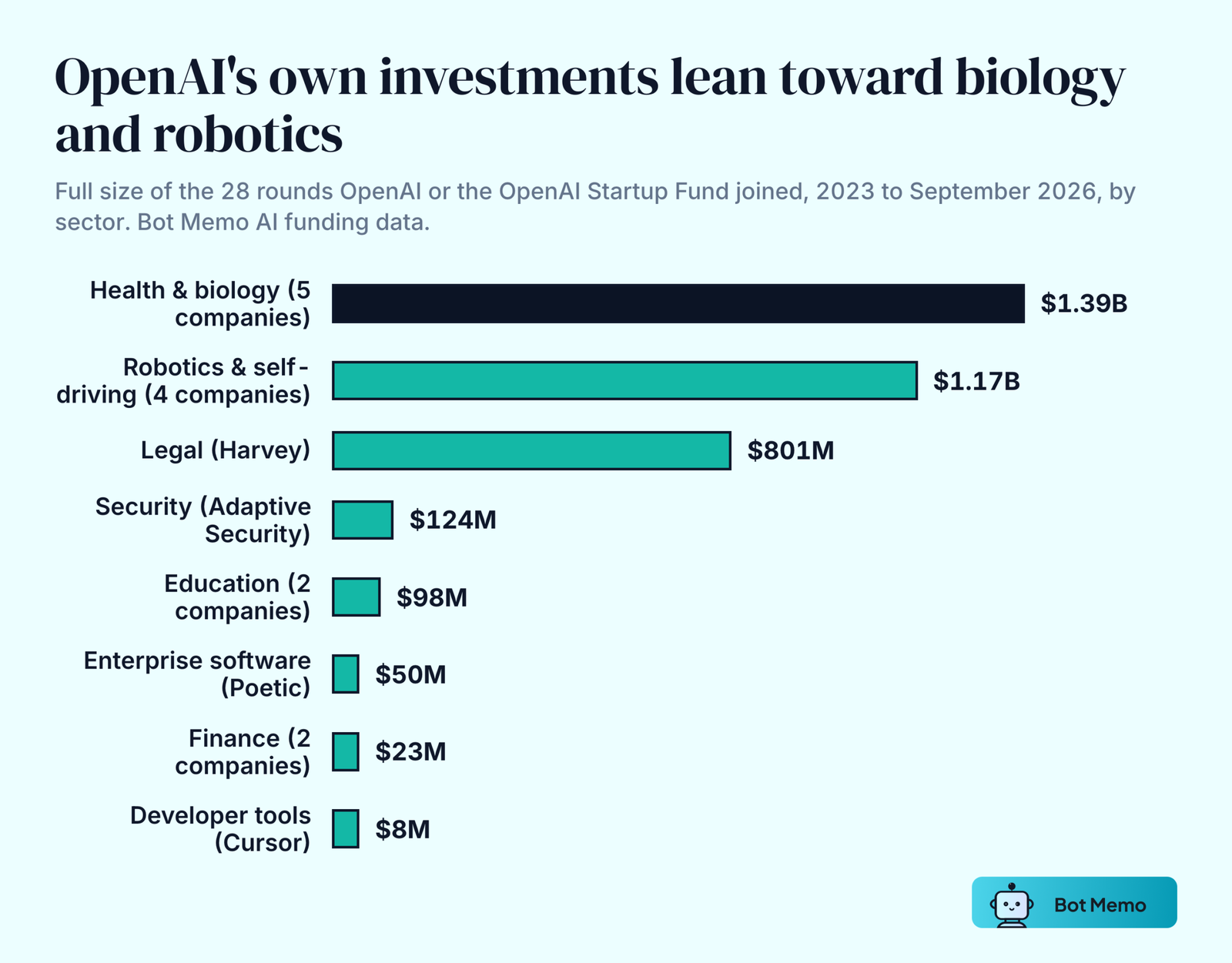
Since 2023, OpenAI or its Startup Fund has joined 28 funding rounds at 17 startups, rounds worth $3.67B in total. Nine of those 17 companies work in biology, health, robotics or self-driving, and their rounds account for $2.56B of the $3.67B. Four of the 17, Harvey, Speak, Cursor and Endex, have public evidence that their product runs on OpenAI models. And among the startups that use OpenAI models, Harvey, Lovable and Retell AI also run models from other providers.
On this page
How big OpenAI’s customer base is
OpenAI said in November 2025 that more than 1 million business customers pay for its products, and that ChatGPT for Work had passed 7 million seats. It named Amgen, Commonwealth Bank, Booking.com, Cisco, Lowe’s, Morgan Stanley, T-Mobile, Target and Thermo Fisher Scientific as customers. In April 2026, Denise Dresser, OpenAI’s chief revenue officer at the time, wrote that enterprise had grown to more than 40% of OpenAI’s revenue and was on track to match consumer revenue by the end of 2026.
Those are buyers of OpenAI’s products. The startups below are a narrower group: companies that build a product on top of OpenAI models and sell it to someone else.
The startups OpenAI has invested in
The table lists every round in Bot Memo’s AI funding data where OpenAI or the OpenAI Startup Fund invested as an institution. Rounds where only OpenAI employees invested as individuals are not included. The amount is the full round, not OpenAI’s share, which is rarely disclosed. OpenAI or its Startup Fund led or co-led 7 of the 28.
| Company | What it does | Announced | Round | Round size | Role of OpenAI or its fund |
|---|---|---|---|---|---|
| Biossil | Gives failed drug candidates a second chance with AI | Sep 2026 | Not disclosed | $153M | Lead |
| Chai Discovery | AI models for molecular and antibody design | Jul 2026 | Series C | $400M | Participant |
| Poetic | Automating complex enterprise processes such as underwriting | Jun 2026 | Series A | $50M | Participant |
| Biossil | Gives failed drug candidates a second chance with AI | Apr 2026 | Not disclosed | $43M | Co-lead |
| Merge Labs | Brain-computer interfaces | Jan 2026 | Seed | $250M | Investor |
| Adaptive Security | Deepfake and social-engineering attack training | Dec 2025 | Series B | $81M | Participant |
| Chai Discovery | AI models for molecular and antibody design | Dec 2025 | Series B | $130M | Participant |
| Valthos | AI biodefense | Oct 2025 | Seed | $30M | Investor |
| Endex | AI financial analyst inside Excel | Aug 2025 | Seed | $14M | Lead |
| Chai Discovery | AI models for molecular and antibody design | Aug 2025 | Series A | $70M | Participant |
| Ambience Healthcare | Clinical documentation and coding for health systems | Jul 2025 | Series C | $243M | Participant |
| Harvey | AI for law firms and legal teams | Jun 2025 | Series E | $300M | Participant |
| Adaptive Security | Deepfake and social-engineering attack training | Apr 2025 | Series A | $43M | Co-lead |
| Harvey | AI for law firms and legal teams | Feb 2025 | Series D | $300M | Participant |
| Speak | Language learning through spoken practice | Dec 2024 | Series C | $78M | Participant |
| Physical Intelligence | General-purpose AI models for robots | Nov 2024 | Series A | $400M | Participant |
| Kick | Automated bookkeeping | Oct 2024 | Seed | $9M | Participant |
| Harvey | AI for law firms and legal teams | Jul 2024 | Series C | $100M | Participant |
| Physical Intelligence | General-purpose AI models for robots | Mar 2024 | Seed | $70M | Participant |
| Ambience Healthcare | Clinical documentation and coding for health systems | Feb 2024 | Series B | $70M | Co-lead |
| Figure | Humanoid robots | Feb 2024 | Series B | $675M | Participant |
| Harvey | AI for law firms and legal teams | Dec 2023 | Series B | $80M | Participant |
| Ghost Autonomy | Self-driving software for carmakers | Nov 2023 | Strategic investment | $5M | Investor |
| Class Companion | Feedback on student writing for teachers | Oct 2023 | Seed | $4M | Participant |
| Anysphere (Cursor) | Cursor AI code editor | Oct 2023 | Seed | $8M | Lead |
| Speak | Language learning through spoken practice | Aug 2023 | Series B-2 | $16M | Participant |
| Harvey | AI for law firms and legal teams | Apr 2023 | Series A | $21M | Participant |
| 1X | Humanoid robots | Mar 2023 | Series A2 | $23.5M | Lead |
The biggest rounds OpenAI joined are in science and machines. Chai Discovery has taken OpenAI money in three straight rounds, the last a $400M Series C in July 2026. TechCrunch reported that OpenAI wrote the largest check in Merge Labs’ $250M seed in January 2026, and the OpenAI Startup Fund led Biossil’s $153M round at a $1B valuation in September 2026.
Harvey is the company OpenAI returned to most. It joined five Harvey rounds from the 2023 Series A to the 2025 Series E, worth $801M together.
An OpenAI investment has not guaranteed a lasting tie. Figure ended its collaboration agreement with OpenAI in February 2025, after its CEO, Brett Adcock, said Figure had built its own robot AI in house. Ghost Autonomy, which took $5M from OpenAI in late 2023, shut down in April 2024. And Cursor, whose maker Anysphere raised an $8M seed round led by the Startup Fund in 2023, is set to lose access to OpenAI models (more on that below).
Startups on record using or testing OpenAI models
Each company below appears in an OpenAI customer story or gives a named quote in an OpenAI model launch, or has said itself that it uses OpenAI models. Two of them, Legora and Rogo, are quoted on their own tests of GPT-5.6 rather than on a product built on it.
| Company | Evidence of OpenAI use | OpenAI models named | Uses other providers too | Latest financing or acquisition |
|---|---|---|---|---|
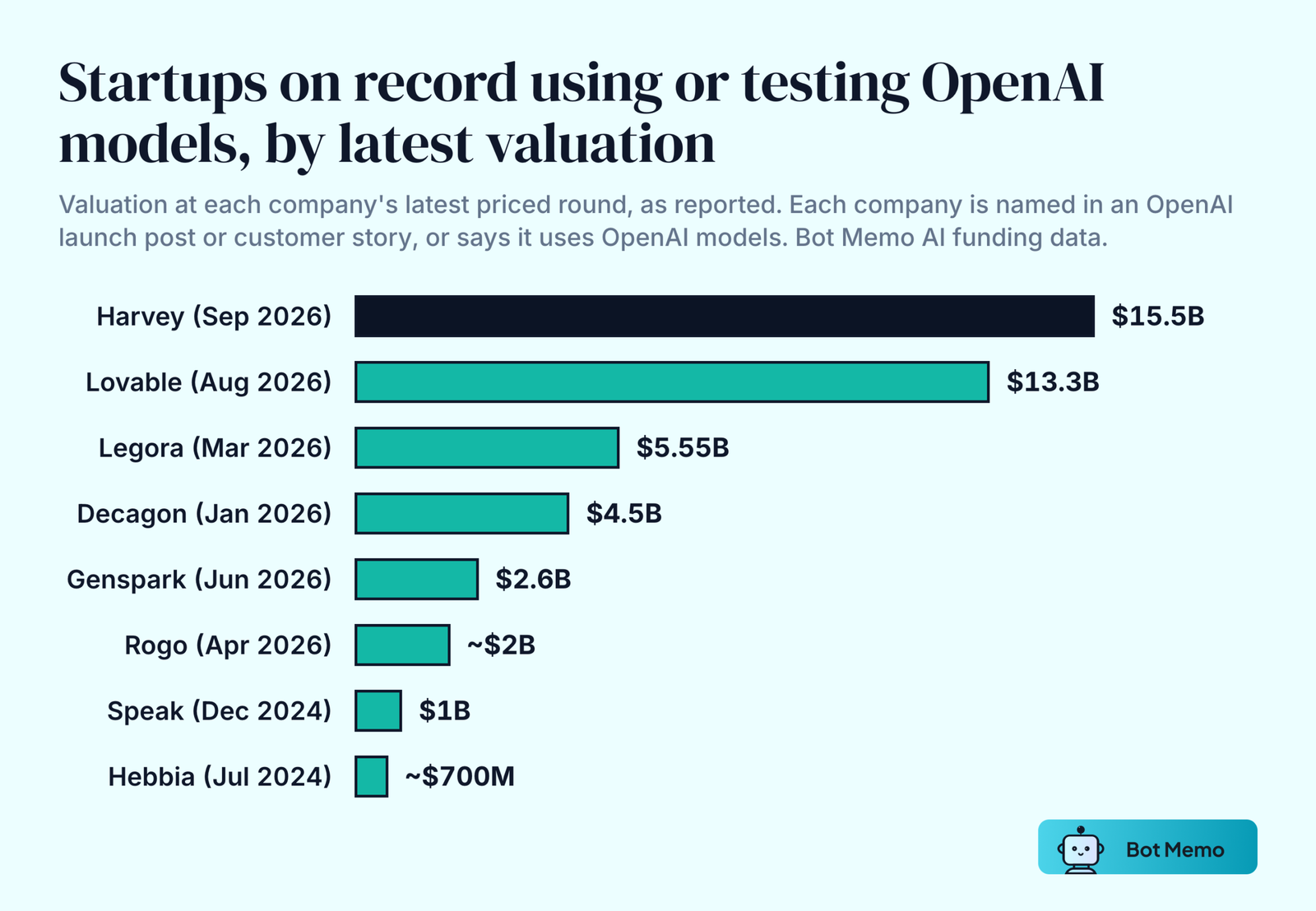
| Harvey | GPT-5.4 launch quote, March 2026; earlier, a custom case-law model built with OpenAI | GPT-5.4 | Yes, Claude and Gemini since 2025 | $550M at $15.5B, Sep 2026 |
| Lovable | GPT-5.6 launch quote, July 2026 | GPT-5.6 | Yes, Gemini, GPT and Claude models | $400M Series C at $13.3B, Aug 2026 |
| Legora | Tested GPT-5.6, quoted in the July 2026 launch | GPT-5.6 | Uses Anthropic’s Claude | $550M Series D at $5.55B, Mar 2026, plus a $50M extension in Apr 2026 |
| Decagon | OpenAI customer story | GPT models, including fine-tuned ones | Not stated | $250M Series D at $4.5B, Jan 2026 |
| Genspark | OpenAI customer story, July 2025 | GPT-4.1, Realtime API | Not stated; its agent spreads work across nine models | $100M Series B extension at $2.6B, Jun 2026 |
| Rogo | Tested GPT-5.6, quoted in the July 2026 launch | GPT-5.6 | Not stated | $160M Series D, Apr 2026 (reported at about $2B) |
| Speak | Whisper API launch partner, March 2023 | Whisper, Realtime API | Not stated | $78M Series C at $1B, Dec 2024 |
| Hebbia | OpenAI customer story | o1, o3-mini, GPT-4o | Not stated | $130M Series B at about $700M, Jul 2024 |
| Retell AI | OpenAI customer story, June 2025 | GPT-4o | Yes, Claude and Gemini in its API | Seed, 2024 |
| Endex | OpenAI customer story | o1, o3-mini | Not stated | $14M seed led by the OpenAI Startup Fund, Aug 2025 |
| Cursor | GPT-5.4 launch quote, March 2026 | GPT-5.4 | Yes | Acquired by SpaceX for $60B in stock, Aug 2026 |
Harvey has the deepest record. OpenAI’s customer story describes a custom case-law model the two built together, and in the GPT-5.4 launch Harvey’s head of applied research, Niko Grupen, said the model scored 91% on Harvey’s BigLaw Bench. Harvey also added Anthropic and Google models to its platform in 2025. Lovable’s co-founder Fabian Hedin described GPT-5.6 in the July 2026 launch as “one of the models now used by Lovable”.
The chart uses the valuation set at each company’s latest priced round; Legora’s $5.55B is from its March 2026 Series D. Rogo’s and Hebbia’s figures were reported, not announced by the companies. Cursor is left off the chart because its last price was an acquisition, not a funding round.
Voice: the Whisper and Realtime APIs
Voice has some of the longest-running examples of startups on OpenAI’s APIs. Speak, the language-learning app, was named in OpenAI’s March 2023 launch of the Whisper speech-recognition API and later built its live role-play feature on the Realtime API. Retell AI runs GPT-4o for its phone agents. Vapi, a voice-agent platform, offers OpenAI Realtime as one option among several model providers.
The counterexample is Bland, which raised a $50M Series C in June 2026. Its own site says: “We don’t wrap anyone’s models. We built our own.” Bland runs speech recognition, the language model and text-to-speech in house.
Voice builders on OpenAI also face two scheduled removals. OpenAI’s deprecations page shows notices sent in August 2026 that whisper-1 and the gpt-4o transcription models will leave the API on February 26, 2027, and notices sent in July 2026 that the original gpt-realtime model goes on January 20, 2027.
What happens when OpenAI changes the terms
The sharpest case of 2026 is Cursor. SpaceX agreed in June to buy Anysphere, Cursor’s maker, for $60B in stock, and the deal closed on August 14. On August 28, OpenAI told SpaceX that it would wind down its contract supplying OpenAI models to Cursor, with a proposed shutoff date of November 12, 2026. Cursor was one of the earliest companies the OpenAI Startup Fund backed. Its CEO, Michael Truell, said OpenAI models carried about 5% of Cursor’s user traffic, according to Channel Insider, and the two companies were still talking. The cut matters less to Cursor than it would to a startup with no other model on hand.
Model retirements are the routine version of the same risk. OpenAI announces them in advance on its deprecations page, with a stated minimum of six months’ notice for generally available models and three months for specialized variants, unless safety or compliance concerns require a faster timeline. The notices keep coming. Notices sent in 2026 alone cover the Sora 2 video models and the Videos API (removed September 24, 2026, with no replacement listed), older GPT-5 and o3 snapshots, and, in October 2026, snapshots of GPT-4o and GPT-4.1, which leave the API on January 14, 2027. A product built around one of those models has to be re-tested on the replacement before the cutoff.
The third pressure is OpenAI’s own products. ChatGPT added Canvas for writing and code in October 2024, Projects in December 2024, Tasks in January 2025 and ChatGPT agent in July 2025, then opened ChatGPT to third-party apps and launched its Atlas browser in October 2025. Several of them cover ground that startups also sell, such as AI writing tools and browser agents.
Why many builders use more than one provider
Of the 11 companies in the builder table, four are on record running models from more than one provider: Harvey, Lovable, Retell AI and Cursor. Legora uses Anthropic’s Claude and has described its own tests of GPT-5.6. The sources cited here don’t show whether the other six use other providers. Outside the table, Copy.ai lets users switch between GPT and Claude models, and Perplexity’s Model Council sends one question to several models at once and combines the answers.
The Cursor shutoff shows why. A company with a second provider already wired in has somewhere to send its traffic; a company with one provider has to build that path first, on the provider’s deadline. For investors, the useful question about a startup “built on OpenAI” is how much of its product would still work if one provider changed price, retired a model or ended a contract.
For more on the companies behind these models, see how AI agent startups are funded, the AI observability and LLMOps funding map, the largest AI rounds of 2026 and how we tell AI-native startups from AI-augmented ones.
Frequently asked questions
Which startups are built on OpenAI?
Startups with public evidence of running OpenAI models include Harvey, Lovable, Decagon, Genspark, Speak, Hebbia, Retell AI and Endex. Each is named in an OpenAI customer story or model launch, or has said so itself. Legora and Rogo have publicly described their own tests of GPT-5.6. Several, including Harvey, Lovable and Retell AI, also run models from Anthropic, Google or others.
Which startups has OpenAI invested in?
Bot Memo’s AI funding data records 28 rounds at 17 startups where OpenAI or the OpenAI Startup Fund invested as an institution since 2023, rounds worth $3.67B in total. They include Harvey, Chai Discovery, Physical Intelligence, Figure, Ambience Healthcare, Merge Labs, Biossil, Adaptive Security, Speak, 1X and Cursor’s maker Anysphere.
Which enterprise customers has OpenAI named?
OpenAI’s November 2025 announcement named Amgen, Commonwealth Bank, Booking.com, Cisco, Lowe’s, Morgan Stanley, T-Mobile, Target and Thermo Fisher Scientific. OpenAI said it had more than 1 million business customers at the time.
Why is OpenAI cutting off Cursor?
After SpaceX bought Anysphere, Cursor’s maker, in a deal that closed on August 14, 2026, OpenAI said on August 28, 2026 that it would wind down its contract supplying models to Cursor, with a proposed shutoff date of November 12, 2026. OpenAI said it could not be confident that SpaceX would use its technology within its terms of service. Cursor’s CEO said OpenAI models carried about 5% of its traffic.
Is it risky to build a startup on OpenAI?
The documented risks are model retirements (snapshots of GPT-4o and GPT-4.1 leave the API on January 14, 2027), contract changes like the Cursor shutoff, and ChatGPT features that overlap with what startups sell. A second provider softens the first two; it does nothing about ChatGPT competing with the product.
Which startups use Whisper or the Realtime API?
Speak was a launch partner for the Whisper API in March 2023 and uses the Realtime API for live role-play. Genspark’s customer story names the Realtime API, and Vapi offers OpenAI Realtime as one of several options. OpenAI has scheduled whisper-1 for removal on February 26, 2027.

About the author
Editorial Staff
The Editorial Staff at Bot Memo is a team of writers, analysts, and AI agents dedicated to mapping the global AI startup ecosystem. Led by Chintan Zalani, the team tracks thousands of funding rounds, classifies companies across verticals, and distills it all into actionable intelligence for investors and founders.