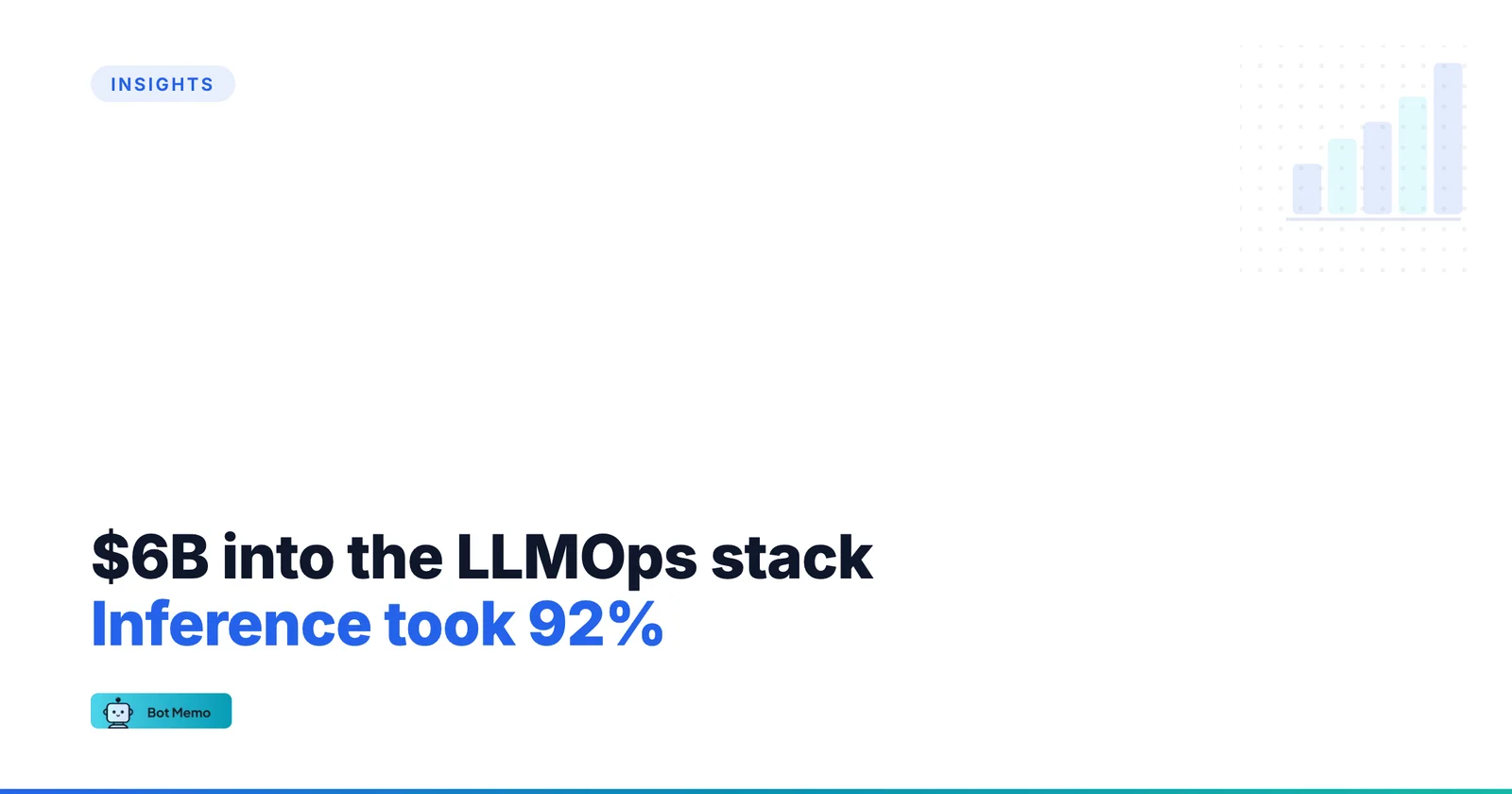

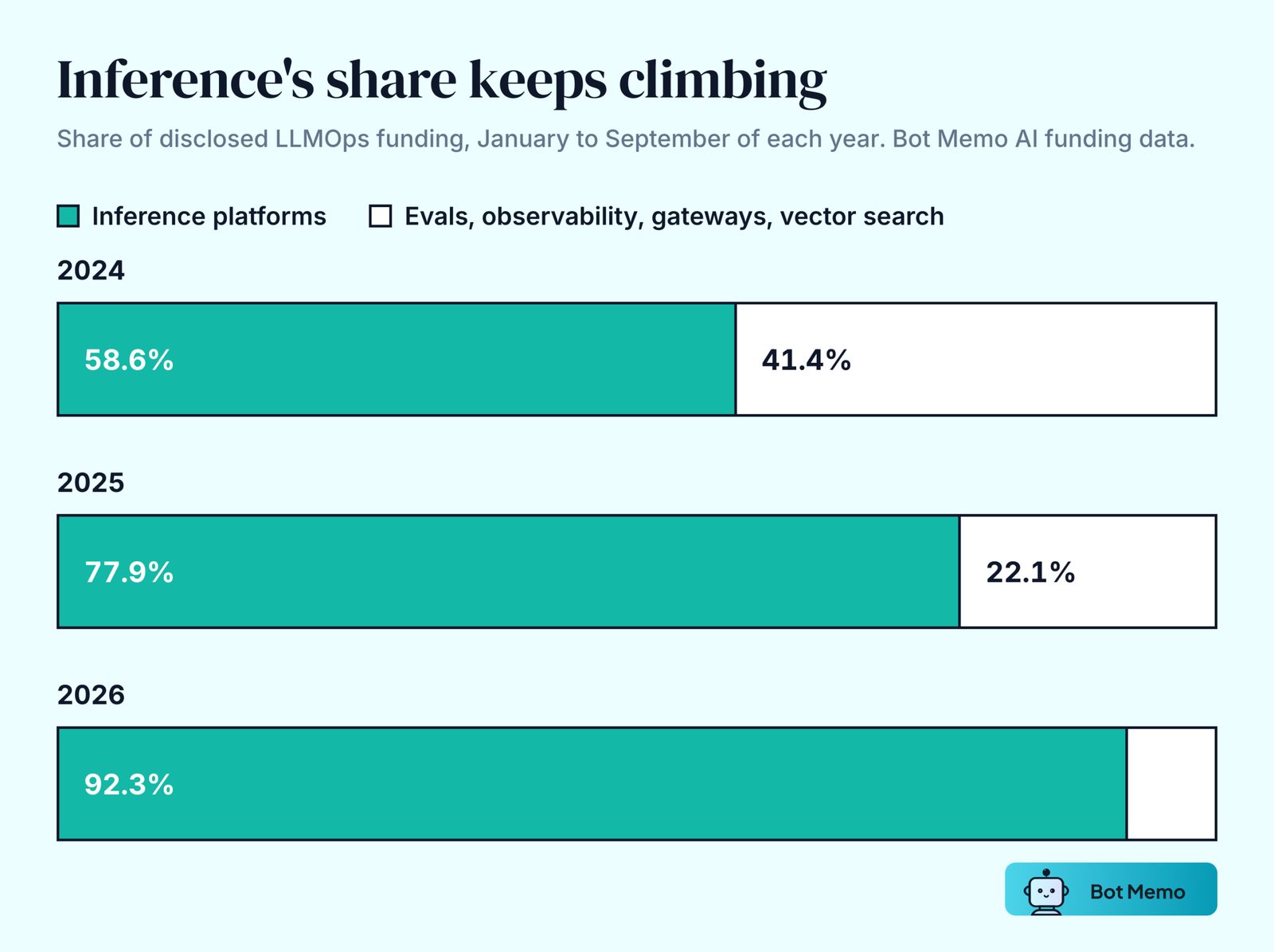
Startups building the software layer that runs AI in production raised $6.02B from January to September 2026, across 36 rounds in Bot Memo’s AI funding data. That layer covers four groups: inference platforms, evaluation and observability tools, AI gateways and routers, and vector search and retrieval. The same nine months of 2025 brought $1.11B. All of 2025 brought $1.70B, so 2026 has already passed it by about 3.5 times.
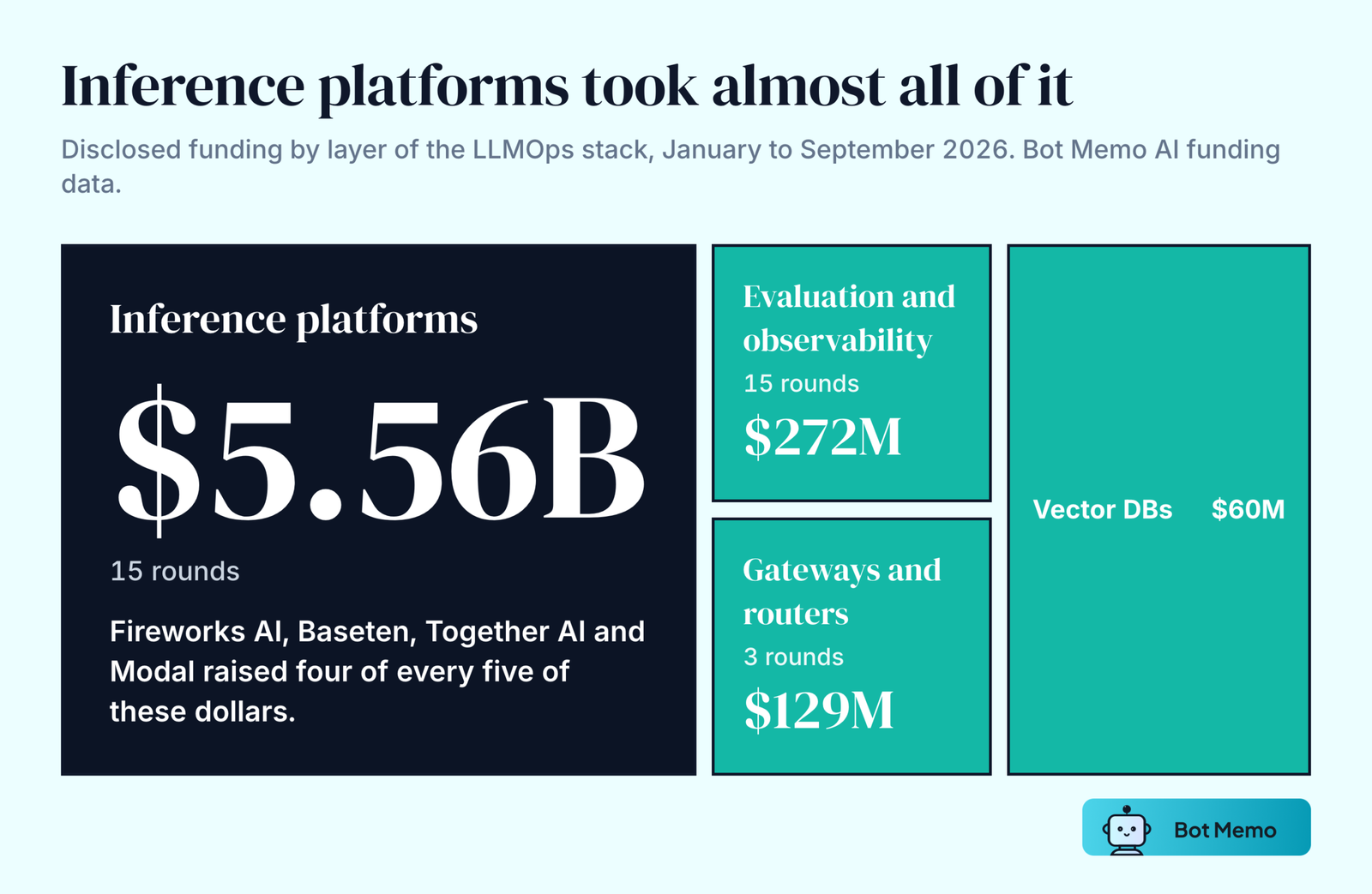
The money did not spread evenly. Inference platforms took $5.56B of it, or 92.3%. Evaluation and observability companies raised $272M. Between August 2025 and October 2026, five of the best-known names in that group were bought or agreed to be bought by larger companies, and a sixth had its team hired by Anthropic. This map covers who raised, who led, and who sold.
On this page
What counts as AI observability and LLMOps
AI observability means tracing, monitoring and evaluating applications built on large language models once they are live: which prompt went in, which tools an agent called, what it cost, how long it took and whether the answer was any good. LLMOps is the wider toolset around it. In this map it has four layers:
- Inference platforms serve open and custom models to applications through an API or managed deployment.
- Evaluation and observability tools test model and agent output before release and trace it in production.
- Gateways and routers sit between an application and many model providers, handling routing, fallback, caching, spend limits and logging.
- Vector search and retrieval stores embeddings and finds the right context for a model to answer from, including memory for agents.
The totals below count rounds at companies whose main product sits in one of these layers. Chipmakers and GPU cloud providers are left out, as are general IT observability vendors that are not built for AI applications.
| Layer | Jan to Sep 2024 | Jan to Sep 2025 | Jan to Sep 2026 |
|---|---|---|---|
| Inference platforms | $223M (4 rounds) | $865M (12) | $5.56B (15) |
| Evaluation and observability | $64M (11) | $166M (15) | $272M (15) |
| Gateways and routers | $2M (1) | $40M (1) | $129M (3) |
| Vector search and retrieval | $92M (6) | $39M (3) | $60M (3) |
| Total | $381M (22) | $1.11B (31) | $6.02B (36) |
Round counts include two 2026 rounds announced without a disclosed amount, SiliconFlow’s Series C and Raindrop’s Series A, both in September. Where a company announced a seed round and a Series A together, they count as one. The first quarter of 2026 alone brought $729M, more than the $539M these four layers raised in all of 2024.
Inference platforms: where the money went
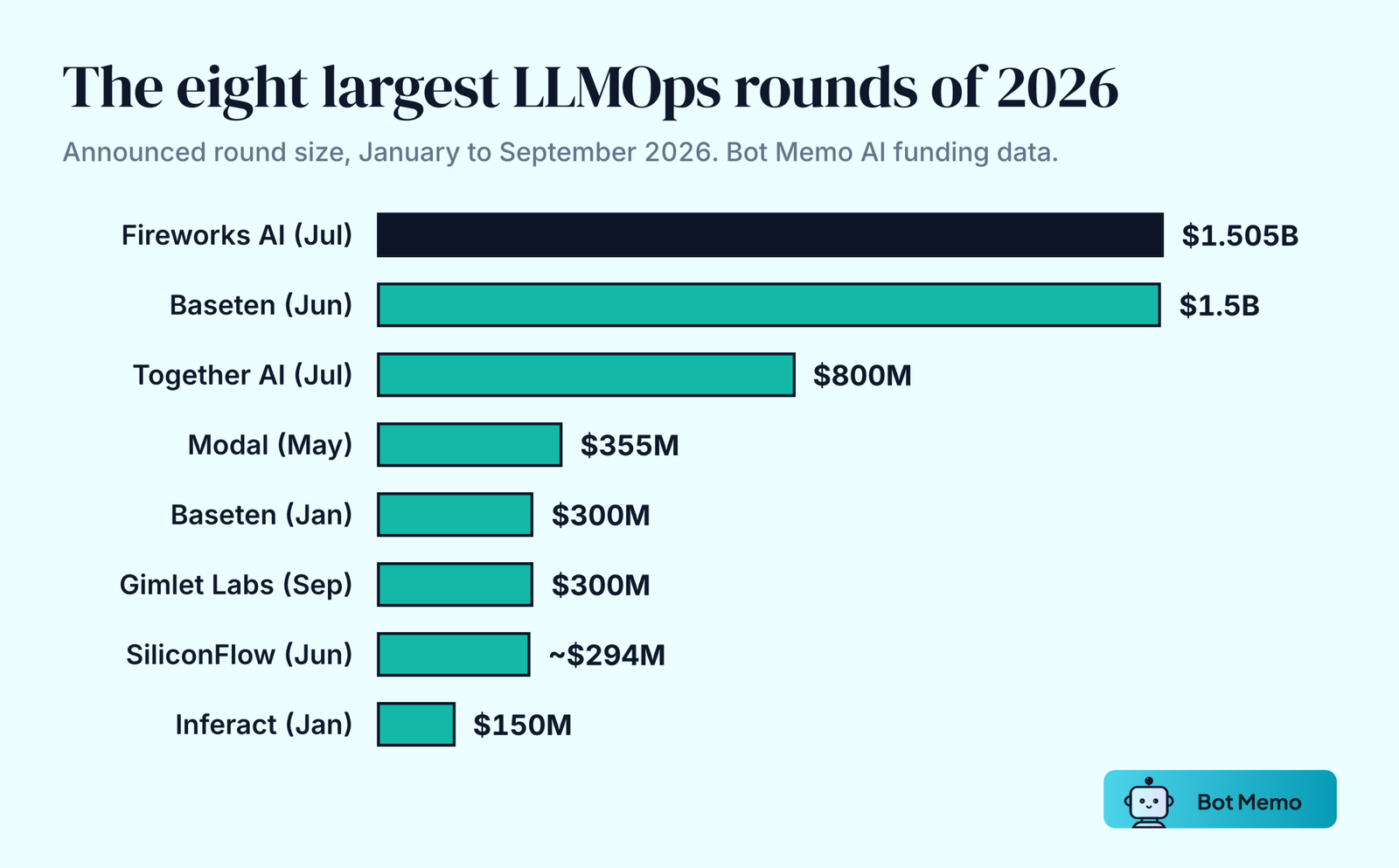
Four companies account for most of the 2026 total. Fireworks AI, Baseten, Together AI and Modal raised $4.46B between them, 80.2% of everything inference platforms raised from January to September.
- Fireworks AI raised a $1.505B Series D in July, led by Atreides Management, Index Ventures and TCV, at a $17.5B post-money valuation. Its $250M Series C in October 2025 had valued it at $4B.
- Baseten raised twice: a $300M Series E in January, co-led by IVP and CapitalG at a $5B valuation, then a $1.5B Series F in June led by Altimeter, Conviction and Spark Capital, with Sands Capital and Wellington Management co-leading. The Series F was priced in two tranches, the higher at $13B. In September 2025 its $150M Series D, led by BOND, valued it at $2.15B.
- Together AI raised an $800M Series C in July, led by Aramco Ventures, at an $8.3B valuation. Its February 2025 Series B was $305M at $3.3B.
- Modal raised a $355M Series C in May, led by General Catalyst and Redpoint, in two tranches, the second at a $4.65B valuation. Its $87M Series B in September 2025, led by Lux Capital, valued it at $1.1B.
Gimlet Labs raised an $80M Series A led by Menlo Ventures in March and a $300M Series B led by Andreessen Horowitz in September. Inferact, the company formed around the open-source vLLM inference engine, raised a $150M first round in January, co-led by Andreessen Horowitz and Lightspeed. RadixArk, the company behind the SGLang serving engine, followed with a $100M seed round in May, co-led by Accel and Spark Capital. DeepInfra raised a $107M Series B in May, co-led by 500 Global and Georges Harik. In China, SiliconFlow raised more than 2 billion yuan (about $294M) in a Series B in June.
The earlier exits in this layer went to bigger platforms. NVIDIA bought OctoAI in 2024. Cloudflare agreed to buy Replicate in November 2025, and Replicate said it would keep its brand and API. Fine-tuning specialists went the same way: Rubrik agreed to buy Predibase in June 2025, and CoreWeave agreed to buy OpenPipe in September 2025.
Evaluation and observability: steady rounds, then buyers
Funding for evaluation and observability grew each year, from $64M in the first nine months of 2024 to $166M in the same months of 2025 and $272M in 2026. The rounds are smaller and more spread out than in inference. Seven of the 14 rounds with a disclosed amount in 2026 were under $10M.
| Company | 2026 round | Month | Lead |
|---|---|---|---|
| Braintrust | $80M Series B | February | ICONIQ |
| Patronus AI | $50M Series B | June | Greenfield Partners |
| Judgment Labs | $32M seed and Series A | May | Lightspeed |
| Fiddler AI | $30M Series C | January | RPS Ventures |
| Coval | $28M Series A | June | Norwest |
| InsightFinder | $15M Series B | April | Yu Galaxy |
| Arato | $10M seed | June | TLV Partners |
| ChatSee.ai | $6.5M seed | June | True Ventures |
| Raindrop | Series A, amount not disclosed | September | CRV |
Braintrust’s round came 16 months after its $36M Series A, led by Andreessen Horowitz in October 2024. Patronus AI raised a $17M Series A in May 2024 and now sells simulated environments for training and testing AI agents. Raindrop, which monitors AI agents for failures in production, raised a $15M seed round led by Lightspeed in December 2025 before its Series A.
Between August 2025 and October 2026, six evaluation, observability or prompt-management companies were bought, agreed to be bought, or had their team hired:
| Company | What it did | Buyer | When |
|---|---|---|---|
| Humanloop | Prompt management and evaluation | Founders and team joined Anthropic; platform shut down | August 2025 |
| Langfuse | Open-source LLM observability | ClickHouse | January 2026 |
| Helicone | Open-source LLM observability and gateway | Mintlify | March 2026 |
| Promptfoo | LLM evaluation and red-teaming | OpenAI (agreement announced) | March 2026 |
| Galileo | Evaluation and agent observability | Cisco, now part of Splunk | Closed May 2026 |
| Arize AI | Evaluation and observability (Phoenix, AX) | Dynatrace, $915M | Announced August 2026, closed October 2026 |
Arize shows the change most clearly. It raised a $70M Series C led by Adams Street Partners in February 2025. Eighteen months later Dynatrace agreed to buy it for $915M, about $815M of it in cash and the rest in replacement equity awards for Arize staff. Galileo had raised a $45M Series B led by Scale Venture Partners in October 2024; Cisco did not disclose what it paid.
The buyers fall into three groups: established observability vendors (Dynatrace, and Cisco through Splunk), a database company (ClickHouse) and model labs (OpenAI, and Anthropic for Humanloop’s team).
Gateways and routers
Gateways sit in the path of every model call an application makes, which is why they can route traffic, fall back when a provider fails, cache answers and enforce spend limits. Funding here was small until 2026, when it reached $129M across three rounds.
Most of that is one company. OpenRouter, which gives developers one API across hundreds of models, raised a $40M seed and Series A led by Andreessen Horowitz and Menlo Ventures in June 2025, then a $113M Series B led by CapitalG in May 2026. Portkey raised a $15M Series A in February 2026, led by Elevation Capital with Lightspeed. In April 2026 Palo Alto Networks agreed to buy Portkey to serve as the AI gateway in its Prisma AIRS security platform, and it completed the deal in May 2026. TrustedRouter, a privacy-focused router, raised a $1.25M seed round in August 2026.
The startups compete with gateway features from larger infrastructure companies, including Cloudflare’s AI Gateway and Kong AI Gateway, and with LiteLLM, an open-source proxy from BerriAI that many teams run themselves.
Vector search and retrieval
Vector search is the one layer that raised less in 2026 than in 2024: $60M across three rounds in the first nine months, against $92M across six in the same months of 2024. The 2025 figure was $39M. MongoDB bought Voyage AI, a maker of embedding and reranking models, in February 2025, and general-purpose databases have added vector search of their own.
Qdrant is the largest 2026 round in the layer: a $50M Series B in March led by Advance Venture Partners, two years after its $28M Series A led by Spark Capital. LanceDB raised a $30M Series A led by Theory Ventures in June 2025. New money has moved toward memory for AI agents: Mem0 announced $24M across a seed round and a Series A led by Basis Set Ventures in October 2025, and Cognee raised a $7.5M seed round led by Pebblebed in February 2026.
What this means for founders and investors
Inference is now priced like a late-stage market. The four largest inference companies all raised at least once in 2026 at more than double the valuation of their previous round. A new inference company needs a clear technical edge, such as Inferact’s and RadixArk’s ties to widely used open-source serving engines, to raise at that scale.
Evaluation and observability is a different market. Rounds are smaller, the companies are younger, and six of the best-known ones have gone to ClickHouse, Mintlify, OpenAI, Cisco, Dynatrace and Anthropic through acquisitions, one pending agreement and one team hire. Most of the 2026 seed and Series A money in this layer went to companies that build tools for testing and monitoring AI agents, including Laminar, Judgment Labs, Coval, ChatSee.ai, Arato and Raindrop.
Gateways raised $2M in the first nine months of 2024 and $129M in the same months of 2026, and Palo Alto Networks has since bought Portkey. For more on where agent infrastructure money is going, see Bot Memo’s AI agent funding guide, the AI infrastructure startup map, the AI developer tools roundup and the 2026 AI mega-rounds tracker.
Frequently asked questions
What is AI observability?
AI observability is tracing, monitoring and evaluating applications built on large language models in production. It records each model call, tool call and retrieval step along with cost, latency and output quality, so teams can find failures and regressions.
What is LLMOps and how does it differ from MLOps?
LLMOps is the set of tools for running language-model applications in production: serving, evaluation, observability, routing and retrieval. MLOps grew up around training and deploying predictive models on structured data. LLMOps deals with prompts, agents and generated text, and it judges output quality with test suites and model-graded scoring rather than accuracy on a labeled dataset.
How much did LLMOps startups raise in 2026?
From January to September 2026, startups in inference platforms, evaluation and observability, gateways and vector search raised $6.02B across 36 rounds in Bot Memo’s data. Inference platforms took $5.56B of that.
What was the largest LLMOps funding round of 2026?
Fireworks AI’s $1.505B Series D in July 2026, led by Atreides Management, Index Ventures and TCV at a $17.5B valuation. Baseten’s $1.5B Series F in June was the second largest.
Which AI observability companies were acquired?
Arize AI (Dynatrace, $915M, closed October 2026), Galileo (Cisco, closed May 2026), Langfuse (ClickHouse, January 2026) and Helicone (Mintlify, March 2026). OpenAI agreed to buy Promptfoo in March 2026, and Humanloop’s team joined Anthropic in August 2025.
What does an AI gateway do?
An AI gateway sits between an application and one or more model providers. It routes each request, retries or falls back when a provider fails, caches responses, enforces rate and spend limits, and logs every call. OpenRouter, Portkey (now part of Palo Alto Networks), Cloudflare AI Gateway, Kong AI Gateway and the open-source LiteLLM are examples.

About the author
Editorial Staff
The Editorial Staff at Bot Memo is a team of writers, analysts, and AI agents dedicated to mapping the global AI startup ecosystem. Led by Chintan Zalani, the team tracks thousands of funding rounds, classifies companies across verticals, and distills it all into actionable intelligence for investors and founders.