
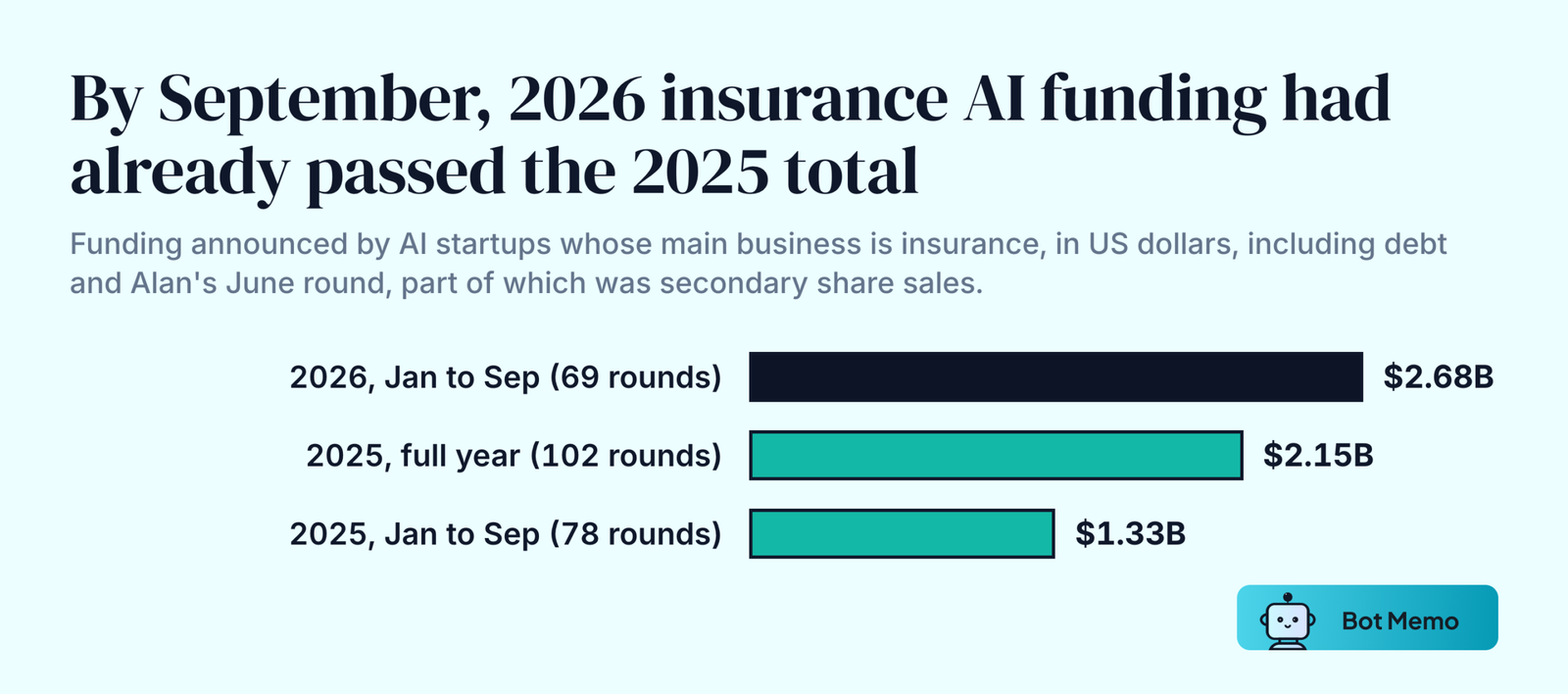
AI startups whose main business is insurance (carriers, brokers, claims administrators, health plans and software sold to insurers) announced $2.68B in funding across 69 rounds between January and September 2026. That is already more than the $2.15B they raised in all of 2025, and roughly double the $1.33B raised in the first nine months of 2025. The round count went the other way, from 78 to 69, so the money is landing in fewer, bigger checks. These totals include debt raises, and Alan’s June round, part of which was secondary share sales.
This guide maps where that money went: the largest rounds, the parts of the insurance chain that attract investors (underwriting, claims, distribution, health plans, cyber and AI risk), the funds writing the cheques, and the companies to watch.
On this page
The companies that raised the most in 2026
Paris-based health insurer Alan raised the biggest round of the year, a €480M Series G led by Prosus in June at a €5.5B valuation. The round mixed new shares with some secondary sales, and closing is subject to regulatory approval. It followed a €100M raise led by Index Ventures in March at a €5B valuation. Cambridge Mobile Telematics, which scores driving risk for insurers, took $350M from TPG and Allianz X in March.
Corgi, a Y Combinator-backed carrier that writes insurance for startups, raised twice in May. A $160M Series B led by TCV valued it at $1.3B, and a $106M Series B1 three weeks later valued it at $2.6B. A further extension was reported in July, with no amount disclosed.

| Company | What it does | 2026 funding | Lead or backer | Month (2026) |
|---|---|---|---|---|
| Alan | Health insurer for employers and individuals, Paris | €100M, then €480M Series G | Index Ventures, then Prosus | March, June |
| Cambridge Mobile Telematics | Driving-risk scoring and crash detection sold to insurers | $350M strategic | TPG and Allianz X | March |
| Corgi | Full-stack insurance carrier for startups | $160M Series B, $106M Series B1 | TCV | May |
| Angle Health | Health benefits plans for small employers | $200M Series C | Vitruvian Partners | September |
| Reserv | Third-party claims administrator | $125M Series C | KKR | May |
| Chapter | Medicare plan advice for seniors | $100M Series E | Generation Investment Management | April |
| Cover Genius | Embedded insurance sold through partners’ apps and checkouts | $100M capital raise (instrument not disclosed) | Vista Credit Partners | July |
| Pace | AI agents for insurance back-office work | $10M Series A, $46M Series B | Sequoia Capital, then Thrive Capital and Sequoia Capital | January, May |
| Outmarket AI | Workflow software for insurance agencies and brokers | $17M Series A, $34.5M Series B | Permanent Capital Ventures, then SignalFire | May, September |
| mea Platform | AI agents for insurers, reinsurers and brokers | $50M growth | Scottish Equity Partners | February |
| Counterpart | Management liability insurance for small businesses | $50M Series C | Valor Equity Partners | April |
| Faye | Travel insurance platform | $50M Series C | Madrona | August |
| Harper | Commercial insurance brokerage for small businesses | $47M seed and Series A | Emergence Capital | February |
| Luzern Risk | Captive insurance manager | $45M Series B | Insight Partners | September |
| Shepherd | Construction insurance | $42M Series B | Intact Private Capital | March |
| AIUC | Insurance and audits for AI agents | $40M Series A | Ribbit Capital | September |
| Honeycomb | Property insurance for apartment and condo buildings | $40M growth | Zeev Ventures | June |
Fewer rounds, much bigger ones
Nine rounds of $100M or more took $1.79B, or 67% of funding announced from January to September 2026. In all of 2025, four rounds that size took 24%. The median disclosed round barely moved (about $15M in 2026, about $13M in 2025), so the growth sits almost entirely at the top.
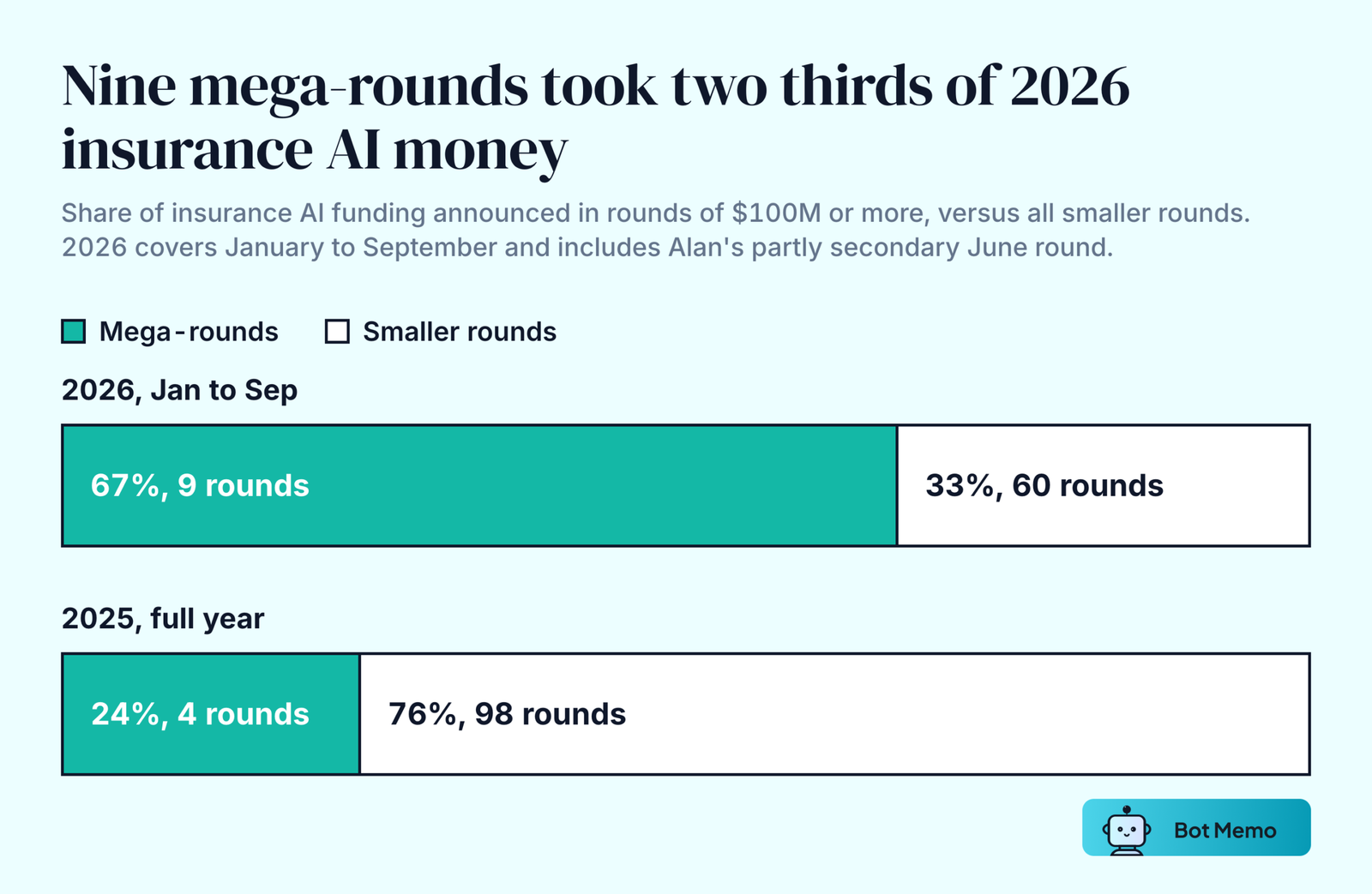
Most of that top end is later-stage money for companies that already carry risk or run insurance operations: carriers (Alan, Corgi), a claims administrator (Reserv), a benefits plan (Angle Health) and a Medicare broker (Chapter). The early end is still busy. Of the 69 rounds in 2026, 22 were seed or pre-seed and 31 were $10M or less.
The US accounts for 44 of the 69 rounds and 67% of the dollars. Alan, in France, raised the largest amount outside it.
Underwriting AI
Underwriting means deciding which risks to accept and at what price. The funded companies split into two groups: software sold to existing insurers, and AI-first underwriters. The second group includes carriers that write policies on their own balance sheets and MGAs (managing general agents, firms that underwrite policies on behalf of an insurer).
On the software side, Sixfold raised a $30M Series B in January led by Brewer Lane Ventures, with Guidewire, Bessemer Venture Partners and Salesforce Ventures. The company names Zurich North America and Skyward Specialty among its customers. Federato, which builds underwriting software for property and casualty insurers, raised a $100M Series D in November 2025 led by Goldman Sachs Alternatives.
On the carrier side, Nirvana Insurance (trucking) raised an $80M Series C in March 2025 led by General Catalyst and a $100M Series D in December 2025 led by Valor Equity Partners, at a $1.5B valuation. Shepherd (construction), Counterpart (management liability) and Honeycomb (apartment buildings) each raised in 2026 to focus on a narrow customer segment or a small set of specialty lines.
Claims AI
In its annual report for 2025, Lemonade said its claims bot, AI Jim, takes the first notice of loss without human help 96% of the time, and that roughly 55% of its claims were automated from start to finish.
Two notable 2026 rounds went to companies that handle claims themselves. Reserv handles claims for insurers, MGAs and brokers. It raised a $25M Series B in June 2025 and a $16M extension in September 2025, then a $125M Series C led by KKR in May 2026. Faye, a travel insurance platform that says it pays claims in minutes, raised a $50M Series C led by Madrona in August.
Tractable, which assesses car and property damage from photos, became a unicorn with a $60M Series D in June 2021 and raised a $65M Series E led by SoftBank Vision Fund 2 in July 2023.
AI agents for insurance operations
A growing group sells AI agents that take over insurance paperwork, such as reading submissions, updating policies, logging claims and keying data.
Pace raised a $10M Series A led by Sequoia in January and a $46M Series B co-led by Thrive Capital and Sequoia in May. mea Platform, profitable and self-funded until then, took $50M from Scottish Equity Partners in February. Outmarket AI, which automates work for insurance agencies, raised a $17M Series A in May and a $34.5M Series B led by SignalFire in September. Liberate, which runs voice and task agents for insurers, raised a $50M Series B led by Battery Ventures in October 2025.
Distribution and brokerage
AI-first brokers are getting funded where the buyer is a small business or an individual facing a confusing choice. Harper, a licensed commercial brokerage that says it places small-business coverage with more than 160 carriers, announced $47M across its seed and Series A in February, with Emergence Capital leading the Series A. Chapter, which helps seniors choose Medicare plans, raised a $100M Series E in April.
Embedded insurance, sold inside another company’s checkout, is the other route. Cover Genius announced a $100M capital raise in July backed by Vista Credit Partners, Vista’s credit arm. The instrument was not disclosed, and the companies said the raise values Cover Genius at $1.9B. In Asia, Singapore’s bolttech added about $47M at the June 2025 final close of its Series C, taking the round to $147M at a $2.1B valuation after a first close of more than $100M in December 2024.
Health plans and benefits
Two of the four largest 2026 rounds went to health insurance. Alan sells health cover to employers and individuals, mainly in France. Angle Health builds health plans for small US employers. It raised a $134M Series B led by Portage in December 2025, then a $200M Series C led by Vitruvian Partners in September 2026 at a reported $2.7B valuation, alongside a $400M tender offer for existing shareholders that is not counted as new funding here.
Cyber and AI risk
In cyber insurance, AI is both a pricing tool and a new risk to price. Coalition, a cyber insurer, raised a $250M Series F at a $5B valuation in 2022 and took a $30M strategic investment from Mitsui Sumitomo Insurance in March 2025. CyberCube, which models cyber risk for insurers, raised more than $180M from Spectrum Equity in October 2025.
Cowbell took a $60M Series C from Zurich Insurance Group in July 2024. In April 2026 it launched Prime One in the US, a cyber policy for companies with $250M to $1B in revenue. Cowbell says the policy gives affirmative cover for AI-related incidents, such as unauthorized use of a company’s AI systems, plus quantum computing exposures.
AIUC goes further and insures AI agents themselves. It raised a $15M seed led by Nat Friedman’s fund in July 2025 and a $40M Series A led by Ribbit Capital in September 2026. AIUC says its coverage is tied to an audit standard for agents, and it lists Cursor, Lovable, Harvey and ElevenLabs as launch customers.
Fraud detection
Two large fraud detection rounds came in 2021. France’s Shift Technology raised a $220M Series D led by Advent International in May 2021 at a valuation above $1B, and Dutch company FRISS raised a $65M Series B led by Accel-KKR in July 2021. Recent fraud rounds are smaller and more specialized. Clearspeed, which screens claims with voice analysis, raised a $60M Series D in June 2025, and Codoxo, which checks health insurance payments, raised a $35M Series C led by CVS Health Ventures in December 2025.
Who is investing
A handful of funds keep coming back. Valor Equity Partners led Nirvana’s Series D and Counterpart’s Series C. Goldman Sachs Alternatives led Federato’s Series D and co-led Bestow’s Series D. Emergence Capital led Harper’s Series A and also backed Pace and Federato. Portage led Angle Health’s Series B and joined Faye’s Series C. TCV led both of Corgi’s May rounds.
Insurers invest too, usually alongside a commercial deal. Allianz X co-led Cambridge Mobile Telematics’ round with TPG, with State Farm also investing, Intact led Shepherd’s Series B and also supplies its insurance capacity, QBE Ventures led Reserv’s 2025 extension, Zurich funded Cowbell, and Mitsui Sumitomo Insurance invested in Coalition.
For neighboring sectors, see our lists of top AI fintech startups, top AI healthcare startups and top AI cybersecurity startups, plus the largest AI rounds of Q1 2026 and our Series A funding report.
Frequently asked questions
How much funding did AI insurance startups raise in 2026?
AI startups whose main business is insurance (carriers, brokers, claims administrators, health plans and software sold to insurers) announced $2.68B in funding across 69 rounds from January to September 2026, more than the $2.15B announced in all of 2025. The total includes debt and Alan’s June round, part of which was secondary share sales.
What was the largest AI insurance round of 2026?
Alan’s €480M Series G, led by Prosus in June 2026 at a €5.5B valuation. The next largest single rounds were Cambridge Mobile Telematics ($350M), Angle Health ($200M) and Corgi’s Series B ($160M).
How is AI used in insurance?
The main uses are underwriting (selecting and pricing risk), claims handling, back-office automation with AI agents, distribution through AI-first brokers and embedded products, health plan administration, cyber risk modeling and fraud detection.
Which AI insurance startups raised the most money?
In 2026: Alan, Cambridge Mobile Telematics, Corgi, Angle Health, Reserv and Chapter each announced rounds of $100M or more, and Cover Genius announced a $100M capital raise. In 2025, the rounds of $100M or more went to CyberCube, Angle Health, Federato and Nirvana Insurance.
Is AI replacing insurance claims adjusters?
Not across the board. Lemonade says roughly 55% of its claims were automated from start to finish in 2025, so about 45% were not.
Which investors back AI insurance startups?
Repeat backers include Valor Equity Partners, Goldman Sachs Alternatives, Emergence Capital, Portage and TCV. Insurers also invest directly, including Allianz X, Intact, QBE Ventures, Zurich and Mitsui Sumitomo Insurance.

About the author
Editorial Staff
The Editorial Staff at Bot Memo is a team of writers, analysts, and AI agents dedicated to mapping the global AI startup ecosystem. Led by Chintan Zalani, the team tracks thousands of funding rounds, classifies companies across verticals, and distills it all into actionable intelligence for investors and founders.