
AI is now part of ordinary schoolwork for most students and many teachers. Between May and December 2025, the share of US middle school, high school and college students using AI for homework rose from 48% to 62%, according to RAND. In a Gallup survey of 2,232 US public school teachers in spring 2025, six in 10 had used an AI tool for their work during the school year. And in the UK, 94% of full-time undergraduates said in December 2025 that they use generative AI to help with assessed work (HEPI).
Only 18% of US public K-12 teachers receive formal guidance on how to use AI at work (Gallup), and as of December 2024 just 31% of US public schools had a written policy on student AI use (Child Trends). Turnitin’s detector flagged about 15% of English-language essay submissions between October 2025 and February 2026 as containing at least 80% AI-generated writing, compared with about 3% flagged by its original detector in 2023 (Turnitin).
Below are the latest AI in education statistics for 2026, grouped by market size and funding, students, teachers, learning results, cheating and detection, school policy, and attitudes. Where a newer edition of a survey is cited, earlier results are kept for comparison.
On this page
- Key AI in Education Statistics for 2026
- AI in Education Market Size and EdTech Funding
- How Many Students Use AI?
- How Teachers Use AI
- Does AI Improve Learning?
- AI Cheating and Academic Integrity
- AI Policy in Schools and Universities
- How Students, Parents and Educators Feel About AI
- The Future of AI in Education
- Key Takeaways
- Frequently Asked Questions
- Sources and Methodology
Key AI in Education Statistics for 2026
- 62% of US middle school, high school and college students used AI for homework in December 2025, up from 48% in May 2025 (RAND, 2026).
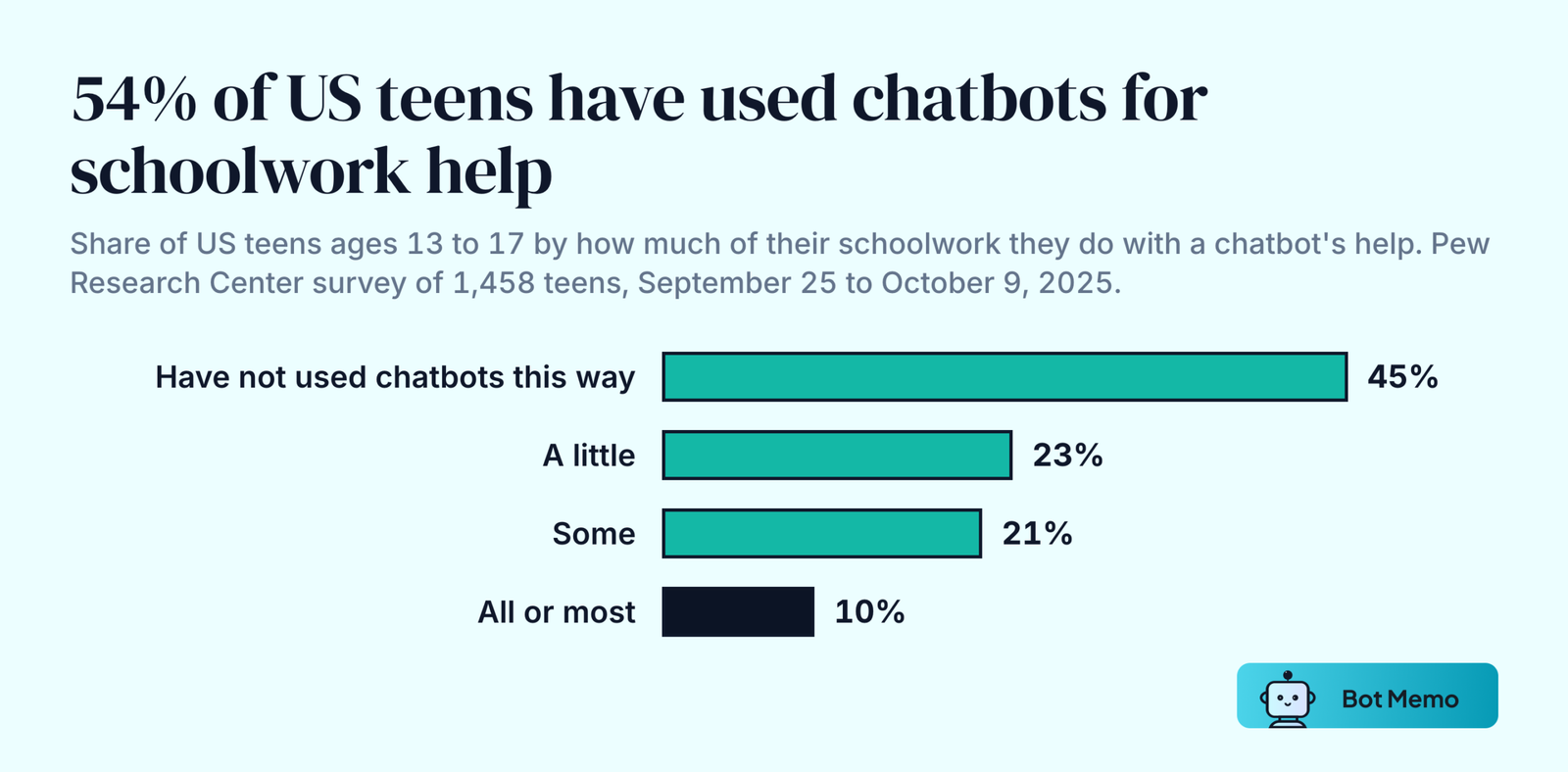
- 54% of US teens ages 13 to 17 had used AI chatbots for help with schoolwork in a fall 2025 survey, and 10% said they do all or most of their schoolwork with a chatbot’s help (Pew Research Center, 2026).
- 94% of full-time UK undergraduates use generative AI for assessed work, up from just over half in 2024 (HEPI, 2026).
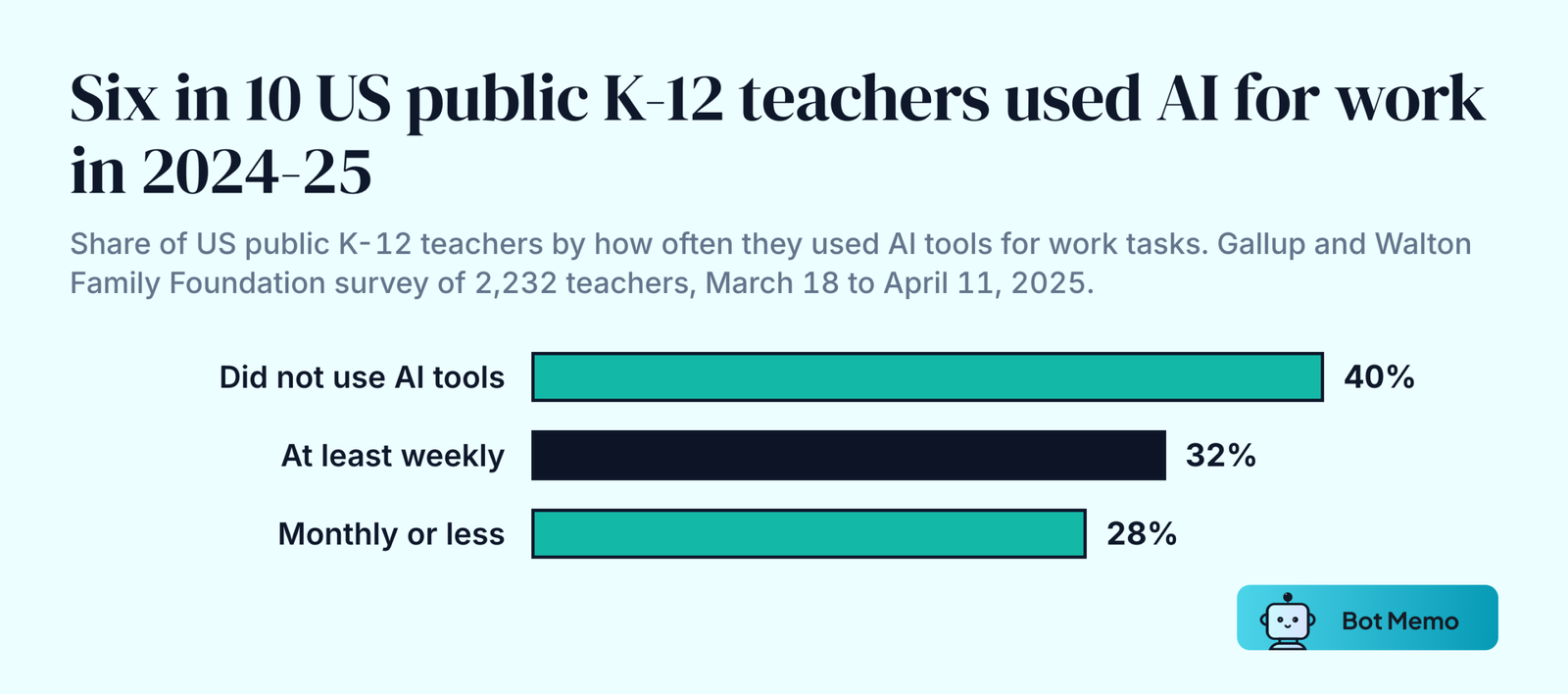
- 60% of US public K-12 teachers used an AI tool for work in the 2024-25 school year, and weekly users save an estimated 5.9 hours a week (Gallup and the Walton Family Foundation, 2025).
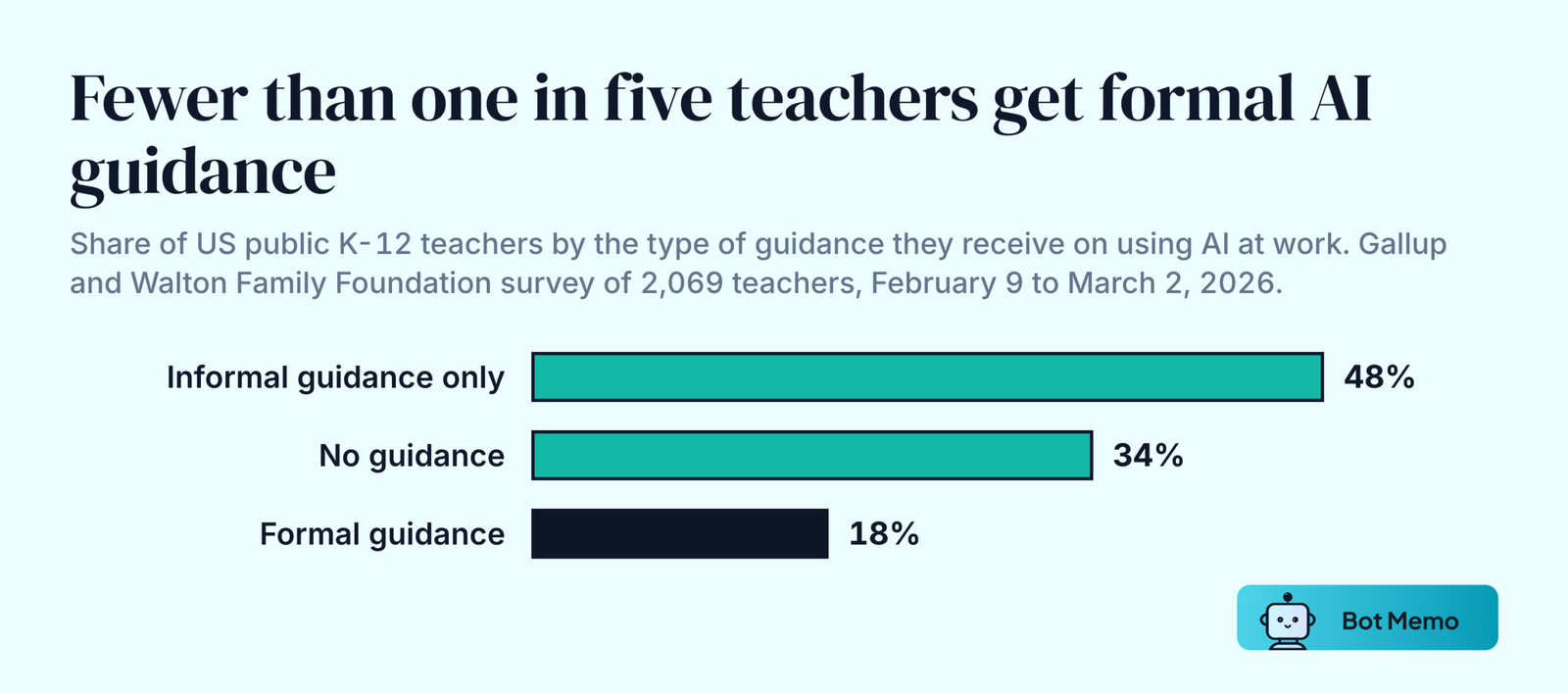
- Only 18% of US public K-12 teachers receive formal guidance on how AI tools should be used at work (Gallup and the Walton Family Foundation, 2026).
- About one in three lower secondary teachers used AI in their work in the past year, on average across 27 OECD education systems in the TALIS 2024 survey (OECD TALIS, 2025).
- Turnitin’s detector flagged about 15% of English-language submissions between October 2025 and February 2026 as having 80% or more AI-generated writing; its original detector flagged 3.3% in 2023 (Turnitin, 2026).
- Harvard physics students using a purpose-built AI tutor had median learning gains more than double those of students in an active learning class (Kestin et al., Scientific Reports, 2025).
- 35 states and Puerto Rico have official guidance or policy on AI in K-12 schools (AI for Education, August 2026).
- The AI in education market was worth $6.4 billion to $8.3 billion in 2025, depending on the research firm (IMARC Group; Grand View Research).
AI in Education Market Size and EdTech Funding
How Big Is the AI in Education Market?
Estimates of the AI in education market vary widely because each research firm defines the market differently. Grand View Research estimates the global AI in education market at $8.3 billion in 2025 and projects $11.4 billion in 2026 and $57.2 billion by 2033, a compound annual growth rate (CAGR) of 25.9% (Grand View Research). Its earlier edition put the market at $5.88 billion in 2024 and forecast $32.27 billion by 2030 at a 31.2% CAGR (Grand View Research, 2025 edition).
IMARC Group puts the 2025 market at $6.4 billion and expects $79.6 billion by 2034, a 31.35% CAGR (IMARC Group). Precedence Research estimates $7.05 billion in 2025, $9.58 billion in 2026 and $136.79 billion by 2035, a 34.52% CAGR (Precedence Research).
Global Market Estimates: $20.65 Billion by 2028
An earlier forecast from Global Market Estimates, published in February 2023, projected growth from $4.25 billion in 2023 to $20.65 billion in 2028. The release states a 45.9% CAGR, although its start and end figures imply about 37% a year. In that report, virtual facilitators and learning environments held the largest share by application, North America was expected to have the largest regional share over the forecast period, and Asia Pacific was expected to grow fastest (GlobeNewswire, 2023).
EdTech Venture Funding Is Far Below Its 2021 Peak
Global EdTech venture capital fell to $2.4 billion in 2024, the lowest level in a decade and 89% below the 2021 peak (HolonIQ). Funding rose slightly to $2.6 billion in 2025 (HolonIQ).
2026 started slower. EdTech startups raised $512 million across 63 deals in Q1 2026, 24% less than in Q1 2025 (HolonIQ). First-half funding totaled $1 billion, down 26% from $1.35 billion in the first half of 2025 (HolonIQ). For funding across all AI sectors, see the AI startup funding statistics.
Language learning companies raised large rounds. Speak raised $78 million at a $1 billion valuation in December 2024 (Speak), and Preply raised $150 million at a $1.2 billion valuation in January 2026 (Preply). MagicSchool, an AI platform for teachers, raised a $45 million Series B in February 2025 (MagicSchool). When it raised a $15 million Series A in July 2024, more than 2 million educators had signed up (MagicSchool). More companies in this space are covered in the list of AI education startups.
Chegg, Duolingo and Khan Academy
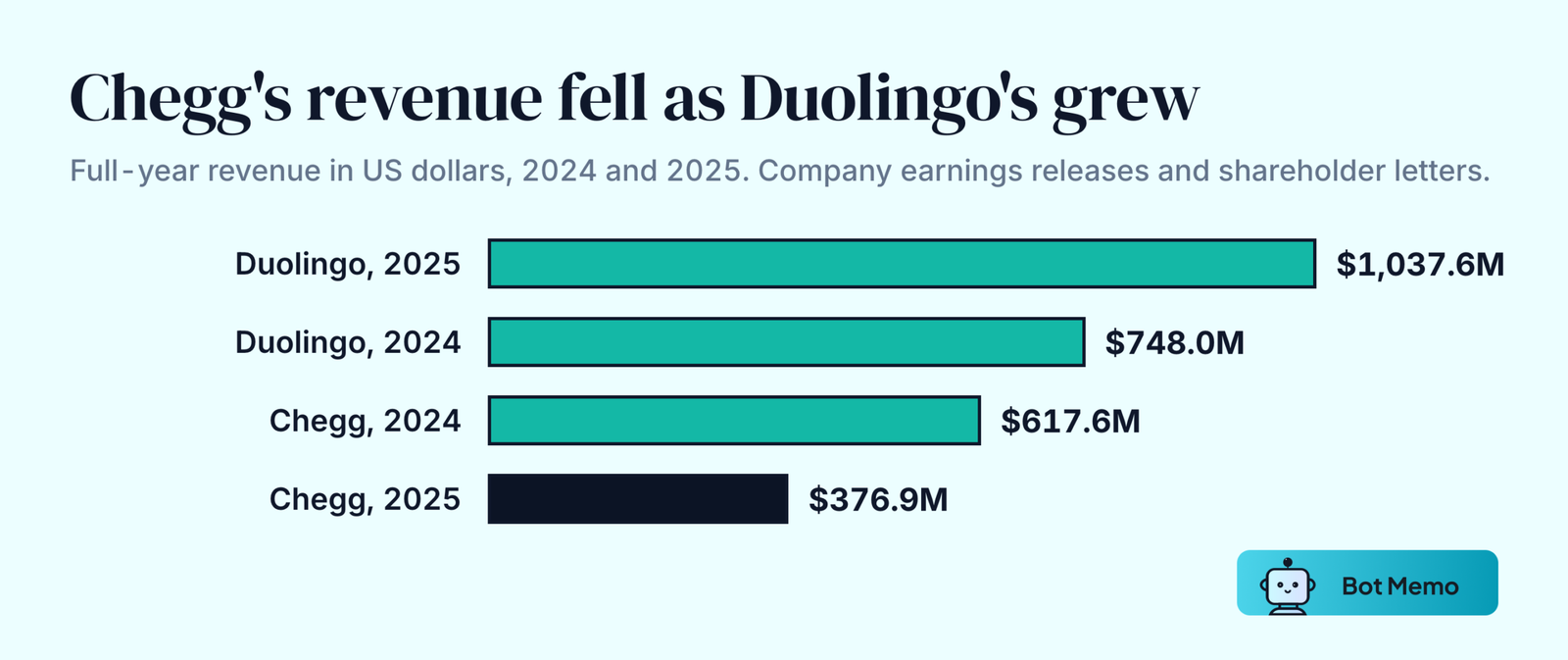
Chegg, the homework help company, has seen revenue fall sharply as students turned to AI chatbots. Revenue fell 14% to $617.6 million in 2024, and subscribers fell 21% to 3.6 million in Q4 2024 (Chegg). In 2025, revenue fell another 39% to $376.9 million (Chegg). In October 2025, Chegg cut 45% of its workforce, or 388 employees, and blamed the “new realities” of AI and lower traffic from search engines (CNBC).
Duolingo went the other way. Revenue grew 39% to $1.04 billion in 2025, daily active users reached 52.7 million in Q4 2025, up 30% from a year earlier, and paid subscribers reached 12.2 million (Duolingo). In April 2025, the company launched 148 new language courses built with generative AI (Duolingo).
Khanmigo, Khan Academy’s AI tutor and teaching assistant, reached 2.0 million students, educators and parents in the 2024-25 school year, after sign-ups grew 731% from the year before. Khan Academy’s US district program reached nearly 1.5 million licensed learners across 795 districts (Khan Academy).
How Many Students Use AI?
US Teens and K-12 Students
In Pew Research Center’s survey of 1,458 US teens ages 13 to 17, conducted in September and October 2025, 54% said they had used chatbots for help with schoolwork. One in 10 said they do all or most of their schoolwork with a chatbot’s help, 21% do some, 23% do a little, and 45% have not used chatbots this way (Pew Research Center, 2026).
Pew’s earlier question asked about ChatGPT only. In the fall 2024 survey, 26% of teens said they had used ChatGPT for schoolwork, double the 13% in 2023, and 79% had heard of ChatGPT, up from 67% (Pew Research Center, 2025). Because the wording changed, the 26% and 54% figures are not a direct trend.
RAND’s American Youth Panel found that the share of middle school, high school and college students using AI for homework rose from 48% in May 2025 to 62% in December 2025. ChatGPT was the most used tool (53%), and use of Google Gemini (28%) more than doubled over the same months (RAND, 2026). In College Board surveys, 84% of high school students reported using generative AI for schoolwork in May 2025, up from 79% in January, and 69% had used ChatGPT for assignments and homework (College Board, 2025).
Use grew quickly in 2024. In a May 2024 poll by Impact Research for the Walton Family Foundation, almost half of US teachers and K-12 students said they use ChatGPT weekly, and less than 20% of students said they never use generative AI. Familiarity with ChatGPT rose from 55% to 79% among teachers and from 37% to 75% among K-12 students in a little over a year (CNBC, 2024).
High School Students in 2023
In June 2023, ACT surveyed 4,006 US students in grades 10 to 12. 46% had used AI tools such as ChatGPT, which 83% of users named. Students used AI tools most in language arts (66%), social studies (49%) and science (37%) classes. Outside school, they used them for entertainment or hobbies, personal recommendations, non-school writing and general information (ACT, 2023).
Students with higher ACT Composite scores were more likely to use AI tools: 53% of students in the top quarter of scores used them, compared with 36% in the bottom quarter. Only 10% said they had considered using AI to write their college admissions essay, so about nine in 10 had not (ACT, 2023).
College Students
In BestColleges’ survey of 1,000 US undergraduate and graduate students in fall 2023, 56% had used AI on assignments or exams, and 53% had coursework that required them to use AI. Men were more likely than women to have used AI tools to complete assignments or exams (64% vs. 48%). Nearly 80% said at least one instructor had discussed the use and ethics of AI in class (BestColleges, 2023).
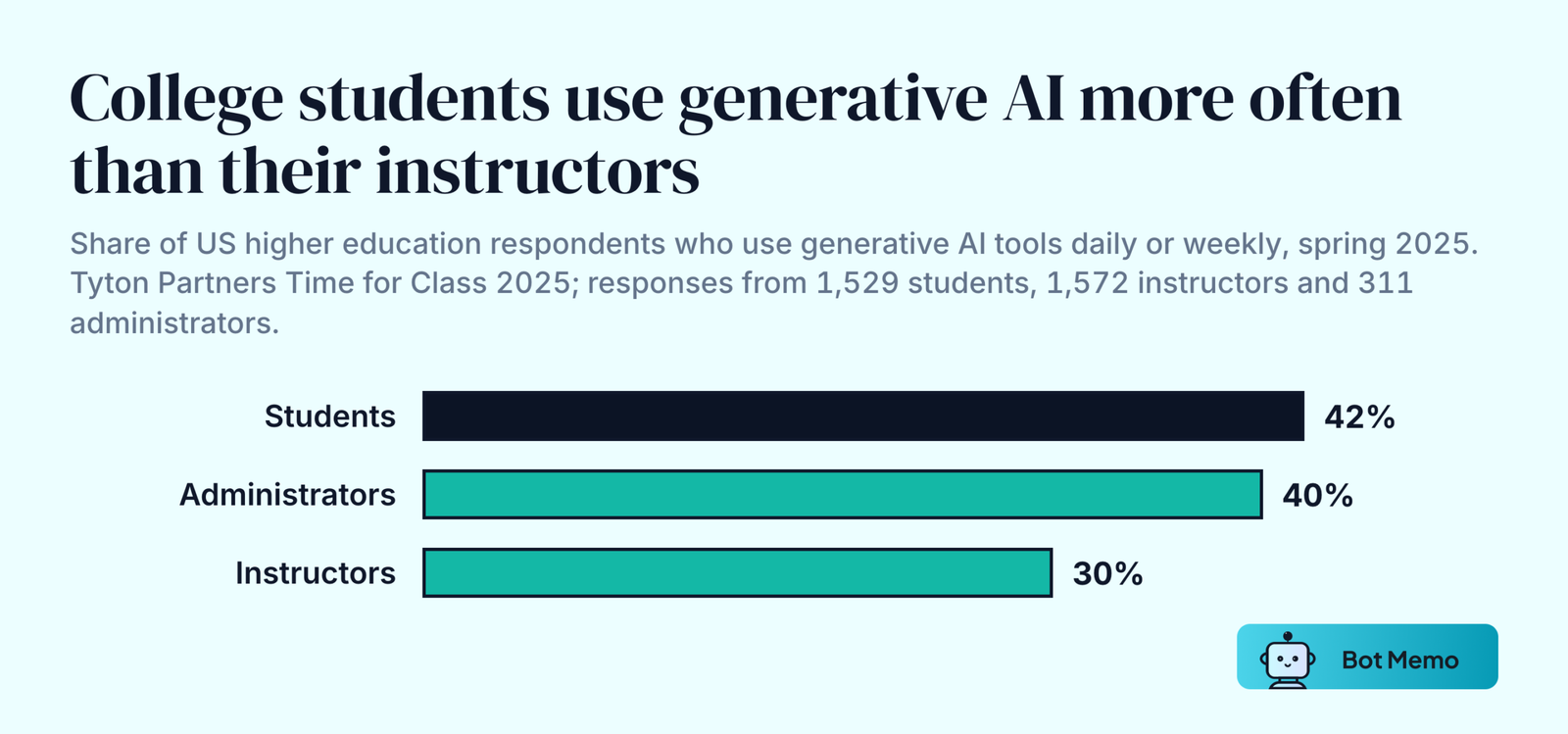
Students still use AI more than their instructors. In Wiley’s March 2024 survey of 850 instructors and 2,067 students in the US and Canada, 45% of students had used AI in their classes in the past year, compared with 15% of instructors (Wiley, 2024). By spring 2025, Tyton Partners found that 42% of US college students used generative AI tools daily or weekly, up from 14% in spring 2023. Weekly or daily use reached 40% among administrators and 30% among instructors (Tyton Partners, 2025).
More than one-third of US 18 to 24 year olds use ChatGPT, and about a quarter of their messages relate to learning and schoolwork, according to OpenAI (OpenAI, 2025). In Anthropic’s analysis of 574,740 student conversations with Claude, computer science accounted for 38.6% of conversations, and nearly half (about 47%) were direct requests for answers or content with little back-and-forth (Anthropic, 2025).
Students Outside the US
In HEPI’s survey of 1,054 full-time UK undergraduates, conducted by Savanta in December 2025, 95% used AI in at least one way and 94% used generative AI to help with assessed work, up from 89% in 2025 and just over half in 2024. The share who directly include AI-generated text in assessed work rose to 12%, from 8% in 2025 and 3% in 2024 (HEPI, 2026).
The Digital Education Council’s July 2024 survey of more than 3,800 higher education students in 16 countries found that 86% regularly use AI in their studies and 54% use it weekly (Digital Education Council, 2024).
In a 2023 study of 6,311 university students in Germany, 63.4% had used AI-based tools for their studies. The paper’s text says 25.2% use them frequently or very frequently, 47.8% rarely, very rarely or occasionally, and 36.6% not at all. Those shares add up to more than 100%. The paper’s frequency table, based on 6,278 answers, gives 25.3% frequently or very often, 37.9% rarely, very rarely or occasionally, and 36.8% not at all (Humanities and Social Sciences Communications, 2023).
How Teachers Use AI
Six in 10 US Public K-12 Teachers Used AI for Work in 2024-25
Gallup and the Walton Family Foundation surveyed 2,232 US public K-12 teachers from March 18 to April 11, 2025. 60% had used an AI tool for their work during the school year: 32% use AI at least weekly, and 28% use it monthly or less (Gallup, 2025).
An earlier Forbes Advisor survey of 500 US educators, conducted in October 2023, also found that 60% of educators use AI in their classrooms. Teachers under 26 reported the highest use (Forbes Advisor, 2023).
RAND found that 53% of US English language arts, math and science teachers and 54% of students used AI for school in 2025, increases of more than 15 percentage points compared with surveys one to two years earlier (RAND, 2025).
How Much Time AI Saves Teachers
Teachers who use AI at least weekly estimate they save 5.9 hours per week. Over a 37.4-week school year, that adds up to about six weeks. Across nine work tasks, 60% to 84% of teachers who use AI for a task say it saves them time (Gallup, 2025).
Before generative AI tools were widely available, McKinsey estimated in 2020 that 20% to 40% of current teacher hours are spent on activities that could be automated with existing technology, or about 13 hours per week that teachers could spend on other work (McKinsey, 2020).
Half of Surveyed Teachers Use AI in Their Workflows
In Carnegie Learning’s 2024 survey of nearly 800 educators, 53% of teachers said they use AI sometimes, often or always to simplify their workflows, including lesson planning and grading. 39% of administrators said they were “extremely optimistic” about the future of AI in education, compared with 22% of teachers (Carnegie Learning, 2024).
A year later, 58% of administrators in Carnegie Learning’s survey said they use AI often or always, up from 31% (Carnegie Learning, 2025).
Few Teachers Get Formal AI Guidance or Training
In Gallup’s February and March 2026 survey of 2,069 US public K-12 teachers, only 18% received formal guidance from school administrators on how AI tools should be used at work. Across 10 tasks, 34% of teachers received no guidance at all and 48% received only informal guidance (Gallup, 2026).
RAND found that 35% of district leaders provided students with AI training as of spring 2025, and more than 80% of students said teachers had not explicitly taught them how to use AI for schoolwork (RAND, 2025). In July 2025, the American Federation of Teachers launched the National Academy for AI Instruction with Microsoft, OpenAI and Anthropic, a $23 million program offering free AI training to its 1.8 million members, starting with K-12 educators (AFT, 2025).
Teachers Outside the US
The OECD’s Teaching and Learning International Survey (TALIS) 2024 covered lower secondary teachers in 55 education systems. On average across 27 OECD education systems, about one in three teachers had used AI in their work in the past year. Use ranged from around 75% of teachers in Singapore and the United Arab Emirates to fewer than 20% in France and Japan (OECD, 2025).
Does AI Improve Learning?
Harvard AI Tutor Trial: More Than Double the Learning Gains
In a randomized controlled trial in Harvard’s largest introductory physics course in fall 2023, 194 students took lessons both from a custom AI tutor and in an in-class active learning session. Median learning gains in the AI tutor group were more than double those in the classroom group (p < 10-8). The median student spent 49 minutes on the AI lesson. On a 5-point scale, students rated their engagement at 4.1 with the AI tutor and 3.6 in class, and they reported higher motivation (Kestin et al., Scientific Reports, 2025).
The tutor was designed around the same teaching methods as the class. The study covered one course at one university.
AI Tutoring Studies in Schools
Stanford researchers tested Tutor CoPilot, an AI tool that suggests guidance to human tutors, in a randomized trial with more than 700 tutors and 1,000 students from underserved communities. Students whose tutors used it were 4 percentage points more likely to master math topics. Students of lower-rated tutors gained 9 percentage points. The tool cost about $20 per tutor per year (Wang et al., EdWorkingPapers, 2025).
In Nigeria, a World Bank trial gave senior secondary students in Edo State a six-week after-school program using ChatGPT as a tutor. Learning gains were about 0.3 standard deviations overall and 0.24 in English, roughly equal to 1.5 to 2 years of typical learning in similar settings (World Bank, 2025).
A 2025 meta-analysis of 29 studies with 2,657 participants found an overall effect size of 0.924 for AI on students’ academic achievement (Dong, Tang and Wang, Computers and Education: Artificial Intelligence, 2025).
When AI Access Hurts Learning
Results depend on how students use AI. In a field experiment with nearly 1,000 high school math students in Turkey, access to GPT-4 during practice improved grades by 48% with a standard chat interface and by 127% with a tutor version that gave hints instead of answers. When access was removed, students who had used the standard version scored 17% lower than students who never had access (Bastani et al., PNAS, 2025).
In an MIT Media Lab study of 54 participants writing essays, 15 of the 18 people who wrote with a large language model (83%) had difficulty quoting from their own essay in the first session, and none quoted it correctly. In the search engine group and the no-tools group, 2 of 18 people (11%) each had the same difficulty. The study was posted as a preprint and had not been peer reviewed as of its December 2025 revision (Kosmyna et al., arXiv, 2025).
Classroom Robots
Before chatbots, some schools tested robots as teaching aids. By 2018, Keeko robots were in more than 600 kindergartens across China, telling stories and responding to children’s answers (Phys.org, 2018). At the MIT Media Lab, researchers tested a social robot called Tega to support language and literacy skills for children ages 5 and 6. “We’re starting to see some exciting and significant learning gains,” said Cynthia Breazeal, then an associate professor of media arts and sciences. “I am very encouraged” (MIT, 2020).
AI Cheating and Academic Integrity
How Much Student Writing Is AI-Generated?
One year after launching its AI writing detector in April 2023, Turnitin had reviewed more than 200 million papers. It flagged more than 22 million (about 11%) as having at least 20% AI writing, and more than 6 million (about 3%) as having at least 80% AI writing. The same announcement cited a Tyton Partners survey in which 75% of students who used generative AI tools monthly, weekly or daily said they would keep using them even if their instructors or institutions banned them (Turnitin, 2024).
Turnitin reported in February 2026 that its latest detector flagged an average of 14.8% of English-language submissions between October 2025 and February 2026 as having 80% or more AI-generated writing. Its original detector flagged 3.3% of submissions between April and August 2023. The two figures come from different versions of the detector (Turnitin, 2026).
What Instructors and Students Say About Cheating
96% of college instructors in Wiley’s 2024 survey believed at least some of their students cheated in the past year, up from 72% in Wiley’s 2021 survey. 53% of students said there is more cheating now than the year before (Wiley, 2024).
81% of educators in Carnegie Learning’s 2024 survey worried about AI’s impact on academic integrity (Carnegie Learning, 2024). In its 2025 survey, 61% of educators said they had experienced students cheating with AI, up from 53% (Carnegie Learning, 2025). Among US teens, 59% think students at their school use AI to cheat at least somewhat often (Pew Research Center, 2026).
Can AI Detectors Be Trusted?
Independent tests show detectors make mistakes, especially with edited or mixed text. In Temple University’s test of 120 samples, Turnitin correctly scored 28 of 30 human-written texts (93%) and gave 23 of 30 fully AI-written texts (77%) a 100% AI score. It correctly identified 19 of 30 paraphrased AI texts (63%) and gave a partial score to only 13 of 30 texts that mixed human and AI writing (43%) (Temple University).
Researchers who tested 14 detection tools, including Turnitin, concluded that they are neither accurate nor reliable. In the authors’ summary, all tools scored below 80% accuracy and only 5 scored above 70%, although Turnitin reached 81% under one of the study’s three scoring methods (Weber-Wulff et al., International Journal for Educational Integrity, 2023). Stanford researchers found that seven detectors misclassified an average of 61.22% of TOEFL essays written by non-native English speakers as AI-generated (Liang et al., Patterns, 2023).
Universities That Advise Against AI Detectors
Several leading US universities have told faculty not to rely on AI detectors. MIT Sloan’s teaching technology team titled its guidance “AI Detectors Don’t Work. Here’s What to Do Instead.” (MIT Sloan). Vanderbilt University disabled Turnitin’s AI detector in August 2023. It noted that at Turnitin’s stated 1% false positive rate, about 750 of the 75,000 papers Vanderbilt submitted in 2022 could have been wrongly flagged (Vanderbilt University). Rumi compiled the stated positions of 20 US universities on AI detectors, many of which recommend against using them (Rumi, 2024).
For more on detection and AI-written text, see the AI writing statistics.
AI Policy in Schools and Universities
Most US Public Schools Lacked a Student AI Policy in December 2024
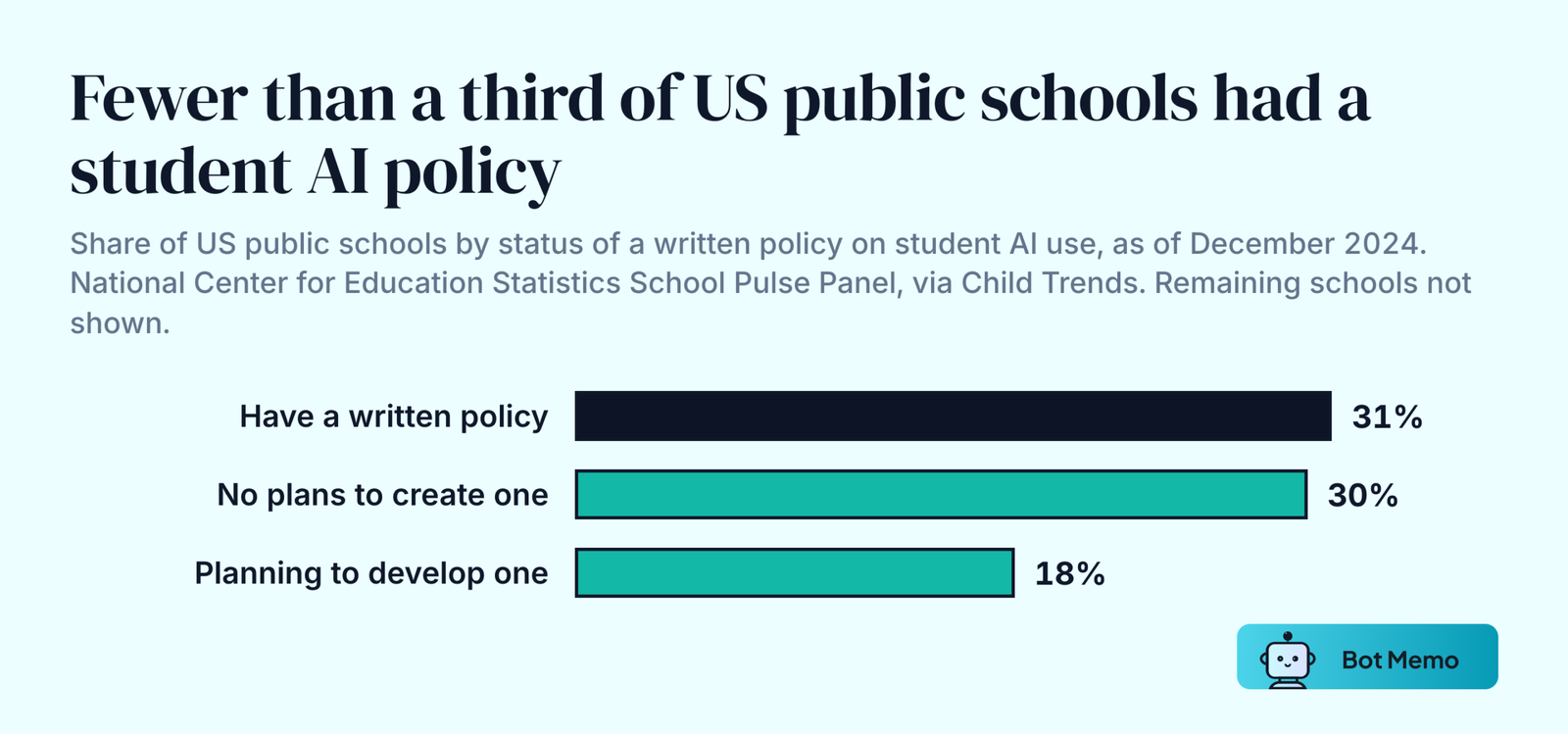
As of December 2024, 31% of US public schools had a written policy on students’ use of AI. Another 18% were planning to develop one, and 30% had no plans to create one, according to the National Center for Education Statistics School Pulse Panel. High schools were more likely to have a policy (43%) than middle schools (29%) or elementary schools (27%) (Child Trends, 2025).
RAND found that 45% of principals reported school or district policies or guidance on AI use in 2025, and 34% of teachers reported policies on AI use related to academic integrity (RAND, 2025).
State and Federal Action
35 states and Puerto Rico have official guidance or policy on AI in K-12 schools, according to AI for Education’s tracker, last updated August 21, 2026 (AI for Education). In April 2025, a US executive order created the White House Task Force on AI Education (The White House). By June 2025, more than 60 organizations had signed a White House pledge to provide AI education resources for young people (The White House).
AI Companies Selling to Schools and Universities
OpenAI launched ChatGPT Edu for universities in May 2024, citing work with Oxford, Wharton, the University of Texas at Austin, Arizona State University and Columbia (OpenAI). Anthropic launched Claude for Education in April 2025 with Northeastern University, the London School of Economics and Champlain College (Anthropic).
How Students, Parents and Educators Feel About AI
Students and Parents
In the May 2024 Walton Family Foundation poll, 70% of K-12 students had a favorable view of AI chatbots, as did 75% of undergraduates and 68% of parents (CNBC, 2024). In Pew’s fall 2025 survey, published in 2026, about a quarter of US teens said chatbots had been extremely or very helpful for schoolwork, another 25% said somewhat helpful, and 3% said they were of little or no help (Pew Research Center, 2026).
Educators on Teaching Students About AI
aiEDU surveyed 1,054 K-12 teachers and administrators between November 14 and December 31, 2023. 75% agreed that lesson plans should include materials to help students learn about the implications of AI, including 74.3% of teachers and 76.6% of administrators (aiEDU).
AI and Education Jobs
In the same aiEDU survey, 46.5% of educators did not think generative AI would affect their employment opportunities. The rest were split between a positive effect (28.1%) and a negative effect (25.3%) (aiEDU).
Jobs that require more education are more exposed to generative AI. McKinsey Global Institute estimated in 2023 that the technical automation potential for occupations requiring a master’s degree or higher rises to 57% with generative AI, from 28% without it, in the United States in 2023 (midpoint scenario). The estimate measures how much of the work in these jobs could technically be automated, not the chance of a job disappearing (McKinsey, 2023; charted by Statista).
Language Learners Want Human Teachers
In August 2023, Preply surveyed 2,503 working professionals learning languages in the US, Germany, Spain, Italy, Poland and Brazil. 73% were concerned about using AI in learning, including 74% of Gen Z, 73% of millennials and 72% of Gen X respondents, and 76% of women compared with 70% of men (Preply, 2024).
31% named the lack of human connection and motivation from a teacher as their main concern. The share who said AI lacks the connection they get with a teacher was 19% among Gen Z, 16% among millennials and 19% among Gen X (15% of men and 21% of women). The share who said AI lacks the motivation they get from a teacher was 13% in each generation (15% of men and 11% of women). 31% of Gen Z respondents were not comfortable sharing private data with AI systems, compared with 23% of millennials and 27% of Gen X, and 31% of women compared with 23% of men (Preply, 2024).
Looking ahead, 54% of learners expect language learning to be a balanced combination of AI and human interaction, while 30% think AI could take a significant role and potentially replace human teachers (Preply, 2024).
The Future of AI in Education
The World Economic Forum says AI can take routine administrative work off teachers’ plates, give students personalized learning and help teachers assess work faster and give timely feedback. It also argues that schools should teach students about AI itself, including how to develop AI technologies and understand their potential risks (World Economic Forum, 2024).
The research so far points to two conditions. AI tutoring works best when the tool is designed to guide rather than give answers, as in the Harvard and Turkey studies. And most US public schools had no written student AI policy as of December 2024 (Child Trends), while only 18% of public K-12 teachers reported formal AI guidance in early 2026 (Gallup). More sector data is in the AI statistics hub.
Key Takeaways
- 62% of US middle school, high school and college students used AI for homework in December 2025 (RAND), 54% of US teens had used chatbots for schoolwork help (Pew Research Center) and 94% of full-time UK undergraduates use generative AI for assessed work (HEPI).
- Six in 10 US public K-12 teachers used AI for work in 2024-25, and weekly users estimate they save about six weeks a school year (Gallup), but only 18% get formal guidance (Gallup).
- AI tutors designed for teaching produced large learning gains in trials (Scientific Reports), while unrestricted chatbot access lowered test scores once it was removed (PNAS).
- Turnitin’s detectors flagged about 3% of submissions as at least 80% AI-written in 2023 and about 15% in late 2025 and early 2026 (Turnitin). Studies from Temple University and Stanford researchers found detectors least reliable on mixed, paraphrased and non-native English writing.
- 31% of US public schools had a written student AI policy as of December 2024 (Child Trends), and 35 states and Puerto Rico have issued K-12 AI guidance or policy (AI for Education).
- EdTech venture funding reached $2.6 billion in 2025, far below its 2021 peak (HolonIQ). In 2025, Chegg’s revenue fell 39% (Chegg) and Duolingo’s grew 39% (Duolingo).
Frequently Asked Questions
What Percentage of Students Use AI?
In December 2025, 62% of US middle school, high school and college students used AI for homework (RAND). 54% of US teens had used chatbots for schoolwork help in fall 2025 (Pew Research Center). In the UK, 95% of full-time undergraduates use AI in at least one way and 94% use it for assessed work (HEPI, 2026).
What Percentage of Teachers Use AI?
60% of US public K-12 teachers used an AI tool for their work in the 2024-25 school year, and 32% used AI at least weekly (Gallup and the Walton Family Foundation). On average across 27 OECD education systems, about one in three lower secondary teachers used AI in their work in the past year (OECD TALIS 2024).
How Much Time Does AI Save Teachers?
US teachers who use AI at least weekly estimate they save 5.9 hours per week, or about six weeks over a 37.4-week school year (Gallup, 2025).
Does AI Improve Student Learning?
It can, when the tool is designed for teaching. Harvard students using a custom AI tutor had median learning gains more than double those of an active learning class (Scientific Reports), and a World Bank trial in Nigeria found gains roughly equal to 1.5 to 2 years of typical learning in six weeks (World Bank). But in a Turkish high school study, students who used a standard chatbot during practice scored 17% lower once access was removed (PNAS).
How Many Students Cheat With AI?
There is no single measure. Turnitin’s detector flagged about 15% of English-language submissions between October 2025 and February 2026 as at least 80% AI-written (Turnitin). 96% of college instructors believed at least some students cheated in the past year (Wiley, 2024), and 59% of US teens think students at their school use AI to cheat at least somewhat often (Pew Research Center).
How Big Is the AI in Education Market?
Estimates for 2025 range from $6.4 billion (IMARC Group) to $8.3 billion (Grand View Research). Forecasts range from $57.2 billion by 2033 (Grand View Research) to $136.79 billion by 2035 (Precedence Research).
Do Schools Have AI Policies?
As of December 2024, only 31% of US public schools had a written policy on student AI use (Child Trends). 35 states and Puerto Rico have issued official K-12 AI guidance or policy (AI for Education, August 2026).
Sources and Methodology
Each statistic links to the report or page that published it, with the sample, geography and date where the publisher states them. Figures reflect those publications as of September 17, 2026. Where a newer edition of a survey is cited, earlier results are kept for comparison. Company figures come from each company’s own filings or announcements. Market size figures are estimates that vary by research firm. AI detection figures are detector classifications, which can misclassify individual texts.
Main sources:
- RAND, Pew Research Center, College Board, ACT and the Walton Family Foundation (via CNBC) on K-12 students
- BestColleges, Wiley, Tyton Partners, HEPI, the Digital Education Council, OpenAI, Anthropic and Humanities and Social Sciences Communications on college students
- Gallup and the Walton Family Foundation, Forbes Advisor, RAND, Carnegie Learning, aiEDU, McKinsey, the American Federation of Teachers and OECD TALIS on teachers
- Scientific Reports, EdWorkingPapers, the World Bank, PNAS, Computers and Education: Artificial Intelligence and MIT Media Lab on learning results
- Turnitin, Temple University, International Journal for Educational Integrity, Patterns, MIT Sloan, Vanderbilt University and Rumi on cheating and detection
- Child Trends and the National Center for Education Statistics, AI for Education and The White House on policy
- Preply and the World Economic Forum on attitudes and the future of learning
- Grand View Research, IMARC Group, Precedence Research, Global Market Estimates, HolonIQ, Chegg, Duolingo, Khan Academy, Speak, Preply and MagicSchool on the market

About the author
Editorial Staff
The Editorial Staff at Bot Memo is a team of writers, analysts, and AI agents dedicated to mapping the global AI startup ecosystem. Led by Chintan Zalani, the team tracks thousands of funding rounds, classifies companies across verticals, and distills it all into actionable intelligence for investors and founders.