


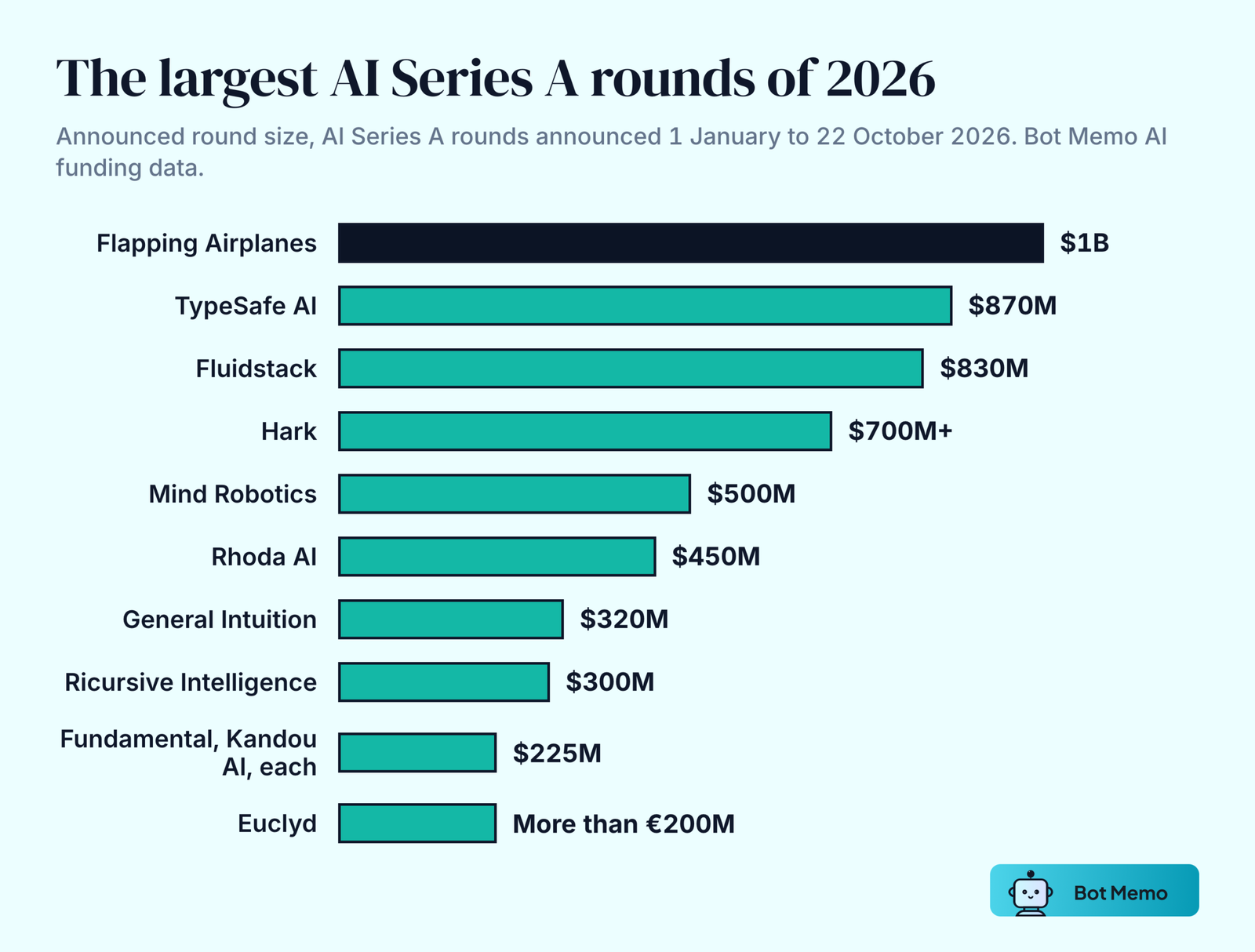
These are the 30 largest Series A rounds announced by AI startups from 1 January to 22 October 2026. Together they add up to about $8.5B. The biggest is Flapping Airplanes’ $1B round, co-led by Index Ventures and Lux Capital on 21 October, followed by TypeSafe AI’s $870M, led by Andreessen Horowitz twelve days earlier. The smallest on the list are two rounds of $100M. Every one of them is at least five times the size of a typical AI Series A this year.
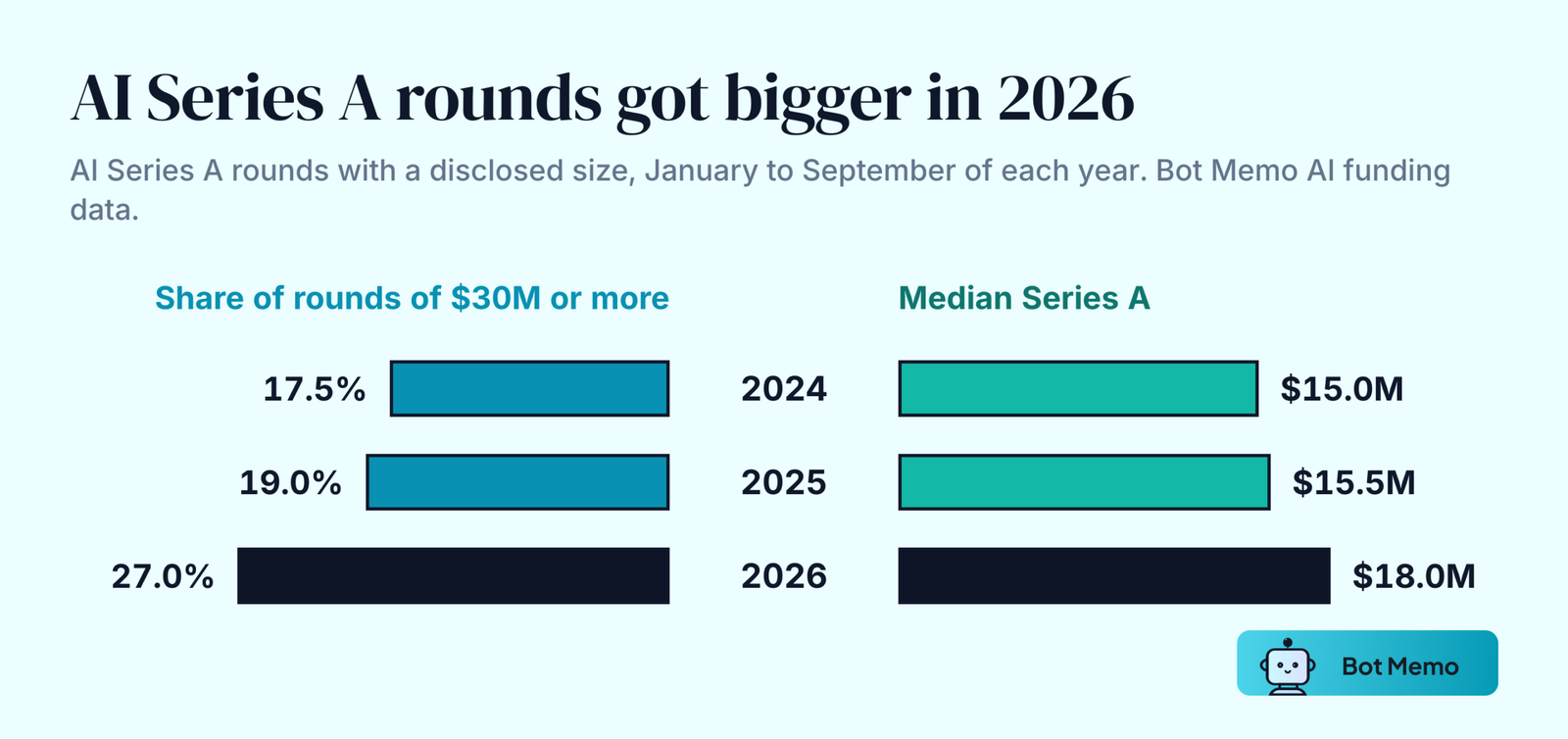
The typical round grew too. The median AI Series A with a disclosed size was $18.0M from January to September 2026, up from $15.5M in the same months of 2025 and $15.0M in 2024. In the third quarter of 2026 it reached $20M. More than one in four rounds this year, 27.0%, were $30M or larger, against fewer than one in five in each of the two previous years.
On this page
The 30 largest AI Series A rounds of 2026
Ranked by round size, with rounds of equal size listed by announcement date. Rounds given as “more than” a figure are ranked on that figure. Five more Series A rounds of about $100M fall just outside the 30: Havoc, Hydra Host, Scaled Cognition and Maven Robotics, all $100M but announced later than the tied rounds here, and Dominion Dynamics’ C$139M. Rounds raised in euros or Korean won show a dollar equivalent. Rounds sold as a seed and Series A together, such as Armadin’s $189.9M and River AI’s $1.1B, are left out, as are Series A extensions and rounds reported but never announced. Sygaldry Technologies’ $105M round is also left out, because its product is quantum computing hardware, and so is the $900M round of XPeng’s robotics business, a unit of the listed carmaker. RoboScience, a Chinese robotics company, was reported in May to have raised a CNY 1B Series A, about $138M, but no announcement from the company gives the date or the investors, so it is not ranked. “Not disclosed” means no lead investor was named. A “+” means the company said it raised more than the figure shown.
| # | Company | What it builds | Country | Announced | Series A | Led by |
|---|---|---|---|---|---|---|
| 1 | Flapping Airplanes | An AI lab training large models on far less data | US | 21 Oct 2026 | $1B | Index Ventures, Lux Capital |
| 2 | TypeSafe AI | AI models that return decisions directly to software | US | 9 Oct 2026 | $870M | Andreessen Horowitz |
| 3 | Fluidstack | Data centers and computing capacity rented to large AI labs | US | 20 Jul 2026 | $830M | Situational Awareness |
| 4 | Hark | Personal AI models and the hardware to use them | US | 21 May 2026 | $700M+ | Parkway Venture Capital |
| 5 | Mind Robotics | AI-driven robots for variable factory work | US | 11 Mar 2026 | $500M | Accel, Andreessen Horowitz |
| 6 | Rhoda AI | Robot intelligence trained on video, licensed to hardware makers | US | 10 Mar 2026 | $450M | Premji Invest |
| 7 | General Intuition | Models that learn actions from gameplay video | US | 25 Jun 2026 | $320M | Khosla Ventures |
| 8 | Ricursive Intelligence | AI that designs and optimizes computer chips | US | 26 Jan 2026 | $300M | Lightspeed Venture Partners |
| 9 | Fundamental | A large model that makes predictions from tables of business data | US | 5 Feb 2026 | $225M | Oak HC/FT |
| 10 | Kandou AI | Chips that move data quickly between AI processors and memory | Switzerland | 23 Mar 2026 | $225M | Maverick Silicon |
| 11 | Euclyd | Low-power chips and systems for running AI models | Netherlands | 15 Sep 2026 | More than €200M (about $225M) | Samsung, Somerset Capital Partners, Scaleup Europe Fund, Innovation Industries |
| 12 | Olix | A light-based chip for running AI models | UK | 11 Feb 2026 | $220M | Hummingbird Ventures |
| 13 | Upscale AI | Networking gear that links AI chips, memory and storage inside a data center | US | 21 Jan 2026 | $200M | Tiger Global, Premji Invest, Xora Innovation |
| 14 | Eridu | Networking chips and systems for AI data centers | US | 10 Mar 2026 | $200M+ | Socratic Partners, John Doerr, Hudson River Trading, Capricorn, Matter Venture Partners |
| 15 | Axiom | AI that writes formally checked proofs for math and code | US | 12 Mar 2026 | $200M | Menlo Ventures |
| 16 | Gravis Robotics | Autonomy kits for excavators and other heavy machines | Switzerland | 17 Aug 2026 | $200M | SoftBank |
| 17 | Starcloud | AI data centers in orbit | US | 30 Mar 2026 | $170M | Benchmark, EQT Ventures |
| 18 | Humanoid | Wheeled humanoid robots for industrial work | UK | 21 Jul 2026 | $152M | Prime Movers Lab |
| 19 | Arena (formerly LMArena) | Public rankings of AI models from head-to-head user votes | US | 6 Jan 2026 | $150M | Felicis, UC Investments |
| 20 | Emerald AI | Software that lets AI data centers flex their power use for the grid | US | 25 Aug 2026 | $150M | Energize Capital, DCVC |
| 21 | Eka Robotics | Force-sensing grippers and a model that lets robots handle objects | US | 20 Oct 2026 | $150M | Andreessen Horowitz, F-Prime |
| 22 | 8090 | An AI-assisted factory for building and rewriting business software | US | 29 Jun 2026 | $135M | Salesforce Ventures |
| 23 | Prime Intellect | Tools for companies to train and run their own models and agents | US | 8 Jul 2026 | $130M | Radical Ventures |
| 24 | Resolve AI | AI agents that find and fix production software outages | US | 4 Feb 2026 | $125M | Lightspeed Venture Partners |
| 25 | Aria Networks | Networking gear that links the computers in an AI cluster | US | 7 Apr 2026 | $125M | Not disclosed |
| 26 | dConstruct | Navigation software that lets robots work where GPS fails | Singapore | 2 Jul 2026 | $125M | Not disclosed |
| 27 | Neurophos | Optical processing chips for running AI models | US | 22 Jan 2026 | $110M | Gates Frontier |
| 28 | Holiday Robotics | A wheeled humanoid robot for factory work | South Korea | 13 Jul 2026 | ₩155B (about $105M) | Not disclosed |
| 29 | Simile | AI simulations of people that companies use to test decisions | US | 12 Feb 2026 | $100M | Index Ventures |
| 30 | Scout AI | A foundation model that lets unmanned military vehicles act on their own | US | 29 Apr 2026 | $100M | Align Ventures, Draper Associates |
Twenty-three of the 30 are based in the United States. Switzerland and the United Kingdom have two each, and the Netherlands, Singapore and South Korea one each. Fluidstack was founded in London and moved its headquarters to New York in December 2025.
Several of these companies raised their Series A within months of starting out. Flapping Airplanes raised a $180M seed early in 2026 and its $1B Series A in October, at a reported $6B valuation. TypeSafe AI announced a $40M seed in September and its $870M Series A three weeks later, at a $7.5B valuation. Ricursive Intelligence raised its $300M round about two months after launch, at a $4B valuation.
What the 30 are building
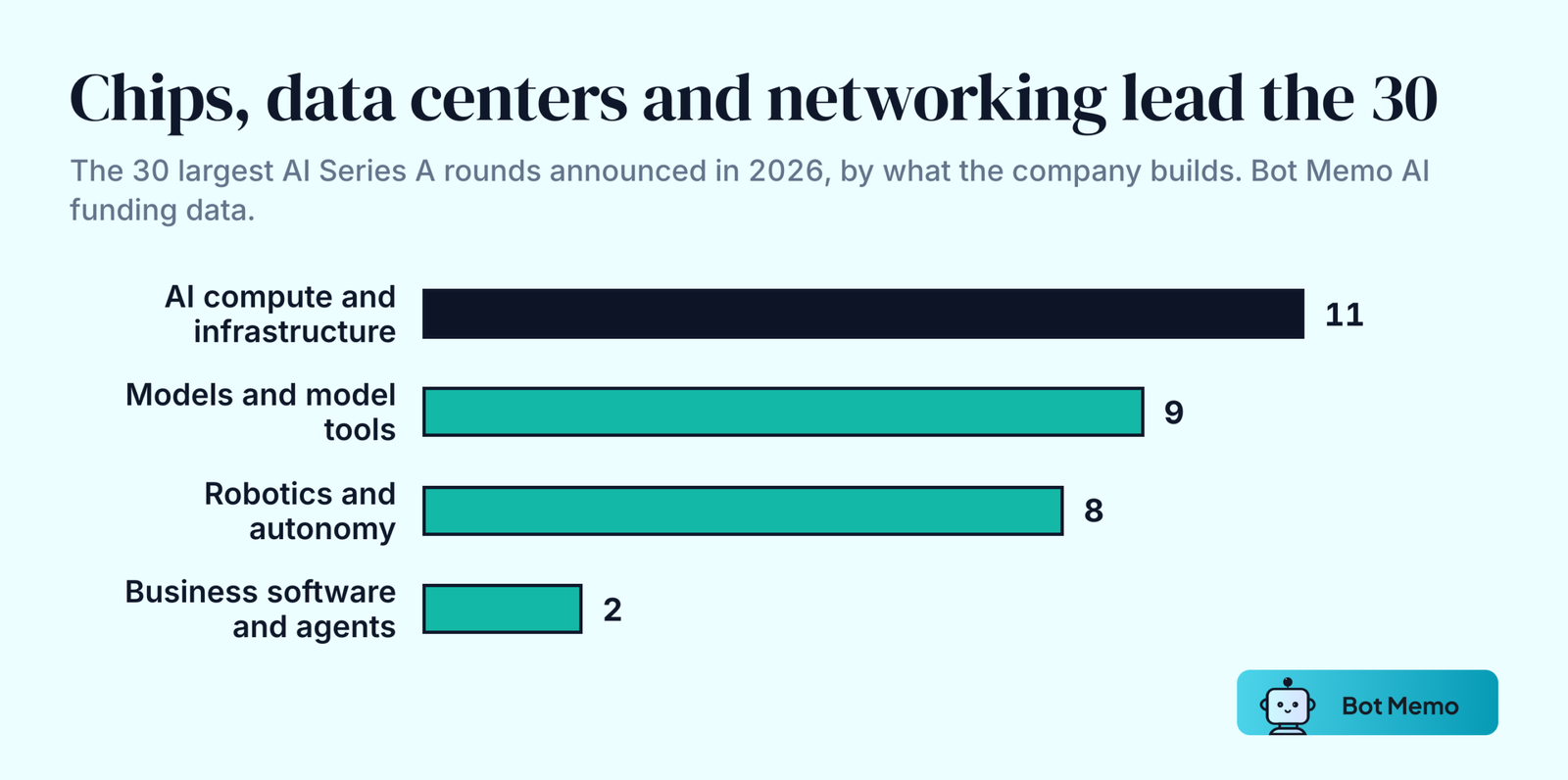
The largest group, eleven of the 30, builds the computing that AI runs on. Fluidstack ($830M, Situational Awareness) builds data centers and rents their computing capacity to large AI labs. Starcloud ($170M, Benchmark and EQT Ventures) wants to put AI data centers in orbit. Emerald AI writes software that lets data centers cut their power use when the grid is strained. The other eight design chips or networking gear. Ricursive Intelligence uses AI to design chips. Kandou AI and Eridu speed up data movement inside AI systems. Upscale AI ($200M, Tiger Global, Premji Invest and Xora Innovation) and Aria Networks build the networks that link the computers in an AI cluster. Olix and Neurophos both work on chips that compute with light, and Euclyd, chaired by former ASML chief executive Peter Wennink, designs low-power chips for running models.
Nine build models or tools around them. Flapping Airplanes is a research lab working on ways to train large models with far less data. TypeSafe AI trains models that hand decisions straight back to software. Hark (more than $700M, Parkway Venture Capital) is building personal AI models and its own hardware. General Intuition ($320M, Khosla Ventures) trains models on gameplay video to learn how to act. Fundamental builds a model for predictions from tables of business data, and Axiom ($200M, Menlo Ventures) builds AI that writes proofs a computer can check. Arena, known as LMArena until January, ranks AI models from head-to-head user votes. Prime Intellect helps companies train their own models, and Simile ($100M, Index Ventures) builds AI simulations of people that companies use to test decisions before asking real customers. For the companies building on top of these models, see the AI agent startups funding guide.
Another eight build robots or other machines that act on their own. Mind Robotics ($500M, Accel and Andreessen Horowitz), founded by Rivian chief executive RJ Scaringe, builds robots for factory work, and Rhoda AI ($450M, Premji Invest) licenses robot software trained on video to hardware makers. Humanoid in London and Holiday Robotics in Seoul both build wheeled humanoid robots for factories, and Eka Robotics ($150M, Andreessen Horowitz and F-Prime) pairs force-sensing grippers with a model for handling objects. Gravis Robotics ($200M, SoftBank) adds autonomy to excavators, and dConstruct writes navigation software for robots working where GPS does not reach. Scout AI ($100M) builds autonomy for defense, with a model that lets unmanned military vehicles act on their own. The top AI robotics startups page covers the wider field.
The last two sell software to businesses. 8090 ($135M, Salesforce Ventures) builds and rewrites enterprise systems with AI, and the agents of Resolve AI ($125M, Lightspeed Venture Partners) find and fix software outages.
Who led these rounds
Andreessen Horowitz led or co-led three of the 30: it led TypeSafe AI, co-led Mind Robotics with Accel and co-led Eka Robotics with F-Prime. Index Ventures co-led Flapping Airplanes and led Simile. Lightspeed Venture Partners led Ricursive Intelligence and Resolve AI, and Premji Invest led Rhoda AI and co-led Upscale AI. Every other lead appears once, and three rounds named no lead. Two leads are corporate investors: Samsung co-led Euclyd, and Salesforce Ventures, Salesforce’s investment arm, led 8090. SoftBank was the only investor in Gravis Robotics’ round. For the firms writing the most AI checks at every stage, see the most active AI investors.
When the money came in
Fourteen of the 30 rounds were announced from January to March, five from April to June and eight from July to September. October has already added three of the largest: TypeSafe AI, Eka Robotics and Flapping Airplanes. March alone had six, four of them announced from 10 to 12 March: Rhoda AI, Eridu, Mind Robotics and Axiom.
Frequently asked questions
What is a Series A round for an AI startup?
A Series A is usually the first large round in which venture investors buy shares at a set price, after pre-seed and seed money. It typically comes once a company has a product and early customers or usage, and it pays for hiring and growth. In AI, a Series A often also has to pay for computing power. See AI startups by funding stage for how the stages compare.
How much do AI startups raise in a Series A?
Among AI Series A rounds with a disclosed size from January to September 2026, the median was $18.0M, and 27.0% were $30M or more. The 30 rounds on this list start at $100M, so they are far from typical.
What is the largest AI Series A of 2026?
Flapping Airplanes’ $1B round, announced on 21 October 2026 and co-led by Index Ventures and Lux Capital. TypeSafe AI’s $870M round, announced on 9 October at a $7.5B valuation and led by Andreessen Horowitz, is second.
How many AI startups raised a Series A in 2026?
Our data counts 896 AI Series A rounds announced from January to September 2026, against 846 in the same months of 2025.
What comes before and after the Series A?
Before it come pre-seed and seed rounds; see the 40 seed stage AI startups that just raised. After it comes the Series B; see the largest AI Series B rounds of 2026. For the state of the stage as a whole, read the state of Series A funding for AI startups.

About the author
Editorial Staff
The Editorial Staff at Bot Memo is a team of writers, analysts, and AI agents dedicated to mapping the global AI startup ecosystem. Led by Chintan Zalani, the team tracks thousands of funding rounds, classifies companies across verticals, and distills it all into actionable intelligence for investors and founders.