
About a sixth of the money did not come as priced venture rounds, single rounds made up most of some cities' months, and the next dollars after compute bought chips, fabs and drones.
On this page
Not all of September’s $41.76B came as priced venture rounds
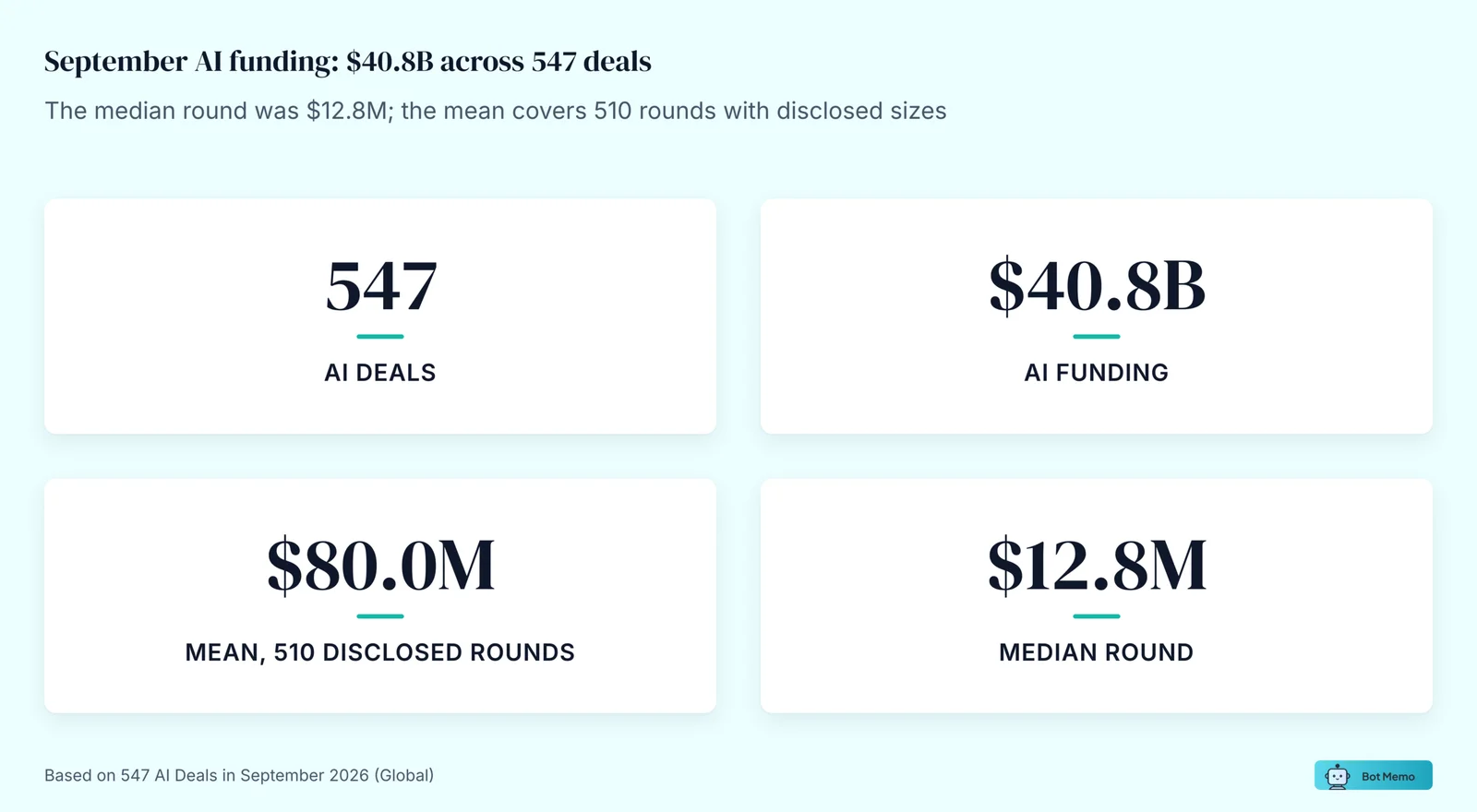
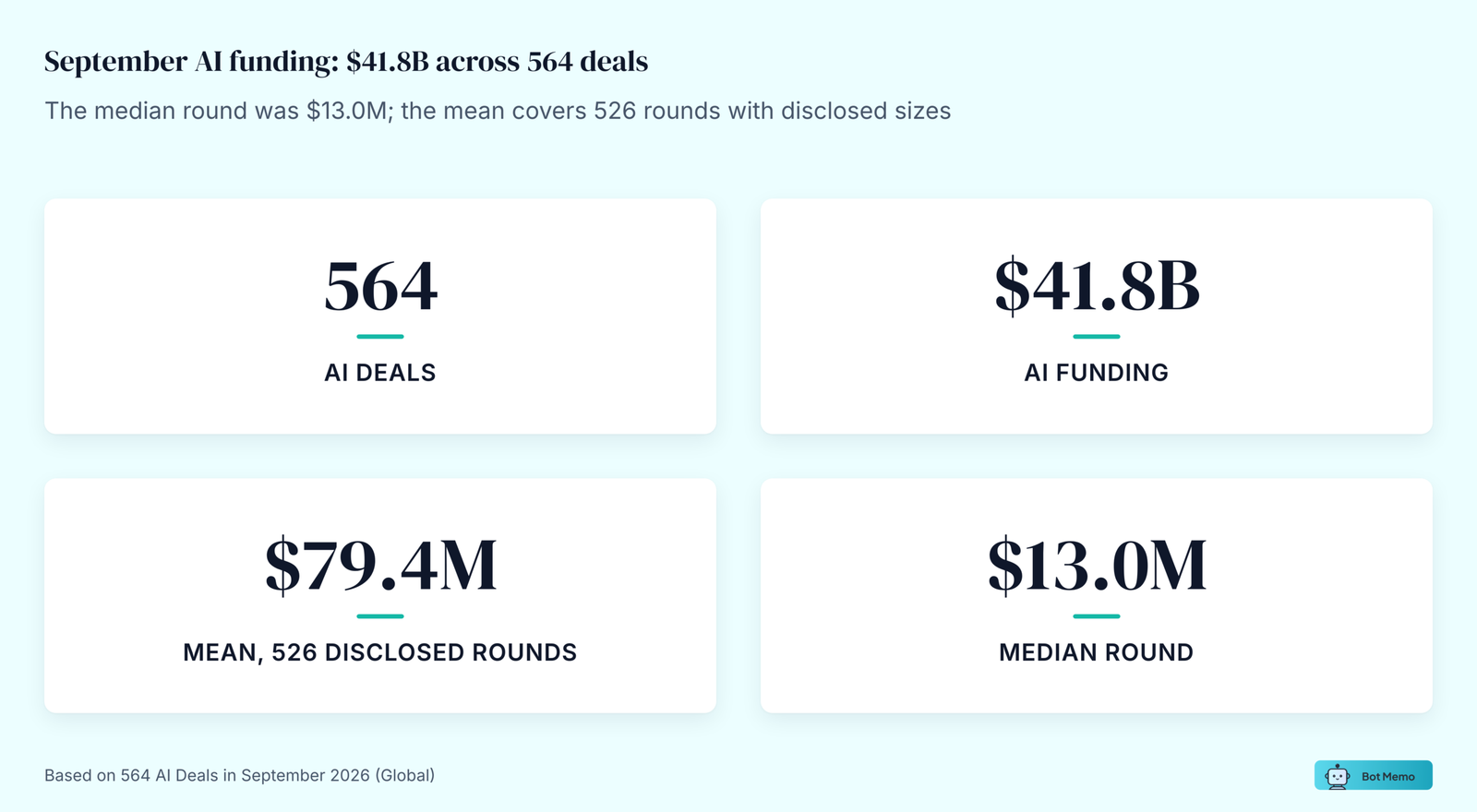
September brought 564 AI deals worth $41.76B. The quick read is one big compute month. The instruments behind the money tell a more mixed story.
Three of the six largest rounds were not priced venture rounds. Nscale raised $3.36B in pre-IPO convertible loan notes, and part of that had not been funded when it was announced.
Fluidstack took $1.5B in the month’s only private equity round. Motive raised $1.3B in structured growth financing recorded as debt; General Catalyst’s Customer Value Fund provided it.
Add up convertible notes ($3,605.0M across 2 deals), debt ($1,622.46M across 9 deals) and the Fluidstack round, and about a sixth of September’s AI funding arrived as something other than a priced venture round.
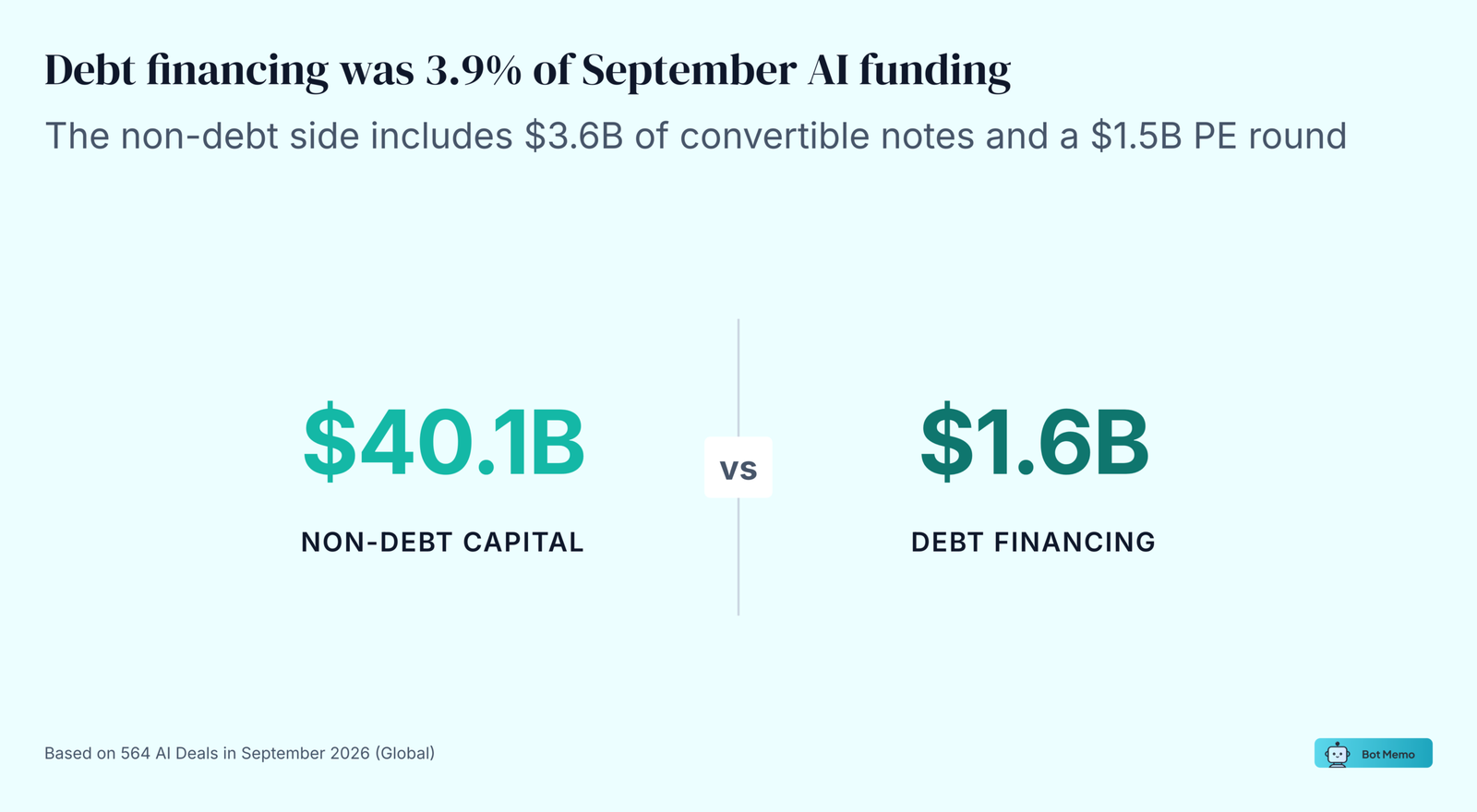
The debt figure looks small on its own. The bigger structures sit inside the non-debt side.
The cuts below split the same total by city, investor and primary sector.
In Three Cities, One Round Was the Month
Split September’s AI funding by city and a few local totals turn out to be one company’s raise.
Big rounds set the scale. Rounds of $50M+ numbered 122 and made up 88.4% of the month’s funding. At that size, a single round can account for nearly everything a city records.
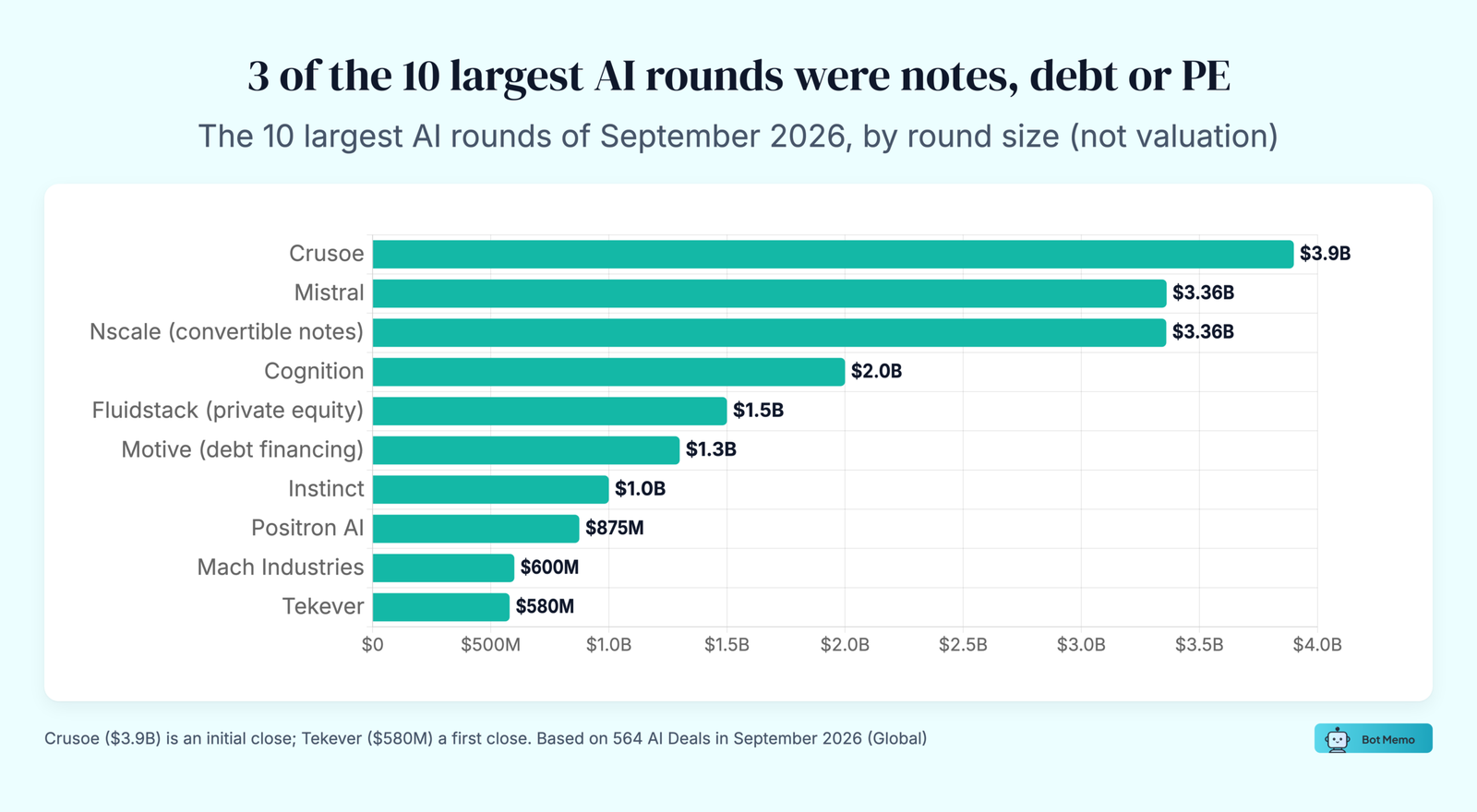
The chart ranks the month’s 10 largest rounds by size. The two longest bars belong to companies that, on their own, made up more than nine tenths of their home metro’s month.
Denver-Boulder ran on Crusoe
Crusoe raised $3.9B, the initial close of its Series F. The Denver-Boulder metro recorded $4,221M across 3 deals in September, so that one round alone is more than nine tenths of the metro’s total.
The other two deals share what’s left, a thin slice of the metro’s month.
Paris ran on Mistral
Mistral raised €3B (about $3,361M) in a Series D. Paris logged 13 deals worth $3,588.46M, and the Series D alone is more than nine tenths of it.
Thirteen deals reads like a busy month. But the rest of the city’s rounds share less than a tenth of the dollars, which says more about the size of one French model lab than about the depth of the Paris market in September.
Reno had exactly one round
Positron AI raised $875M in a Series C, and it was Reno’s only round of the month. Reno’s $875M total and Positron AI’s round are the same money.
Part of that headline is a ceiling. The round includes a Series C-1 tranche whose size is an upper limit, so the amount that finally lands could come in under $875M.
In all three places, the city figure is really a company figure.
The investors who skipped small rounds
Several of the investors in September’s largest AI rounds had no deals under $50M.
Atreides Management backed 7 rounds with disclosed amounts, and all 7 were $100M or more. The smallest was $145M. Maverick Silicon had 5 deals with disclosed amounts, none under $100M; its smallest was $125M.
NVIDIA and Lightspeed Venture Partners each had two rounds in the $50M to $100M band and the rest at $100M or more. NVIDIA backed 9 disclosed-amount rounds, and Lightspeed backed 12 of its 13. For both, the smallest was $50M.
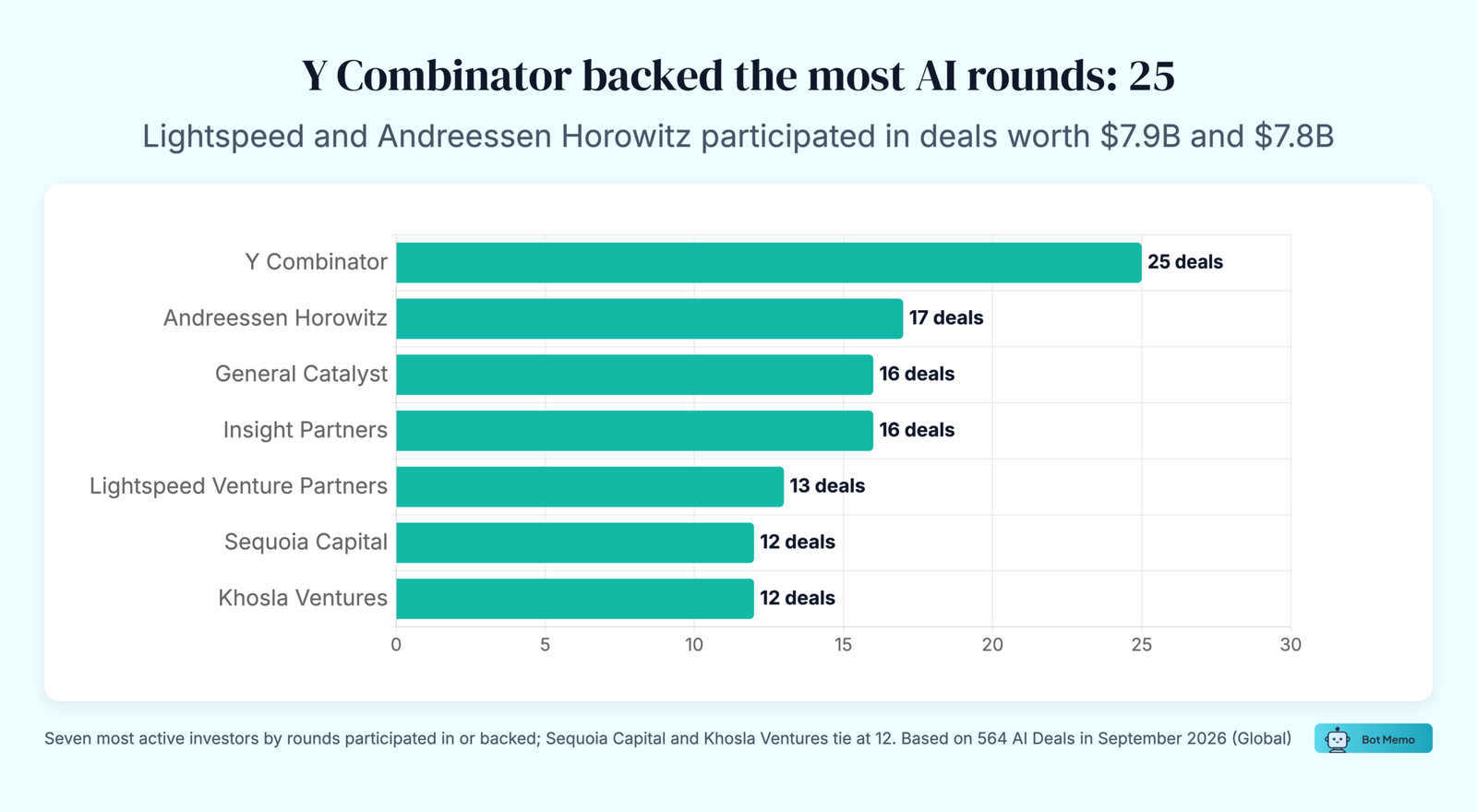
The ranking above counts every round each investor backed, disclosed or not. Rank alone hides what kind of rounds each name was in.
Different round sizes behind the rankings
Cognition shows where Atreides and Lightspeed played. Its $2B Series E drew both firms among a long list of backers. Atreides participated in deals worth $7,565.0M in September.
Atreides and Valor Equity Partners appeared together in 4 rounds.
Y Combinator worked at the other end. Of its 24 disclosed-amount rounds, 8 were under $5M, and its median round was $10M. Wafer, which builds agents that tune AI model inference, raised a $40M Series A with Y Combinator in the round. Y Combinator participated in deals worth $770.72M.
Antler sat lower still. Its median round was $2.24M, and 6 of its 7 disclosed-amount rounds were under $10M.
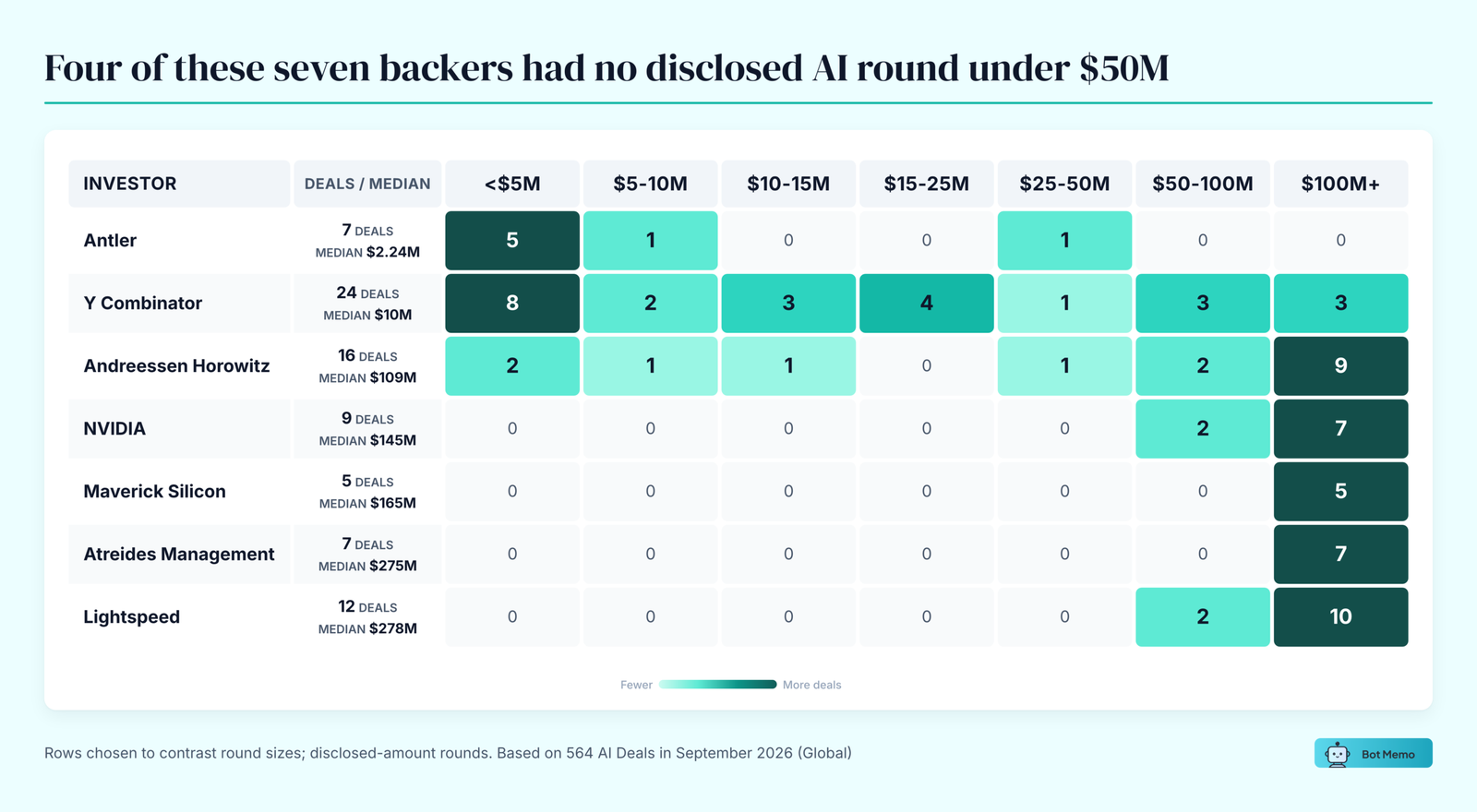
The heatmap makes the split visible. Atreides and Maverick Silicon appear only in the $100M+ column, while the biggest cell for both Y Combinator and Antler is the under-$5M band.
So a deal-count ranking mixes two separate businesses. Atreides, Maverick Silicon, NVIDIA and Lightspeed were backing companies already big enough to raise nine figures, or close to it, while Y Combinator and Antler did much of their work in early rounds.
After Compute, the Money Bought Fabs, Robot Chips and Drone Factories
Developer Tools & AI Infrastructure took 48.0% of September’s AI funding by primary sector. Compute was the headline. Second place went to hardware.
Manufacturing & Industrials ranked second by primary sector, with $3,835.34M across 59 deals, a 9.2% share. Health & Biotech came next at $3,563.6M, and it needed 92 deals to get there.
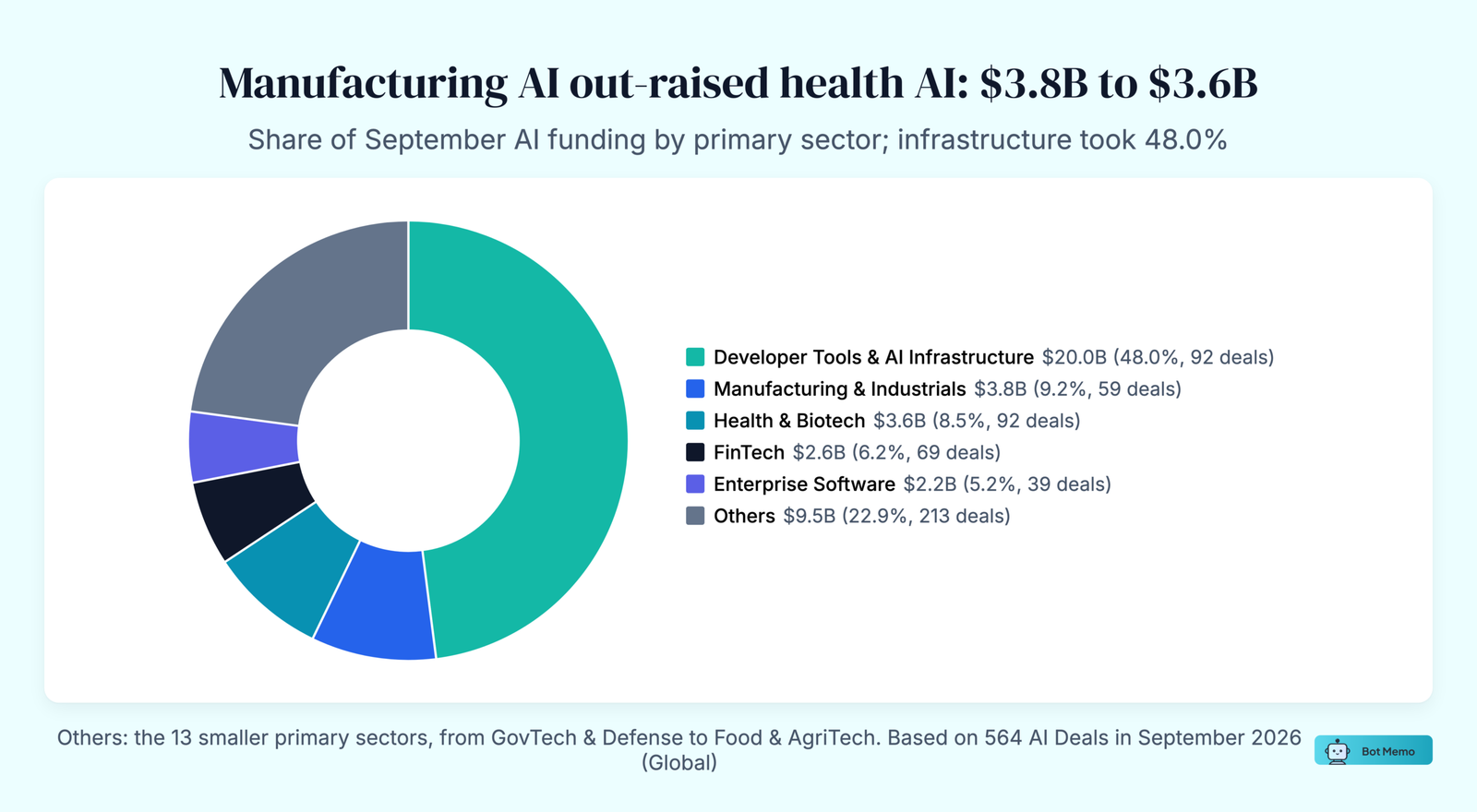
In the chart, manufacturing sits ahead of health after the infrastructure slice, even though health closed more rounds.
A Series A that paid for a factory
Fab2 shows what that manufacturing money bought. The Austin company builds compact, vertically integrated semiconductor fabs, the production layer under AI chips.
Its $500M Series A was backed by Fundomo, StepStone Group and others. That is Series A money going into manufacturing capacity rather than a model.
It was not only a US story. D-Robotics, based in Shenzhen, raised a $400M Series C. It designs compute chips and development kits that let robots run AI on the device.
Defense raised nearly four fifths of FinTech’s money on a third of the rounds
GovTech & Defense raised $2,043.27M on 24 deals by primary sector. FinTech raised $2,601.14M on 69.
That is about 79% of FinTech’s dollars on roughly a third of the rounds. Take away FinTech’s two largest rounds, FNZ at $450M and TabaPay at $155M, and it would trail defense. Defense got there with far fewer, larger rounds.
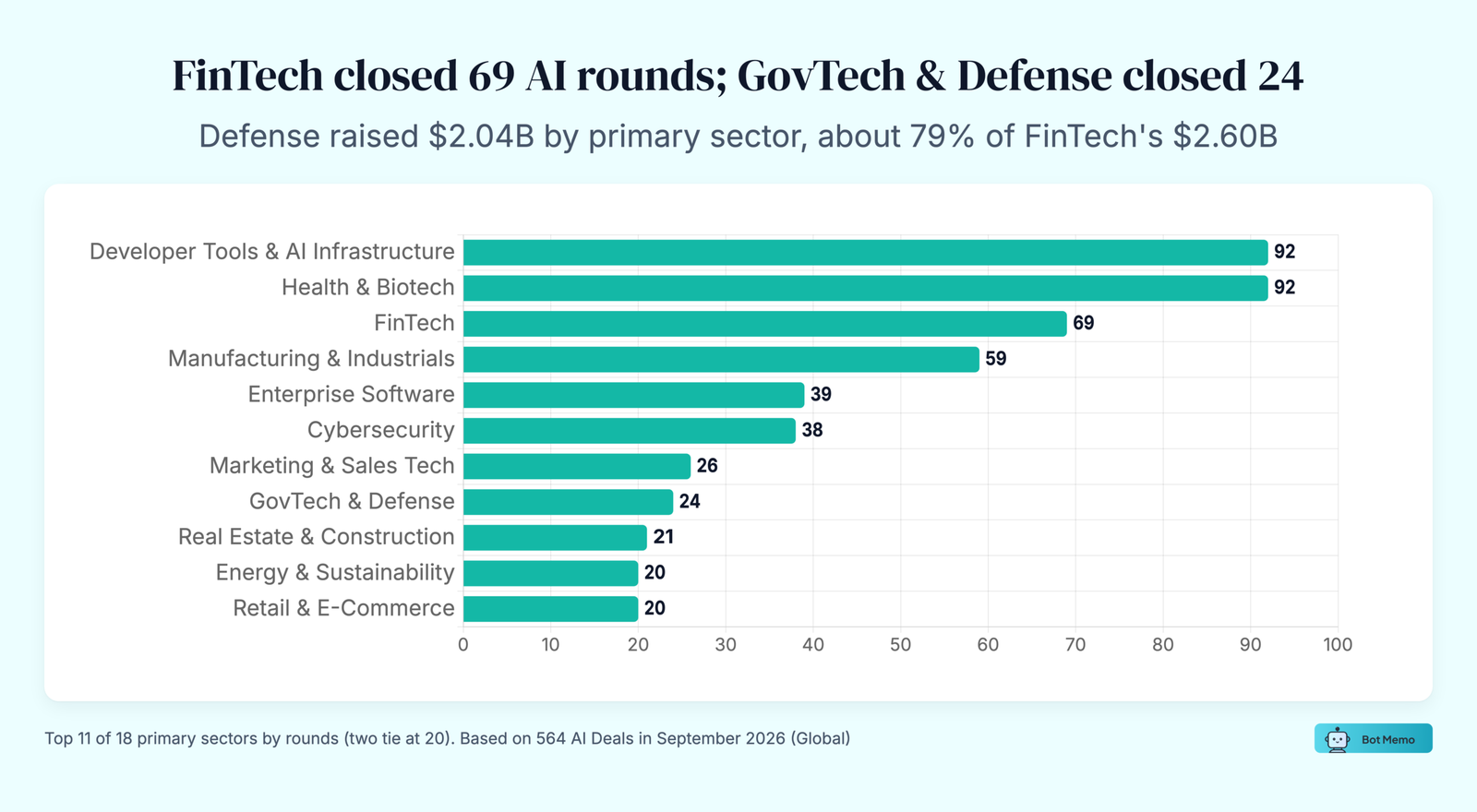
In the bar chart, FinTech’s deal count is almost three times defense’s, while the subtitle shows the dollar gap is far smaller.
Mach Industries raised the largest GovTech & Defense round of the month, a $600M Series C extension. The Huntington Beach company builds autonomous unmanned systems and the factory capacity to produce them.
Put the three rounds side by side and the pattern is consistent. Each one funds hardware that has to be manufactured, from chip fabs to drone lines.
Where September’s AI dollars actually sat
Read by stage, the ladder shows where the rest of the month’s money landed.
Series C took the most money of any stage: $6,710.78M across 39 deals. Growth rounds, including one private equity round, added $2,431.96M across 17 deals. Another 59 rounds worth $3,317.06M, mostly with no stated stage plus a few bridges and grants, are counted as Other.
Further down the ladder, the money thins and the deal counts climb. Series B had 65 deals. Series A came to $3,109.79M across 108 deals, and Seed to $1,377.78M across 169 deals.
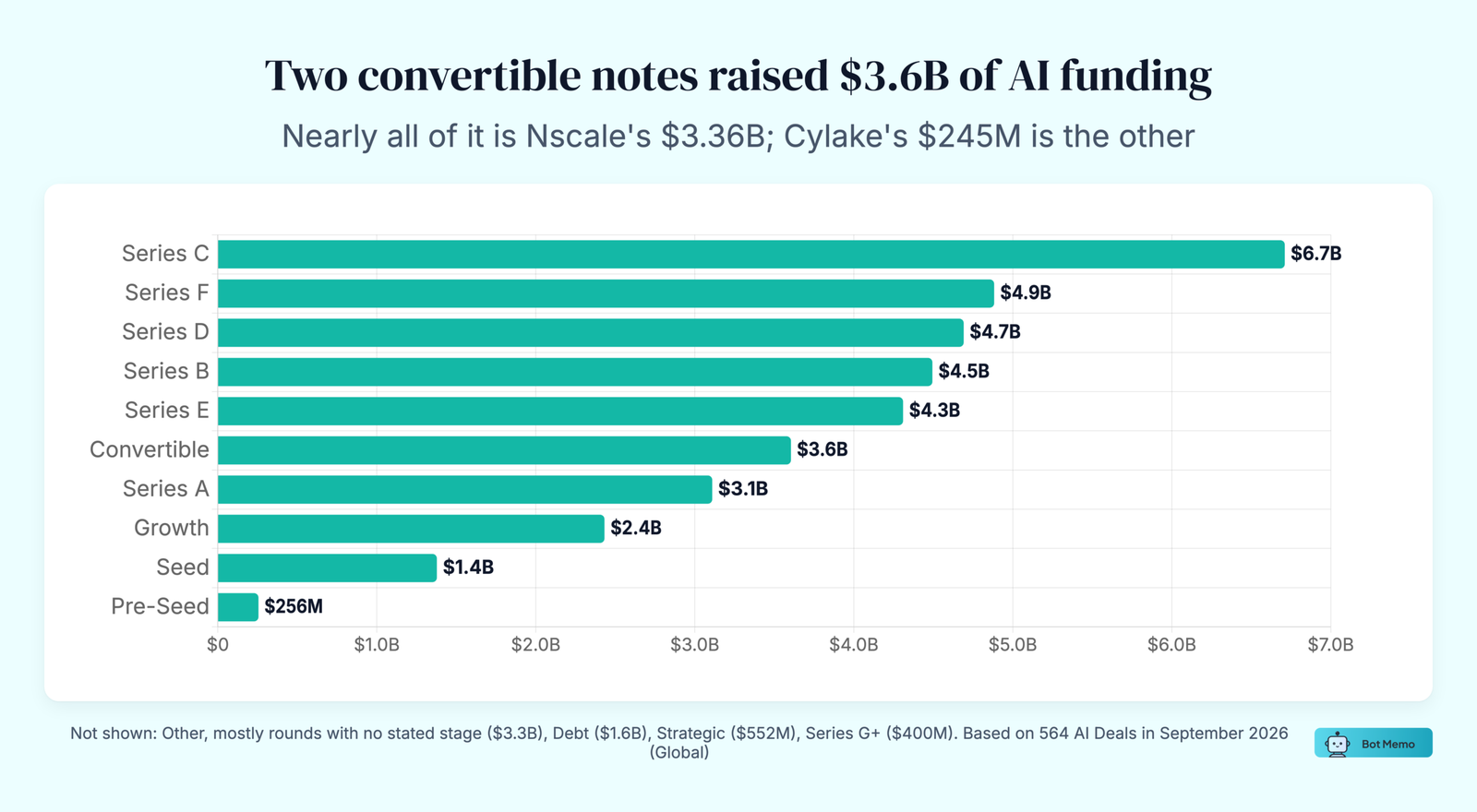
The bars in the chart run the opposite way to the deal counts. Seed had more than four times as many rounds as Series C and about a fifth of its dollars.
The typical round was $13.0M median vs $79.40M average, with the average measured over the 526 rounds that disclosed an amount. A small number of very large rounds set the total.
What founders and investors can take from it
Plan a raise against the median, not the monthly total. Half of September’s disclosed rounds were $13M or less, and the total was set by a handful of companies financing compute and hardware.
Ask what instrument sits behind any large announced number. A note that converts at an IPO, or a debt facility, carries terms a priced round does not, and some headline amounts include tranches that had not been paid in when they were announced.
Later-stage hardware rounds drew large sums outside the US in September, some with security-linked money in them. The Portuguese-founded Tekever raised a $580M Series D first close for autonomous drones and space systems, with Baillie Gifford and UC Investments among its backers. Open Cosmos, the Oxford microsatellite company, raised €300M in its Series C, and the UK’s National Security Strategic Investment Fund participated. Investors chasing those rounds are competing with buyers who also want strategic access.
The fab, chip and drone rounds also create demand for the software that runs factories, and those companies raise at Series A sizes. Harmoni raised a $10M Series A from Bessemer Venture Partners in Akron for factory orchestration software that connects operators, machine tools and engineering systems on the shop floor. For early-stage investors, that layer is where physical AI still raises software-sized rounds.
Methodology
Based on 564 AI funding deals tracked by Bot Memo between September 1, 2026 and September 30, 2026. Total funding: $41,761.89M.
Records: Every deal is verified, deduplicated and AI-classified before it is counted.
Scope: Global AI funding, worldwide with no geographic filter. The totals cover AI funding of every type, including convertible notes, debt financing and strategic investments, not only priced equity rounds. Secondary share sales and public-company financings are excluded.
Round sizes: Medians and averages use the 526 rounds that disclosed an amount. Round sizes are never valuations.
Currency conversion: Non-USD rounds are converted to US dollars for totals; individual rounds are shown in the currency they were announced in.
AI Classification: AI Native: AI is foundational to the product. AI Augmented: existing product enhanced with AI. AI Adjacent: enables AI infrastructure. AI Platforms: builds foundation models or chips.
Multi-attribution: Every participating investor is credited with the full round, so investor figures reflect participation, not dollars deployed, and are never summed into a market total. Sector figures assign each deal to one primary sector. City figures credit a deal to each city it lists.
Deal size bands: under $5M, $5M to $10M, $10M to $15M, $15M to $25M, $25M to $50M, $50M to $100M, and $100M+.
Limitations: Figures reflect rounds announced and verified as of November 11, 2026.

About the author
Editorial Staff
The Editorial Staff at Bot Memo is a team of writers, analysts, and AI agents dedicated to mapping the global AI startup ecosystem. Led by Chintan Zalani, the team tracks thousands of funding rounds, classifies companies across verticals, and distills it all into actionable intelligence for investors and founders.