
A zombie unicorn is a private company valued at $1 billion or more that is still operating but cannot raise at a higher price, has no clear path to an IPO, and gets no acquisition offer that matches its last valuation. The term took hold after the 2021 boom, when more than 1,100 unicorns had raised a combined $700 billion at a total valuation of $4 trillion, according to the Chicago Booth Review. Many of them never raised again.
AI took close to half of all venture money in 2025, so it is the sector where a stuck unicorn looks least likely. Bot Memo tracked 38 AI-first companies that raised money, including debt, between January 2023 and October 20, 2024 while valued at $1 billion or more, and followed each one through October 20, 2026. Twenty-three raised again at a higher valuation. Eight were sold, agreed to be sold, sold a business unit, or signed technology-licensing deals with larger companies, most of which also hired their staff. Five have gone more than two years without a new round at a disclosed valuation. One listed in Hong Kong without a higher-priced round first, and one raised at a lower price.
On this page
- What counts as a zombie unicorn
- The 2021-2022 overhang
- What happened to 38 AI unicorns valued at $1 billion by October 2024
- The five AI unicorns that have gone quiet
- The eight that were sold or signed licence deals
- The Hong Kong listings and the one down round
- Where the risk sits in AI
- Scope and definitions
- Frequently asked questions
What counts as a zombie unicorn
The working definition comes from Female Founders Fund, quoted by Fortune in March 2026: companies with unicorn valuations that are “still operating, but are unable to raise an up round, not on a clear path to IPO, and not attracting acquisition offers that match their last private valuation.” The label describes a stuck company. Many keep selling products and paying staff for years.
A company that accepts a lower price (a down round) and drops below $1 billion is usually called a fallen unicorn, because the markdown has already happened. “Zombiecorn” is press shorthand for the same stuck state as a zombie unicorn.
The signs to look for are practical. There has been no priced round for 24 months or more, no IPO filing and no buyer at the last price, and the news runs to layoffs, executive exits or a change of focus rather than funding.
The 2021-2022 overhang
The zombie problem is mostly a hangover from 2021 and 2022. CB Insights found in December 2024 that over one-third of the 1,200+ unicorns then in existence had not raised funding since 2021, and more than 100 of them were last valued at exactly $1 billion, so any down round would cost them unicorn status.
Kindbody shows how that ends. The fertility clinic network was valued at $1.8 billion in 2023, and by early 2026 its valuation was reported to have fallen to $400 million as it shut clinics, Fortune reported.
New money has gone to AI instead. AI took close to 50% of all global venture funding in 2025, up from 34% in 2024, and 58% of AI funding went to rounds of $500 million or more, according to Crunchbase. More than 100 new tech unicorns were minted in 2025, most of them AI-related, TechCrunch counted. Our AI unicorn list for 2026 tracks the current group.
What happened to 38 AI unicorns valued at $1 billion by October 2024
Each company is counted once, by the first outcome after its last $1 billion-plus round before October 20, 2024. When one transaction combines a technology licence with a higher-valued investment, it counts as a licence deal.
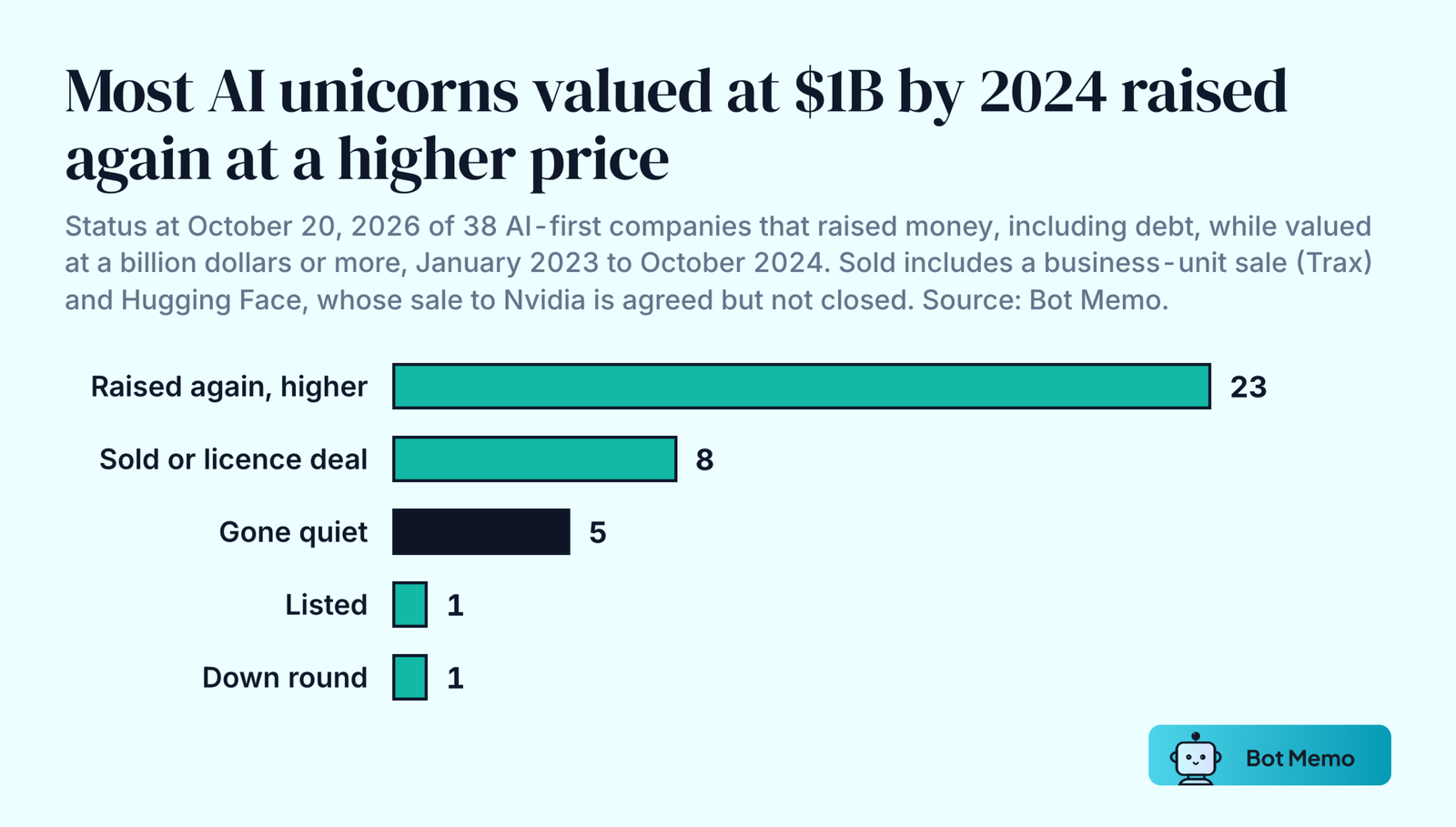
Most of the group kept raising at higher prices. Cognition went from $2 billion in April 2024 to $48 billion in September 2026. Anduril went from $14 billion in August 2024 to $61 billion in May 2026. Perplexity went from about $1 billion in April 2024 to a reported $20 billion in September 2025, and Skild AI from $1.5 billion in July 2024 to more than $14 billion in January 2026.
The 23 that raised higher are Anduril, Skydio, OpenAI, xAI, Anthropic, Mistral AI, Helsing, Cohere, Safe Superintelligence, Moonshot AI, MiniMax, Shield AI, AlphaSense, Cognition, Quantexa, Sakana AI, Runway, Skild AI, Together AI, Perplexity, World Labs, Synthesia and Saronic. Three of them later reached an exit. SpaceX combined with xAI in February 2026, MiniMax listed in Hong Kong in January 2026, and AMD agreed in September 2026 to buy World Labs for about $8.2 billion in stock.
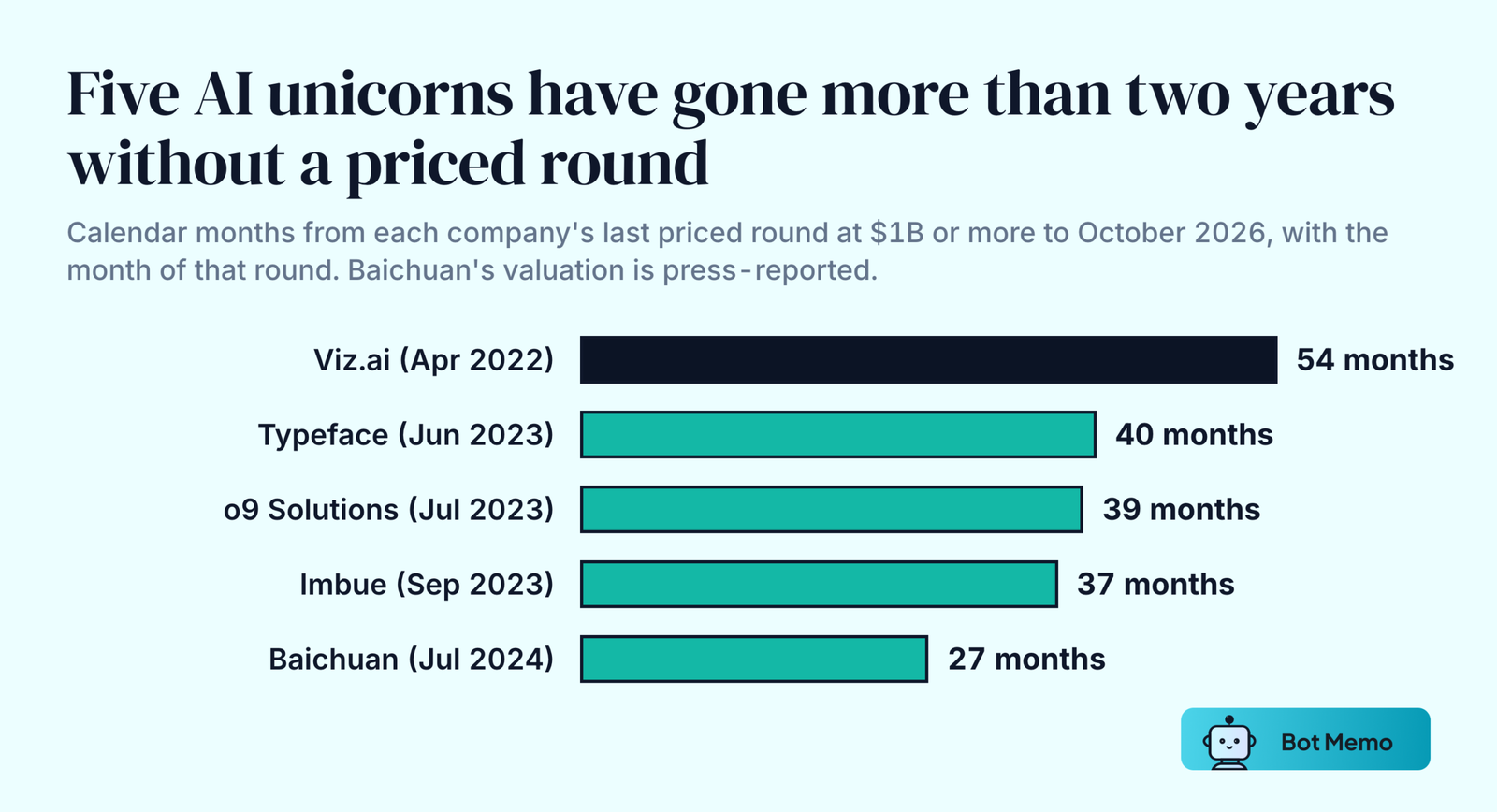
The five that went quiet sit at the opposite end. Each last raised at a disclosed valuation in 2022 or 2023 (mid-2024 for Baichuan), and none has announced a new round at a disclosed valuation, a sale or a listing since.
The five AI unicorns that have gone quiet
| Company | Last priced round | Valuation | What has happened since |
|---|---|---|---|
| Viz.ai | April 2022, $100M Series D | $1.2B | A debt financing in 2023; no new priced round, sale or listing. |
| Typeface | June 2023, $100M Series B | $1B | Product launches and partnerships; no new priced round, sale or listing. |
| o9 Solutions | July 2023, $116M from existing investors | $3.7B | No new priced round, sale or listing. |
| Imbue | September 2023, $200M Series B | Over $1B | A $12M top-up in October 2023 with no valuation given; no new priced round, sale or listing since. |
| Baichuan | July 2024, RMB 5B Series A | About RMB 20B (reported) | Co-founders left; moved the whole business to healthcare AI in March 2025. |
Baichuan, founded in 2023 by former Sogou chief executive Wang Xiaochuan, completed a RMB 5 billion Series A in July 2024 at a reported valuation of about RMB 20 billion. It moved its whole business to healthcare AI in March 2025, and several co-founders left from December 2024 onward.
Viz.ai has gone longest. Its $100 million Series D at $1.2 billion in April 2022 was its last priced round, 54 months before October 2026.
A quiet company can still be a healthy one. o9 Solutions raised $116 million at $3.7 billion in July 2023 from investors who were already on its cap table and has announced no funding since. A company that does not need new money will not show up in funding data. Typeface ($100 million at $1 billion in June 2023) and Imbue ($200 million at over $1 billion in September 2023) have both kept building without a new priced round.
The eight that were sold or signed licence deals
Big tech found a way to buy AI teams without buying the company. Microsoft paid Inflection AI roughly $650 million in March 2024 for access to its models and legal protections, Bloomberg reported, and hired most of its staff, including co-founder Mustafa Suleyman. Amazon hired Adept’s chief executive David Luan and co-founders in June 2024 and licensed its technology. Google did the same with Character.AI in August 2024, in a deal the Wall Street Journal put at about $2.7 billion.
Character.AI shows what can follow. The company kept running after Google hired its founders, but in mid-October 2026 it filed for Chapter 11 bankruptcy to run a court-supervised sale. Disney is the $20 million stalking-horse bidder for a licence to some of its technology, and other bidders can top that offer. If no buyer keeps the platform going, it will be wound down.
Codeium, the maker of the Windsurf coding tool, was valued at $1.25 billion in August 2024 and split up in July 2025. Google paid $2.4 billion for a licence and hired its chief executive, and Cognition bought the rest.
Two more followed the same pattern in 2026. Poolside, valued at a reported $3 billion in October 2024, agreed in August 2026 that Nvidia would pay $6 billion to license its model-building software and offer jobs to 109 of its staff, and invest $1 billion at a $12 billion pre-money valuation, according to a letter to investors. The founders are staying. AI21, the Israeli model developer last valued at $1.4 billion in a November 2023 Series C extension, held sale talks with several buyers that did not produce a sale. In May 2026 AI21 cut headcount from about 180 to about 70, and Nebius said it had agreed to license AI21’s technology. AI21 says it was not sold, and Nebius denies that the deal was an acqui-hire.
Trax, an Israeli-Singapore maker of image-recognition software for retail shelves, raised $640 million in 2021 (about half of it a secondary sale of employee shares) at a valuation that sources put at $2 billion, according to Globes. Its next financing was $50 million of venture debt in November 2023. In February 2026 it announced the sale of its image-recognition business outside China to an affiliate of Gemspring Capital, which is merging it with FORM.
Hugging Face had the best result of the eight. It last raised at $4.5 billion in August 2023 and never raised again. On September 2, 2026 Nvidia agreed to buy it for about $11.9 billion, plus up to about $1.0 billion in retention equity for staff, with closing expected in the first half of 2027.
The Hong Kong listings and the one down round
Two Chinese model developers took the IPO route. Zhipu AI listed in Hong Kong on January 8, 2026, and is the one company counted under listing. Its listing document shows its last private series agreed from August 2024 at a post-money valuation of about RMB 24.4 billion, with later tranches through May 2025 at the same price, so no higher-priced round came between that series and the listing. MiniMax followed on January 9, when its market value briefly passed HK$90 billion ($11.5 billion). MiniMax counts as raising higher, because its listing document shows private rounds at post-money valuations of $3.1 billion (agreed December 2024) and $4.2 billion (August 2025), up from $2.6 billion in March 2024.
Instabase is the one company in the group to raise at a lower price. It was valued at $2 billion in a 2023 Series C. In January 2025 it raised $100 million at a valuation that Bloomberg reported at $1.24 billion, a 38% cut that still left it a unicorn.
Where the risk sits in AI
Five quiet companies out of 38 is about 13%. Most of the group kept raising, and only Instabase took a lower price.
The bigger pattern is the licence deal. Eight of the 38 were sold, agreed to be sold, sold a business unit, or signed technology-licensing deals with larger companies. After a licence deal the remaining company has to find a new reason to exist, as Character.AI found. Model developers that fall behind the leaders are the most exposed. AI21, Inflection, Adept and Baichuan all set out to build general-purpose models, and none of them has raised at a higher price since. For the companies still raising, see our breakdown of how AI startup valuations changed in 2026.
Scope and definitions
The 38 companies are AI-first companies (AI is the core product, not an added feature) in Bot Memo data that raised money, including debt, between January 2023 and October 20, 2024 while carrying a valuation of $1 billion or more. That valuation can come from an earlier round, as with Viz.ai’s April 2022 Series D or Trax’s 2021 round. Status is as of October 20, 2026. Valuations marked “reported” were not confirmed by the company. A company counts as quiet if it has announced no new round at a disclosed valuation, no sale, no licence deal and no listing since its last $1 billion-plus round; debt and small top-ups without a valuation do not count. A higher headline valuation counts as raising higher, whatever the round’s terms.
Frequently asked questions
What is a zombie unicorn?
A private company valued at $1 billion or more that is still operating but cannot raise at a higher price, has no clear route to an IPO, and has no buyer at its last valuation.
How many zombie unicorns are there?
There is no single official count. CB Insights found in December 2024 that over one-third of the 1,200+ unicorns then in existence had not raised since 2021.
Which AI unicorns have stopped raising?
As of October 2026, five AI unicorns have gone more than two years without a new round at a disclosed valuation, a sale or a listing: Viz.ai (last priced round April 2022), Typeface (June 2023), o9 Solutions (July 2023), Imbue (September 2023) and Baichuan (July 2024).
What happens to a zombie unicorn?
The common endings are a down round, a sale below the last valuation, a licence-and-hire deal in which a larger company takes the team and technology, or a wind-down. Character.AI went from a licence-and-hire deal with Google in 2024 to a Chapter 11 sale process in October 2026.
What is the difference between a unicorn and a zombie unicorn?
A unicorn is any private company valued at $1 billion or more. A zombie unicorn is a unicorn whose valuation no longer reflects what investors or buyers will pay, so it cannot raise or sell without taking a lower price.

About the author
Editorial Staff
The Editorial Staff at Bot Memo is a team of writers, analysts, and AI agents dedicated to mapping the global AI startup ecosystem. Led by Chintan Zalani, the team tracks thousands of funding rounds, classifies companies across verticals, and distills it all into actionable intelligence for investors and founders.