


US venture funds held $278.5 billion of unspent capital as of September 30, 2025, according to the dry powder chart in the Q1 2026 PitchBook-NVCA Venture Monitor, the latest edition that reports it. That was down from $299.3 billion as of June 30, 2025. The pile fell between June and September 2025, and in 2026 the biggest firms have been refilling it. Through September, US VC funds raised $108.5 billion in 2026, already more than in all of 2025, and Andreessen Horowitz alone closed $23.8 billion of it.
This tracker follows both sides of that money. The first half lists the largest venture fund closes since January 2025, with the amount, date and source for each. The second half uses Bot Memo’s 2026 deal data to show which firms are joining AI rounds, how often, and at what round size.
On this page
- What dry powder means in venture capital
- The 2026 snapshot: less unspent money, more new funds
- Why AI changes the dry powder picture
- The biggest venture fund closes since January 2025
- Which firms joined the most AI rounds in 2026
- What founders should take from the tracker
- What LPs should take from the tracker
- Methodology
- Frequently asked questions
What dry powder means in venture capital
Dry powder is money that limited partners have committed to a fund but the fund has not yet called. The general partner draws it down as it writes checks. Until then it is a promise on paper, not cash in a bank account.
It works like a clock. A typical venture fund has a 10-year life and spends new money over roughly the first three to five years; Collaborative Fund describes the standard as a “10 year fund, 4 year investing period”. Capital that is not invested in that window mostly goes to follow-on checks for existing companies or is never called at all. That is why a large dry powder number does not mean every firm is eager to write new checks. See our AI startup glossary for related terms.
The 2026 snapshot: less unspent money, more new funds
Two published numbers frame the US market.
- US VC dry powder: $299.3 billion as of June 30, 2025, in the Q4 2025 Venture Monitor, then $278.5 billion as of September 30, 2025, in the Q1 2026 edition. The Q4 2025 report put more than $90 billion of it in 2021 and 2022 funds, and said funds of $500 million or more held 52.3% of it while making up 6.7% of funds closed over the past four years.
- US VC fundraising: $108.5 billion across 699 funds through September 30, 2026, per the Q3 2026 Venture Monitor. Funds of $500 million or more took 78.1% of that capital while making up 6% of funds closed.
Last year’s fundraising number has moved as late closes were counted. The Q4 2025 Monitor reported $66.1 billion for 2025, the fewest funds closed in a decade. The Q3 2026 edition now puts 2025 at $78.3 billion, and 2024 at $117.3 billion, against $101.3 billion in the Q4 2025 edition.
Why AI changes the dry powder picture
AI is now most of what venture capital buys. The OECD found AI firms took 61% of global VC in 2025, $258.7 billion of $427.1 billion, with about 75% of that, $194 billion, going to US companies. In the US this year, AI accounted for 82.7% of venture deal value through September, the highest annual share in PitchBook-NVCA’s data.
Most of those dollars sit in a few very large rounds. The OECD put mega deals over $100 million at about 73% of AI investment value in 2025, with deals over $1 billion making up almost half. In Q1 2026, PitchBook-NVCA counted $267.2 billion of US deal value, and removing the five largest deals (OpenAI, Anthropic, xAI, Waymo and Databricks) cut that total by 73.2%.
Bot Memo’s own count of AI startup funding worldwide shows the same shape, though less extreme in recent quarters. From January to September 2026 we recorded 4,609 AI rounds worth $561.4 billion. The 57 rounds of $1 billion or more took 65.7% of that money. Rounds under $100 million, which is where most startups raise, added up to $62.3 billion, or 11.1%.
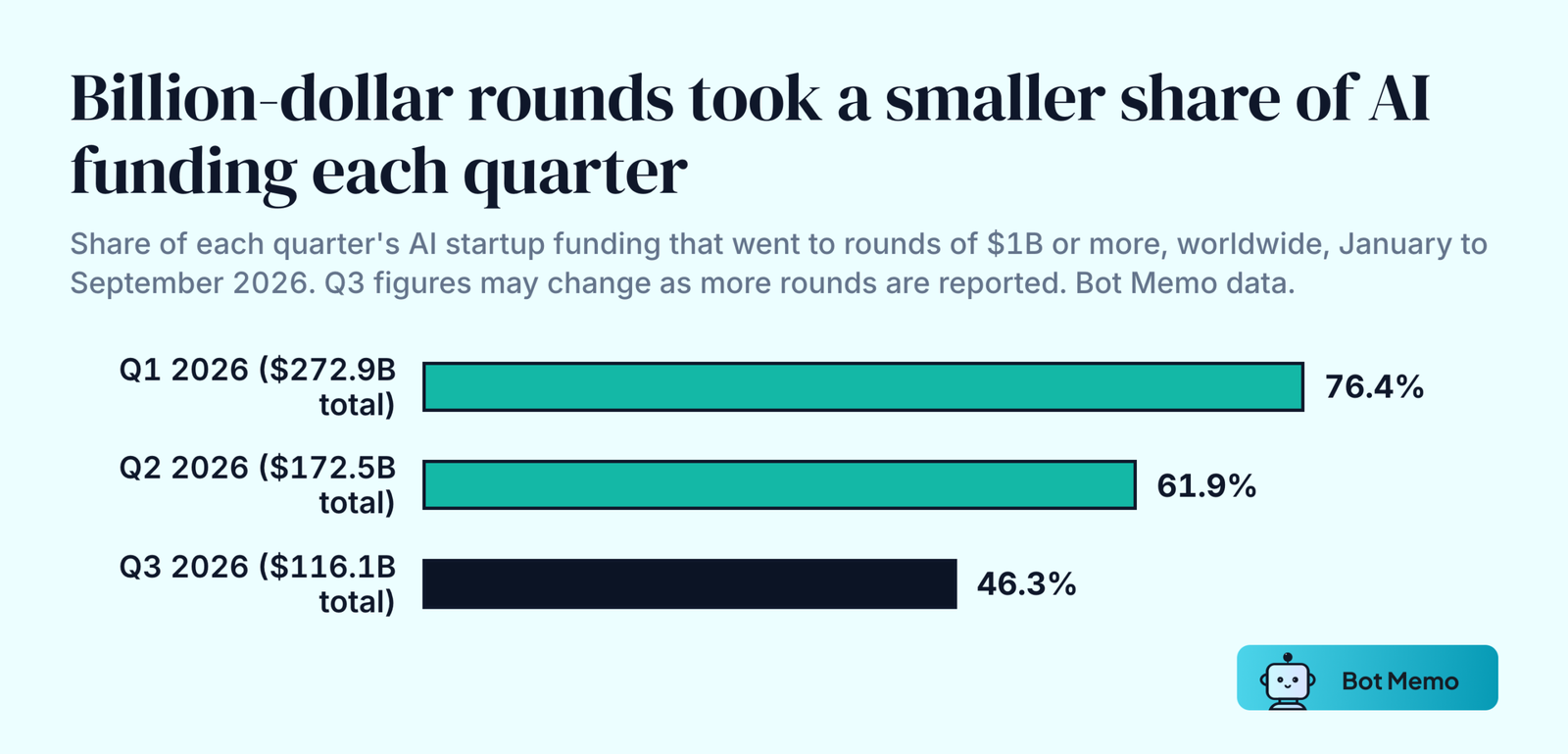
The quarter split matters for anyone reading the dry powder figure. Q1 held OpenAI’s $122 billion round and Anthropic’s $30 billion Series G; Q2 held Anthropic’s $65 billion Series H. In Q3 the largest rounds were about $5 billion each, from Safe Superintelligence and Databricks. Q3 had more $1 billion rounds than either earlier quarter (26, against 16 and 15), but they made up 46.3% of the quarter’s dollars, down from 76.4% in Q1. Q3 totals may still rise as late rounds are reported.
The biggest venture fund closes since January 2025
The table lists new venture funds of about $1.5 billion and up announced by US and European venture firms from January 2025 to mid-October 2026. Amounts come from announcements by the firm or its legal counsel unless marked “reported”, which means the figure comes only from press coverage. Several firms describe AI as a major focus of the new money, and Menlo Ventures raised its $3 billion specifically to back AI companies, but the announcements do not give a consistent breakdown of planned AI allocations.
| Firm | New capital | Announced | Funds | Source |
|---|---|---|---|---|
| Andreessen Horowitz | More than $20B | January, May and August 2026 | January: more than $15B (Growth $6.75B, Apps $1.7B, Infrastructure $1.7B, American Dynamism $1.176B, Bio & Health $700M, other strategies $3B). May: fifth crypto fund $2.2B. August: Growth Fund V expanded to $8.5B; Machine Age Fund $1.1B | a16z; Cooley |
| Insight Partners | $12.5B | January 2025 | Fund XIII and Opportunities Fund II | Insight Partners |
| Founders Fund | $10.6B (part reported) | April 2025 and May 2026 | Growth III $4.6B (SEC filing, April 2025); new growth fund $6B (reported, May 2026) | Bloomberg |
| Thrive Capital | More than $10B | February 2026 | Thrive X: $1B early stage, $9B growth | Alternatives Watch |
| Lightspeed | More than $9B | December 2025 | Six vehicles, including a $3.3B opportunity fund | TechCrunch |
| Accel | $8.5B | April and August 2026 | About $5B in April, including a $4B fifth Leaders fund and a $650M sidecar; $3.5B across four early-stage funds in August | Accel |
| Sequoia Capital | About $7B (reported) | April 2026 | New expansion fund; Sequoia has not announced it | Bloomberg |
| Bessemer Venture Partners | $5.75B | September 2026 | $1.75B seed and early stage, $4B growth | Kirkland & Ellis |
| Kleiner Perkins | $3.5B | March 2026 | KP22 early stage $1B, growth funds $2.5B | Gunderson Dettmer |
| Battery Ventures | $3.25B | February 2026 | Battery Ventures XV | Alternatives Watch |
| Menlo Ventures | $3B | June 2026 | Menlo Ventures XVII and Menlo Inflection IV, raised to back AI companies | Cooley |
| Index Ventures | $2B | July 2026 | Seed $400M, venture $900M, growth fund top-up $700M | TechCrunch |
| Benchmark | $2B (reported) | June 2026 | First growth fund $1.25B, early-stage fund $750M | Pulse 2.0 |
| Bain Capital Ventures | $1.6B | September 2026 | Fund XI | Alternatives Watch |
| Lux Capital | More than $1.5B | January 2026 | Lux Ventures IX | Sidley |
| Greylock | $1.5B | July 2026 | Greylock 18, early stage | Greylock |
| 8VC | $1.5B | July 2026 | Fund VII | Gunderson Dettmer |
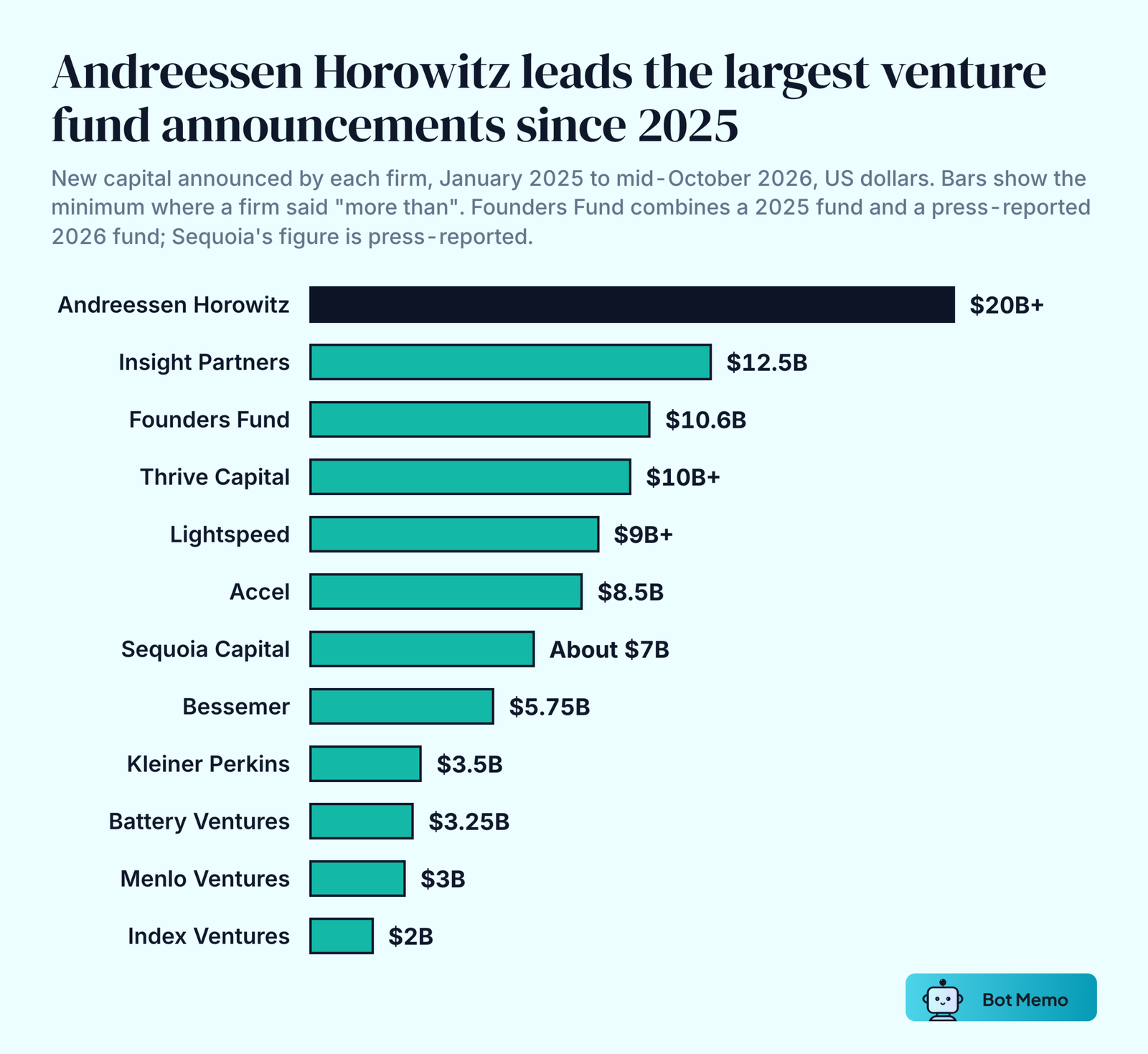
Several large firms are still raising. General Catalyst was reported in talks to raise about $10 billion in March 2026 (Bloomberg); we found no close by mid-October. Khosla Ventures, IVP and Tiger Global have also been reported raising new funds without an announced final close.
PitchBook-NVCA reported that five firms raised 73.1% of all new US VC commitments in Q1 2026, and that a16z’s fund closes through September came to $23.8 billion, more than 20% of all US venture capital raised this year. That is higher than the a16z announcements in the table, which add up to just over $20 billion; the report names the $8.5 billion Growth Fund V but does not break down the rest of its total. Established managers, those on their fourth fund or later, took 88.2% of the capital.
Which firms joined the most AI rounds in 2026
A fund close shows who has capital; deal activity shows which firms are showing up in AI rounds. The chart below counts the AI rounds from January to September 2026 in which each firm was named as an investor, from Bot Memo’s data on AI startup funding worldwide. The ranking covers venture firms; accelerators, corporate investors and scout programs are excluded.
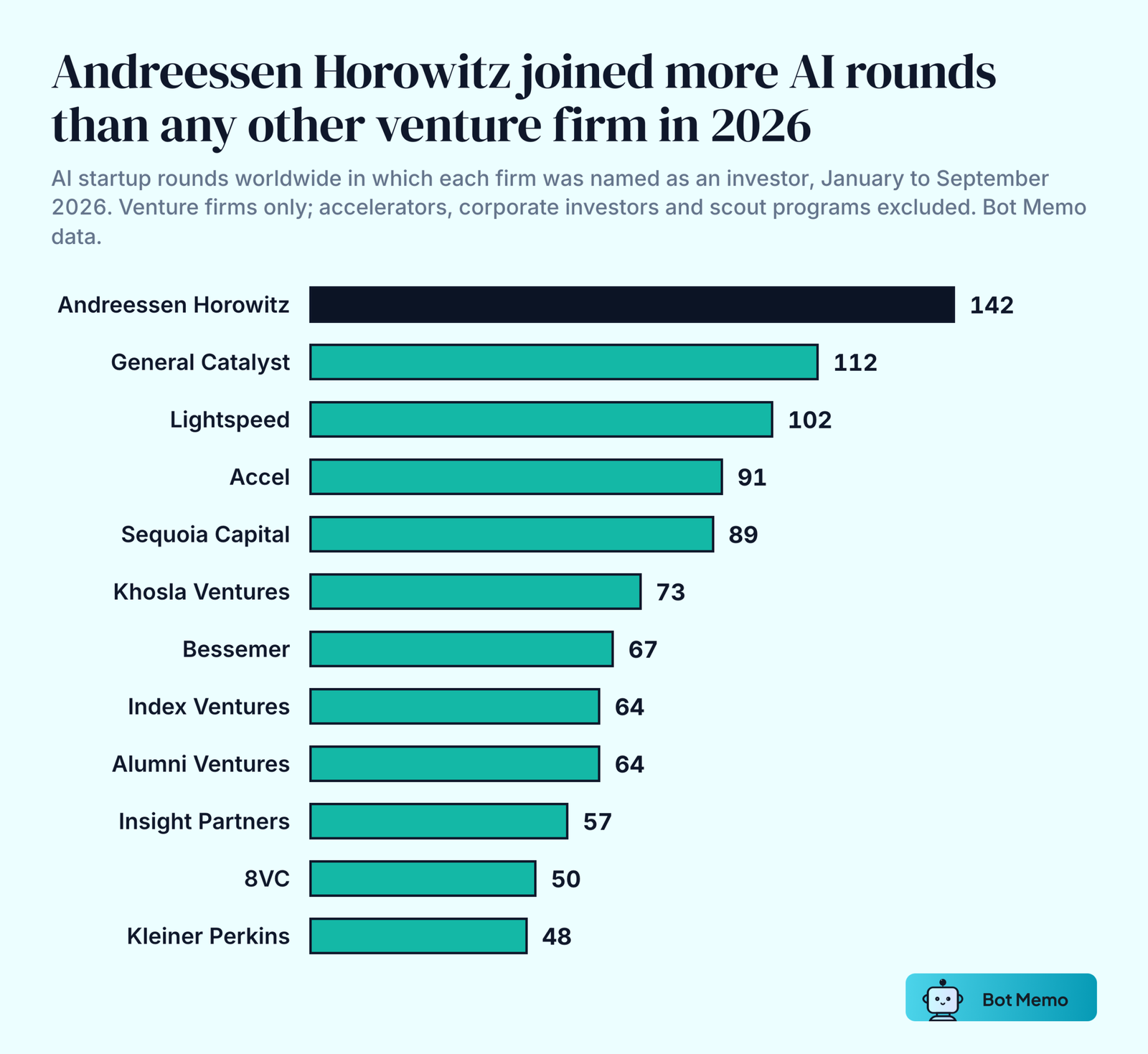
Andreessen Horowitz joined 142 AI rounds, more than any other venture firm, followed by General Catalyst with 112 and Lightspeed with 102. Accel joined 91 and Sequoia 89. These firms write checks at every stage, from seed to growth. a16z’s median disclosed round was $41.5 million, and General Catalyst’s was $39 million.
The growth funds work differently. Thrive Capital, which closed more than $10 billion in February, joined 25 AI rounds, with a median disclosed round of $152.5 million. Coatue joined 33 at a median of $400 million, and Founders Fund 32 at $100 million. Thrive joined far fewer rounds than a16z or General Catalyst, but its median round was almost four times larger.
Two investors outside the chart joined more AI rounds than most firms on it. Y Combinator, an accelerator, appeared in 204 AI rounds, mostly early rounds with a median disclosed round of $14.5 million. Nvidia, a corporate investor that does not raise money from LPs, joined 85 AI rounds with a median disclosed round of $211.5 million.
For a deeper look at one firm’s activity, see every AI deal a16z made, and our list of the most active AI investors of 2025. Corporate investors such as Nvidia are covered in our piece on corporate VC in AI.
What founders should take from the tracker
Large fund closes do not mean every AI startup will find a check. Most of the capital raised in 2026 went to multi-stage and growth funds, and AI funding dollars were concentrated in a small number of very large rounds. Through September, rounds under $100 million took 11.1% of AI funding dollars in our data.
The better question is which firms are writing checks at your stage and in your sector. The deal counts above are a starting point. a16z and General Catalyst each joined more than 100 AI rounds this year with median disclosed rounds under $50 million. Thrive and Coatue mostly join rounds well above $100 million. Greylock, Index Ventures and Benchmark all raised new early-stage funds this year as well.
What LPs should take from the tracker
LP money in 2026 has gone mostly to established managers. Firms on their fourth fund or later took 88.2% of US VC capital through September, which PitchBook-NVCA described as a record high. First-time managers are on track for the fewest new funds since 2016, by the same report’s count.
Two risks are worth watching. The first is concentration: a large share of 2026 capital is committed to a few firms, so LPs who back several of them may hold similar AI exposure. The second is timing. Much of the 2021 and 2022 capital is still uncalled, and those funds are reaching the end of their investment periods while also needing reserves for existing portfolios.
Methodology
Fund closes come from each firm’s announcement, its legal counsel’s announcement, or major news coverage, and each row links to a source. “Reported” marks a figure that comes only from press coverage. Where a firm announced more than one fund in the period, the Funds column lists each announcement and the new commitments are added; a fund expansion counts only the added capital. Amounts are in US dollars.
Deal activity covers AI startup funding rounds worldwide announced from January 1 to September 30, 2026, in Bot Memo’s data. A firm is counted when it is named as an investor in a round. Median round size uses rounds with a disclosed amount, and counts the full round, not the firm’s own check. These counts measure how often a firm joins AI rounds, not how much it invested.
US dry powder and fundraising figures are taken from the PitchBook-NVCA Venture Monitor as published, with the edition each comes from named in the text. Later editions revise earlier quarters as late fund closes are counted.
Frequently asked questions
What is dry powder in venture capital?
Dry powder is capital that investors have committed to a venture fund but the fund has not yet called. The fund draws it down as it makes investments. Most funds invest new money over the first three to five years of a 10-year life.
How much dry powder do US VCs have?
The most recent figure is $278.5 billion as of September 30, 2025, published in the Q1 2026 PitchBook-NVCA Venture Monitor, down from $299.3 billion as of June 30, 2025. Later editions of the report have not updated the figure.
Which VC firm raised the most money in 2026?
Andreessen Horowitz. It announced more than $15 billion across several funds in January 2026 and just over $20 billion by the end of August, and PitchBook-NVCA counted $23.8 billion of a16z fund closes through September 30, 2026, more than 20% of all US venture capital raised in that period. Thrive Capital’s Thrive X, at more than $10 billion across early-stage and growth money, was the largest raise by any other firm this year.
How much did US VC funds raise in 2026?
$108.5 billion across 699 funds through September 30, 2026, per the Q3 2026 PitchBook-NVCA Venture Monitor. That is already more than the $78.3 billion raised in all of 2025.
How much of venture capital goes to AI?
The OECD found AI firms took 61% of global VC in 2025 ($258.7 billion of $427.1 billion). In the US, AI accounted for 82.7% of venture deal value through September 2026, per PitchBook-NVCA. Bot Memo recorded $561.4 billion across 4,609 AI startup rounds worldwide from January to September 2026.
Which VC firms joined the most AI rounds in 2026?
In Bot Memo’s data for January to September 2026, Andreessen Horowitz joined 142 AI rounds, General Catalyst 112, Lightspeed 102, Accel 91 and Sequoia 89. Y Combinator (204), an accelerator, and Nvidia (85), a corporate investor, were also very active.
What happens to dry powder that is never invested?
Once a fund’s investment period ends, it usually stops making new investments and keeps the remaining commitments for follow-on rounds in its existing companies and for fees. Capital that is never called stays with the LPs. Funds can also ask LPs to extend the investment period.

About the author
Editorial Staff
The Editorial Staff at Bot Memo is a team of writers, analysts, and AI agents dedicated to mapping the global AI startup ecosystem. Led by Chintan Zalani, the team tracks thousands of funding rounds, classifies companies across verticals, and distills it all into actionable intelligence for investors and founders.