

Waabi, a Toronto company building self-driving software for trucks and robotaxis, raised the largest round in this guide: a $750 million Series C in January 2026, co-led by Khosla Ventures and G2 Venture Partners. Uber committed up to $250 million more if Waabi hits milestones that were not disclosed. Cohere, which builds language models for businesses and governments, raised $500 million in August 2025 at a $6.8 billion valuation and added $100 million in September at $7 billion.
Below those two, the money went to a wide spread of AI businesses: chips built for one model at a time, drug development, tax and legal research, video generation, factory inspection and a buyer of small software companies. Most of the companies in this guide sell to a specific industry rather than to consumers.
This guide covers notable rounds raised in 2025 and 2026 by AI companies headquartered in Toronto, the investors behind them, and the research institutes and accelerators around them. Amounts are in US dollars unless marked C$.
On this page
Canadian venture funding in 2025 and 2026
Canadian startups raised C$8.0 billion across 571 venture deals in 2025, down 6% in dollars and 12% in deal count from 2024. Ontario, home to Toronto, took C$4.6 billion across 247 deals, just over half of the national total and more than any other province.
In the first half of 2026, Canadian venture investment rose 17% from a year earlier to C$2.69 billion across 250 deals. It was the first year-over-year increase in first-half dollars since 2021, even as the number of deals fell. The rounds below are limited to companies whose main product is AI or that build their business around it.
Notable Toronto AI rounds of 2025
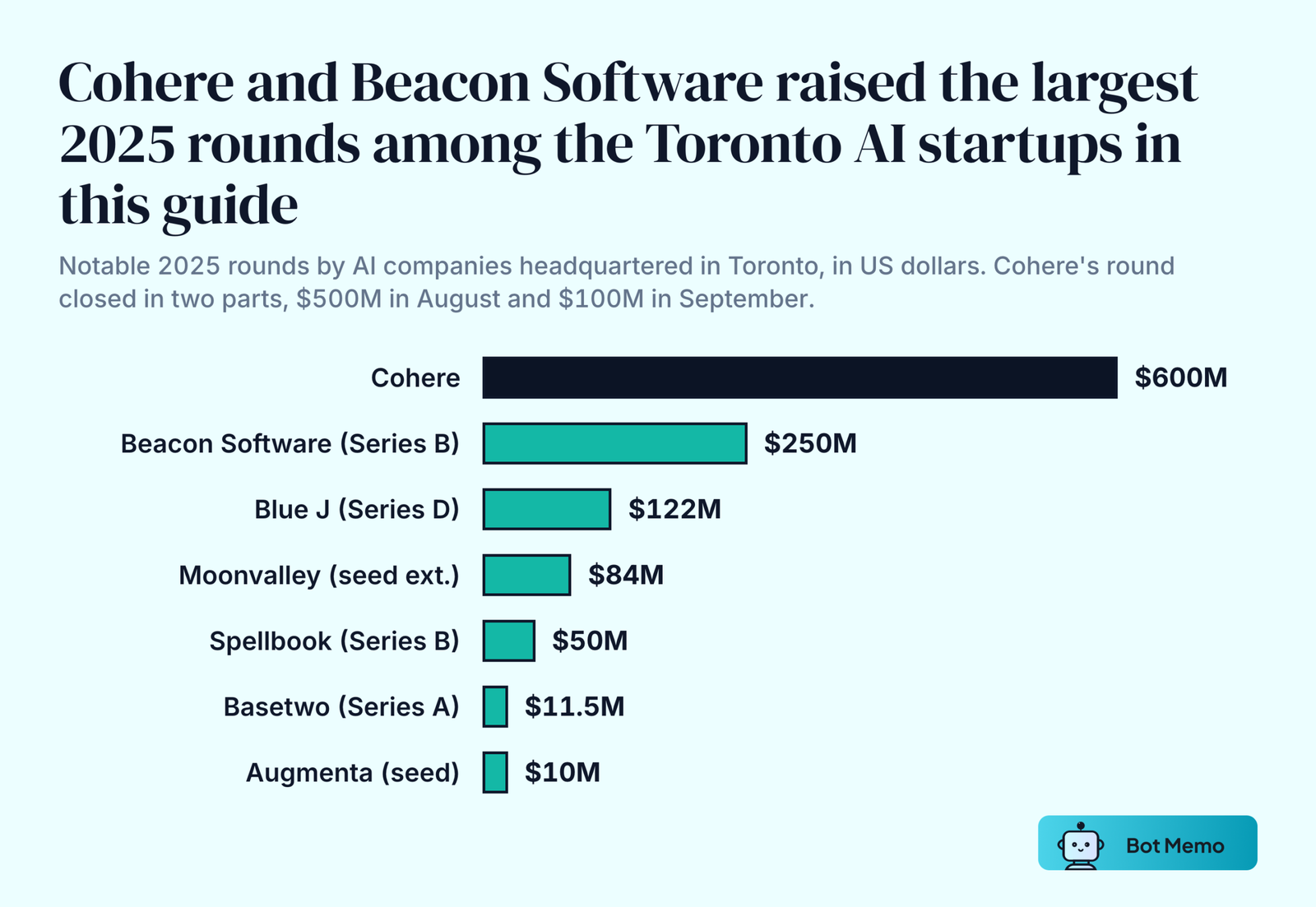
Cohere was founded in 2019 by Aidan Gomez, Nick Frosst and Ivan Zhang. Gomez is one of the authors of the 2017 research paper that introduced the transformer, the design behind most of today’s large language models. Radical Ventures and Inovia Capital co-led its $500 million round in August 2025, with AMD and Nvidia investing again. A second close in September brought in $100 million more, including from BDC, Canada’s federal development bank, and lifted the valuation to $7 billion.
Beacon Software, launched in 2024 by former Instacart president Nilam Ganenthiran, buys small, profitable software and services businesses and adds AI to how they run. It closed a $250 million Series B in November 2025, co-led by General Catalyst, Lightspeed Venture Partners and D1 Capital, which valued the company at $1 billion.
Blue J, whose AI answers tax research questions for accountants and lawyers, raised a $122 million Series D led by Oak HC/FT and Sapphire Ventures in August 2025.
Moonvalley builds an AI video generator for film and TV studios, trained on licensed footage. It raised an $84 million seed extension led by General Catalyst in July 2025, which brought its funding to $154 million since it was founded in 2023.
Spellbook, which uses AI to draft and review contracts for lawyers, raised a $50 million Series B led by Khosla Ventures in October 2025 at a $350 million valuation. The company was founded in St. John’s, Newfoundland, and is now based in Toronto.
Smaller 2025 rounds included Basetwo ($11.5 million Series A led by AVP in January, AI that tunes chemical and drug manufacturing processes) and Augmenta ($10 million seed led by Prelude Ventures in March, AI that designs electrical systems for buildings).
Notable Toronto AI rounds of 2026 so far
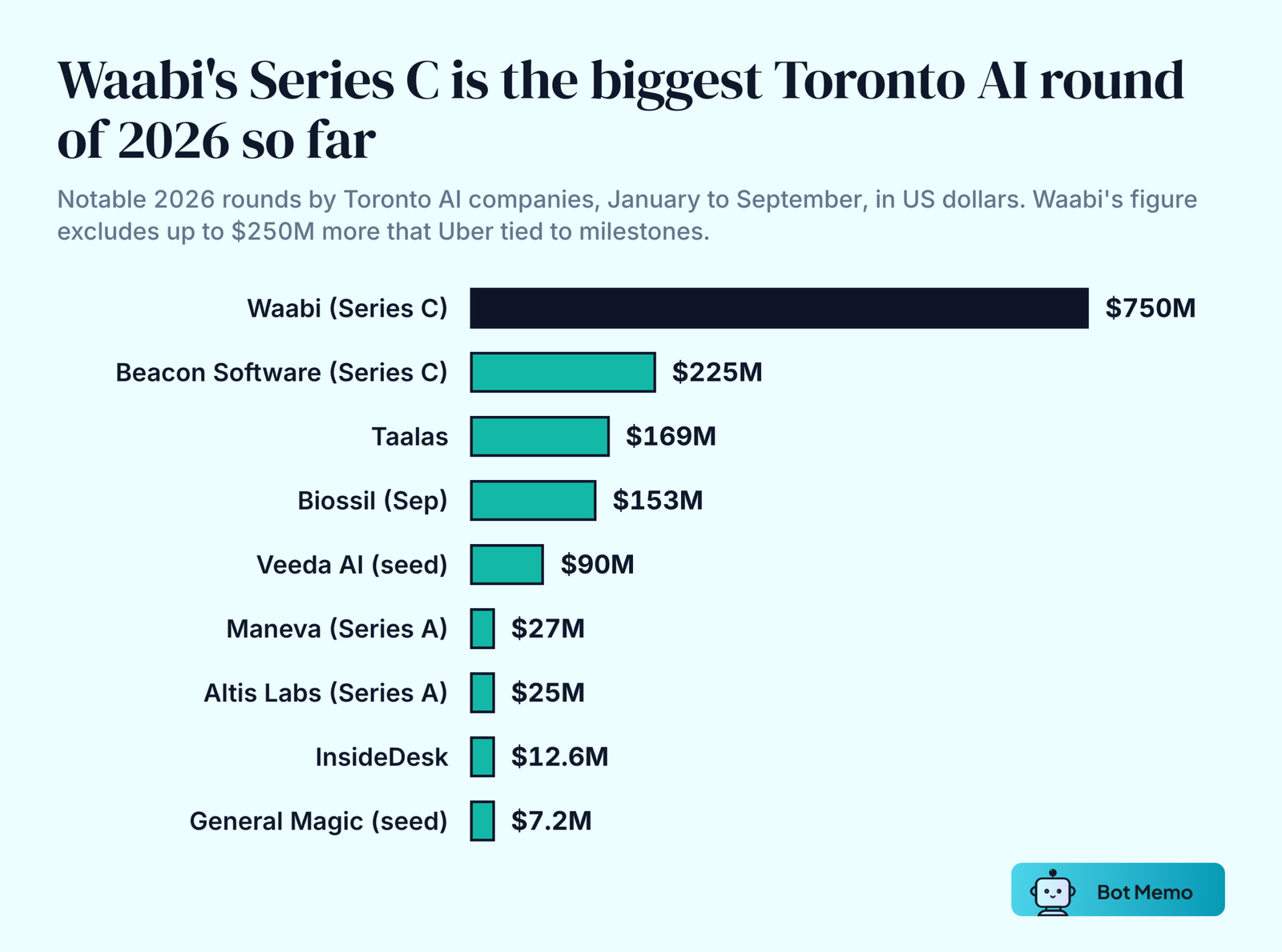
Waabi was founded in 2021 by Raquel Urtasun, a University of Toronto professor who was previously chief scientist at Uber’s self-driving unit. Its Series C came with a partnership to put Waabi’s software in robotaxis on Uber’s network. The company called it the largest round ever raised by a Canadian tech company.
Beacon Software returned in June 2026 with a $225 million Series C co-led by HarbourVest and General Catalyst, taking its outside funding past $550 million.
Taalas designs chips that are each built around one specific AI model, which it says makes them run faster and cheaper than general-purpose hardware. Its first product targets a version of Meta’s open-source Llama model. Taalas raised $169 million in February 2026 from investors including Quiet Capital, Fidelity and Pierre Lamond, bringing its total past $200 million. At the time it had 24 employees.
Biossil uses AI to pick drug candidates that failed in earlier trials, acquires them and runs new trials. It came out of stealth in April 2026, having raised about $70 million in equity from investors including OpenAI, Founders Fund and Staircase Ventures. In September, the OpenAI Startup Fund led a $153 million round that made Biossil a unicorn, a private company valued at $1 billion or more.
Veeda AI builds world models: simulations of the physical world in which robots and AI agents learn by trial. Khosla Ventures and Radical Ventures co-led its $90 million seed round in August 2026.
Maneva, founded by a former Alberta welder turned engineer, sells AI that watches factory camera feeds for defects, safety hazards and slowdowns. US Venture Partners led its $27 million Series A in June 2026. Altis Labs, whose AI reads routine CT scans to predict how cancer patients will fare in drug trials, raised a $25 million Series A co-led by OrbiMed and Qiming Venture Partners USA in September.
Earlier-stage 2026 rounds included InsideDesk ($12.6 million led by Pender Ventures in July, AI billing and collections for dental groups) and General Magic ($7.2 million led by Radical Ventures in February, AI agents that text with insurance customers on behalf of brokers).
Cohere’s biggest 2026 move was a merger. In April it agreed to combine with Aleph Alpha, a German AI company, and the two signed a merger agreement in September that reportedly values the combined company at $20 billion. The combined company is to keep the Cohere name and have dual headquarters in Toronto and Berlin, and Schwarz Group, the German retail group behind Aleph Alpha, committed $600 million to lead its Series E. That round is not in the charts because it had not been announced as closed.
Toronto AI startups at a glance
The table lists the rounds shown in the two charts, newest first.
| Company | What it builds | Funding | Date |
|---|---|---|---|
| Biossil | AI-picked revival of failed drug candidates | $153M led by OpenAI Startup Fund, valued at $1B or more | Sep 2026 |
| Altis Labs | AI that predicts trial outcomes from CT scans | $25M Series A co-led by OrbiMed and Qiming Venture Partners USA | Sep 2026 |
| Veeda AI | World models for training robots | $90M seed co-led by Khosla Ventures and Radical Ventures | Aug 2026 |
| InsideDesk | AI billing and collections for dental groups | $12.6M led by Pender Ventures | Jul 2026 |
| Maneva | AI vision for factory lines | $27M Series A led by US Venture Partners | Jun 2026 |
| Beacon Software | Buys small software firms and adds AI | $225M Series C co-led by HarbourVest and General Catalyst | Jun 2026 |
| Taalas | Chips built around a single AI model | $169M from investors including Quiet Capital and Fidelity | Feb 2026 |
| General Magic | AI texting agents for insurance brokers | $7.2M led by Radical Ventures | Feb 2026 |
| Waabi | Self-driving software for trucks and robotaxis | $750M Series C co-led by Khosla Ventures and G2 Venture Partners | Jan 2026 |
| Beacon Software | Buys small software firms and adds AI | $250M Series B co-led by General Catalyst, Lightspeed and D1 Capital, $1B valuation | Nov 2025 |
| Spellbook | AI contract drafting for lawyers | $50M Series B led by Khosla Ventures, $350M valuation | Oct 2025 |
| Cohere | Language models for businesses and governments | $600M in two closes: $500M co-led by Radical Ventures and Inovia Capital at a $6.8B valuation, then $100M at $7B | Aug to Sep 2025 |
| Blue J | AI tax research | $122M Series D led by Oak HC/FT and Sapphire Ventures | Aug 2025 |
| Moonvalley | AI video generation for studios | $84M seed extension led by General Catalyst | Jul 2025 |
| Augmenta | AI design of building electrical systems | $10M seed led by Prelude Ventures | Mar 2025 |
| Basetwo | AI for chemical and drug manufacturing | $11.5M Series A led by AVP | Jan 2025 |
The Vector Institute, U of T and the research base
Much of modern AI research traces back to the University of Toronto. In 2012, Geoffrey Hinton and his students Alex Krizhevsky and Ilya Sutskever built AlexNet, the image-recognition network that won that year’s ImageNet competition and set off the deep learning boom. Google bought their startup, DNNresearch, in 2013, and Hinton shared the 2024 Nobel Prize in Physics with John Hopfield.
The Vector Institute, an independent AI research institute built on that University of Toronto work, launched in 2017 with C$135 million in commitments from Canadian governments and more than 40 companies. In November 2025 the federal government put C$42.5 million into AI computing capacity at the University of Toronto, announced by Evan Solomon, Canada’s first Minister of Artificial Intelligence and Digital Innovation.
Two Toronto AI teams went to US chipmakers in June 2025. Nvidia acquired CentML, which helped companies run AI models more efficiently, for an undisclosed price, and AMD hired the team behind Untether AI, a maker of AI inference chips, which then stopped supporting its products.
Who invests in Toronto AI startups
Radical Ventures, a Toronto venture firm focused on AI, co-led Cohere’s 2025 round and Veeda AI’s seed round and led General Magic’s round. It closed its fourth early-stage fund at $650 million in October 2025, and in September 2026 it announced the Radical Breakouts Fund with a $1 billion first close, aimed at AI companies as they grow.
Montreal-based Inovia Capital co-led Cohere’s 2025 round. In January 2026, Inovia and Mila, the Quebec AI institute, launched the Venture Scientist Fund, which targets $100 million (C$125 million) to back at least 55 startups coming out of research at Mila, Amii in Edmonton and the Vector Institute.
The largest rounds in this guide were mostly led by firms from outside Canada, including Khosla Ventures (Waabi, Spellbook and Veeda AI), General Catalyst (Beacon Software and Moonvalley), HarbourVest, Oak HC/FT, Sapphire Ventures, US Venture Partners, OrbiMed and the OpenAI Startup Fund.
For founders at the earliest stage, the Creative Destruction Lab, started in 2012 at the University of Toronto’s Rotman School of Management, runs a seed-stage program for science and technology companies. NEXT Canada’s NEXT AI program took 18 ventures into its 2026 Toronto cohort.
Frequently asked questions
What AI companies are in Toronto?
AI companies headquartered in Toronto that raised money in 2025 and 2026 include Waabi, Cohere, Beacon Software, Taalas, Biossil, Blue J, Veeda AI, Moonvalley, Spellbook, Maneva, Altis Labs, InsideDesk, Basetwo and Augmenta. The Vector Institute, an AI research institute, is also based in the city.
What were the largest Toronto AI rounds in this guide?
Waabi’s $750 million Series C in January 2026 was the largest, followed by Cohere’s $600 million round, which closed in two parts in August and September 2025, then Beacon Software’s $250 million Series B in November 2025 and its $225 million Series C in June 2026.
Which Toronto AI companies in this guide have disclosed valuations of $1 billion or more?
Cohere was valued at $7 billion after its September 2025 second close, Beacon Software at $1 billion with its November 2025 Series B, and Biossil became a unicorn with its $153 million round in September 2026.
How much venture money did Canadian startups raise in 2025?
Canadian startups raised C$8.0 billion across 571 venture deals in 2025, and Ontario took C$4.6 billion of that across 247 deals. In the first half of 2026, Canadian venture investment rose 17% to C$2.69 billion.
Which investors led the most rounds in this guide?
Three firms each led or co-led three rounds in this guide. Radical Ventures, a Toronto venture firm focused on AI, did so for Cohere, Veeda AI and General Magic. Khosla Ventures did so for Waabi, Spellbook and Veeda AI, and General Catalyst for both Beacon Software rounds and Moonvalley.
For how Toronto compares with other cities, see the full AI startup funding by city breakdown, Bot Memo’s ranking of AI hubs outside Silicon Valley, and the guides to AI companies in Seattle, Pittsburgh and Austin.

About the author
Editorial Staff
The Editorial Staff at Bot Memo is a team of writers, analysts, and AI agents dedicated to mapping the global AI startup ecosystem. Led by Chintan Zalani, the team tracks thousands of funding rounds, classifies companies across verticals, and distills it all into actionable intelligence for investors and founders.