

Artificial Intelligence tools are rapidly being adopted in the music industry.
AI-generated songs are going viral, and AI music platforms and generating songs in the 100 million.
Some examples of AI songs that went include David Guetta’s remix of Eminem’s vocals for his live show, which you can see here: AI Eminem.
Let’s gain some insight into what makes the AI music industry one to look out for!
Key AI Music Stats: Editor’s Pick
1. The AI in Music market is anticipated to grow from USD 3.9 billion in 2023 to USD 38.7 billion by 2033, exhibiting a robust CAGR of 25.8% during the forecast period. (Market.us., 2023)
The music streaming recommendation segment dominates the market with a share of 45.7% in 2023.
2. 51.4% of creators are just starting to monetize AI music, with only 4.5% making it a major income source. (Mubert, 2023)
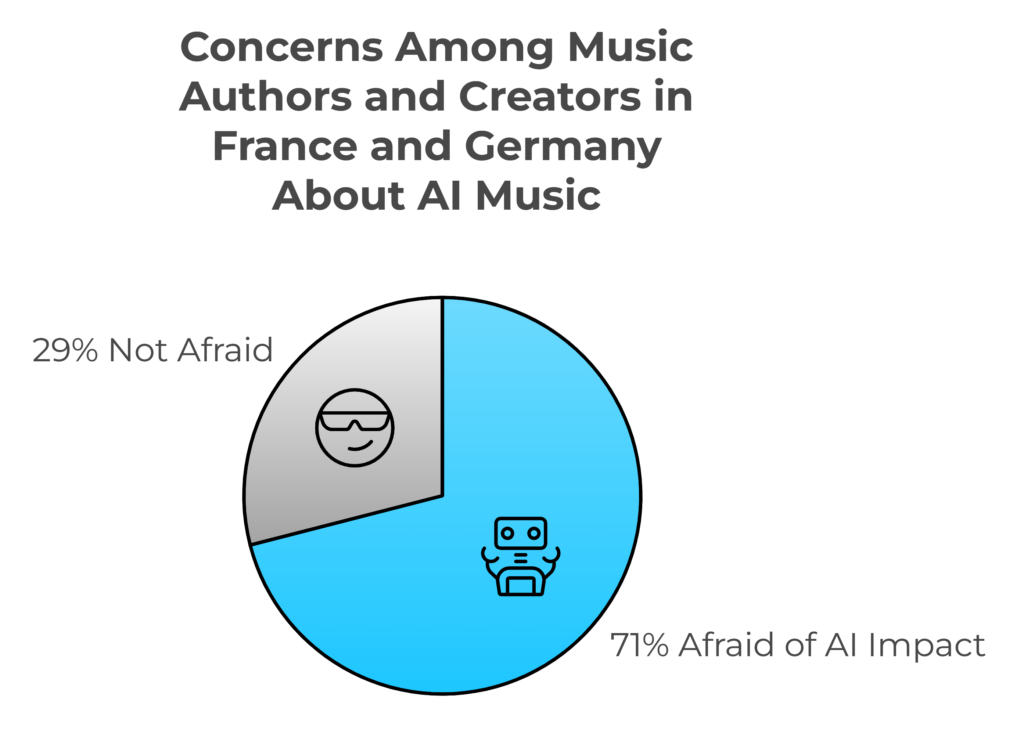
3. 71% of music authors and creators in France and Germany surveyed are afraid that AI music could lead to music creators no longer being able to make a living from their work. (Gema, 2024)
4. AI music platform Mubert generated over 100,000,000 songs in the first half of 2023. (Mubert, 2023)
5. Music creators predominantly see AI as a risk. (Gema, 2024)
Copyright laws for AI-generated music are still debated and unclear.
6. Typically, copyright laws protect AI music just like any traditional music. However, the ownership usually rests with the AI platform or its developers, not with an individual artist. (Soundful, 2024)
Is AI Music Legal?
There are myriad issues when it comes to AI music and copyright laws, which are still unclear and hotly debated.
Let’s look at some of the problems concerning AI Music:
Issues with AI and Copyright Infringement
1. Typically, copyright laws protect AI music just like any traditional music. However, the ownership usually rests with the AI platform or its developers, not with an individual artist. (Soundful, 2024)
2. When you use Soundful, you’re essentially getting a license to use the music within specified conditions. (Soundful, 2024)
3. If AI-generated music is trained on copyrighted material, the output could be considered a derivative work that infringes on the original. (Saracens Solicitors., 2024)
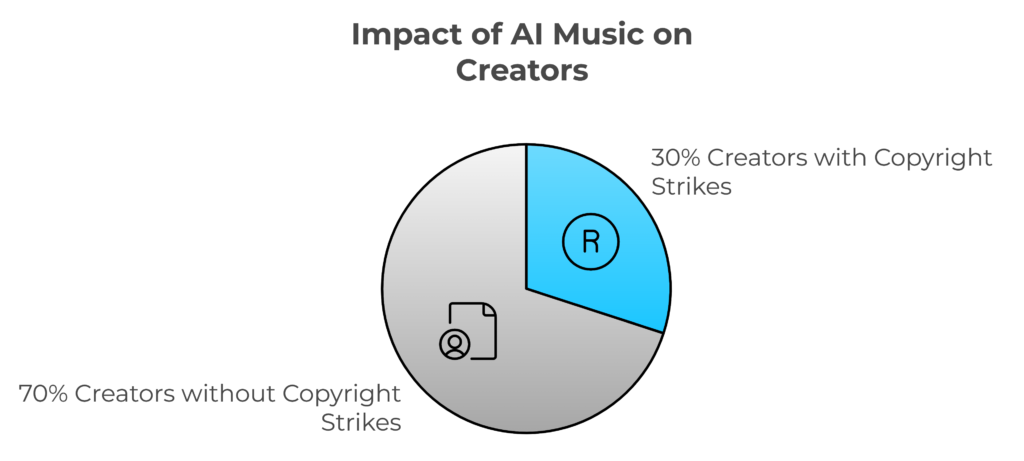
4. 30% of creators have experienced copyright strikes from content platforms due to AI music. (Mubert, 2023)
AI music is royalty-free and not licensed, so this shouldn’t be an issue.
Yet some lawsuits claim copyright laws were broken:
5. Universal Music Group filed a lawsuit against Anthropic for infringement, claiming its large language model was trained without permission on copyrighted song lyrics. (Aba Journal, 2024)
Others aren’t as convinced, such as Emory University law professor Matthew Sag.
6. Matthew Sag, an expert in intellectual property and copyright law, argues large language models do not so much copy work as predict the next line in a sequence. (Aba Journal, 2024)
“This is a process of deriving abstractions from the data. Those abstractions are not meant to be copyrightable,” he says. “My view is that as long as the outputs don’t look too much like inputs, then this is fair use under U.S. law.” (Aba Journal, 2024)
7. The lack of clear ownership and copyright protection can create uncertainty for those seeking to use AI-generated music commercially. (Saracens Solicitors., 2024)
8. It’s a certainty that more AI-generated copycat tracks are on the horizon.
Music Laundering
In April 2023, a track claiming to feature Drake and The Weeknd titled Heart on My Sleeve spread rapidly across TikTok and Spotify.
Would this be considered as music laundering?
On March 15, the Copyright Office issued its latest formal guidance, which reaffirmed its position that works that are created by AI without human intervention or human involvement cannot be copyrighted. (Harvard Law School, 2023)
The video was taken down by the DMCA, and as the court procedure was private the exact reason was unclear. (Harvard Law School, 2023)
The topic of AI music laundering remains a contentious issue.
Will AI Replace Singers?
Could AI replicate a singer’s voice to create a whole album, and would this be allowed?
Let’s look at what music creators think about AI and their jobs.
Music Creators Predominantly See AI as a Risk (Gema, 2024)
1. 71% of music authors and creators in France and Germany surveyed are afraid that AI music could lead to music creators no longer being able to make a living from their work. (Gema, 2024)
2. It can be assumed that by 2028, 27% of music creators’ revenues will be at risk due to generative AI. (Gema, 2024)
3. The expected monetary loss due to this is approximately €950m in 2028 alone and a cumulative total damage for the period 2023-2028 of around €2.7bn. (Gema, 2024)
4. No remuneration system exists that closes the AI-generated financial gap for creators. (Gema, 2024)
5. 64% of the respondents believe that the risks of AI use outweigh its potential opportunities. Only 11% believe that the opportunities outweigh the risks. (Gema, 2024)
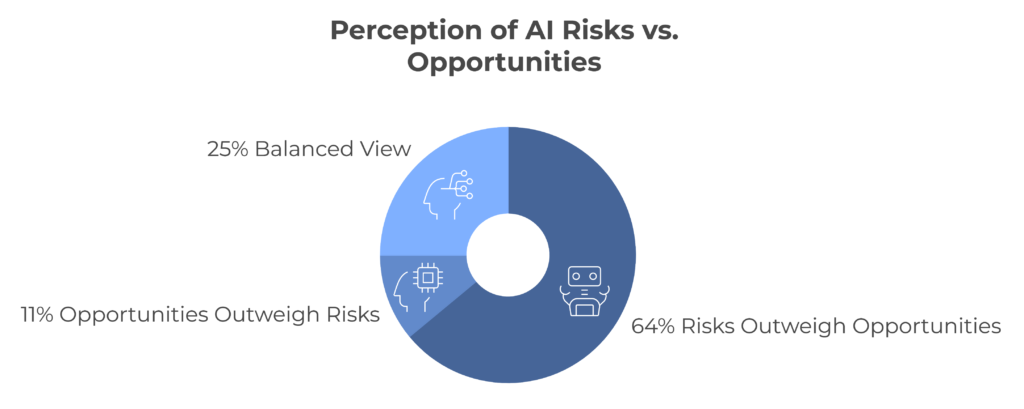
The majority of music creators dislike the invasion of AI in the music sphere.
How is AI Currently Used in Music?
Let’s look at some of the use cases of AI in music right now:
1. AI is mostly used for creating music artwork, followed by music mastery and production, and then for songwriting. (Gema, 2024)
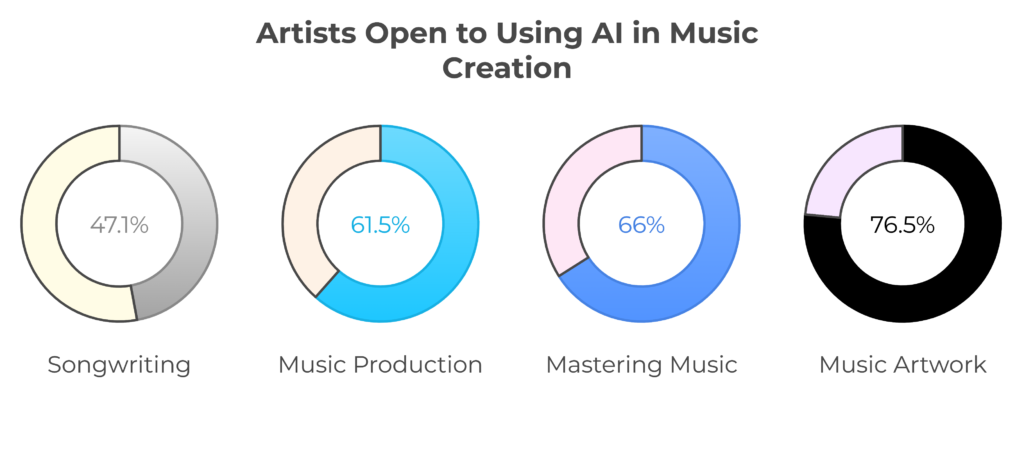
As you can see, 76.5% use AI for music artwork, while 66% use it for music mastery, 61.5% for music production, and 47.1% for songwriting.
2. According to another study, AI is mostly used to create album artwork. (TuneCore, 2024)
Album art seems to be the predominant use case of AI right now, with 57% of people using AI for that.
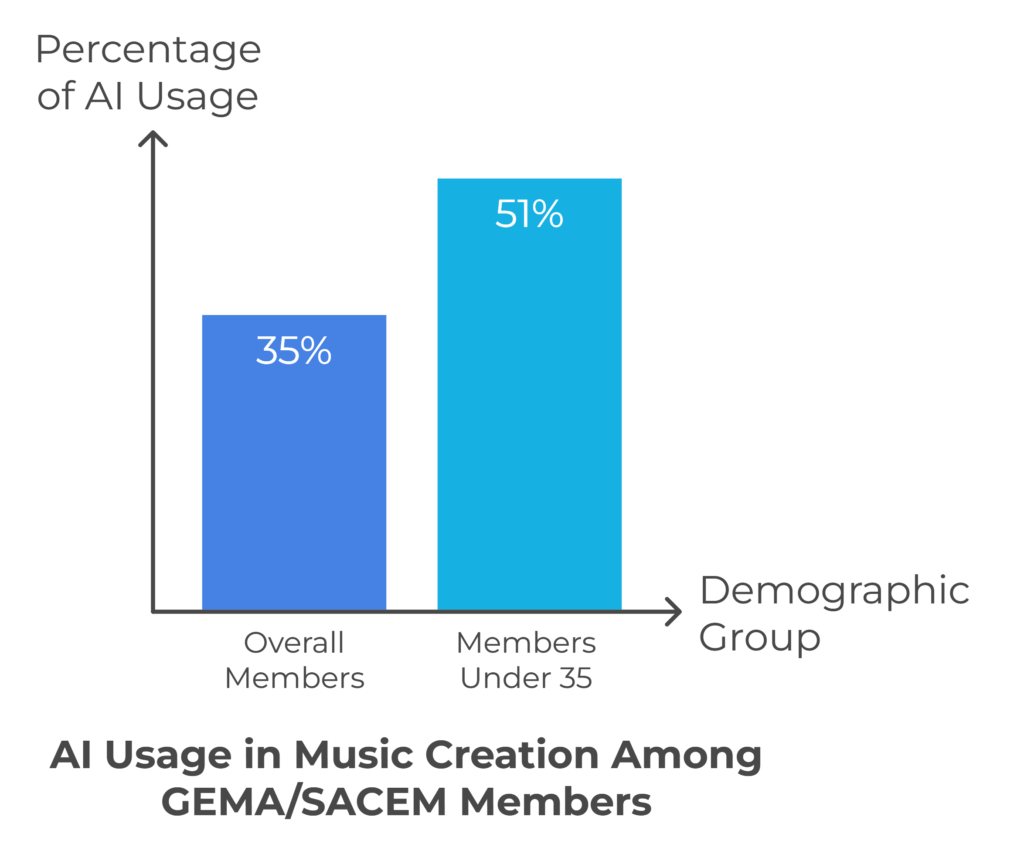
3. For those under the age of 35, 51% have used AI tools of some kind in their work with music. (Gema, 2024)
4. 48% of people in the music industry said they would consider utilizing AI as a source of income for their business in the future. (Mubert, 2023)
AI Music Platform Mubert Generated Over 100,000,000 Songs in the First Half of 2023
By mid-2023, Mubert users consumed over 100 million AI-generated tracks.
Every single track had a human artist provide input by pressing keys on their keyboard.
At least one person has listened to each of these tracks. (Mubert, 2023)
34.8% of People Feel Positive Towards AI-generated Music
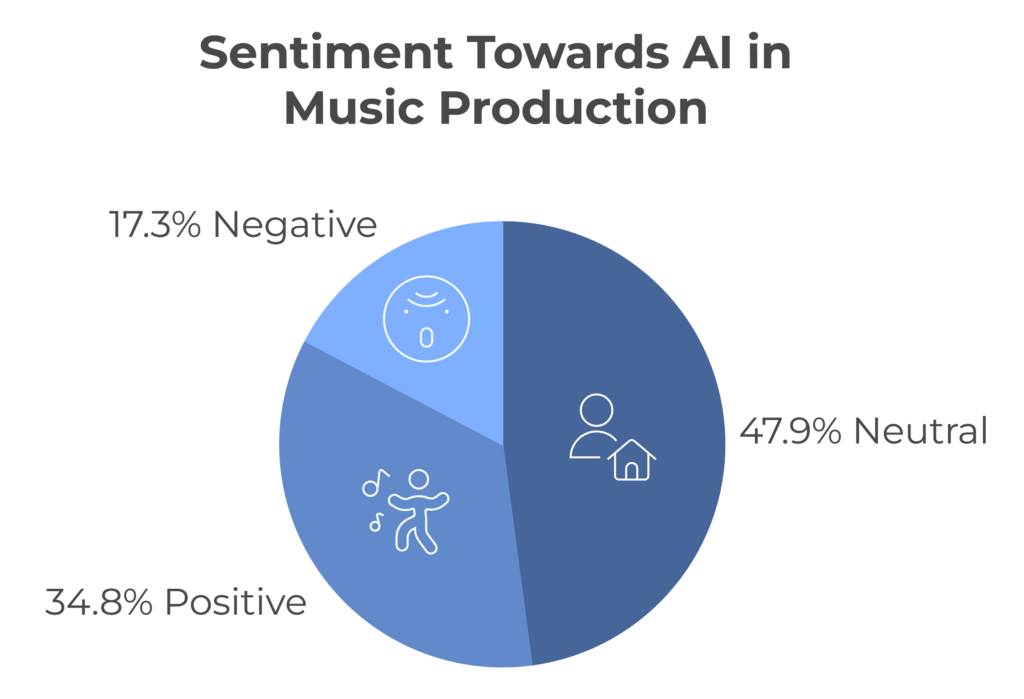
Only 17.3% feel negative, and 47.9% are neutral towards it. (BpB, 2023)
83% of UK Adults Want AI Songs That are Clearly Labeled
5% disagree that AI songs need to be labeled, and 11% don’t know. (UK Music, 2024)
AI Music Composition Stats
Can AI Analyze Music?
Interestingly, AI (Artificial Intelligence) for music analysis relies on images (spectrograms) to understand and predict a song’s features.
Let’s look at how Bridge Audio performed AI analysis on music.
AI tools were assessed based on their ability to accurately analyze genre, mood, key, BPM (beats per minute), tempo, and vocals, among other parameters.
For the famous “Dracula Theme,” AI tools were challenged to analyze a classical piece without vocals.
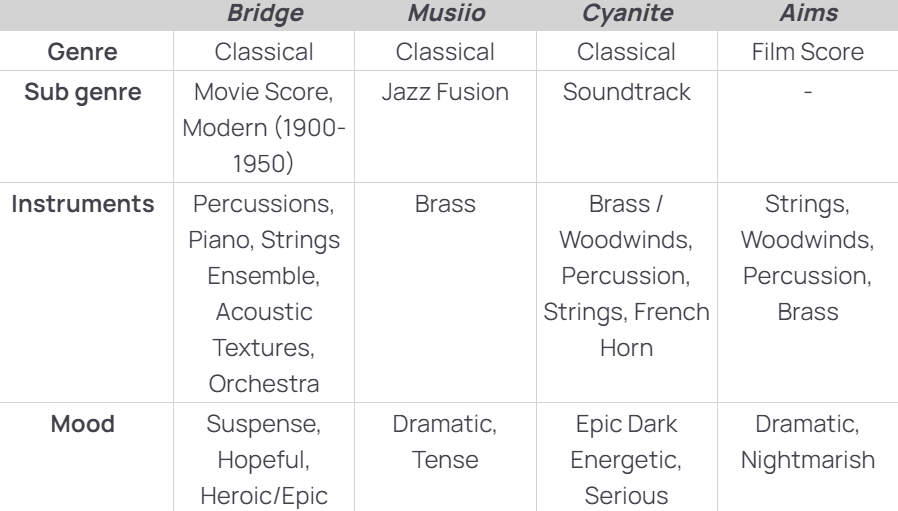
Bridge accurately captured the mood of suspense and heroism, along with the precise identification of instruments typical of a movie score. (Bridge Audio, 2024)
Musiio and Cyanite both identified the classical genre but with varying focuses. (Bridge Audio, 2024)
Can AI Make Better Music Than Humans?
The human-composed modified tracks rated more highly than AI composed/modified tracks, in a study done by Stephen Arnold Music.
- Human modification increases the appeal of the AI track
- The Human track is preferred to the AI track
- AI modification generally deteriorated the quality of the human-made track
Here are the attributes that were associated with the tracks, given by US consumers:
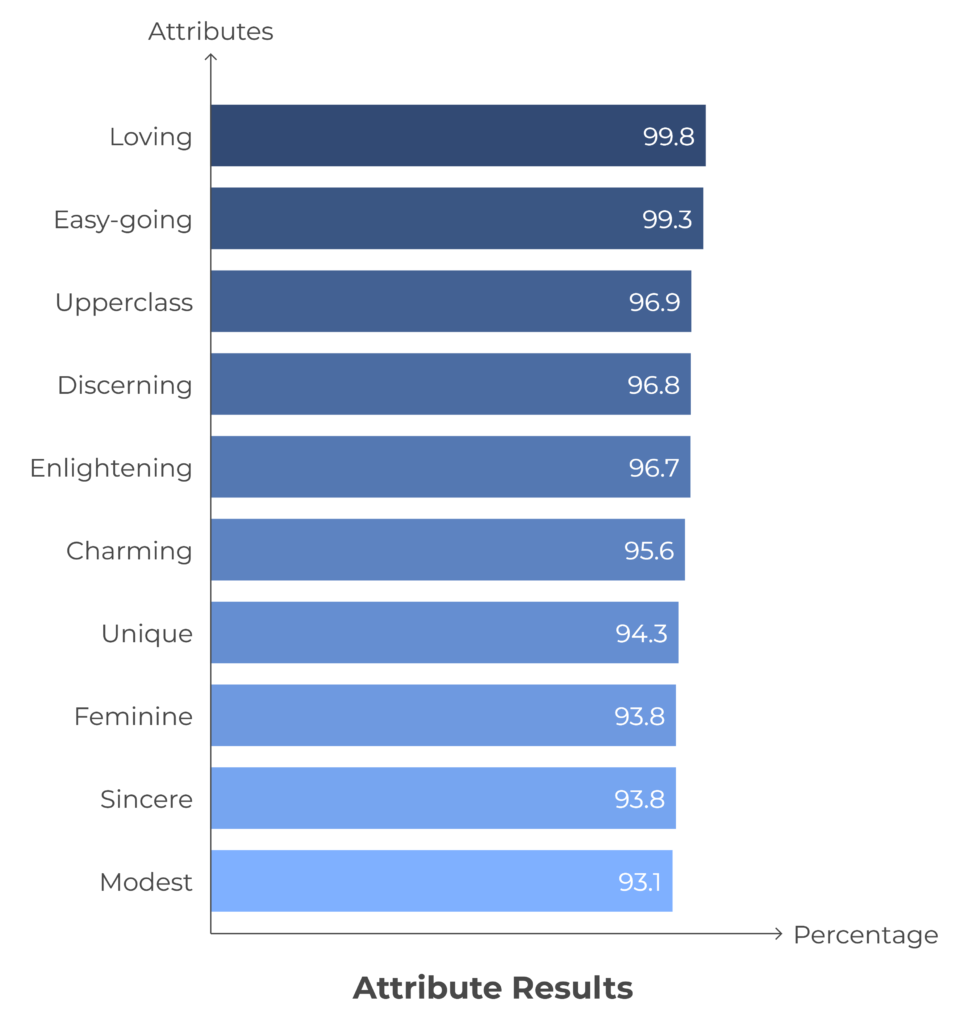
Here we see the attributes listed for human-made tracks.
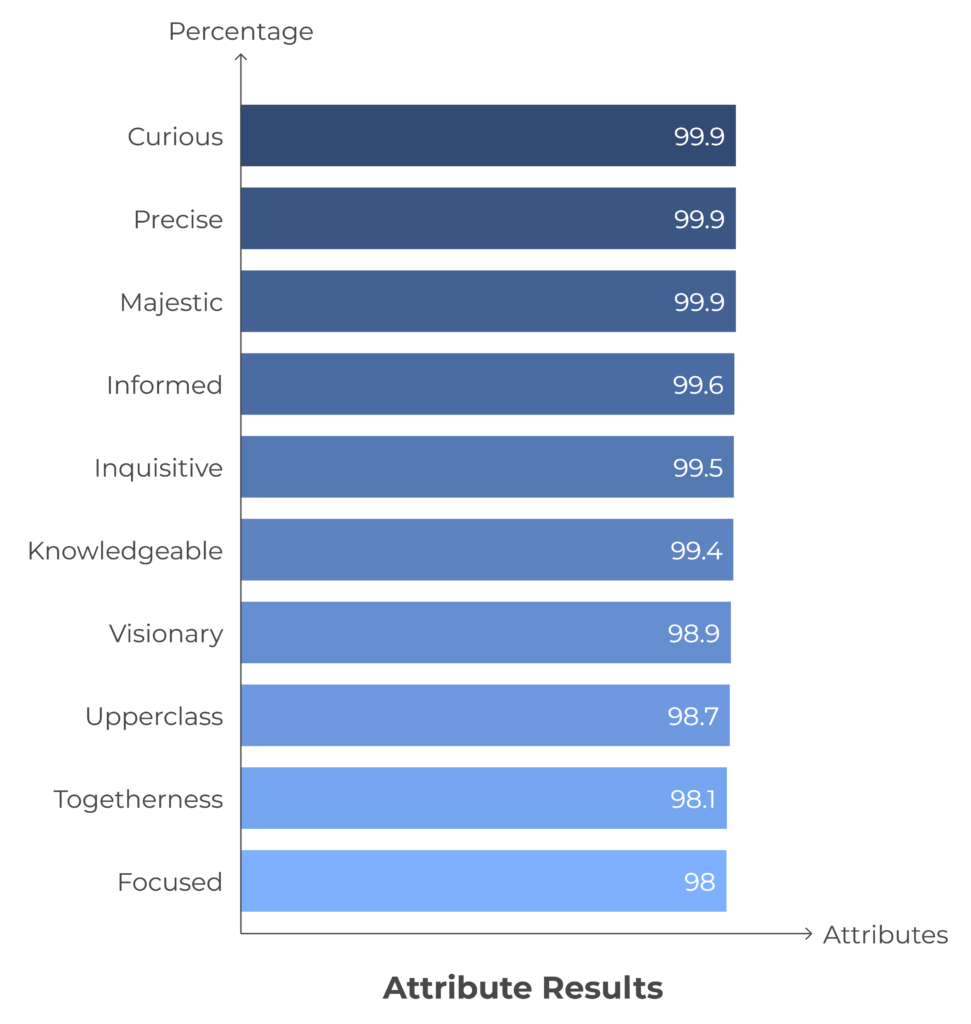
Here we see the attributes listed for human-made tracks that have been modified by AI.
These are purely AI-generated tracks.
The Human track comes across as loving, discerning, and sincere while the AI track is more precise and textbook-like. (Stephen Arnold Music, 2024)
The AI makes the Human track more precise, focused, and visionary The Human makes the AI more easy-going, dreamy, and organic, according to the study. (Stephen Arnold Music, 2024)
How Accurately Can AI Predict Hit Songs?
People want new music but generally prefer songs similar to those they already know. (Ward et al., 2014; Askin and Mauskapf, 2017).
Researchers at Claremont Graduate University tested this hypothesis, using the measured neurophysiological responses of participants listening to songs as input.
Here are their results:
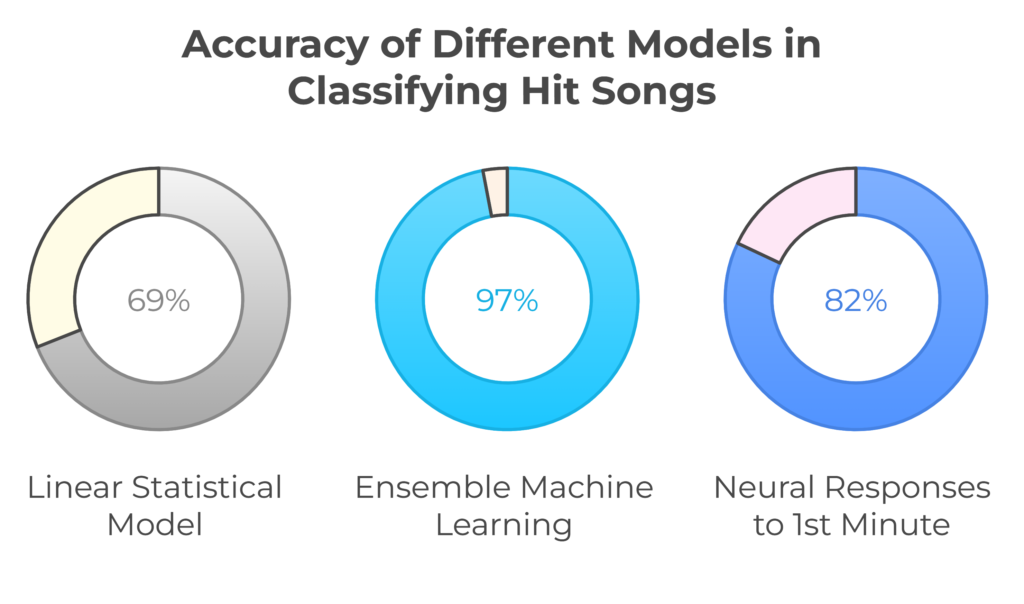
- A linear statistical model using two neural measures identified hits with 69% accuracy.
- After creating a synthetic dataset and applying ensemble machine learning, the model classified hit songs with 97% accuracy.
- Applying machine learning to the neural responses to 1st minute of songs accurately classified hits 82% of the time
The last point suggests that the brain rapidly classifies hit music.
Can AI Predict Copyright Infringement?
The test for copyright infringement requires a metric of “substantial similarity”, which has been criticized for being unclear. (West Virginia University, 2021)
AI has been showed to resolve this issue when it comes to music.
It can be used to establish whether copyright infringement holds in a less biased and more accurate way than judges, juries, and laymen. (West Virginia University, 2021)
Attorney P.Grinvalsky argues that music can be viewed as a pyramid divided into four sections, as shown below:
- At the base of the pyramid is fundamental similarity (simple characteristics and public domain materials)
- The next level up is genre (rap, country, classical, heavy metal, etc.)
- The third level is the similarity of ideas (either in sound or on paper) that is based on expert opinion
- The top level is a substantial similarity with identical works at the apex of the pyramid
This gives us a rough idea of how works are judged to be breaking copyright laws.
Spotify AI Statistics
Does Spotify Accept AI-Generated Songs?
The boss of Spotify says he has no plans to completely ban content created by artificial intelligence from the music streaming platform. (BBC, 2023)
Did Spotify Remove Any AI Song?
Yet, Spotify doesn’t support cloning artists or using their sound.
(WLRN, 2024)
When a creator used AI to create a rap battle between two industry stars- Drake and Kendrick Lamar, Spotify removed the song from its catalog. (WLRN, 2024)
The song still went viral, receiving 2.6 million listens on Spotify itself before it was taken down.
Does Spotify Use AI For Music Recommendations?
Spotify does use AI for its musical recommendations.
For example, Discover Weekly is a feature that creates playlists using AI, based on the user’s listening history. (AIM research, 2024)
Spotify’s Curated AI Playlists
You can now prompt Spotify to generate playlists you’d like!
With the AI Playlist feature, you can type a unique prompt like “an indie folk playlist to give my brain a big warm hug,” and it will generate one for you. (Spotify Newsroom, 2024)
Final Thoughts
AI tools will have a huge impact on the music industry landscape in the next decade.
Making music all around has become much easier, especially for people without formal training, and will hopefully continue to do so.
We can also see the rise of ‘personalized songs’ with generative AI, that is songs customized for the user’s preferences. (Billboard, 2024)
In conclusion, while AI music seems to have potential for creativity and virality, it also raises significant legal as well as ethical considerations when AI tools are used indiscriminately.