

The Global Artificial Intelligence in Art Market is projected to reach $ 40 Billion by the year 2033, which accounts to a CAGR of 28.9%.
With bustling new technologies like Midjourney and Stable Diffusion, there is a lot of excitement for the potential for artistic creation.
Top AI Art Stats: Editor’s Picks
1. The Global AI in Art Market is projected to reach USD 40.3 billion by the year 2033, expanding at a Compound Annual Growth Rate (CAGR) of 28.9% during the forecast period. (Market.us, 2024)
2. North America held a dominant market position in the AI in Art Market in 2023, capturing over 40% of the market share, with revenue approximating USD 1.2 billion. (Market.us, 2024)
3. The AI-generated NFT with the highest value was sold for USD 1.1 million. (Market.us, 2024)
NFT stands for non-fungible token, which essentially means that it can’t be replicated.
4. An estimated 35% of fine art auctions now include AI-created artworks. (Market.us, 2024)
5. AI-generated art is estimated to represent 5% of the total contemporary art market by 2025. (Market.us, 2024)
The global art market is worth an estimated $65 billion, as per Statista.
6. Generative AI could create 90 percent of a movie. (Gartner. 2024)
7. People generally can’t tell the difference between AI and human art, but they prefer the latter — even if they can’t explain why. (BGSU, 2023)
Humans seem to be biased towards art of human-origin, whereas AI is viewed as non-human.
How Much of AI Art is Generated Per Day?
More than 15 billion images were created using prompts given to AI image generators from 2022-2023. (Everypixel, 2023)
It took photographers 150 years, from the first photograph taken in 1826 until 1975, to reach the 15 billion mark.
Hence, a lot of images are currently being generated by AI, so let’s break down how many AI images are created per model and their distribution.
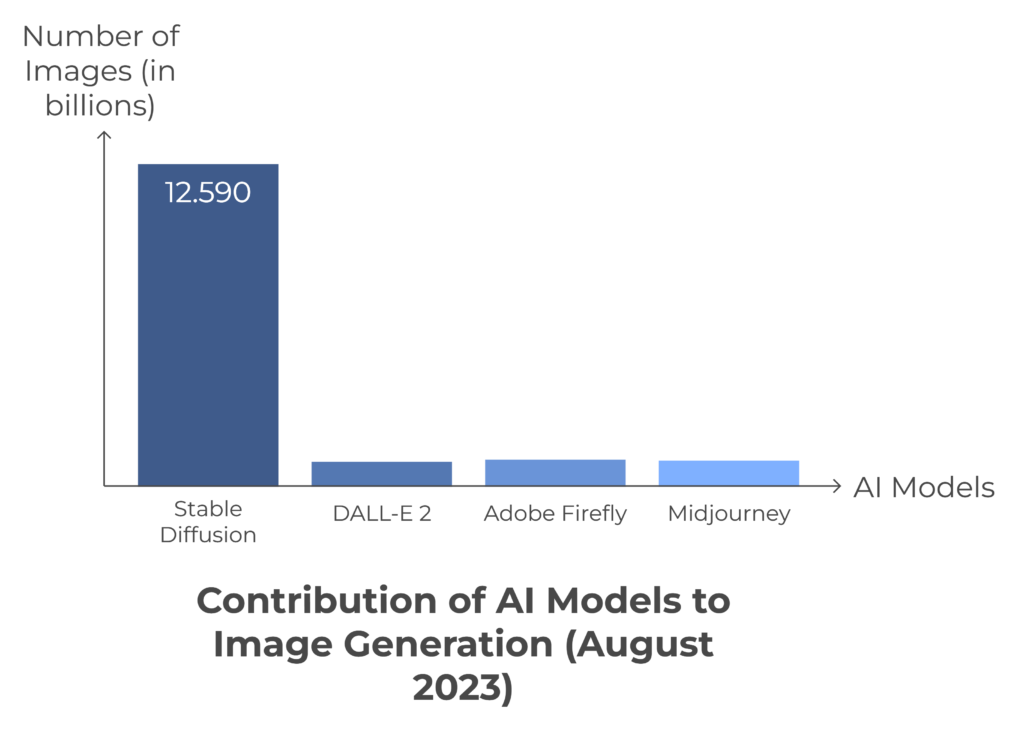
1. Since the Launch of DALLE-2, People Have Created an Average of 34 Million Images per Day on Its Platform. (Everypixel, 2023)
2. Midjourney Has 15 Million Users, the Largest User Base of Any Image Generation Platform. (Similar Web, 2024)
3. There Are 964 Million Images That Have Been Created With Midjourney Since Its Launch. (Similar Web, 2024)
4. Adobe Firefly Is One of the Fastest Growing Image Generators, They Managed To Rake In 1 Billion Images Created in 3 Months Since Launch. (Adobe, 2024)
5. Through the Official Stable Diffusion Channels, Users Generate 2 Million Images Daily, and in More Than a Year Since the Release, This Number Has Reached 12 Billion Images. (Market.us, 2024)
6. By 2030, We Can Have Entire Movies Created by AI!
Generative AI could create 90 percent of a movie. (Gartner. 2024)
What Percentage of Art is Made By AI?
1. Just 27% of Americans had seen AI artwork, in a 2000-person survey. (You Gov,2023)
2. The AI-generated art industry is estimated to represent 5% of the total contemporary art market by 2025. (Market.us, 2024)
3. Most AI art generators are based on a single dataset of 5.85 billion images. (LAION, 2024)
What Do Artists Think of AI Art?
1. Among those who have heard of AI image generators such as DALL-E 2 or Midjourney – only around three-in-ten (31%) describe this as a major advance for the visual arts, while another 39% call it a minor advance. (Pew Research, 2023)
2. From another survey, 78% of artists believe that AI will bring new aesthetic possibilities to the art world. (Market.us, 2024)
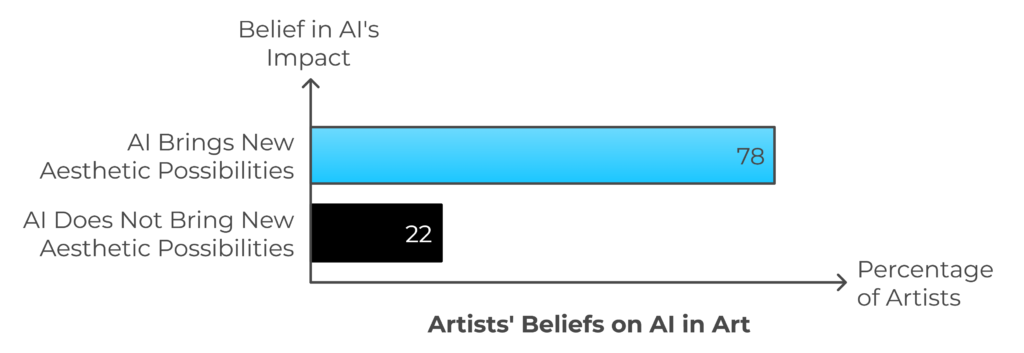
3. AI is currently being used by 29% of digital artists. (Market.us, 2024)
Can AI Art Be Considered Art?
AI art isn’t original, the outputs are generated from training data sets and so are directly influenced by them,
Instead of creating radically new art, it recombines and merges elements from its training data.
To dig deeper into this question, we must ask why do we create Art?
- To send a message or communicate an ideal, such as the Platonic Forms, or expand human creativity
- To preserve memories
- To evoke emotions and even heal by providing catharsis
- To create beauty
If we limit the definition of art to just creating beauty, AI generators like Midjourney already surpass that criteria.
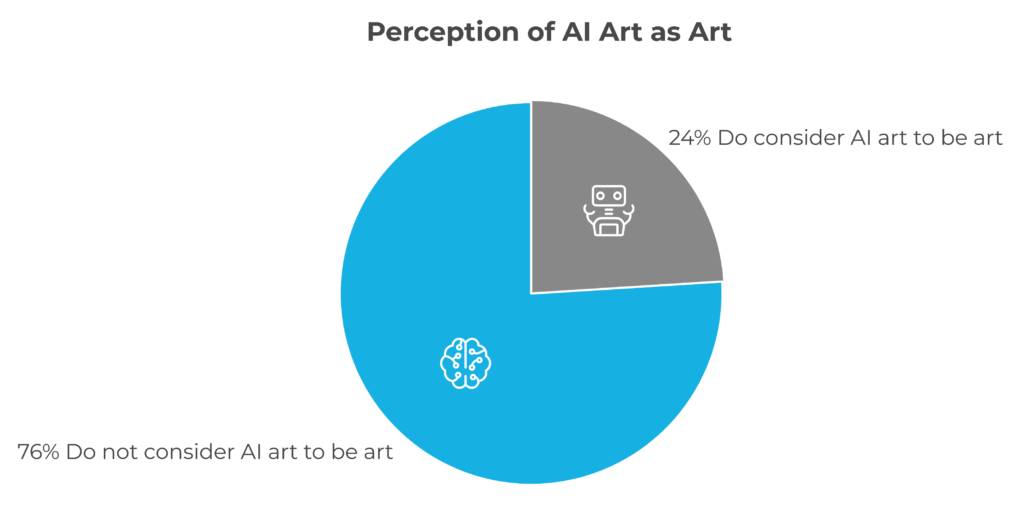
Otherwise, AI is programmed and there is no real sense in which it “expresses itself”. In a digital survey by Koaa News5, it was found that 76% of the people surveyed said they didn’t consider AI art to be art, and the other 24% said they did.
Only 9% of Americans believe the person who entered the prompt into an AI art generator, such as MidJourney, deserves credit. (Market.us, 2024)
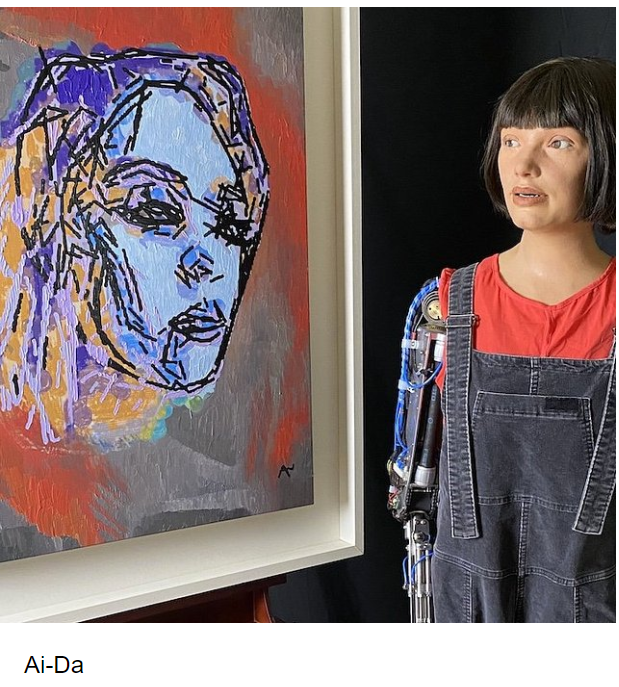
More confusing cases where it is hard to pinpoint the distinction between AI and human art is in the case of AI Da:
Humanoid robot artist Ai-Da (named after Ada Lovelace, perhaps the first person ever to program a computer) draws and paints using cameras in her eyes, her AI algorithms and her robotic arm.
How Many Artists Have Lost Their Jobs Due to AI?
According to artists that have corresponded with Business Insider, the job market isn’t too great right now.
Artists told Insider that it’s these freelance and entry-level jobs, particularly in film, TV and gaming, that are increasingly being done by AI. (Business Insider, 2023)
As the popularity of tools like Midjourney and Dall-E grows, some artists say work and opportunities have begun to dry up. (Business Insider, 2023)
How Many People Are Against AI Art?
Intellectual property rights is a pressing issue to artists in the art world nowadays.
Let’s see how artists as well as citizens think about the rise of AI art.
Did Artists Allow Their Art To Be Used by AI?
A lot of artists are upset about their work being used in training data by popular ai image generator companies.
On January 13, 2023, three visual artists filed a lawsuit against three AI companies in the Northern District of California, on behalf of themselves and other artists.
Sarah Andersen, Kelly McKernan, and Karla Ortiz challenge the AI company’s use of images of their artwork, registered with the U.S. Copyright Office, in the development of AI image generators. (Centre for Art Law, 2024)
The amended complaint details the technical process through which AI platforms use the artists’ work to create output images that are strikingly similar and with the same style their own.. (Centre for Art Law, 2024)
The members were biased against AI art, regardless of whether the art by AI or by a human artist. (Science Direct, 2023)
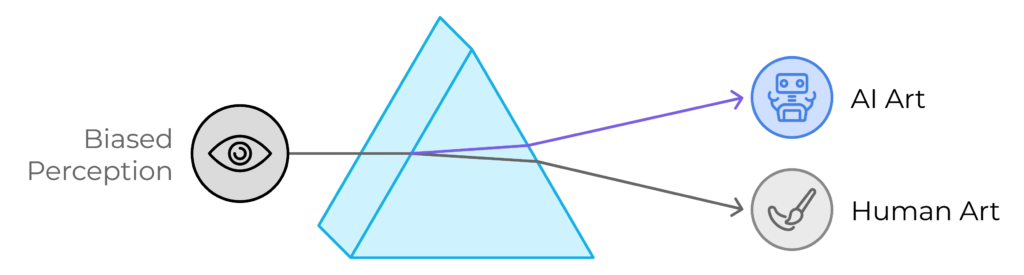
They assign attributes like creativity and awe to the art generated by artificial intelligence, when they think is generated by a human artist. (Science Direct, 2023)
Researchers showed that the anti-AI sentiment was more pronounced in people with stronger “anthropocentric creativity beliefs”, or who believed creativity is an exclusively human trait. (Science Direct, 2023)
Can People Tell AI Art From Human-Created Art?
From quite a few social experiments designed to test this, the short answer is not really.
1. People generally can’t tell the difference between AI and human art, but they prefer the latter — even if they can’t explain why. (BGSU, 2023)
2. There seemed to be more of a positive feeling in relation to human-created art versus ai generated artwork even though there wasn’t any visual or perceptive difference between the artworks. (BGSU, 2023)
3. Human-made art scored higher in self-reflection, attraction, nostalgia and amusement, a sign that people felt more connected to human art. (BGSU, 2023)
4. It could be that AI-generated art creates micro differences that are picked up subconsciously and cause something akin to the uncanny valley effect, where our primate brains automatically avoid the stimulus. (BGSU, 2023)
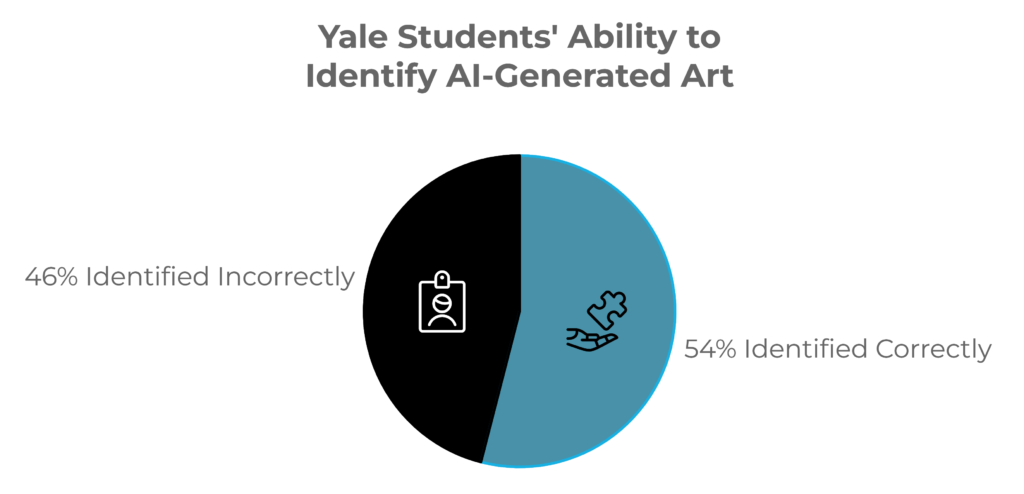
A survey was created to gauge how easily Yale students could discern whether art was generated by AI or a human.
5. On average, Yale students could tell if art was AI-generated 54% of the time. (Yale daily, 2023)
This is the image they were shown.
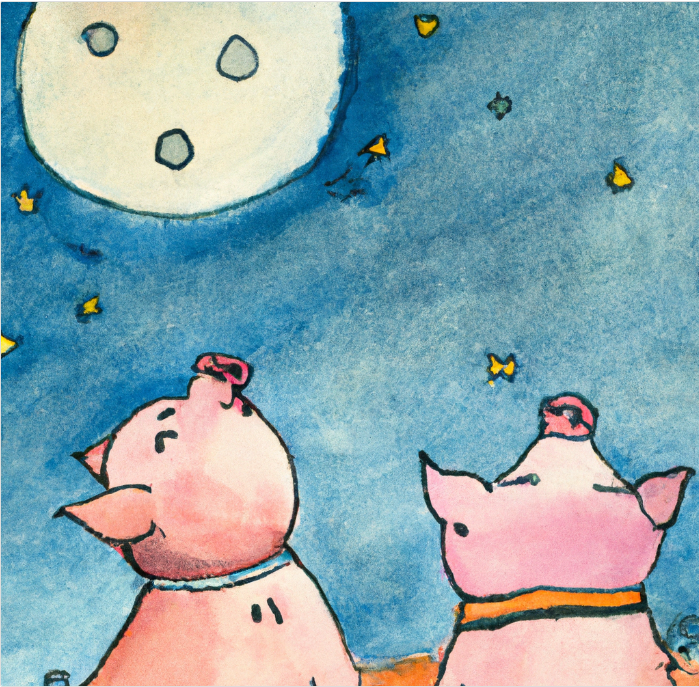
81 percent of Yale undergraduates thought that this image was drawn by a human.
Can AI Detect AI-Generated Art?
A study was conducted by the New York times to check whether AI detectors worked.
Despite the implausibility of the image given (Elon Musk embracing a robot), it managed to fool several A.I.-image detectors. (New York Times, 2023)
In another study, from the Emerging Investigators Organization, shows that:
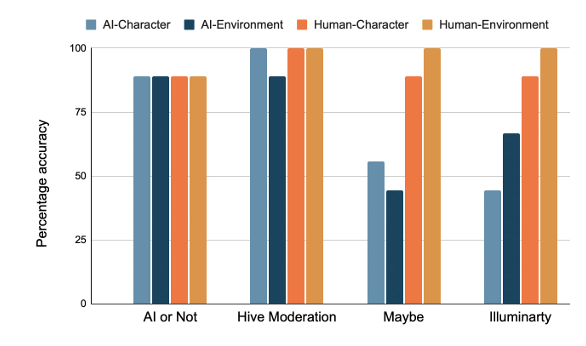
The overall accuracy of each model is:
- 88.89% for AI or Not
- 97.22% for Hive Moderation
- 72.22% for Maybe
- 75.0% for Illuminarty.
The combined result of all four models shows that they can accurately detect whether an image is AI-generated or not 84.7% of the time for images of environments,compared to 81.9% for images of human characters, although this difference was not significant.
Hence with these models, AI art can brought to more stringent regulations.
Concerns of People With AI Art
1.Work Substitution: AI art causes unease and anger among artists because it isn’t a use-case of AI that benefits people in the field, for example when AI is being used in a call center.
Here, AI art generators are substituting human artists instead of enhancing their work. (IEEE Computer Society, 2023)
2. Unethical data collection: LAION 5B, an AI training dataset of 5,85 billion high-quality image-text pairs, has been used to train AI art models like DALL-E. (LAION, 2024)
With this number of images, quality, copyright concerns, and selectivity for appropriate images are impacted.
Researchers have found inappropriate pictures of children in this dataset. (Silicon Angle, 2023)
3. Imitation and legal protection: Despite the legal restrictions and copyright laws, AI art has taken off. Laws around ‘Authorship’ are still in uncharted territory, (Houston Law Review, 2023)
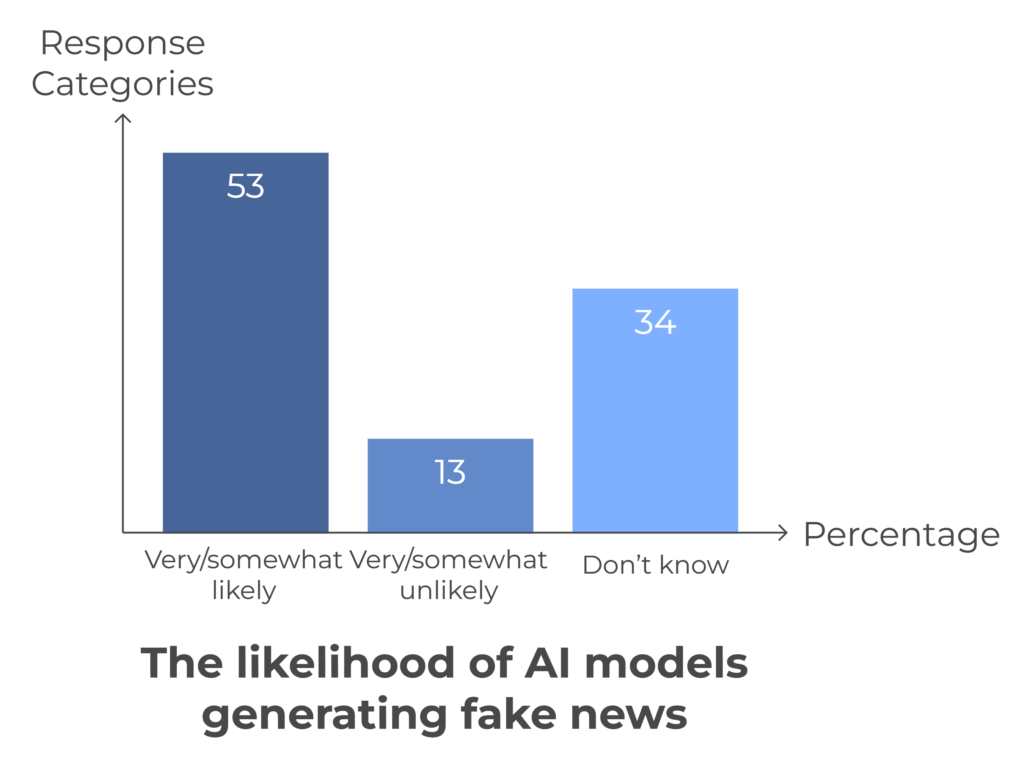
4. Fake News: Around 53% in a 2000-person survey said they believed fake news being propagated by AI models such as DALL-E was very likely. (You Gov,2023)
AI Art’s Societal Impact
Nisheeth Vishnoi, a Bartlett Giamatti professor of computer science and co-founder of the Computation and Society Initiative says:
“It is likely that AI will discover new types of art forms which are visually appealing,” Vishnoi said. “However, the popularity of art, the price of art and artistic styles is a very human-driven process. And I’m not sure how AI itself is going to enter and capture that.”(Yale, 2023)
Can You Legally Sell AI-Generated Art?
1. Copyright Protection: AI-generated art can be copyrighted if you have prompted it creatively. You can’t copy existing copyrighted works without permission. (Bot Memo, 2024)
2. Fair Use: Minimal use of copyrighted AI art is allowed for purposes like criticism, teaching, or research. (Bot Memo, 2024)
3. Platform Rules: Every AI platform has its terms and conditions that you have to agree to while using them. (Bot Memo, 2024)
Can You Sell Canva Generated AI Art?
As long as you agree with Canva’s AI Product Terms, you should be able to sell images generated by AI. (Canva, 2024)
Does Etsy Allow You to Sell AI Art?
Etsy allows you to sell AI art, but prohibits the sale of the text prompts used to generate the image, as they are an ‘integral part of the creative process’. (PCMag, 2024)
Why Are People Liking AI Art?
Art generated by artificial intelligence has finally captivated the general public in a way it hadn’t before. Perhaps it’s due to the involvement of the ego, and people’s fascination with seeing their own image replicated in fine art. (Elephant Stock, 2023)
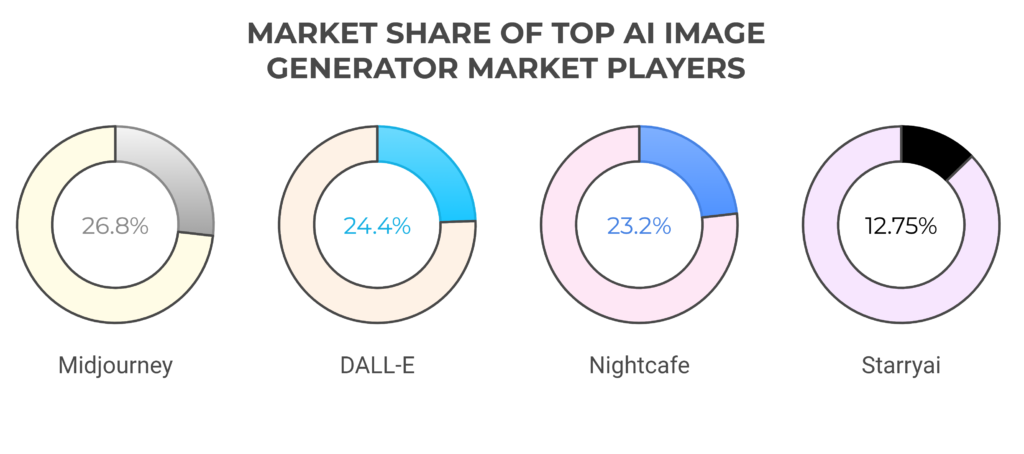
Market Share of AI Image Generators
1. The global AI image generator market size was valued at USD 257,175 thousand in 2022. (Fortune Business Insights, 2024)
2. It is projected to grow from USD 299,295 thousand in 2023 to USD 917,448 thousand by 2030, exhibiting a CAGR of 17.4%. (Fortune Business Insights, 2024)
3. North America dominated the global market with a share of 39.99% in 2022. (Fortune Business Insights, 2024)
What Was the Highest Bid for Art Created by AI?
The highest bid for AI art was for an AI-created portrait of a man, that sold at Christie’s for $432,500. (New York Times, 2018)
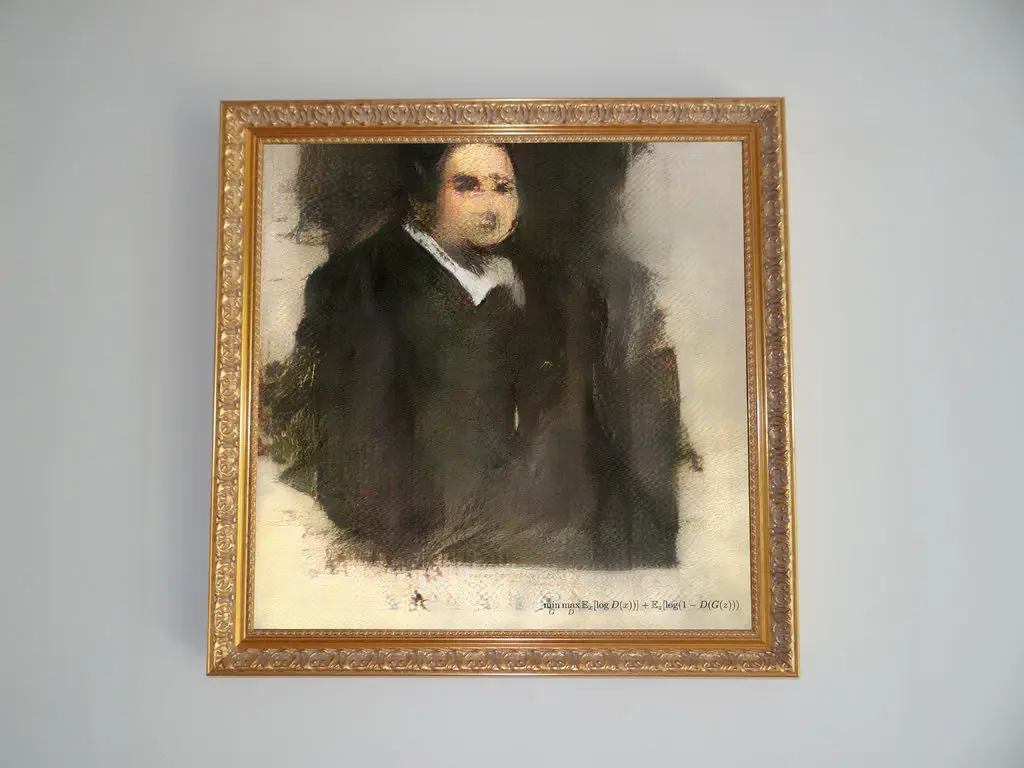
“Edmond de Belamy, from La Famille de Belamy,” by the French art collective Obvious, was sold on Thursday at Christie’s New York.
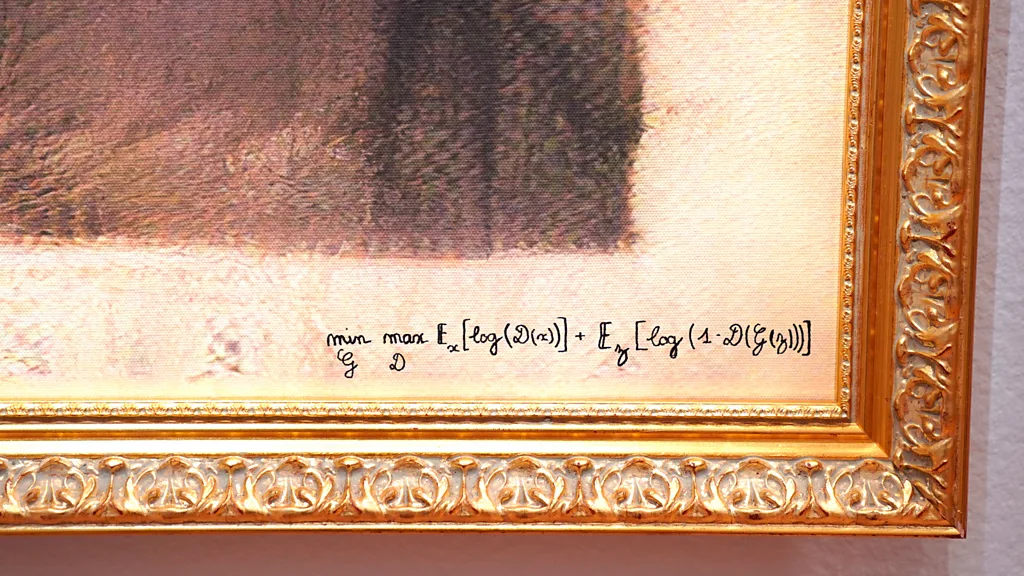
Credits are given to the algorithm as well!
Final Thoughts
The sale of AI-generated art at such high prices, as well as them being shown in art shows, is proof that AI artworks are valued in the art industry.
For those interested in exploring AI-generated art, platforms like MidJourney, DALL·E, and Stability AI are worth checking for new and exciting updates.